wheel size KIA K900 2017 User Guide
[x] Cancel search | Manufacturer: KIA, Model Year: 2017, Model line: K900, Model: KIA K900 2017Pages: 542, PDF Size: 14.89 MB
Page 467 of 542
Maintenance
7
7-61
Wheel size designation
Wheels are also marked with impor-
tant information that you need if you
ever have to replace one. The follow-
ing explains what the letters and
numbers in the wheel size designa-
tion mean.
Example wheel size designation:
8.0JX19
8.0 - Rim width in inches.
J - Rim contour designation.
19 - Rim diameter in inches. Tire speed ratings
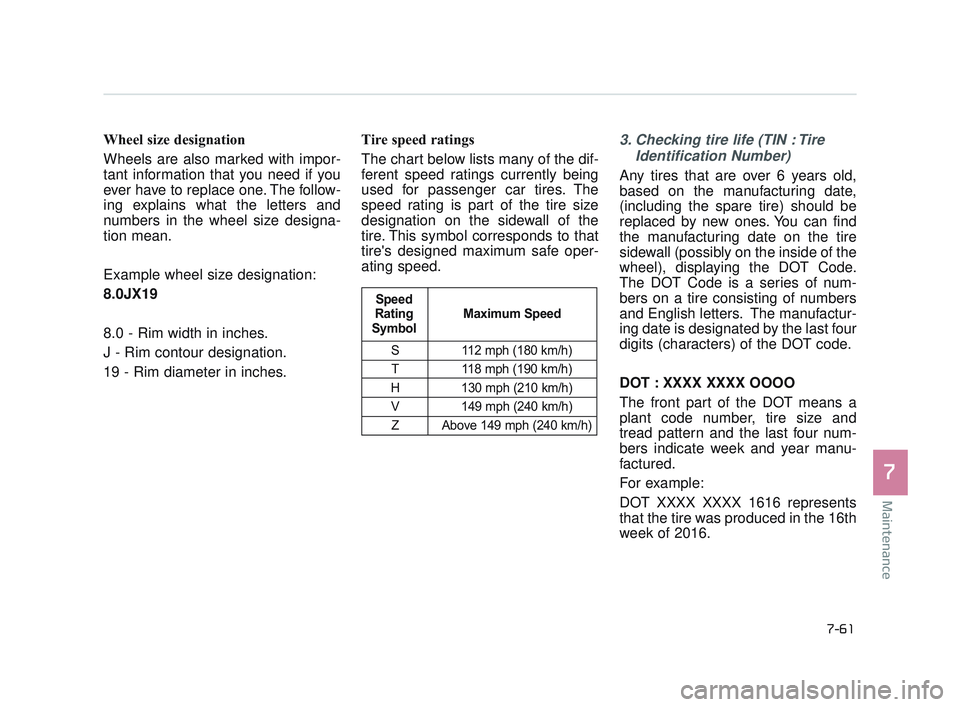
The chart below lists many of the dif-
ferent speed ratings currently being
used for passenger car tires. The
speed rating is part of the tire size
designation on the sidewall of the
tire. This symbol corresponds to that
tire's designed maximum safe oper-
ating speed. 3. Checking tire life (TIN : Tire
Identification Number)
Any tires that are over 6 years old,
based on the manufacturing date,
(including the spare tire) should be
replaced by new ones. You can find
the manufacturing date on the tire
sidewall (possibly on the inside of the
wheel), displaying the DOT Code.
The DOT Code is a series of num-
bers on a tire consisting of numbers
and English letters. The manufactur-
ing date is designated by the last four
digits (characters) of the DOT code.
DOT : XXXX XXXX OOOO
The front part of the DOT means a
plant code number, tire size and
tread pattern and the last four num-
bers indicate week and year manu-
factured.
For example:
DOT XXXX XXXX 1616 represents
that the tire was produced in the 16th
week of 2016.
S 112 mph (180 km/h)
T 118 mph (190 km/h)
H 130 mph (210 km/h) V 149 mph (240 km/h)Z Above 149 mph (240 km/h)
Maximum Speed
Speed
Rating
Symbol
KH USA 7:2016 12/1/2016 11:20 PM Page 61
Page 473 of 542
Maintenance
7
7-67
Rim:A metal support for a tire and
upon which the tire beads are seat-
ed.
Sidewall: The portion of a tire
between the tread and the bead.
Speed Rating: An alphanumeric
code assigned to a tire indicating the
maximum speed at which a tire can
operate.
Traction: The friction between the
tire and the road surface. The
amount of grip provided.
Tread: The portion of a tire that
comes into contact with the road.
Treadwear Indicators: Narrow
bands, sometimes called "wear
bars," that show across the tread of a
tire when only 2/32 inch of tread
remains.
UTQGS: Uniform Tire Quality
Grading Standards, a tire information
system that provides consumers with
ratings for a tire's traction, tempera-
ture and treadwear. Ratings are
determined by tire manufacturers
using government testing proce-
dures. The ratings are molded into
the sidewall of the tire. Vehicle Capacity Weight:
The num-
ber of designated seating positions
multiplied by 150 lbs. (68 kg) plus the
rated cargo and luggage load.
Vehicle Maximum Load on the
Tire: Load on an individual tire due
to curb and accessory weight plus
maximum occupant and cargo
weight.
Vehicle Normal Load on the Tire:
Load on an individual tire that is
determined by distributing to each
axle its share of the curb weight,
accessory weight, and normal occu-
pant weight and dividing by 2.
Vehicle Placard: A label permanent-
ly attached to a vehicle showing the
original equipment tire size and rec-
ommended inflation pressure.All season tires
Kia specifies all season tires on
some models to provide good per-
formance for use all year round,
including snowy and icy road condi-
tions. All season tires are identified
by ALL SEASON and/or M+S (Mud
and Snow) on the tire sidewall. Snow
tires have better snow traction than
all season tires and may be more
appropriate in some areas.
Summer tires
Kia specifies summer tires on some
models to provide superior perform-
ance on dry roads. Summer tire per-
formance is substantially reduced in
snow and ice. Summer tires do not
have the tire traction rating M+S
(Mud and Snow) on the tire side wall.
If you plan to operate your vehicle in
snowy or icy conditions, Kia recom-
mends the use of snow tires or all
season tires on all four wheels.
KH USA 7:2016 12/1/2016 11:20 PM Page 67
Page 474 of 542
7-68
Maintenance
Snow tires
If you equip your car with snow tires,
they should be the same size and
have the same load capacity as the
original tires. Snow tires should be
installed on all four wheels; other-
wise, poor handling may result.
Snow tires should carry 4 psi (28
kPa) more air pressure than the
pressure recommended for the stan-
dard tires on the tire label on the dri-
ver's side of the center pillar, or up to
the maximum pressure shown on the
tire sidewall, whichever is less.
Do not drive faster than 75 mph (120
km/h) when your car is equipped with
snow tires. When driving on roads covered
with snow or ice, drive at less than
20 mph (30 km/h).
Do not use tire chains on vehicles equipped with aluminum wheels.
If snow chains must be used, use the Auto Sock
® (fabric snow chain).
If you hear noise caused by chains contacting the body, retighten the
chain to avoid contact with the
vehicle body.
To prevent body damage, retighten the chains after driving 0.3~0.6
miles (0.5~1.0 km).
* Auto Sock
® is a trade mark of Auto
sock.
Tire chains
Tire chains, if necessary, should be
installed on the drive wheels (rear
wheels).
Be sure that the chains are installed in
accordance with the manufacturer's
instructions.
To minimize tire and chain wear, do
not continue to use tire chains when
they are no longer needed.
KH USA 7:2016 12/1/2016 11:20 PM Page 68
Page 519 of 542
Specifications, Consumer information and Reporting safety defects
8
8-5
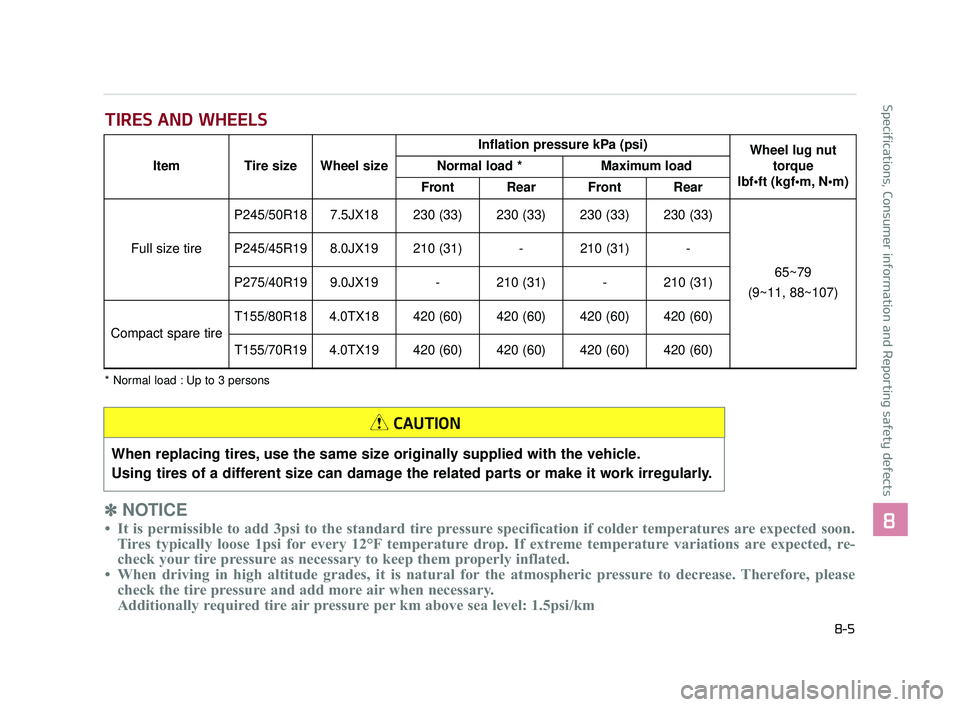
TIRES AND WHEELS
✽NOTICE
• It is permissible to add 3psi to the standard tire pressure specification if colder temperatures are expected soon.
Tires typically loose 1psi for every 12°F temperature drop. If extreme temperature variations are expected, re-
check your tire pressure as necessary to keep them properly inflated.
• When driving in high altitude grades, it is natural for the atmospheric pressure to decrease. Therefore, please check the tire pressure and add more air when necessary.
Additionally required tire air pressure per km above sea level: 1.5psi/km
* Normal load : Up to 3 persons
Item Tire size Wheel size Inflation pressure kPa (psi)
Wheel lug nut
torque
Normal load *
Maximum load
Front Rear Front Rear
Full size tire
P245/50R187.5JX18230 (33)230 (33)230 (33)230 (33)
65~79
(9~11, 88~107)
P245/45R19 8.0JX19 210 (31) - 210 (31) -
P275/40R19 9.0JX19 - 210 (31) - 210 (31)
Compact spare tire
T155/80R184.0TX18420 (60)420 (60)420 (60)420 (60)
T155/70R194.0TX19420 (60)420 (60)420 (60)420 (60)
When replacing tires, use the same size originally supplied with the vehicle.
Using tires of a different size can damage the related parts or make it work irregularly.
CAUTION
KH USA 8:2015 4/26/2016 11:01 AM Page 5