coolant KIA K900 2017 Owner's Manual
[x] Cancel search | Manufacturer: KIA, Model Year: 2017, Model line: K900, Model: KIA K900 2017Pages: 542, PDF Size: 14.89 MB
Page 432 of 542
7-26
Maintenance
No check, No service required
❑Automatic transmission fluid *5
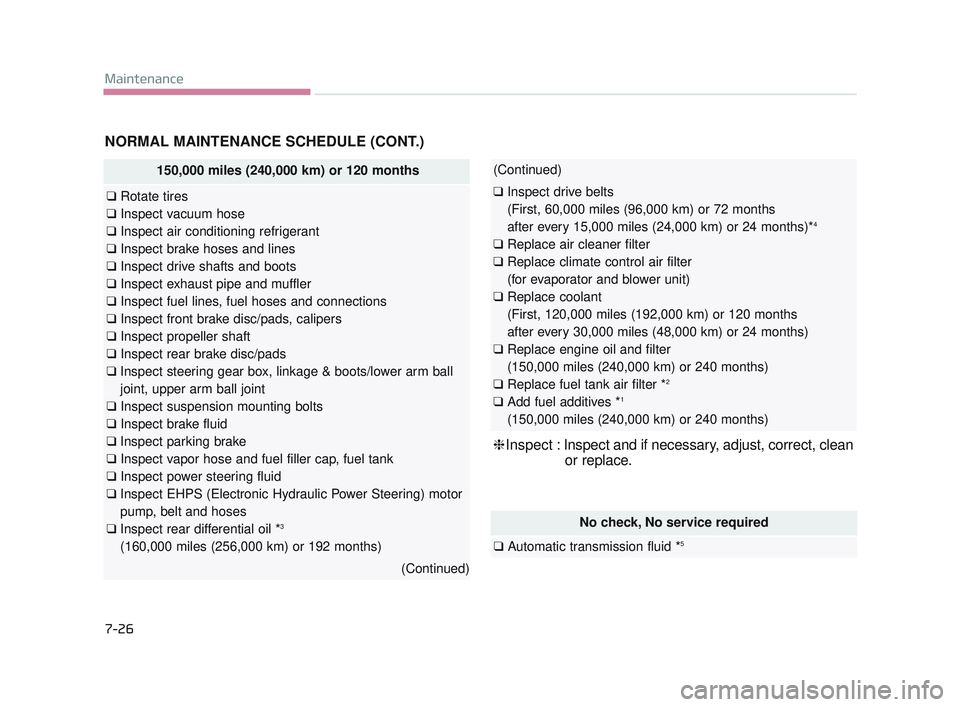
NORMAL MAINTENANCE SCHEDULE (CONT.)
150,000 miles (240,000 km) or 120 months
❑Rotate tires
❑ Inspect vacuum hose
❑ Inspect air conditioning refrigerant
❑ Inspect brake hoses and lines
❑ Inspect drive shafts and boots
❑ Inspect exhaust pipe and muffler
❑ Inspect fuel lines, fuel hoses and connections
❑ Inspect front brake disc/pads, calipers
❑ Inspect propeller shaft
❑ Inspect rear brake disc/pads
❑ Inspect steering gear box, linkage & boots/lower arm ball
joint, upper arm ball joint
❑ Inspect suspension mounting bolts
❑ Inspect brake fluid
❑ Inspect parking brake
❑ Inspect vapor hose and fuel filler cap, fuel tank
❑ Inspect power steering fluid
❑ Inspect EHPS (Electronic Hydraulic Power Steering) motor
pump, belt and hoses
❑ Inspect rear differential oil *
3
(160,000 miles (256,000 km) or 192 months)
(Continued)
(Continued)
❑Inspect drive belts
(First, 60,000 miles (96,000 km) or 72 months
after every 15,000 miles (24,000 km) or 24 months)*
4
❑ Replace air cleaner filter
❑ Replace climate control air filter
(for evaporator and blower unit)
❑ Replace coolant
(First, 120,000 miles (192,000 km) or 120 months
after every 30,000 miles (48,000 km) or 24 months)
❑ Replace engine oil and filter
(150,000 miles (240,000 km) or 240 months)
❑ Replace fuel tank air filter *
2
❑Add fuel additives *1
(150,000 miles (240,000 km) or 240 months)
❈Inspect : Inspect and if necessary, adjust, correct, clean
or replace.
KH USA 7:2016 12/1/2016 11:19 PM Page 26
Page 436 of 542
7-30
Maintenance
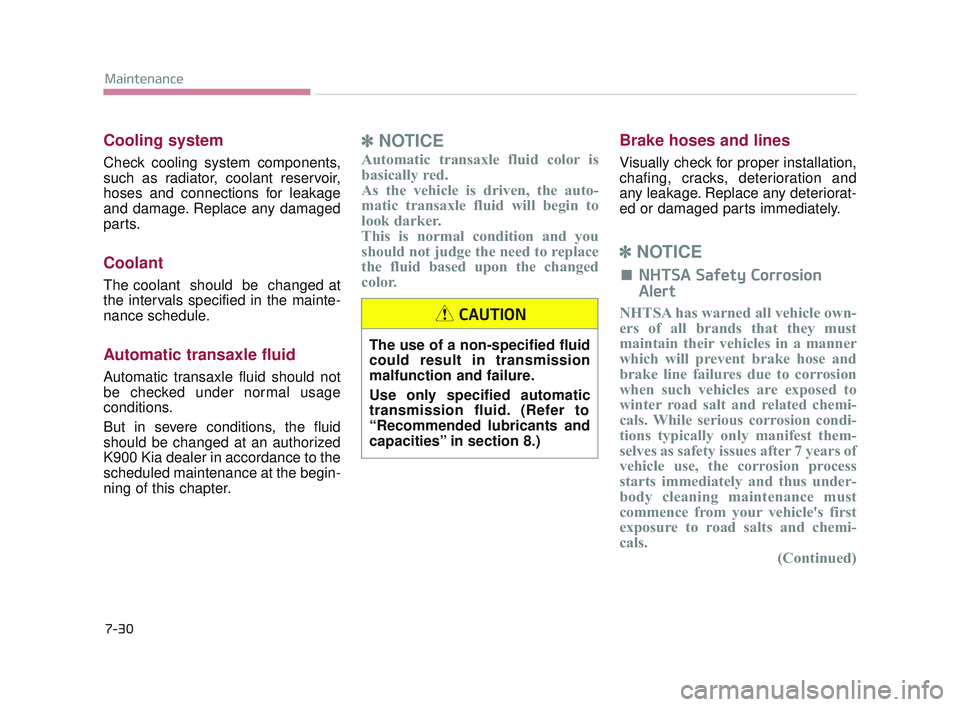
Cooling system
Check cooling system components,
such as radiator, coolant reservoir,
hoses and connections for leakage
and damage. Replace any damaged
parts.
Coolant
The coolant should be changed at
the intervals specified in the mainte-
nance schedule.
Automatic transaxle fluid
Automatic transaxle fluid should not
be checked under normal usage
conditions.
But in severe conditions, the fluid
should be changed at an authorized
K900 Kia dealer in accordance to the
scheduled maintenance at the begin-
ning of this chapter.
✽NOTICE
Automatic transaxle fluid color is
basically red.
As the vehicle is driven, the auto-
matic transaxle fluid will begin to
look darker.
This is normal condition and you
should not judge the need to replace
the fluid based upon the changed
color.
Brake hoses and lines
Visually check for proper installation,
chafing, cracks, deterioration and
any leakage. Replace any deteriorat-
ed or damaged parts immediately.
✽NOTICE
■ NHTSA Safety Corrosion
Alert
NHTSA has warned all vehicle own-
ers of all brands that they must
maintain their vehicles in a manner
which will prevent brake hose and
brake line failures due to corrosion
when such vehicles are exposed to
winter road salt and related chemi-
cals. While serious corrosion condi-
tions typically only manifest them-
selves as safety issues after 7 years of
vehicle use, the corrosion process
starts immediately and thus under-
body cleaning maintenance must
commence from your vehicle's first
exposure to road salts and chemi-
cals. (Continued)
The use of a non-specified fluid
could result in transmission
malfunction and failure.
Use only specified automatic
transmission fluid. (Refer to
“Recommended lubricants and
capacities” in section 8.)
CAUTION
KH USA 7:2016 12/1/2016 11:19 PM Page 30
Page 440 of 542
7-34
Maintenance
ENGINE COOLANT
The high-pressure cooling system
has a reservoir filled with year-round
antifreeze coolant. The reservoir is
filled at the factory.
Check the antifreeze protection and
coolant level at least once a year, at
the beginning of the winter season,
and before traveling to a colder cli-
mate. Checking the coolant level Turn the engine off and wait until itcools down. Use extreme care
when removing the radiator cap.
Wrap a thick towel around it, and
turn it counterclockwise slowly to
the first stop. Step back while the
pressure is released from the cool-
ing system.
When you are sure all the pressure
has been released, press down on
the cap, using a thick towel, and
continue turning counterclockwise
to remove it.
Even if the engine is not operating, do not remove the radiator cap or
the drain plug while the engine and
radiator are hot. Hot coolant and
steam may still blow out under
pressure, causing serious injury.
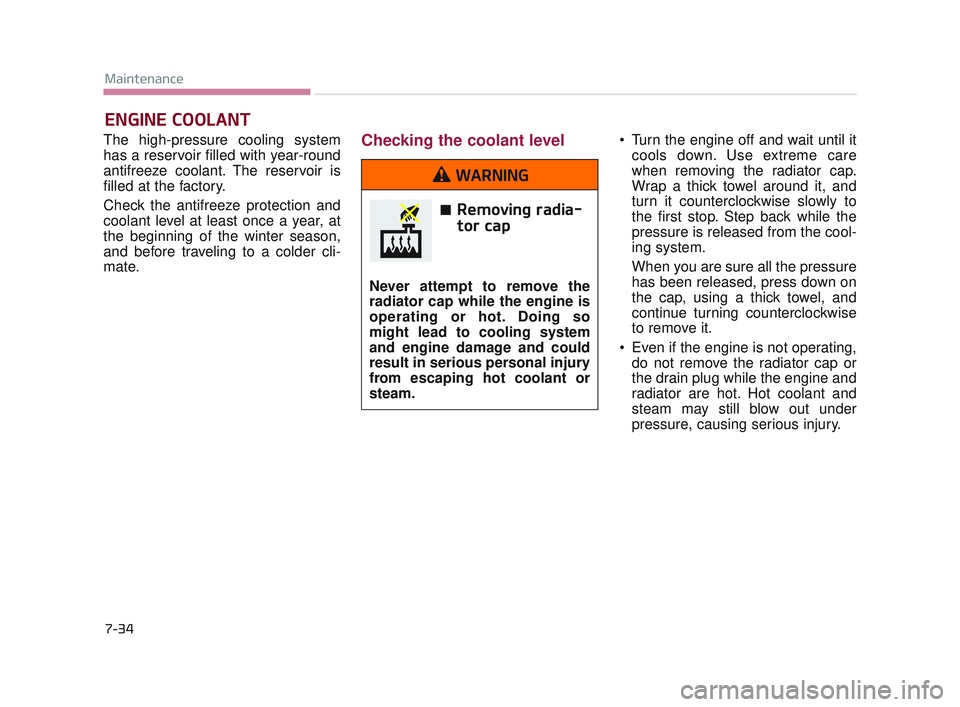
Removing radia-
tor cap
Never attempt to remove the
radiator cap while the engine is
operating or hot. Doing so
might lead to cooling system
and engine damage and could
result in serious personal injury
from escaping hot coolant or
steam.
WARNING
KH USA 7:2016 12/1/2016 11:19 PM Page 34
Page 441 of 542
Maintenance
7
7-35
Check the condition and connections
of all cooling system hoses and
heater hoses. Replace any swollen
or deteriorated hoses.
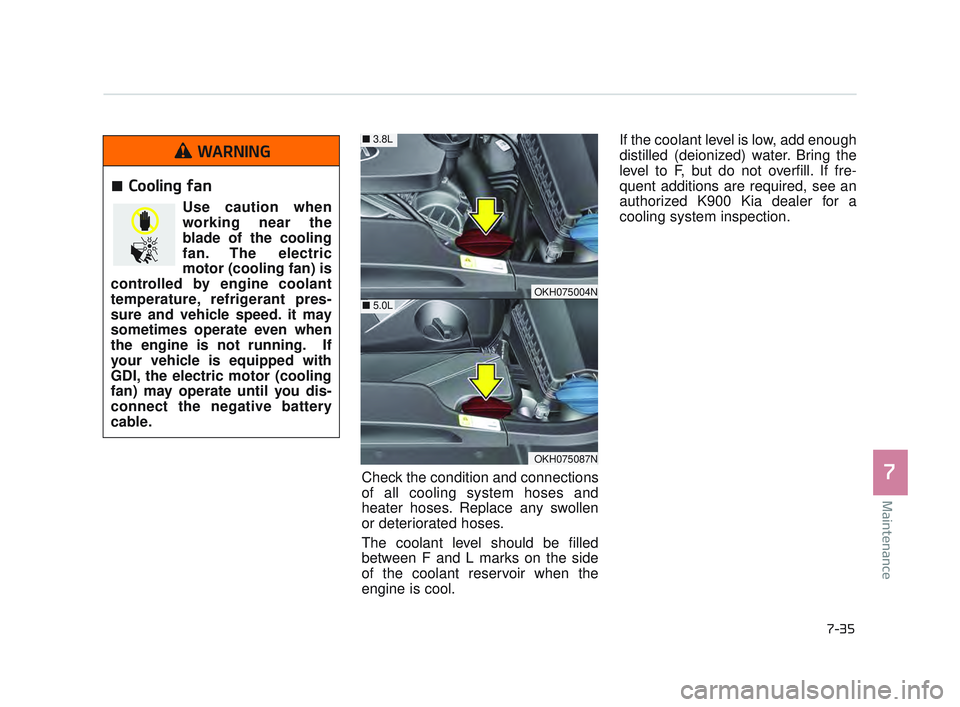
The coolant level should be filled
between F and L marks on the side
of the coolant reservoir when the
engine is cool.If the coolant level is low, add enough
distilled (deionized) water. Bring the
level to F, but do not overfill. If fre-
quent additions are required, see an
authorized K900 Kia dealer for a
cooling system inspection.
Cooling fan
Use caution when
working near the
blade of the cooling
fan. The electric
motor (cooling fan) is
controlled by engine coolant
temperature, refrigerant pres-
sure and vehicle speed. it may
sometimes operate even when
the engine is not running. If
your vehicle is equipped with
GDI, the electric motor (cooling
fan) may operate until you dis-
connect the negative battery
cable.
WARNING
OKH075004N
OKH075087N
■ 3.8L
■ 5.0L
KH USA 7:2016 12/1/2016 11:19 PM Page 35
Page 442 of 542
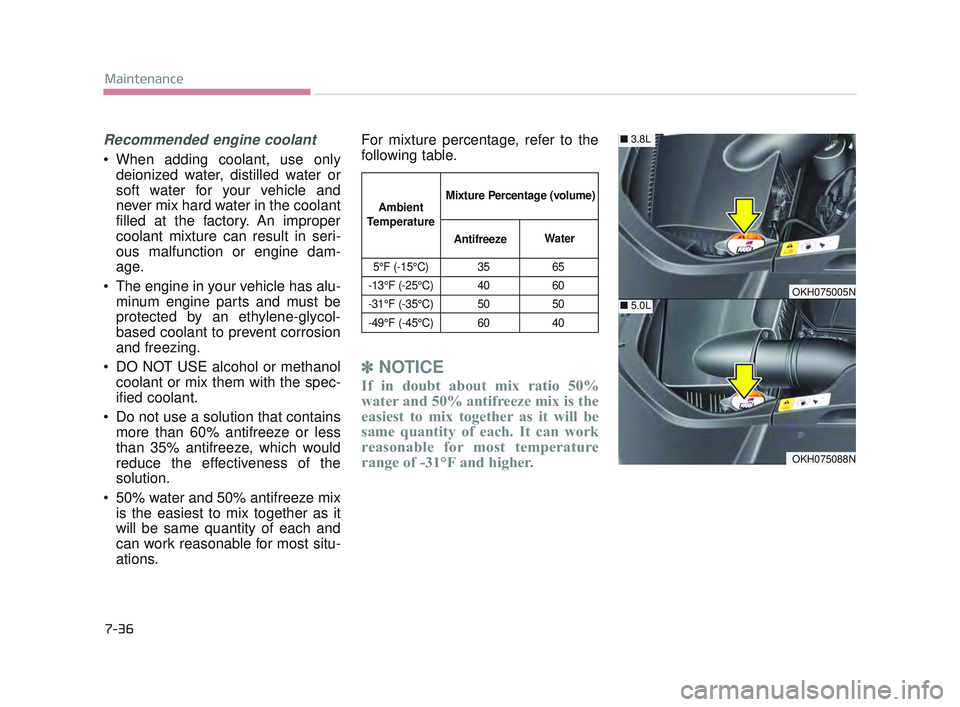
Recommended engine coolant
When adding coolant, use onlydeionized water, distilled water or
soft water for your vehicle and
never mix hard water in the coolant
filled at the factory. An improper
coolant mixture can result in seri-
ous malfunction or engine dam-
age.
The engine in your vehicle has alu- minum engine parts and must be
protected by an ethylene-glycol-
based coolant to prevent corrosion
and freezing.
DO NOT USE alcohol or methanol coolant or mix them with the spec-
ified coolant.
Do not use a solution that contains more than 60% antifreeze or less
than 35% antifreeze, which would
reduce the effectiveness of the
solution.
50% water and 50% antifreeze mix is the easiest to mix together as it
will be same quantity of each and
can work reasonable for most situ-
ations. For mixture percentage, refer to the
following table.
✽
NOTICE
If in doubt about mix ratio 50%
water and 50% antifreeze mix is the
easiest to mix together as it will be
same quantity of each. It can work
reasonable for most temperature
range of -31°F and higher.
7-36
Maintenance
5°F (-15°C) 35 65
-13°F (-25°C) 40 60
-31°F (-35°C) 50 50
-49°F (-45°C) 60 40
Ambient
Temperature Mixture Percentage (volume)
Antifreeze Water
OKH075005N
OKH075088N
■
3.8L
■ 5.0L
KH USA 7:2016 12/1/2016 11:19 PM Page 36
Page 443 of 542
Maintenance
7
7-37
Changing the coolant
Have coolant changed by an author-
ized K900 Kia dealer according to
the Maintenance Schedule at the
beginning of this section.
Put a thick cloth around the radiator
cap before refilling the coolant in
order to prevent the coolant from
overflowing into engine parts such as
the generator.
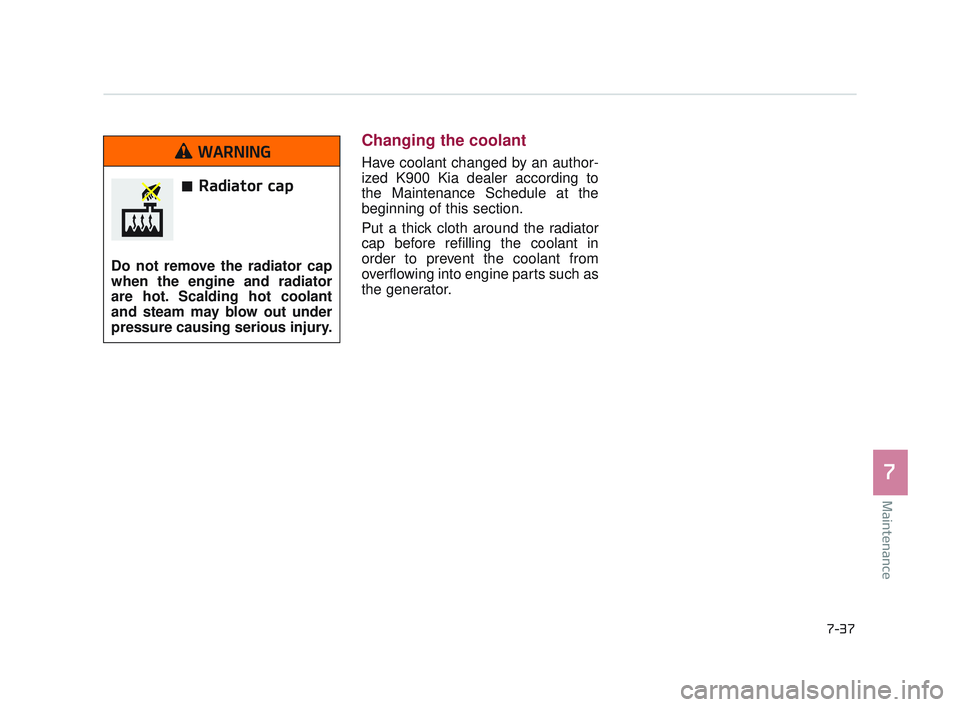
Radiator cap
Do not remove the radiator cap
when the engine and radiator
are hot. Scalding hot coolant
and steam may blow out under
pressure causing serious injury.
WARNING
KH USA 7:2016 12/1/2016 11:19 PM Page 37
Page 446 of 542
7-40
Maintenance
WASHER FLUID
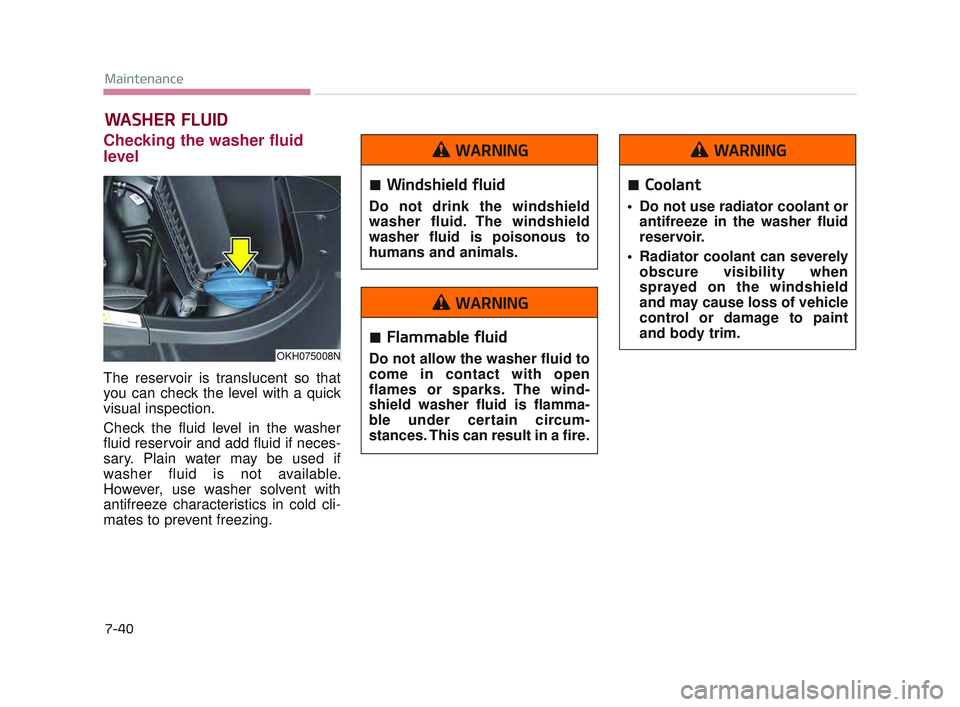
Checking the washer fluid
level
The reservoir is translucent so that
you can check the level with a quick
visual inspection.
Check the fluid level in the washer
fluid reservoir and add fluid if neces-
sary. Plain water may be used if
washer fluid is not available.
However, use washer solvent with
antifreeze characteristics in cold cli-
mates to prevent freezing.
OKH075008N
Windshield fluid
Do not drink the windshield
washer fluid. The windshield
washer fluid is poisonous to
humans and animals.
WARNING
Flammable fluid
Do not allow the washer fluid to
come in contact with open
flames or sparks. The wind-
shield washer fluid is flamma-
ble under certain circum-
stances. This can result in a fire.
WARNING
Coolant
Do not use radiator coolant orantifreeze in the washer fluid
reservoir.
Radiator coolant can severely obscure visibility when
sprayed on the windshield
and may cause loss of vehicle
control or damage to paint
and body trim.
WARNING
KH USA 7:2016 12/1/2016 11:19 PM Page 40
Page 471 of 542
Maintenance
7
7-65
It is not easy to recognize the tiredamage with your own eyes. But if
there is the slightest hint of tire
damage, even though you cannot
see the tire damage with your own
eyes, have the tire checked or
replaced because the tire damage
may cause air leakage from the
tire.
If the tire is damaged by driving on a rough road, off road, pothole,
manhole, or curb stone, it will not
be covered by the warranty.
You can find out the tire information on the tire sidewall.Tire terminology and defini-
tions
Air Pressure: The amount of air
inside the tire pressing outward on
the tire. Air pressure is expressed in
pounds per square inch (psi) or kilo-
pascal (kPa).
Accessory Weight: This means the
combined weight of optional acces-
sories. Some examples of optional
accessories are, automatic transmis-
sion, power seats, and air condition-
ing.
Aspect Ratio: The relationship of a
tire's height to its width.
Belt: A rubber coated layer of cords
that is located between the plies and
the tread. Cords may be made from
steel or other reinforcing materials.
Bead: The tire bead contains steel
wires wrapped by steel cords that
hold the tire onto the rim.
Bias Ply Tire: A pneumatic tire in
which the plies are laid at alternate
angles less than 90 degrees to the
centerline of the tread. Cold Tire Pressure:
The amount of
air pressure in a tire, measured in
pounds per square inch (psi) or kilo-
pascals (kPa) before a tire has built
up heat from driving.
Curb Weight: This means the weight
of a motor vehicle with standard and
optional equipment including the
maximum capacity of fuel, oil and
coolant, but without passengers and
cargo.
DOT Markings: A code molded into
the sidewall of a tire signifying that
the tire is in compliance with the U.S.
Department of Transportation motor
vehicle safety standards. The DOT
code includes the Tire Identification
Number (TIN), an alphanumeric des-
ignator which can also identify the
tire manufacturer, production plant,
brand and date of production.
GVWR: Gross Vehicle Weight Rating
GAWR FRT: Gross Axle Weight
Rating for the Front Axle.
GAWR RR: Gross Axle Weight
Rating for the Rear axle.
KH USA 7:2016 12/1/2016 11:20 PM Page 65
Page 511 of 542
Maintenance
7
7-105
Canister
Fuel vapors generated inside the fuel
tank are absorbed and stored in the
onboard canister. When the engine is
running, the fuel vapors absorbed in
the canister are drawn into the
engine intake manifold through the
purge control solenoid valve.
Purge Control Solenoid Valve(PCSV)
The purge control solenoid valve is
controlled by the Engine Control
Module (ECM); when the engine
coolant temperature is low during
idling, the PCSV closes so that evap-
orated fuel is not taken into the
engine. After the engine warms-up
during ordinary driving, the PCSV
opens to introduce evaporated fuel to
the engine.
3. Exhaust emission control system
The Exhaust Emission Control
System is a highly effective system
which controls exhaust emissions
while maintaining good vehicle per-
formance.
Vehicle modifications
This vehicle should not be modi-
fied. Modification of your vehicle
could affect its performance, safety
or durability and may even violate
governmental safety and emis-
sions regulations.
In addition, damage or perform-
ance problems resulting from any
modification may not be covered
under warranty.
Use of unauthorized electric devices may cause: Abnormal
vehicle operation, Wire damage,
Battery discharge, Fire.
Be careful not to damage your
vehicle by use of unauthorized
electric devices.
Engine exhaust gas precautions
(carbon monoxide)
Carbon monoxide can be present with other exhaust fumes.
Therefore, if you smell exhaust
fumes of any kind inside your vehi-
cle, have it inspected and repaired
immediately. If you ever suspect
exhaust fumes are coming into
your vehicle, drive it only with all
the windows fully open. Have your
vehicle checked and repaired
immediately.
KH USA 7:2016 12/1/2016 11:21 PM Page 105
Page 521 of 542
Specifications, Consumer information and Reporting safety defects
8
8-7
*1Refer to the recommended SAE viscosity numbers on the next page.
*
2Engine oils labeled Energy Conserving Oil are now available. Along with other additional benefits, they contribute
to fuel economy by reducing the amount of fuel necessary to overcome engine friction. Often, these improvements
are difficult to measure in everyday driving, but in a year’s time, they can offer significant cost and energy savings.
*
3If the ACEA A5 engine oil is not available in your country, you are able to use API service SL, ILSAC GF-3, ACEA
A3.
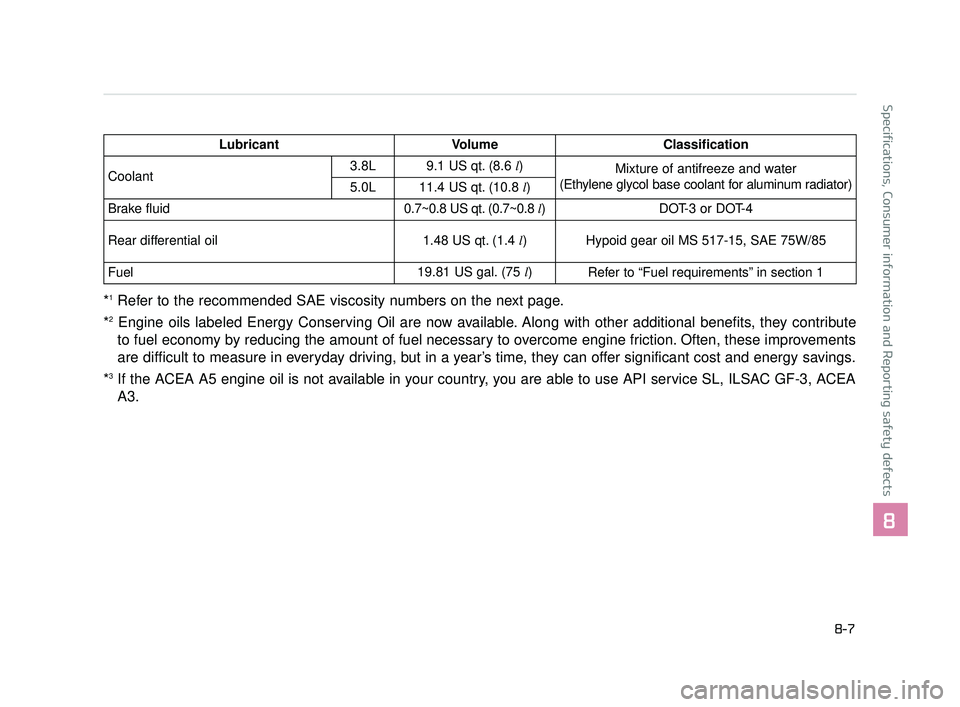
LubricantVolumeClassification
Coolant 3.8L9.1 US qt. (8.6 l)Mixture of antifreeze and water
(Ethylene glycol base coolant for aluminum radiator)
5.0L11.4 US qt. (10.8 l)
Brake fluid0.7~0.8 US qt. (0.7~0.8 l)DOT-3 or DOT-4
Rear differential oil1.48 US qt. (1.4 l)Hypoid gear oil MS 517-15, SAE 75W/85
Fuel19.81 US gal. (75 l)Refer to “Fuel requirements” in section 1
KH USA 8:2015 4/26/2016 11:01 AM Page 7