wheel KIA K900 2017 Workshop Manual
[x] Cancel search | Manufacturer: KIA, Model Year: 2017, Model line: K900, Model: KIA K900 2017Pages: 542, PDF Size: 14.89 MB
Page 363 of 542
5-100
Driving your vehicle
Severe weather conditions in the
winter result in greater wear and
other problems. To minimize the
problems of winter driving, you
should follow these suggestions:Snowy or Icy conditions
To drive your vehicle in deep snow, it
may be necessary to use snow tires
or to install tire chains on your tires. If
snow tires are needed, it is neces-
sary to select tires equivalent in size
and type of the original equipment
tires. Failure to do so may adversely
affect the safety and handling of your
car. Furthermore, speeding, rapid
acceleration, sudden brake applica-
tions, and sharp turns are potentially
very hazardous practices.
During deceleration, use engine
braking to the fullest extent. Sudden
brake applications on snowy or icy
roads may cause skids. You need to
keep sufficient distance between the
vehicle in operation in front and your
vehicle. Also, apply the brake gently.
It should be noted that installing tire
chains on the tire will provide greater
driving force, but will not prevent side
skids.
Tire chains are not legal in all states.
Check state laws before installing tire
chains.
Snow tires
If you mount snow tires on your vehi-
cle, make sure they are radial tires of
the same size and load range as the
original tires. Mount snow tires on all
four wheels to balance your vehicle’s
handling in all weather conditions.
Keep in mind that the traction provid-
ed by snow tires on dry roads may
not be as high as your vehicle's orig-
inal equipment tires. You should drive
cautiously even when the roads are
clear. Check with the tire dealer for
maximum speed recommendations.
Do not install studded tires withoutfirst checking local, state and munic-ipal regulations for possible restric-tions against their use.
WINTER DRIVING
Snow tire size
Snow tires should be equivalent
in size and type to the vehicle's
standard tires. Otherwise, the
safety and handling of your vehi-
cle may be adversely affected.
WARNING
KH USA 5:2016 12/1/2016 10:57 PM Page 100
Page 364 of 542
Driving your vehicle
5
5-101
Tire chains
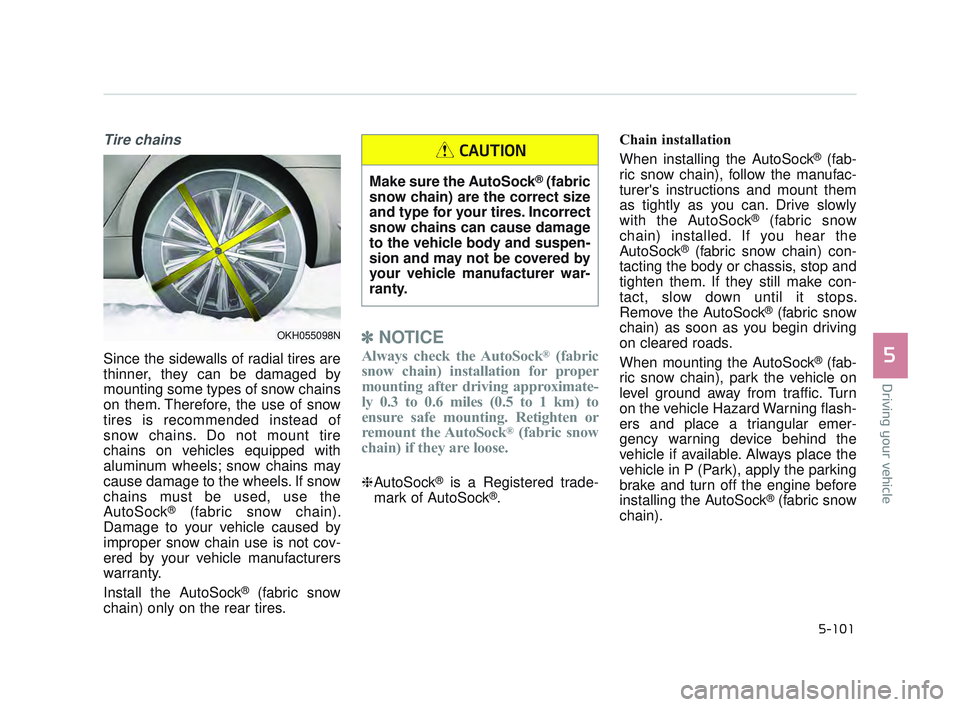
Since the sidewalls of radial tires are
thinner, they can be damaged by
mounting some types of snow chains
on them. Therefore, the use of snow
tires is recommended instead of
snow chains. Do not mount tire
chains on vehicles equipped with
aluminum wheels; snow chains may
cause damage to the wheels. If snow
chains must be used, use the
AutoSock
®(fabric snow chain).
Damage to your vehicle caused by
improper snow chain use is not cov-
ered by your vehicle manufacturers
warranty.
Install the AutoSock
®(fabric snow
chain) only on the rear tires.
✽ NOTICE
Always check the AutoSock®(fabric
snow chain) installation for proper
mounting after driving approximate-
ly 0.3 to 0.6 miles (0.5 to 1 km) to
ensure safe mounting. Retighten or
remount the AutoSock
®(fabric snow
chain) if they are loose.
❈ AutoSock®is a Registered trade-
mark of AutoSock®. Chain installation
When installing the AutoSock
®(fab-
ric snow chain), follow the manufac-
turer's instructions and mount them
as tightly as you can. Drive slowly
with the AutoSock
®(fabric snow
chain) installed. If you hear the
AutoSock
®(fabric snow chain) con-
tacting the body or chassis, stop and
tighten them. If they still make con-
tact, slow down until it stops.
Remove the AutoSock
®(fabric snow
chain) as soon as you begin driving
on cleared roads.
When mounting the AutoSock
®(fab-
ric snow chain), park the vehicle on
level ground away from traffic. Turn
on the vehicle Hazard Warning flash-
ers and place a triangular emer-
gency warning device behind the
vehicle if available. Always place the
vehicle in P (Park), apply the parking
brake and turn off the engine before
installing the AutoSock
®(fabric snow
chain).
OKH055098N
Make sure the AutoSock®(fabric
snow chain) are the correct size
and type for your tires. Incorrect
snow chains can cause damage
to the vehicle body and suspen-
sion and may not be covered by
your vehicle manufacturer war-
ranty.
CAUTION
KH USA 5:2016 12/1/2016 10:57 PM Page 101
Page 365 of 542
5-102
Driving your vehicle
The use of the AutoSock®(fabric
snow chain) may adversely affect
vehicle handling.
Do not exceed 20 mph (30 km/h) or the AutoSock
®(fabric snow chain)
manufacturer’s recommended
speed limit, whichever is lower.
Drive carefully and avoid bumps, holes, sharp turns, and other road
hazards, which may cause the vehi-
cle to bounce.
Avoid sharp turns or locked-wheel braking.
❈AutoSock
®is a Registered trade-
mark of AutoSock®.
Use high quality ethylene gly-
col coolant
Your vehicle is delivered with high
quality ethylene glycol coolant in the
cooling system. It is the only type of
coolant that should be used because
it helps prevent corrosion in the cool-
ing system, lubricates the water
pump and prevents freezing. Be sure
to replace or replenish your coolant
in accordance with the maintenance
schedule in section 7. Before winter,
have your coolant tested to assure
that its freezing point is sufficient for
the temperatures anticipated during
the winter.
Check battery and cables
Winter puts additional burdens on
the battery system. Visually inspect
the battery and cables as described
in section 7. The level of charge in
your battery can be checked by an
authorized K900 Kia dealer or a
service station.
The AutoSock®(fabric snow
chain) that are the wrong size
or improperly installed can
damage your vehicle's brake
lines, suspension, body and
wheels.
Stop driving and retighten the AutoSock
®(fabric snow chain)
any time you hear them hitting
the vehicle.
CAUTION
KH USA 5:2016 12/1/2016 10:57 PM Page 102
Page 366 of 542
Driving your vehicle
5
5-103
Change to "winter weight" oil
if necessary
In some climates it is recommended
that a lower viscosity "winter weight"
oil be used during cold weather. See
section 8 for recommendations. If
you aren't sure what weight oil you
should use, consult an authorized
K900 Kia dealer.
Check spark plugs and igni-
tion system
Inspect your spark plugs as
described in section 7 and replace
them if necessary. Also check all
ignition wiring and components to be
sure they are not cracked, worn or
damaged in any way.
To keep locks from freezing
To keep the locks from freezing,
squirt an approved de-icer fluid or
glycerine into the key opening. If a
lock is covered with ice, squirt it with
an approved de-icing fluid to remove
the ice. If the lock is frozen internally,
you may be able to thaw it out by
using a heated key. Handle the heat-
ed key with care to avoid injury.
Use approved window washer
anti-freeze in system
To keep the water in the window
washer system from freezing, add an
approved window washer anti-freeze
solution in accordance with instruc-
tions on the container. Window wash-
er anti-freeze is available from an
authorized K900 Kia dealer and most
auto parts outlets. Do not use engine
coolant or other types of anti-freeze
as these may damage the paint fin-
ish.
Don't let your parking brake
freeze
Under some conditions your parking
brake can freeze in the engaged
position. This is most likely to hap-
pen when there is an accumulation
of snow or ice around or near the
rear brakes or if the brakes are wet. If
there is a risk the parking brake may
freeze, apply it only temporarily while
you put the shift lever in P (Park) and
block the rear wheels so the vehicle
cannot roll. Then release the parking
brake.
Don't let ice and snow accu-
mulate underneath
Under some conditions, snow and
ice can build up under the fenders
and interfere with the steering. When
driving in severe winter conditions
where this may happen, you should
periodically check underneath the
car to be sure the movement of the
front wheels and the steering com-
ponents is not obstructed.
KH USA 5:2016 12/1/2016 10:57 PM Page 103
Page 385 of 542

Please note that the TPMS is not a
substitute for proper tire maintenance,
and it is the driver’s responsibility to
maintain correct tire pressure, even if
under-inflation has not reached the
level to trigger illumination of the
TPMS low tire pressure telltale.Your vehicle has also been equipped
with a TPMS malfunction indicator to
indicate when the system is not oper-
ating properly. The TPMS malfunction
indicator is combined with the low tire
pressure telltale. When the system
detects a malfunction, the telltale will
flash for approximately one minute
and then remain continuously illumi-
nated. This sequence will continue
upon subsequent vehicle start-ups as
long as the malfunction exists.
When the malfunction indicator is illu-
minated, the system may not be able
to detect or signal low tire pressure
as intended. TPMS malfunctions may
occur for a variety of reasons, includ-
ing the installation of replacement or
alternate tires or wheels on the vehi-
cle that prevent the TPMS from func-
tioning properly. Always check the TPMS malfunction
telltale after replacing one or more
tires or wheels on your vehicle to
ensure that the replacement or alter-
nate tires and wheels allow the TPMS
to continue to function properly.
✽
NOTICE
If any of the below happens, have
the system be checked by an author-
ized K900 Kia dealer.
1.The low tire pressure telltale/
TPMS malfunction indicator does
not illuminate for 3 seconds when
the Engine Start/Stop button is
turned to the ON or engine is run-
ning.
2. The TPMS malfunction indicator remains illuminated after blinking
for approximately 1 minute.
3. The Low tire pressure position telltale remains illuminated.
6-12
What to do in an emergency
KH USA 6:2016 12/1/2016 11:08 PM Page 12
Page 386 of 542

What to do in an emergency
6
6-13
Low tire pressure telltale
Low tire pressure position tell-
tale
When the tire pressure monitoring
system warning indicators are illumi-
nated and warning message dis-
played on the cluster LCD display,
one or more of your tires is signifi-
cantly under-inflated. The low tire
pressure position telltale light will
indicate which tire is significantly
under-inflated by illuminating the cor-
responding position light.If either telltale illuminates, immedi-
ately reduce your speed, avoid hard
cornering and anticipate increased
stopping distances. You should stop
and check your tires as soon as pos-
sible. Inflate the tires to the proper
pressure as indicated on the vehi-
cle’s placard or tire inflation pressure
label located on the driver’s side cen-
ter pillar outer panel.
If you cannot reach a service station
or if the tire cannot hold the newly
added air, replace the low pressure
tire with the spare tire.
If you drive the vehicle for about 20
minutes at speeds above 15 mph (25
km/h) after replacing the low pres-
sure tire with the spare tire, the
below will happen:
The TPMS malfunction indicator
may blink for approximately 1 minute
and then remain continuously illumi-
nated because the TPMS sensor is
not mounted on the spare wheel.
✽ NOTICE
The spare tire is not equipped with a
tire pressure sensor.
In winter or cold weather, the low
tire pressure telltale may be illumi-
nated if the tire pressure was
adjusted to the recommended tire
inflation pressure in warm weather.
It does not mean your TPMS is
malfunctioning because the
decreased temperature leads to a
proportional lowering of tire pres-
sure.
When you drive your vehicle from a warm area to a cold area or from a
cold area to a warm area, or the
outside temperature is greatly
higher or lower, you should check
the tire inflation pressure and
adjust the tires to the recommend-
ed tire inflation pressure.
The tire pressure may vary depending on various factors
including the temperature condi-
tions of parking area, driving condi-
tions and ambient temperature,
altitude above sea level.
OKH043415N
■Type A■Type B
KH USA 6:2016 12/1/2016 11:08 PM Page 13
Page 388 of 542

What to do in an emergency
6
6-15
Changing a tire with TPMS
If you have a flat tire, the Low Tire
Pressure and Position telltales will
come on. Have the flat tire repaired
by an authorized K900 Kia dealer as
soon as possible or replace the flat
tire with the spare tire.Each wheel is equipped with a tire
pressure sensor mounted inside the
tire behind the valve stem. You must
use TPMS specific wheels. It is rec-
ommended that you always have
your tires serviced by an authorized
K900 Kia dealer.
If you drive the vehicle for about 20
minutes at speeds above 15 mph (25
km/h) after replacing the low pres-
sure tire with the spare tire, the
below will happen:
The TPMS malfunction indicator
may blink for approximately 1
minute and then remain continu-
ously illuminated because the
TPMS sensor is not mounted on
the spare wheel. You may not be able to identify a tire
with low pressure by simply looking
at it. Always use a good quality tire
pressure gauge to measure. Please
note that a tire that is hot (from being
driven) will have a higher pressure
measurement than a tire that is cold.
A cold tire means the vehicle has
been sitting for 3 hours and driven for
less than 1 mile (1.6 km) in that 3 hour
period.
Allow the tire to cool before measur-
ing the inflation pressure. Always be
sure the tire is cold before inflating to
the recommended pressure.
Repair Agents
Never use a puncture-repairing
agent not approved by K900 Kia
dealer to repair and/or inflate a
low pressure tire. Tire sealant
not approved by K900 Kia deal-
er may damage the tire pres-
sure sensor.
CAUTION
KH USA 6:2016 12/1/2016 11:08 PM Page 15
Page 390 of 542
What to do in an emergency
6
6-17
IF YOU HAVE A FLAT TIRE
Jack and tools
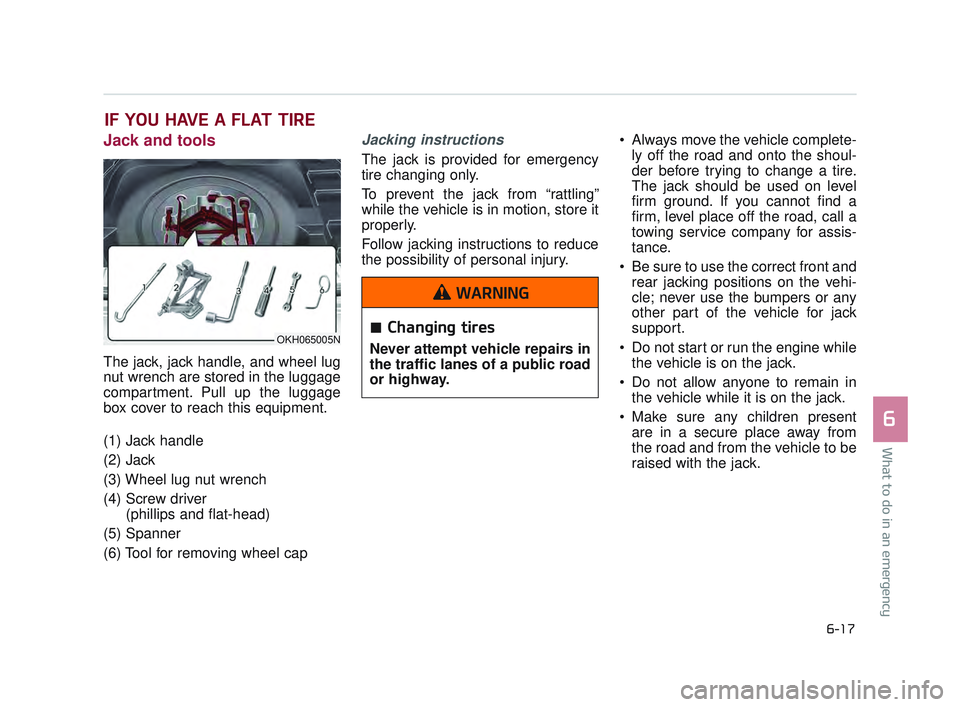
The jack, jack handle, and wheel lug
nut wrench are stored in the luggage
compartment. Pull up the luggage
box cover to reach this equipment.
(1) Jack handle
(2) Jack
(3) Wheel lug nut wrench
(4) Screw driver (phillips and flat-head)
(5) Spanner
(6) Tool for removing wheel cap
Jacking instructions
The jack is provided for emergency
tire changing only.
To prevent the jack from “rattling”
while the vehicle is in motion, store it
properly.
Follow jacking instructions to reduce
the possibility of personal injury. Always move the vehicle complete-
ly off the road and onto the shoul-
der before trying to change a tire.
The jack should be used on level
firm ground. If you cannot find a
firm, level place off the road, call a
towing service company for assis-
tance.
Be sure to use the correct front and rear jacking positions on the vehi-
cle; never use the bumpers or any
other part of the vehicle for jack
support.
Do not start or run the engine while the vehicle is on the jack.
Do not allow anyone to remain in the vehicle while it is on the jack.
Make sure any children present are in a secure place away from
the road and from the vehicle to be
raised with the jack.
OKH065005NChanging tires
Never attempt vehicle repairs in
the traffic lanes of a public road
or highway.
WARNING
KH USA 6:2016 12/1/2016 11:08 PM Page 17
Page 393 of 542
6-20
What to do in an emergency
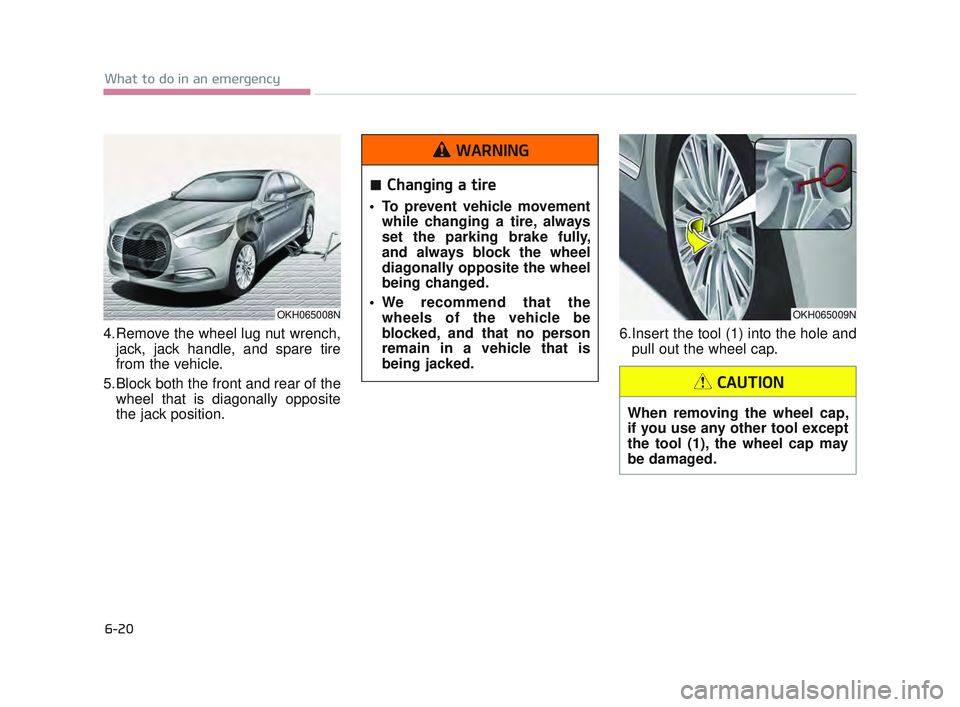
4.Remove the wheel lug nut wrench,jack, jack handle, and spare tire
from the vehicle.
5.Block both the front and rear of the wheel that is diagonally opposite
the jack position. 6.Insert the tool (1) into the hole and
pull out the wheel cap.
OKH065008NOKH065009N
Changing a tire
To prevent vehicle movementwhile changing a tire, always
set the parking brake fully,
and always block the wheel
diagonally opposite the wheel
being changed.
We recommend that the wheels of the vehicle be
blocked, and that no person
remain in a vehicle that is
being jacked.
WARNING
When removing the wheel cap,
if you use any other tool except
the tool (1), the wheel cap may
be damaged.
CAUTION
KH USA 6:2016 12/1/2016 11:08 PM Page 20
Page 394 of 542
What to do in an emergency
6
6-21
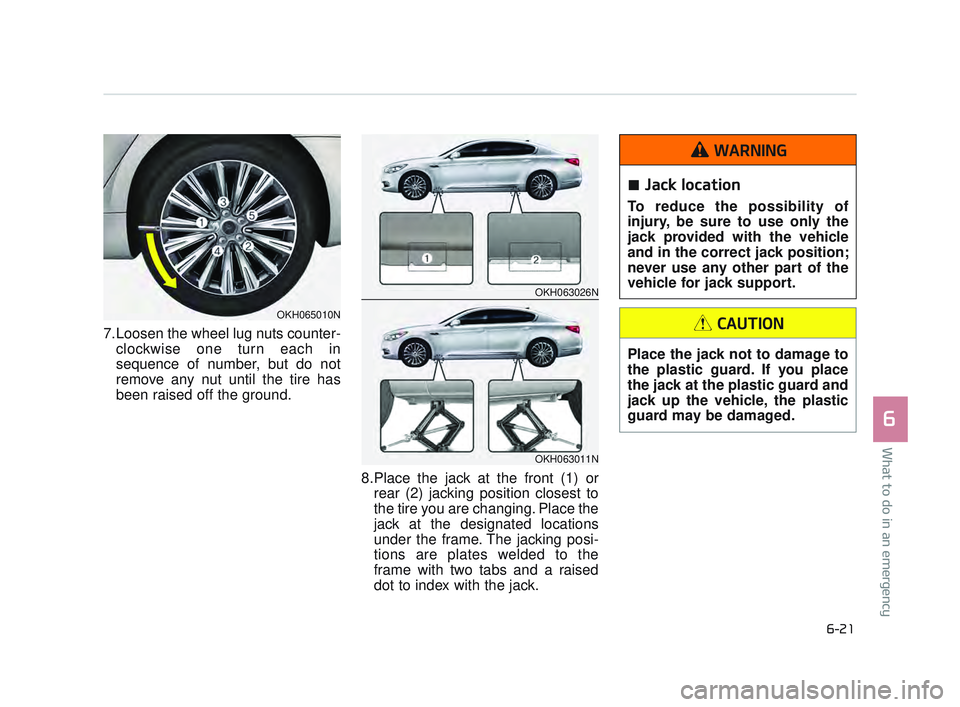
7.Loosen the wheel lug nuts counter-clockwise one turn each in
sequence of number, but do not
remove any nut until the tire has
been raised off the ground.
8.Place the jack at the front (1) orrear (2) jacking position closest to
the tire you are changing. Place the
jack at the designated locations
under the frame. The jacking posi-
tions are plates welded to the
frame with two tabs and a raised
dot to index with the jack.
OKH065010N
OKH063026N
OKH063011N
Place the jack not to damage to
the plastic guard. If you place
the jack at the plastic guard and
jack up the vehicle, the plastic
guard may be damaged.
CAUTION
Jack location
To reduce the possibility of
injury, be sure to use only the
jack provided with the vehicle
and in the correct jack position;
never use any other part of the
vehicle for jack support.
WARNING
KH USA 6:2016 12/1/2016 11:08 PM Page 21