fuel KIA K900 2017 Repair Manual
[x] Cancel search | Manufacturer: KIA, Model Year: 2017, Model line: K900, Model: KIA K900 2017Pages: 542, PDF Size: 14.89 MB
Page 491 of 542
Maintenance
7
7-85
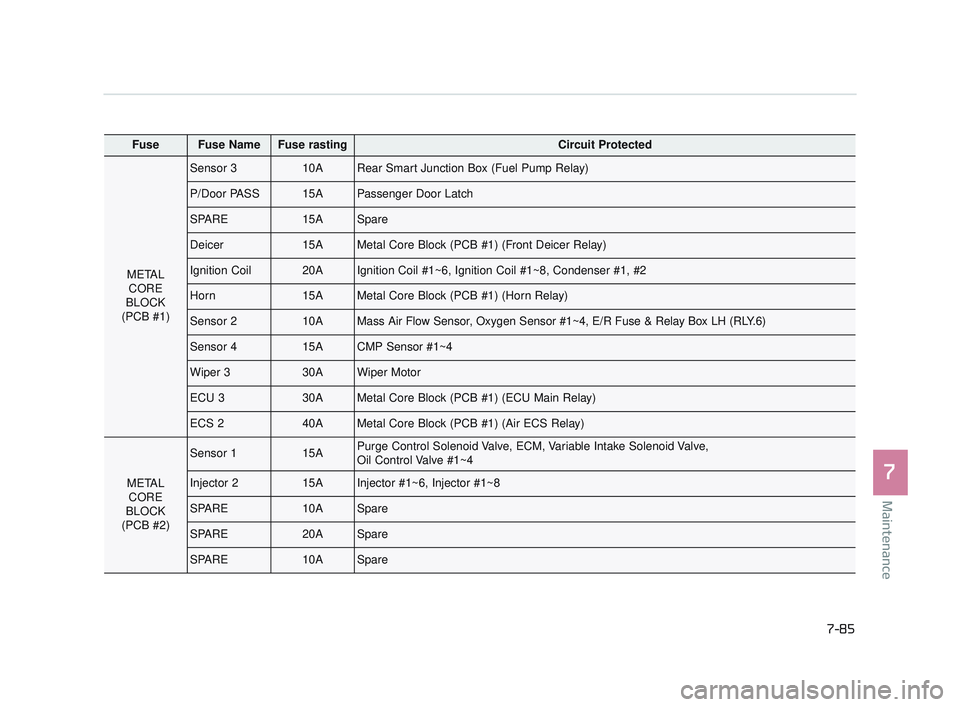
FuseFuse NameFuse rastingCircuit Protected
METALCORE
BLOCK
(PCB #1)
Sensor 310ARear Smart Junction Box (Fuel Pump Relay)
P/Door PASS15APassenger Door Latch
SPARE15ASpare
Deicer15AMetal Core Block (PCB #1) (Front Deicer Relay)
Ignition Coil20AIgnition Coil #1~6, Ignition Coil #1~8, Condenser #1, #2
Horn15AMetal Core Block (PCB #1) (Horn Relay)
Sensor 210AMass Air Flow Sensor, Oxygen Sensor #1~4, E/R Fuse & Relay Box LH (RLY.6)
Sensor 415ACMP Sensor #1~4
Wiper 330AWiper Motor
ECU 330AMetal Core Block (PCB #1) (ECU Main Relay)
ECS 240AMetal Core Block (PCB #1) (Air ECS Relay)
METAL CORE
BLOCK
(PCB #2)
Sensor 115APurge Control Solenoid Valve, ECM, Variable Intake Solenoid Valve,
Oil Control Valve #1~4
Injector 215AInjector #1~6, Injector #1~8
SPARE10ASpare
SPARE20ASpare
SPARE10ASpare
KH USA 7:2016 12/1/2016 11:21 PM Page 85
Page 494 of 542
7-88
Maintenance
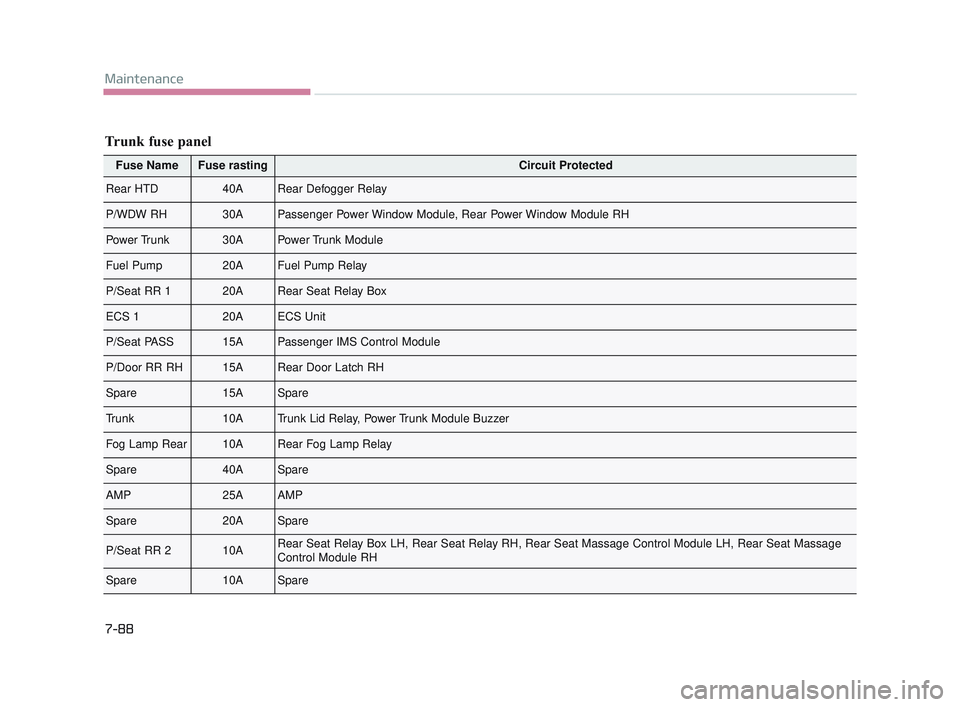
Fuse NameFuse rastingCircuit Protected
Rear HTD40ARear Defogger Relay
P/WDW RH30APassenger Power Window Module, Rear Power Window Module RH
Power Trunk30APower Trunk Module
Fuel Pump20AFuel Pump Relay
P/Seat RR 120ARear Seat Relay Box
ECS 120AECS Unit
P/Seat PASS 15APassenger IMS Control Module
P/Door RR RH15ARear Door Latch RH
Spare15ASpare
Trunk10ATrunk Lid Relay, Power Trunk Module Buzzer
Fog Lamp Rear10ARear Fog Lamp Relay
Spare40ASpare
AMP25AAMP
Spare20ASpare
P/Seat RR 210ARear Seat Relay Box LH, Rear Seat Relay RH, Rear Seat Massage Control Module LH, Rear Seat Massage
Control Module RH
Spare10ASpare
Trunk fuse panel
KH USA 7:2016 12/1/2016 11:21 PM Page 88
Page 505 of 542
Maintenance
7
7-99
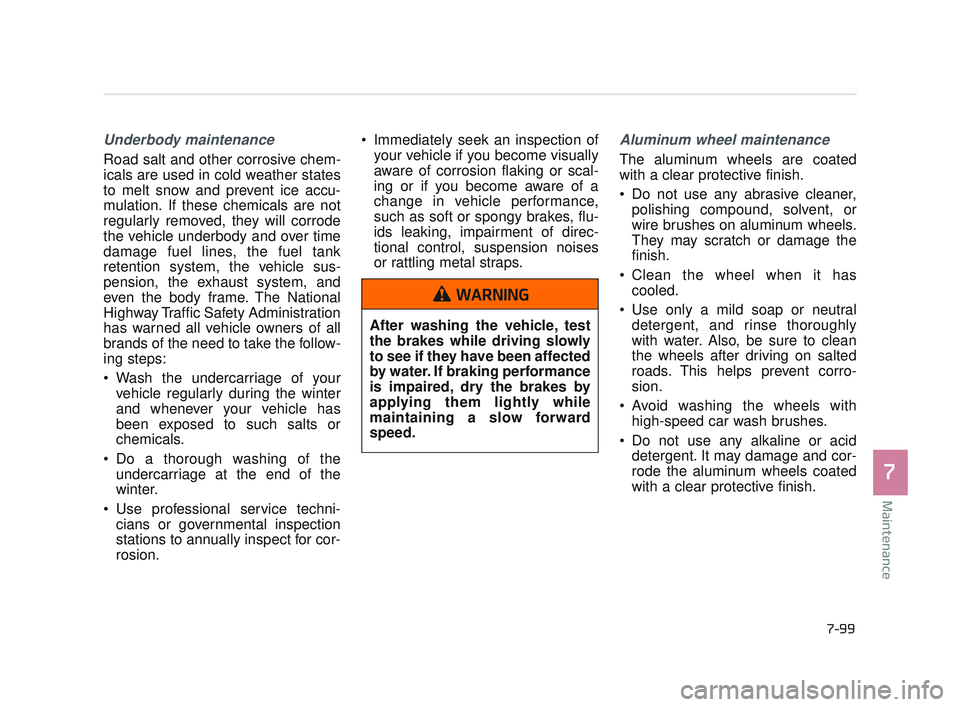
Underbody maintenance
Road salt and other corrosive chem-
icals are used in cold weather states
to melt snow and prevent ice accu-
mulation. If these chemicals are not
regularly removed, they will corrode
the vehicle underbody and over time
damage fuel lines, the fuel tank
retention system, the vehicle sus-
pension, the exhaust system, and
even the body frame. The National
Highway Traffic Safety Administration
has warned all vehicle owners of all
brands of the need to take the follow-
ing steps:
Wash the undercarriage of yourvehicle regularly during the winter
and whenever your vehicle has
been exposed to such salts or
chemicals.
Do a thorough washing of the undercarriage at the end of the
winter.
Use professional service techni- cians or governmental inspection
stations to annually inspect for cor-
rosion. Immediately seek an inspection of
your vehicle if you become visually
aware of corrosion flaking or scal-
ing or if you become aware of a
change in vehicle performance,
such as soft or spongy brakes, flu-
ids leaking, impairment of direc-
tional control, suspension noises
or rattling metal straps.
Aluminum wheel maintenance
The aluminum wheels are coated
with a clear protective finish.
Do not use any abrasive cleaner,polishing compound, solvent, or
wire brushes on aluminum wheels.
They may scratch or damage the
finish.
Clean the wheel when it has cooled.
Use only a mild soap or neutral detergent, and rinse thoroughly
with water. Also, be sure to clean
the wheels after driving on salted
roads. This helps prevent corro-
sion.
Avoid washing the wheels with high-speed car wash brushes.
Do not use any alkaline or acid detergent. It may damage and cor-
rode the aluminum wheels coated
with a clear protective finish.
After washing the vehicle, test
the brakes while driving slowly
to see if they have been affected
by water. If braking performance
is impaired, dry the brakes by
applying them lightly while
maintaining a slow forward
speed.
WARNING
KH USA 7:2016 12/1/2016 11:21 PM Page 99
Page 510 of 542
7-104
Maintenance
EMISSION CONTROL SYSTEM
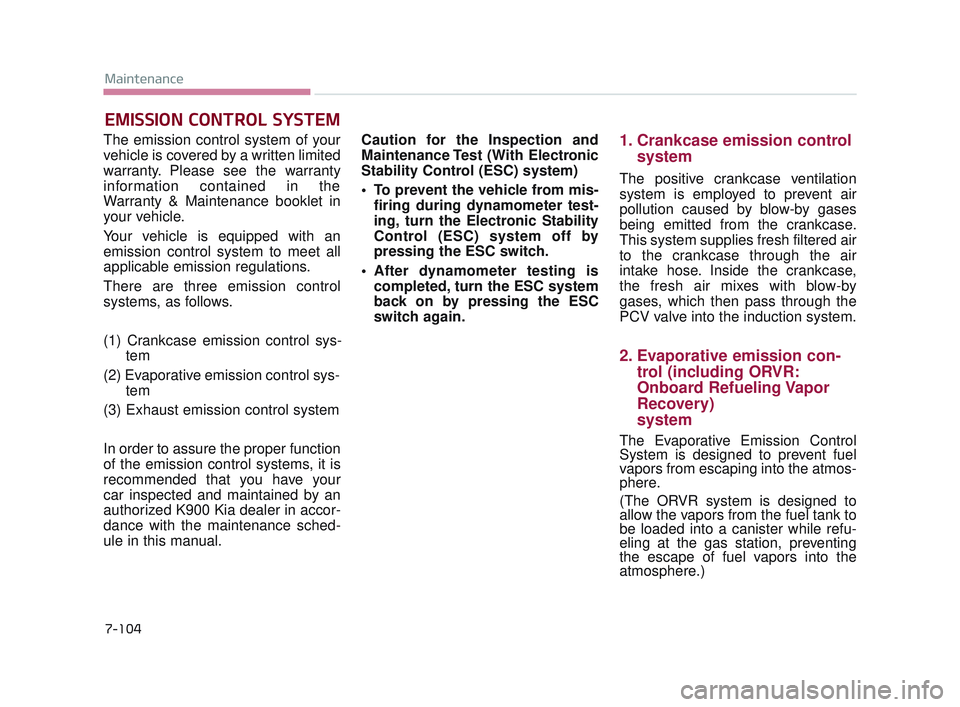
The emission control system of your
vehicle is covered by a written limited
warranty. Please see the warranty
information contained in the
Warranty & Maintenance booklet in
your vehicle.
Your vehicle is equipped with an
emission control system to meet all
applicable emission regulations.
There are three emission control
systems, as follows.
(1) Crankcase emission control sys-tem
(2) Evaporative emission control sys- tem
(3) Exhaust emission control system
In order to assure the proper function
of the emission control systems, it is
recommended that you have your
car inspected and maintained by an
authorized K900 Kia dealer in accor-
dance with the maintenance sched-
ule in this manual. Caution for the Inspection and
Maintenance Test (With Electronic
Stability Control (ESC) system)
To prevent the vehicle from mis-
firing during dynamometer test-
ing, turn the Electronic Stability
Control (ESC) system off by
pressing the ESC switch.
After dynamometer testing is completed, turn the ESC system
back on by pressing the ESC
switch again.1. Crankcase emission control system
The positive crankcase ventilation
system is employed to prevent air
pollution caused by blow-by gases
being emitted from the crankcase.
This system supplies fresh filtered air
to the crankcase through the air
intake hose. Inside the crankcase,
the fresh air mixes with blow-by
gases, which then pass through the
PCV valve into the induction system.
2. Evaporative emission con-trol (including ORVR:
Onboard Refueling Vapor
Recovery)
system
The Evaporative Emission Control
System is designed to prevent fuel
vapors from escaping into the atmos-
phere.
(The ORVR system is designed to
allow the vapors from the fuel tank to
be loaded into a canister while refu-
eling at the gas station, preventing
the escape of fuel vapors into the
atmosphere.)
KH USA 7:2016 12/1/2016 11:21 PM Page 104
Page 511 of 542
Maintenance
7
7-105
Canister
Fuel vapors generated inside the fuel
tank are absorbed and stored in the
onboard canister. When the engine is
running, the fuel vapors absorbed in
the canister are drawn into the
engine intake manifold through the
purge control solenoid valve.
Purge Control Solenoid Valve(PCSV)
The purge control solenoid valve is
controlled by the Engine Control
Module (ECM); when the engine
coolant temperature is low during
idling, the PCSV closes so that evap-
orated fuel is not taken into the
engine. After the engine warms-up
during ordinary driving, the PCSV
opens to introduce evaporated fuel to
the engine.
3. Exhaust emission control system
The Exhaust Emission Control
System is a highly effective system
which controls exhaust emissions
while maintaining good vehicle per-
formance.
Vehicle modifications
This vehicle should not be modi-
fied. Modification of your vehicle
could affect its performance, safety
or durability and may even violate
governmental safety and emis-
sions regulations.
In addition, damage or perform-
ance problems resulting from any
modification may not be covered
under warranty.
Use of unauthorized electric devices may cause: Abnormal
vehicle operation, Wire damage,
Battery discharge, Fire.
Be careful not to damage your
vehicle by use of unauthorized
electric devices.
Engine exhaust gas precautions
(carbon monoxide)
Carbon monoxide can be present with other exhaust fumes.
Therefore, if you smell exhaust
fumes of any kind inside your vehi-
cle, have it inspected and repaired
immediately. If you ever suspect
exhaust fumes are coming into
your vehicle, drive it only with all
the windows fully open. Have your
vehicle checked and repaired
immediately.
KH USA 7:2016 12/1/2016 11:21 PM Page 105
Page 513 of 542
Maintenance
7
7-107
Operating precautions for catalyt-ic converters (if equipped)Your vehicle is equipped with a cat-
alytic converter emission control
device.
Therefore, the following precautions
must be observed:
Use only UNLEADED FUEL for gasoline engines.
Do not operate the vehicle when there are signs of engine malfunc-
tion, such as misfire or a noticeable
loss of performance.
Do not misuse or abuse the engine. Examples of misuse are
coasting with the engine off and
descending steep grades in gear
with the engine off.
Do not operate the engine at high idle speed for extended periods (5
minutes or more).
Do not modify or tamper with any part of the engine or emission con-
trol system. All inspections and
adjustments must be made by an
authorized K900 Kia dealer.
Avoid driving with a very low fuel level. If you run out of gasoline, it
could cause the engine to misfire
and result in excessive loading of
the catalytic converter. Failure to observe these precautions
could result in damage to the catalyt-
ic converter and to your vehicle.
Additionally, such actions could void
your warranties.
Fire
Do not park, idle or drive the
vehicle over or near flamma-
ble objects, such as grass,
vegetation, paper, leaves, etc.
A hot exhaust system can
ignite flammable items under
your vehicle.
Also, do not remove the heat sink around the exhaust sys-
tem, do not seal the bottom of
the vehicle or do not coat the
vehicle for corrosion control.
It may present a fire risk under
certain conditions.
WARNING
Catalytic converter
Keep away from the catalytic
converter and exhaust system
while the vehicle is running or
immediately thereafter. The
exhaust and catalytic systems
are very hot and may burn you.
WARNING
KH USA 7:2016 12/1/2016 11:21 PM Page 107
Page 520 of 542
8-6
Specifications, Consumer information and Reporting safety defects
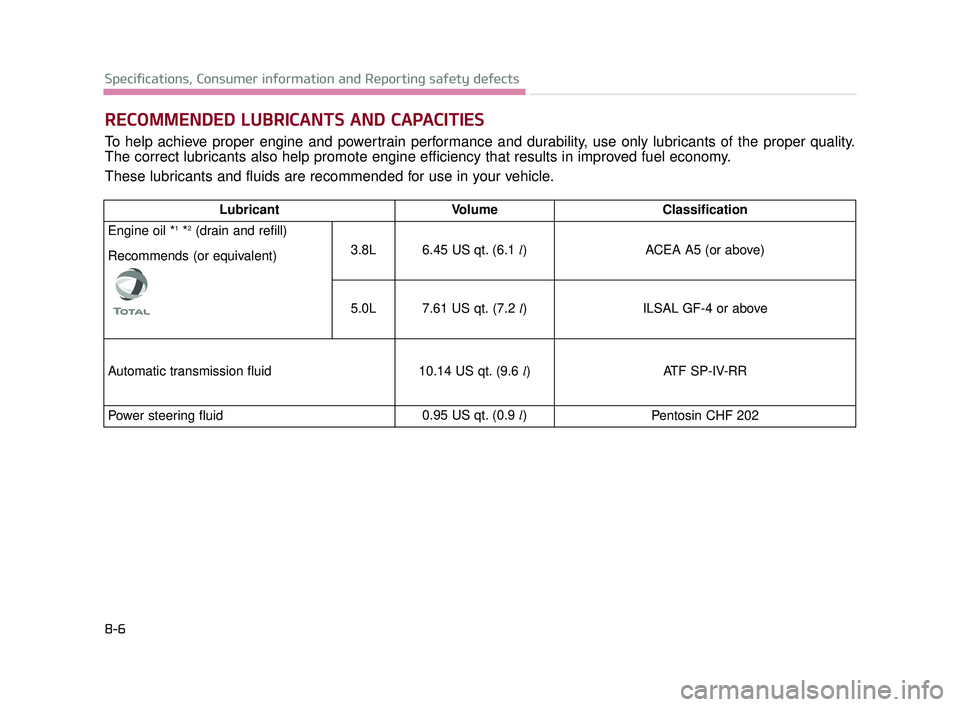
RECOMMENDED LUBRICANTS AND CAPACITIES
To help achieve proper engine and powertrain performance and durability, use only lubricants of the proper quality.
The correct lubricants also help promote engine efficiency that results in improved fuel economy.
These lubricants and fluids are recommended for use in your vehicle.
LubricantVolumeClassification
Engine oil *1*2 (drain and refill)
Recommends (or equivalent)
3.8L6.45 US qt. (6.1 l)ACEA A5 (or above)
5.0L7.61 US qt. (7.2 l)ILSAL GF-4 or above
Automatic transmission fluid10.14 US qt. (9.6 l)ATF SP-IV-RR
Power steering fluid0.95 US qt. (0.9 l)Pentosin CHF 202
KH USA 8:2015 4/26/2016 11:01 AM Page 6
Page 521 of 542
Specifications, Consumer information and Reporting safety defects
8
8-7
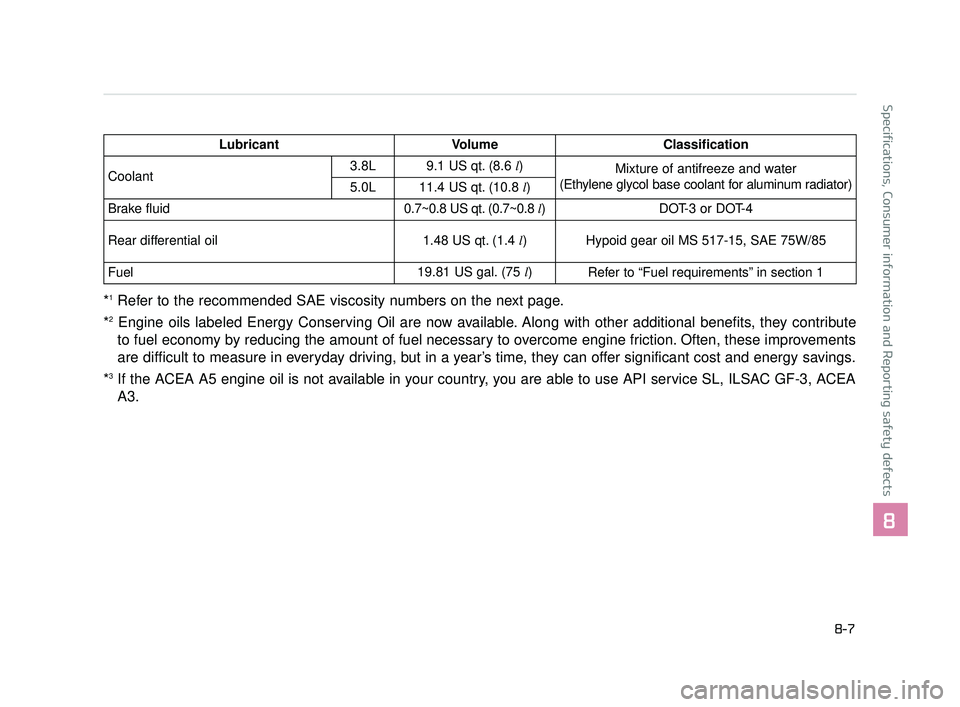
*1Refer to the recommended SAE viscosity numbers on the next page.
*
2Engine oils labeled Energy Conserving Oil are now available. Along with other additional benefits, they contribute
to fuel economy by reducing the amount of fuel necessary to overcome engine friction. Often, these improvements
are difficult to measure in everyday driving, but in a year’s time, they can offer significant cost and energy savings.
*
3If the ACEA A5 engine oil is not available in your country, you are able to use API service SL, ILSAC GF-3, ACEA
A3.
LubricantVolumeClassification
Coolant 3.8L9.1 US qt. (8.6 l)Mixture of antifreeze and water
(Ethylene glycol base coolant for aluminum radiator)
5.0L11.4 US qt. (10.8 l)
Brake fluid0.7~0.8 US qt. (0.7~0.8 l)DOT-3 or DOT-4
Rear differential oil1.48 US qt. (1.4 l)Hypoid gear oil MS 517-15, SAE 75W/85
Fuel19.81 US gal. (75 l)Refer to “Fuel requirements” in section 1
KH USA 8:2015 4/26/2016 11:01 AM Page 7
Page 522 of 542
8-8
Specifications, Consumer information and Reporting safety defects
Recommended SAE viscosity
number
Always be sure to clean the area
around any filler plug, drain plug, or
dipstick before checking or draining
any lubricant. This is especially
important in dusty or sandy areas
and when the vehicle is used on
unpaved roads. Cleaning the plug
and dipstick areas will prevent dirt
and grit from entering the engine and
other mechanisms that could be
damaged.
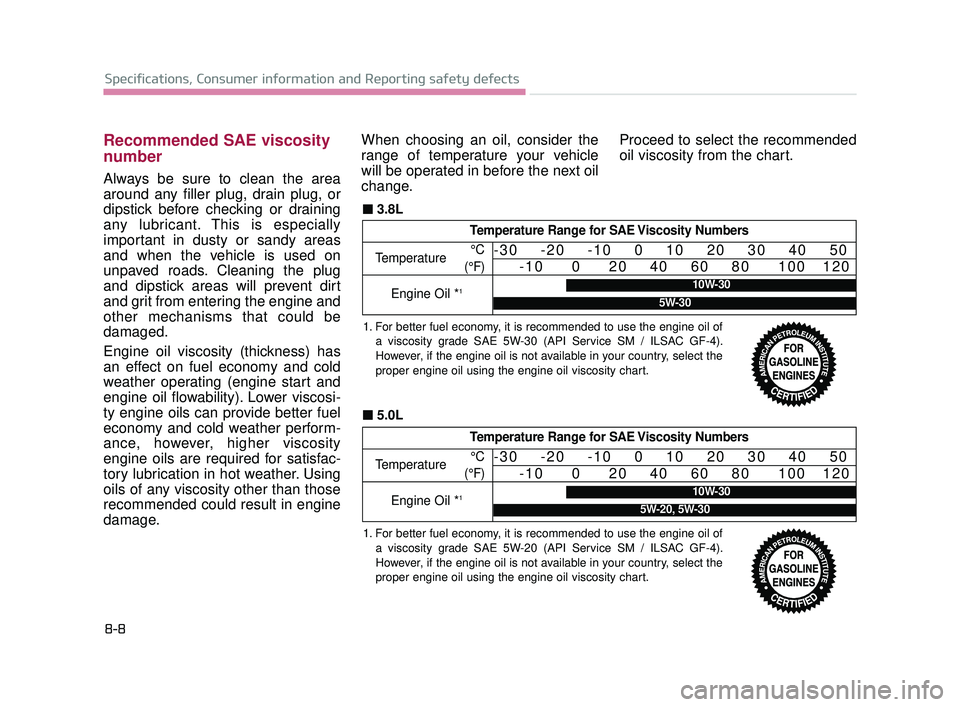
Engine oil viscosity (thickness) has
an effect on fuel economy and cold
weather operating (engine start and
engine oil flowability). Lower viscosi-
ty engine oils can provide better fuel
economy and cold weather perform-
ance, however, higher viscosity
engine oils are required for satisfac-
tory lubrication in hot weather. Using
oils of any viscosity other than those
recommended could result in engine
damage. When choosing an oil, consider the
range of temperature your vehicle
will be operated in before the next oil
change.
Proceed to select the recommended
oil viscosity from the chart.
Temperature Range for SAE Viscosity Numbers
Temperature
Engine Oil *
1
°C
(°F)-30 -20 -10 0 10 20 30 40 50 -10 0 20 40 60 80 100 120
1. For better fuel economy, it is recommended to use the engine oil of
a viscosity grade SAE 5W-30 (API Service SM / ILSAC GF-4).
However, if the engine oil is not available in your country, select the
proper engine oil using the engine oil viscosity chart.
10W-30
5W-30
Temperature Range for SAE Viscosity Numbers
Temperature
Engine Oil *
1
°C
(°F)-30 -20 -10 0 10 20 30 40 50 -10 0 20 40 60 80 100 120
1. For better fuel economy, it is recommended to use the engine oil of
a viscosity grade SAE 5W-20 (API Service SM / ILSAC GF-4).
However, if the engine oil is not available in your country, select the
proper engine oil using the engine oil viscosity chart.
10W-30
5W-20, 5W-30
■3.8L
■ 5.0L
KH USA 8:2015 4/26/2016 11:01 AM Page 8
Page 525 of 542
Roadside Assistance is provided on all new current
model year Kia Vehicles from the date the vehicle is deliv-
ered to the first retail buyer or otherwise put into use (in-
service date), whichever is earlier, for a period of 60
months or 60,000 miles, whichever is earlier, subject to
the terms, conditions and exclusions set forth in the Kia
Warranty and Consumer Information Manual applicable
to your model year vehicle.
KMA reserves the right to limit or deny services or other
benefits to any owner or driver when, in KMA's judgment,
the claims and/or service requests are excessive in fre-
quency or type of occurrence.
Toll free consumer assistance
Kia's toll-free Consumer Assistance hot line is staffed
from 5:00 AM to 6:00 PM PST, Monday through Friday
and is accessible by dialing 1-855-4KIAVIP (855-454-
2847) or 1-800-333-4KIA (800-333-4542).
For more information regarding assistance available,
please refer to your Kia Warranty & Consumer
Information Manual.
Emergency roadside assistance
Kia's toll free Roadside Assistance hot line is staffed 24
hours a day, 365 days a year and is accessible by dialing
1-855-4KIAVIP (855-454-2847) or 1-800-333-4KIA (800-
333-4542).
Please note that you must provide your Vehicle
Identification Number (VIN) to verify coverage at the time
of your call. The VIN can be found on the dash of your
vehicle on the driver’s side, on the door jamb of the dri-
ver’s door, your vehicle’s registration or proof of insur-
ance card.
Kia utilizes a network of over 17,000 roadside assistance
providers. Should you accidentally run out of fuel, require
a battery jump, or need help changing a tire, a Kia
Roadside Assistance Representative will dispatch some-
one to deliver a small quantity of gas, change a flat tire
with your inflated spare, or arrange a battery jump to
allow you to proceed to your destination. We have access
to a network of over 10,000 locksmiths to help you should
you become locked out of your Kia.
In the event that mechanical difficulty renders your vehi-
cle undriveable due to a warranty-related concern, Kia’s
Roadside Assistance Representative will arrange to
transport your vehicle to the nearest Kia dealer or to an
alternative service location.
CONSUMER ASSISTANCE (U.S. ONLY)
Specifications, Consumer information and Reporting safety defects
8
8-11
KH USA 8:2015 4/26/2016 11:02 AM Page 11