wheel KIA K900 2019 Owners Manual
[x] Cancel search | Manufacturer: KIA, Model Year: 2019, Model line: K900, Model: KIA K900 2019Pages: 580, PDF Size: 15.11 MB
Page 502 of 580
Maintenance
48
7
GVWR: Gross Vehicle Weight Rating
GAWR FRT: Gross Axle Weight
Rating for the Front Axle.
GAWR RR: Gross Axle Weight
Rating for the Rear axle.
Intended Outboard Sidewall: The
side of an asymmetrical tire, that
must always face outward when
mounted on a vehicle.
Kilopascal (kPa): The metric unit for
air pressure.
Light truck(LT) tire: A tire designat-
ed by its manufacturer as primarily
intended for use on lightweight trucks
or multipurpose passenger vehicles.
Load Index: An assigned number
ranging from 1 to 279 that corre-
sponds to the load carrying capacity
of a tire.
Load ratings: The maximum load
that a tire is rated to carry for a given
inflation pressure. Maximum Inflation Pressure:
The
maximum air pressure to which a
cold tire may be inflated. The maxi-
mum air pressure is molded onto the
sidewall.
Maximum Load Rating: The load
rating for a tire at the maximum per-
missible inflation pressure for that
tire.
Maximum Loaded Vehicle Weight:
The sum of curb weight; accessory
weight; vehicle capacity weight; and
production options weight.
Normal Occupant Weight: The
number of occupants a vehicle is
designed to seat multiplied by 150
lbs. (68kg). Occupant Distribution:
Designated
seating positions.
Outward Facing Sidewall: The side
of a asymmetrical tire that has a par-
ticular side that faces outward when
mounted on a vehicle. The outward
facing sidewall bears white lettering
or bears manufacturer, brand, and/or
model name molding that is higher or
deeper than the same moldings on
the inner facing sidewall.
Passenger (P-Metric) Tire: A tire
used on passenger cars and some
light duty trucks and multipurpose
vehicles.
Ply: A layer of rubber-coated parallel
cords
Pneumatic tire: A mechanical
device made of rubber, chemicals,
fabric and steel or other materials,
that, when mounted on an automo-
tive wheel, provides the traction and
contains the gas or fluid that sustains
the load.
Page 504 of 580
Maintenance
50
7
All season tires
Kia specifies all season tires on
some models to provide good per-
formance for use all year round,
including snowy and icy road condi-
tions. All season tires are identified
by ALL SEASON and/or M+S (Mud
and Snow) on the tire sidewall. Snow
tires have better snow traction than
all season tires and may be more
appropriate in some areas.
Summer tires
Kia specifies summer tires on some
models to provide superior perform-
ance on dry roads. Summer tire per-
formance is substantially reduced in
snow and ice. Summer tires do not
have the tire traction rating M+S
(Mud and Snow) on the tire side wall.
If you plan to operate your vehicle in
snowy or icy conditions, Kia recom-
mends the use of snow tires or all
season tires on all four wheels.
Snow tires
If you equip your car with snow tires,
they should be the same size and
have the same load capacity as the
original tires. Snow tires should be
installed on all four wheels; other-
wise, poor handling may result.
Snow tires should carry 4 psi (28
kPa) more air pressure than the
pressure recommended for the stan-
dard tires on the tire label on the dri-
ver's side of the center pillar, or up to
the maximum pressure shown on the
tire sidewall, whichever is less.
Do not drive faster than 75 mph (120
km/h) when your vehicle is equipped
with snow tires.WARNING
Do not use summer tires at tem-
peratures below 45°F (7°C) or
when driving on snow or ice. At
temperatures below 45°F (7°C),
summer tires can lose elastici-
ty, and therefore traction and
braking power as well. Change
the tires on your vehicle to win-
ter or all-weather tires of the
same size as the standard tires
of the vehicle. Both types of
tires are identified by the M+S
(Mud and Snow) marking. Using
summer tires at very cold tem-
peratures could cause cracks to
form, thereby damaging the
tires permanently.
Page 505 of 580
751
Maintenance
Tire chains
Tire chains, if necessary, should be
installed on the front wheels.
Be sure that the chains are installed
in accordance with the manufactur-
er's instructions.
To minimize tire and chain wear, do
not continue to use tire chains when
they are no longer needed.
When driving on roads coveredwith snow or ice, drive at less than
20 mph (30 km/h).
Use the SAE “S” class or wire chains.
If you hear noise caused by chains contacting the body, retighten the
chain to avoid contact with the
vehicle body.
To prevent body damage, retighten the chains after driving 0.3~0.6
miles (0.5~1.0 km).
Do not use tire chains on vehicles equipped with aluminum wheels.
In unavoidable circumstances, use
a wire type chain.
Use wire chains less than 0.47 inches (12 mm) to prevent damage
to the chain’s connection.
Radial-ply tires
Radial-ply tires provide improved
tread life, road hazard resistance and
smoother high speed ride. The radi-
al-ply tires used on this vehicle are
of belted construction and are select-
ed to complement the ride and han-
dling characteristics of your vehicle.
Radial-ply tires have the same load
carrying capacity as bias-ply or bias
belted tires of the same size and use
the same recommended inflation
pressure. Mixing of radial-ply tires
with bias-ply or bias belted tires is
not recommended. Any combina-
tions of radial-ply and bias-ply or bias
belted tires when used on the same
vehicle will seriously deteriorate
vehicle handling. The best rule to fol-
low is: identical radial-ply tires should
always be used as a set of four. Longer wearing tires can be more
susceptible to irregular tread wear. It
is very important to follow the tire
rotation interval shown in this section
to achieve the tread life potential of
these tires. Cuts and punctures in
radial-ply tires are repairable only in
the tread area, because of sidewall
flexing. Consult your tire dealer for
radial-ply tire repairs.
Page 506 of 580
Maintenance
52
7
Low aspect ratio tire
(if equipped)
Low aspect ratio tires, whose aspect
ratio is lower than 50, are provided
for sporty looks.
Because the low aspect ratio tires
are optimized for handling and brak-
ing, it may be more uncomfortable to
ride in and there is more noise com-
pare with normal tires. Tire damage can be difficult to
identify; therefore, in the event that
the tire is impacted it is recom-
mended to have the tire checked or
replaced to prevent potential air
leakage.
If the tire is damaged by driving on a rough road, off road, pothole,
manhole, or curb stone, it will not
be covered by the warranty.
You can find out the tire information on the tire sidewall.
CAUTION
Because the sidewall of the lowaspect ratio tire is shorter thanthe normal, the wheel and tire ofthe low aspect ratio tire is easi-er to be damaged. So, follow theinstructions below.
- When driving on a rough road or off road, drive cautiouslybecause tires and wheels maybe damaged. And after driv-ing, inspect tires and wheels.
- When passing over a pothole, speed bump, manhole, or curbstone, drive slowly so that thetires and wheels are not dam-aged.
- If the tire is impacted, we rec- ommend that you inspect thetire condition or contact anauthorized K900 Kia dealer.
- To prevent damage to the tire, inspect the tire condition andpressure every 1,900 miles(3,000 km).
Page 518 of 580
Maintenance
64
7
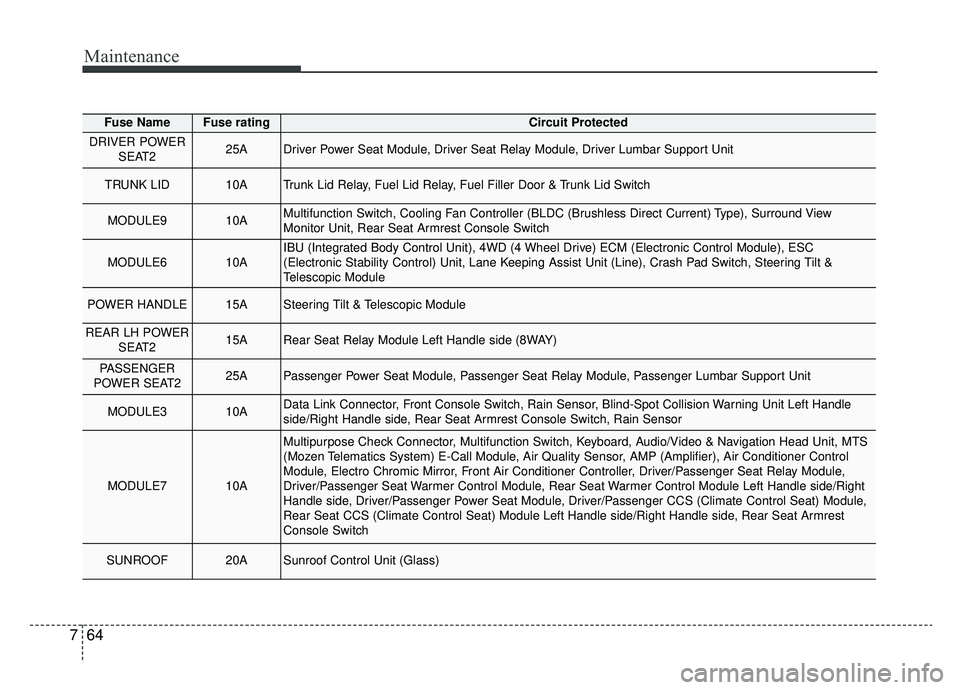
Fuse NameFuse ratingCircuit Protected
DRIVER POWER
SEAT225ADriver Power Seat Module, Driver Seat Relay Module, Driver Lumbar Support Unit
TRUNK LID10ATrunk Lid Relay, Fuel Lid Relay, Fuel Filler Door & Trunk Lid Switch
MODULE910AMultifunction Switch, Cooling Fan Controller (BLDC (Brushless Direct Current) Type), Surround View
Monitor Unit, Rear Seat Armrest Console Switch
MODULE610AIBU (Integrated Body Control Unit), 4WD (4 Wheel Drive) ECM (Electronic Control Module), ESC
(Electronic Stability Control) Unit, Lane Keeping Assist Unit (Line), Crash Pad Switch, Steering Tilt &
Telescopic Module
POWER HANDLE15ASteering Tilt & Telescopic Module
REAR LH POWER SEAT215ARear Seat Relay Module Left Handle side (8WAY)
PASSENGER
POWER SEAT225APassenger Power Seat Module, Passenger Seat Relay Module, Passenger Lumbar Support Unit
MODULE310AData Link Connector, Front Console Switch, Rain Sensor, Blind-Spot Collision Warning Unit Left Handle
side/Right Handle side, Rear Seat Armrest Console Switch, Rain Sensor
MODULE710A
Multipurpose Check Connector, Multifunction Switch, Keyboard, Audio/Video & Navigation Head Unit, MTS
(Mozen Telematics System) E-Call Module, Air Quality Sensor, AMP (Amplifier), Air Conditioner Control
Module, Electro Chromic Mirror, Front Air Conditioner Controller, Driver/Passenger Seat Relay Module,
Driver/Passenger Seat Warmer Control Module, Rear Seat Warmer Control Module Left Handle side/Right
Handle side, Driver/Passenger Power Seat Module, Driver/Passenger CCS (Climate Control Seat) Module,
Rear Seat CCS (Climate Control Seat) Module Left Handle side/Right Han\
dle side, Rear Seat Armrest
Console Switch
SUNROOF20ASunroof Control Unit (Glass)
Page 522 of 580
Maintenance
68
7
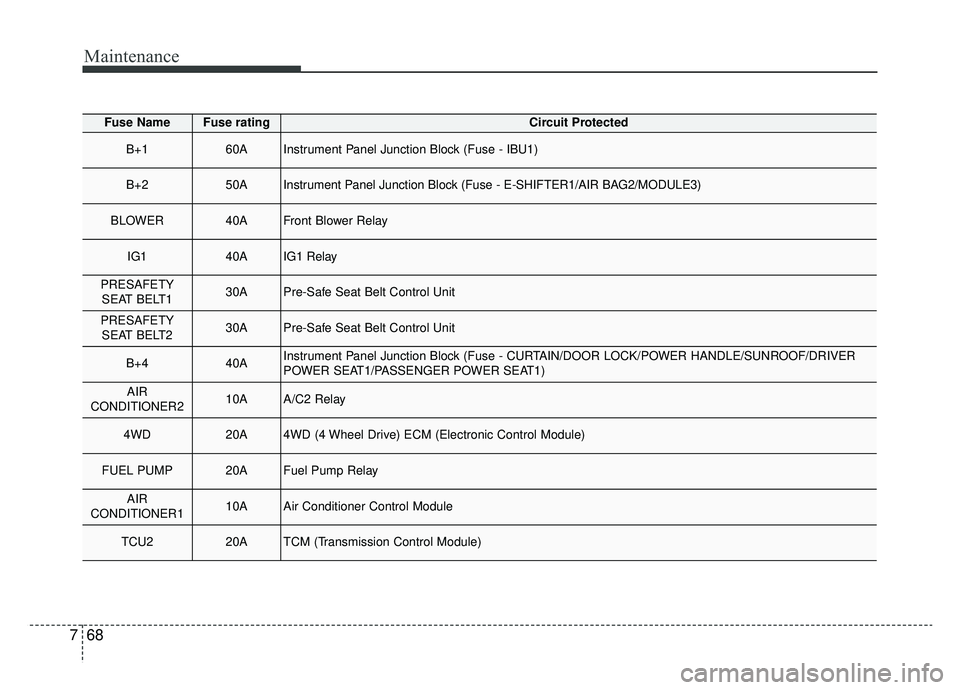
Fuse NameFuse ratingCircuit Protected
B+160AInstrument Panel Junction Block (Fuse - IBU1)
B+250AInstrument Panel Junction Block (Fuse - E-SHIFTER1/AIR BAG2/MODULE3)
BLOWER40AFront Blower Relay
IG140AIG1 Relay
PRESAFETY
SEAT BELT130APre-Safe Seat Belt Control Unit
PRESAFETYSEAT BELT230APre-Safe Seat Belt Control Unit
B+440AInstrument Panel Junction Block (Fuse - CURTAIN/DOOR LOCK/POWER HANDLE/SUNROOF/DRIVER
POWER SEAT1/PASSENGER POWER SEAT1)
AIR
CONDITIONER210AA/C2 Relay
4WD20A4WD (4 Wheel Drive) ECM (Electronic Control Module)
FUEL PUMP20AFuel Pump Relay
AIR
CONDITIONER110AAir Conditioner Control Module
TCU220ATCM (Transmission Control Module)
Page 541 of 580
787
Maintenance
Do a thorough washing of theundercarriage at the end of the
winter.
Use professional service techni- cians or governmental inspection
stations to annually inspect for cor-
rosion.
Immediately seek an inspection of your vehicle if you become visually
aware of corrosion flaking or scal-
ing or if you become aware of a
change in vehicle performance,
such as soft or spongey brakes,
fluids leaking, impairment of direc-
tional control, suspension noises
or rattling metal straps.Aluminum wheel maintenance
The aluminum wheels are coated
with a clear protective finish.
Do not use any abrasive cleaner,polishing compound, solvent, or
wire brushes on aluminum wheels.
They may scratch the finish.
Clean the wheel when it has cooled.
Use only a mild soap or neutral detergent, and rinse thoroughly
with water. Also, be sure to clean
the wheels after driving on salted
roads. This helps prevent corro-
sion.
Avoid washing the wheels with highspeed vehicle wash brushes.
Do not use any alkaline or acid detergents It may damage and cor-
rode the aluminum wheels coated
with a clear protective finish.
Corrosion protection
Protecting your vehicle from corrosion
By using the most advanced design
and construction practices to combat
corrosion, we produce vehicles of
the highest quality. However, this is
only part of the job. To achieve the
long-term corrosion resistance your
vehicle can deliver, the owner's
cooperation and assistance is also
required.
Common causes of corrosion
The most common causes of corro-
sion on your vehicle are:
Road salt, dirt and moisture that isallowed to accumulate underneath
the vehicle.
Removal of paint or protective coatings by stones, gravel, abra-
sion or minor scrapes and dents
which leave unprotected metal
exposed to corrosion.
Page 544 of 580
Maintenance
90
7
Cleaning the upholstery and inte-
rior trim
Vinyl
Remove dust and loose dirt from
vinyl with a whisk broom or vacuum
cleaner. Clean vinyl surfaces with a
vinyl cleaner.
Fabric
Remove dust and loose dirt from fab-
ric with a whisk broom or vacuum
cleaner. Clean with a mild soap solu-
tion recommended for upholstery or
carpets. Remove fresh spots imme-
diately with a fabric spot cleaner. If
fresh spots do not receive immediate
attention, the fabric can be stained
and its color can be affected. Also, its
fire-resistant properties can be
reduced if the material is not proper-
ly maintained.
Using anything but recommended
cleaners and procedures may affect
the fabric’s appearance and fire-
resistant properties.
Cleaning the lap/shoulder beltwebbing
Clean the belt webbing with any mild
soap solution recommended for
cleaning upholstery or carpet. Follow
the instructions provided with the
soap. Do not bleach or re-dye the
webbing because this may weaken it.
Cleaning the interior windowglass
If the interior glass surfaces of the
vehicle become fogged (that is, cov-
ered with an oily, greasy or waxy
film), they should be cleaned with a
glass cleaner. Follow the directions
on the glass cleaner container.
CAUTION- Rear window
Do not scrape or scratch theinside of the rear window. Thismay result in damage of the rearwindow defroster grid.
CAUTION - Electrical
components
Never allow water or other liq-uids to come in contact withelectrical/electronic compo-nents inside the vehicle as thismay damage them.
CAUTION - Leather
When cleaning leather products(steering wheel, seats etc.), useneutral detergents or low alco-hol content solutions. If you usehigh alcohol content solutionsor acid/alkaline detergents, thecolor of the leather may fade orthe surface may get stripped off.
Page 550 of 580
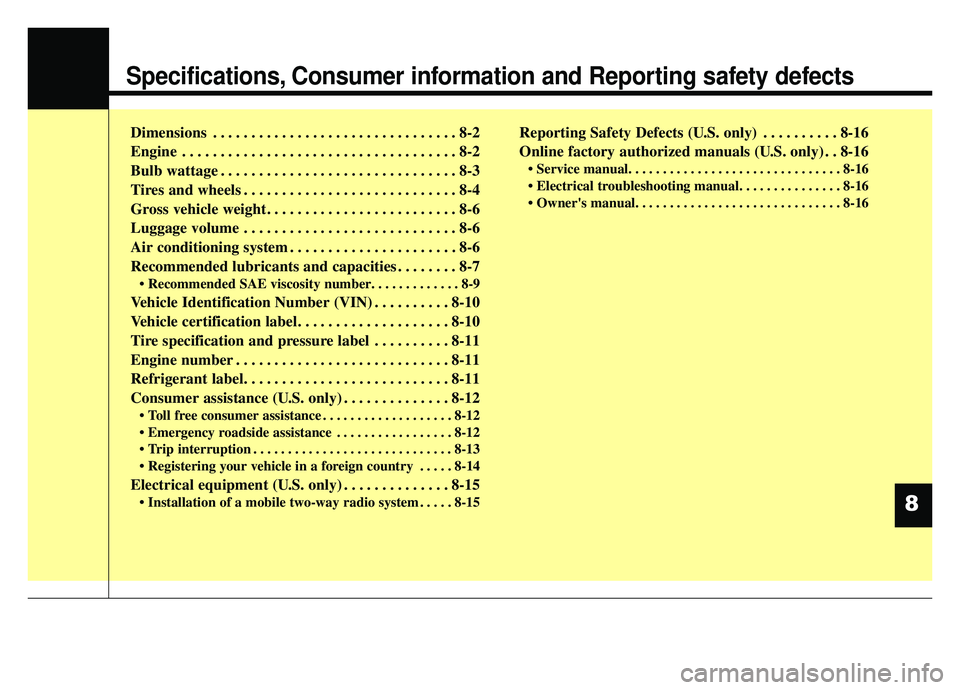
Specifications, Consumer information and Reporting safety defects
Dimensions . . . . . . . . . . . . . . . . . . . . . . . . . . . . . . . . 8-2
Engine . . . . . . . . . . . . . . . . . . . . . . . . . . . . . . . . . . . . \
8-2
Bulb wattage . . . . . . . . . . . . . . . . . . . . . . . . . . . . . . . 8-3
Tires and wheels . . . . . . . . . . . . . . . . . . . . . . . . . . . . 8-4
Gross vehicle weight. . . . . . . . . . . . . . . . . . . . . . . . . 8-6
Luggage volume . . . . . . . . . . . . . . . . . . . . . . . . . . . . 8-6
Air conditioning system . . . . . . . . . . . . . . . . . . . . . . 8-6
Recommended lubricants and capacities . . . . . . . . 8-7
• Recommended SAE viscosity number. . . . . . . . . . . . . 8-9
Vehicle Identification Number (VIN) . . . . . . . . . . 8-10
Vehicle certification label. . . . . . . . . . . . . . . . . . . . 8-10
Tire specification and pressure label . . . . . . . . . . 8-11
Engine number . . . . . . . . . . . . . . . . . . . . . . . . . . . . 8-11
Refrigerant label. . . . . . . . . . . . . . . . . . . . . . . . . . . 8-11
Consumer assistance (U.S. only) . . . . . . . . . . . . . . 8-12
. . . . . . . . . . . . . . . . . . . 8-12
. . . . . . . . . . . . . . . . . 8-12
. . . . . . . . . . . . . . . . . . . . . . . . . . . . . 8-13
. . . . . 8-14
Electrical equipment (U.S. only) . . . . . . . . . . . . . . 8-15
. . . . . 8-15
Reporting Safety Defects (U.S. only) . . . . . . . . . . 8-16
Online factory authorized manuals (U.S. only) . . 8-16
8
Page 551 of 580
Specifications, Consumer information, Reporting safety defects
28
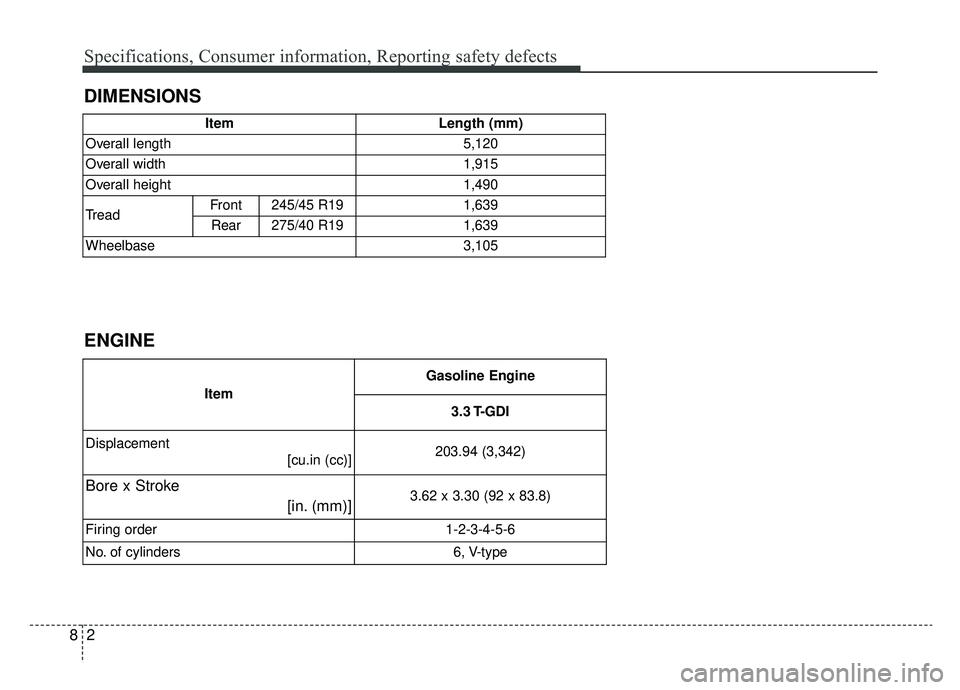
DIMENSIONS
ENGINE
ItemLength (mm)
Overall length5,120
Overall width1,915
Overall height1,490
TreadFront245/45 R191,639
Rear275/40 R191,639
Wheelbase3,105
ItemGasoline Engine
3.3 T-GDI
Displacement [cu.in (cc)]203.94 (3,342)
Bore x Stroke
[in. (mm)]3.62 x 3.30 (92 x 83.8)
Firing order 1-2-3-4-5-6
No. of cylinders 6, V-type