climate control KIA K900 2020 User Guide
[x] Cancel search | Manufacturer: KIA, Model Year: 2020, Model line: K900, Model: KIA K900 2020Pages: 593, PDF Size: 14.99 MB
Page 242 of 593

4149
Features of your vehicle
To cancel or reset the Auto Defogging
System
Press the front windshield defroster
button for 3 seconds when the igni-
tion switch is in the ON position.
When the ADS system is canceled,
the indicator on the button will blink 3
times every 0.5 seconds and the
message “ADS OFF” will displayed
from the climate control information
screen.
When the ADS system is reset, the
indicator on the button will blink 6
times every 0.25 seconds and the
message “ADS OFF” will disappear
from the climate control information
screen.
You can set or release the Auto
Defogging System on the AVN
Climate Information selection screen.
“AVN → Climate →Menu →Auto
defog”
If the battery is discharged or
detached, the auto defogging system
will be reset. Adjust the feature
accordingly.Automatic ventilation
(if equipped)
The system automatically selects the
outside (fresh) air position when the
climate control system operates over
a certain period of time (approxi-
mately 5 minutes) in low temperature
with the recirculated air position and
Floor/Bi-level Mode selected and the
state that air conditioning is turned
off.
CAUTION
Do not remove the sensor cover located on the upper end of thepassenger side windshieldglass. Damage to the systemparts could occur and may notbe covered by your vehicle war-ranty.
Page 243 of 593
Features of your vehicle
150
4
To cancel or reset the Automatic
Ventilation
When the air conditioning system is
on, select Face Level mode and
while pressing the A/C button, press
the recirculated air position button
five times within three seconds.
When the automatic ventilation is
canceled, the indicator blinks 3
times. When the automatic ventila-
tion is activated, the indicator blinks
6 times.
If the battery is discharged or
detached, the automatic ventilation
will be reset. Adjust the feature
accordingly.
Smart ventilation (if equipped)
The smart ventilation system main-
tains pleasant/fresh air inside the
passenger compartment by automat-
ically detecting/controlling the tem-
perature and humidity when you
drive the vehicle with the climate
control system in the OFF position.
When the smart ventilation system
starts to operate, the message,
“SMART VENTILATION ON”
appears for 5 seconds. The driver can activate the smart
ventilation by placing the ignition
switch to the ON position and by
selecting on the audio display:
“AVN
→Climate →Menu →Smart
vent”
The smart ventilation system stops operating, when the OFF button of
the climate control system is
selected.
The smart ventilation system stops operating, when any button of the
climate control system is selected
for operation.
The smart ventilation system may not operate, when the vehicle is
driven at low speed.
Page 298 of 593
Driving your vehicle
32
5
In the event of brake failure
If the service brakes fail to operate
while the vehicle is in motion, you
can make an emergency stop with
the parking brake. The stopping dis-
tance, however, will be much greater
than normal.
Disc brakes wear indicator
When your brake pads are worn and
new pads are required, you will hear
a high-pitched warning sound from
your front brakes or rear brakes. You
may hear this sound come and go or
it may occur whenever you depress
the brake pedal.
Please remember that some driving
conditions or climates may cause a
brake squeal when you first apply (or
lightly apply) the brakes. This is nor-
mal and does not indicate a problem
with your brakes.
Always replace the front or rear
brake pads as pairs.
WARNING- Parking
brake
Avoid applying the parking
brake to stop the vehicle while it
is moving except in an emer-
gency situation. Applying the
parking brake while the vehicle
is moving at normal speeds can
cause a sudden loss of control
of the vehicle. If you must use
the parking brake to stop the
vehicle, use great caution in
applying the brake.
WARNING- Brake wear
Do not ignore high pitched wear
sounds from your brakes. If you
ignore this audible warning, you
will eventually lose braking per-
formance, which could lead to a
serious accident.
CAUTION- Replace brake pads
Do not continue to drive withworn brake pads. Continuing todrive with worn brake pads candamage the braking system andresult in costly brake repairs.
Page 393 of 593
5127
Driving your vehicle
(Continued)
• If you move the transmission leverfrom N to D (manual mode) or R
without depressing the brake
pedal after stopping engine auto-
matically, the engine does not
restart automatically and a warn-
ing chime alarms. When this hap-
pens, press the brake pedal for
auto start.
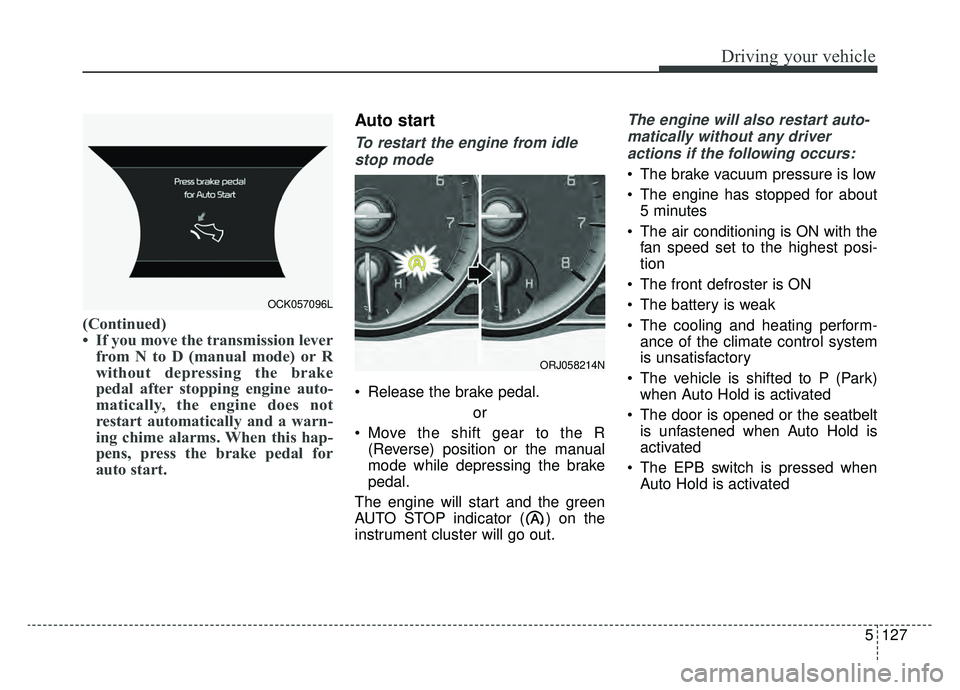
Auto start
To restart the engine from idle
stop mode
Release the brake pedal.
or
Move the shift gear to the R (Reverse) position or the manual
mode while depressing the brake
pedal.
The engine will start and the green
AUTO STOP indicator ( ) on the
instrument cluster will go out.
The engine will also restart auto- matically without any driveractions if the following occurs:
The brake vacuum pressure is low
The engine has stopped for about 5 minutes
The air conditioning is ON with the fan speed set to the highest posi-
tion
The front defroster is ON
The battery is weak
The cooling and heating perform- ance of the climate control system
is unsatisfactory
The vehicle is shifted to P (Park) when Auto Hold is activated
The door is opened or the seatbelt is unfastened when Auto Hold is
activated
The EPB switch is pressed when Auto Hold is activated
OCK057096L
ORJ058214N
Page 394 of 593

Driving your vehicle
128
5
Condition of ISG system oper-
ation
The ISG system will operate
under the following condition:
The driver’s seatbelt is fastened
The driver’s door and hood are closed
The brake vacuum pressure is adequate
The battery sensor is activated and the battery is sufficiently charged
Outside temperature is not too low or too high
The vehicle is driven over a con- stant speed and stops
The climate control system satis- fies the conditions
The vehicle is sufficiently warmed up
The incline is gradual
The steering wheel is turned less than 180 degrees and then the
vehicle stops
✽ ✽ NOTICE
• If the ISG system does not meet
the operation conditions, the ISG
system is deactivated. The light on
the ISG OFF button will illumi-
nate and a message “Auto Stop
conditions not met” will appear on
the LCD display.
• If the light or notice comes on con- tinuously, please check the opera-
tion condition.
ISG system deactivation
If you wish to deactivate the ISG
system, press the ISG OFF button
(1). The light on the ISG OFF but-
ton will illuminate.
If you press the ISG OFF button again, the system will be activated
and the light on the ISG OFF but-
ton will turn off.
ORJ058215N
Page 471 of 593
Maintenance
Engine compartment . . . . . . . . . . . . . . . . . . . . . . . . 7-4
Maintenance services . . . . . . . . . . . . . . . . . . . . . . . . 7-5
• Owner’s responsibility . . . . . . . . . . . . . . . . . . . . . . . . . 7-5
• Owner maintenance precautions . . . . . . . . . . . . . . . . . 7-6
Owner maintenance . . . . . . . . . . . . . . . . . . . . . . . . . 7-8
• Owner maintenance schedule . . . . . . . . . . . . . . . . . . . 7-8
Scheduled maintenance service. . . . . . . . . . . . . . . 7-10
Explanation of scheduled maintenance items . . . 7-17
• Engine oil and filter. . . . . . . . . . . . . . . . . . . . . . . . . . . 7-17
• Drive belts . . . . . . . . . . . . . . . . . . . . . . . . . . . . . . . . . . 7-17\
• Fuel filter (for gasoline) . . . . . . . . . . . . . . . . . . . . . . . 7-17
• Fuel lines, fuel hoses and connections . . . . . . . . . . . . 7-17
• Vapor hose and fuel filler cap . . . . . . . . . . . . . . . . . . 7-17
• Vacuum crankcase ventilation hoses . . . . . . . . . . . . . 7-18
• Air cleaner filter . . . . . . . . . . . . . . . . . . . . . . . . . . . . . 7-18
• Spark plugs . . . . . . . . . . . . . . . . . . . . . . . . . . . . . . . . . 7-18
• Valve clearance . . . . . . . . . . . . . . . . . . . . . . . . . . . . . . 7-18
• Cooling system . . . . . . . . . . . . . . . . . . . . . . . . . . . . . . . 7-18
• Coolant . . . . . . . . . . . . . . . . . . . . . . . . . . . . . . . . . . . . \
. 7-18
• Automatic transmission fluid . . . . . . . . . . . . . . . . . . . 7-18
• Brake hoses and lines . . . . . . . . . . . . . . . . . . . . . . . . . 7-19
• Brake fluid . . . . . . . . . . . . . . . . . . . . . . . . . . . . . . . . . . 7-19\
• Parking brake . . . . . . . . . . . . . . . . . . . . . . . . . . . . . . . 7-20
• Brake discs, pads, calipers and rotors. . . . . . . . . . . . 7-20• Exhaust pipe and muffler . . . . . . . . . . . . . . . . . . . . . . 7-20
• Suspension mounting bolts . . . . . . . . . . . . . . . . . . . . . 7-20
• Steering gear box, linkage &
boots/lower arm ball joint . . . . . . . . . . . . . . . . . . . . 7-20
• Drive shafts and boots. . . . . . . . . . . . . . . . . . . . . . . . . 7-20
• Air conditioning refrigerant . . . . . . . . . . . . . . . . . . . 7-20
Checking fluid levels . . . . . . . . . . . . . . . . . . . . . . . 7-20
Engine oil. . . . . . . . . . . . . . . . . . . . . . . . . . . . . . . . . 7-21
• Checking the engine oil level . . . . . . . . . . . . . . . . . . . 7-21
• Changing the engine oil and filter . . . . . . . . . . . . . . . 7-22
Engine coolant . . . . . . . . . . . . . . . . . . . . . . . . . . . . 7-23
• Checking the coolant level . . . . . . . . . . . . . . . . . . . . . 7-23
• Changing the coolant . . . . . . . . . . . . . . . . . . . . . . . . . 7-25
Brake fluid . . . . . . . . . . . . . . . . . . . . . . . . . . . . . . . 7-26
• Checking the brake fluid level . . . . . . . . . . . . . . . . . . 7-26
Washer fluid . . . . . . . . . . . . . . . . . . . . . . . . . . . . . . 7-27
• Checking the washer fluid level . . . . . . . . . . . . . . . . . 7-27
Air cleaner. . . . . . . . . . . . . . . . . . . . . . . . . . . . . . . . 7-28
• Replace the filter according to the Maintenance Schedule . . . . . . . . . . . . . . . . . . . . . . . . . . . . . . . . . . . 7-\
28
Climate control air filter . . . . . . . . . . . . . . . . . . . . 7-29
• Filter inspection . . . . . . . . . . . . . . . . . . . . . . . . . . . . . . 7-29
Wiper blades . . . . . . . . . . . . . . . . . . . . . . . . . . . . . . 7-31
• Blade inspection . . . . . . . . . . . . . . . . . . . . . . . . . . . . . . 7-31
• Blade replacement . . . . . . . . . . . . . . . . . . . . . . . . . . . . 7-31
7
Page 482 of 593
Maintenance
12
7
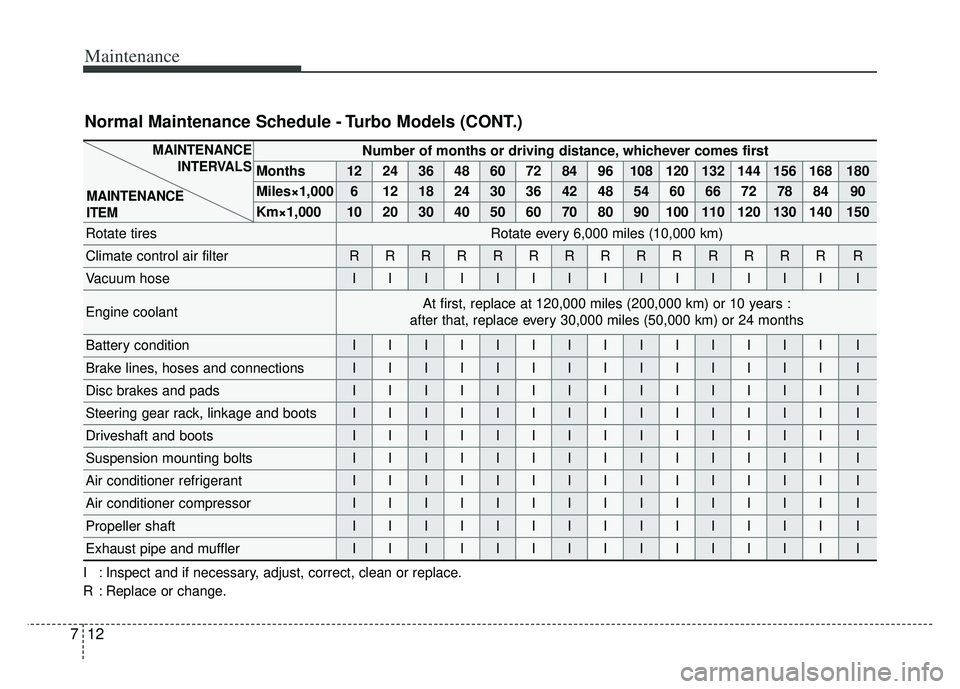
Normal Maintenance Schedule - Turbo Models (CONT.)
Number of months or driving distance, whichever comes first
Months1224364860728496108120132144156168180
Miles×1,00061218243036424854606672788490
Km×1,000102030405060708090100110120130140150
Rotate tiresRotate every 6,000 miles (10,000 km)
Climate control air filterRRRRRRRRRRRRRRR
Vacuum hoseIIIIIIIIIIIIIII
Engine coolantAt first, replace at 120,000 miles (200,000 km) or 10 years :
after that, replace every 30,000 miles (50,000 km) or 24 months
Battery conditionIIIIIIIIIIIIIII
Brake lines, hoses and connectionsIIIIIIIIIIIIIII
Disc brakes and padsIIIIIIIIIIIIIII
Steering gear rack, linkage and bootsIIIIIIIIIIIIIII
Driveshaft and bootsIIIIIIIIIIIIIII
Suspension mounting boltsIIIIIIIIIIIIIII
Air conditioner refrigerantIIIIIIIIIIIIIII
Air conditioner compressorIIIIIIIIIIIIIII
Propeller shaftIIIIIIIIIIIIIII
Exhaust pipe and mufflerIIIIIIIIIIIIIII
MAINTENANCE INTERVALS
MAINTENANCE
ITEM
I : Inspect and if necessary, adjust, correct, clean or replace.
R : Replace or change.
Page 486 of 593
Maintenance
16
7
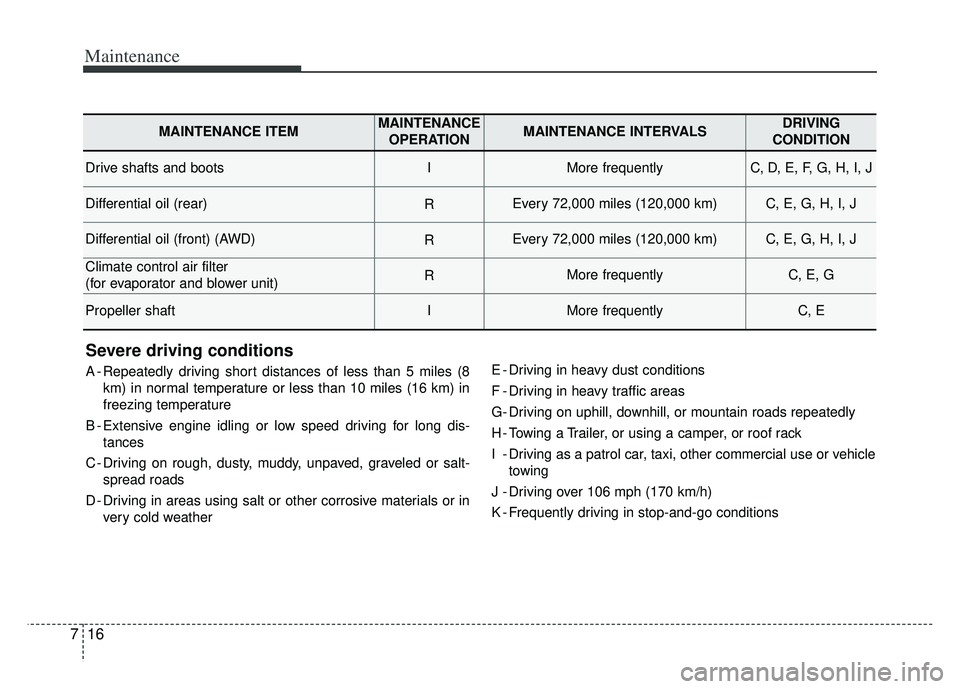
Severe driving conditions
A - Repeatedly driving short distances of less than 5 miles (8
km) in normal temperature or less than 10 miles (16 km) in
freezing temperature
B - Extensive engine idling or low speed driving for long dis- tances
C - Driving on rough, dusty, muddy, unpaved, graveled or salt- spread roads
D - Driving in areas using salt or other corrosive materials or in very cold weather E - Driving in heavy dust conditions
F - Driving in heavy traffic areas
G- Driving on uphill, downhill, or mountain roads repeatedly
H - Towing a Trailer, or using a camper, or roof rack
I - Driving as a patrol car, taxi, other commercial use or vehicle
towing
J - Driving over 106 mph (170 km/h)
K - Frequently driving in stop-and-go conditions
MAINTENANCE ITEMMAINTENANCE OPERATIONMAINTENANCE INTERVALSDRIVING
CONDITION
Drive shafts and bootsIMore frequentlyC, D, E, F, G, H, I, J
Differential oil (rear)REvery 72,000 miles (120,000 km)C, E, G, H, I, J
Differential oil (front) (AWD)REvery 72,000 miles (120,000 km)C, E, G, H, I, J
Climate control air filter
(for evaporator and blower unit)RMore frequentlyC, E, G
Propeller shaftIMore frequentlyC, E
Page 497 of 593
727
Maintenance
WASHER FLUID
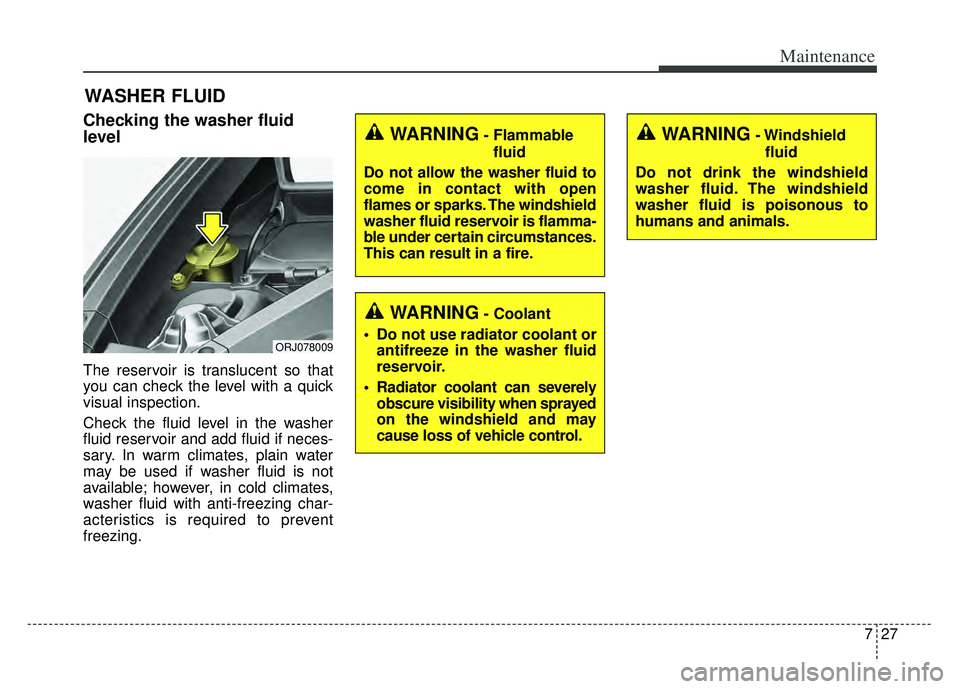
Checking the washer fluid
level
The reservoir is translucent so that
you can check the level with a quick
visual inspection.
Check the fluid level in the washer
fluid reservoir and add fluid if neces-
sary. In warm climates, plain water
may be used if washer fluid is not
available; however, in cold climates,
washer fluid with anti-freezing char-
acteristics is required to prevent
freezing.
WARNING- Flammablefluid
Do not allow the washer fluid to
come in contact with open
flames or sparks. The windshield
washer fluid reservoir is flamma-
ble under certain circumstances.
This can result in a fire.WARNING- Windshield fluid
Do not drink the windshield
washer fluid. The windshield
washer fluid is poisonous to
humans and animals.
WARNING- Coolant
Do not use radiator coolant or antifreeze in the washer fluid
reservoir.
Radiator coolant can severely obscure visibility when sprayed
on the windshield and may
cause loss of vehicle control.
ORJ078009
Page 499 of 593
729
Maintenance
CLIMATE CONTROL AIR FILTER (IF EQUIPPED)
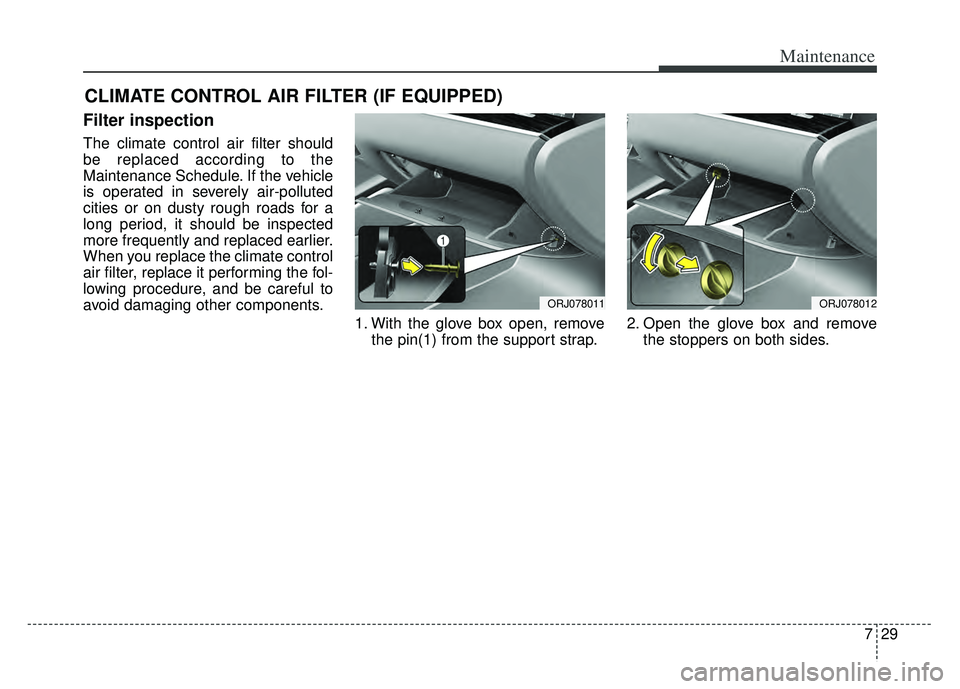
Filter inspection
The climate control air filter should
be replaced according to the
Maintenance Schedule. If the vehicle
is operated in severely air-polluted
cities or on dusty rough roads for a
long period, it should be inspected
more frequently and replaced earlier.
When you replace the climate control
air filter, replace it performing the fol-
lowing procedure, and be careful to
avoid damaging other components.1. With the glove box open, removethe pin(1) from the support strap. 2. Open the glove box and remove
the stoppers on both sides.
ORJ078012ORJ078011