brakes KIA K900 2020 Owner's Guide
[x] Cancel search | Manufacturer: KIA, Model Year: 2020, Model line: K900, Model: KIA K900 2020Pages: 593, PDF Size: 14.99 MB
Page 476 of 593
Maintenance
67
✽ ✽NOTICE - NHTSA Safety
Corrosion Alert
The National Highway Traffic
Safety Administration (NHTSA) has
issued a general warning to all vehi-
cle owners of all brands regarding
the risks associated with vehicle
underbody corrosion. From your
initial purchase, take the following
steps to prevent unsafe corrosion
damage to your vehicle:
• Wash the undercarriage of your
vehicle regularly during the win-
ter and whenever your vehicle has
been exposed to such salts or
chemicals.
• Do a thorough washing of the undercarriage at the end of the
winter.
• Use professional service techni- cians or governmental inspection
stations to annually inspect for
corrosion. (Continued)(Continued)
• Immediately seek an inspection of
your vehicle if you become visual-
ly aware of corrosion flaking or
scaling or if you become aware of
a change in vehicle performance,
such as soft or spongy brakes, flu-
ids leaking, impairment of direc-
tional control, suspension noises
or rattling metal straps.
NHTSA further advises that after
a vehicle is 7 years old, it is essen-
tial that you take these indicated
maintenance steps to ensure that
you protect yourself from unsafe
corrosion conditions.
Owner maintenance precau-
tions
Improper or incomplete service may
result in problems. This section gives
instructions only for the maintenance
items that are easy to perform.
As explained earlier in this section,
several procedures can be done only
by an authorized K900 Kia dealer
with special tools.
✽ ✽ NOTICE
Improper owner maintenance dur-
ing the warranty period may affect
warranty coverage. For details, read
the separate Warranty & Consumer
Information manual provided with
the vehicle. If you're unsure about
any servicing or maintenance proce-
dure, have it done by an authorized
K900 Kia dealer.
Page 482 of 593
Maintenance
12
7
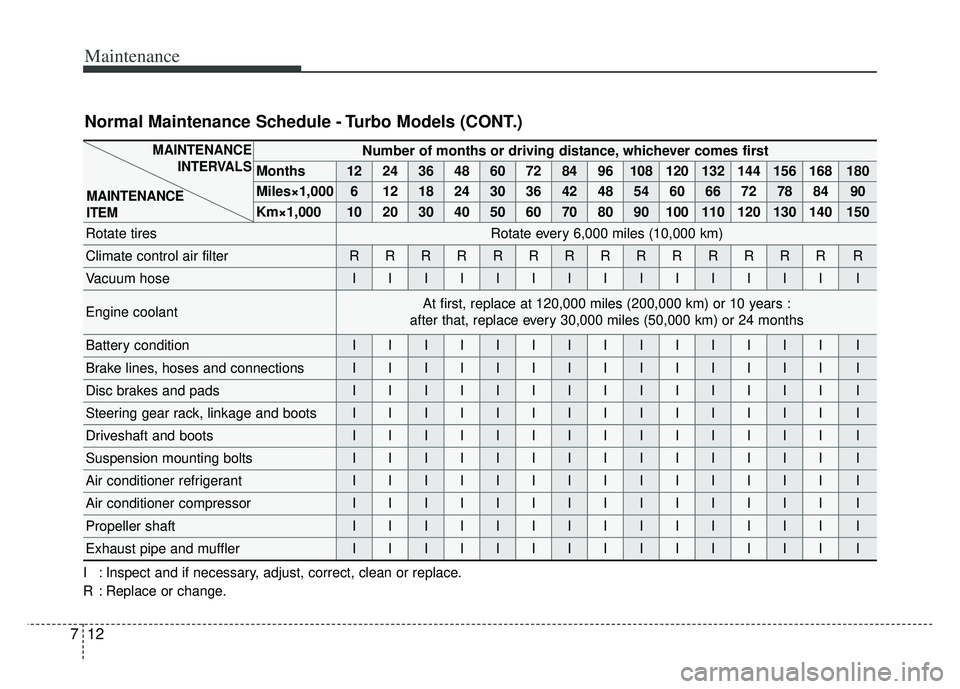
Normal Maintenance Schedule - Turbo Models (CONT.)
Number of months or driving distance, whichever comes first
Months1224364860728496108120132144156168180
Miles×1,00061218243036424854606672788490
Km×1,000102030405060708090100110120130140150
Rotate tiresRotate every 6,000 miles (10,000 km)
Climate control air filterRRRRRRRRRRRRRRR
Vacuum hoseIIIIIIIIIIIIIII
Engine coolantAt first, replace at 120,000 miles (200,000 km) or 10 years :
after that, replace every 30,000 miles (50,000 km) or 24 months
Battery conditionIIIIIIIIIIIIIII
Brake lines, hoses and connectionsIIIIIIIIIIIIIII
Disc brakes and padsIIIIIIIIIIIIIII
Steering gear rack, linkage and bootsIIIIIIIIIIIIIII
Driveshaft and bootsIIIIIIIIIIIIIII
Suspension mounting boltsIIIIIIIIIIIIIII
Air conditioner refrigerantIIIIIIIIIIIIIII
Air conditioner compressorIIIIIIIIIIIIIII
Propeller shaftIIIIIIIIIIIIIII
Exhaust pipe and mufflerIIIIIIIIIIIIIII
MAINTENANCE INTERVALS
MAINTENANCE
ITEM
I : Inspect and if necessary, adjust, correct, clean or replace.
R : Replace or change.
Page 496 of 593
Maintenance
26
7
BRAKE FLUID
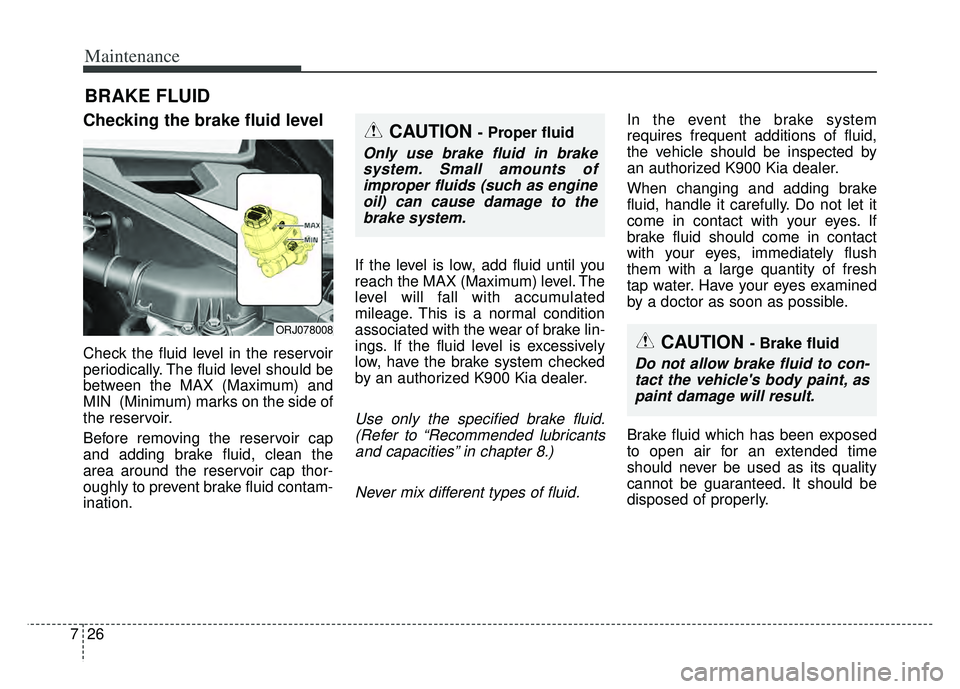
Checking the brake fluid level
Check the fluid level in the reservoir
periodically. The fluid level should be
between the MAX (Maximum) and
MIN (Minimum) marks on the side of
the reservoir.
Before removing the reservoir cap
and adding brake fluid, clean the
area around the reservoir cap thor-
oughly to prevent brake fluid contam-
ination. If the level is low, add fluid until you
reach the MAX (Maximum) level. The
level will fall with accumulated
mileage. This is a normal condition
associated with the wear of brake lin-
ings. If the fluid level is excessively
low, have the brake system checked
by an authorized K900 Kia dealer.
Use only the specified brake fluid.
(Refer to “Recommended lubricantsand capacities” in chapter 8.)
Never mix different types of fluid.
In the event the brake system
requires frequent additions of fluid,
the vehicle should be inspected by
an authorized K900 Kia dealer.
When changing and adding brake
fluid, handle it carefully. Do not let it
come in contact with your eyes. If
brake fluid should come in contact
with your eyes, immediately flush
them with a large quantity of fresh
tap water. Have your eyes examined
by a doctor as soon as possible.
Brake fluid which has been exposed
to open air for an extended time
should never be used as its quality
cannot be guaranteed. It should be
disposed of properly.
ORJ078008CAUTION - Brake fluid
Do not allow brake fluid to con-tact the vehicle's body paint, aspaint damage will result.
CAUTION - Proper fluid
Only use brake fluid in brakesystem. Small amounts ofimproper fluids (such as engineoil) can cause damage to thebrake system.
Page 519 of 593

749
Maintenance
Production options weight:The
combined weight of installed regular
production options weighing over 5
lb.(2.3 kg) in excess of the standard
items which they replace, not previ-
ously considered in curb weight or
accessory weight, including heavy
duty brakes, ride levelers, roof rack,
heavy duty battery, and special trim.
Recommended Inflation Pressure:
Vehicle manufacturer's recommend-
ed tire inflation pressure and shown
on the tire placard.
Radial Ply Tire: A pneumatic tire in
which the ply cords that extend to the
beads are laid at 90 degrees to the
centerline of the tread.
Rim: A metal support for a tire and
upon which the tire beads are seat-
ed.
Sidewall: The portion of a tire
between the tread and the bead. Speed Rating:
An alphanumeric
code assigned to a tire indicating the
maximum speed at which a tire can
operate.
Traction: The friction between the
tire and the road surface. The
amount of grip provided.
Tread: The portion of a tire that
comes into contact with the road.
Treadwear Indicators: Narrow
bands, sometimes called "wear
bars," that show across the tread of a
tire when only 1/16 inch of tread
remains.
UTQGS: Uniform Tire Quality
Grading Standards, a tire information
system that provides consumers with
ratings for a tire's traction, tempera-
ture and treadwear. Ratings are
determined by tire manufacturers
using government testing proce-
dures. The ratings are molded into
the sidewall of the tire.
Vehicle Capacity Weight: The num-
ber of designated seating positions
multiplied by 150 lbs. (68kg) plus the
rated cargo and luggage load. Vehicle Maximum Load on the
Tire:
Load on an individual tire due
to curb and accessory weight plus
maximum occupant and cargo
weight.
Vehicle Normal Load on the Tire:
Load on an individual tire that is
determined by distributing to each
axle its share of the curb weight,
accessory weight, and normal occu-
pant weight and diving by 2.
Vehicle Placard: A label permanent-
ly attached to a vehicle showing the
original equipment tire size and rec-
ommended inflation pressure.
Page 555 of 593
785
Maintenance
Waxing
Wax the vehicle when water will no
longer bead on the paint.
Always wash and dry the vehicle
before waxing. Use a good quality
liquid or paste wax, and follow the
manufacturer’s instructions. Wax all
metal trim to protect it and to main-
tain its luster.
Removing oil, tar, and similar materi-
als with a spot remover will usually
strip the wax from the finish. Be sure
to re-wax these areas even if the rest
of the vehicle does not yet need wax-
ing.
Do not apply wax on an embossed
unpainted unit, as it may tarnish the
unit.
ORJ078045
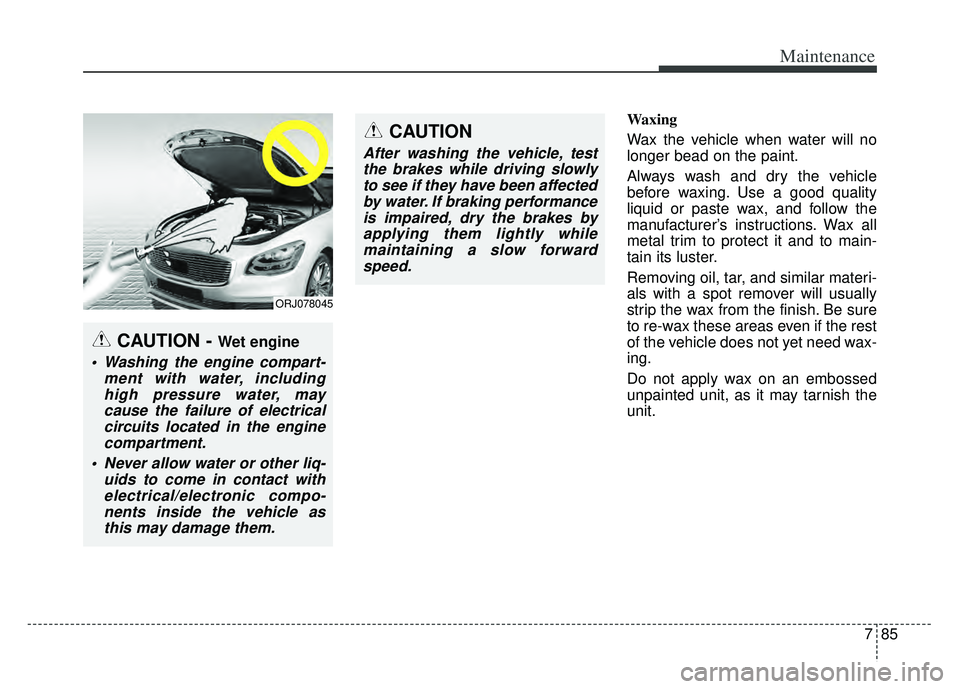
CAUTION - Wet engine
Washing the engine compart-ment with water, includinghigh pressure water, maycause the failure of electricalcircuits located in the enginecompartment.
Never allow water or other liq- uids to come in contact withelectrical/electronic compo-nents inside the vehicle asthis may damage them.
CAUTION
After washing the vehicle, testthe brakes while driving slowlyto see if they have been affectedby water. If braking performanceis impaired, dry the brakes byapplying them lightly whilemaintaining a slow forwardspeed.
Page 557 of 593

787
Maintenance
Do a thorough washing of theundercarriage at the end of the
winter.
Use professional service techni- cians or governmental inspection
stations to annually inspect for cor-
rosion.
Immediately seek an inspection of your vehicle if you become visually
aware of corrosion flaking or scal-
ing or if you become aware of a
change in vehicle performance,
such as soft or spongey brakes,
fluids leaking, impairment of direc-
tional control, suspension noises
or rattling metal straps.Aluminum wheel maintenance
The aluminum wheels are coated
with a clear protective finish.
Do not use any abrasive cleaner,polishing compound, solvent, or
wire brushes on aluminum wheels.
They may scratch the finish.
Clean the wheel when it has cooled.
Use only a mild soap or neutral detergent, and rinse thoroughly
with water. Also, be sure to clean
the wheels after driving on salted
roads. This helps prevent corro-
sion.
Avoid washing the wheels with highspeed vehicle wash brushes.
Do not use any alkaline or acid detergents as they may damage or
corrode aluminum wheels coated
with a clear protective finish.
Corrosion protection
Protecting your vehicle from corrosion
By using the most advanced design
and construction practices to combat
corrosion, we produce vehicles of
the highest quality. However, this is
only part of the job. To achieve the
long-term corrosion resistance your
vehicle can deliver, the owner's
cooperation and assistance is also
required.
Common causes of corrosion
The most common causes of corro-
sion on your vehicle are:
Road salt, dirt and moisture that isallowed to accumulate underneath
the vehicle.
Removal of paint or protective coatings by stones, gravel, abra-
sion or minor scrapes and dents
which leave unprotected metal
exposed to corrosion.
Page 584 of 593
/Blind-Spot Collision-Avoidance Assist (BCA)
system . . . . . . . . . . . . . . . . . . . . . . . . . . . . . . . . . . . . \
5-80
System description . . .")
I3
Index
Blind-Spot Collision Warning (BCW)/Blind-Spot Collision-Avoidance Assist (BCA)
system . . . . . . . . . . . . . . . . . . . . . . . . . . . . . . . . . . . . \
5-80
System description . . . . . . . . . . . . . . . . . . . . . . . . . . 5-80
System setting and activation . . . . . . . . . . . . . . . . . . 5-81
Warning message and system control . . . . . . . . . . . 5-84
Brake fluid . . . . . . . . . . . . . . . . . . . . . . . . . . . . . . . . . . 7-26\
Checking the brake fluid level . . . . . . . . . . . . . . . . . 7-26
Brake system. . . . . . . . . . . . . . . . . . . . . . . . . . . . . . . . . 5-31 Power brakes . . . . . . . . . . . . . . . . . . . . . . . . . . . . . . 5-31
Electronic Parking Brake (EPB) . . . . . . . . . . . . . . . 5-33
Auto hold . . . . . . . . . . . . . . . . . . . . . . . . . . . . . . . . . 5-39
Warning messages . . . . . . . . . . . . . . . . . . . . . . . . . . 5-42
Anti-lock Brake System (ABS) . . . . . . . . . . . . . . . . 5-43
Electronic Stability Control (ESC) system . . . . . . . 5-45
Vehicle Stability Management (VSM) . . . . . . . . . . . 5-49
Hill-start Assist Control (HAC) . . . . . . . . . . . . . . . . 5-51
Good braking practices . . . . . . . . . . . . . . . . . . . . . . 5-51
Electronic Control Suspension (ECS) . . . . . . . . . . . 5-52
Bulb wattage . . . . . . . . . . . . . . . . . . . . . . . . . . . . . . . . . . 5-3
California perchlorate notice . . . . . . . . . . . . . . . . . . . . 7-95
Checking fluid levels . . . . . . . . . . . . . . . . . . . . . . . . . . 7-20 Child Restraint System (CRS) . . . . . . . . . . . . . . . . . . . 3-39
Children always in the rear . . . . . . . . . . . . . . . . . . . 3-39
Selecting a Child Restraint System (CRS) . . . . . . . 3-40
Installing a Child Restraint System (CRS) . . . . . . . 3-43
Climate control air filter . . . . . . . . . . . . . . . . . . . . . . . . 7-29 Filter inspection . . . . . . . . . . . . . . . . . . . . . . . . . . . . 7-29
Consumer assistance (U.S. only) . . . . . . . . . . . . . . . . . 8-12 Toll free consumer assistance . . . . . . . . . . . . . . . . . 8-12
Emergency roadside assistance . . . . . . . . . . . . . . . . 8-12
Trip interruption . . . . . . . . . . . . . . . . . . . . . . . . . . . . 8-13
Registering your vehicle in a foreign country . . . . . 8-14
Declaration of Conformity . . . . . . . . . . . . . . . . . . . . . 4-172 FCC . . . . . . . . . . . . . . . . . . . . . . . . . . . . . . . . . . . . \
4-172
Defroster . . . . . . . . . . . . . . . . . . . . . . . . . . . . . . . . . . . 4-\
131 Rear window defroster . . . . . . . . . . . . . . . . . . . . . . 4-131
Dimensions . . . . . . . . . . . . . . . . . . . . . . . . . . . . . . . . . . . 8-\
2
Door locks. . . . . . . . . . . . . . . . . . . . . . . . . . . . . . . . . . . 4-\
17 Operating door locks from outside the vehicle . . . . 4-17
Operating door locks from inside the vehicle . . . . . 4-18
Door lock/unlock features . . . . . . . . . . . . . . . . . . . . 4-20
Auto door lock/unlock feature . . . . . . . . . . . . . . . . . 4-20
Child-protector rear door lock . . . . . . . . . . . . . . . . . 4-21
Drive mode integrated control system . . . . . . . . . . . . 5-130
C
D