maintenance KIA Magnetis 2006 2.G Owner's Guide
[x] Cancel search | Manufacturer: KIA, Model Year: 2006, Model line: Magnetis, Model: KIA Magnetis 2006 2.GPages: 225, PDF Size: 3.77 MB
Page 196 of 225
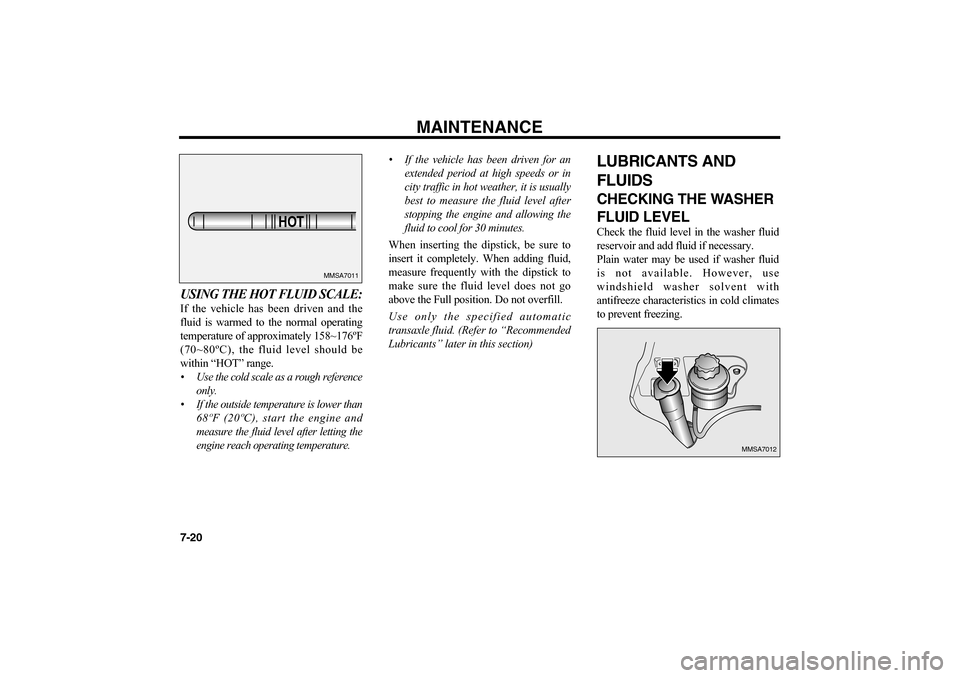
USING THE HOT FLUID SCALE:If the vehicle has been driven and the
fluid is warmed to the normal operating
temperature of approximately 158~176ºF
(70~80ºC), the fluid level should be
within “HOT” range.
• Use the cold scale as a rough reference
only.
• If the outside temperature is lower than
68ºF (20ºC), start the engine and
measure the fluid level after letting the
engine reach operating temperature.• If the vehicle has been driven for an
extended period at high speeds or in
city traffic in hot weather, it is usually
best to measure the fluid level after
stopping the engine and allowing the
fluid to cool for 30 minutes.
When inserting the dipstick, be sure to
insert it completely. When adding fluid,
measure frequently with the dipstick to
make sure the fluid level does not go
above the Full position. Do not overfill.
Use only the specified automatic
transaxle fluid. (Refer to “Recommended
Lubricants” later in this section)
LUBRICANTS AND
FLUIDSCHECKING THE WASHER
FLUID LEVELCheck the fluid level in the washer fluid
reservoir and add fluid if necessary.
Plain water may be used if washer fluid
is not available. However, use
windshield washer solvent with
antifreeze characteristics in cold climates
to prevent freezing.
MAINTENANCE
7-20
HOT
MMSA7011
MMSA7012
MS-CNA-Eng 7.QXD 7/25/2005 5:09 PM Page 20
Page 198 of 225
4. Re-install in the reverse order of removal.
Replace the element according to the
Scheduled Maintenance.
If the vehicle is operated in extremely
dusty or sandy areas, replace the
element more often than at the usual
recommended intervals.
WIPER BLADESWIPER BLADE
MAINTENANCEContamination of either the windshield
or the wiper blades with foreign matter
can reduce the effectiveness of the
windshield wipers. Common sources of
contamination are insects, tree sap, and
hot wax treatments used by some
commercial car washes. If the blades are
not wiping properly, clean both the
window and the blades with a good
cleaner or mild detergent, and
thoroughly rinse with clear water.
WINDSHIELD WIPER BLADE
REPLACEMENTWhen the wipers no longer clean
adequately, the wiper blades may be worn
or cracked, requiring replacement.
MAINTENANCE
7-22
CAUTION
• Do not drive with the air cleaner
removed; this will result in
excessive engine wear.
• Driving without an air cleaner
encourages backfiring, which
could cause a fire in the engine
compartment.
✻
NOTICE
Commercial hot waxes applied by
automatic car washes have been
known to make the windshield
difficult to clean.
✻
NOTICE
To prevent damage to the wiper
blades, do not use gasoline,
kerosene, paint thinner, or other
solvents on or near them.✻
NOTICE
To prevent damage to the wiper
arms or other components, do not
attempt to move the wipers
manually.
MS-CNA-Eng 7.QXD 7/25/2005 5:09 PM Page 22
Page 200 of 225
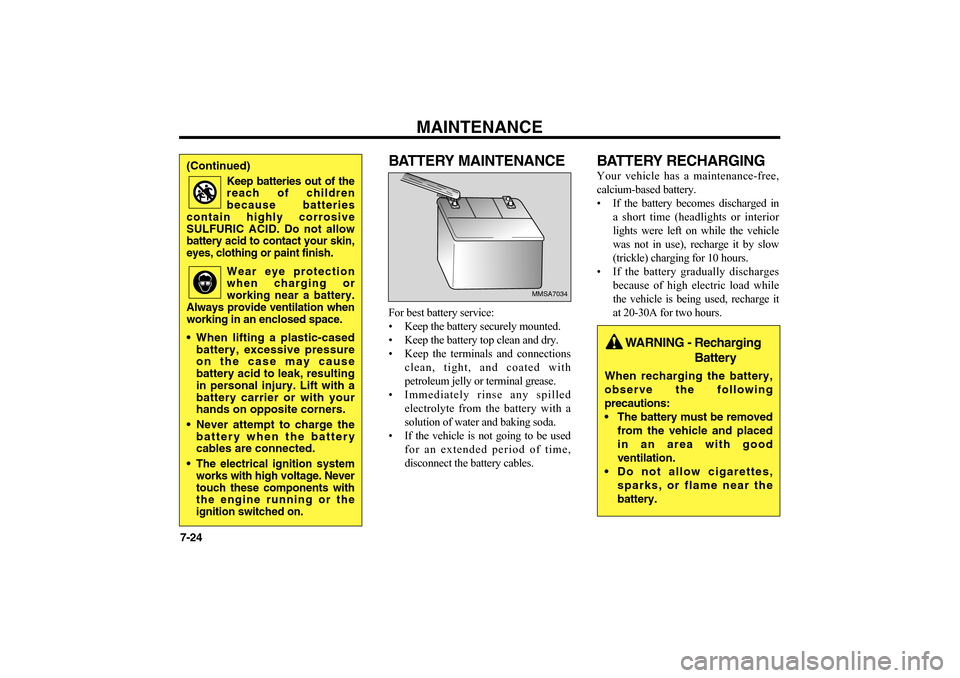
BATTERY MAINTENANCEFor best battery service:
• Keep the battery securely mounted.
• Keep the battery top clean and dry.
• Keep the terminals and connections
clean, tight, and coated with
petroleum jelly or terminal grease.
• Immediately rinse any spilled
electrolyte from the battery with a
solution of water and baking soda.
• If the vehicle is not going to be used
for an extended period of time,
disconnect the battery cables.
BATTERY RECHARGINGYour vehicle has a maintenance-free,
calcium-based battery.
• If the battery becomes discharged in
a short time (headlights or interior
lights were left on while the vehicle
was not in use), recharge it by slow
(trickle) charging for 10 hours.
• If the battery gradually discharges
because of high electric load while
the vehicle is being used, recharge it
at 20-30A for two hours.
MAINTENANCE
7-24
MMSA7034
(Continued)
Keep batteries out of the
reach of children
because batteries
contain highly corrosive
SULFURIC ACID. Do not allow
battery acid to contact your skin,
eyes, clothing or paint finish.
Wear eye protection
when charging or
working near a battery.
Always provide ventilation when
working in an enclosed space.
When lifting a plastic-cased
battery, excessive pressure
on the case may cause
battery acid to leak, resulting
in personal injury. Lift with a
battery carrier or with your
hands on opposite corners.
Never attempt to charge the
battery when the battery
cables are connected.
The electrical ignition system
works with high voltage. Never
touch these components with
the engine running or the
ignition switched on.
WARNING - Recharging
Battery
When recharging the battery,
observe the following
precautions:
The battery must be removed
from the vehicle and placed
in an area with good
ventilation.
Do not allow cigarettes,
sparks, or flame near the
battery.
MS-CNA-Eng 7.QXD 7/25/2005 5:09 PM Page 24
Page 201 of 225
7-25
TIRES AND WHEELSTIRE CAREFor proper maintenance, safety, and
maximum fuel economy, you must
always maintain recommended tire
inflation pressures and stay within the
load limits and weight distribution
recommended for your vehicle.INFLATION PRESSURESCheck all tire pressures (including the
spare) monthly when the tires are cold.
“Cold tires” means the car has not been
driven for at least three hours or driven
less than one mile (1.6 km).
Recommended pressures must be
maintained to ensure ride quality, vehicle
handling, and minimum tire wear.
Watch the battery during
charging, and stop or reduce
the charging rate if the battery
cells begin gasing (boiling)
violently or if the temperature
of the electrolyte of any cell
exceeds 120°F (49°C).
Wear eye protection when
checking the battery during
charging.
Disconnect the battery
charger in the following
order.
1. Turn off the battery
charger main switch.
2. Unhook the negative
clamp from the negative
battery terminal.
3. Unhook the positive clamp
from the positive battery
terminal.
✻
NOTICE
• Before performing battery
maintenance or recharging, turn
OFF all accessories and stop the
engine.
• When remounted battery,
disconnect the negative (-)
battery cable first. When re-
installing the battery, reconnect
the negative (-) battery cable
last.
MS-CNA-Eng 7.QXD 7/25/2005 5:09 PM Page 25
Page 202 of 225
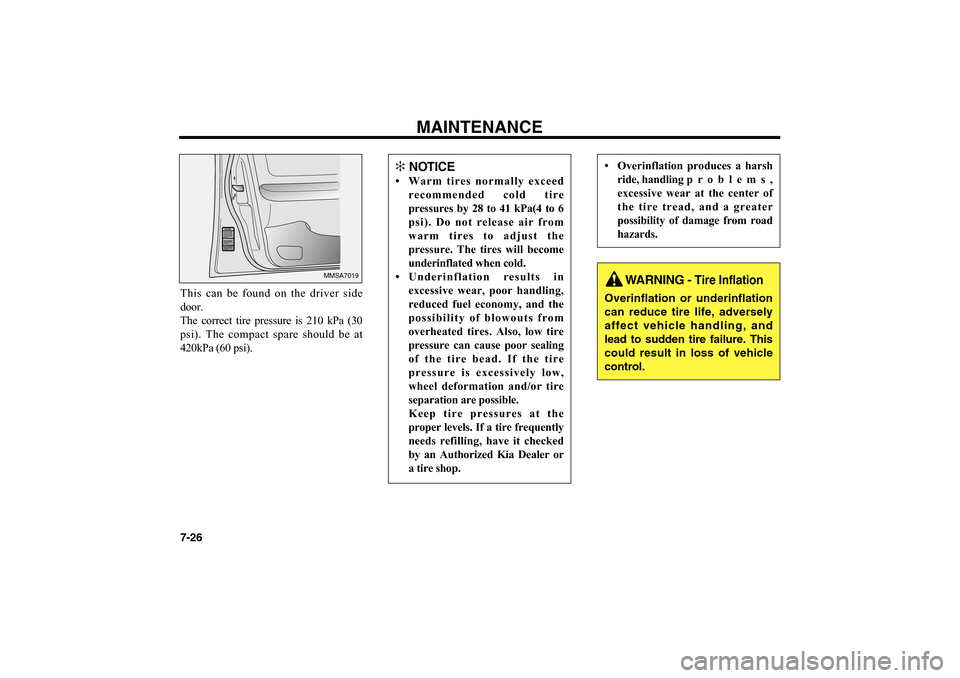
This can be found on the driver side
door.
The correct tire pressure is 210 kPa (30
psi). The compact spare should be at
420kPa (60 psi).
MAINTENANCE
7-26
MMSA7019
✻
NOTICE
• Warm tires normally exceed
recommended cold tire
pressures by 28 to 41 kPa(4 to 6
psi). Do not release air from
warm tires to adjust the
pressure. The tires will become
underinflated when cold.
• Underinflation results in
excessive wear, poor handling,
reduced fuel economy, and the
possibility of blowouts from
overheated tires. Also, low tire
pressure can cause poor sealing
of the tire bead. If the tire
pressure is excessively low,
wheel deformation and/or tire
separation are possible.
Keep tire pressures at the
proper levels. If a tire frequently
needs refilling, have it checked
by an Authorized Kia Dealer or
a tire shop.
• Overinflation produces a harsh
ride, handling problems,
excessive wear at the center of
the tire tread, and a greater
possibility of damage from road
hazards.
WARNING -
Tire Inflation
Overinflation or underinflation
can reduce tire life, adversely
affect vehicle handling, and
lead to sudden tire failure. This
could result in loss of vehicle
control.
MS-CNA-Eng 7.QXD 7/25/2005 5:09 PM Page 26
Page 204 of 225
MAINTENANCE
7-28COMPACT SPARE TIRE
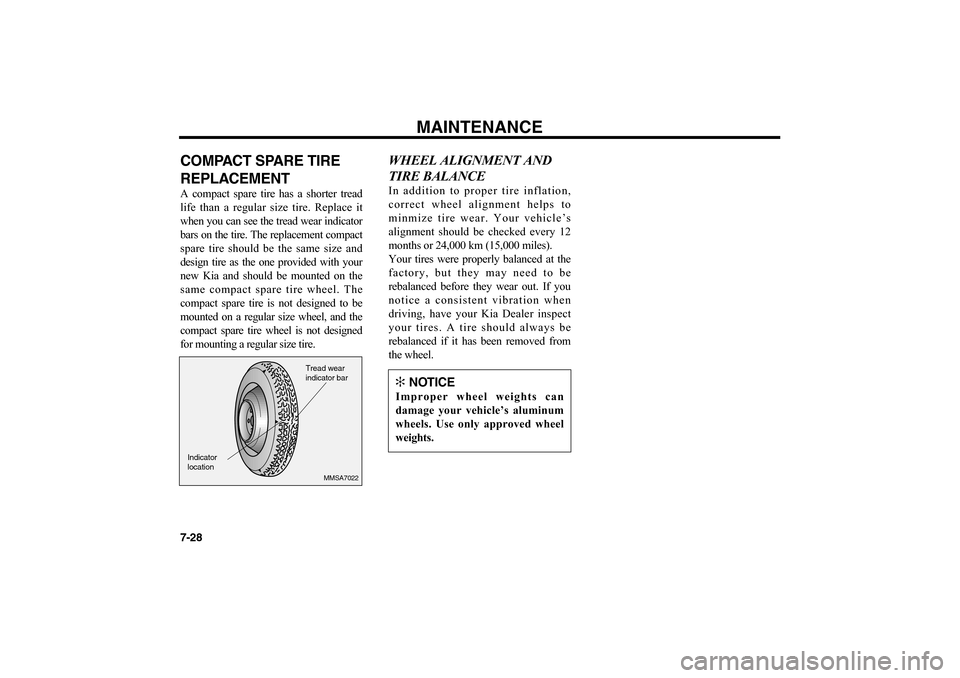
REPLACEMENTA compact spare tire has a shorter tread
life than a regular size tire. Replace it
when you can see the tread wear indicator
bars on the tire. The replacement compact
spare tire should be the same size and
design tire as the one provided with your
new Kia and should be mounted on the
same compact spare tire wheel. The
compact spare tire is not designed to be
mounted on a regular size wheel, and the
compact spare tire wheel is not designed
for mounting a regular size tire.
WHEEL ALIGNMENT AND
TIRE BALANCEIn addition to proper tire inflation,
correct wheel alignment helps to
minmize tire wear. Your vehicle’s
alignment should be checked every 12
months or 24,000 km (15,000 miles).
Your tires were properly balanced at the
factory, but they may need to be
rebalanced before they wear out. If you
notice a consistent vibration when
driving, have your Kia Dealer inspect
your tires. A tire should always be
rebalanced if it has been removed from
the wheel.
MMSA7022
Tread wear
indicator bar
Indicator
location
✻
NOTICE
Improper wheel weights can
damage your vehicle’s aluminum
wheels. Use only approved wheel
weights.
MS-CNA-Eng 7.QXD 7/25/2005 5:09 PM Page 28
Page 206 of 225
MAINTENANCE
7-30WHEEL SIZE DESIGNATIONWheels are also marked with important
information that you need if you ever
need to replace one. The following
explains what the letters and numbers in
the wheel size designation mean.
Example wheel size designation: 15 X 6J
15 - Rim diameter in inches.
6 - Rim width in inches.
J - Rim contour designation.TIRE SPEED RATINGSThe following chart below shows many
of the different speed ratings currently
used for passenger car tires. The speed
rating symbol is part of the tire size
designation on the sidewall of the tire.
This symbol corresponds to that tire’s
designed maximum safe operating speed.
UNIFORM TIRE QUALITY
GRADINGThe following information relates to the
tire grading system developed by the
Canadian Motor Vehicle Safety Standard
(CMVSS) for grading tires by tread wear,
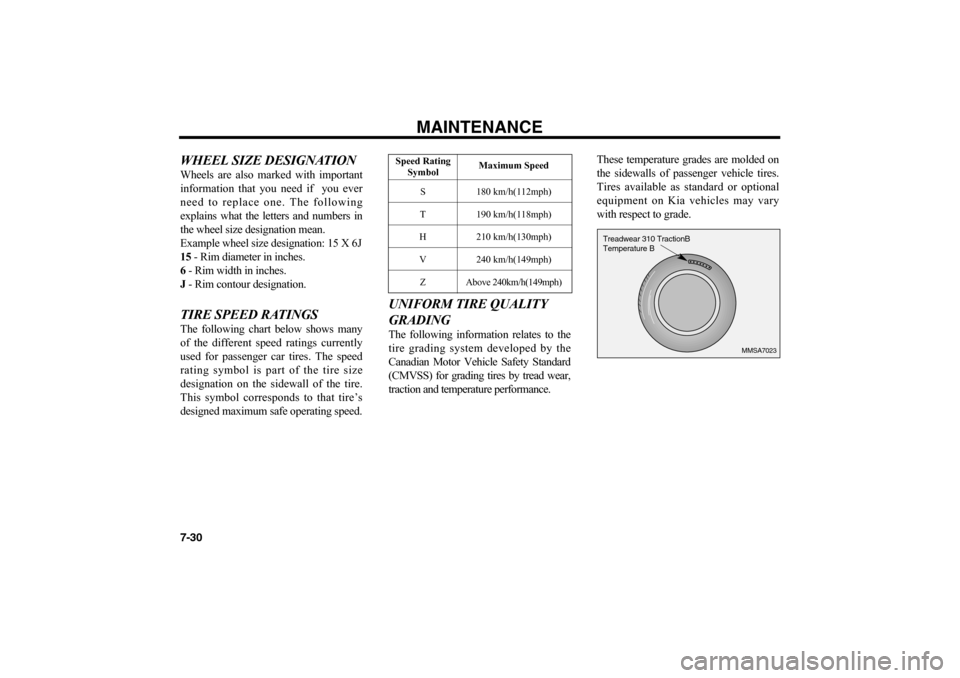
traction and temperature performance.These temperature grades are molded on
the sidewalls of passenger vehicle tires.
Tires available as standard or optional
equipment on Kia vehicles may vary
with respect to grade.
MMSA7023
Treadwear 310 TractionB
Temperature B
Maximum Speed
S 180 km/h(112mph)
T 190 km/h(118mph)
H 210 km/h(130mph)
V 240 km/h(149mph)
Z Above 240km/h(149mph)
Speed Rating
Symbol
MS-CNA-Eng 7.QXD 7/25/2005 5:09 PM Page 30
Page 208 of 225
MAINTENANCE
7-32WHEEL REPLACEMENTWhen replacing the metal wheels for any
reason, make sure the new wheels are
equivalent to the original factory units in
diameter, rim width and offset.
BULB REPLACEMENTHEADLIGHT BULB
REPLACEMENT
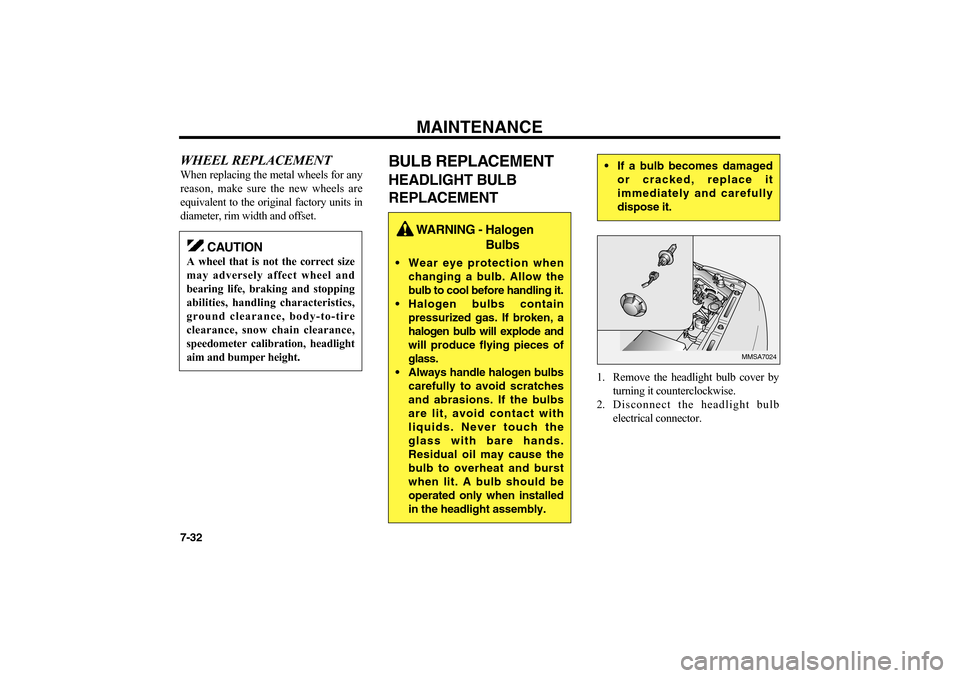
1. Remove the headlight bulb cover by
turning it counterclockwise.
2. Disconnect the headlight bulb
electrical connector.
MMSA7024
CAUTION
A wheel that is not the correct size
may adversely affect wheel and
bearing life, braking and stopping
abilities, handling characteristics,
ground clearance, body-to-tire
clearance, snow chain clearance,
speedometer calibration, headlight
aim and bumper height.
WARNING - Halogen
Bulbs
Wear eye protection when
changing a bulb. Allow the
bulb to cool before handling it.
Halogen bulbs contain
pressurized gas. If broken, a
halogen bulb will explode and
will produce flying pieces of
glass.
Always handle halogen bulbs
carefully to avoid scratches
and abrasions. If the bulbs
are lit, avoid contact with
liquids. Never touch the
glass with bare hands.
Residual oil may cause the
bulb to overheat and burst
when lit. A bulb should be
operated only when installed
in the headlight assembly.
If a bulb becomes damaged
or cracked, replace it
immediately and carefully
dispose it.
MS-CNA-Eng 7.QXD 7/25/2005 5:09 PM Page 32
Page 210 of 225
MAINTENANCE
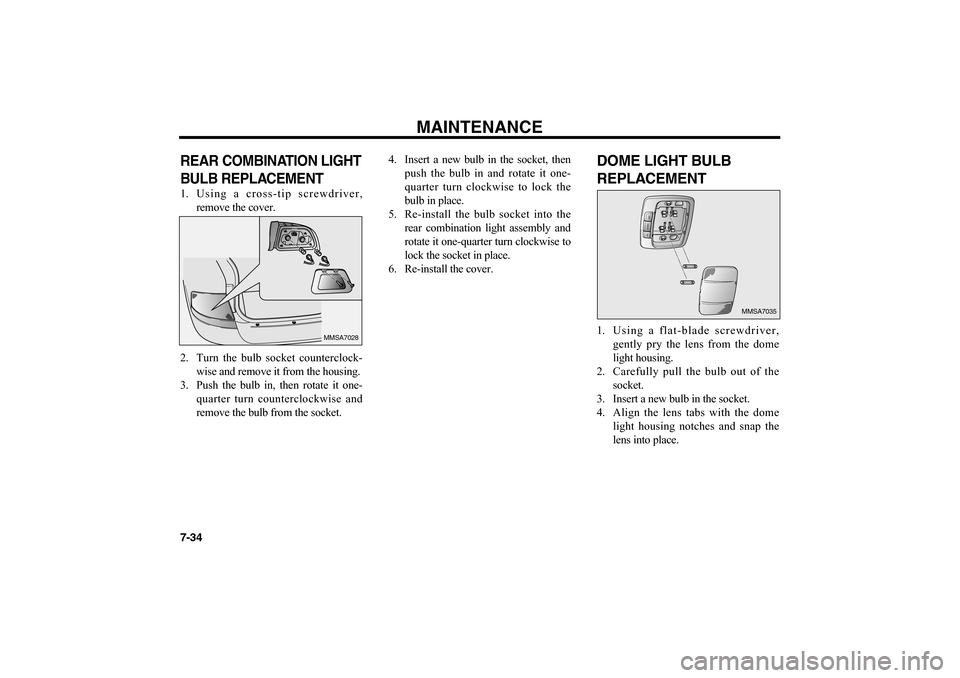
7-34REAR COMBINATION LIGHT
BULB REPLACEMENT 1. Using a cross-tip screwdriver,
remove the cover.
2. Turn the bulb socket counterclock-
wise and remove it from the housing.
3. Push the bulb in, then rotate it one-
quarter turn counterclockwise and
remove the bulb from the socket.4. Insert a new bulb in the socket, then
push the bulb in and rotate it one-
quarter turn clockwise to lock the
bulb in place.
5. Re-install the bulb socket into the
rear combination light assembly and
rotate it one-quarter turn clockwise to
lock the socket in place.
6. Re-install the cover.
DOME LIGHT BULB
REPLACEMENT1. Using a flat-blade screwdriver,
gently pry the lens from the dome
light housing.
2. Carefully pull the bulb out of the
socket.
3. Insert a new bulb in the socket.
4. Align the lens tabs with the dome
light housing notches and snap the
lens into place.
MMSA7028
O
F
FDOORON
MMSA7035
MS-CNA-Eng 7.QXD 7/25/2005 5:09 PM Page 34
Page 212 of 225
MAINTENANCE
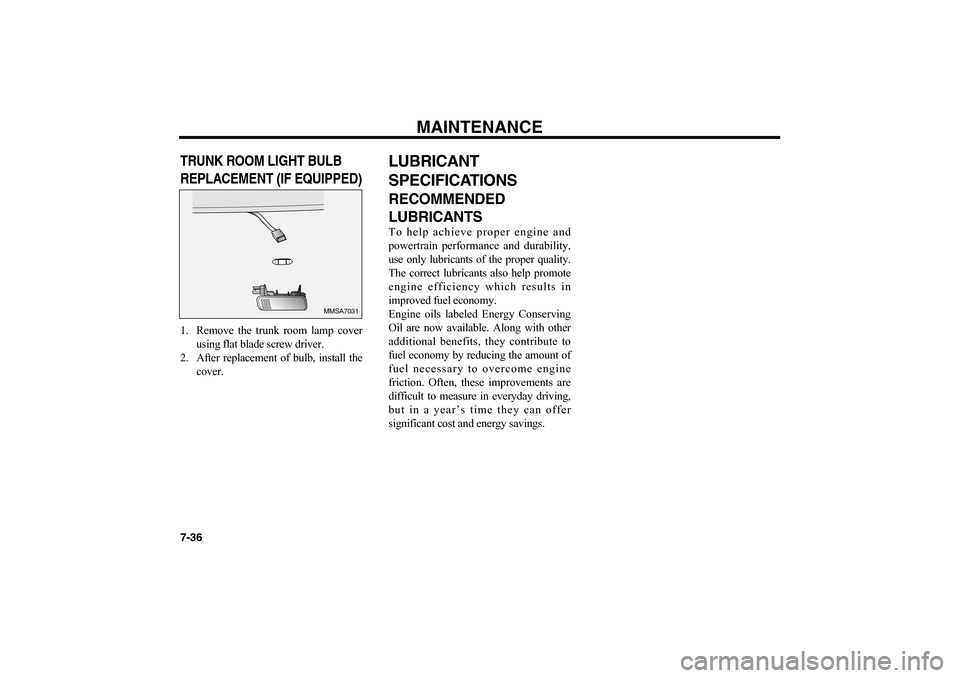
7-36TRUNK ROOM LIGHT BULB
REPLACEMENT (IF EQUIPPED)1. Remove the trunk room lamp cover
using flat blade screw driver.
2. After replacement of bulb, install the
cover.
LUBRICANT
SPECIFICATIONSRECOMMENDED
LUBRICANTSTo help achieve proper engine and
powertrain performance and durability,
use only lubricants of the proper quality.
The correct lubricants also help promote
engine efficiency which results in
improved fuel economy.
Engine oils labeled Energy Conserving
Oil are now available. Along with other
additional benefits, they contribute to
fuel economy by reducing the amount of
fuel necessary to overcome engine
friction. Often, these improvements are
difficult to measure in everyday driving,
but in a year’s time they can offer
significant cost and energy savings.
MMSA7031
MS-CNA-Eng 7.QXD 7/25/2005 5:09 PM Page 36