maintenance KIA Magnetis 2006 2.G Owner's Guide
[x] Cancel search | Manufacturer: KIA, Model Year: 2006, Model line: Magnetis, Model: KIA Magnetis 2006 2.GPages: 225, PDF Size: 3.77 MB
Page 214 of 225
MAINTENANCE
7-38When choosing an oil, consider the range
of temperature your vehicle will be
operated in before the next oil change.
Then select the recommended oil
viscosity from the chart.EXTERIOR CAREEXTERIOR GENERAL
CAUTIONIt is very important to follow the
manufacturer’s directions when using
any chemical cleaner or polish. Read all
warning and caution statements that
appear on the label.FINISH MAINTENANCE
WASHINGTo help protect your vehicle’s finish from
rust and deterioration, wash it thoroughly
and frequently at least once a month with
special attention to the removal of any
accumulation of salt, dirt, mud, or other
foreign materials. Make sure the drainholes in the lower edges of the doors and
rocker panels are kept clear and clean.
Insects, tar, tree sap, bird droppings,
industrial fallout and similar deposits can
damage your vehicle’s finish if not
removed immediately.
Even prompt washing with plain water
may not completely remove all these
deposits. A mild soap, safe for use on
painted surfaces, can be used.
After washing, rinse the vehicle
thoroughly with lukewarm or cold water.
Do not allow soap to dry on the finish.
WAXINGWax the vehicle when water will no
longer bead on the paint.
Always wash and dry the vehicle before
waxing. Use a good quality liquid or
paste wax, and follow the manufacturer’s
instructions. Wax all metal trim as well,
to protect it and to maintain its luster.
Removing oil, tar, and similar materials
with a spot remover will usually strip the
wax from the finish. Be sure to re-wax
these areas even if the rest of the vehicle
does not yet need waxing.
✻
NOTICE
Do not use strong soap, chemical
detergents or hot water, and do not
wash the vehicle in direct sunlight
or when the body of the vehicle is
warm.
CAUTION
After washing the vehicle, test the
brakes while driving slowly to see if
they have been affected by water. If
braking performance is impaired,
dry the brakes by applying them
lightly while maintaining a slow
forward speed.
MS-CNA-Eng 7.QXD 7/25/2005 5:09 PM Page 38
Page 215 of 225
7-39
FINISH DAMAGE REPAIRDeep scratches or stone chips in the
painted surface must be repaired
promptly. Exposed metal will quickly
rust and may develop into a major repair
expense.
BRIGHT-METAL MAINTENANCE• To remove road tar and insects, use a
tar remover, not a scraper or other
sharp object.
• To protect the surfaces of bright-
metal parts from corrosion, apply a
coating of wax or chrome
preservative and rub to a high luster.
• During winter weather or in coastal
areas, cover the bright metal parts
with a heavier coating of wax or
preservative. If necessary, coat the
parts with non-corrosive petroleum
jelly or other protective compound.
UNDERBODY
MAINTENANCECorrosive materials used for ice and
snow removal or dust control may
collect on the underbody. If these
materials are not removed, accelerated
rusting can occur on underbody parts,
such as the fuel lines, frame, floor pan
and exhaust system, even though they
have been treated with rust protection.
Thoroughly flush the vehicle underbody
and wheel openings with lukewarm or
cold water once a month and especially
at the end of each winter. Pay special
attention to these areas because it is
difficult to see all the mud and dirt. The
lower edges of doors, rocker panels, and
frame members have drain holes that
should not be allowed to clog with dirt;
trapped water in these areas can cause
rusting. It will do more harm than good
to wet down the road grime without
removing it.
✻
NOTICE
• Wiping dust or dirt off the body
with a dry cloth will scratch the
inish.
• Do not use steel wool, abrasive
cleaners, or strong detergents
containing highly alkaline or
caustic agents on chrome-plated
or anodized aluminum parts.
This may result in damage to the
protective coating and cause
discoloration or paint
deterioration.
✻
NOTICE
If your vehicle is damaged and
requires any metal repair or
replacement, be sure the body shop
applies anti-corrosion materials to
the parts repaired or replaced.
MS-CNA-Eng 7.QXD 7/25/2005 5:09 PM Page 39
Page 216 of 225
MAINTENANCE
7-40ALUMINUM WHEEL
MAINTENANCEThe aluminum wheels are coated with a
clear protective finish.
• Do not use any abrasive cleaner,
polishing compound, solvent, or wire
brushes on aluminum wheels. They
may scratch or damage the finish.
• Use only a mild soap or neutral
detergent, and rinse thoroughly with
water. Also, be sure to clean the
wheels after driving on salted roads.
This helps prevent corrosion.
• Avoid washing the wheels with high-
speed car wash brushes.
INTERIOR CAREINTERIOR GENERAL
PRECAUTIONSPrevent caustic solutions such as
perfume and cosmetic oil from
contacting the dashboard; they may
cause damage or discoloration. If they do
contact the dashboard, wipe them off
immediately.UPHOLSTERY AND
INTERIOR TRIM CLEANINGVINYLFirst, remove dust and loose dirt from
vinyl with a whisk broom or vacuum
cleaner. Then, clean vinyl surfaces with a
vinyl cleaner.
FABRICFirst, remove dust and loose dirt from
fabric with a whisk broom or vacuum
cleaner. Then, clean with a mild soap
solution recommended for upholstery or
carpets. Remove fresh spots immediately
with a fabric spot cleaner. If a fresh spot
do not receive immediate attention, the
fabric may be stained and its color can be
affected. Also, its fire-resistant properties
may be reduced if the material is not
properly maintained.
CAUTION
After washing the vehicle, test the
brakes while driving slowly to see if
they have been affected by water.
CAUTION
Using anything but recommended
cleaners and procedures may affect
the fabric’s appearance and fire-
resistant properties.
MS-CNA-Eng 7.QXD 7/25/2005 5:09 PM Page 40
Page 218 of 225
MAINTENANCE
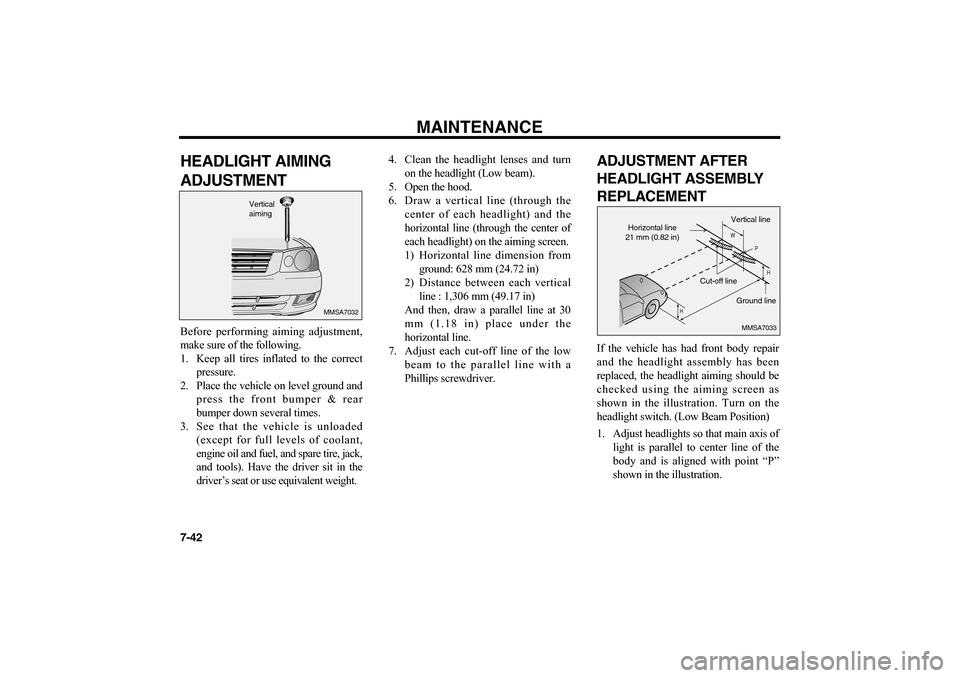
7-42HEADLIGHT AIMING
ADJUSTMENTBefore performing aiming adjustment,
make sure of the following.
1. Keep all tires inflated to the correct
pressure.
2. Place the vehicle on level ground and
press the front bumper & rear
bumper down several times.
3. See that the vehicle is unloaded
(except for full levels of coolant,
engine oil and fuel, and spare tire, jack,
and tools). Have the driver sit in the
driver’s seat or use equivalent weight.4. Clean the headlight lenses and turn
on the headlight (Low beam).
5. Open the hood.
6. Draw a vertical line (through the
center of each headlight) and the
horizontal line (through the center of
each headlight) on the aiming screen.
1) Horizontal line dimension from
ground: 628 mm (24.72 in)
2) Distance between each vertical
line : 1,306 mm (49.17 in)
And then, draw a parallel line at 30
mm (1.18 in) place under the
horizontal line.
7. Adjust each cut-off line of the low
beam to the parallel line with a
Phillips screwdriver.
ADJUSTMENT AFTER
HEADLIGHT ASSEMBLY
REPLACEMENTIf the vehicle has had front body repair
and the headlight assembly has been
replaced, the headlight aiming should be
checked using the aiming screen as
shown in the illustration. Turn on the
headlight switch. (Low Beam Position)
1. Adjust headlights so that main axis of
light is parallel to center line of the
body and is aligned with point “P”
shown in the illustration.
MMSA7032
Vertical
aiming
HH W
P
MMSA7033
Horizontal line
21 mm (0.82 in)
Cut-off line
Ground line Vertical line
MS-CNA-Eng 7.QXD 7/25/2005 5:09 PM Page 42
Page 225 of 225
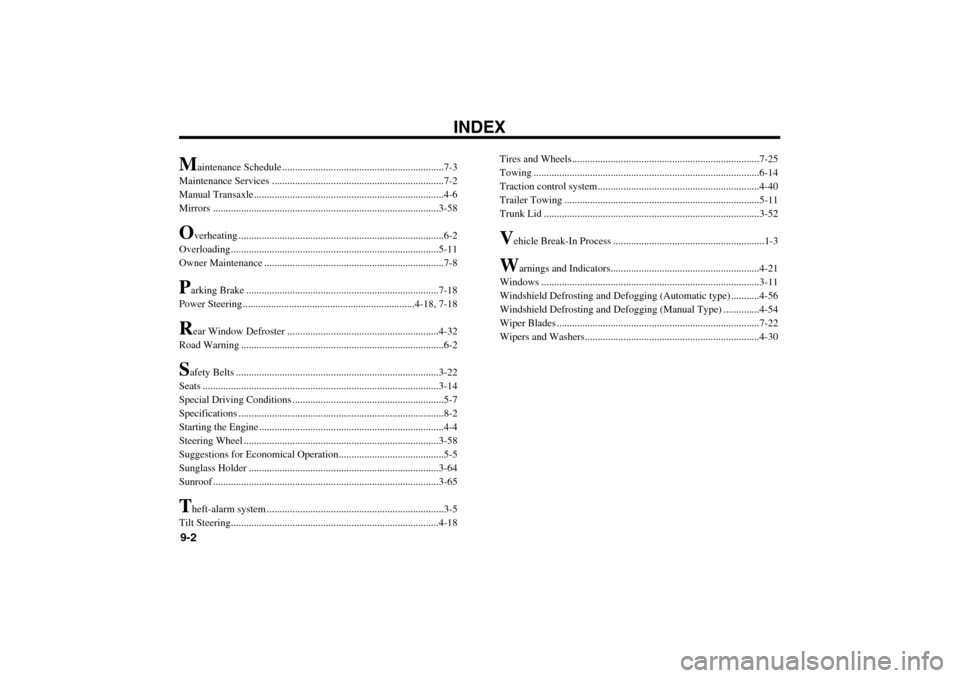
INDEX
9-2M
aintenance Schedule ...............................................................7-3
Maintenance Services ...................................................................7-2
Manual Transaxle ..........................................................................4-6
Mirrors ........................................................................................3-58
O
verheating ................................................................................6-2
Overloading .................................................................................5-11
Owner Maintenance ......................................................................7-8
P
arking Brake ...........................................................................7-18
Power Steering ...................................................................4-18, 7-18
R
ear Window Defroster ...........................................................4-32
Road Warning ...............................................................................6-2
Safety Belts ...............................................................................3-22
Seats ............................................................................................3-14
Special Driving Conditions ...........................................................5-7
Specifications ................................................................................8-2
Starting the Engine ........................................................................4-4
Steering Wheel ............................................................................3-58
Suggestions for Economical Operation.........................................5-5
Sunglass Holder ..........................................................................3-64
Sunroof ........................................................................................3-65T
heft-alarm system .....................................................................3-5
Tilt Steering.................................................................................4-18Tires and Wheels .........................................................................7-25
Towing ........................................................................................6-14
Traction control system ...............................................................4-40
Trailer Towing ............................................................................5-11
Trunk Lid ....................................................................................3-52
V
ehicle Break-In Process ...........................................................1-3
W
arnings and Indicators..........................................................4-21
Windows .....................................................................................3-11
Windshield Defrosting and Defogging (Automatic type) ...........4-56
Windshield Defrosting and Defogging (Manual Type) ..............4-54
Wiper Blades ...............................................................................7-22
Wipers and Washers....................................................................4-30
Ms-CNA-Eng-INDEX.qxd 7/25/2005 5:07 PM Page 2