heating KIA MOHAVE 2014 Owner's Manual
[x] Cancel search | Manufacturer: KIA, Model Year: 2014, Model line: MOHAVE, Model: KIA MOHAVE 2014Pages: 417, PDF Size: 38.72 MB
Page 251 of 417
Driving your vehicle
10
5
Diesel engine
To start the diesel engine when the engine is cold, it has to be pre-heated
before starting the engine and then have
to be warmed up before starting to drive.
1. Make sure the parking brake is
applied.
2. Place the transmission shift lever in P (Park).
3. Press the ENGINE START/STOP but- ton while depressing the brake pedal.
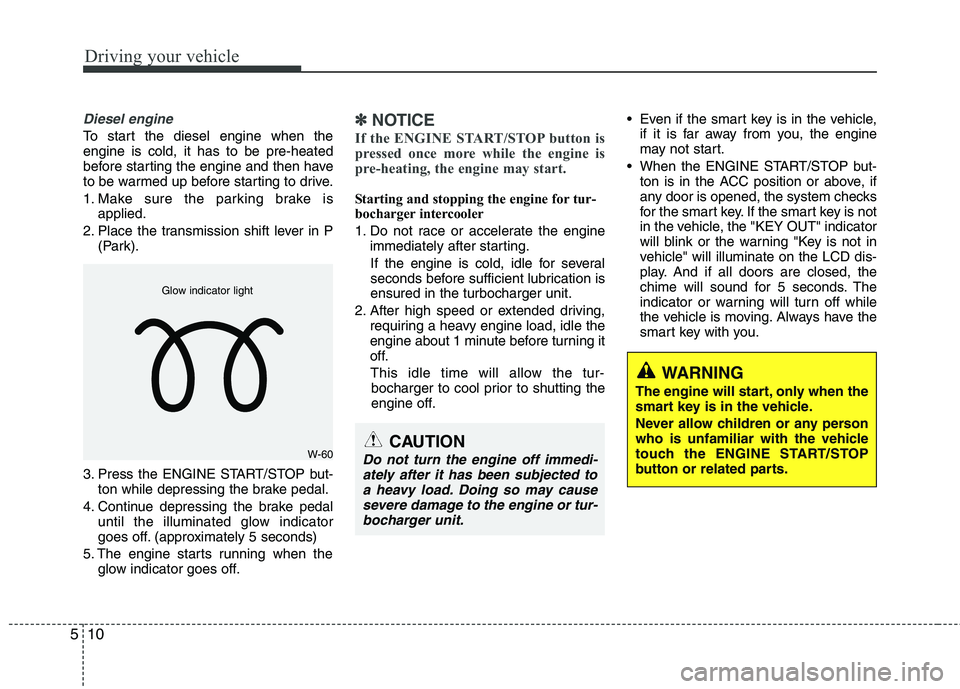
4. Continue depressing the brake pedal until the illuminated glow indicator
goes off. (approximately 5 seconds)
5. The engine starts running when the glow indicator goes off.✽✽
NOTICE
If the ENGINE START/STOP button is
pressed once more while the engine is
pre-heating, the engine may start.
Starting and stopping the engine for tur-
bocharger intercooler
1. Do not race or accelerate the engine immediately after starting.
If the engine is cold, idle for several
seconds before sufficient lubrication isensured in the turbocharger unit.
2. After high speed or extended driving, requiring a heavy engine load, idle the
engine about 1 minute before turning it
off.
This idle time will allow the tur- bocharger to cool prior to shutting the
engine off. Even if the smart key is in the vehicle,
if it is far away from you, the engine
may not start.
When the ENGINE START/STOP but- ton is in the ACC position or above, if
any door is opened, the system checks
for the smart key. If the smart key is not
in the vehicle, the "KEY OUT" indicator
will blink or the warning "Key is not in
vehicle" will illuminate on the LCD dis-
play. And if all doors are closed, the
chime will sound for 5 seconds. The
indicator or warning will turn off while
the vehicle is moving. Always have the
smart key with you.
WARNING
The engine will start, only when the
smart key is in the vehicle.
Never allow children or any person
who is unfamiliar with the vehicle
touch the ENGINE START/STOP
button or related parts.
W-60
Glow indicator light
CAUTION
Do not turn the engine off immedi- ately after it has been subjected to
a heavy load. Doing so may cause severe damage to the engine or tur-bocharger unit.
Page 252 of 417
511
Driving your vehicle
✽✽
NOTICE
If the ENGINE START/STOP button is
pressed once more while the engine is
pre-heating, the engine may start.
✽
✽
NOTICE
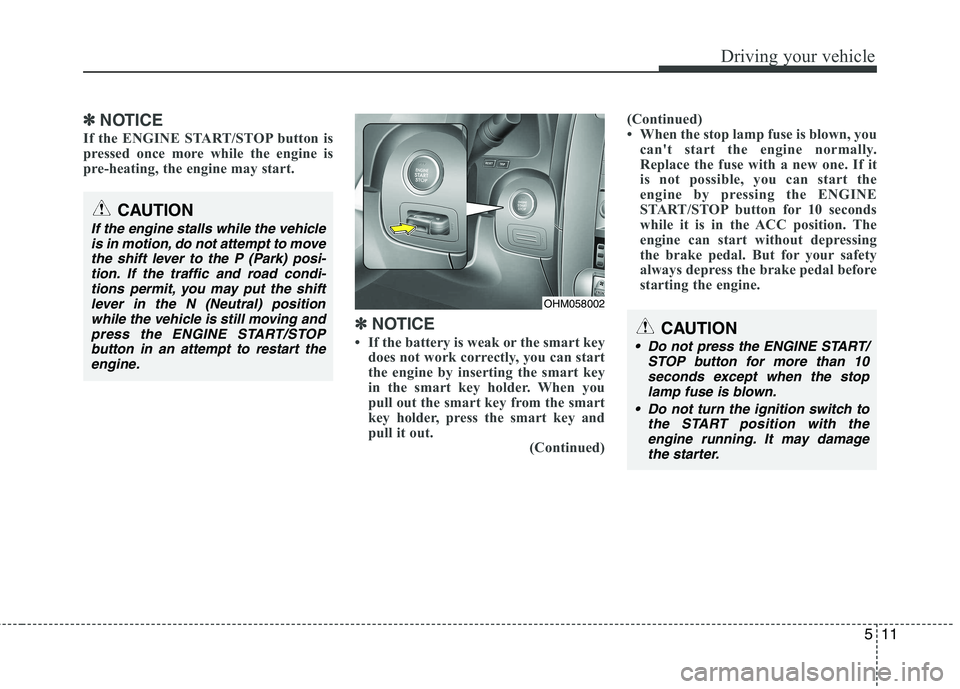
If the battery is weak or the smart key does not work correctly, you can start
the engine by inserting the smart key
in the smart key holder. When you
pull out the smart key from the smart
key holder, press the smart key and
pull it out. (Continued)(Continued)
When the stop lamp fuse is blown, you
can't start the engine normally.
Replace the fuse with a new one. If it
is not possible, you can start the
engine by pressing the ENGINE
START/STOP button for 10 seconds
while it is in the ACC position. The
engine can start without depressing
the brake pedal. But for your safety
always depress the brake pedal before
starting the engine.CAUTION
Do not press the ENGINE START/
STOP button for more than 10
seconds except when the stoplamp fuse is blown.
Do not turn the ignition switch to the START position with theengine running. It may damage
the starter.
OHM058002
CAUTION
If the engine stalls while the vehicle is in motion, do not attempt to move
the shift lever to the P (Park) posi-tion. If the traffic and road condi-tions permit, you may put the shiftlever in the N (Neutral) position
while the vehicle is still moving andpress the ENGINE START/STOPbutton in an attempt to restart theengine.
Page 291 of 417
Driving your vehicle
50
5
E110100AHM
Hazardous driving conditions
When hazardous driving conditions are
encountered such as water, snow, ice,
mud, sand, or similar hazards, followthese suggestions:
Drive cautiously and allow extra dis-
tance for braking.
Avoid sudden braking or steering. When braking with non-ABS brakes
pump the brake pedal with a light up-
and-down motion until the vehicle isstopped.
If stalled in snow, mud, or sand, use second gear. Accelerate slowly to
avoid spinning the drive wheels.
Use sand, rock salt, tire chains, or other non-slip material under the drive
wheels to provide traction when stalled
in ice, snow, or mud. E110200BHM
Rocking the vehicle
If it is necessary to rock the vehicle to free
it from snow, sand, or mud, first turn the
steering wheel right and left to clear the
area around your driving wheels. Then,
shift back and forth between R (Reverse)
and any forward gear in vehicles
equipped with an automatic transmission.
Do not race the engine, and spin the
wheels as little as possible. If you are still
stuck after a few tries, have the vehicle
pulled out by a tow vehicle to avoid
engine overheating and possible damage
to the transmission.
SPECIAL DRIVING CONDITIONS
1VQA3002
WARNING -
ABS
Do not pump the brake pedal on a
vehicle equipped with ABS.
WARNING - Downshifting
Downshifting with an automatic
transmission, while driving on slip-
pery surfaces can cause an acci-
dent. The sudden change in tirespeed could cause the tires to skid.
Be careful when downshifting on
slippery surfaces.
CAUTION
Prolonged rocking may cause engine overheating, transmission
damage or failure, and tire damage.
Page 294 of 417
553
Driving your vehicle
E110700AHM
Highway driving
Tires
Adjust the tire inflation pressures to
specification. Low tire inflation pressures
will result in overheating and possible
failure of the tires.
Avoid using worn or damaged tires which
may result in reduced traction or tire fail-
ure.
✽✽NOTICE
Never exceed the maximum tire inflation
pressure shown on the tires.
Fuel, engine coolant and engine oil
High speed travel consumes more fuel
than urban motoring. Do not forget to
check both the engine coolant andengine oil.
Drive belt
A loose or damaged drive belt may over-
heat the engine.
WARNING
Underinflated or overinflated tires can cause poor handling,
loss of vehicle control, and sud-den tire failure leading to acci-
dents, injuries, and even death.
Always check tires for proper
inflation before driving. For prop-
er tire pressures, refer to “Tires
and wheels” in section 8.
Driving on tires with no or insuffi- cient tread is dangerous. Worn-out tires can result in loss of
vehicle control, collisions, injury,
and even death. Worn-out tiresshould be replaced as soon as
possible and should never be
used for driving. Always check
the tire tread before driving your
vehicle. For further information
and tread limits, refer to “Tires
and wheels” in section 7.
1VQA1004
Page 302 of 417
561
Driving your vehicle
Making turns
When you’re turning with a trailer, make
wider turns than normal. Do this so your
trailer won’t strike soft shoulders, curbs,
road signs, trees, or other objects. Avoid
jerky or sudden maneuvers. Signal well
in advance.
Turn signals when towing a trailer
When you tow a trailer, your vehicle has
to have a different turn signal flasher and
extra wiring. The green arrows on your
instrument panel will flash whenever you
signal a turn or lane change. Properly
connected, the trailer lights will also flash
to alert other drivers you’re about to turn,
change lanes, or stop.
When towing a trailer, the green arrows
on your instrument panel will flash for
turns even if the bulbs on the trailer are
burned out. Thus, you may think drivers
behind you are seeing your signals
when, in fact, they are not. It’s important
to check occasionally to be sure the trail-
er bulbs are still working. You must also
check the lights every time you discon-
nect and then reconnect the wires.
Do not connect a trailer lighting system
directly to your vehicle’s lighting system.
Use only an approved trailer wiring harness.
An authorized Kia dealer can assist you
in installing the wiring harness.
Driving on grades
Reduce speed and shift to a lower gear
before you start down a long or steep
downgrade. If you don’t shift down, you
might have to use your brakes so much
that they would get hot and no longer
operate efficiently.
On a long uphill grade, shift down and
reduce your speed to around 70 km/h (45mph) to reduce the possibility of engine
and transmission overheating.
If your trailer weighs more than the max-
imum trailer weight without trailer brakes
and you have an automatic transmission,
you should drive in D (Drive) when tow-
ing a trailer.
Operating your vehicle in D (Drive) when
towing a trailer will minimize heat build up
and extend the life of your transmission.
WARNING
Failure to use an approved trailer wiring harness could result in dam-
age to the vehicle electrical system
and/or personal injury.
CAUTION
When towing a trailer on steep grades (in excess of 6%) pay
close attention to the engine coolant temperature gauge toensure the engine does not over-heat. If the needle of the coolant
temperature gauge moves acrossthe dial towards “H” (HOT), pull over and stop as soon as it is safe
to do so, and allow the engine to idle until it cools down. You mayproceed once the engine hascooled sufficiently.
You must decide the driving speed depending on trailerweight and uphill grade to reduce the possibility of engine andtransmission overheating.
Page 304 of 417
563
Driving your vehicle
Maintenance when trailer towing
Your vehicle will need service more often
when you regularly pull a trailer.
Important items to pay particular atten-tion to include engine oil, automatic
transmission fluid, mission lubricant and
cooling system fluid. Brake condition is
another important item to frequently
check. Each item is covered in this man-
ual, and the Index will help you find them
quickly. If you’re trailering, it’s a good idea
to review these sections before you start
your trip.
Don’t forget to also maintain your trailer
and hitch. Follow the maintenance
schedule that accompanied your trailer
and check it periodically. Preferably, con-
duct the check at the start of each day’s
driving. Most importantly, all hitch nutsand bolts should be tight.If you do decide to pull a trailer
Here are some important points if you
decide to pull a trailer:
Consider using a sway control. You can
ask a hitch dealer about sway control.
Do not do any towing with your car dur- ing its first 2,000 km (1,200 miles) in
order to allow the engine to properly
break in. Failure to heed this caution
may result in serious engine or trans-
mission damage.
When towing a trailer, be sure to con- sult an authorized Kia dealer for further
information on additional requirements
such as a towing kit, etc.
Always drive your vehicle at a moder- ate speed (less than 100 km/h / 60mph).
On a long uphill grade, do not exceed 70 km/h (45 mph) or the posted towing
speed limit, whichever is lower.CAUTION
Due to higher load during trailer
usage, overheating might occurin hot days or during uphill driv-ing. If the coolant gauge indicatesover-heating, switch off the A/C
and stop the vehicle in a safe area to cool down the engine.
When towing, check the transmis- sion fluid more frequently.
If your vehicle is not equipped with an air conditioner, youshould install a condenser fan to improve engine performancewhen towing a trailer.
Page 313 of 417
What to do in an emergency
6
6
IF THE ENGINE OVERHEATS
F050000BHM
If your temperature gauge indicates over-
heating, you will experience a loss of
power, or hear loud pinging or knocking,
the engine will probably be too hot. If this
happens, you should:
1. Pull off the road and stop as soon as it is safe to do so.
2. Place the gear shift lever in P (Park) and set the parking brake. If the air
conditioning is on, turn it off.
3. If engine coolant is running out under the vehicle or steam is coming out
from the hood, stop the engine. Do notopen the hood until the coolant has
stopped running or the steaming has
stopped. If there is no visible loss of
engine coolant and no steam, leave
the engine running and check to be
sure the engine cooling fan is operat-
ing. If the fan is not running, turn the
engine off. 4. Check to see if the water pump drive
belt is missing. If it is not missing,
check to see that it is tight. If the drive
belt seems to be satisfactory, check for
coolant leaking from the radiator,
hoses or under the vehicle. (If the air
conditioning had been in use, it is nor-
mal for cold water to be draining from
it when you stop).
5. If the water pump drive belt is broken or engine coolant is leaking out, stop the engine immediately and call the
nearest authorized Kia dealer for
assistance. 6. If you cannot find the cause of the
overheating, wait until the engine tem-
perature has returned to normal. Then,if coolant has been lost, carefully add
coolant to the reservoir to bring the
fluid level in the reservoir up to the
halfway mark.
7. Proceed with caution, keeping alert for further signs of overheating. If over-heating happens again, call an author-
ized Kia dealer for assistance.
WARNING
While the engine is running, keep
hair, hands and clothing away from
moving parts such as the fan and
drive belts to prevent injury.
WARNING
Do not remove the radiator cap
when the engine is hot. This can
allow coolant to be blown out of the
opening and cause serious burns.
CAUTION
Serious loss of coolant indicates there is a leak in the cooling sys-
tem and this should be checked as soon as possible by an author-ized Kia dealer.
When the engine overheats from low engine coolant, suddenly
adding engine coolant may causecracks in the engine. To prevent damage, add engine coolantslowly in small quantities.
Page 409 of 417
Index
2
I
Air bags ···········································································3-42
Air bag warning label................................................3-60
Air bag warning light ................................................3-45
Curtain air bag ..........................................................3-52
Driver's and passenger's front air bag ......................3-48
Side impact air bag....................................................3-50
Air cleaner·······································································7-26
Air conditioner compressor label ·····································8-9
Air leveling system (ALS) ··············································5-41
Alarm system ··································································4-12
All wheel drive (AWD), see four wheel drive (4WD) ···5-18
Antenna ·········································································4-126
Anti-lock brake system (ABS)········································5-31
Appearance care······························································7-62 Exterior care ······························································7-62
Interior care ·······························································7-67
Armrest ···········································································3-16
Ashtray ··········································································4-116
Audio system ································································4-126 Antenna ···································································4-126
Aux, USB and iPod ·················································4-128
Steering wheel audio control ··································4-127
Automatic climate control system ··································4-99 Air conditioning ······················································4-106
Automatic heating and air conditioning··················4-101
Manual heating and air conditioning ······················4-102 Automatic transmission ··················································5-12
Shift lock system ·······················································5-15
Sports mode·······························································5-14
Battery ·············································································7-32
Battery saver function ·····················································4-71
Before driving ···································································5-3
Bottle holders, see cup holders ·····································4-117
Brake system ···································································5-28 Anti-lock brake system (ABS) ··································5-31
Downhill brake control (DBC)··································5-37
Electronic stability program (ESP) ···························5-33
Hill-start assist control (HAC) ··································5-36
Parking brake·····························································5-29
Power brakes ·····························································5-28
Brakes fluid ·····································································7-22
Bulb replacement ····························································7-55 Door courtesy lamp bulb replacement ······················7-60
Front fog light bulb replacement ·····················7-55, 7-57
Headlight bulb replacement ·····························7-55, 7-57
High mounted stop light replacement ·······················7-60
Interior light bulb replacement··································7-61
License plate light bulb replacement ························7-60
Position light bulb replacement ·······················7-55, 7-57
Rear combination light bulb replacement ·················7-58
Rear fog light bulb replacement································7-60
A
B
Page 410 of 417
I3
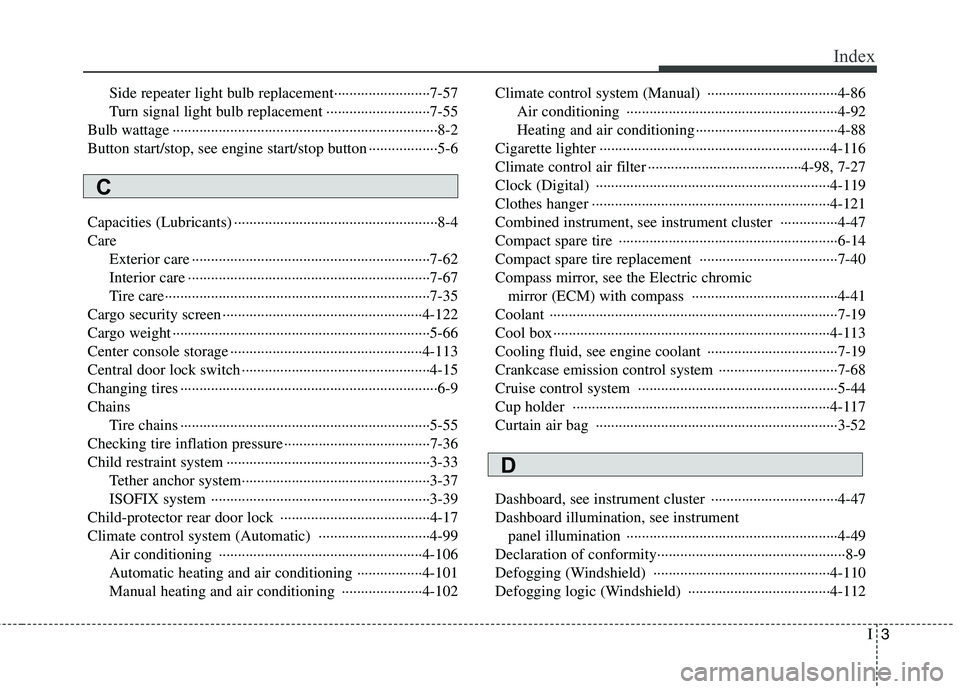
Index
Side repeater light bulb replacement·························7-57
Turn signal light bulb replacement ···························7-55
Bulb wattage ·····································································8-2
Button start/stop, see engine start/stop button ··················5-6
Capacities (Lubricants) ·····················································8-4 Care Exterior care ······························································7-62
Interior care ·······························································7-67
Tire care·····································································7-35
Cargo security screen ····················································4-122
Cargo weight ···································································5-66
Center console storage ··················································4-113
Central door lock switch ·················································4-15
Changing tires ···································································6-9Chains Tire chains ·································································5-55
Checking tire inflation pressure ······································7-36
Child restraint system ·····················································3-33 Tether anchor system·················································3-37
ISOFIX system ·························································3-39
Child-protector rear door lock ·······································4-17
Climate control system (Automatic) ·····························4-99 Air conditioning ·····················································4-106Automatic heating and air conditioning ·················4-101
Manual heating and air conditioning ·····················4-102 Climate control system (Manual) ··································4-86
Air conditioning ·······················································4-92
Heating and air conditioning ·····································4-88
Cigarette lighter ····························································4-116
Climate control air filter ········································4-98, 7-27
Clock (Digital) ·····························································4-119
Clothes hanger ······························································4-121
Combined instrument, see instrument cluster ···············4-47
Compact spare tire ·························································6-14
Compact spare tire replacement ····································7-40
Compass mirror, see the Electric chromic mirror (ECM) with compass ······································4-41
Coolant ···········································································7-19
Cool box········································································4-113
Cooling fluid, see engine coolant ··································7-19
Crankcase emission control system ·······························7-68
Cruise control system ····················································5-44
Cup holder ···································································4-117
Curtain air bag ·······························································3-52
Dashboard, see instrument cluster ·································4-47
Dashboard illumination, see instrument panel illumination ·······················································4-49
Declaration of conformity·················································8-9
Defogging (Windshield) ··············································4-110
Defogging logic (Windshield) ·····································4-112
C
D
Page 412 of 417
I5
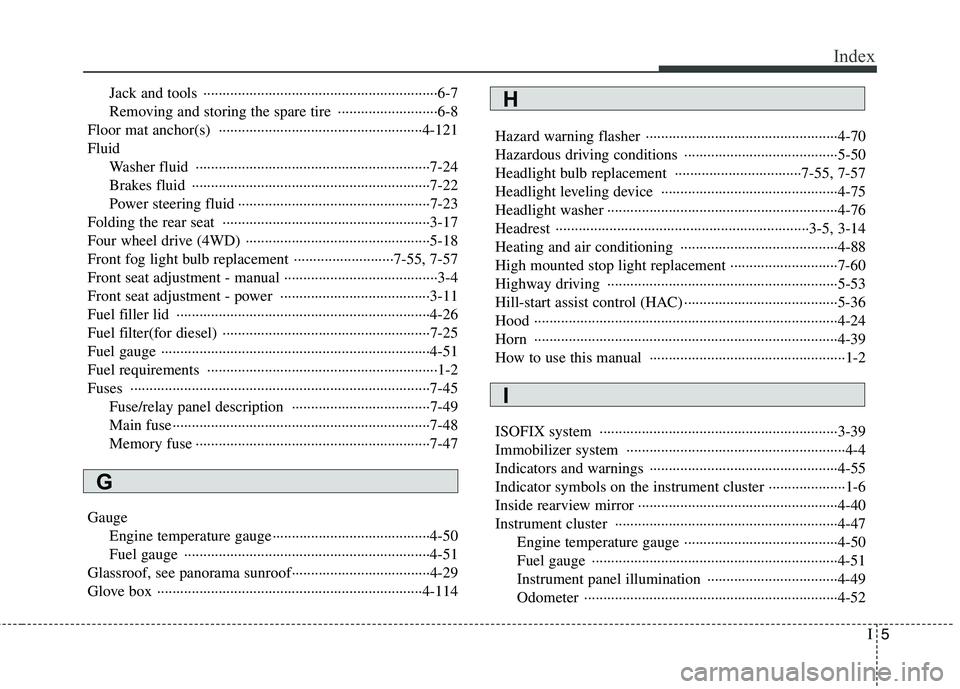
Index
Jack and tools ·····························································6-7
Removing and storing the spare tire ··························6-8
Floor mat anchor(s) ·····················································4-121Fluid Washer fluid ·····························································7-24
Brakes fluid ······························································7-22
Power steering fluid ··················································7-23
Folding the rear seat ······················································3-17
Four wheel drive (4WD) ················································5-18
Front fog light bulb replacement ··························7-55, 7-57Front seat adjustment - manual ········································3-4
Front seat adjustment - power ·······································3-11
Fuel filler lid ··································································4-26
Fuel filter(for diesel) ······················································7-25
Fuel gauge ······································································4-51
Fuel requirements ····························································1-2Fuses ··············································································7-45 Fuse/relay panel description ····································7-49
Main fuse···································································7-48
Memory fuse ·····························································7-47
Gauge Engine temperature gauge ·········································4-50
Fuel gauge ································································4-51
Glassroof, see panorama sunroof····································4-29
Glove box ·····································································4-114 Hazard warning flasher ··················································4-70
Hazardous driving conditions ········································5-50
Headlight bulb replacement ·································7-55, 7-57
Headlight leveling device ··············································4-75
Headlight washer ····························································4-76
Headrest ··································································3-5, 3-14
Heating and air conditioning ·········································4-88High mounted stop light replacement ····························7-60
Highway driving ····························································5-53
Hill-start assist control (HAC) ········································5-36Hood ···············································································4-24Horn ···············································································4-39
How to use this manual ···················································1-2
ISOFIX system ······························································3-39
Immobilizer system ·························································4-4
Indicators and warnings ·················································4-55
Indicator symbols on the instrument cluster ····················1-6
Inside rearview mirror ····················································4-40
Instrument cluster ··························································4-47
Engine temperature gauge ········································4-50
Fuel gauge ································································4-51
Instrument panel illumination ··································4-49Odometer ··································································4-52
G
I
H