key KIA MOHAVE 2014 Service Manual
[x] Cancel search | Manufacturer: KIA, Model Year: 2014, Model line: MOHAVE, Model: KIA MOHAVE 2014Pages: 417, PDF Size: 38.72 MB
Page 249 of 417
Driving your vehicle
8
5
E040000BUN-EU E040100CHM
Starting the engine with an igni-
tion key (if equipped)
Gasoline engine
1. Make sure the parking brake is
applied.
2. Place the transmission shift lever in P (Park). Depress the brake pedal fully.
You can also start the engine when
the shift lever is in the N (Neutral) position.
3. Turn the ignition switch to START and hold it there until the engine starts (a
maximum of 10 seconds), then
release the key.
4. In extremely cold weather (below -18°C (0°F)) or after the vehicle has
not been operated for several days, let
the engine warm up without depress-
ing the accelerator.
Whether the engine is cold or warm, it
should be started without depressing
the accelerator.
Diesel engine
To start the diesel engine when the engine is cold, it has to be pre-heated
before starting the engine and then have
to be warmed up before starting to drive.
1. Make sure the parking brake is applied.
2. Place the transmission shift lever in P(park). Depress the brake pedal fully.
You can also start the engine when the
shift lever is in the N(neutral) position.
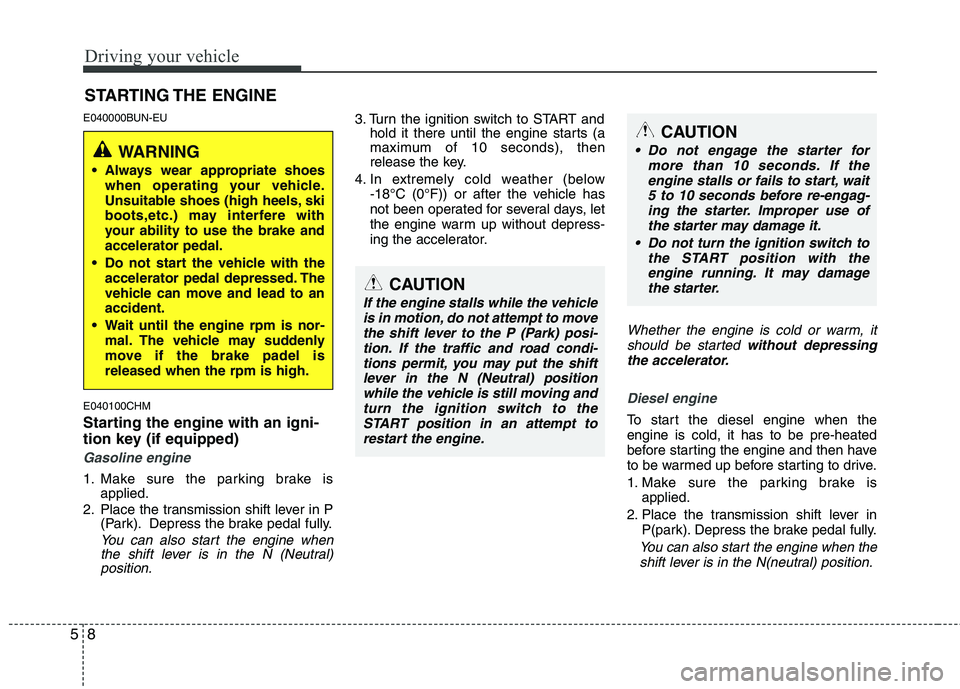
STARTING THE ENGINE
WARNING
Always wear appropriate shoes when operating your vehicle.
Unsuitable shoes (high heels, ski
boots,etc.) may interfere with
your ability to use the brake andaccelerator pedal.
Do not start the vehicle with the accelerator pedal depressed. The
vehicle can move and lead to anaccident.
Wait until the engine rpm is nor- mal. The vehicle may suddenly
move if the brake padel isreleased when the rpm is high.
CAUTION
If the engine stalls while the vehicle
is in motion, do not attempt to move
the shift lever to the P (Park) posi- tion. If the traffic and road condi-tions permit, you may put the shift lever in the N (Neutral) position
while the vehicle is still moving andturn the ignition switch to the START position in an attempt torestart the engine.
CAUTION
Do not engage the starter for more than 10 seconds. If the
engine stalls or fails to start, wait 5 to 10 seconds before re-engag-ing the starter. Improper use ofthe starter may damage it.
Do not turn the ignition switch to the START position with theengine running. It may damage the starter.
Page 250 of 417
59
Driving your vehicle
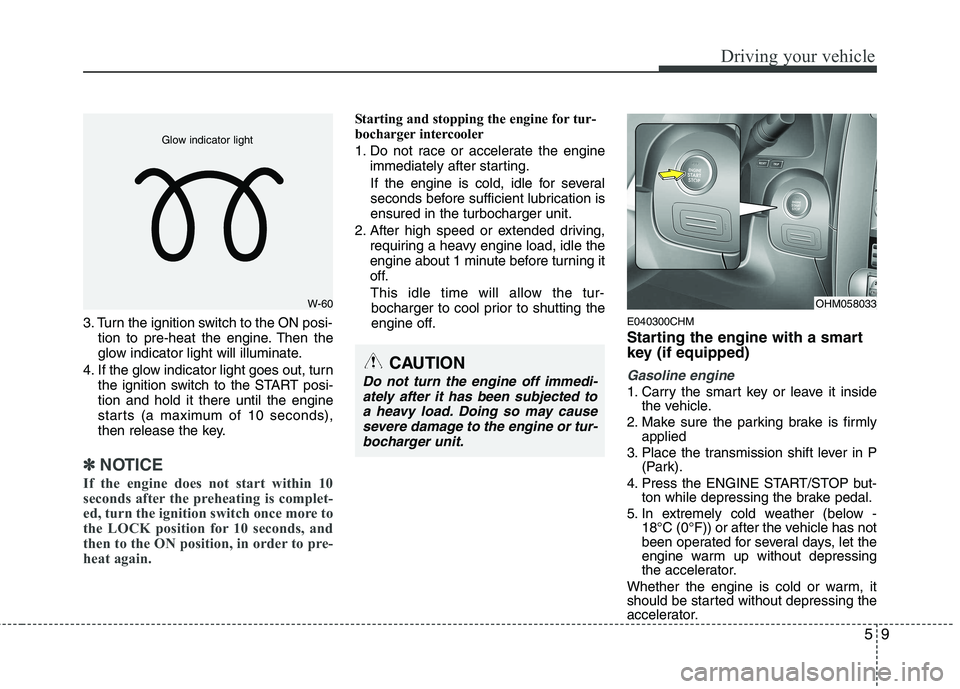
3. Turn the ignition switch to the ON posi-tion to pre-heat the engine. Then the
glow indicator light will illuminate.
4. If the glow indicator light goes out, turn the ignition switch to the START posi-tion and hold it there until the engine
starts (a maximum of 10 seconds),
then release the key.
✽✽
NOTICE
If the engine does not start within 10
seconds after the preheating is complet-
ed, turn the ignition switch once more to
the LOCK position for 10 seconds, and
then to the ON position, in order to pre-
heat again.
Starting and stopping the engine for tur-
bocharger intercooler
1. Do not race or accelerate the engine immediately after starting.
If the engine is cold, idle for several
seconds before sufficient lubrication isensured in the turbocharger unit.
2. After high speed or extended driving, requiring a heavy engine load, idle the
engine about 1 minute before turning it
off.
This idle time will allow the tur- bocharger to cool prior to shutting the
engine off. E040300CHM
Starting the engine with a smart
key (if equipped)
Gasoline engine
1. Carry the smart key or leave it inside
the vehicle.
2. Make sure the parking brake is firmly applied
3. Place the transmission shift lever in P (Park).
4. Press the ENGINE START/STOP but- ton while depressing the brake pedal.
5. In extremely cold weather (below - 18°C (0°F)) or after the vehicle has not
been operated for several days, let the
engine warm up without depressing
the accelerator.
Whether the engine is cold or warm, it
should be started without depressing the
accelerator.
W-60
Glow indicator light
CAUTION
Do not turn the engine off immedi- ately after it has been subjected toa heavy load. Doing so may causesevere damage to the engine or tur-
bocharger unit.
OHM058033
Page 251 of 417
Driving your vehicle
10
5
Diesel engine
To start the diesel engine when the engine is cold, it has to be pre-heated
before starting the engine and then have
to be warmed up before starting to drive.
1. Make sure the parking brake is
applied.
2. Place the transmission shift lever in P (Park).
3. Press the ENGINE START/STOP but- ton while depressing the brake pedal.
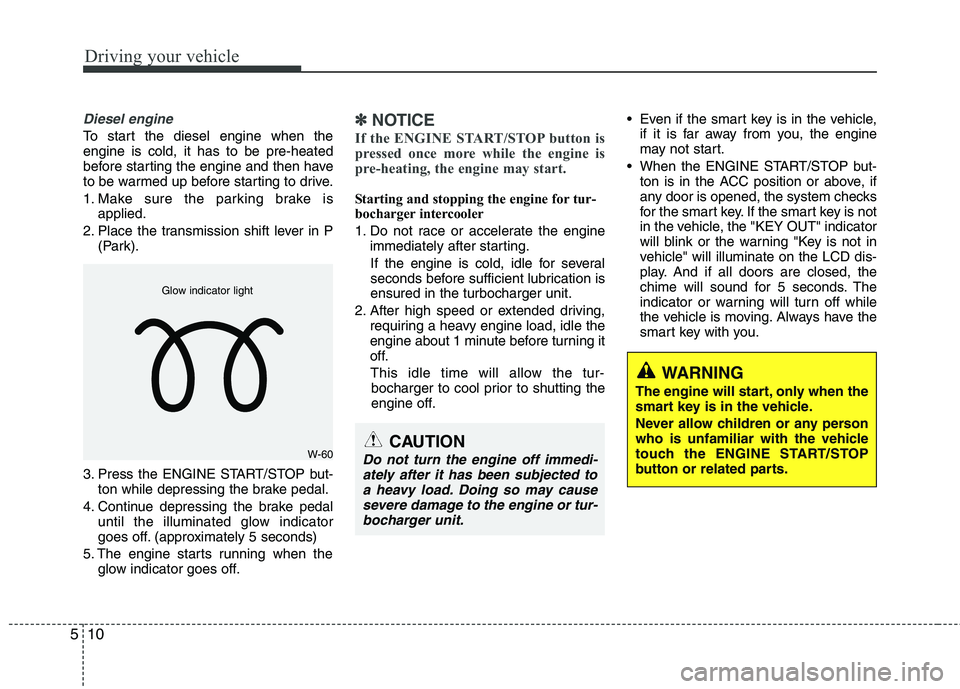
4. Continue depressing the brake pedal until the illuminated glow indicator
goes off. (approximately 5 seconds)
5. The engine starts running when the glow indicator goes off.✽✽
NOTICE
If the ENGINE START/STOP button is
pressed once more while the engine is
pre-heating, the engine may start.
Starting and stopping the engine for tur-
bocharger intercooler
1. Do not race or accelerate the engine immediately after starting.
If the engine is cold, idle for several
seconds before sufficient lubrication isensured in the turbocharger unit.
2. After high speed or extended driving, requiring a heavy engine load, idle the
engine about 1 minute before turning it
off.
This idle time will allow the tur- bocharger to cool prior to shutting the
engine off. Even if the smart key is in the vehicle,
if it is far away from you, the engine
may not start.
When the ENGINE START/STOP but- ton is in the ACC position or above, if
any door is opened, the system checks
for the smart key. If the smart key is not
in the vehicle, the "KEY OUT" indicator
will blink or the warning "Key is not in
vehicle" will illuminate on the LCD dis-
play. And if all doors are closed, the
chime will sound for 5 seconds. The
indicator or warning will turn off while
the vehicle is moving. Always have the
smart key with you.
WARNING
The engine will start, only when the
smart key is in the vehicle.
Never allow children or any person
who is unfamiliar with the vehicle
touch the ENGINE START/STOP
button or related parts.
W-60
Glow indicator light
CAUTION
Do not turn the engine off immedi- ately after it has been subjected to
a heavy load. Doing so may cause severe damage to the engine or tur-bocharger unit.
Page 252 of 417
511
Driving your vehicle
✽✽
NOTICE
If the ENGINE START/STOP button is
pressed once more while the engine is
pre-heating, the engine may start.
✽
✽
NOTICE
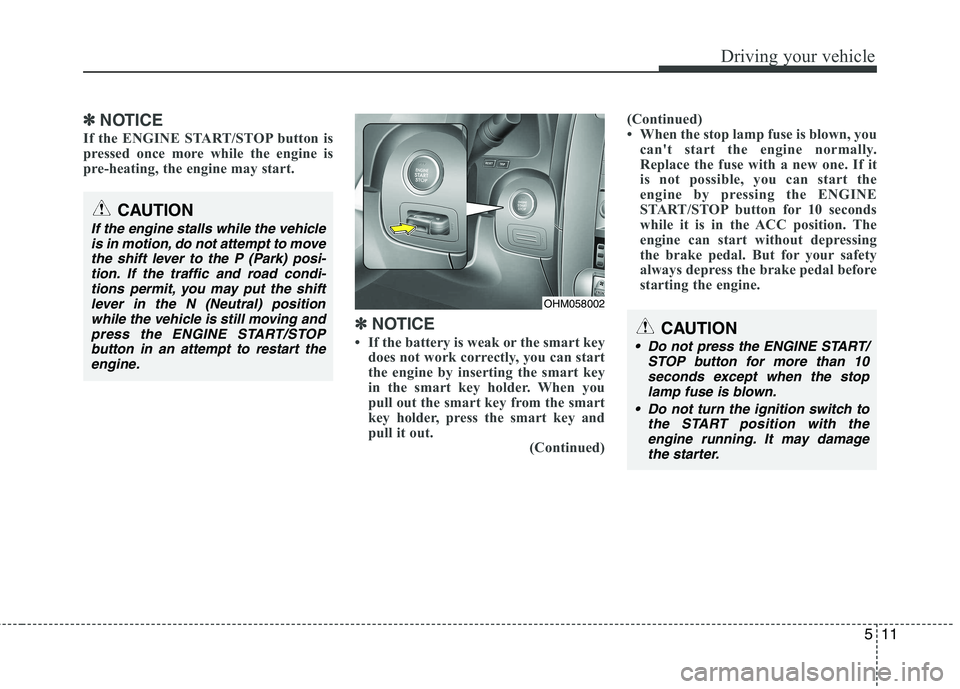
If the battery is weak or the smart key does not work correctly, you can start
the engine by inserting the smart key
in the smart key holder. When you
pull out the smart key from the smart
key holder, press the smart key and
pull it out. (Continued)(Continued)
When the stop lamp fuse is blown, you
can't start the engine normally.
Replace the fuse with a new one. If it
is not possible, you can start the
engine by pressing the ENGINE
START/STOP button for 10 seconds
while it is in the ACC position. The
engine can start without depressing
the brake pedal. But for your safety
always depress the brake pedal before
starting the engine.CAUTION
Do not press the ENGINE START/
STOP button for more than 10
seconds except when the stoplamp fuse is blown.
Do not turn the ignition switch to the START position with theengine running. It may damage
the starter.
OHM058002
CAUTION
If the engine stalls while the vehicle is in motion, do not attempt to move
the shift lever to the P (Park) posi-tion. If the traffic and road condi-tions permit, you may put the shiftlever in the N (Neutral) position
while the vehicle is still moving andpress the ENGINE START/STOPbutton in an attempt to restart theengine.
Page 257 of 417
Driving your vehicle
16
5
Ignition key interlock system
(if equipped)
The ignition key cannot be removed
unless the shift lever is in the P (Park)
position. If the ignition switch is in any
other position, the key cannot be
removed. E060200AHM Good driving practices
Never move the shift lever from P
(Park) or N (Neutral) to any other posi-
tion with the accelerator pedaldepressed.
Never move the shift lever into P (Park) when the vehicle is in motion.
Be sure the vehicle is completely stopped before you attempt to shift into
R (Reverse) or D (Drive).
Never take the vehicle out of gear and coast down a hill. This may be
extremely hazardous. Always leave the
vehicle in gear when moving.
Do not "ride" the brakes. This can cause them to overheat and malfunc-
tion. Instead, when you are driving
down a long hill, shift to a lower gear.
When you do this, engine braking will
help slow down the vehicle.
Slow down before shifting to a lower gear. Otherwise, the lower gear maynot be engaged. Always use the parking brake. Do not
depend on placing the transmission in P
(Park) to keep the vehicle from moving.
Exercise extreme caution when driving on a slippery surface. Be especially
careful when braking, accelerating or
shifting gears. On a slippery surface,
an abrupt change in vehicle speed can
cause the drive wheels to lose traction
and the vehicle to go out of control.
Optimum vehicle performance and economy is obtained by smoothly
depressing and releasing the accelera-tor pedal.
Page 298 of 417
557
Driving your vehicle
E120600AUN
To keep locks from freezing
To keep the locks from freezing, squirt an
approved de-icer fluid or glycerine into
the key opening. If a lock is covered with
ice, squirt it with an approved de-icing
fluid to remove the ice. If the lock is
frozen internally, you may be able to thaw
it out by using a heated key. Handle the
heated key with care to avoid injury.
E120700AUN
Use approved window washer
anti-freeze in system
To keep the water in the window washer
system from freezing, add an approved
window washer anti-freeze solution in
accordance with instructions on the con-
tainer. Window washer anti-freeze is
available from an authorized Kia dealer
and most auto parts outlets. Do not useengine coolant or other types of anti-
freeze as these may damage the paintfinish.E120800AHM
Don't let your parking brake
freeze
Under some conditions your parking
brake can freeze in the engaged position.
This is most likely to happen when there
is an accumulation of snow or ice around
or near the rear brakes or if the brakes
are wet. If there is a risk the parking
brake may freeze, apply it only temporar-
ily while you put the gear shift lever in P
(Park) and block the rear wheels so the
vehicle cannot roll. Then release the
parking brake.
E120900AUN
Don't let ice and snow accumu- late underneath
Under some conditions, snow and ice
can build up under the fenders and inter-
fere with the steering. When driving in
severe winter conditions where this may
happen, you should periodically check
underneath the vehicle to be sure the
movement of the front wheels and the
steering components is not obstructed.E121000ASA
Carry emergency equipment
Depending on the severity of the weath-
er, you should carry appropriate emer-
gency equipment. Some of the items you
may want to carry include tire chains, tow
straps or chains, flashlight, emergency
flares, sand, shovel, jumper cables, win-
dow scraper, gloves, ground cloth, cover-
alls, blanket, etc.
Page 377 of 417
Maintenance
50
7
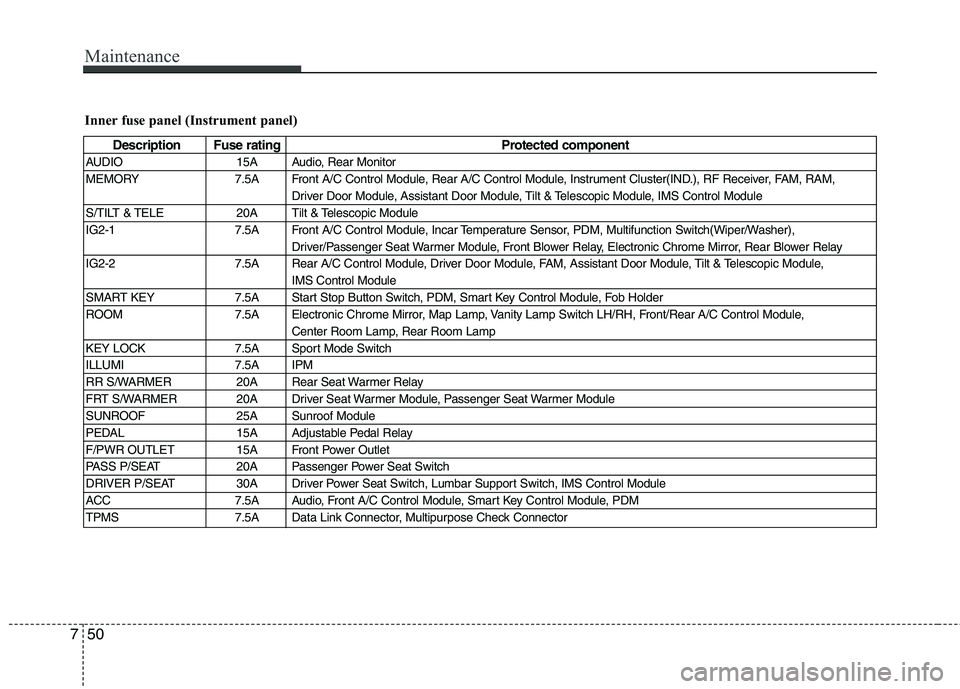
Inner fuse panel (Instrument panel)
Description Fuse rating Protected component
AUDIO 15A Audio, Rear Monitor
MEMORY 7.5A Front A/C Control Module, Rear A/C Control Module, Instrument Cluster(IND.), RF Receiver, FAM, RAM, Driver Door Module, Assistant Door Module, Tilt & Telescopic Module, IMS Control Module
S/TILT & TELE 20A Tilt & Telescopic Module
IG2-1 7.5A Front A/C Control Module, Incar Temperature Sensor, PDM, Multifunction Switch(Wiper/Washer), Driver/Passenger Seat Warmer Module, Front Blower Relay, Electronic Chrome Mirror, Rear Blower Relay
IG2-2 7.5A Rear A/C Control Module, Driver Door Module, FAM, Assistant Door Module, Tilt & Telescopic Module, IMS Control Module
SMART KEY 7.5A Start Stop Button Switch, PDM, Smart Key Control Module, Fob Holder
ROOM 7.5A Electronic Chrome Mirror, Map Lamp, Vanity Lamp Switch LH/RH, Front/Rear A/C Control Module, Center Room Lamp, Rear Room Lamp
KEY LOCK 7.5A Sport Mode Switch
ILLUMI 7.5A IPM
RR S/WARMER 20A Rear Seat Warmer Relay
FRT S/WARMER 20A Driver Seat Warmer Module, Passenger Seat Warmer Module
SUNROOF 25A Sunroof Module
PEDAL 15A Adjustable Pedal Relay
F/PWR OUTLET 15A Front Power Outlet
PASS P/SEAT 20A Passenger Power Seat Switch
DRIVER P/SEAT 30A Driver Power Seat Switch, Lumbar Support Switch, IMS Control Module
ACC 7.5A Audio, Front A/C Control Module, Smart Key Control Module, PDM
TPMS 7.5A Data Link Connector, Multipurpose Check Connector
Page 378 of 417
751
Maintenance
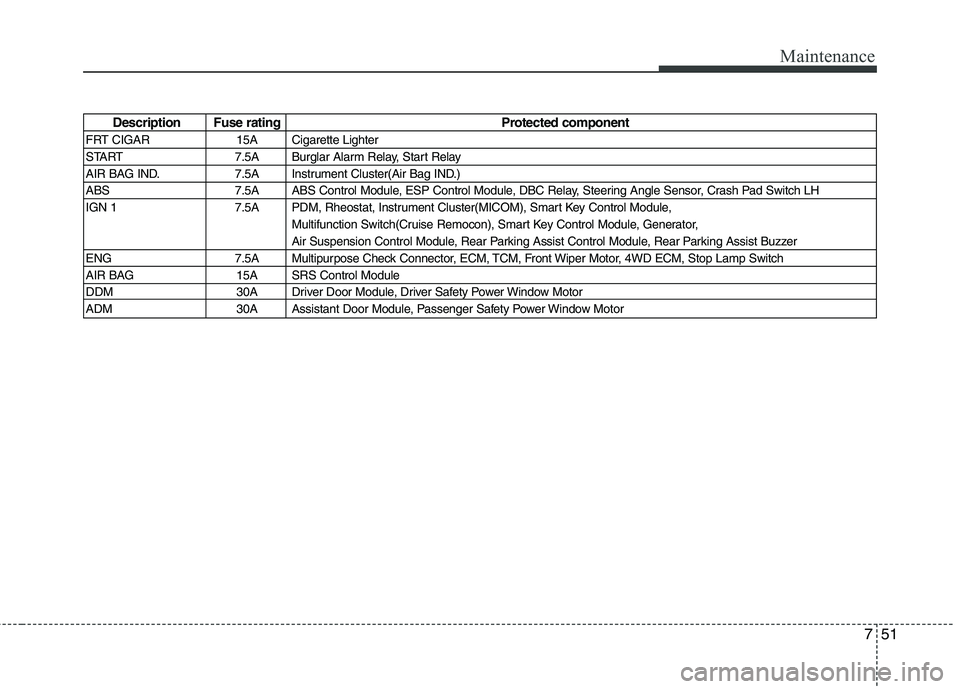
Description Fuse ratingProtected component
FRT CIGAR 15A Cigarette Lighter
START 7.5A Burglar Alarm Relay, Start Relay
AIR BAG IND. 7.5A Instrument Cluster(Air Bag IND.)
ABS 7.5A ABS Control Module, ESP Control Module, DBC Relay, Steering Angle Sensor, Crash Pad Switch LH
IGN 1 7.5A PDM, Rheostat, Instrument Cluster(MICOM), Smart Key Control Module, Multifunction Switch(Cruise Remocon), Smart Key Control Module, Generator,
Air Suspension Control Module, Rear Parking Assist Control Module, Rear Parking Assist Buzzer
ENG 7.5A Multipurpose Check Connector, ECM, TCM, Front Wiper Motor, 4WD ECM, Stop Lamp Switch
AIR BAG 15A SRS Control Module
DDM 30A Driver Door Module, Driver Safety Power Window Motor
ADM 30A Assistant Door Module, Passenger Safety Power Window Motor
Page 380 of 417
753
Maintenance
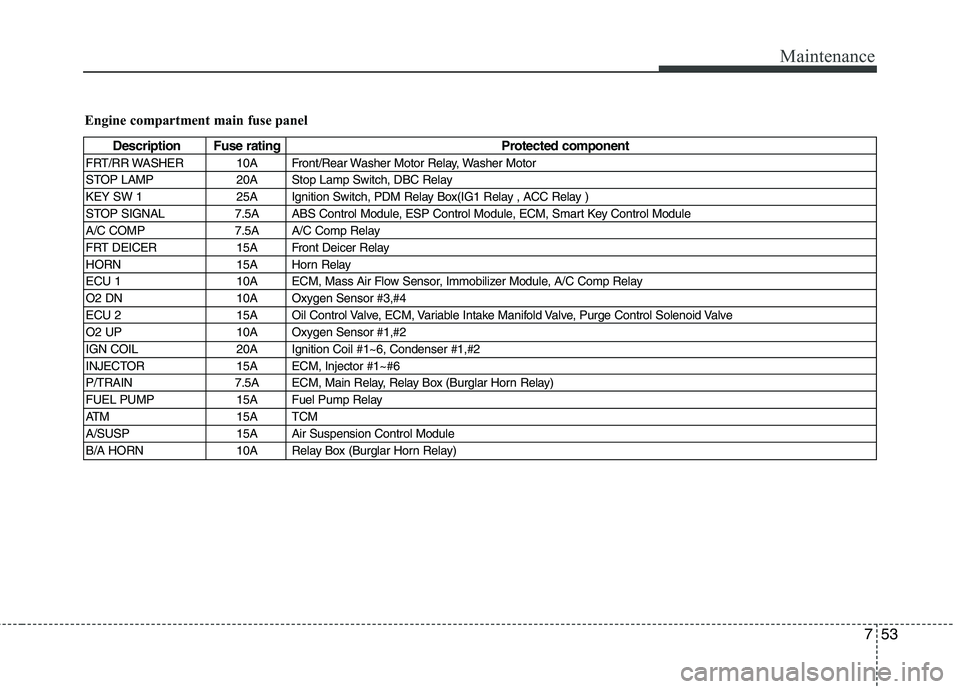
Engine compartment main fuse panel
Description Fuse ratingProtected component
FRT/RR WASHER 10A Front/Rear Washer Motor Relay, Washer Motor
STOP LAMP 20A Stop Lamp Switch, DBC Relay
KEY SW 1 25A Ignition Switch, PDM Relay Box(IG1 Relay , ACC Relay )
STOP SIGNAL 7.5A ABS Control Module, ESP Control Module, ECM, Smart Key Control Module
A/C COMP 7.5A A/C Comp Relay
FRT DEICER 15A Front Deicer Relay
HORN 15A Horn Relay
ECU 1 10A ECM, Mass Air Flow Sensor, Immobilizer Module, A/C Comp Relay
O2 DN 10A Oxygen Sensor #3,#4
ECU 2 15A Oil Control Valve, ECM, Variable Intake Manifold Valve, Purge Control Solenoid Valve
O2 UP 10A Oxygen Sensor #1,#2
IGN COIL 20A Ignition Coil #1~6, Condenser #1,#2
INJECTOR 15A ECM, Injector #1~#6
P/TRAIN 7.5A ECM, Main Relay, Relay Box (Burglar Horn Relay)
FUEL PUMP 15A Fuel Pump Relay
ATM 15A TCM
A/SUSP 15A Air Suspension Control Module
B/A HORN 10A Relay Box (Burglar Horn Relay)
Page 381 of 417
Maintenance
54
7
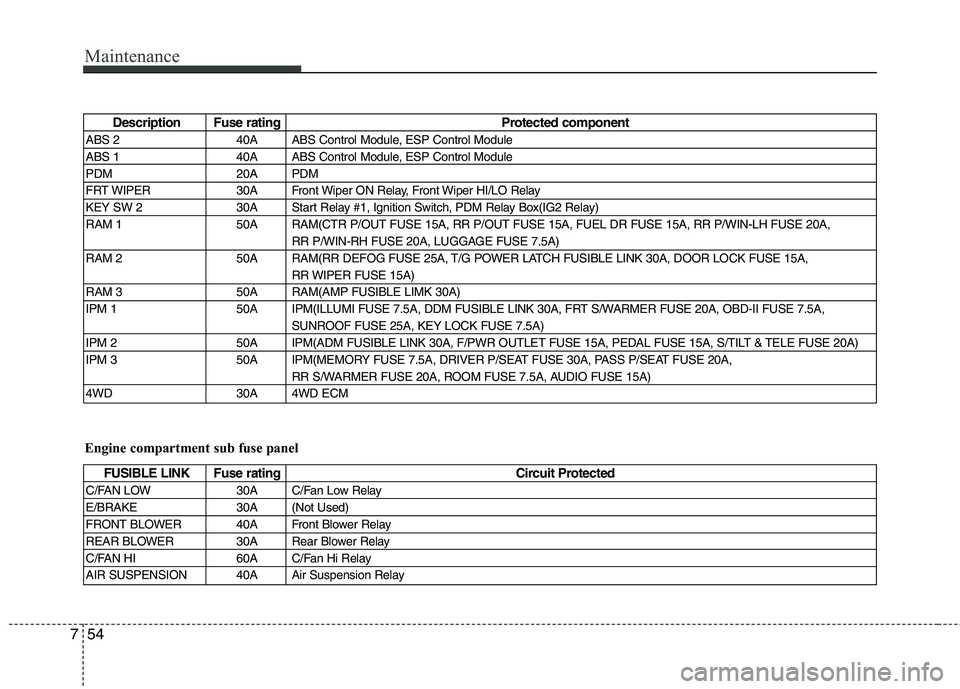
Description Fuse rating Protected component
ABS 2 40A ABS Control Module, ESP Control Module
ABS 1 40A ABS Control Module, ESP Control Module
PDM 20A PDM
FRT WIPER 30A Front Wiper ON Relay, Front Wiper HI/LO Relay
KEY SW 2 30A Start Relay #1, Ignition Switch, PDM Relay Box(IG2 Relay)
RAM 1 50A RAM(CTR P/OUT FUSE 15A, RR P/OUT FUSE 15A, FUEL DR FUSE 15A, RR P/WIN-LH FUSE 20A, RR P/WIN-RH FUSE 20A, LUGGAGE FUSE 7.5A)
RAM 2 50A RAM(RR DEFOG FUSE 25A, T/G POWER LATCH FUSIBLE LINK 30A, DOOR LOCK FUSE 15A, RR WIPER FUSE 15A)
RAM 3 50A RAM(AMP FUSIBLE LIMK 30A)
IPM 1 50A IPM(ILLUMI FUSE 7.5A, DDM FUSIBLE LINK 30A, FRT S/WARMER FUSE 20A, OBD-II FUSE 7.5A, SUNROOF FUSE 25A, KEY LOCK FUSE 7.5A)
IPM 2 50A IPM(ADM FUSIBLE LINK 30A, F/PWR OUTLET FUSE 15A, PEDAL FUSE 15A, S/TILT & TELE FUSE 20A)
IPM 3 50A IPM(MEMORY FUSE 7.5A, DRIVER P/SEAT FUSE 30A, PASS P/SEAT FUSE 20A, RR S/WARMER FUSE 20A, ROOM FUSE 7.5A, AUDIO FUSE 15A)
4WD 30A 4WD ECM
Engine compartment sub fuse panel
FUSIBLE LINK Fuse rating Circuit Protected
C/FAN LOW 30A C/Fan Low Relay
E/BRAKE 30A (Not Used)
FRONT BLOWER 40A Front Blower Relay
REAR BLOWER 30A Rear Blower Relay
C/FAN HI 60A C/Fan Hi Relay
AIR SUSPENSION 40A Air Suspension Relay