climate control KIA MORNING 2015 Owner's Manual
[x] Cancel search | Manufacturer: KIA, Model Year: 2015, Model line: MORNING, Model: KIA MORNING 2015Pages: 420, PDF Size: 42.6 MB
Page 340 of 420
713
Maintenance
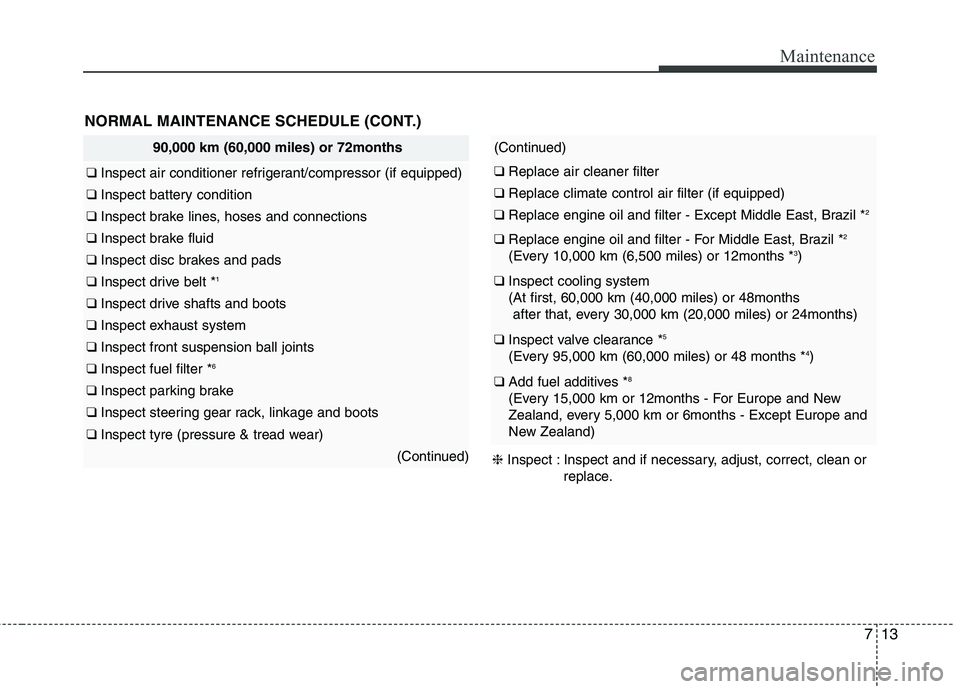
NORMAL MAINTENANCE SCHEDULE (CONT.)
90,000 km (60,000 miles) or 72months
❑ Inspect air conditioner refrigerant/compressor (if equipped)
❑ Inspect battery condition
❑ Inspect brake lines, hoses and connections
❑ Inspect brake fluid
❑ Inspect disc brakes and pads
❑ Inspect drive belt *1
❑ Inspect drive shafts and boots
❑ Inspect exhaust system
❑ Inspect front suspension ball joints
❑ Inspect fuel filter *6
❑ Inspect parking brake
❑ Inspect steering gear rack, linkage and boots
❑ Inspect tyre (pressure & tread wear)
(Continued)
(Continued)
❑ Replace air cleaner filter
❑ Replace climate control air filter (if equipped)
❑ Replace engine oil and filter - Except Middle East, Brazil *2
❑ Replace engine oil and filter - For Middle East, Brazil *2
(Every 10,000 km (6,500 miles) or 12months *3)
❑ Inspect cooling system
(At first, 60,000 km (40,000 miles) or 48months
after that, every 30,000 km (20,000 miles) or 24months)
❑ Inspect valve clearance *5
(Every 95,000 km (60,000 miles) or 48 months *4)
❑ Add fuel additives *8
(Every 15,000 km or 12months - For Europe and New
Zealand, every 5,000 km or 6months - Except Europe and
New Zealand)
❈Inspect : Inspect and if necessary, adjust, correct, clean or
replace.
Page 341 of 420
Maintenance
14 7
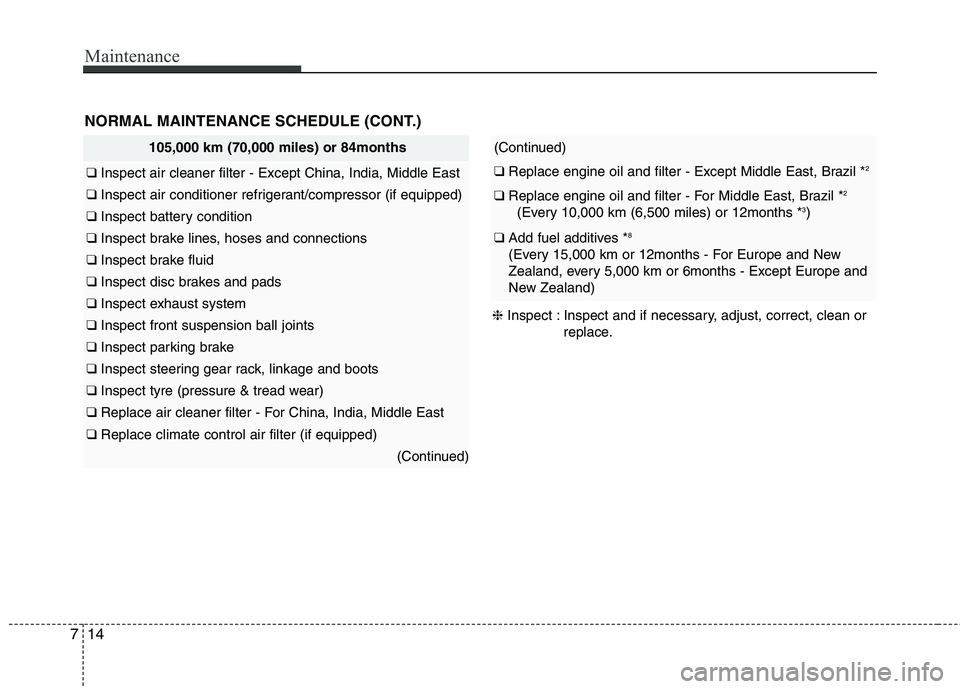
105,000 km (70,000 miles) or 84months
❑ Inspect air cleaner filter - Except China, India, Middle East
❑ Inspect air conditioner refrigerant/compressor (if equipped)
❑ Inspect battery condition
❑ Inspect brake lines, hoses and connections
❑ Inspect brake fluid
❑ Inspect disc brakes and pads
❑ Inspect exhaust system
❑ Inspect front suspension ball joints
❑ Inspect parking brake
❑ Inspect steering gear rack, linkage and boots
❑ Inspect tyre (pressure & tread wear)
❑ Replace air cleaner filter - For China, India, Middle East
❑ Replace climate control air filter (if equipped)
(Continued)
NORMAL MAINTENANCE SCHEDULE (CONT.)
(Continued)
❑ Replace engine oil and filter - Except Middle East, Brazil *2
❑ Replace engine oil and filter - For Middle East, Brazil *2
(Every 10,000 km (6,500 miles) or 12months *3)
❑ Add fuel additives *8
(Every 15,000 km or 12months - For Europe and New
Zealand, every 5,000 km or 6months - Except Europe and
New Zealand)
❈Inspect : Inspect and if necessary, adjust, correct, clean or
replace.
Page 342 of 420
715
Maintenance
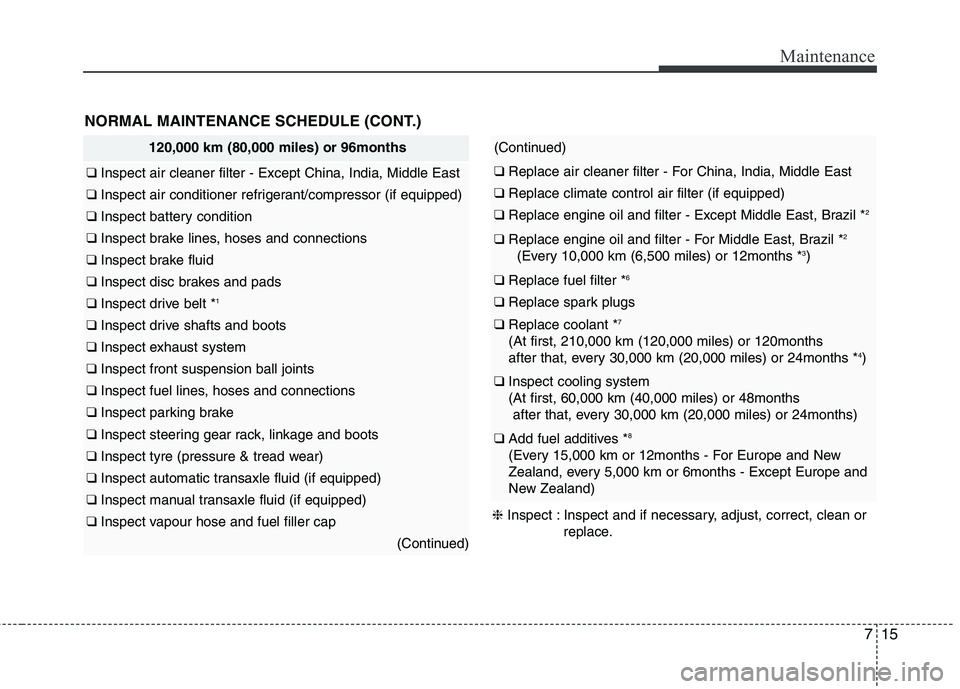
NORMAL MAINTENANCE SCHEDULE (CONT.)
120,000 km (80,000 miles) or 96months
❑ Inspect air cleaner filter - Except China, India, Middle East
❑ Inspect air conditioner refrigerant/compressor (if equipped)
❑ Inspect battery condition
❑ Inspect brake lines, hoses and connections
❑ Inspect brake fluid
❑ Inspect disc brakes and pads
❑ Inspect drive belt *1
❑ Inspect drive shafts and boots
❑ Inspect exhaust system
❑ Inspect front suspension ball joints
❑ Inspect fuel lines, hoses and connections
❑ Inspect parking brake
❑ Inspect steering gear rack, linkage and boots
❑ Inspect tyre (pressure & tread wear)
❑ Inspect automatic transaxle fluid (if equipped)
❑ Inspect manual transaxle fluid (if equipped)
❑ Inspect vapour hose and fuel filler cap
(Continued)
(Continued)
❑ Replace air cleaner filter - For China, India, Middle East
❑ Replace climate control air filter (if equipped)
❑ Replace engine oil and filter - Except Middle East, Brazil *2
❑ Replace engine oil and filter - For Middle East, Brazil *2
(Every 10,000 km (6,500 miles) or 12months *3)
❑ Replace fuel filter *6
❑ Replace spark plugs
❑ Replace coolant *7
(At first, 210,000 km (120,000 miles) or 120months
after that, every 30,000 km (20,000 miles) or 24months *4)
❑ Inspect cooling system
(At first, 60,000 km (40,000 miles) or 48months
after that, every 30,000 km (20,000 miles) or 24months)
❑ Add fuel additives *8
(Every 15,000 km or 12months - For Europe and New
Zealand, every 5,000 km or 6months - Except Europe and
New Zealand)
❈Inspect : Inspect and if necessary, adjust, correct, clean or
replace.
Page 344 of 420
717
Maintenance
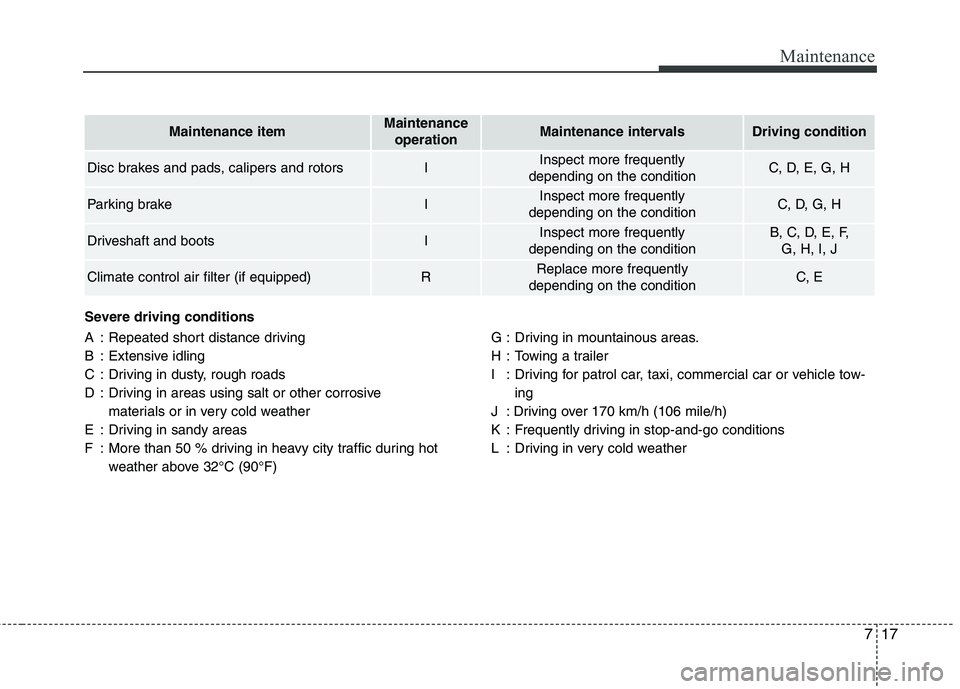
Severe driving conditions
A : Repeated short distance driving
B : Extensive idling
C : Driving in dusty, rough roads
D : Driving in areas using salt or other corrosive
materials or in very cold weather
E : Driving in sandy areas
F : More than 50 % driving in heavy city traffic during hot
weather above 32°C (90°F)G : Driving in mountainous areas.
H : Towing a trailer
I : Driving for patrol car, taxi, commercial car or vehicle tow-
ing
J : Driving over 170 km/h (106 mile/h)
K : Frequently driving in stop-and-go conditions
L : Driving in very cold weather
Maintenance itemMaintenance
operationMaintenance intervalsDriving condition
Disc brakes and pads, calipers and rotorsIInspect more frequently
depending on the conditionC, D, E, G, H
Parking brakeIInspect more frequently
depending on the conditionC, D, G, H
Driveshaft and bootsIInspect more frequently
depending on the conditionB, C, D, E, F,
G, H, I, J
Climate control air filter (if equipped)RReplace more frequently
depending on the conditionC, E
Page 350 of 420
723
Maintenance
ENGINE COOLANT
The high-pressure cooling system has a
reservoir filled with year-round antifreeze
coolant. The reservoir is filled at the fac-
tory.
Check the antifreeze protection and
coolant level at least once a year, at the
beginning of the winter season, and
before travelling to a colder climate.Checking the coolant level
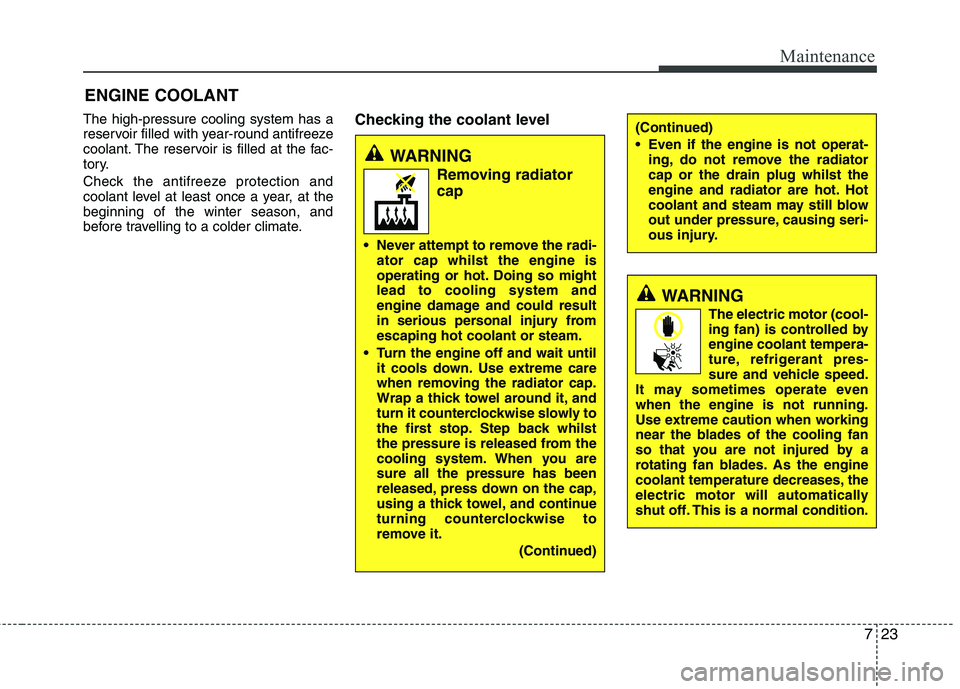
WARNING
Removing radiator
cap
Never attempt to remove the radi-
ator cap whilst the engine is
operating or hot. Doing so might
lead to cooling system and
engine damage and could result
in serious personal injury from
escaping hot coolant or steam.
Turn the engine off and wait until
it cools down. Use extreme care
when removing the radiator cap.
Wrap a thick towel around it, and
turn it counterclockwise slowly to
the first stop. Step back whilst
the pressure is released from the
cooling system. When you are
sure all the pressure has been
released, press down on the cap,
using a thick towel, and continue
turning counterclockwise to
remove it.
(Continued)
(Continued)
Even if the engine is not operat-
ing, do not remove the radiator
cap or the drain plug whilst the
engine and radiator are hot. Hot
coolant and steam may still blow
out under pressure, causing seri-
ous injury.
WARNING
The electric motor (cool-
ing fan) is controlled by
engine coolant tempera-
ture, refrigerant pres-
sure and vehicle speed.
It may sometimes operate even
when the engine is not running.
Use extreme caution when working
near the blades of the cooling fan
so that you are not injured by a
rotating fan blades. As the engine
coolant temperature decreases, the
electric motor will automatically
shut off. This is a normal condition.
Page 359 of 420
Maintenance
32 7
CLIMATE CONTROL AIR FILTER
Filter inspection
The climate control air filter should be
replaced according to the maintenance
schedule. If the vehicle is operated in the
severely air-polluted cities or on dusty
rough roads for a long period, it should
be inspected more frequently and
replaced earlier. When you, the owner,
replace the climate control air filter,
replace it performing the following proce-
dure, and be careful to avoid damaging
other components.
Replace the filter according to the main-
tenance Schedule.
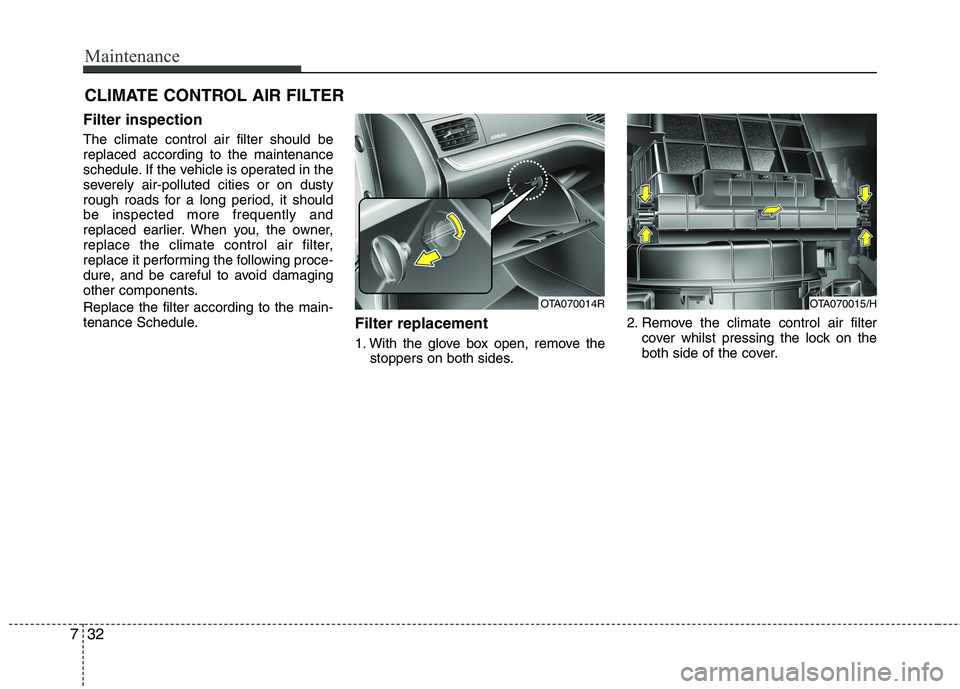
Filter replacement
1. With the glove box open, remove the
stoppers on both sides.2. Remove the climate control air filter
cover whilst pressing the lock on the
both side of the cover.
OTA070015/HOTA070014R
Page 360 of 420
733
Maintenance
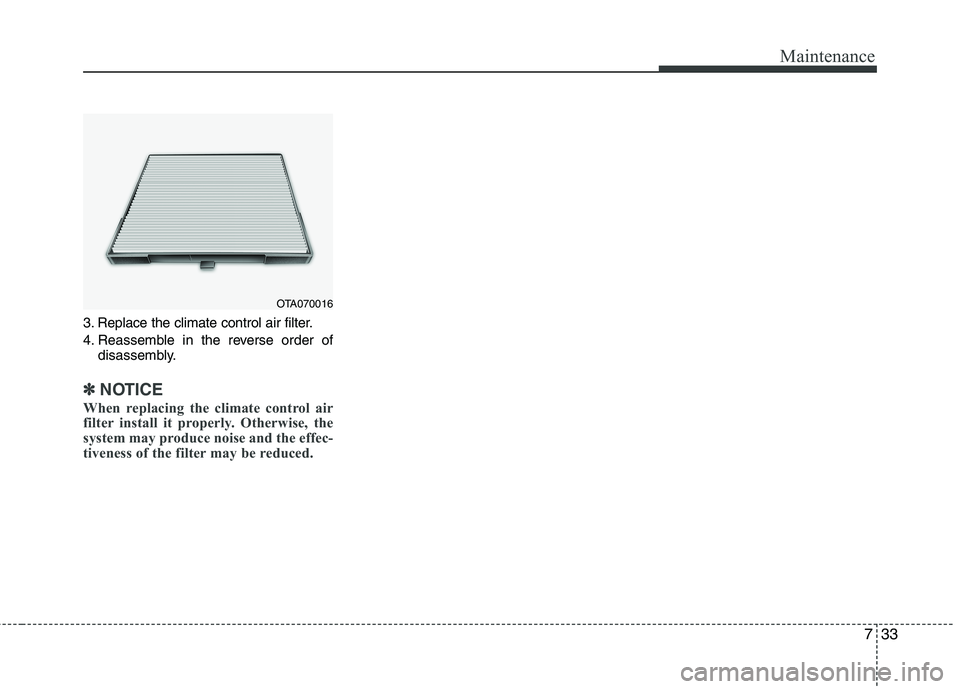
3. Replace the climate control air filter.
4. Reassemble in the reverse order of
disassembly.
✽ ✽
NOTICE
When replacing the climate control air
filter install it properly. Otherwise, the
system may produce noise and the effec-
tiveness of the filter may be reduced.
OTA070016
Page 366 of 420
739
Maintenance
Reset items
Items should be reset after the battery
has been discharged or the battery has
been disconnected.
Auto up/down window (See section 4)
Sunroof (See section 4)
Trip computer (See section 4)
Climate control system
(See section 4)
Clock (See section 4)
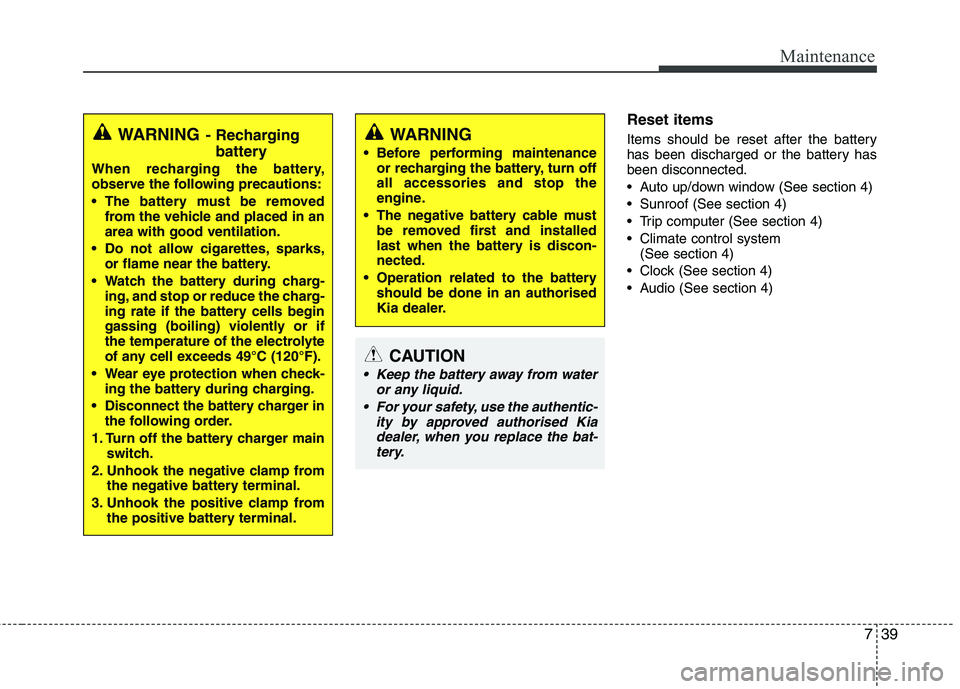
Audio (See section 4)WARNING
Before performing maintenance
or recharging the battery, turn off
all accessories and stop the
engine.
The negative battery cable must
be removed first and installed
last when the battery is discon-
nected.
Operation related to the battery
should be done in an authorised
Kia dealer.
CAUTION
Keep the battery away from water
or any liquid.
For your safety, use the authentic-
ity by approved authorised Kia
dealer, when you replace the bat-
tery.
WARNING- Recharging
battery
When recharging the battery,
observe the following precautions:
The battery must be removed
from the vehicle and placed in an
area with good ventilation.
Do not allow cigarettes, sparks,
or flame near the battery.
Watch the battery during charg-
ing, and stop or reduce the charg-
ing rate if the battery cells begin
gassing (boiling) violently or if
the temperature of the electrolyte
of any cell exceeds 49°C (120°F).
Wear eye protection when check-
ing the battery during charging.
Disconnect the battery charger in
the following order.
1. Turn off the battery charger main
switch.
2. Unhook the negative clamp from
the negative battery terminal.
3. Unhook the positive clamp from
the positive battery terminal.
Page 375 of 420
Maintenance
48 7
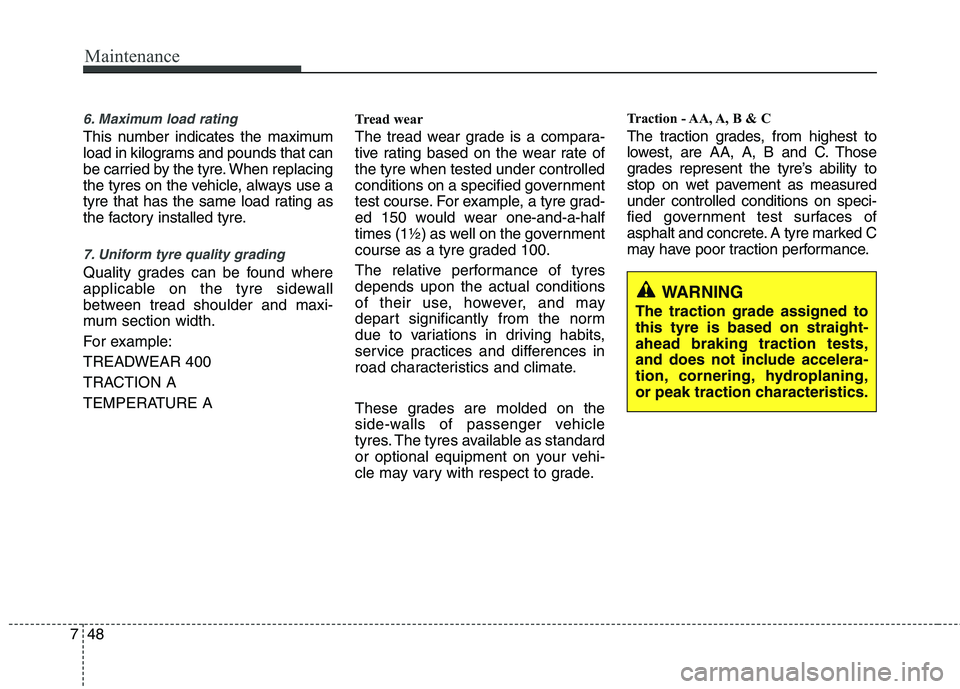
6. Maximum load rating
This number indicates the maximum
load in kilograms and pounds that can
be carried by the tyre. When replacing
the tyres on the vehicle, always use a
tyre that has the same load rating as
the factory installed tyre.
7. Uniform tyre quality grading
Quality grades can be found where
applicable on the tyre sidewall
between tread shoulder and maxi-
mum section width.
For example:
TREADWEAR 400
TRACTION A
TEMPERATURE A
Tread wear
The tread wear grade is a compara-
tive rating based on the wear rate of
the tyre when tested under controlled
conditions on a specified government
test course. For example, a tyre grad-
ed 150 would wear one-and-a-half
times (1½) as well on the government
course as a tyre graded 100.
The relative performance of tyres
depends upon the actual conditions
of their use, however, and may
depart significantly from the norm
due to variations in driving habits,
service practices and differences in
road characteristics and climate.
These grades are molded on the
side-walls of passenger vehicle
tyres. The tyres available as standard
or optional equipment on your vehi-
cle may vary with respect to grade.
Traction - AA, A, B & C
The traction grades, from highest to
lowest, are AA, A, B and C. Those
grades represent the tyre’s ability to
stop on wet pavement as measured
under controlled conditions on speci-
fied government test surfaces of
asphalt and concrete. A tyre marked C
may have poor traction performance.
WARNING
The traction grade assigned to
this tyre is based on straight-
ahead braking traction tests,
and does not include accelera-
tion, cornering, hydroplaning,
or peak traction characteristics.
Page 413 of 420
Index
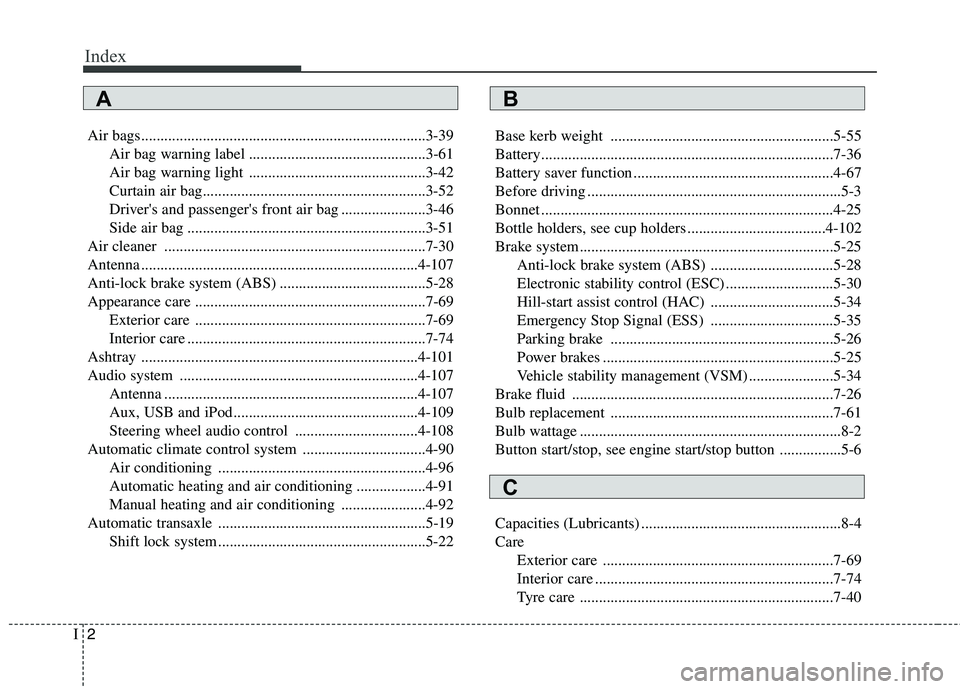
2I
Air bags..........................................................................3-39
Air bag warning label ..............................................3-61
Air bag warning light ..............................................3-42
Curtain air bag..........................................................3-52
Driver's and passenger's front air bag ......................3-46
Side air bag ..............................................................3-51
Air cleaner ....................................................................7-30
Antenna ........................................................................4-107
Anti-lock brake system (ABS) ......................................5-28
Appearance care ............................................................7-69
Exterior care ............................................................7-69
Interior care ..............................................................7-74
Ashtray ........................................................................4-101
Audio system ..............................................................4-107
Antenna ..................................................................4-107
Aux, USB and iPod................................................4-109
Steering wheel audio control ................................4-108
Automatic climate control system ................................4-90
Air conditioning ......................................................4-96
Automatic heating and air conditioning ..................4-91
Manual heating and air conditioning ......................4-92
Automatic transaxle ......................................................5-19
Shift lock system ......................................................5-22Base kerb weight ..........................................................5-55
Battery............................................................................7-36
Battery saver function ....................................................4-67
Before driving ..................................................................5-3
Bonnet ............................................................................4-25
Bottle holders, see cup holders ....................................4-102
Brake system..................................................................5-25
Anti-lock brake system (ABS) ................................5-28
Electronic stability control (ESC) ............................5-30
Hill-start assist control (HAC) ................................5-34
Emergency Stop Signal (ESS) ................................5-35
Parking brake ..........................................................5-26
Power brakes ............................................................5-25
Vehicle stability management (VSM) ......................5-34
Brake fluid ....................................................................7-26
Bulb replacement ..........................................................7-61
Bulb wattage ....................................................................8-2
Button start/stop, see engine start/stop button ................5-6
Capacities (Lubricants) ....................................................8-4
Care
Exterior care ............................................................7-69
Interior care ..............................................................7-74
Tyre care ..................................................................7-40
AB
C