engine overheat KIA NIRO 2017 User Guide
[x] Cancel search | Manufacturer: KIA, Model Year: 2017, Model line: NIRO, Model: KIA NIRO 2017Pages: 552, PDF Size: 14.92 MB
Page 369 of 552
681
Driving your vehicle
Rocking the vehicle
If it is necessary to rock the vehicle
to free it from snow, sand, or mud,
first turn the steering wheel right and
left to clear the area around your
front wheels. Then, shift back and
forth between R (Reverse) and any
forward gear in vehicles equipped
with a dual clutch transmission. Do
not race the engine, and spin the
wheels as little as possible. If you are
still stuck after a few tries, have the
vehicle pulled out by a tow vehicle to
avoid engine overheating and possi-
ble damage to the transaxle.
WARNING- Sudden
Vehicle Movement
Do not attempt to rock the vehi-
cle if people or objects are near-
by. The vehicle may suddenly
move forward or backwards as it
becomes unstuck.
WARNING
Your vehicle is equipped with
tires designed to provide safe
ride and handling capability. Do
not use a size and type of tire
and wheel that is different from
the one that is originally
installed on your vehicle. It can
affect the safety and perform-
ance of your vehicle, which
could lead to steering failure or
rollover and serious injury.
When replacing the tires, be
sure to equip all four tires with
the tire and wheel of the same
size, type, tread, brand and
load-carrying capacity. If you
nevertheless decide to equip
your vehicle with any tire/wheel
combination not recommended
by Kia for off road driving, you
should not use these tires for
highway driving.
WARNING - Rollover
Reduce speed when you turn
corners. The center of gravity of
AWD vehicles is higher than
that of conventional FWD vehi-
cles, making them more likely to
roll over when you turn corners
too fast.
Page 370 of 552
Driving your vehicle
82
6
The ESC system should be turned
OFF prior to rocking the vehicle.
Smooth cornering
Avoid braking or gear changing in
corners, especially when roads are
wet. Ideally, corners should always
be taken under gentle acceleration. If
you follow these suggestions, tire
wear will be held to a minimum.
Driving at night
Because night driving presents more
hazards than driving in the daylight,
here are some important tips to
remember:
Slow down and keep more dis-
tance between you and other vehi-
cles, as it may be more difficult to
see at night, especially in areas
where there may not be any street
lights.
Adjust your mirrors to reduce the glare from other driver's head-
lights.
Keep your headlights clean and properly aimed. (On vehicles not
equipped with the automatic head-
light aiming feature.) Dirty or
improperly aimed headlights will
make it much more difficult to see
at night.
Avoid staring directly at the head- lights of oncoming vehicles. You
could be temporarily blinded, and it
will take several seconds for your
eyes to readjust to the darkness.CAUTION- Vehicle rocking
Prolonged rocking may causeengine overheating, transaxledamage or failure, and tire dam-age.
CAUTION- Spinning tires
Do not spin the wheels, espe-cially at speeds more than 35mph (56 km/h). Spinning thewheels at high speeds when thevehicle is stationary couldcause a tire to overheat whichcould result in tire damage thatmay injure bystanders.
Page 372 of 552
Driving your vehicle
84
6
Highway driving
Tires
Adjust the tire inflation pressures to
specification. Low tire inflation pres-
sures will result in overheating and
possible failure of the tires.
Avoid using worn or damaged tires
which may result in reduced traction
or tire failure.
Never exceed the maximum tire
inflation pressure shown on the tires.
Fuel, engine coolant and engine oil
High speed travel consumes more
fuel than urban motoring. Do not for-
get to check both the engine coolant
and engine oil.
Drive belt
A loose or damaged drive belt may
result in overheating of the engine.
WARNING- Under/over
inflated tires
Always check the tires for proper
inflation before driving.
Underinflated or overinflated
tires can cause poor handling,
loss of vehicle control, and sud-
den tire failure leading to acci-
dents, injuries, and even death.
For proper tire pressures, refer to
“Tires and wheels” in chapter 9.
WARNING- Tire tread
Always check the tire tread
before driving your vehicle.
Worn-out tires can result in loss
of vehicle control. Worn-out tires
should be replaced as soon as
possible. For further information
and tread limits, refer to "Tires
and wheels" in chapter 8.
Page 382 of 552

What to do in an emergency
Road warning . . . . . . . . . . . . . . . . . . . . . . . . . . . . . . 7-2
• Hazard warning flasher . . . . . . . . . . . . . . . . . . . . . . . . 7-2
In case of an emergency while driving . . . . . . . . . . 7-3
• If the engine stalls at a crossroad or crossing. . . . . . . 7-3
• If you have a flat tire while driving . . . . . . . . . . . . . . . 7-3
• If the engine stalls while driving . . . . . . . . . . . . . . . . . 7-3
If the engine will not start . . . . . . . . . . . . . . . . . . . . 7-4
• If engine doesn't turn over or turns over slowly . . . . 7-4
• If engine turns over normally but does not start . . . . 7-4
Emergency starting . . . . . . . . . . . . . . . . . . . . . . . . . 7-5
• Before Jump Starting . . . . . . . . . . . . . . . . . . . . . . . . . . 7-5
• Method to disconnect the (-) cable for regularmaintenance . . . . . . . . . . . . . . . . . . . . . . . . . . . . . . . . . 7-7
• Jump starting . . . . . . . . . . . . . . . . . . . . . . . . . . . . . . . . . 7-7
• Push-starting . . . . . . . . . . . . . . . . . . . . . . . . . . . . . . . . . 7-9
If the engine overheats . . . . . . . . . . . . . . . . . . . . . . 7-10
Tire Pressure Monitoring System (TPMS) . . . . . 7-12
• Check tire pressure . . . . . . . . . . . . . . . . . . . . . . . . . . . 7-12
• Low tire pressure telltale . . . . . . . . . . . . . . . . . . . . . . 7-14
• Low tire pressure position telltale . . . . . . . . . . . . . . . 7-14
• Changing a tire with TPMS . . . . . . . . . . . . . . . . . . . . 7-16
• This device complies with Part 15 of the FCC rules. . . 7-17
If you have a flat tire (with spare tire) . . . . . . . . . 7-18
• Jack and tools . . . . . . . . . . . . . . . . . . . . . . . . . . . . . . . 7-18
• Removing and storing the spare tire . . . . . . . . . . . . . 7-19
• Changing tires . . . . . . . . . . . . . . . . . . . . . . . . . . . . . . . 7-20
If you have a flat tire (With Tire Mobility Kit). . 7-27
• Introduction . . . . . . . . . . . . . . . . . . . . . . . . . . . . . . . . . 7-27
• Notes on the safe use of the Tire Mobility Kit . . . . . 7-28
• Components of the Tire Mobility Kit . . . . . . . . . . . . 7-29
• Using the Tire Mobility Kit . . . . . . . . . . . . . . . . . . . . 7-31
• Distributing the sealant. . . . . . . . . . . . . . . . . . . . . . . . 7-34
• Checking the tire inflation pressure . . . . . . . . . . . . . 7-35
• Technical Data (16 inch tire) . . . . . . . . . . . . . . . . . . . 7-36
• Technical Data (18 inch tire) . . . . . . . . . . . . . . . . . . . 7-36
Towing . . . . . . . . . . . . . . . . . . . . . . . . . . . . . . . . . . 7-37\
• Towing service . . . . . . . . . . . . . . . . . . . . . . . . . . . . . . . 7-37
• Removable towing hook . . . . . . . . . . . . . . . . . . . . . . . 7-38
Emergency towing . . . . . . . . . . . . . . . . . . . . . . . . . . . . . 7-39
If an accident occurs . . . . . . . . . . . . . . . . . . . . . . . 7-427
Page 389 of 552
What to do in an emergency
87
CAUTION - Push/pull start
to 12 Volt Battery
Use only a 12-volt jumper sys- tem. You can damage a 12-voltstarting motor, ignition system,and other electrical partsbeyond repair by use of a 24-volt power supply (either two12-volt batteries in series or a24-volt motor generator set).
WARNING- Battery
Never attempt to check the elec-
trolyte level of the battery as
this may cause the battery to
rupture or explode.
WARNING- Frozen batteries
Do not attempt to jump start the
vehicle if the discharged battery
is frozen as the battery may
rupture or explode.
WARNING- Battery cables
Do not connect the jumper cable
from the negative terminal of the
booster battery to the negative
terminal of the discharged bat-
tery, directly. This can cause the
discharged battery to overheat
and crack, degradation.
Connect the jumper cable from
the negative terminal of the
booster battery to the chassis
ground in the engine room.WARNING- Electrolyte
• Do not charge or discharge arbitrarily. It may lead to fault,
electric shock or burns.
Do not damage the unit in such ways as drop, deform,
impact, out or spear with a
sharp object. It may cause
electrolyte leakage or fire.
Breakdown of the unit may lead to electrolyte leakage or flam-
mable gas generation. Contact
service center immediately.
When electrolyte leak out, avoid contact with eyes, skin
or clothes. In event of acci-
dent, flush with water and get
medical help immediately.
Do not place near open flame or incinerate. It may lead to
fire or explosion.
Keep out of reach of children or animals.
Keep the unit away from mois- ture of liquid. Do not touch or
use if liquids have been
spilled on.
Page 391 of 552
What to do in an emergency
10
7
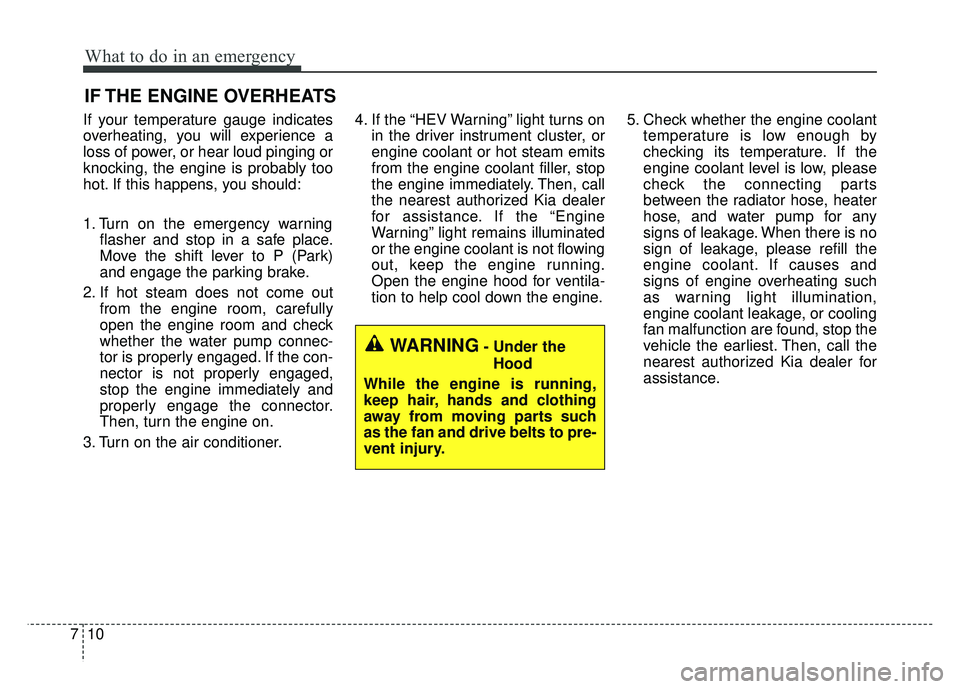
IF THE ENGINE OVERHEATS
If your temperature gauge indicates
overheating, you will experience a
loss of power, or hear loud pinging or
knocking, the engine is probably too
hot. If this happens, you should:
1. Turn on the emergency warning
flasher and stop in a safe place.
Move the shift lever to P (Park)
and engage the parking brake.
2. If hot steam does not come out from the engine room, carefully
open the engine room and check
whether the water pump connec-
tor is properly engaged. If the con-
nector is not properly engaged,
stop the engine immediately and
properly engage the connector.
Then, turn the engine on.
3. Turn on the air conditioner. 4. If the “HEV Warning” light turns on
in the driver instrument cluster, or
engine coolant or hot steam emits
from the engine coolant filler, stop
the engine immediately. Then, call
the nearest authorized Kia dealer
for assistance. If the “Engine
Warning” light remains illuminated
or the engine coolant is not flowing
out, keep the engine running.
Open the engine hood for ventila-
tion to help cool down the engine. 5. Check whether the engine coolant
temperature is low enough by
checking its temperature. If the
engine coolant level is low, please
check the connecting parts
between the radiator hose, heater
hose, and water pump for any
signs of leakage. When there is no
sign of leakage, please refill the
engine coolant. If causes and
signs of engine overheating such
as warning light illumination,
engine coolant leakage, or cooling
fan malfunction are found, stop the
vehicle the earliest. Then, call the
nearest authorized Kia dealer for
assistance.
WARNING- Under the
Hood
While the engine is running,
keep hair, hands and clothing
away from moving parts such
as the fan and drive belts to pre-
vent injury.
Page 392 of 552
711
What to do in an emergency
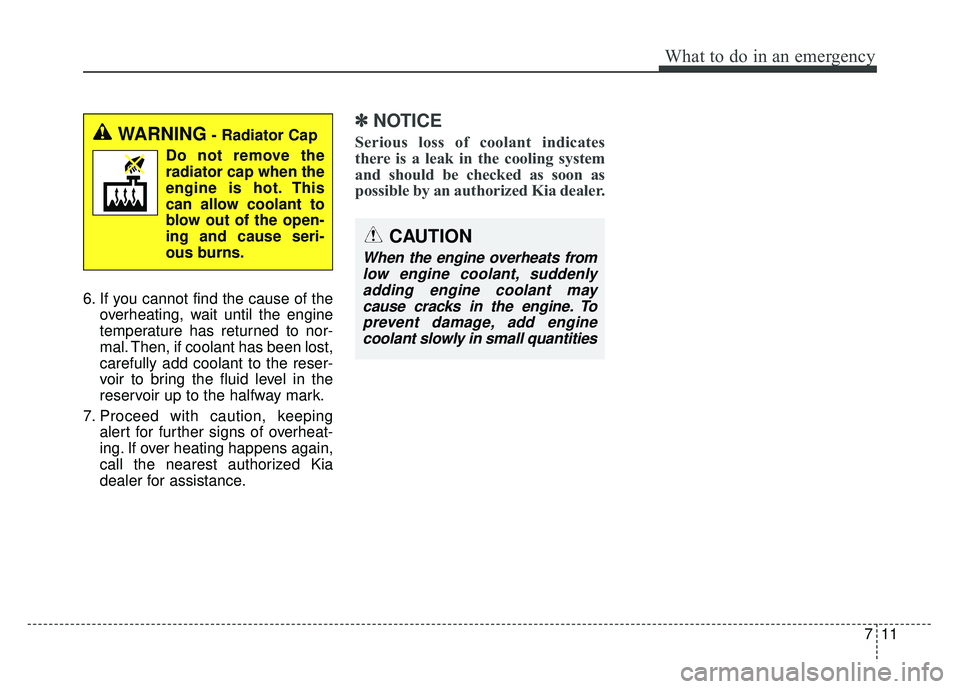
6. If you cannot find the cause of theoverheating, wait until the engine
temperature has returned to nor-
mal. Then, if coolant has been lost,
carefully add coolant to the reser-
voir to bring the fluid level in the
reservoir up to the halfway mark.
7. Proceed with caution, keeping alert for further signs of overheat-
ing. If over heating happens again,
call the nearest authorized Kia
dealer for assistance.
✽ ✽NOTICE
Serious loss of coolant indicates
there is a leak in the cooling system
and should be checked as soon as
possible by an authorized Kia dealer.
CAUTION
When the engine overheats from
low engine coolant, suddenlyadding engine coolant maycause cracks in the engine. Toprevent damage, add enginecoolant slowly in small quantities
WARNING- Radiator Cap
Do not remove the
radiator cap when the
engine is hot. This
can allow coolant to
blow out of the open-
ing and cause seri-
ous burns.
Page 409 of 552
What to do in an emergency
28
7
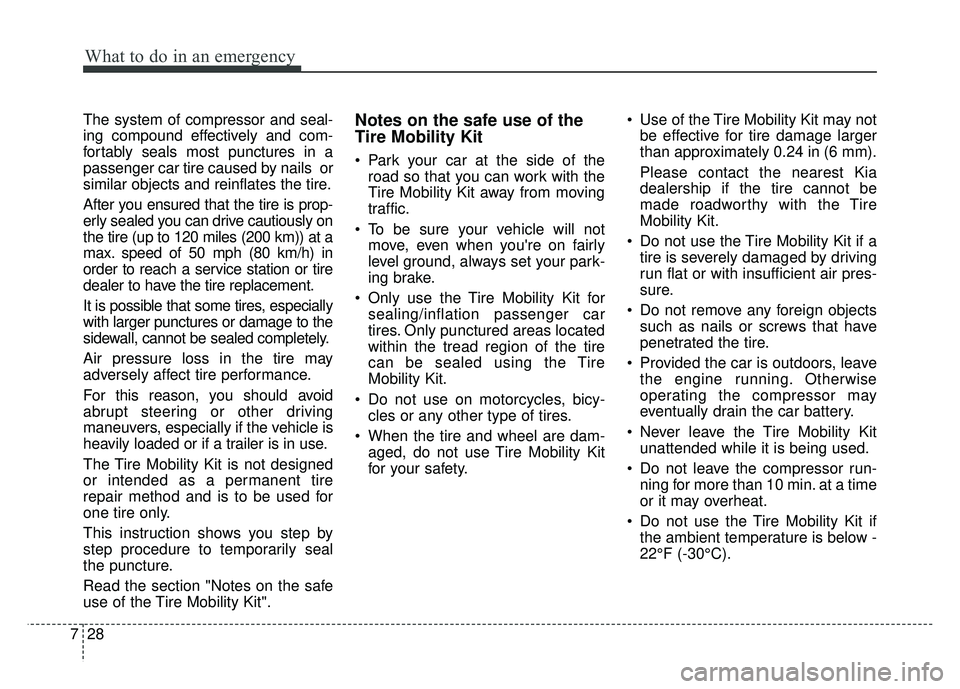
The system of compressor and seal-
ing compound effectively and com-
fortably seals most punctures in a
passenger car tire caused by nails or
similar objects and reinflates the tire.
After you ensured that the tire is prop-
erly sealed you can drive cautiously on
the tire (up to 120 miles (200 km)) at a
max. speed of 50 mph (80 km/h) in
order to reach a service station or tire
dealer to have the tire replacement.
It is possible that some tires, especially
with larger punctures or damage to the
sidewall, cannot be sealed completely.
Air pressure loss in the tire may
adversely affect tire performance.
For this reason, you should avoid
abrupt steering or other driving
maneuvers, especially if the vehicle is
heavily loaded or if a trailer is in use.
The Tire Mobility Kit is not designed
or intended as a permanent tire
repair method and is to be used for
one tire only.
This instruction shows you step by
step procedure to temporarily seal
the puncture.
Read the section "Notes on the safe
use of the Tire Mobility Kit".Notes on the safe use of the
Tire Mobility Kit
Park your car at the side of the
road so that you can work with the
Tire Mobility Kit away from moving
traffic.
To be sure your vehicle will not move, even when you're on fairly
level ground, always set your park-
ing brake.
Only use the Tire Mobility Kit for sealing/inflation passenger car
tires. Only punctured areas located
within the tread region of the tire
can be sealed using the Tire
Mobility Kit.
Do not use on motorcycles, bicy- cles or any other type of tires.
When the tire and wheel are dam- aged, do not use Tire Mobility Kit
for your safety. Use of the Tire Mobility Kit may not
be effective for tire damage larger
than approximately 0.24 in (6 mm).
Please contact the nearest Kia
dealership if the tire cannot be
made roadworthy with the Tire
Mobility Kit.
Do not use the Tire Mobility Kit if a tire is severely damaged by driving
run flat or with insufficient air pres-
sure.
Do not remove any foreign objects such as nails or screws that have
penetrated the tire.
Provided the car is outdoors, leave the engine running. Otherwise
operating the compressor may
eventually drain the car battery.
Never leave the Tire Mobility Kit unattended while it is being used.
Do not leave the compressor run- ning for more than 10 min. at a time
or it may overheat.
Do not use the Tire Mobility Kit if the ambient temperature is below -
22°F (-30°C).
Page 542 of 552
I5
Index
Driving in the rain. . . . . . . . . . . . . . . . . . . . . . . . . . . . . 6-83
Driving off-road . . . . . . . . . . . . . . . . . . . . . . . . . . . . . . 6-83
Dual clutch transmission . . . . . . . . . . . . . . . . . . . . . . . 6-14Manual mode . . . . . . . . . . . . . . . . . . . . . . . . . . . . . . 6-19
Shift-lock override . . . . . . . . . . . . . . . . . . . . . . . . . . 6-20
Dual clutch transmission shift indicator . . . . . . . . . . . . 4-58
Dual clutch transmission shift indicator in sports mode . . 4-58
Economical operation . . . . . . . . . . . . . . . . . . . . . . . . . . 6-78
Electrical equipment . . . . . . . . . . . . . . . . . . . . . . . . . . . 9-14
Electrochromic mirror (ECM) . . . . . . . . . . . . . . . . . . . 4-47
Electronic power steering . . . . . . . . . . . . . . . . . . . . . . . 4-42
Electronic stability control (ESC) . . . . . . . . . . . . . . . . 6-29
Emergency Liftgatesafety release . . . . . . . . . . . . . . . . . 4-26
Emergency starting . . . . . . . . . . . . . . . . . . . . . . . . . . . . . 7-5 Before Jump Starting . . . . . . . . . . . . . . . . . . . . . . . . . 7-5
Jump starting . . . . . . . . . . . . . . . . . . . . . . . . . . . . . . . 7-7
"Method to disconnect the (-) cable for regularmaintenance" . . . . . . . . . . . . . . . . . . . . . . . . . . . . . . 7-7
Emergency while driving . . . . . . . . . . . . . . . . . . . . . . . . 7-3
Emission control system . . . . . . . . . . . . . . . . . . . . . . . . 8-96 Crankcase emission control system . . . . . . . . . . . . . 8-96
Evaporative emission control (including ORVR:Onboard Refueling Vapor Recovery) system. . . . . 8-96
Exhaust emission control system . . . . . . . . . . . . . . . 8-97
Energy flow. . . . . . . . . . . . . . . . . . . . . . . . . . . . . . . . . . 4-63\
Engine . . . . . . . . . . . . . . . . . . . . . . . . . . . . . . . . . . . . \
. . . 9-2
Engine clutch actuator fluid . . . . . . . . . . . . . . . . . . . . . 8-32
Checking the Engine clutch actuator fluid level . . . 8-32
Engine compartment . . . . . . . . . . . . . . . . . . . . . . . . . . . . 2-6
Engine compartment . . . . . . . . . . . . . . . . . . . . . . . . . . . . 8-3
Engine number . . . . . . . . . . . . . . . . . . . . . . . . . . . . . . . . 9-9
Engine oil . . . . . . . . . . . . . . . . . . . . . . . . . . . . . . . . . . . 8-\
25 Changing the engine oil and filter . . . . . . . . . . . . . . 8-26
Checking the engine oil level . . . . . . . . . . . . . . . . . . 8-25
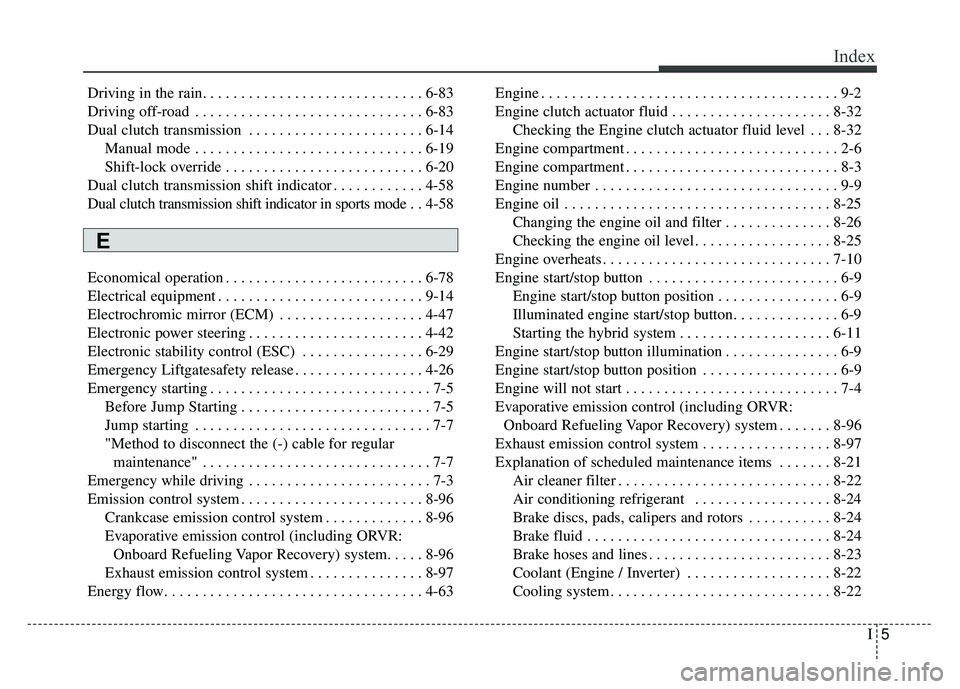
Engine overheats . . . . . . . . . . . . . . . . . . . . . . . . . . . . . . 7-10
Engine start/stop button . . . . . . . . . . . . . . . . . . . . . . . . . 6-9 Engine start/stop button position . . . . . . . . . . . . . . . . 6-9
Illuminated engine start/stop button. . . . . . . . . . . . . . 6-9
Starting the hybrid system . . . . . . . . . . . . . . . . . . . . 6-11
Engine start/stop button illumination . . . . . . . . . . . . . . . 6-9
Engine start/stop button position . . . . . . . . . . . . . . . . . . 6-9
Engine will not start . . . . . . . . . . . . . . . . . . . . . . . . . . . . 7-4
Evaporative emission control (including ORVR: Onboard Refueling Vapor Recovery) system . . . . . . . 8-96
Exhaust emission control system . . . . . . . . . . . . . . . . . 8-97
Explanation of scheduled maintenance items . . . . . . . 8-21 Air cleaner filter . . . . . . . . . . . . . . . . . . . . . . . . . . . . 8-22
Air conditioning refrigerant . . . . . . . . . . . . . . . . . . 8-24
Brake discs, pads, calipers and rotors . . . . . . . . . . . 8-24
Brake fluid . . . . . . . . . . . . . . . . . . . . . . . . . . . . . . . . 8-24
Brake hoses and lines . . . . . . . . . . . . . . . . . . . . . . . . 8-23
Coolant (Engine / Inverter) . . . . . . . . . . . . . . . . . . . 8-22
Cooling system . . . . . . . . . . . . . . . . . . . . . . . . . . . . . 8-22
E
Page 547 of 552
Index
10I
Owner maintenance precautions . . . . . . . . . . . . . . . . 8-5
Owner’s responsibility . . . . . . . . . . . . . . . . . . . . . . . . 8-4
Manual mode - Dual clutch transmission . . . . . . . . . . . 6-19
Map lamp . . . . . . . . . . . . . . . . . . . . . . . . . . . . . . . . . . 4-11\
0
Map lamp bulb replacement . . . . . . . . . . . . . . . . . . . . . 8-85
"Method to disconnect the (-)cable for regular maintenance" . . . . . . . . . . . . . . . . . . . . . . . . . . . . . . . . 7-7
Mirrors . . . . . . . . . . . . . . . . . . . . . . . . . . . . . . . . . . . . \
. 4-46 Day/night rearview mirror . . . . . . . . . . . . . . . . . . . . 4-46
Electrochromic mirror (ECM) . . . . . . . . . . . . . . . . 4-47
Folding the outside rearview mirror. . . . . . . . . . . . . 4-49
Inside rearview mirror . . . . . . . . . . . . . . . . . . . . . . . 4-46
Outside rearview mirror . . . . . . . . . . . . . . . . . . . . . . 4-48
Remote control . . . . . . . . . . . . . . . . . . . . . . . . . . . . . 4-48
Non-inflation conditions(Air bags) . . . . . . . . . . . . . . . 3-65
Occupant Detection System . . . . . . . . . . . . . . . . . . . . . 3-49
Odometer . . . . . . . . . . . . . . . . . . . . . . . . . . . . . . . . . . . 4-\
57
Oil (Engine) . . . . . . . . . . . . . . . . . . . . . . . . . . . . . . . . . 8-25
Online factory authorized manuals . . . . . . . . . . . . . . . . 9-15
Outside rearview mirror . . . . . . . . . . . . . . . . . . . . . . . . 4-48
Outside Temperature Gauge . . . . . . . . . . . . . . . . . . . . . 4-57
Over view(LCD Window). . . . . . . . . . . . . . . . . . . . . . . 4-59 Overheats . . . . . . . . . . . . . . . . . . . . . . . . . . . . . . . . . . . 7-\
10
Owner maintenance . . . . . . . . . . . . . . . . . . . . . . . . . . . . 8-6
Owner maintenance schedule. . . . . . . . . . . . . . . . . . . 8-6
Parking assist system . . . . . . . . . . . . . . . . . . . . . . . . . . 4-94 Non-operational conditions of parkingassist system . . . . . . . . . . . . . . . . . . . . . . . . . . . . . . 4-96
Operation of the parking assist system . . . . . . . . . . 4-94
Self-diagnosis . . . . . . . . . . . . . . . . . . . . . . . . . . . . . . 4-98
Parking brake . . . . . . . . . . . . . . . . . . . . . . . . . . . . . . . . 6-25
Parking brake . . . . . . . . . . . . . . . . . . . . . . . . . . . . . . . . 8-35 Checking the parking brake . . . . . . . . . . . . . . . . . . . 8-35
Parking light position . . . . . . . . . . . . . . . . . . . . . . . . . 4-101
Power brakes . . . . . . . . . . . . . . . . . . . . . . . . . . . . . . . . . 6-23
Power outlet . . . . . . . . . . . . . . . . . . . . . . . . . . . . . . . . 4-139
Power window lock button . . . . . . . . . . . . . . . . . . . . . . 4-30
Precautions . . . . . . . . . . . . . . . . . . . . . . . . . . . . . . . . . . 3-28\
Pre-tensioner seat belt. . . . . . . . . . . . . . . . . . . . . . . . . . 3-25
Rear parking assist system . . . . . . . . . . . . . . . . . . . . . . 4-91 Non-operational conditions of rear parking assistsystem. . . . . . . . . . . . . . . . . . . . . . . . . . . . . . . . . . . 4-\
92
Operation of the rear parking assist system . . . . . . . 4-91
Rear parking assist system precautions . . . . . . . . . . 4-93
O
R
N
P