parking brake KIA NIRO 2017 Owner's Guide
[x] Cancel search | Manufacturer: KIA, Model Year: 2017, Model line: NIRO, Model: KIA NIRO 2017Pages: 552, PDF Size: 14.92 MB
Page 384 of 552
73
What to do in an emergency
If the engine stalls at a cross-
road or crossing
If the engine stalls at a crossroad or
crossing, set the shift lever in the N
(Neutral) position and then push the
vehicle to a safe place.
If you have a flat tire while
driving
If a tire goes flat while you are driv-
ing:
1. Take your foot off the acceleratorpedal and let the vehicle slow
down while driving straight ahead.
Do not apply the brakes immedi-
ately or attempt to pull off the road
as this may cause a loss of con-
trol. When the vehicle has slowed
to such a speed that it is safe to do
so, brake carefully and pull off the
road. Drive off the road as far as
possible and park on firm level
ground. If you are on a divided
highway, do not park in the median
area between the two traffic lanes. 2. When the vehicle is stopped, turn
on your emergency hazard flash-
ers, set the parking brake and put
the transaxle in P.
3. Have all passengers get out of the vehicle. Be sure they all get out on
the side of the vehicle that is away
from traffic.
4. When changing a flat tire, follow the instruction provided later in
this section.
If the engine stalls while driv-
ing
1. Reduce your speed gradually,keeping a straight line. Move cau-
tiously off the road to a safe place.
2. Turn on your emergency flashers.
3. Try to start the hybrid system again. If your vehicle will not start,
contact an authorized Kia dealer
or seek other qualified assistance.
✽ ✽NOTICE
If there was a check engine light and
loss of power or stall and if safe to do
so, wait at least 10 seconds to restart
the vehicle after it stalls. This may
reset the car so it will no longer run
at low power (limp home) condition.
IN CASE OF AN EMERGENCY WHILE DRIVING
Page 391 of 552
What to do in an emergency
10
7
IF THE ENGINE OVERHEATS
If your temperature gauge indicates
overheating, you will experience a
loss of power, or hear loud pinging or
knocking, the engine is probably too
hot. If this happens, you should:
1. Turn on the emergency warning
flasher and stop in a safe place.
Move the shift lever to P (Park)
and engage the parking brake.
2. If hot steam does not come out from the engine room, carefully
open the engine room and check
whether the water pump connec-
tor is properly engaged. If the con-
nector is not properly engaged,
stop the engine immediately and
properly engage the connector.
Then, turn the engine on.
3. Turn on the air conditioner. 4. If the “HEV Warning” light turns on
in the driver instrument cluster, or
engine coolant or hot steam emits
from the engine coolant filler, stop
the engine immediately. Then, call
the nearest authorized Kia dealer
for assistance. If the “Engine
Warning” light remains illuminated
or the engine coolant is not flowing
out, keep the engine running.
Open the engine hood for ventila-
tion to help cool down the engine. 5. Check whether the engine coolant
temperature is low enough by
checking its temperature. If the
engine coolant level is low, please
check the connecting parts
between the radiator hose, heater
hose, and water pump for any
signs of leakage. When there is no
sign of leakage, please refill the
engine coolant. If causes and
signs of engine overheating such
as warning light illumination,
engine coolant leakage, or cooling
fan malfunction are found, stop the
vehicle the earliest. Then, call the
nearest authorized Kia dealer for
assistance.
WARNING- Under the
Hood
While the engine is running,
keep hair, hands and clothing
away from moving parts such
as the fan and drive belts to pre-
vent injury.
Page 401 of 552
What to do in an emergency
20
7
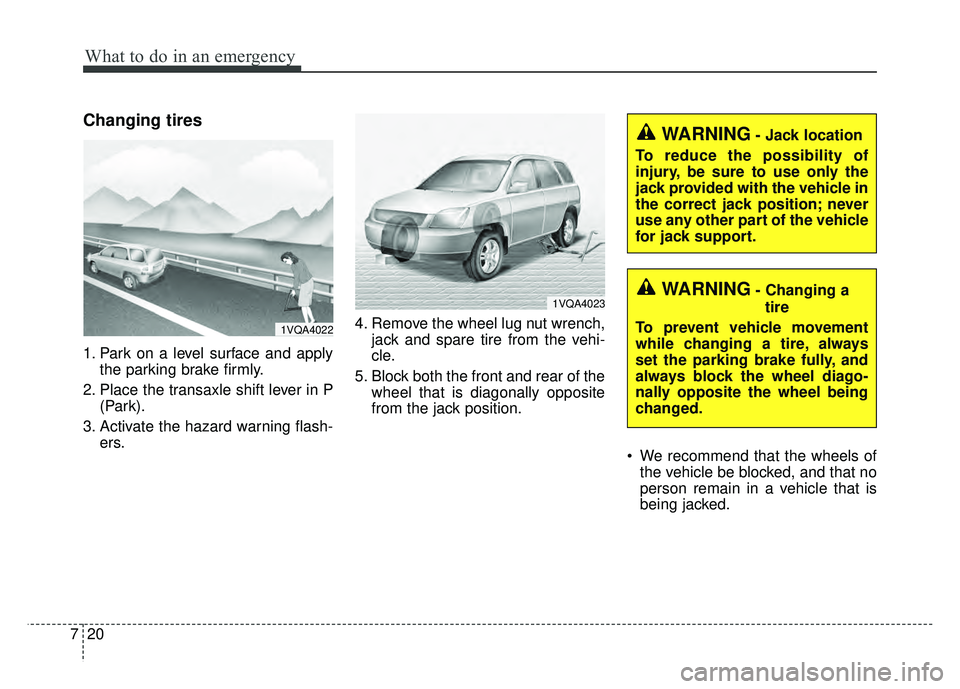
Changing tires
1. Park on a level surface and apply
the parking brake firmly.
2. Place the transaxle shift lever in P (Park).
3. Activate the hazard warning flash- ers. 4. Remove the wheel lug nut wrench,
jack and spare tire from the vehi-
cle.
5. Block both the front and rear of the wheel that is diagonally opposite
from the jack position.
We recommend that the wheels ofthe vehicle be blocked, and that no
person remain in a vehicle that is
being jacked.
WARNING- Jack location
To reduce the possibility of
injury, be sure to use only the
jack provided with the vehicle in
the correct jack position; never
use any other part of the vehicle
for jack support.
WARNING- Changing a tire
To prevent vehicle movement
while changing a tire, always
set the parking brake fully, and
always block the wheel diago-
nally opposite the wheel being
changed.
1VQA4022
1VQA4023
Page 407 of 552
What to do in an emergency
26
7
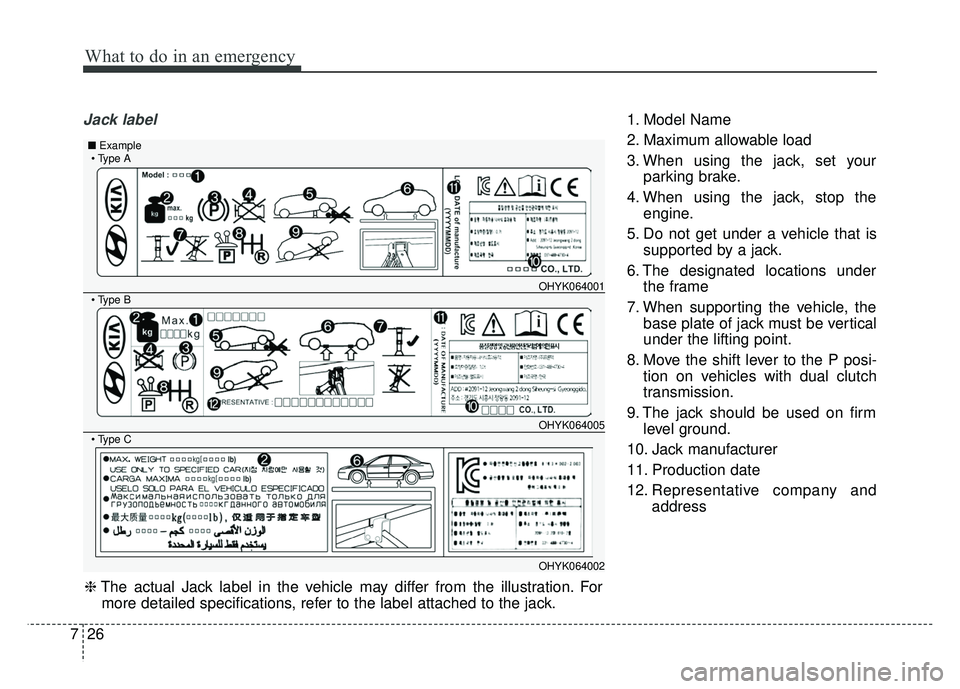
Jack label1. Model Name
2. Maximum allowable load
3. When using the jack, set your
parking brake.
4. When using the jack, stop the engine.
5. Do not get under a vehicle that is supported by a jack.
6. The designated locations under the frame
7. When supporting the vehicle, the base plate of jack must be vertical
under the lifting point.
8. Move the shift lever to the P posi- tion on vehicles with dual clutch
transmission.
9. The jack should be used on firm level ground.
10. Jack manufacturer
11. Production date
12. Representative company and address
OHYK064001
OHYK064005
OHYK064002
■Example
❈The actual Jack label in the vehicle may differ from the illustration. For
more detailed specifications, refer to the label attached to the jack.
Page 419 of 552
What to do in an emergency
38
7
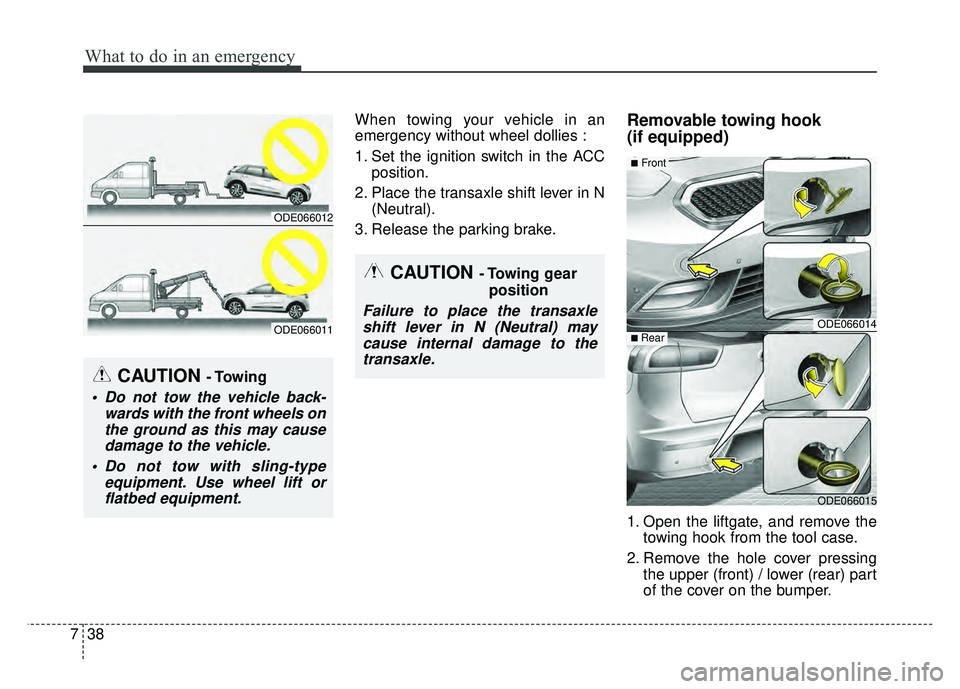
When towing your vehicle in an
emergency without wheel dollies :
1. Set the ignition switch in the ACC
position.
2. Place the transaxle shift lever in N (Neutral).
3. Release the parking brake.Removable towing hook
(if equipped)
1. Open the liftgate, and remove the towing hook from the tool case.
2. Remove the hole cover pressing the upper (front) / lower (rear) part
of the cover on the bumper.
CAUTION - Towing gear
position
Failure to place the transaxleshift lever in N (Neutral) maycause internal damage to thetransaxle.
CAUTION - Towing
Do not tow the vehicle back- wards with the front wheels onthe ground as this may causedamage to the vehicle.
Do not tow with sling-type equipment. Use wheel lift orflatbed equipment.
ODE066012
ODE066011ODE066014
ODE066015
■Front
■ Rear
Page 422 of 552
741
What to do in an emergency
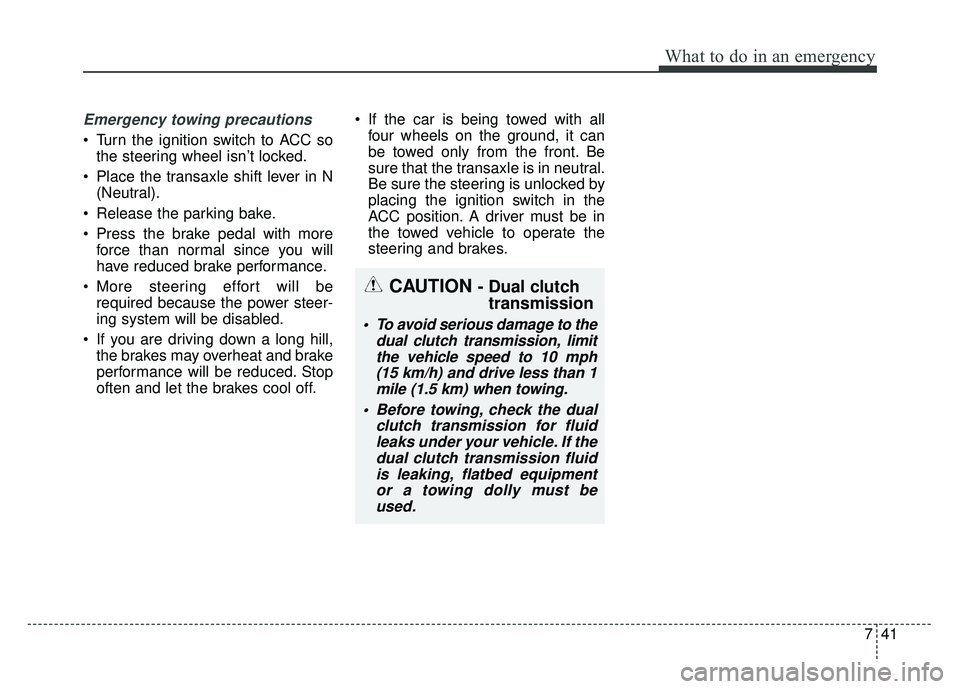
Emergency towing precautions
Turn the ignition switch to ACC sothe steering wheel isn’t locked.
Place the transaxle shift lever in N (Neutral).
Release the parking bake.
Press the brake pedal with more force than normal since you will
have reduced brake performance.
More steering effort will be required because the power steer-
ing system will be disabled.
If you are driving down a long hill, the brakes may overheat and brake
performance will be reduced. Stop
often and let the brakes cool off. If the car is being towed with all
four wheels on the ground, it can
be towed only from the front. Be
sure that the transaxle is in neutral.
Be sure the steering is unlocked by
placing the ignition switch in the
ACC position. A driver must be in
the towed vehicle to operate the
steering and brakes.
CAUTION - Dual clutchtransmission
To avoid serious damage to the
dual clutch transmission, limitthe vehicle speed to 10 mph(15 km/h) and drive less than 1mile (1.5 km) when towing.
Before towing, check the dual clutch transmission for fluidleaks under your vehicle. If thedual clutch transmission fluidis leaking, flatbed equipmentor a towing dolly must beused.
Page 424 of 552
Maintenance
Engine compartment . . . . . . . . . . . . . . . . . . . . . . . . 8-3
Maintenance services . . . . . . . . . . . . . . . . . . . . . . . . 8-4
• Owner’s responsibility . . . . . . . . . . . . . . . . . . . . . . . . . 8-4
• Owner maintenance precautions . . . . . . . . . . . . . . . . . 8-5
Owner maintenance . . . . . . . . . . . . . . . . . . . . . . . . . 8-6
• Owner maintenance schedule . . . . . . . . . . . . . . . . . . . 8-6
Scheduled maintenance service . . . . . . . . . . . . . . 8-8
Explanation of scheduled maintenance items . . . 8-21
Engine oil. . . . . . . . . . . . . . . . . . . . . . . . . . . . . . . . . 8-25
• Checking the engine oil level . . . . . . . . . . . . . . . . . . . 8-25
• Changing the engine oil and filter . . . . . . . . . . . . . . . 8-26
Coolant . . . . . . . . . . . . . . . . . . . . . . . . . . . . . . . . . . 8-27\
• Checking the coolant level . . . . . . . . . . . . . . . . . . . . . 8-27
• Engine coolant . . . . . . . . . . . . . . . . . . . . . . . . . . . . . . 8-28
• Inverter coolant . . . . . . . . . . . . . . . . . . . . . . . . . . . . . 8-28
• Recommended coolant . . . . . . . . . . . . . . . . . . . . . . . . 8-29
• Changing the coolant . . . . . . . . . . . . . . . . . . . . . . . . . 8-30
Brake fluid . . . . . . . . . . . . . . . . . . . . . . . . . . . . . . . 8-31
• Checking the brake fluid level . . . . . . . . . . . . . . . . . . 8-31
Engine clutch actuator fluid . . . . . . . . . . . . . . . . . 8-32
• Checking the engine clutch actuator fluid level . . . . 8-32
Washer fluid . . . . . . . . . . . . . . . . . . . . . . . . . . . . . . 8-34
• Checking the washer fluid level . . . . . . . . . . . . . . . . . 8-34
Parking brake . . . . . . . . . . . . . . . . . . . . . . . . . . . . . 8-35
• Checking the parking brake. . . . . . . . . . . . . . . . . . . . 8-35
Air cleaner. . . . . . . . . . . . . . . . . . . . . . . . . . . . . . . . 8-36
• Filter replacement . . . . . . . . . . . . . . . . . . . . . . . . . . . 8-36
Climate control air filter . . . . . . . . . . . . . . . . . . . . 8-38
• Filter inspection . . . . . . . . . . . . . . . . . . . . . . . . . . . . . . 8-38
Wiper blades . . . . . . . . . . . . . . . . . . . . . . . . . . . . . . 8-40
• Blade inspection . . . . . . . . . . . . . . . . . . . . . . . . . . . . . . 8-40
• Blade replacement . . . . . . . . . . . . . . . . . . . . . . . . . . . . 8-40
Tires and wheels . . . . . . . . . . . . . . . . . . . . . . . . . . . 8-43
• Tire care . . . . . . . . . . . . . . . . . . . . . . . . . . . . . . . . . . . . \
8-43
• Recommended cold tire inflation pressures . . . . . . . 8-43
• Tire pressure . . . . . . . . . . . . . . . . . . . . . . . . . . . . . . . . 8-44
• Checking tire inflation pressure. . . . . . . . . . . . . . . . . 8-44
• Tire rotation . . . . . . . . . . . . . . . . . . . . . . . . . . . . . . . . 8-45
• Wheel alignment and tire balance . . . . . . . . . . . . . . . 8-46
• Tire replacement . . . . . . . . . . . . . . . . . . . . . . . . . . . . . 8-47
• Wheel replacement . . . . . . . . . . . . . . . . . . . . . . . . . . . 8-47
• Tire traction . . . . . . . . . . . . . . . . . . . . . . . . . . . . . . . . . 8-48
• Tire maintenance . . . . . . . . . . . . . . . . . . . . . . . . . . . . 8-48
• Tire sidewall labeling . . . . . . . . . . . . . . . . . . . . . . . . . 8-48
• All season tires . . . . . . . . . . . . . . . . . . . . . . . . . . . . . . 8-55
• Summer tires . . . . . . . . . . . . . . . . . . . . . . . . . . . . . . . . 8-55
• Snow tires . . . . . . . . . . . . . . . . . . . . . . . . . . . . . . . . . . . 8-\
55
• Tire chains . . . . . . . . . . . . . . . . . . . . . . . . . . . . . . . . . . 8-55\
8
Page 429 of 552
Maintenance
68
OWNER MAINTENANCE
The following lists are vehicle checks
and inspections that should be per-
formed by the owner or an author-
ized Kia dealer at the frequencies
indicated to help ensure safe,
dependable operation of your vehi-
cle.
Any adverse conditions should be
brought to the attention of your deal-
er as soon as possible.
These Owner Maintenance Checks
are generally not covered by war-
ranties and you may be charged for
labor, parts and lubricants used.Owner maintenance schedule
When you stop for fuel:
Check the engine oil level.
Check the coolant level in coolantreservoir.
Check the windshield washer fluid level.
Look for low or under-inflated tires.
While operating your vehicle:
Note any changes in the sound of the exhaust or any smell of
exhaust fumes in the vehicle.
Check for vibrations in the steering wheel. Notice any increased steer-
ing effort or looseness in the steer-
ing wheel, or change in its straight-
ahead position.
Notice if your vehicle constantly turns slightly or “pulls” to one side
when traveling on smooth, level
road.
When stopping, listen and check for unusual sounds, pulling to one
side, increased brake pedal travel
or “hard-to-push” brake pedal.
If any slipping or changes in the operation of your transaxle occurs,
check the transaxle fluid level.
Check the dual clutch transmission P (Park) function.
Check the parking brake.
Check for fluid leaks under your vehicle (water dripping from the air
conditioning system during or after
use is normal).
WARNING- Hot coolant
Be careful when checking your
engine coolant level when the
engine is hot. Scalding hot
coolant and steam may blow
out under pressure.
WARNING
When you open the engine
hood, turn the Hybrid system
off. If not, it may result in death
or serious injury because of the
high voltage flow.
Page 433 of 552
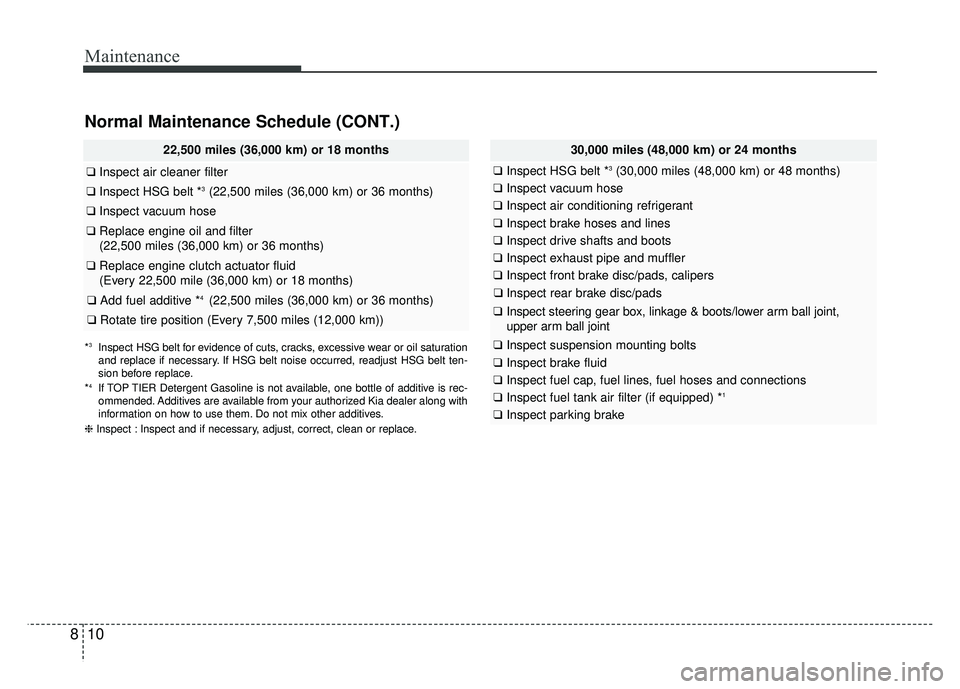
30,000 miles (48,000 km) or 24 months
❑Inspect HSG belt *3(30,000 miles (48,000 km) or 48 months)
❑Inspect vacuum hose
❑Inspect air conditioning refrigerant
❑Inspect brake hoses and lines
❑Inspect drive shafts and boots
❑Inspect exhaust pipe and muffler
❑Inspect front brake disc/pads, calipers
❑Inspect rear brake disc/pads
❑Inspect steering gear box, linkage & boots/lower arm ball joint,
upper arm ball joint
❑Inspect suspension mounting bolts
❑Inspect brake fluid
❑Inspect fuel cap, fuel lines, fuel hoses and connections
❑Inspect fuel tank air filter (if equipped) *1
❑Inspect parking brake
Maintenance
10
8
22,500 miles (36,000 km) or 18 months
❑ Inspect air cleaner filter
❑Inspect HSG belt *3(22,500 miles (36,000 km) or 36 months)
❑Inspect vacuum hose
❑Replace engine oil and filter
(22,500 miles (36,000 km) or 36 months)
❑Replace engine clutch actuator fluid
(Every 22,500 mile (36,000 km) or 18 months)
❑ Add fuel additive *4 (22,500 miles (36,000 km) or 36 months)
❑Rotate tire position (Every 7,500 miles (12,000 km))
*3Inspect HSG belt for evidence of cuts, cracks, excessive wear or oil saturation
and replace if necessary. If HSG belt noise occurred, readjust HSG belt ten-
sion before replace.
*
4If TOP TIER Detergent Gasoline is not available, one bottle of additive is rec-
ommended. Additives are available from your authorized Kia dealer along with
information on how to use them. Do not mix other additives.
❈ Inspect : Inspect and if necessary, adjust, correct, clean or replace.
Normal Maintenance Schedule (CONT.)
Page 436 of 552
813
Maintenance
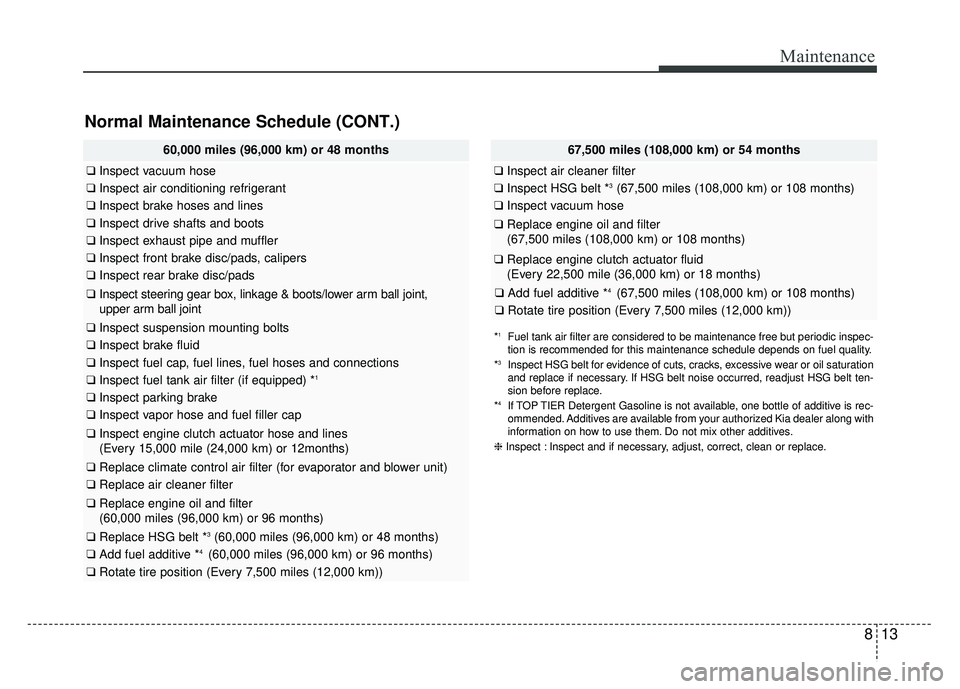
60,000 miles (96,000 km) or 48 months
❑Inspect vacuum hose
❑Inspect air conditioning refrigerant
❑Inspect brake hoses and lines
❑Inspect drive shafts and boots
❑Inspect exhaust pipe and muffler
❑Inspect front brake disc/pads, calipers
❑Inspect rear brake disc/pads
❑Inspect steering gear box, linkage & boots/lower arm ball joint,
upper arm ball joint
❑ Inspect suspension mounting bolts
❑Inspect brake fluid
❑Inspect fuel cap, fuel lines, fuel hoses and connections
❑Inspect fuel tank air filter (if equipped) *1
❑Inspect parking brake
❑Inspect vapor hose and fuel filler cap
❑Inspect engine clutch actuator hose and lines
(Every 15,000 mile (24,000 km) or 12months)
❑ Replace climate control air filter (for evaporator and blower unit)
❑Replace air cleaner filter
❑Replace engine oil and filter
(60,000 miles (96,000 km) or 96 months)
❑Replace HSG belt *3(60,000 miles (96,000 km) or 48 months)
❑ Add fuel additive *4 (60,000 miles (96,000 km) or 96 months)
❑Rotate tire position (Every 7,500 miles (12,000 km))
67,500 miles (108,000 km) or 54 months
❑Inspect air cleaner filter
❑Inspect HSG belt *3(67,500 miles (108,000 km) or 108 months)
❑Inspect vacuum hose
❑Replace engine oil and filter
(67,500 miles (108,000 km) or 108 months)
❑Replace engine clutch actuator fluid
(Every 22,500 mile (36,000 km) or 18 months)
❑ Add fuel additive *4 (67,500 miles (108,000 km) or 108 months)
❑Rotate tire position (Every 7,500 miles (12,000 km))
*1Fuel tank air filter are considered to be maintenance free but periodic inspec-
tion is recommended for this maintenance schedule depends on fuel quality.
*
3Inspect HSG belt for evidence of cuts, cracks, excessive wear or oil saturation
and replace if necessary. If HSG belt noise occurred, readjust HSG belt ten-
sion before replace.
*
4If TOP TIER Detergent Gasoline is not available, one bottle of additive is rec-
ommended. Additives are available from your authorized Kia dealer along with
information on how to use them. Do not mix other additives.
❈ Inspect : Inspect and if necessary, adjust, correct, clean or replace.
Normal Maintenance Schedule (CONT.)