air condition KIA NIRO 2017 Workshop Manual
[x] Cancel search | Manufacturer: KIA, Model Year: 2017, Model line: NIRO, Model: KIA NIRO 2017Pages: 552, PDF Size: 14.92 MB
Page 478 of 552
855
Maintenance
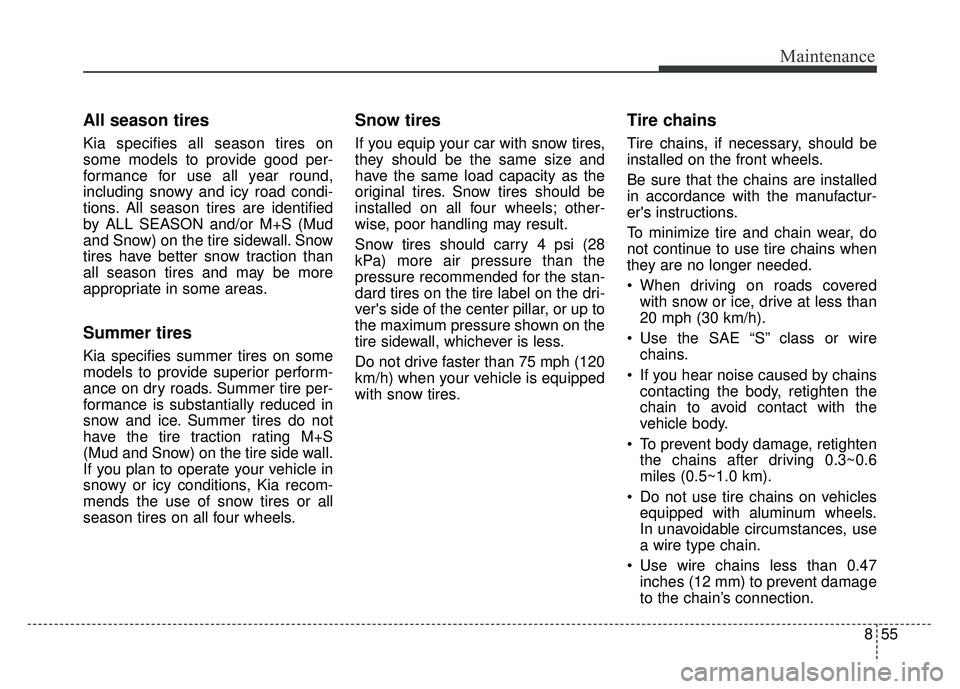
All season tires
Kia specifies all season tires on
some models to provide good per-
formance for use all year round,
including snowy and icy road condi-
tions. All season tires are identified
by ALL SEASON and/or M+S (Mud
and Snow) on the tire sidewall. Snow
tires have better snow traction than
all season tires and may be more
appropriate in some areas.
Summer tires
Kia specifies summer tires on some
models to provide superior perform-
ance on dry roads. Summer tire per-
formance is substantially reduced in
snow and ice. Summer tires do not
have the tire traction rating M+S
(Mud and Snow) on the tire side wall.
If you plan to operate your vehicle in
snowy or icy conditions, Kia recom-
mends the use of snow tires or all
season tires on all four wheels.
Snow tires
If you equip your car with snow tires,
they should be the same size and
have the same load capacity as the
original tires. Snow tires should be
installed on all four wheels; other-
wise, poor handling may result.
Snow tires should carry 4 psi (28
kPa) more air pressure than the
pressure recommended for the stan-
dard tires on the tire label on the dri-
ver's side of the center pillar, or up to
the maximum pressure shown on the
tire sidewall, whichever is less.
Do not drive faster than 75 mph (120
km/h) when your vehicle is equipped
with snow tires.
Tire chains
Tire chains, if necessary, should be
installed on the front wheels.
Be sure that the chains are installed
in accordance with the manufactur-
er's instructions.
To minimize tire and chain wear, do
not continue to use tire chains when
they are no longer needed.
When driving on roads coveredwith snow or ice, drive at less than
20 mph (30 km/h).
Use the SAE “S” class or wire chains.
If you hear noise caused by chains contacting the body, retighten the
chain to avoid contact with the
vehicle body.
To prevent body damage, retighten the chains after driving 0.3~0.6
miles (0.5~1.0 km).
Do not use tire chains on vehicles equipped with aluminum wheels.
In unavoidable circumstances, use
a wire type chain.
Use wire chains less than 0.47 inches (12 mm) to prevent damage
to the chain’s connection.
Page 480 of 552
857
Maintenance
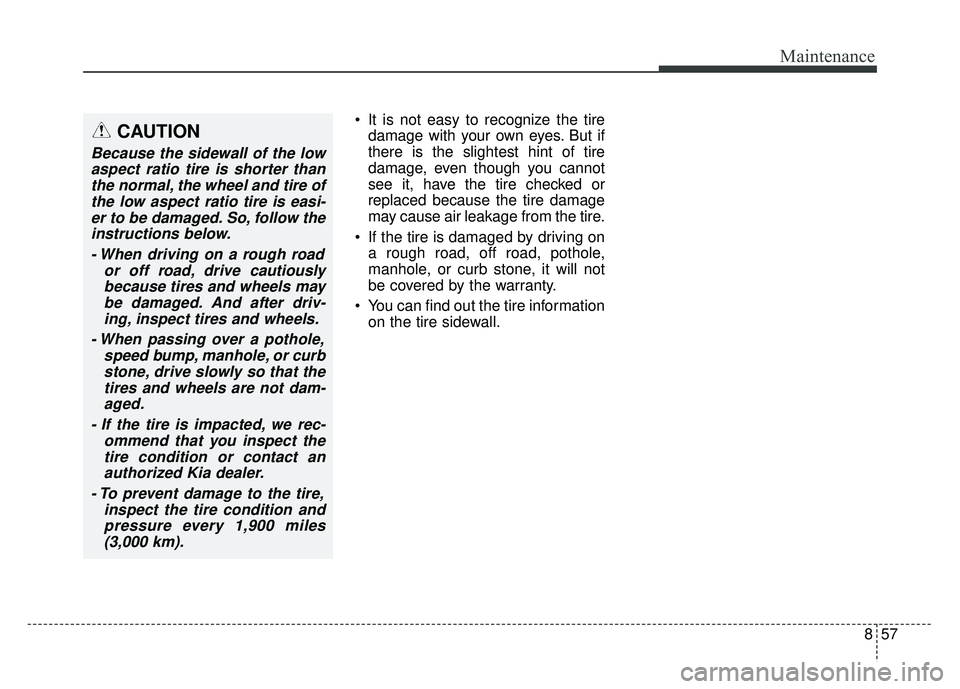
It is not easy to recognize the tiredamage with your own eyes. But if
there is the slightest hint of tire
damage, even though you cannot
see it, have the tire checked or
replaced because the tire damage
may cause air leakage from the tire.
If the tire is damaged by driving on a rough road, off road, pothole,
manhole, or curb stone, it will not
be covered by the warranty.
You can find out the tire information on the tire sidewall.CAUTION
Because the sidewall of the lowaspect ratio tire is shorter thanthe normal, the wheel and tire ofthe low aspect ratio tire is easi-er to be damaged. So, follow theinstructions below.
- When driving on a rough road or off road, drive cautiouslybecause tires and wheels maybe damaged. And after driv-ing, inspect tires and wheels.
- When passing over a pothole, speed bump, manhole, or curbstone, drive slowly so that thetires and wheels are not dam-aged.
- If the tire is impacted, we rec- ommend that you inspect thetire condition or contact anauthorized Kia dealer.
- To prevent damage to the tire, inspect the tire condition andpressure every 1,900 miles(3,000 km).
Page 487 of 552

Maintenance
64
8
Instrument panel (Driver’s side fuse panel)
Fuse NameFuse ratingCircuit Protected
MODULE 510A
Crash Pad Switch, Electro Chromic Mirror, Audio / Video &Navigation Head Unit, Audio, Shift Lever
Indicator, VESS Unit, Air Conditioner Control Module, Head Lamp Leveling Device Actuator LH/RH, Driver
IMS Module, Front Seat Warmer Control Module, Rear Seat Warmer Control Module, Auto Head Lamp
Leveling Device Module
MODULE 410ALane Departure Warning Control Module, Crash Pad Switch, AEB Module, Blind Spot Detection Radar Left
Handle side/Right Handle side
INTERIOR
LAMP10ALuggage Lamp, Ignition Key ILL. & Door Warning Switch, Front Vanity Lamp LH/RH, Room Lamp, Overhead
Console Lamp
A/BAG15ASRS (Supplemental Restraint System) Control Module
IG 125APrinted Circuit Board Block (Fuse - F35, F36, F37, F38)
CLUSTER10AInstrument Cluster
MODULE 310ABCM (Body Control Module), Dual clutch transmission Shift Lever, Driver/Passenger Door Module, Stop
Lamp Switch
MEMORY 27.5AActive Air Flap Unit
MODULE 810AElectric Water Pump (Engine), Active Air Flap Unit, VPD Sensor,
E/R Junction Block (RLY. 4), BMS Control Module
A/BAG IND7.5AAir Conditioner Control Module, Instrument Cluster
START7.5A[Without Smart Key & Without Immobilizer] Burglaralarm Relay
[With Smart Key / With Immobilizer] Inhibitor Switch
Page 488 of 552

865
Maintenance
Fuse NameFuse ratingCircuit Protected
MODULE 210AEngine Room Junction Block (Relay. 14), Wireless Charger, BCM (Body Control Module), AMP (Amplifier),
Smart Key Control Module, USB Charger, Audio, Audio / Video & Navigation Head Unit, Driver Power
Outside Mirror
PDM 37.5A[Without Smart Key] Immobilizer Module
[With Smart Key] Smart Key Control Module
MEMORY 110AInstrument Cluster, Wireless Charger, Air Conditioner Control Module, Auto Light & Photo Sensor, Rain Sensor,
BCM (Body Control Module), ICM Relay Box (Outside Mirror Folding/Unfolding Relay), Driver Integrated memory
system Module, Driver/Passenger Door Module
MULTI MEDIA15AAudio, Audio / Video & Navigation Head Unit
EEWP10AElectric Water Pump (HEV)
MDPS7.5AMDPS (Motor Driven Power Steering) Unit
TAIL GATE10ATail Gate Relay, ICM Relay Box (Fuel Lid Relay), Fuel Filler Switch
PDM 115ASmart Key Control Module
MODULE 77.5AAC Inverter (220V), AC Inverter Module, Rear Seat Warmer Control Module, Front Seat Warmer Control
Module/ Front Air Ventilation Seat Control Module
WIPER (REAR)15AEngine Room Junction Block (Relay.5)
HEATED
STEERING15ABCM (Body Control Module)
SUNROOF20ASunroof Motor
Page 489 of 552

Maintenance
66
8
Fuse NameFuse ratingCircuit Protected
P/WINDOW RH25APower Window Right Handle side Relay, Driver/Passenger Safety Power Window Module
P/WINDOW LH25APower Window Left Handle side Relay, Driver/Passenger Safety Power Window Module
PDM 27.5A[Without Smart Key] Immobilizer Module
[With Smart Key] Smart Key Control Module, Start/Stop Button Switch
BRAKE SWITCH7.5AStop Lamp Switch
A/CON7.5AAir Conditioner Control Module, Ionizer, Engine Room Junction Block (Relay.1/2/12), Electronic Air
Conditioner Compressor
WASHER15AMultifunction Switch
S/HEATER (FRT)25AFront Seat Warmer Control Module, Front Air Ventilation Seat Control Module
BATTERY
MANAGEMENT10ABMS Control Module
P/SEAT (DRV)30A[Without Integrated memory system] Driver Seat Manual Switch
[With Integrated memory system] Driver Seat Manual Switch, Driver Integrated memory system Module
AMP30AAMP (Amplifier)
AMS10ABattery Sensor
MODULE 110AData Link Connector, Hazard Switch/Key Interlock, AEB Module, Driver Door Module, Passenger Door
Module, Driver Smart Key Outside Handle, Passenger Smart Key Outside Handle
Page 490 of 552
867
Maintenance
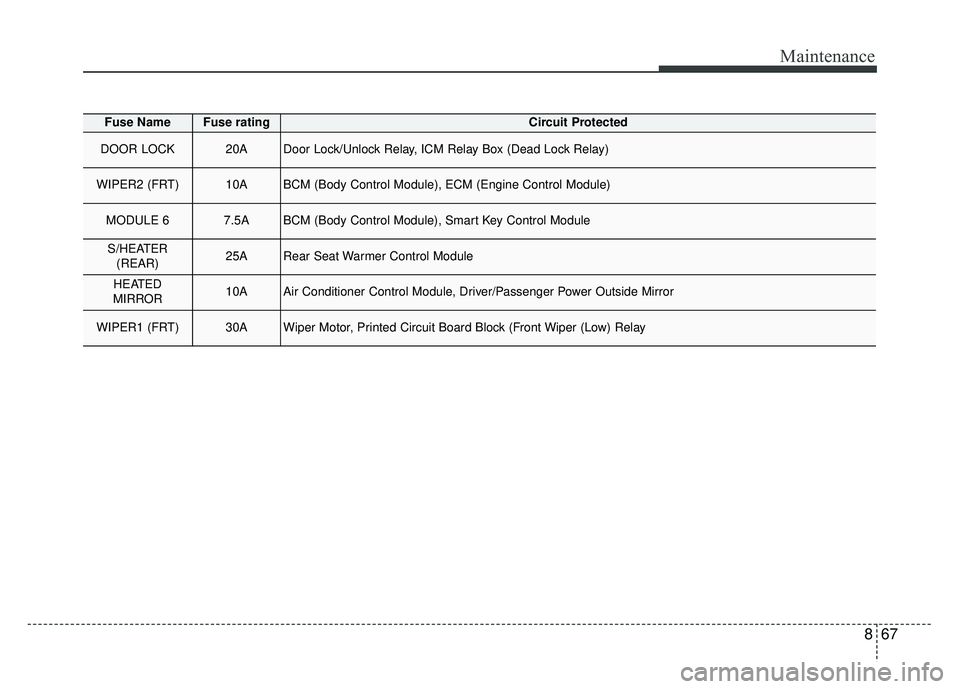
Fuse NameFuse ratingCircuit Protected
DOOR LOCK20ADoor Lock/Unlock Relay, ICM Relay Box (Dead Lock Relay)
WIPER2 (FRT)10ABCM (Body Control Module), ECM (Engine Control Module)
MODULE 67.5ABCM (Body Control Module), Smart Key Control Module
S/HEATER(REAR)25ARear Seat Warmer Control Module
HEATED
MIRROR10AAir Conditioner Control Module, Driver/Passenger Power Outside Mirror
WIPER1 (FRT)30AWiper Motor, Printed Circuit Board Block (Front Wiper (Low) Relay
Page 515 of 552
Maintenance
92
8
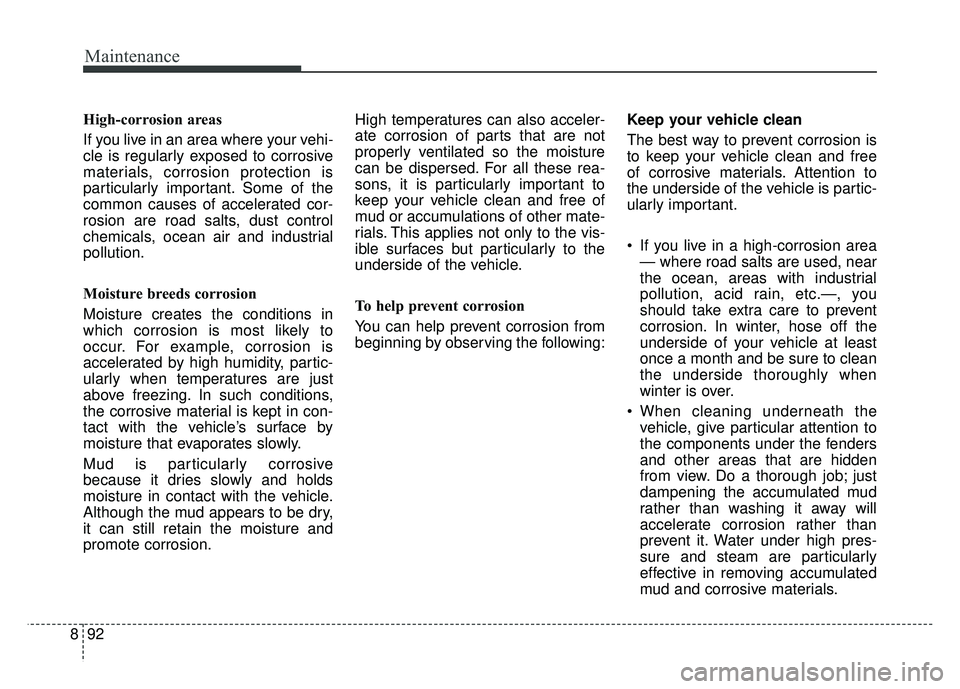
High-corrosion areas
If you live in an area where your vehi-
cle is regularly exposed to corrosive
materials, corrosion protection is
particularly important. Some of the
common causes of accelerated cor-
rosion are road salts, dust control
chemicals, ocean air and industrial
pollution.
Moisture breeds corrosion
Moisture creates the conditions in
which corrosion is most likely to
occur. For example, corrosion is
accelerated by high humidity, partic-
ularly when temperatures are just
above freezing. In such conditions,
the corrosive material is kept in con-
tact with the vehicle’s surface by
moisture that evaporates slowly.
Mud is particularly corrosive
because it dries slowly and holds
moisture in contact with the vehicle.
Although the mud appears to be dry,
it can still retain the moisture and
promote corrosion. High temperatures can also acceler-
ate corrosion of parts that are not
properly ventilated so the moisture
can be dispersed. For all these rea-
sons, it is particularly important to
keep your vehicle clean and free of
mud or accumulations of other mate-
rials. This applies not only to the vis-
ible surfaces but particularly to the
underside of the vehicle.
To help prevent corrosion
You can help prevent corrosion from
beginning by observing the following:
Keep your vehicle clean
The best way to prevent corrosion is
to keep your vehicle clean and free
of corrosive materials. Attention to
the underside of the vehicle is partic-
ularly important.
If you live in a high-corrosion area
— where road salts are used, near
the ocean, areas with industrial
pollution, acid rain, etc.—, you
should take extra care to prevent
corrosion. In winter, hose off the
underside of your vehicle at least
once a month and be sure to clean
the underside thoroughly when
winter is over.
vehicle, give particular attention to
the components under the fenders
and other areas that are hidden
from view. Do a thorough job; just
dampening the accumulated mud
rather than washing it away will
accelerate corrosion rather than
prevent it. Water under high pres-
sure and steam are particularly
effective in removing accumulated
mud and corrosive materials.
Page 521 of 552
Maintenance
98
8
Do not operate the engine in con-
fined or closed areas (such as
garages) any more than what is
necessary to move the vehicle in or
out of the area.
When the vehicle is stopped in an open area for more than a short
time with the engine running,
adjust the ventilation system (as
needed) to draw outside air into the
vehicle.
Never sit in a parked or stopped vehicle for any extended time with
the engine running.
When the engine stalls or fails to start, excessive attempts to restart
the engine may cause damage to
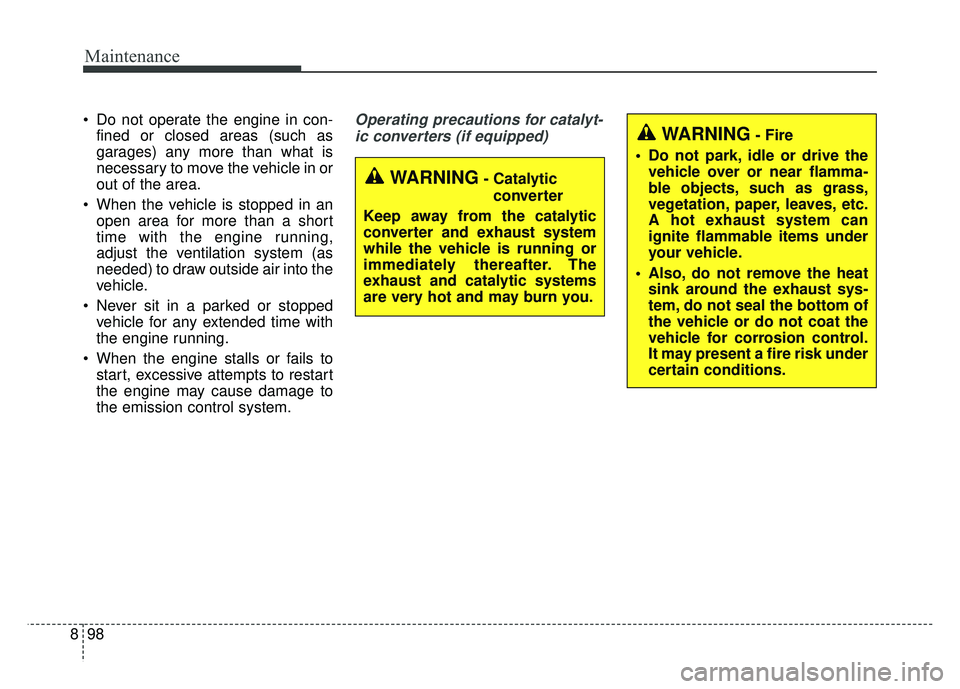
the emission control system.Operating precautions for catalyt-
ic converters (if equipped)
WARNING- Catalytic converter
Keep away from the catalytic
converter and exhaust system
while the vehicle is running or
immediately thereafter. The
exhaust and catalytic systems
are very hot and may burn you.
WARNING- Fire
Do not park, idle or drive the vehicle over or near flamma-
ble objects, such as grass,
vegetation, paper, leaves, etc.
A hot exhaust system can
ignite flammable items under
your vehicle.
Also, do not remove the heat sink around the exhaust sys-
tem, do not seal the bottom of
the vehicle or do not coat the
vehicle for corrosion control.
It may present a fire risk under
certain conditions.
Page 523 of 552

Specifications, Consumer information and Reporting safety defects
Engine . . . . . . . . . . . . . . . . . . . . . . . . . . . . . . . . . . . . \
9-2
Dimensions . . . . . . . . . . . . . . . . . . . . . . . . . . . . . . . . 9-2
Bulb wattage . . . . . . . . . . . . . . . . . . . . . . . . . . . . . . . 9-3
Tires and wheels . . . . . . . . . . . . . . . . . . . . . . . . . . . . 9-4
Gross vehicle weight. . . . . . . . . . . . . . . . . . . . . . . . . 9-5
Luggage volume . . . . . . . . . . . . . . . . . . . . . . . . . . . . 9-5
Air conditioning system . . . . . . . . . . . . . . . . . . . . . . 9-5
Recommended lubricants and capacities . . . . . . . . 9-6
• Recommended SAE viscosity number. . . . . . . . . . . . . 9-7
Vehicle identification number (VIN) . . . . . . . . . . . 9-8
Vehicle certification label. . . . . . . . . . . . . . . . . . . . . 9-8
Tire specification and pressure label . . . . . . . . . . . 9-9
Engine number . . . . . . . . . . . . . . . . . . . . . . . . . . . . . 9-9
Air conditioner compressor label . . . . . . . . . . . . . . 9-9
Refrigerant label. . . . . . . . . . . . . . . . . . . . . . . . . . . 9-10 Consumer assistance (U.S. only) . . . . . . . . . . . . . . 9-11
•
Toll free consumer assistance . . . . . . . . . . . . . . . . . . . 9-11
• Emergency roadside assistance . . . . . . . . . . . . . . . . . 9-11
• Trip interruption . . . . . . . . . . . . . . . . . . . . . . . . . . . . . 9-12
• Registering your vehicle in a foreign country . . . . . 9-13
Electrical Equipment (U.S. only) . . . . . . . . . . . . . 9-14
• Installation of a mobile two-way radio system . . . . . 9-14
Reporting Safety Defects (U.S. only) . . . . . . . . . . 9-15
Online factory authorized manuals (U.S. only) . . 9-15
• Service manual: . . . . . . . . . . . . . . . . . . . . . . . . . . . . . . 9-15
• Electrical troubleshooting manual: . . . . . . . . . . . . . . 9-15
• Owner's manual: . . . . . . . . . . . . . . . . . . . . . . . . . . . . . 9-
15
9
Page 527 of 552
95
Specifications, Consumer information, Reporting safety defects
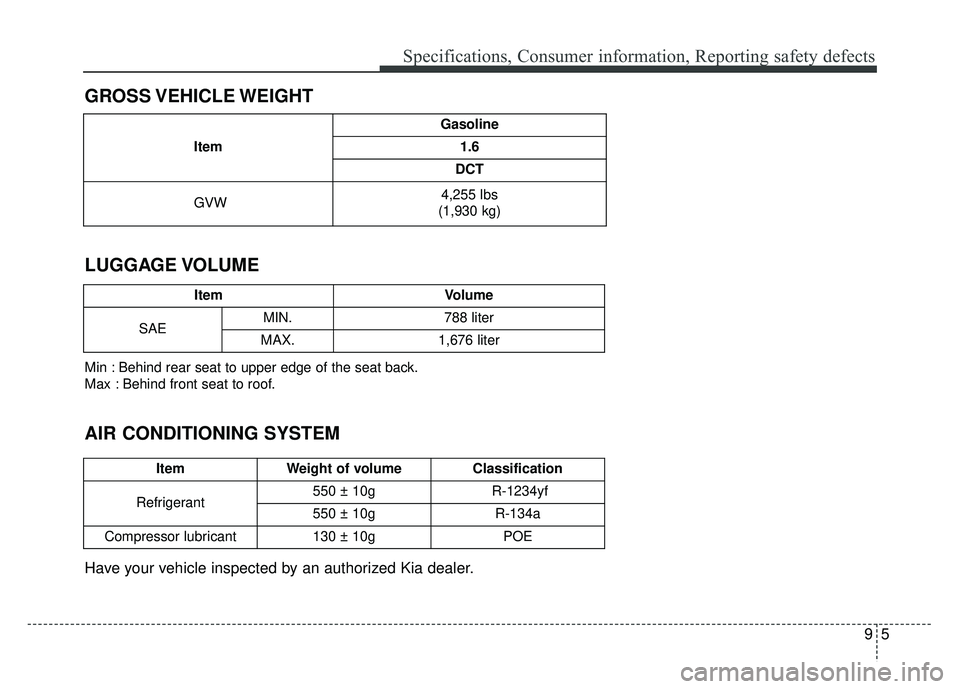
GROSS VEHICLE WEIGHT
AIR CONDITIONING SYSTEM LUGGAGE VOLUME
Have your vehicle inspected by an authorized Kia dealer.
Item
Gasoline
1.6
DCT
GVW4,255 lbs
(1,930 kg)
Min : Behind rear seat to upper edge of the seat back.
Max : Behind front seat to roof.
ItemVolume
SAEMIN.788 liter
MAX.1,676 liter
ItemWeight of volumeClassification
Refrigerant550 ± 10gR-1234yf
550 ± 10gR-134a
Compressor lubricant130 ± 10gPOE