fuel cap KIA NIRO 2018 User Guide
[x] Cancel search | Manufacturer: KIA, Model Year: 2018, Model line: NIRO, Model: KIA NIRO 2018Pages: 616, PDF Size: 18.3 MB
Page 481 of 616
Maintenance
12
8
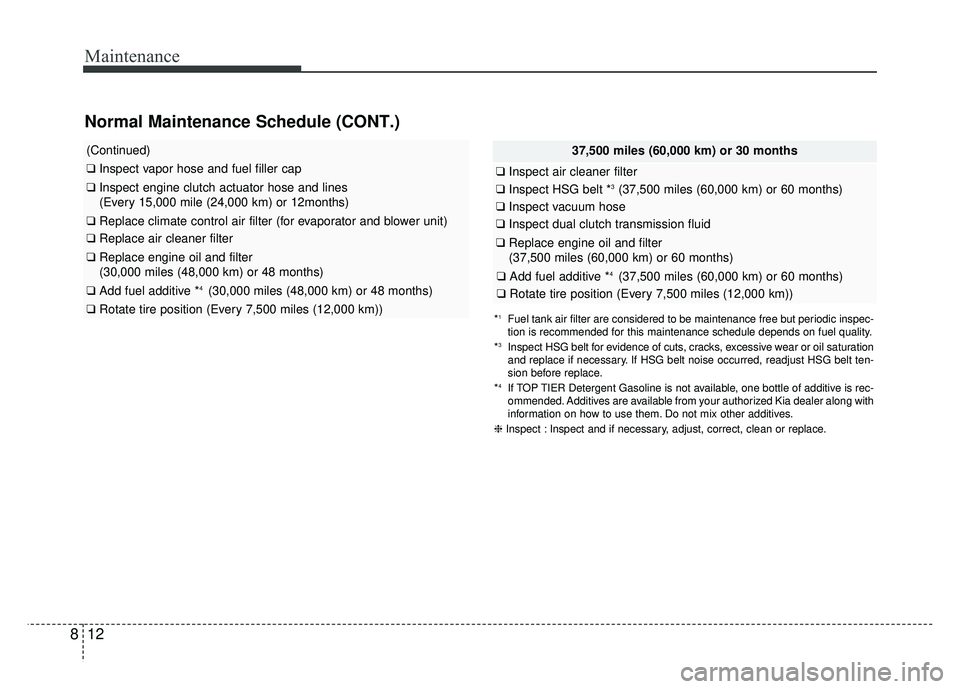
Normal Maintenance Schedule (CONT.)
37,500 miles (60,000 km) or 30 months
❑ Inspect air cleaner filter
❑Inspect HSG belt *3(37,500 miles (60,000 km) or 60 months)
❑Inspect vacuum hose
❑Inspect dual clutch transmission fluid
❑Replace engine oil and filter
(37,500 miles (60,000 km) or 60 months)
❑ Add fuel additive *4 (37,500 miles (60,000 km) or 60 months)
❑Rotate tire position (Every 7,500 miles (12,000 km))
*1Fuel tank air filter are considered to be maintenance free but periodic inspec-
tion is recommended for this maintenance schedule depends on fuel quality.
*
3Inspect HSG belt for evidence of cuts, cracks, excessive wear or oil saturation
and replace if necessary. If HSG belt noise occurred, readjust HSG belt ten-
sion before replace.
*
4If TOP TIER Detergent Gasoline is not available, one bottle of additive is rec-
ommended. Additives are available from your authorized Kia dealer along with
information on how to use them. Do not mix other additives.
❈ Inspect : Inspect and if necessary, adjust, correct, clean or replace.
(Continued)
❑Inspect vapor hose and fuel filler cap
❑Inspect engine clutch actuator hose and lines
(Every 15,000 mile (24,000 km) or 12months)
❑ Replace climate control air filter (for evaporator and blower unit)
❑Replace air cleaner filter
❑Replace engine oil and filter
(30,000 miles (48,000 km) or 48 months)
❑ Add fuel additive *4 (30,000 miles (48,000 km) or 48 months)
❑Rotate tire position (Every 7,500 miles (12,000 km))
Page 483 of 616
Maintenance
14
8
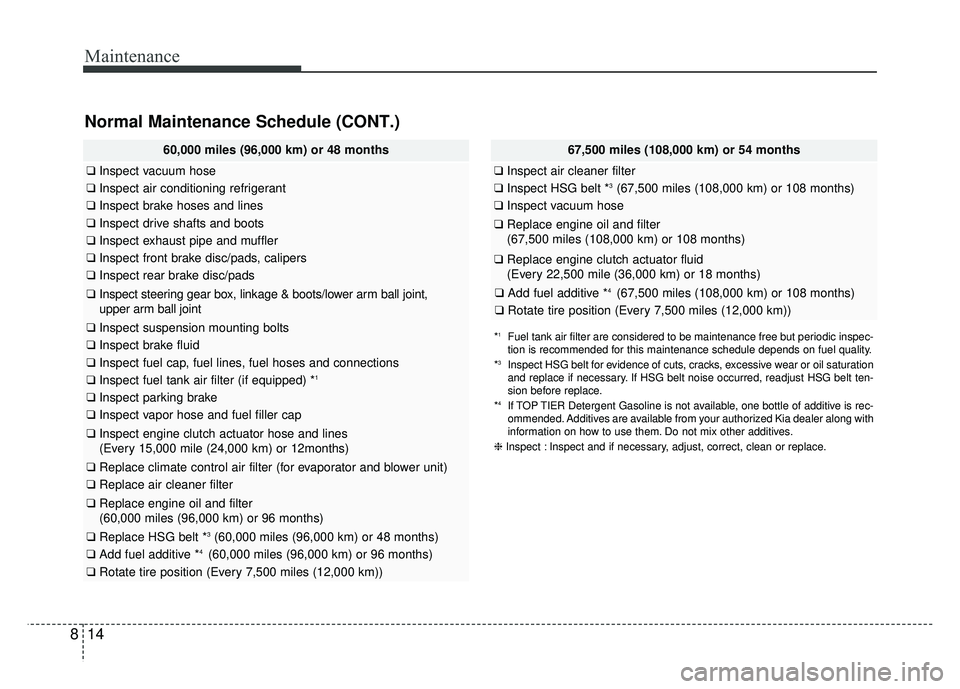
60,000 miles (96,000 km) or 48 months
❑ Inspect vacuum hose
❑Inspect air conditioning refrigerant
❑Inspect brake hoses and lines
❑Inspect drive shafts and boots
❑Inspect exhaust pipe and muffler
❑Inspect front brake disc/pads, calipers
❑Inspect rear brake disc/pads
❑Inspect steering gear box, linkage & boots/lower arm ball joint,
upper arm ball joint
❑ Inspect suspension mounting bolts
❑Inspect brake fluid
❑Inspect fuel cap, fuel lines, fuel hoses and connections
❑Inspect fuel tank air filter (if equipped) *1
❑Inspect parking brake
❑Inspect vapor hose and fuel filler cap
❑Inspect engine clutch actuator hose and lines
(Every 15,000 mile (24,000 km) or 12months)
❑ Replace climate control air filter (for evaporator and blower unit)
❑Replace air cleaner filter
❑Replace engine oil and filter
(60,000 miles (96,000 km) or 96 months)
❑Replace HSG belt *3(60,000 miles (96,000 km) or 48 months)
❑ Add fuel additive *4 (60,000 miles (96,000 km) or 96 months)
❑Rotate tire position (Every 7,500 miles (12,000 km))
67,500 miles (108,000 km) or 54 months
❑Inspect air cleaner filter
❑Inspect HSG belt *3(67,500 miles (108,000 km) or 108 months)
❑Inspect vacuum hose
❑Replace engine oil and filter
(67,500 miles (108,000 km) or 108 months)
❑Replace engine clutch actuator fluid
(Every 22,500 mile (36,000 km) or 18 months)
❑ Add fuel additive *4 (67,500 miles (108,000 km) or 108 months)
❑Rotate tire position (Every 7,500 miles (12,000 km))
*1Fuel tank air filter are considered to be maintenance free but periodic inspec-
tion is recommended for this maintenance schedule depends on fuel quality.
*
3Inspect HSG belt for evidence of cuts, cracks, excessive wear or oil saturation
and replace if necessary. If HSG belt noise occurred, readjust HSG belt ten-
sion before replace.
*
4If TOP TIER Detergent Gasoline is not available, one bottle of additive is rec-
ommended. Additives are available from your authorized Kia dealer along with
information on how to use them. Do not mix other additives.
❈ Inspect : Inspect and if necessary, adjust, correct, clean or replace.
Normal Maintenance Schedule (CONT.)
Page 485 of 616
Maintenance
16
8
Normal Maintenance Schedule (CONT.)
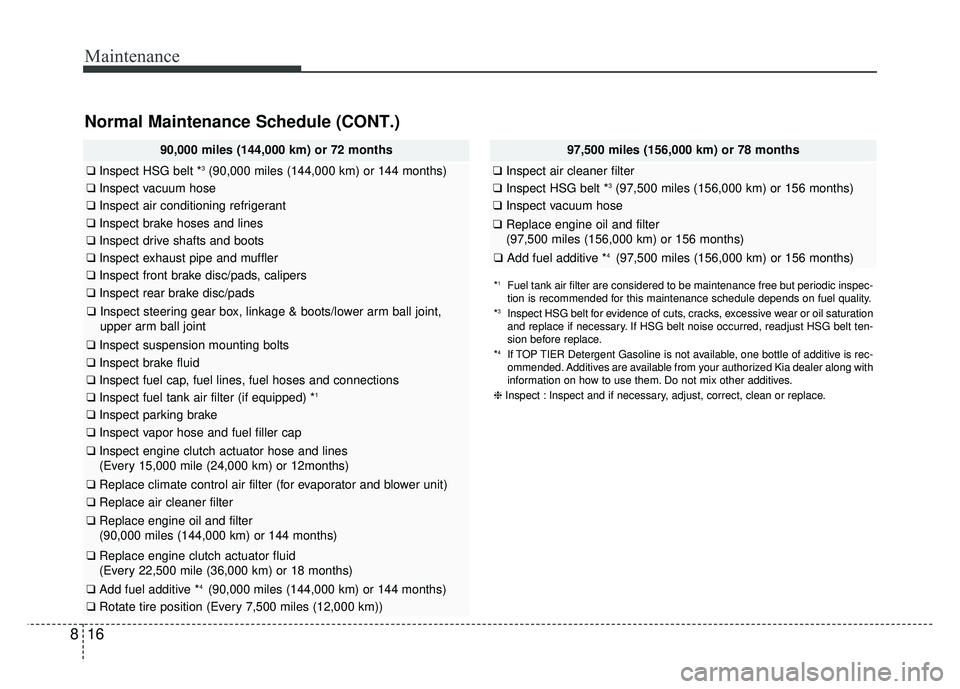
97,500 miles (156,000 km) or 78 months
❑ Inspect air cleaner filter
❑Inspect HSG belt *3(97,500 miles (156,000 km) or 156 months)
❑Inspect vacuum hose
❑Replace engine oil and filter
(97,500 miles (156,000 km) or 156 months)
❑ Add fuel additive *4 (97,500 miles (156,000 km) or 156 months)
90,000 miles (144,000 km) or 72 months
❑Inspect HSG belt *3(90,000 miles (144,000 km) or 144 months)
❑Inspect vacuum hose
❑Inspect air conditioning refrigerant
❑Inspect brake hoses and lines
❑Inspect drive shafts and boots
❑Inspect exhaust pipe and muffler
❑Inspect front brake disc/pads, calipers
❑Inspect rear brake disc/pads
❑Inspect steering gear box, linkage & boots/lower arm ball joint,
upper arm ball joint
❑ Inspect suspension mounting bolts
❑Inspect brake fluid
❑Inspect fuel cap, fuel lines, fuel hoses and connections
❑Inspect fuel tank air filter (if equipped) *1
❑Inspect parking brake
❑Inspect vapor hose and fuel filler cap
❑Inspect engine clutch actuator hose and lines
(Every 15,000 mile (24,000 km) or 12months)
❑ Replace climate control air filter (for evaporator and blower unit)
❑Replace air cleaner filter
❑Replace engine oil and filter
(90,000 miles (144,000 km) or 144 months)
❑Replace engine clutch actuator fluid
(Every 22,500 mile (36,000 km) or 18 months)
❑ Add fuel additive *4 (90,000 miles (144,000 km) or 144 months)
❑Rotate tire position (Every 7,500 miles (12,000 km))
*1Fuel tank air filter are considered to be maintenance free but periodic inspec-
tion is recommended for this maintenance schedule depends on fuel quality.
*
3Inspect HSG belt for evidence of cuts, cracks, excessive wear or oil saturation
and replace if necessary. If HSG belt noise occurred, readjust HSG belt ten-
sion before replace.
*
4If TOP TIER Detergent Gasoline is not available, one bottle of additive is rec-
ommended. Additives are available from your authorized Kia dealer along with
information on how to use them. Do not mix other additives.
❈ Inspect : Inspect and if necessary, adjust, correct, clean or replace.
Page 487 of 616
Maintenance
18
8
Normal Maintenance Schedule (CONT.)
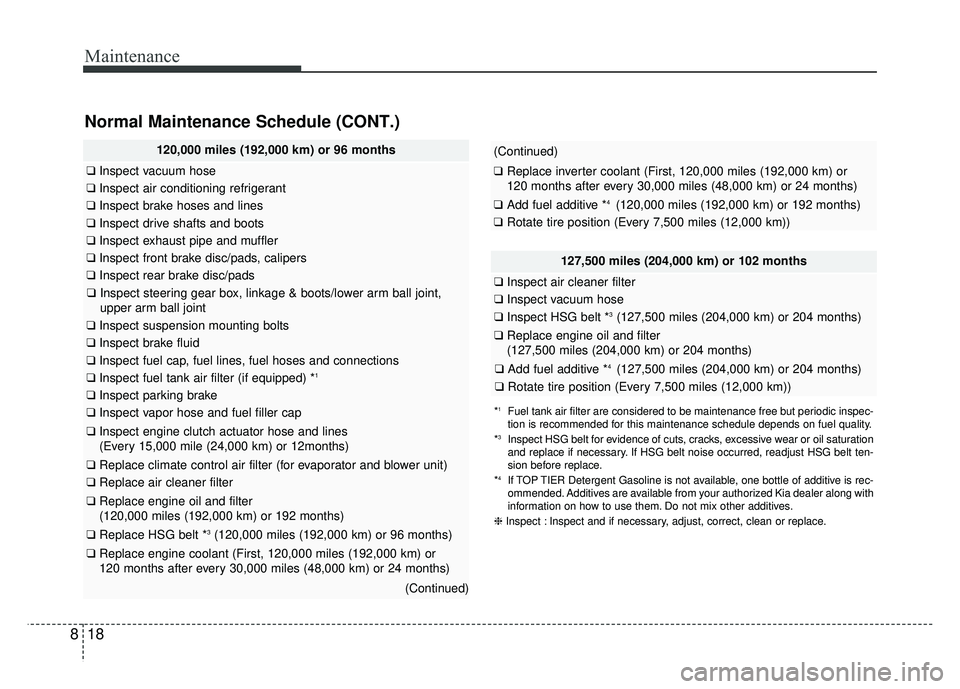
120,000 miles (192,000 km) or 96 months
❑ Inspect vacuum hose
❑Inspect air conditioning refrigerant
❑Inspect brake hoses and lines
❑Inspect drive shafts and boots
❑Inspect exhaust pipe and muffler
❑Inspect front brake disc/pads, calipers
❑Inspect rear brake disc/pads
❑Inspect steering gear box, linkage & boots/lower arm ball joint,
upper arm ball joint
❑ Inspect suspension mounting bolts
❑Inspect brake fluid
❑Inspect fuel cap, fuel lines, fuel hoses and connections
❑Inspect fuel tank air filter (if equipped) *1
❑Inspect parking brake
❑Inspect vapor hose and fuel filler cap
❑Inspect engine clutch actuator hose and lines
(Every 15,000 mile (24,000 km) or 12months)
❑ Replace climate control air filter (for evaporator and blower unit)
❑Replace air cleaner filter
❑Replace engine oil and filter
(120,000 miles (192,000 km) or 192 months)
❑Replace HSG belt *3(120,000 miles (192,000 km) or 96 months)
❑Replace engine coolant (First, 120,000 miles (192,000 km) or
120 months after every 30,000 miles (48,000 km) or 24 months)
(Continued)
*1Fuel tank air filter are considered to be maintenance free but periodic inspec-
tion is recommended for this maintenance schedule depends on fuel quality.
*
3Inspect HSG belt for evidence of cuts, cracks, excessive wear or oil saturation
and replace if necessary. If HSG belt noise occurred, readjust HSG belt ten-
sion before replace.
*
4If TOP TIER Detergent Gasoline is not available, one bottle of additive is rec-
ommended. Additives are available from your authorized Kia dealer along with
information on how to use them. Do not mix other additives.
❈ Inspect : Inspect and if necessary, adjust, correct, clean or replace.
127,500 miles (204,000 km) or 102 months
❑Inspect air cleaner filter
❑Inspect vacuum hose
❑Inspect HSG belt *3(127,500 miles (204,000 km) or 204 months)
❑Replace engine oil and filter
(127,500 miles (204,000 km) or 204 months)
❑ Add fuel additive *4 (127,500 miles (204,000 km) or 204 months)
❑Rotate tire position (Every 7,500 miles (12,000 km))
(Continued)
❑Replace inverter coolant (First, 120,000 miles (192,000 km) or
120 months after every 30,000 miles (48,000 km) or 24 months)
❑ Add fuel additive *4 (120,000 miles (192,000 km) or 192 months)
❑Rotate tire position (Every 7,500 miles (12,000 km))
Page 489 of 616
Maintenance
20
8
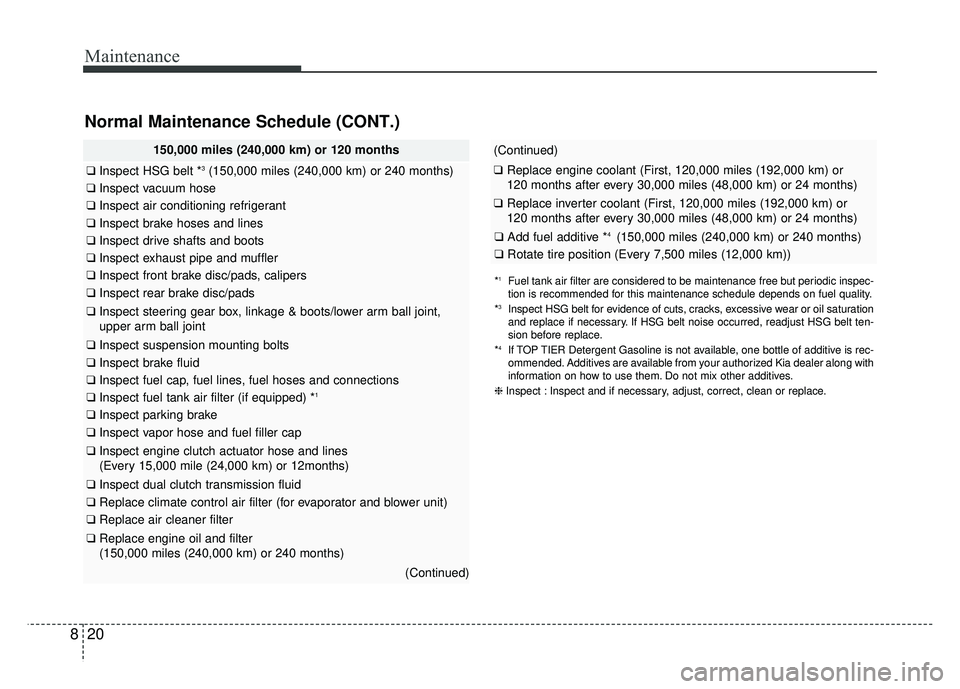
Normal Maintenance Schedule (CONT.)
150,000 miles (240,000 km) or 120 months
❑ Inspect HSG belt *3(150,000 miles (240,000 km) or 240 months)
❑Inspect vacuum hose
❑Inspect air conditioning refrigerant
❑Inspect brake hoses and lines
❑Inspect drive shafts and boots
❑Inspect exhaust pipe and muffler
❑Inspect front brake disc/pads, calipers
❑Inspect rear brake disc/pads
❑Inspect steering gear box, linkage & boots/lower arm ball joint,
upper arm ball joint
❑ Inspect suspension mounting bolts
❑Inspect brake fluid
❑Inspect fuel cap, fuel lines, fuel hoses and connections
❑Inspect fuel tank air filter (if equipped) *1
❑Inspect parking brake
❑Inspect vapor hose and fuel filler cap
❑Inspect engine clutch actuator hose and lines
(Every 15,000 mile (24,000 km) or 12months)
❑ Inspect dual clutch transmission fluid
❑Replace climate control air filter (for evaporator and blower unit)
❑Replace air cleaner filter
❑Replace engine oil and filter
(150,000 miles (240,000 km) or 240 months)
(Continued)
(Continued)
❑Replace engine coolant (First, 120,000 miles (192,000 km) or
120 months after every 30,000 miles (48,000 km) or 24 months)
❑Replace inverter coolant (First, 120,000 miles (192,000 km) or
120 months after every 30,000 miles (48,000 km) or 24 months)
❑ Add fuel additive *4 (150,000 miles (240,000 km) or 240 months)
❑Rotate tire position (Every 7,500 miles (12,000 km))
*1Fuel tank air filter are considered to be maintenance free but periodic inspec-
tion is recommended for this maintenance schedule depends on fuel quality.
*
3Inspect HSG belt for evidence of cuts, cracks, excessive wear or oil saturation
and replace if necessary. If HSG belt noise occurred, readjust HSG belt ten-
sion before replace.
*
4If TOP TIER Detergent Gasoline is not available, one bottle of additive is rec-
ommended. Additives are available from your authorized Kia dealer along with
information on how to use them. Do not mix other additives.
❈ Inspect : Inspect and if necessary, adjust, correct, clean or replace.
Page 491 of 616
Maintenance
22
8
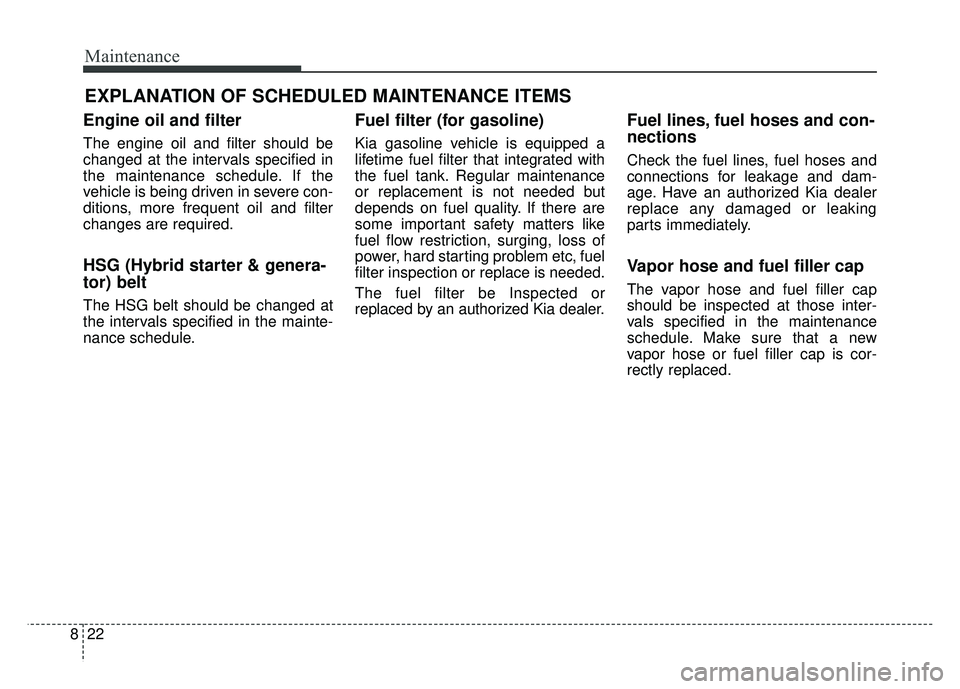
EXPLANATION OF SCHEDULED MAINTENANCE ITEMS
Engine oil and filter
The engine oil and filter should be
changed at the intervals specified in
the maintenance schedule. If the
vehicle is being driven in severe con-
ditions, more frequent oil and filter
changes are required.
HSG (Hybrid starter & genera-
tor) belt
The HSG belt should be changed at
the intervals specified in the mainte-
nance schedule.
Fuel filter (for gasoline)
Kia gasoline vehicle is equipped a
lifetime fuel filter that integrated with
the fuel tank. Regular maintenance
or replacement is not needed but
depends on fuel quality. If there are
some important safety matters like
fuel flow restriction, surging, loss of
power, hard starting problem etc, fuel
filter inspection or replace is needed.
The fuel filter be Inspected or
replaced by an authorized Kia dealer.
Fuel lines, fuel hoses and con-
nections
Check the fuel lines, fuel hoses and
connections for leakage and dam-
age. Have an authorized Kia dealer
replace any damaged or leaking
parts immediately.
Vapor hose and fuel filler cap
The vapor hose and fuel filler cap
should be inspected at those inter-
vals specified in the maintenance
schedule. Make sure that a new
vapor hose or fuel filler cap is cor-
rectly replaced.
Page 518 of 616
849
Maintenance
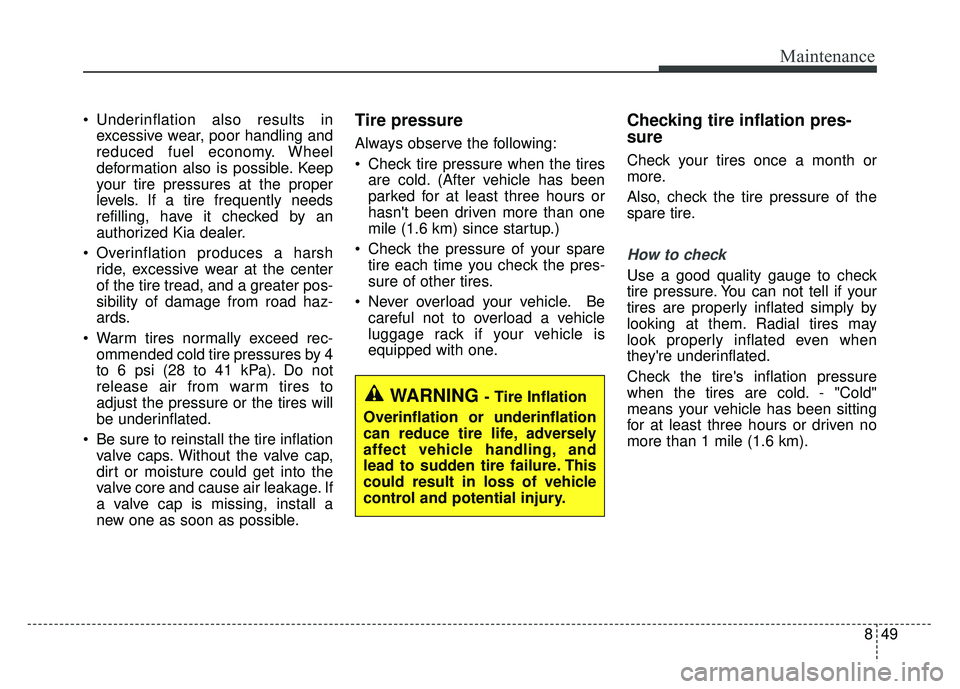
Underinflation also results inexcessive wear, poor handling and
reduced fuel economy. Wheel
deformation also is possible. Keep
your tire pressures at the proper
levels. If a tire frequently needs
refilling, have it checked by an
authorized Kia dealer.
Overinflation produces a harsh ride, excessive wear at the center
of the tire tread, and a greater pos-
sibility of damage from road haz-
ards.
Warm tires normally exceed rec- ommended cold tire pressures by 4
to 6 psi (28 to 41 kPa). Do not
release air from warm tires to
adjust the pressure or the tires will
be underinflated.
Be sure to reinstall the tire inflation valve caps. Without the valve cap,
dirt or moisture could get into the
valve core and cause air leakage. If
a valve cap is missing, install a
new one as soon as possible.Tire pressure
Always observe the following:
Check tire pressure when the tiresare cold. (After vehicle has been
parked for at least three hours or
hasn't been driven more than one
mile (1.6 km) since startup.)
Check the pressure of your spare tire each time you check the pres-
sure of other tires.
Never overload your vehicle. Be careful not to overload a vehicle
luggage rack if your vehicle is
equipped with one.
Checking tire inflation pres-
sure
Check your tires once a month or
more.
Also, check the tire pressure of the
spare tire.
How to check
Use a good quality gauge to check
tire pressure. You can not tell if your
tires are properly inflated simply by
looking at them. Radial tires may
look properly inflated even when
they're underinflated.
Check the tire's inflation pressure
when the tires are cold. - "Cold"
means your vehicle has been sitting
for at least three hours or driven no
more than 1 mile (1.6 km).
WARNING - Tire Inflation
Overinflation or underinflation
can reduce tire life, adversely
affect vehicle handling, and
lead to sudden tire failure. This
could result in loss of vehicle
control and potential injury.
Page 526 of 616
857
Maintenance
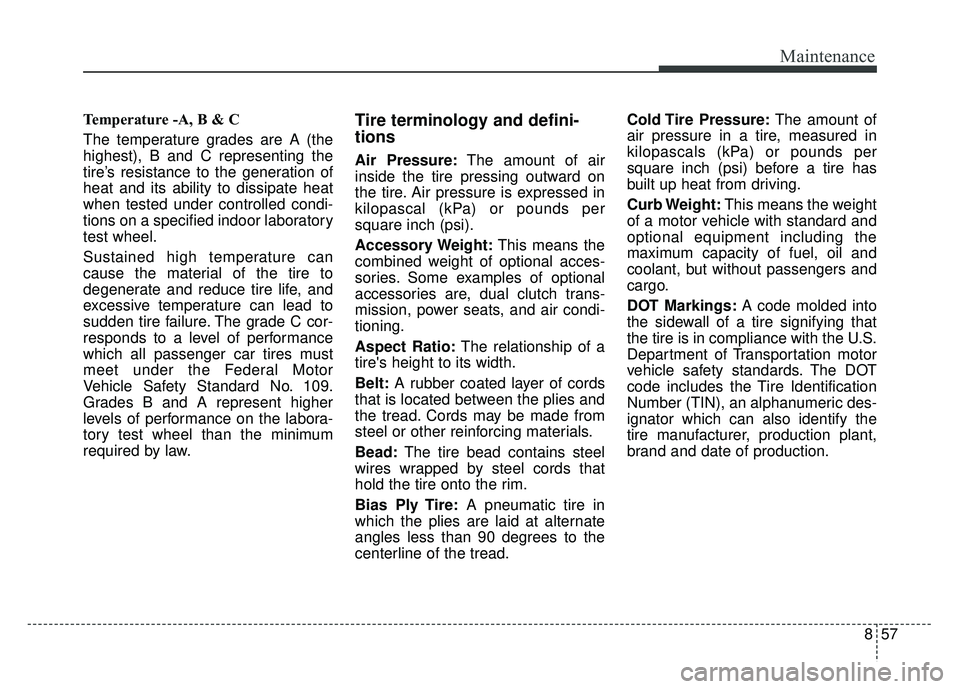
Temperature -A, B & C
The temperature grades are A (the
highest), B and C representing the
tire’s resistance to the generation of
heat and its ability to dissipate heat
when tested under controlled condi-
tions on a specified indoor laboratory
test wheel.
Sustained high temperature can
cause the material of the tire to
degenerate and reduce tire life, and
excessive temperature can lead to
sudden tire failure. The grade C cor-
responds to a level of performance
which all passenger car tires must
meet under the Federal Motor
Vehicle Safety Standard No. 109.
Grades B and A represent higher
levels of performance on the labora-
tory test wheel than the minimum
required by law.Tire terminology and defini-
tions
Air Pressure:The amount of air
inside the tire pressing outward on
the tire. Air pressure is expressed in
kilopascal (kPa) or pounds per
square inch (psi).
Accessory Weight: This means the
combined weight of optional acces-
sories. Some examples of optional
accessories are, dual clutch trans-
mission, power seats, and air condi-
tioning.
Aspect Ratio: The relationship of a
tire's height to its width.
Belt: A rubber coated layer of cords
that is located between the plies and
the tread. Cords may be made from
steel or other reinforcing materials.
Bead: The tire bead contains steel
wires wrapped by steel cords that
hold the tire onto the rim.
Bias Ply Tire: A pneumatic tire in
which the plies are laid at alternate
angles less than 90 degrees to the
centerline of the tread. Cold Tire Pressure:
The amount of
air pressure in a tire, measured in
kilopascals (kPa) or pounds per
square inch (psi) before a tire has
built up heat from driving.
Curb Weight: This means the weight
of a motor vehicle with standard and
optional equipment including the
maximum capacity of fuel, oil and
coolant, but without passengers and
cargo.
DOT Markings: A code molded into
the sidewall of a tire signifying that
the tire is in compliance with the U.S.
Department of Transportation motor
vehicle safety standards. The DOT
code includes the Tire Identification
Number (TIN), an alphanumeric des-
ignator which can also identify the
tire manufacturer, production plant,
brand and date of production.
Page 582 of 616
8113
Maintenance
EMISSION CONTROL SYSTEM
The emission control system of your
vehicle is covered by a written limited
warranty. Please see the warranty
information contained in the
Warranty & Consumer Information
manual in your vehicle.
Your vehicle is equipped with an
emission control system to meet all
applicable emission regulations.
There are three emission control
systems, as follows.
(1) Crankcase emission control sys-tem
(2) Evaporative emission control sys- tem
(3) Exhaust emission control system
In order to assure the proper function
of the emission control systems, it is
recommended that you have your
vehicle inspected and maintained by
an authorized Kia dealer in accor-
dance with the maintenance sched-
ule in this manual. Caution for the Inspection and
Maintenance Test (With Electronic
Stability Control (ESC) system)
To prevent the vehicle from mis-
firing during dynamometer test-
ing, turn the Electronic Stability
Control (ESC) system off by
pressing the ESC switch.
After dynamometer testing is completed, turn the ESC system
back on by pressing the ESC
switch again.1. Crankcase emission control system
The positive crankcase ventilation
system is employed to prevent air
pollution caused by blow-by gases
being emitted from the crankcase.
This system supplies fresh filtered air
to the crankcase through the air
intake hose. Inside the crankcase,
the fresh air mixes with blow-by
gases, which then pass through the
PCV valve into the induction system.
2. Evaporative emission con-trol (including ORVR:
Onboard Refueling Vapor
Recovery)
system
The Evaporative Emission Control
System is designed to prevent fuel
vapors from escaping into the atmos-
phere.
(The ORVR system is designed to
allow the vapors from the fuel tank to
be loaded into a canister while refu-
eling at the gas station, preventing
the escape of fuel vapors into the
atmosphere.)
Page 592 of 616
97
Specifications, Consumer information, Reporting safety defects
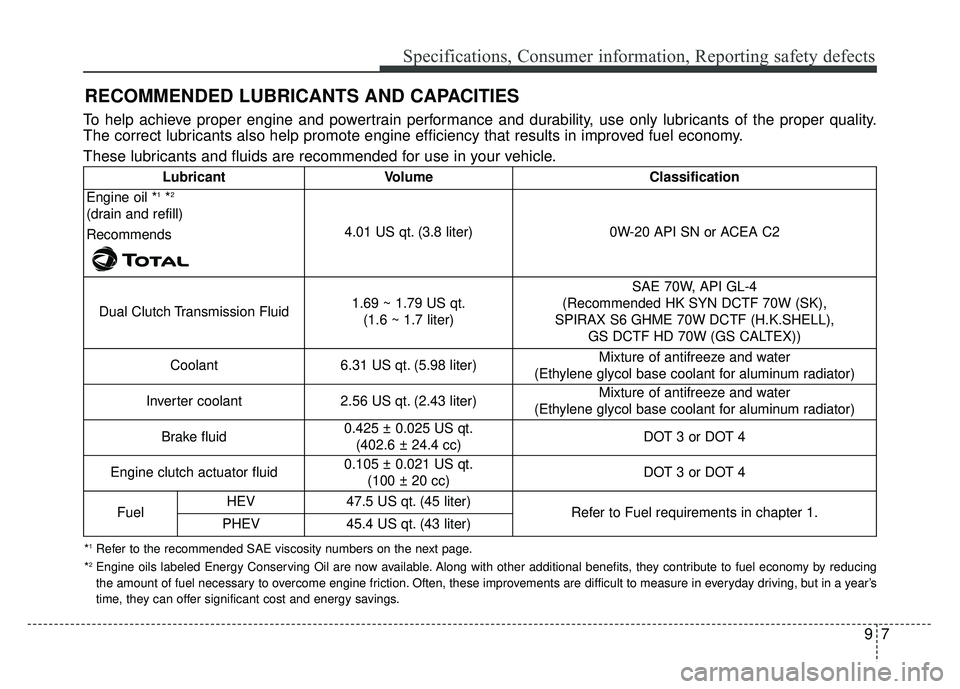
RECOMMENDED LUBRICANTS AND CAPACITIES
To help achieve proper engine and powertrain performance and durability, use only lubricants of the proper quality.
The correct lubricants also help promote engine efficiency that results in improved fuel economy.
These lubricants and fluids are recommended for use in your vehicle.
*1Refer to the recommended SAE viscosity numbers on the next page.
*2Engine oils labeled Energy Conserving Oil are now available. Along with other additional benefits, they contribute to fuel econo my by reducing
the amount of fuel necessary to overcome engine friction. Often, these improvements are difficult to measure in everyday driving, but in a year’s
time, they can offer significant cost and energy savings.
Lubricant VolumeClassification
Engine oil *1*2
(drain and refill)
Recommends
4.01 US qt. (3.8 liter)0W-20 API SN or ACEA C2
Dual Clutch Transmission Fluid1.69 ~ 1.79 US qt. (1.6 ~ 1.7 liter)
SAE 70W, API GL-4
(Recommended HK SYN DCTF 70W (SK),
SPIRAX S6 GHME 70W DCTF (H.K.SHELL), GS DCTF HD 70W (GS CALTEX))
Coolant6.31 US qt. (5.98 liter)Mixture of antifreeze and water
(Ethylene glycol base coolant for aluminum radiator)
Inverter coolant2.56 US qt. (2.43 liter)Mixture of antifreeze and water
(Ethylene glycol base coolant for aluminum radiator)
Brake fluid0.425 ± 0.025 US qt. (402.6 ± 24.4 cc)DOT 3 or DOT 4
Engine clutch actuator fluid0.105 ± 0.021 US qt. (100 ± 20 cc)DOT 3 or DOT 4
FuelHEV47.5 US qt. (45 liter)Refer to Fuel requirements in chapter 1.PHEV45.4 US qt. (43 liter)