12 volt KIA NIRO 2018 Owner's Guide
[x] Cancel search | Manufacturer: KIA, Model Year: 2018, Model line: NIRO, Model: KIA NIRO 2018Pages: 616, PDF Size: 18.3 MB
Page 444 of 616
What to do in an emergency
87
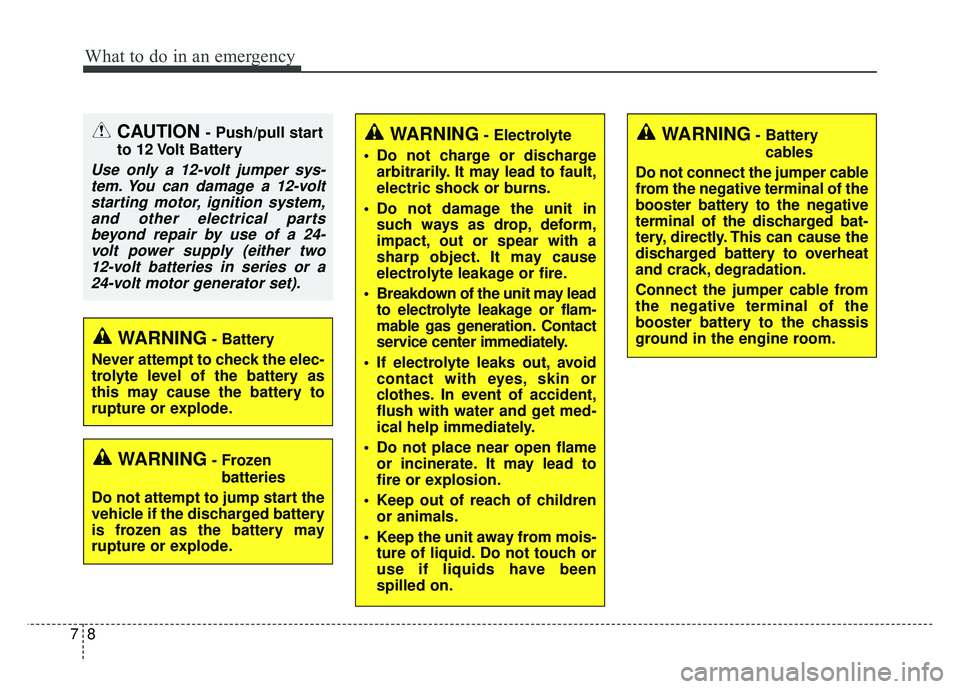
CAUTION - Push/pull start
to 12 Volt Battery
Use only a 12-volt jumper sys- tem. You can damage a 12-voltstarting motor, ignition system,and other electrical partsbeyond repair by use of a 24-volt power supply (either two12-volt batteries in series or a24-volt motor generator set).
WARNING- Battery
Never attempt to check the elec-
trolyte level of the battery as
this may cause the battery to
rupture or explode.
WARNING- Frozen batteries
Do not attempt to jump start the
vehicle if the discharged battery
is frozen as the battery may
rupture or explode.
WARNING- Battery cables
Do not connect the jumper cable
from the negative terminal of the
booster battery to the negative
terminal of the discharged bat-
tery, directly. This can cause the
discharged battery to overheat
and crack, degradation.
Connect the jumper cable from
the negative terminal of the
booster battery to the chassis
ground in the engine room.WARNING- Electrolyte
Do not charge or discharge arbitrarily. It may lead to fault,
electric shock or burns.
Do not damage the unit in such ways as drop, deform,
impact, out or spear with a
sharp object. It may cause
electrolyte leakage or fire.
Breakdown of the unit may lead to electrolyte leakage or flam-
mable gas generation. Contact
service center immediately.
If electrolyte leaks out, avoid contact with eyes, skin or
clothes. In event of accident,
flush with water and get med-
ical help immediately.
Do not place near open flame or incinerate. It may lead to
fire or explosion.
Keep out of reach of children or animals.
Keep the unit away from mois- ture of liquid. Do not touch or
use if liquids have been
spilled on.
Page 445 of 616
79
What to do in an emergency
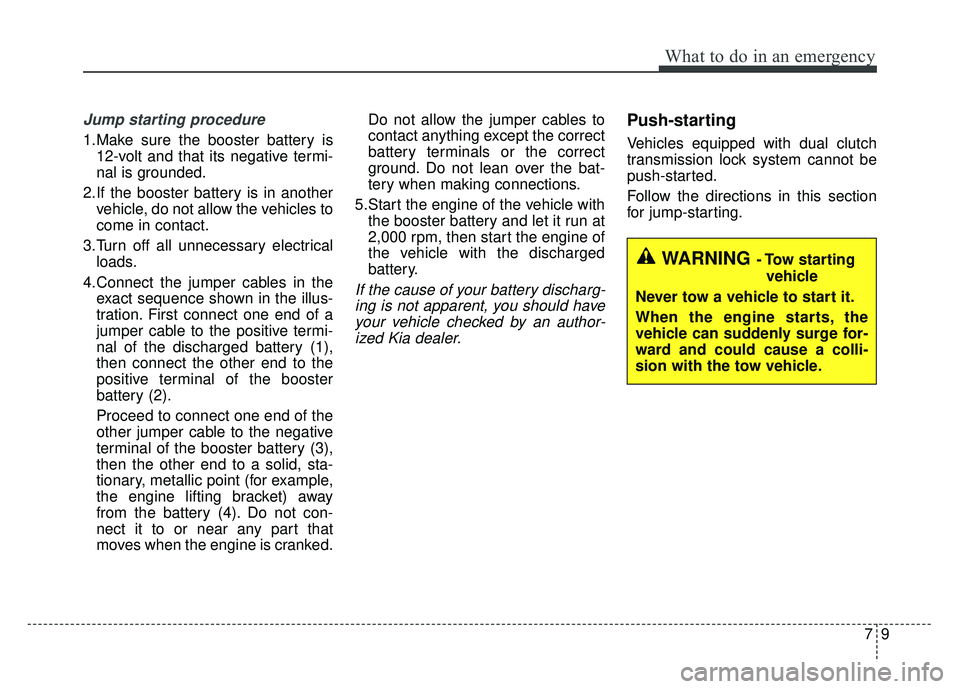
Jump starting procedure
1.Make sure the booster battery is12-volt and that its negative termi-
nal is grounded.
2.If the booster battery is in another vehicle, do not allow the vehicles to
come in contact.
3.Turn off all unnecessary electrical loads.
4.Connect the jumper cables in the exact sequence shown in the illus-
tration. First connect one end of a
jumper cable to the positive termi-
nal of the discharged battery (1),
then connect the other end to the
positive terminal of the booster
battery (2).
Proceed to connect one end of the
other jumper cable to the negative
terminal of the booster battery (3),
then the other end to a solid, sta-
tionary, metallic point (for example,
the engine lifting bracket) away
from the battery (4). Do not con-
nect it to or near any part that
moves when the engine is cranked. Do not allow the jumper cables to
contact anything except the correct
battery terminals or the correct
ground. Do not lean over the bat-
tery when making connections.
5.Start the engine of the vehicle with the booster battery and let it run at
2,000 rpm, then start the engine of
the vehicle with the discharged
battery.
If the cause of your battery discharg-ing is not apparent, you should haveyour vehicle checked by an author-ized Kia dealer.
Push-starting
Vehicles equipped with dual clutch
transmission lock system cannot be
push-started.
Follow the directions in this section
for jump-starting.
WARNING - Tow starting
vehicle
Never tow a vehicle to start it.
When the engine starts, the
vehicle can suddenly surge for-
ward and could cause a colli-
sion with the tow vehicle.
Page 463 of 616
727
What to do in an emergency
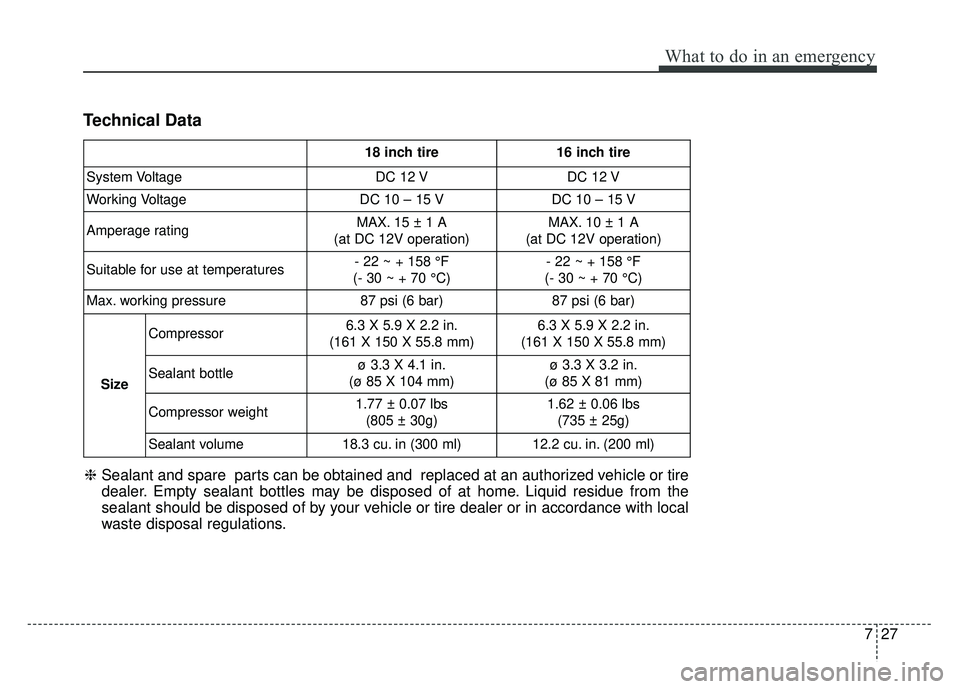
Technical Data
18 inch tire16 inch tire
System Voltage DC 12 VDC 12 V
Working Voltage DC 10 – 15 VDC 10 – 15 V
Amperage rating MAX. 15 ± 1 A
(at DC 12V operation) MAX. 10 ± 1 A
(at DC 12V operation)
Suitable for use at temperatures - 22 ~ + 158 °F
(- 30 ~ + 70 °C) - 22 ~ + 158 °F
(- 30 ~ + 70 °C)
Max. working pressure 87 psi (6 bar)87 psi (6 bar)
Size Compressor
6.3 X 5.9 X 2.2 in.
(161 X 150 X 55.8 mm) 6.3 X 5.9 X 2.2 in.
(161 X 150 X 55.8 mm)
Sealant bottle ø 3.3 X 4.1 in.
(ø 85 X 104 mm) ø 3.3 X 3.2 in.
(ø 85 X 81 mm)
Compressor weight 1.77 ± 0.07 lbs
(805 ± 30g) 1.62 ± 0.06 lbs
(735 ± 25g)
Sealant volume 18.3 cu. in (300 ml)12.2 cu. in. (200 ml)
❈Sealant and spare parts can be obtained and replaced at an authorized vehicle or tire
dealer. Empty sealant bottles may be disposed of at home. Liquid residue from the
sealant should be disposed of by your vehicle or tire dealer or in accordance with local
waste disposal regulations.
Page 469 of 616
733
What to do in an emergency
IF AN ACCIDENT OCCURS
✽
✽ NOTICE
Any gas or electrolyte leakage from
your vehicle is not only poisonous
but also flammable. Upon witness-
ing one of those, open the windows,
and remain a safe distance from the
vehicle out of the road. Immediately
contact an authorized Kia dealer
and advise them that a hybrid vehi-
cle is involved.
If you need towing, refer to
"Towing" in the previous pages.
When the vehicle is severely dam- aged, remain a safe distance of 50
feet (15 meter) or more between
your vehicle and other
vehicles/flammables.
If a fire occurs :
Immediately call emergency services
(911) and advise the emergency
responders that a hybrid vehicle is
involved.
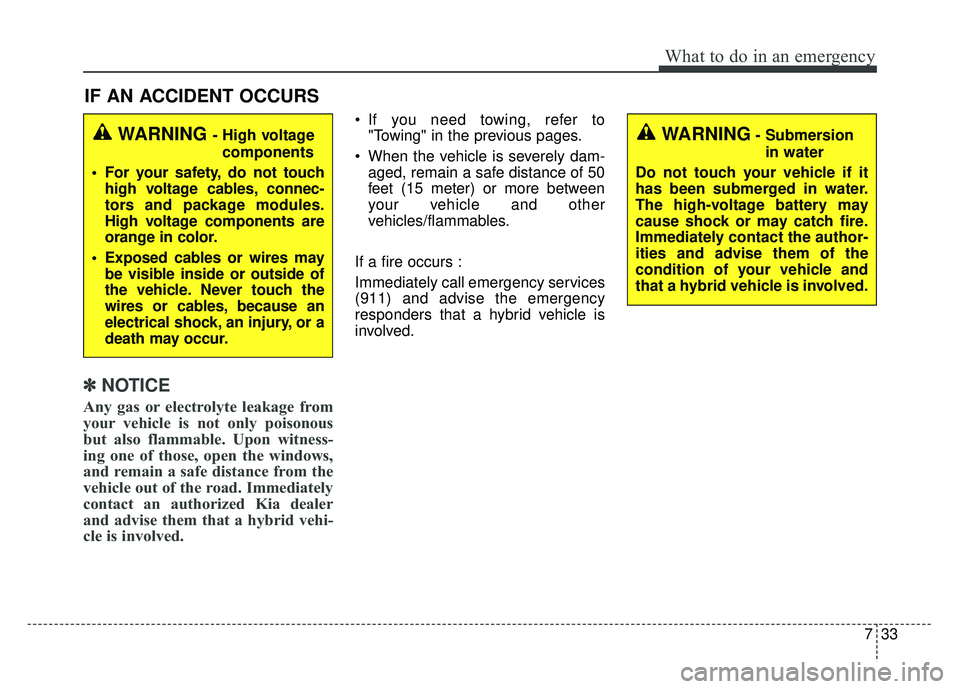
WARNING - High voltage components
For your safety, do not touch high voltage cables, connec-
tors and package modules.
High voltage components are
orange in color.
Exposed cables or wires may be visible inside or outside of
the vehicle. Never touch the
wires or cables, because an
electrical shock, an injury, or a
death may occur.WARNING- Submersion
in water
Do not touch your vehicle if it
has been submerged in water.
The high-voltage battery may
cause shock or may catch fire.
Immediately contact the author-
ities and advise them of the
condition of your vehicle and
that a hybrid vehicle is involved.
Page 476 of 616
87
Maintenance
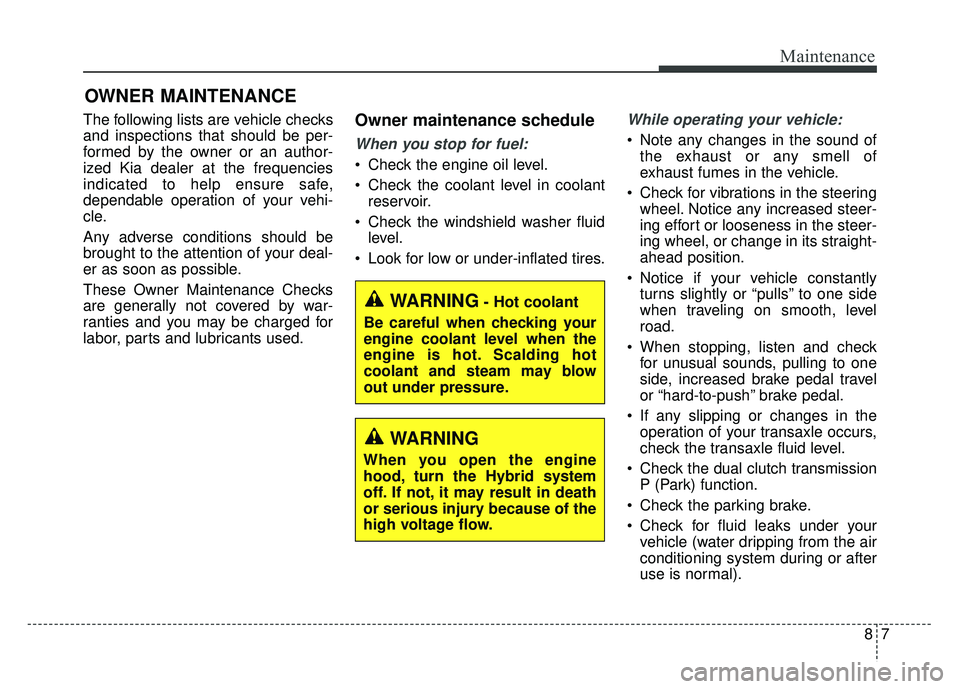
OWNER MAINTENANCE
The following lists are vehicle checks
and inspections that should be per-
formed by the owner or an author-
ized Kia dealer at the frequencies
indicated to help ensure safe,
dependable operation of your vehi-
cle.
Any adverse conditions should be
brought to the attention of your deal-
er as soon as possible.
These Owner Maintenance Checks
are generally not covered by war-
ranties and you may be charged for
labor, parts and lubricants used.Owner maintenance schedule
When you stop for fuel:
Check the engine oil level.
Check the coolant level in coolantreservoir.
Check the windshield washer fluid level.
Look for low or under-inflated tires.
While operating your vehicle:
Note any changes in the sound of the exhaust or any smell of
exhaust fumes in the vehicle.
Check for vibrations in the steering wheel. Notice any increased steer-
ing effort or looseness in the steer-
ing wheel, or change in its straight-
ahead position.
Notice if your vehicle constantly turns slightly or “pulls” to one side
when traveling on smooth, level
road.
When stopping, listen and check for unusual sounds, pulling to one
side, increased brake pedal travel
or “hard-to-push” brake pedal.
If any slipping or changes in the operation of your transaxle occurs,
check the transaxle fluid level.
Check the dual clutch transmission P (Park) function.
Check the parking brake.
Check for fluid leaks under your vehicle (water dripping from the air
conditioning system during or after
use is normal).
WARNING- Hot coolant
Be careful when checking your
engine coolant level when the
engine is hot. Scalding hot
coolant and steam may blow
out under pressure.
WARNING
When you open the engine
hood, turn the Hybrid system
off. If not, it may result in death
or serious injury because of the
high voltage flow.
Page 515 of 616
Maintenance
46
8
✽
✽
NOTICE
If you connect unauthorized elec-
tronic devices to the battery, the bat-
tery may be discharged. Never use
unauthorized devices.
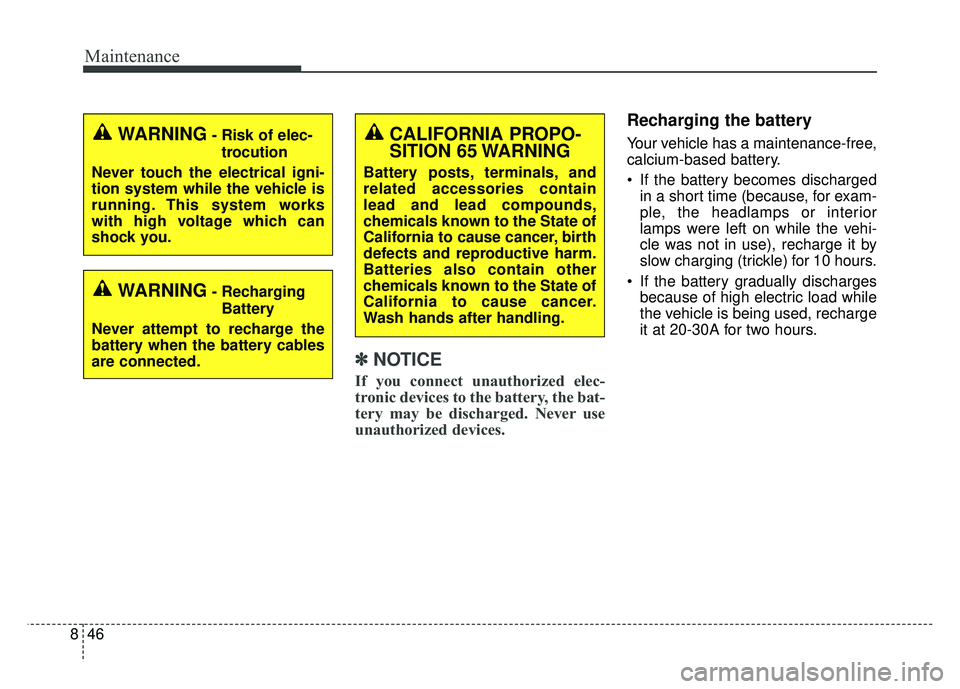
Recharging the battery
Your vehicle has a maintenance-free,
calcium-based battery.
If the battery becomes discharged
in a short time (because, for exam-
ple, the headlamps or interior
lamps were left on while the vehi-
cle was not in use), recharge it by
slow charging (trickle) for 10 hours.
If the battery gradually discharges because of high electric load while
the vehicle is being used, recharge
it at 20-30A for two hours.CALIFORNIA PROPO-
SITION 65 WARNING
Battery posts, terminals, and
related accessories contain
lead and lead compounds,
chemicals known to the State of
California to cause cancer, birth
defects and reproductive harm.
Batteries also contain other
chemicals known to the State of
California to cause cancer.
Wash hands after handling.
WARNING- Risk of elec-
trocution
Never touch the electrical igni-
tion system while the vehicle is
running. This system works
with high voltage which can
shock you.
WARNING- Recharging Battery
Never attempt to recharge the
battery when the battery cables
are connected.
Page 549 of 616
Maintenance
80
8
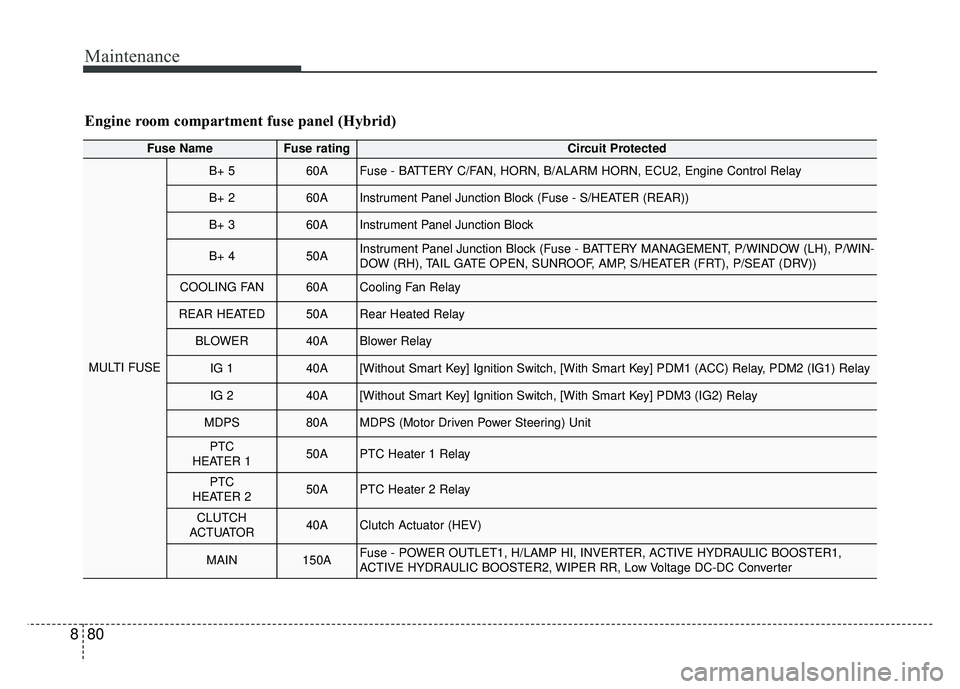
Engine room compartment fuse panel (Hybrid)
Fuse NameFuse ratingCircuit Protected
MULTI FUSE
B+ 560AFuse - BATTERY C/FAN, HORN, B/ALARM HORN, ECU2, Engine Control Relay
B+ 260AInstrument Panel Junction Block (Fuse - S/HEATER (REAR))
B+ 360AInstrument Panel Junction Block
B+ 450AInstrument Panel Junction Block (Fuse - BATTERY MANAGEMENT, P/WINDOW (LH), P/WIN-
DOW (RH), TAIL GATE OPEN, SUNROOF, AMP, S/HEATER (FRT), P/SEAT (DRV))
COOLING FAN60ACooling Fan Relay
REAR HEATED50ARear Heated Relay
BLOWER40ABlower Relay
IG 140A[Without Smart Key] Ignition Switch, [With Smart Key] PDM1 (ACC) Relay, PDM2 (IG1) Relay
IG 240A[Without Smart Key] Ignition Switch, [With Smart Key] PDM3 (IG2) Relay
MDPS80AMDPS (Motor Driven Power Steering) Unit
PTC
HEATER 150APTC Heater 1 Relay
PTC
HEATER 250APTC Heater 2 Relay
CLUTCH
ACTUATOR40AClutch Actuator (HEV)
MAIN150AFuse - POWER OUTLET1, H/LAMP HI, INVERTER, ACTIVE HYDRAULIC BOOSTER1,
ACTIVE HYDRAULIC BOOSTER2, WIPER RR, Low Voltage DC-DC Converter
Page 553 of 616
Maintenance
84
8
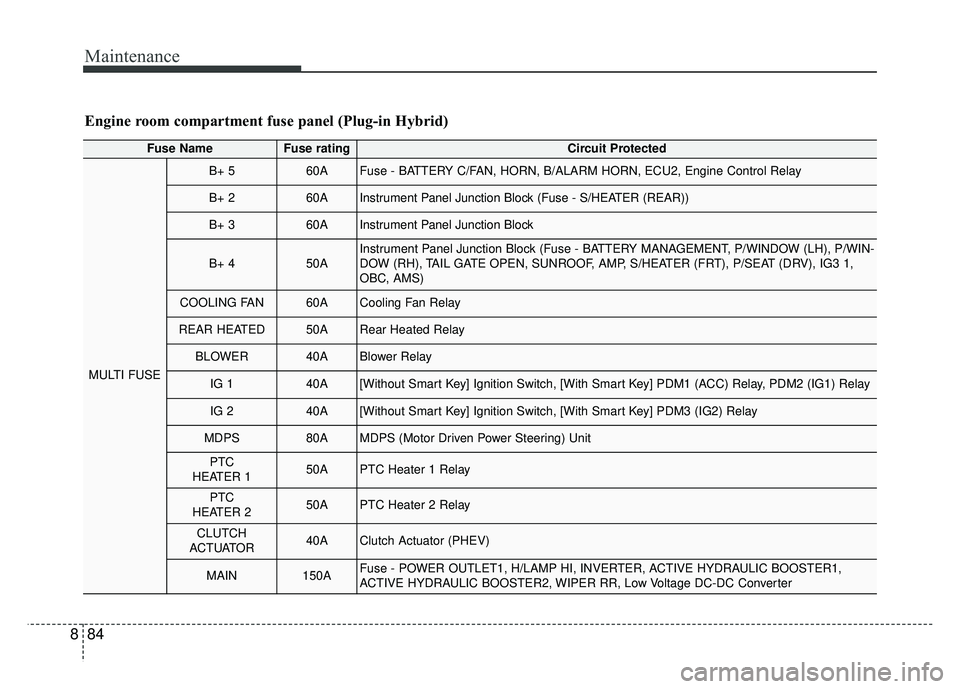
Engine room compartment fuse panel (Plug-in Hybrid)
Fuse NameFuse ratingCircuit Protected
MULTI FUSE
B+ 560AFuse - BATTERY C/FAN, HORN, B/ALARM HORN, ECU2, Engine Control Relay
B+ 260AInstrument Panel Junction Block (Fuse - S/HEATER (REAR))
B+ 360AInstrument Panel Junction Block
B+ 450AInstrument Panel Junction Block (Fuse - BATTERY MANAGEMENT, P/WINDOW (LH), P/WIN-
DOW (RH), TAIL GATE OPEN, SUNROOF, AMP, S/HEATER (FRT), P/SEAT (DRV), IG3 1,
OBC, AMS)
COOLING FAN60ACooling Fan Relay
REAR HEATED50ARear Heated Relay
BLOWER40ABlower Relay
IG 140A[Without Smart Key] Ignition Switch, [With Smart Key] PDM1 (ACC) Relay, PDM2 (IG1) Relay
IG 240A[Without Smart Key] Ignition Switch, [With Smart Key] PDM3 (IG2) Relay
MDPS80AMDPS (Motor Driven Power Steering) Unit
PTC
HEATER 150APTC Heater 1 Relay
PTC
HEATER 250APTC Heater 2 Relay
CLUTCH
ACTUATOR40AClutch Actuator (PHEV)
MAIN150AFuse - POWER OUTLET1, H/LAMP HI, INVERTER, ACTIVE HYDRAULIC BOOSTER1,
ACTIVE HYDRAULIC BOOSTER2, WIPER RR, Low Voltage DC-DC Converter