cover KIA NIRO 2019 Workshop Manual
[x] Cancel search | Manufacturer: KIA, Model Year: 2019, Model line: NIRO, Model: KIA NIRO 2019Pages: 611, PDF Size: 15.28 MB
Page 447 of 611
77
What to do in an emergency
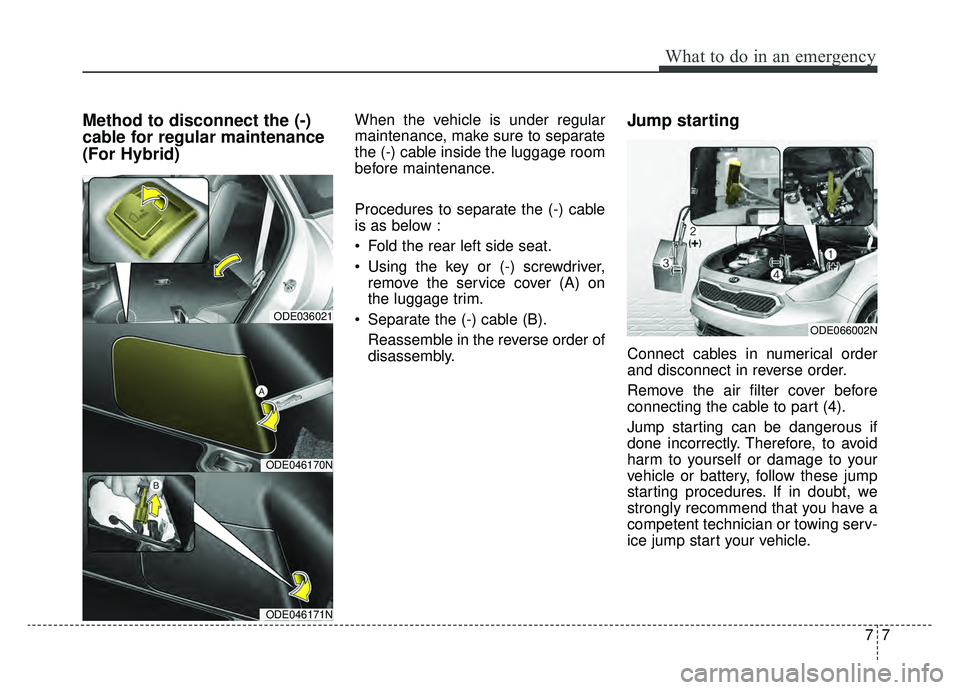
Method to disconnect the (-)
cable for regular maintenance
(For Hybrid)When the vehicle is under regular
maintenance, make sure to separate
the (-) cable inside the luggage room
before maintenance.
Procedures to separate the (-) cable
is as below :
Fold the rear left side seat.
Using the key or (-) screwdriver,remove the service cover (A) on
the luggage trim.
Separate the (-) cable (B). Reassemble in the reverse order of
disassembly.Jump starting
Connect cables in numerical order
and disconnect in reverse order.
Remove the air filter cover before
connecting the cable to part (4).
Jump starting can be dangerous if
done incorrectly. Therefore, to avoid
harm to yourself or damage to your
vehicle or battery, follow these jump
starting procedures. If in doubt, we
strongly recommend that you have a
competent technician or towing serv-
ice jump start your vehicle.
ODE036021
ODE046170N
ODE046171N
ODE066002N
Page 470 of 611
What to do in an emergency
30
7
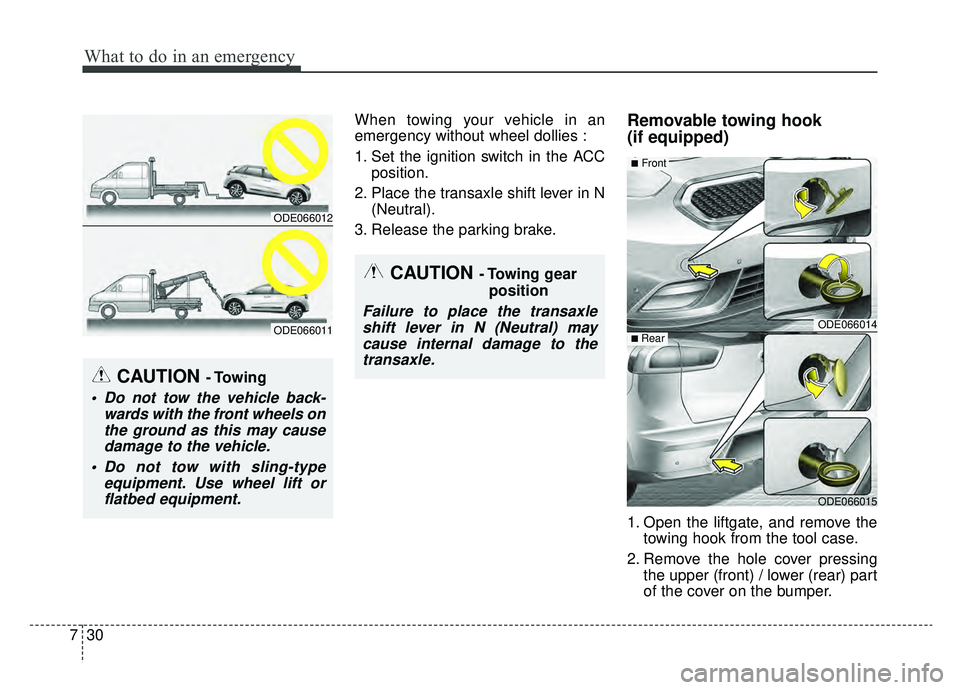
When towing your vehicle in an
emergency without wheel dollies :
1. Set the ignition switch in the ACC
position.
2. Place the transaxle shift lever in N (Neutral).
3. Release the parking brake.Removable towing hook
(if equipped)
1. Open the liftgate, and remove the towing hook from the tool case.
2. Remove the hole cover pressing the upper (front) / lower (rear) part
of the cover on the bumper.
CAUTION - Towing gear
position
Failure to place the transaxleshift lever in N (Neutral) maycause internal damage to thetransaxle.
CAUTION - Towing
Do not tow the vehicle back- wards with the front wheels onthe ground as this may causedamage to the vehicle.
Do not tow with sling-type equipment. Use wheel lift orflatbed equipment.
ODE066012
ODE066011ODE066014
ODE066015
■Front
■ Rear
Page 471 of 611
731
What to do in an emergency
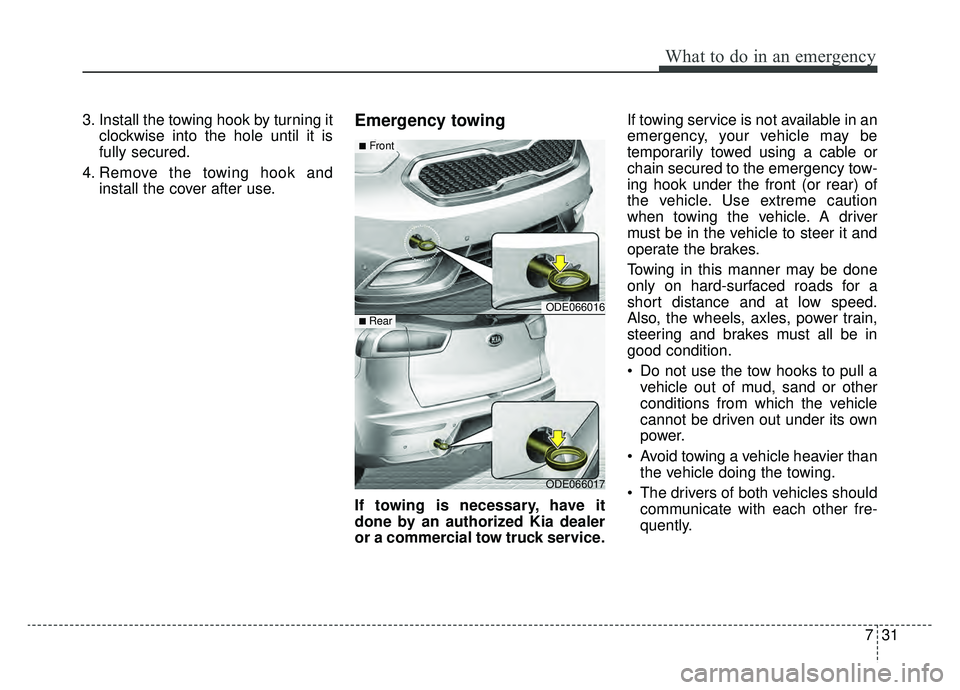
3. Install the towing hook by turning itclockwise into the hole until it is
fully secured.
4. Remove the towing hook and install the cover after use.Emergency towing
If towing is necessary, have it
done by an authorized Kia dealer
or a commercial tow truck service. If towing service is not available in an
emergency, your vehicle may be
temporarily towed using a cable or
chain secured to the emergency tow-
ing hook under the front (or rear) of
the vehicle. Use extreme caution
when towing the vehicle. A driver
must be in the vehicle to steer it and
operate the brakes.
Towing in this manner may be done
only on hard-surfaced roads for a
short distance and at low speed.
Also, the wheels, axles, power train,
steering and brakes must all be in
good condition.
Do not use the tow hooks to pull a
vehicle out of mud, sand or other
conditions from which the vehicle
cannot be driven out under its own
power.
Avoid towing a vehicle heavier than the vehicle doing the towing.
The drivers of both vehicles should communicate with each other fre-
quently.
ODE066016
ODE066017
■Front
■ Rear
Page 476 of 611
Tire terminology and definitions . . . . . . . . . . . . . . . . 8-50
All season tires . . . . . . . . . . . . . . . . . . . . . . . . . . . . . . 8-53
Summer tires . . . . . . . . . . . . . . . . . . . . . . . . . . . . . . . . 8-53
Snow tires . . . . . . . . . . . . . . . . . . . . . . . . . . . . . . . . . . . 8-\
53
Tire chains . . . . . . . . . . . . . . . . . . . . . . . . . . . . . . . . . . 8-54\
Radial-ply tires . . . . . . . . . . . . . . . . . . . . . . . . . . . . . . 8-54
Low aspect ratio tire . . . . . . . . . . . . . . . . . . . . . . . . . . 8-55
Fuses . . . . . . . . . . . . . . . . . . . . . . . . . . . . . . . . . . . . \
8-56
Inner panel fuse replacement . . . . . . . . . . . . . . . . . . . 8-57
Engine compartment fuse replacement. . . . . . . . . . . 8-59
Fuse/relay panel description. . . . . . . . . . . . . . . . . . . . 8-62
Light bulbs . . . . . . . . . . . . . . . . . . . . . . . . . . . . . . . 8-84
Bulb replacement precaution . . . . . . . . . . . . . . . . . . 8-84
Light bulb position (Front). . . . . . . . . . . . . . . . . . . . . 8-85
Light bulb position (Rear) . . . . . . . . . . . . . . . . . . . . . 8-86
Light bulb position (Side) . . . . . . . . . . . . . . . . . . . . . . 8-87
Headlamp (HID type) bulb replacement . . . . . . . . . 8-87
Headlamp (LED type) replacement. . . . . . . . . . . . . . 8-88
Headlamp (High/Low beam) bulb replacement . . . 8-88
Front turn signal lamp bulb replacement . . . . . . . . 8-89
Fog lamp/DRL bulb replacement . . . . . . . . . . . . . . . 8-90
Stop and tail lamp bulb replacement . . . . . . . . . . . . 8-90
Tail lamp (inside) bulb replacement . . . . . . . . . . . . . 8-92
Stop and tail lamp (LED type) bulb replacement . . 8-93
Back-up lamp bulb replacement . . . . . . . . . . . . . . . . 8-93
High mounted stop lamp bulb replacement . . . . . . . 8-93
License plate lamp bulb replacement . . . . . . . . . . . . 8-94
Side repeater lamp (LED type) bulb replacement . . 8-94
Map lamp (Bulb type) bulb replacement . . . . . . . . . 8-95
Map lamp (LED type) bulb replacement . . . . . . . . . 8-95
Vanity mirror lamp bulb replacement . . . . . . . . . . . 8-95
Room lamp (Bulb type) bulb replacement . . . . . . . . 8-96
Room lamp (LED type) bulb replacement . . . . . . . . 8-97
Liftgate room lamp bulb replacement . . . . . . . . . . . 8-97
Appearance care . . . . . . . . . . . . . . . . . . . . . . . . . . . 8-98
Exterior care . . . . . . . . . . . . . . . . . . . . . . . . . . . . . . . . 8-98
Interior care . . . . . . . . . . . . . . . . . . . . . . . . . . . . . . . . 8-103
Emission control system . . . . . . . . . . . . . . . . . . . 8-106
Crankcase emission control system . . . . . . . . . . . . . 8-106
Evaporative emission control (Including ORVR :
Onboard Refueling Vapor Recovery) system . . . . 8-106
Exhaust emission control system . . . . . . . . . . . . . . . 8-107
California perchlorate notice . . . . . . . . . . . . . . . 8-109
8
Page 479 of 611
85
Maintenance
MAINTENANCE SERVICES
You should exercise the utmost care
to prevent damage to your vehicle
and injury to yourself whenever per-
forming any maintenance or inspec-
tion procedures.
Should you have any doubts con-
cerning the inspection or servicing of
your vehicle, we strongly recom-
mend that you have an authorized
Kia dealer perform this work.
An authorized Kia dealer has factory-
trained technicians and genuine Kia
parts to service your vehicle proper-
ly. For expert advice and quality serv-
ice, see an authorized Kia dealer.
Inadequate, incomplete or insuffi-
cient servicing may result in opera-
tional problems with your vehicle that
could lead to vehicle damage, an
accident, or personal injury.Owner’s responsibility
✽ ✽NOTICE
Maintenance Service and Record
Retention are the owner's responsi-
bility.
You should retain documents that
show proper maintenance has been
performed on your vehicle in accor-
dance with the scheduled mainte-
nance service charts shown on the
following pages. You need this infor-
mation to establish your compliance
with the servicing and maintenance
requirements of your vehicle war-
ranties.
Detailed warranty information is
provided in your Warranty &
Consumer Information manual.
Repairs and adjustments required as
a result of improper maintenance or
a lack of required maintenance are
not covered.
We recommend you have your vehi-
cle maintained and repaired by an
authorized Kia dealer. An authorized
Kia dealer meets Kia’s high service
quality standards and receives tech-
nical support from Kia in order to pro-
vide you with a high level of service
satisfaction.
✽ ✽NOTICE - NHTSA Safety
Corrosion Alert
The National Highway Traffic
Safety Administration (NHTSA) has
issued a general warning to all vehi-
cle owners of all brands regarding
the risks associated with vehicle
underbody corrosion. From your
initial purchase, take the following
steps to prevent unsafe corrosion
damage to your vehicle:
(Continued)
Page 480 of 611
Maintenance
68
(Continued)
• Wash the undercarriage of yourvehicle regularly during the win-
ter and whenever your vehicle has
been exposed to such salts or
chemicals.
• Do a thorough washing of the undercarriage at the end of the
winter.
• Use professional service techni- cians or governmental inspection
stations to annually inspect for
corrosion.
• Immediately seek an inspection of your vehicle if you become visual-
ly aware of corrosion flaking or
scaling or if you become aware of
a change in vehicle performance,
such as soft or spongy brakes, flu-
ids leaking, impairment of direc-
tional control, suspension noises
or rattling metal straps.
NHTSA further advises that after
a vehicle is 7 years old, it is essen-
tial that you take these indicated
maintenance steps to ensure that
you protect yourself from unsafe
corrosion conditions.Owner maintenance precau-
tions
Improper or incomplete service may
result in problems. This section gives
instructions only for the maintenance
items that are easy to perform.
As explained earlier in this section,
several procedures can be done only
by an authorized Kia dealer with spe-
cial tools.
✽ ✽ NOTICE
Improper owner maintenance dur-
ing the warranty period may affect
warranty coverage. For details, read
the separate Warranty & Consumer
Information manual provided with
the vehicle. If you're unsure about
any servicing or maintenance proce-
dure, have it done by an authorized
Kia dealer.
WARNING- Maintenance
work
Do not wear jewelry or loose
clothing while working under
the hood of your vehicle with
the engine running. These can
become entangled in moving
parts, if you must run the
engine while working under the
hood, make certain that you
remove all jewelry (especially
rings, bracelets, watches, and
necklaces) and all neckties,
scarves, and similar loose
clothing before getting near the
engine or cooling fans.
WARNING- Touching metal parts
Do not touch metal parts
(including strut bars) while the
engine is operating or hot.
Doing so could result in serious
bodily injury. Turn the engine off
and wait until the metal parts
cool down to perform any main-
tenance work on the vehicle.
Page 481 of 611
87
Maintenance
OWNER MAINTENANCE
The following lists are vehicle checks
and inspections that should be per-
formed by the owner or an author-
ized Kia dealer at the frequencies
indicated to help ensure safe,
dependable operation of your vehi-
cle.
Any adverse conditions should be
brought to the attention of your deal-
er as soon as possible.
These Owner Maintenance Checks
are generally not covered by war-
ranties and you may be charged for
labor, parts and lubricants used.Owner maintenance schedule
When you stop for fuel:
Check the engine oil level.
Check the coolant level in coolantreservoir.
Check the windshield washer fluid level.
Look for low or under-inflated tires.
While operating your vehicle:
Note any changes in the sound of the exhaust or any smell of
exhaust fumes in the vehicle.
Check for vibrations in the steering wheel. Notice any increased steer-
ing effort or looseness in the steer-
ing wheel, or change in its straight-
ahead position.
Notice if your vehicle constantly turns slightly or “pulls” to one side
when traveling on smooth, level
road.
When stopping, listen and check for unusual sounds, pulling to one
side, increased brake pedal travel
or “hard-to-push” brake pedal.
If any slipping or changes in the operation of your transaxle occurs,
check the transaxle fluid level.
Check the dual clutch transmission P (Park) function.
Check the parking brake.
Check for fluid leaks under your vehicle (water dripping from the air
conditioning system during or after
use is normal).
WARNING- Hot coolant
Be careful when checking your
engine coolant level when the
engine is hot. Scalding hot
coolant and steam may blow
out under pressure.
WARNING
When you open the engine
hood, turn the Hybrid system
off. If not, it may result in death
or serious injury because of the
high voltage flow.
Page 505 of 611
831
Maintenance
AIR CLEANER
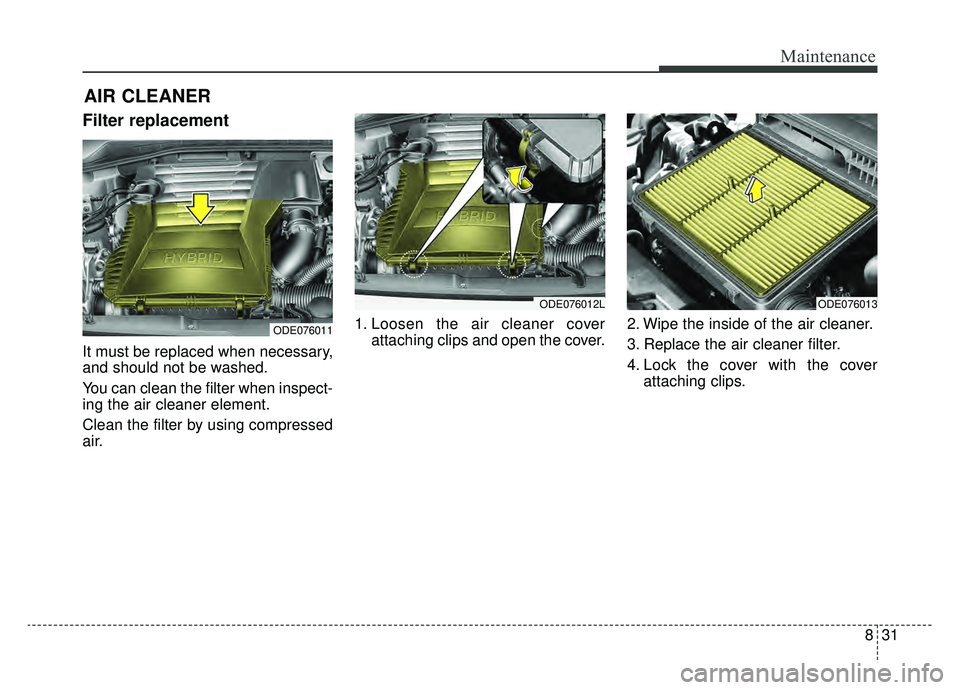
Filter replacement
It must be replaced when necessary,
and should not be washed.
You can clean the filter when inspect-
ing the air cleaner element.
Clean the filter by using compressed
air.1. Loosen the air cleaner cover
attaching clips and open the cover. 2. Wipe the inside of the air cleaner.
3. Replace the air cleaner filter.
4. Lock the cover with the cover
attaching clips.
ODE076011
ODE076012LODE076013
Page 508 of 611
Maintenance
34
8
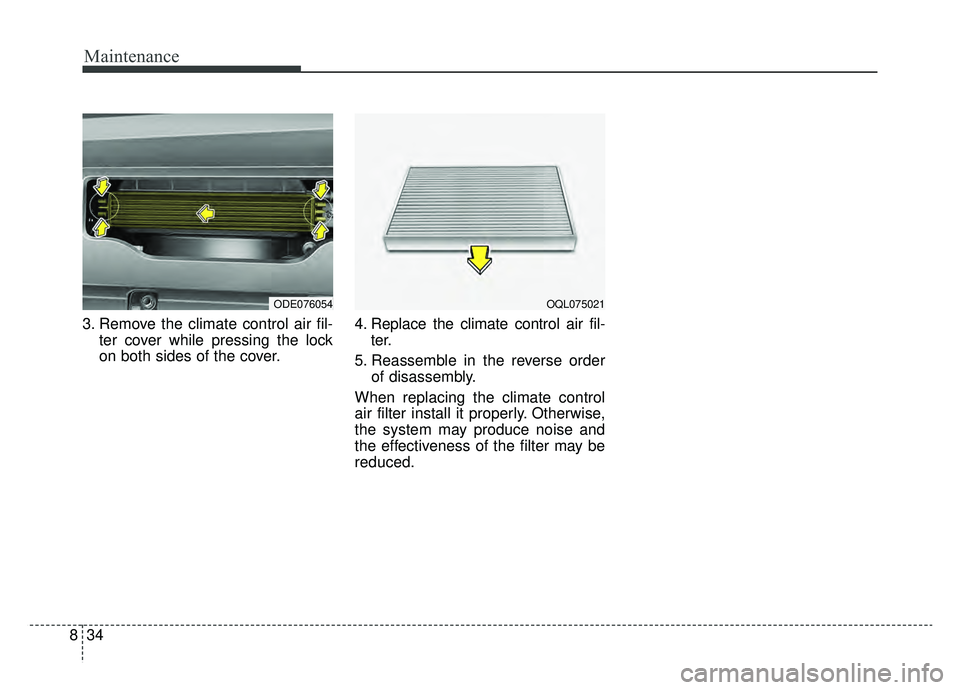
3. Remove the climate control air fil-
ter cover while pressing the lock
on both sides of the cover. 4. Replace the climate control air fil-
ter.
5. Reassemble in the reverse order of disassembly.
When replacing the climate control
air filter install it properly. Otherwise,
the system may produce noise and
the effectiveness of the filter may be
reduced.
ODE076054OQL075021
Page 528 of 611
Maintenance
54
8
Tire chains
Tire chains, if necessary, should be
installed on the front wheels.
Be sure that the chains are installed
in accordance with the manufactur-
er's instructions.
To minimize tire and chain wear, do
not continue to use tire chains when
they are no longer needed.
When driving on roads covered
with snow or ice, drive at less than
20 mph (30 km/h).
Use the SAE “S” class or wire chains.
If you hear noise caused by chains contacting the body, retighten the
chain to avoid contact with the
vehicle body.
To prevent body damage, retighten the chains after driving 0.3~0.6
miles (0.5~1.0 km).
Do not use tire chains on vehicles equipped with aluminum wheels.
In unavoidable circumstances, use
a wire type chain.
Use wire chains less than 0.47 inches (12 mm) to prevent damage
to the chain’s connection.
Radial-ply tires
Radial-ply tires provide improved
tread life, road hazard resistance and
smoother high speed ride. The radi-
al-ply tires used on this vehicle are
of belted construction and are select-
ed to complement the ride and han-
dling characteristics of your vehicle.
Radial-ply tires have the same load
carrying capacity as bias-ply or bias
belted tires of the same size and use
the same recommended inflation
pressure. Mixing of radial-ply tires
with bias-ply or bias belted tires is
not recommended. Any combina-
tions of radial-ply and bias-ply or bias
belted tires when used on the same
vehicle will seriously deteriorate
vehicle handling. The best rule to fol-
low is: identical radial-ply tires should
always be used as a set of four. Longer wearing tires can be more
susceptible to irregular tread wear. It
is very important to follow the tire
rotation interval shown in this section
to achieve the tread life potential of
these tires. Cuts and punctures in
radial-ply tires are repairable only in
the tread area, because of sidewall
flexing. Consult your tire dealer for
radial-ply tire repairs.