ABS KIA NIRO 2021 Owner's Manual
[x] Cancel search | Manufacturer: KIA, Model Year: 2021, Model line: NIRO, Model: KIA NIRO 2021Pages: 710, PDF Size: 14.77 MB
Page 661 of 710
797
Maintenance
4. Remove the rear combination
lamp assembly from the body of
the vehicle.
5. Disconnect the rear combination
lamp connector.
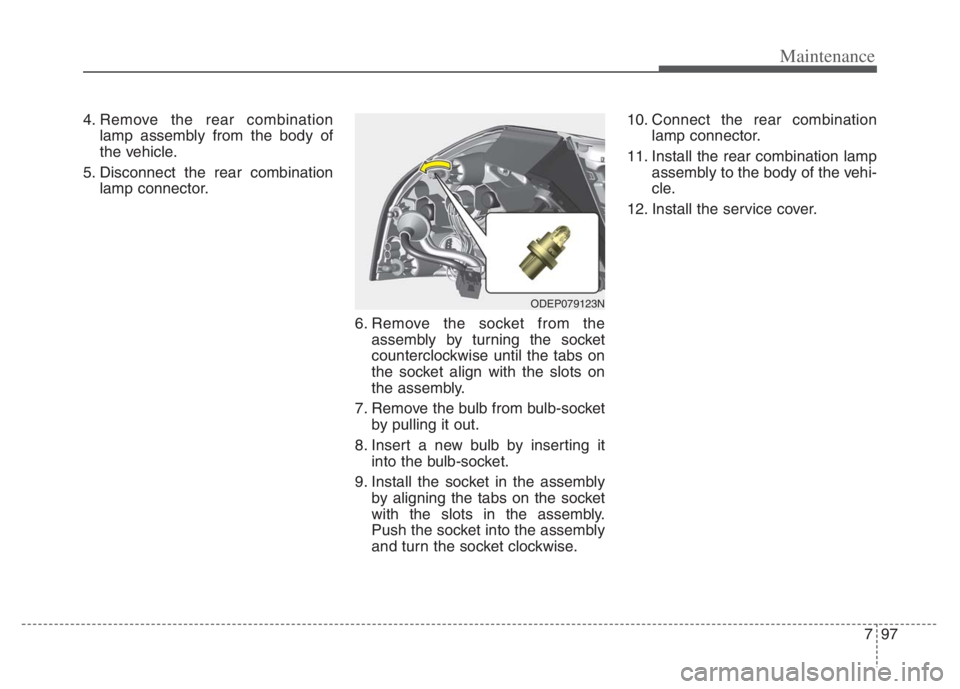
6. Remove the socket from the
assembly by turning the socket
counterclockwise until the tabs on
the socket align with the slots on
the assembly.
7. Remove the bulb from bulb-socket
by pulling it out.
8. Insert a new bulb by inserting it
into the bulb-socket.
9. Install the socket in the assembly
by aligning the tabs on the socket
with the slots in the assembly.
Push the socket into the assembly
and turn the socket clockwise.10. Connect the rear combination
lamp connector.
11. Install the rear combination lamp
assembly to the body of the vehi-
cle.
12. Install the service cover.
ODEP079123N
Page 663 of 710
799
Maintenance
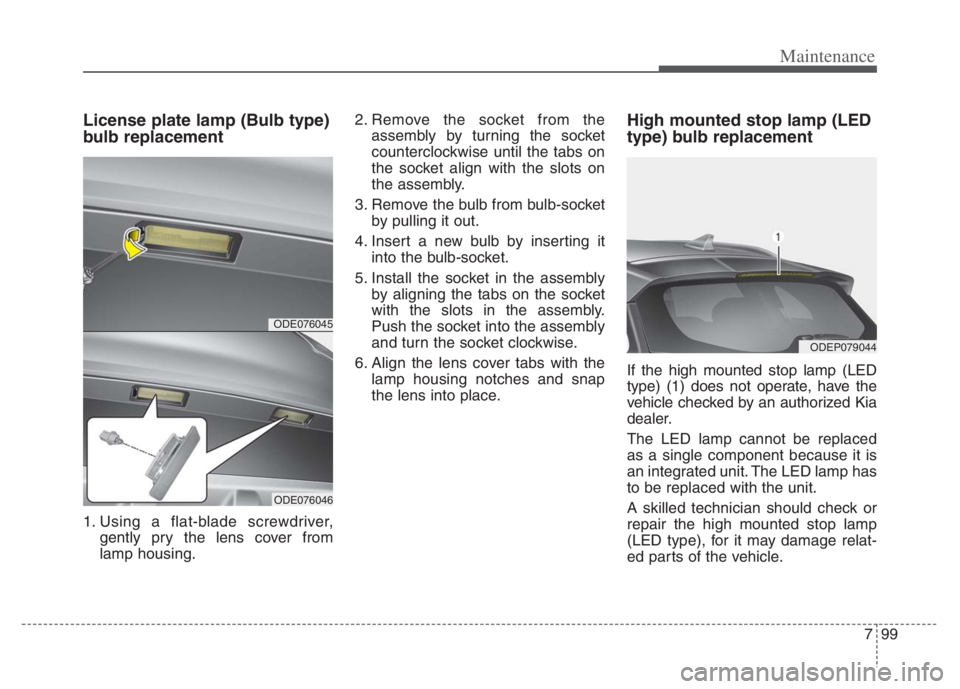
License plate lamp (Bulb type)
bulb replacement
1. Using a flat-blade screwdriver,
gently pry the lens cover from
lamp housing.2. Remove the socket from the
assembly by turning the socket
counterclockwise until the tabs on
the socket align with the slots on
the assembly.
3. Remove the bulb from bulb-socket
by pulling it out.
4. Insert a new bulb by inserting it
into the bulb-socket.
5. Install the socket in the assembly
by aligning the tabs on the socket
with the slots in the assembly.
Push the socket into the assembly
and turn the socket clockwise.
6. Align the lens cover tabs with the
lamp housing notches and snap
the lens into place.
High mounted stop lamp (LED
type) bulb replacement
If the high mounted stop lamp (LED
type) (1) does not operate, have the
vehicle checked by an authorized Kia
dealer.
The LED lamp cannot be replaced
as a single component because it is
an integrated unit. The LED lamp has
to be replaced with the unit.
A skilled technician should check or
repair the high mounted stop lamp
(LED type), for it may damage relat-
ed parts of the vehicle.
ODE076045
ODE076046
ODEP079044
Page 664 of 710
Maintenance
100 7
Side repeater lamp (LED type)
bulb replacement
If the side repeater lamp (LED type)
(1) does not operate, have the vehicle
checked by an authorized Kia dealer.
The LED lamp cannot be replaced
as a single component because it is
an integrated unit. The LED lamp has
to be replaced with the unit.
A skilled technician should check or
repair the side repeater lamp (LED
type), for it may damage related
parts of the vehicle.
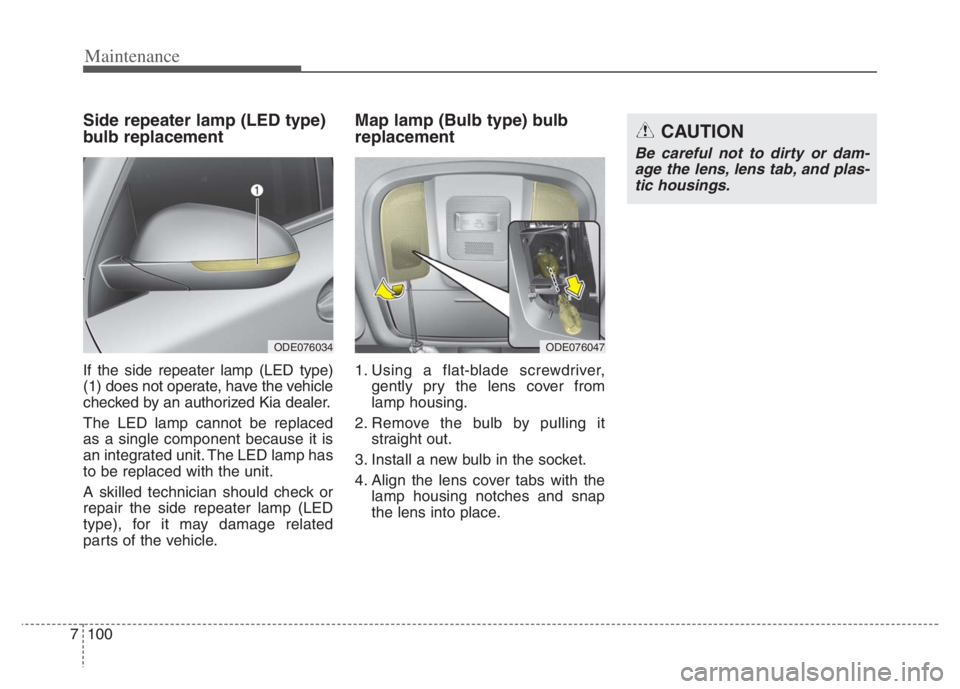
Map lamp (Bulb type) bulb
replacement
1. Using a flat-blade screwdriver,
gently pry the lens cover from
lamp housing.
2. Remove the bulb by pulling it
straight out.
3. Install a new bulb in the socket.
4. Align the lens cover tabs with the
lamp housing notches and snap
the lens into place.
ODE076034ODE076047
CAUTION
Be careful not to dirty or dam-
age the lens, lens tab, and plas-
tic housings.
Page 666 of 710
Maintenance
102 7
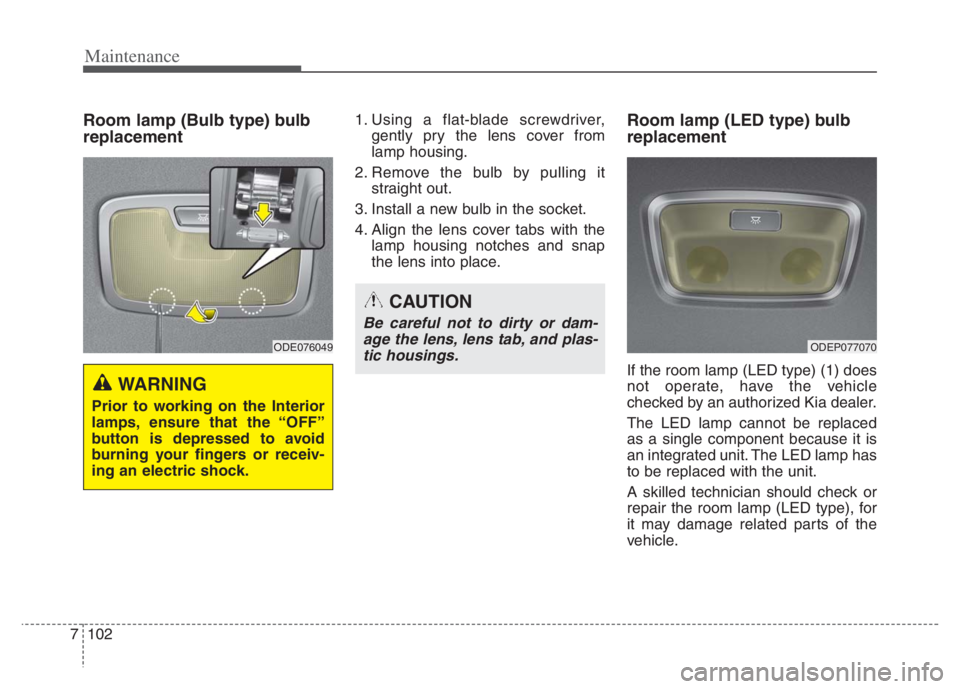
Room lamp (Bulb type) bulb
replacement1. Using a flat-blade screwdriver,
gently pry the lens cover from
lamp housing.
2. Remove the bulb by pulling it
straight out.
3. Install a new bulb in the socket.
4. Align the lens cover tabs with the
lamp housing notches and snap
the lens into place.Room lamp (LED type) bulb
replacement
If the room lamp (LED type) (1) does
not operate, have the vehicle
checked by an authorized Kia dealer.
The LED lamp cannot be replaced
as a single component because it is
an integrated unit. The LED lamp has
to be replaced with the unit.
A skilled technician should check or
repair the room lamp (LED type), for
it may damage related parts of the
vehicle.
WARNING
Prior to working on the Interior
lamps, ensure that the “OFF”
button is depressed to avoid
burning your fingers or receiv-
ing an electric shock.
ODE076049
CAUTION
Be careful not to dirty or dam-
age the lens, lens tab, and plas-
tic housings.
ODEP077070
Page 667 of 710
7103
Maintenance
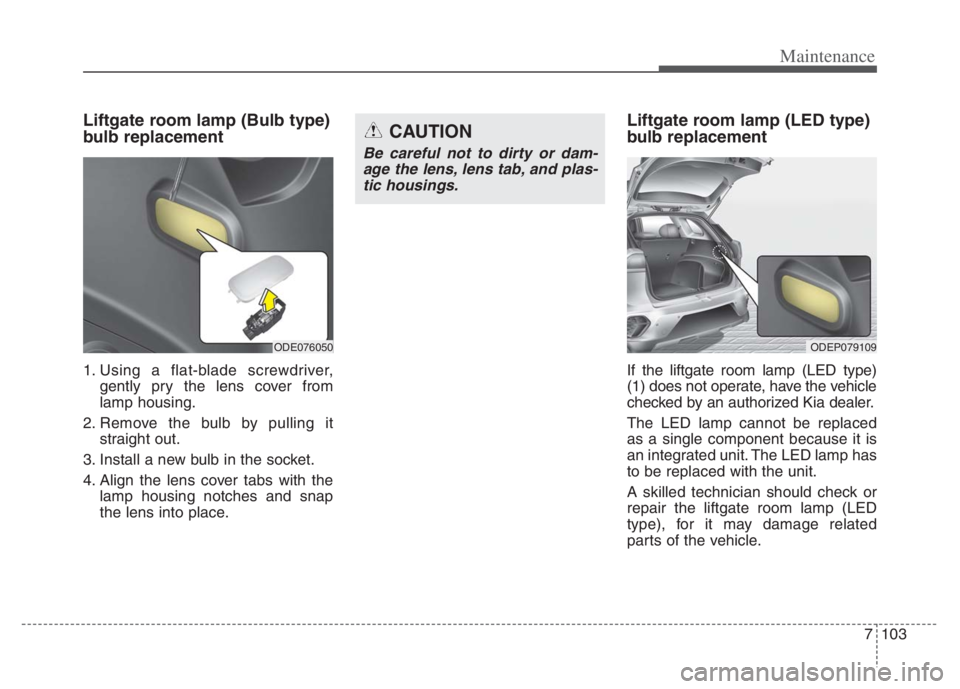
Liftgate room lamp (Bulb type)
bulb replacement
1. Using a flat-blade screwdriver,
gently pry the lens cover from
lamp housing.
2. Remove the bulb by pulling it
straight out.
3. Install a new bulb in the socket.
4. Align the lens cover tabs with the
lamp housing notches and snap
the lens into place.
Liftgate room lamp (LED type)
bulb replacement
If the liftgate room lamp (LED type)
(1) does not operate, have the vehicle
checked by an authorized Kia dealer.
The LED lamp cannot be replaced
as a single component because it is
an integrated unit. The LED lamp has
to be replaced with the unit.
A skilled technician should check or
repair the liftgate room lamp (LED
type), for it may damage related
parts of the vehicle.
ODE076050
CAUTION
Be careful not to dirty or dam-
age the lens, lens tab, and plas-
tic housings.
ODEP079109
Page 675 of 710
7111
Maintenance
Taking care of leather seats
Vacuum the seat periodically to
remove dust and sand on the seat.
It will prevent abrasion or damage of
the leather and maintain its quality.
Wipe the natural leather seat cover
often with dry or soft cloth.
Sufficient use of a leather protec-
tive may prevent abrasion of the
cover and helps maintain the color.
Be sure to read the instructions
and consult a specialist when
using leather coating or protective
agents.
Leather with bright colors(beige,
cream beige) is easily contaminat-
ed and clear in appearance. Clean
the seats frequently.
Avoid wiping with wet cloth. It may
cause the surface to crack.
Cleaning the leather seats
Remove all contaminations instant-
ly. Refer to instructions below for
removal of each contaminant.
Cosmetic products(sunscreen,
foundation, etc.)
- Apply cleansing cream on a cloth
and wipe the contaminated point.
Wipe off the cream with a wet
cloth and remove water with a dry
cloth.
Beverages(coffee, soft drink, etc.)
- Apply a small amount of neutral
detergent and wipe until contami-
nations do not smear.
Oil
- Remove oil instantly with
absorbable cloth and wipe with
stain remover for natural leather
only.
Chewing gum
- Harden the gum with ice and
remove gradually.CAUTION - Electrical
components
Never allow water or other liq-
uids to come in contact with
electrical/electronic compo-
nents inside the vehicle as this
may damage them.
CAUTION - Leather
When cleaning leather products
(steering wheel, seats etc.), use
neutral detergents or low alco-
hol content solutions. If you use
high alcohol content solutions
or acid/alkaline detergents, the
color of the leather may fade or
the surface may get stripped off.
Page 679 of 710
7115
Maintenance
Canister
Fuel vapors generated inside the fuel
tank are absorbed and stored in the
onboard canister. When the engine is
running, the fuel vapors absorbed in
the canister are drawn into the surge
tank through the purge control sole-
noid valve.
Purge Control Solenoid Valve
(PCSV)
The purge control solenoid valve is
controlled by the Engine Control
Module (ECM); when the engine
coolant temperature is low during
idling, the PCSV closes so that evap-
orated fuel is not taken into the
engine. After the engine warms up
during ordinary driving, the PCSV
opens to introduce evaporated fuel to
the engine.
3. Exhaust emission control
system
The Exhaust Emission Control
System is a highly effective system
which controls exhaust emissions
while maintaining good vehicle per-
formance.
Engine exhaust gas precautions
(carbon monoxide)
Carbon monoxide can be present
with other exhaust fumes.
Therefore, if you smell exhaust
fumes of any kind inside your vehi-
cle, have it inspected and repaired
immediately. If you ever suspect
exhaust fumes are coming into
your vehicle, drive it only with all
the windows fully open. Have your
vehicle checked and repaired
immediately.
WARNING - Exhaust
Engine exhaust gases contain
carbon monoxide (CO). Though
colorless and odorless, it is
dangerous and could be lethal if
inhaled. Follow the instructions
on this page to avoid CO poi-
soning.
Page 689 of 710
Specifications, Consumer information, Reporting safety defects
8 8
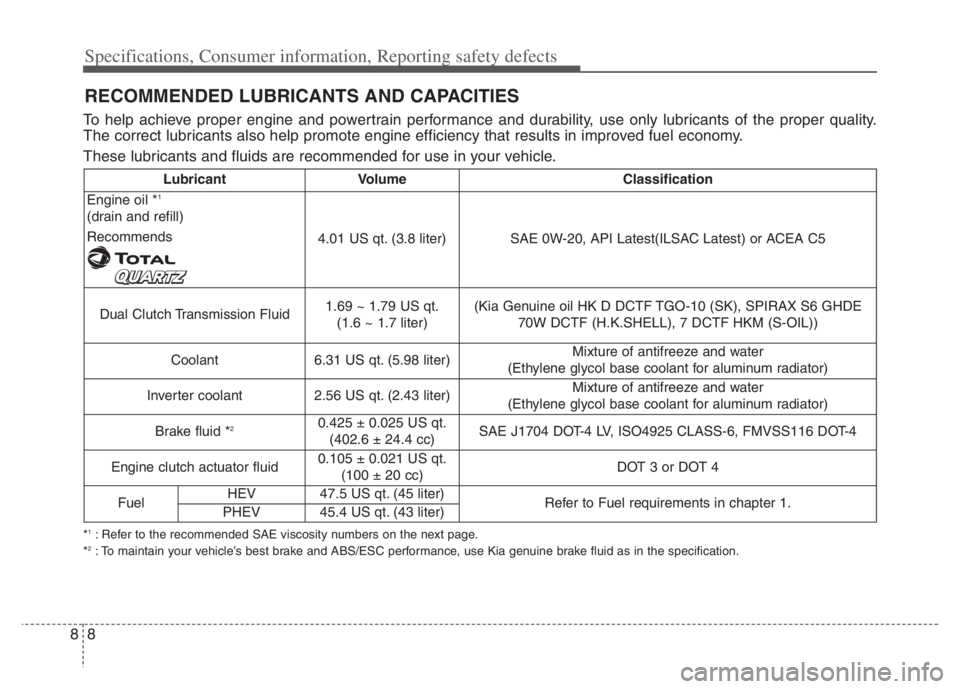
RECOMMENDED LUBRICANTS AND CAPACITIES
To help achieve proper engine and powertrain performance and durability, use only lubricants of the proper quality.
The correct lubricants also help promote engine efficiency that results in improved fuel economy.
These lubricants and fluids are recommended for use in your vehicle.
*1: Refer to the recommended SAE viscosity numbers on the next page.
*2: To maintain your vehicle’s best brake and ABS/ESC performance, use Kia genuine brake fluid as in the specification.
Lubricant VolumeClassification
Engine oil *1
(drain and refill)
Recommends
4.01 US qt. (3.8 liter)SAE 0W-20, API Latest(ILSAC Latest) or ACEA C5
Dual Clutch Transmission Fluid1.69 ~ 1.79 US qt.
(1.6 ~ 1.7 liter)(Kia Genuine oil HK D DCTF TGO-10 (SK), SPIRAX S6 GHDE
70W DCTF (H.K.SHELL), 7 DCTF HKM (S-OIL))
Coolant6.31 US qt. (5.98 liter)Mixture of antifreeze and water
(Ethylene glycol base coolant for aluminum radiator)
Inverter coolant2.56 US qt. (2.43 liter)Mixture of antifreeze and water
(Ethylene glycol base coolant for aluminum radiator)
Brake fluid *20.425 ± 0.025 US qt.
(402.6 ± 24.4 cc)SAE J1704 DOT-4 LV, ISO4925 CLASS-6, FMVSS116 DOT-4
Engine clutch actuator fluid0.105 ± 0.021 US qt.
(100 ± 20 cc)DOT 3 or DOT 4
FuelHEV47.5 US qt. (45 liter)Refer to Fuel requirements in chapter 1.PHEV45.4 US qt. (43 liter)
Page 700 of 710
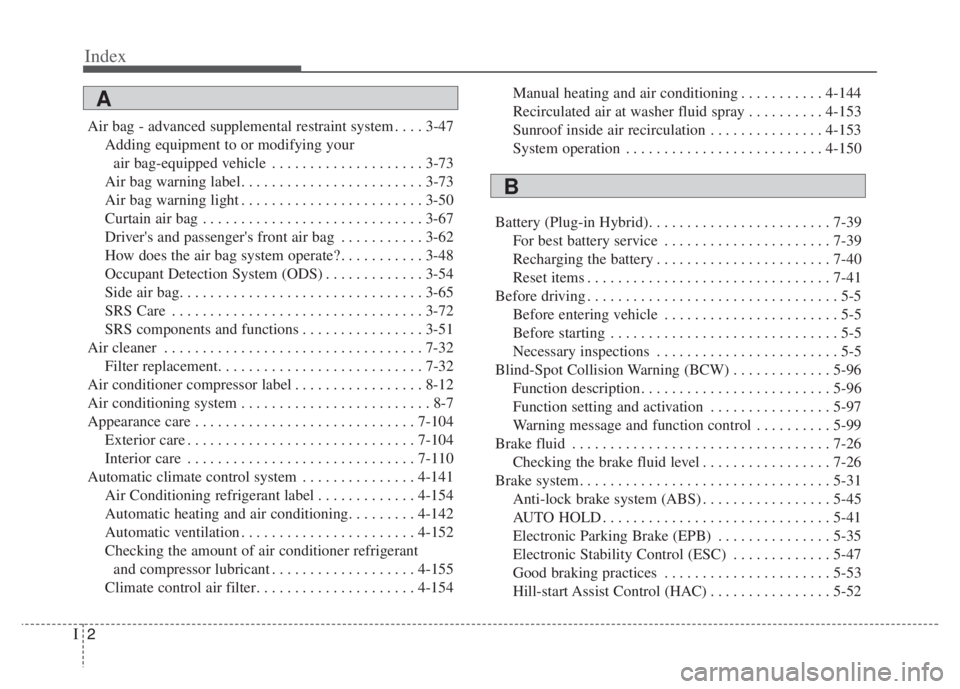
Index
2I
Air bag - advanced supplemental restraint system . . . . 3-47
Adding equipment to or modifying your
air bag-equipped vehicle . . . . . . . . . . . . . . . . . . . . 3-73
Air bag warning label. . . . . . . . . . . . . . . . . . . . . . . . 3-73
Air bag warning light . . . . . . . . . . . . . . . . . . . . . . . . 3-50
Curtain air bag . . . . . . . . . . . . . . . . . . . . . . . . . . . . . 3-67
Driver's and passenger's front air bag . . . . . . . . . . . 3-62
How does the air bag system operate? . . . . . . . . . . . 3-48
Occupant Detection System (ODS) . . . . . . . . . . . . . 3-54
Side air bag. . . . . . . . . . . . . . . . . . . . . . . . . . . . . . . . 3-65
SRS Care . . . . . . . . . . . . . . . . . . . . . . . . . . . . . . . . . 3-72
SRS components and functions . . . . . . . . . . . . . . . . 3-51
Air cleaner . . . . . . . . . . . . . . . . . . . . . . . . . . . . . . . . . . 7-32
Filter replacement. . . . . . . . . . . . . . . . . . . . . . . . . . . 7-32
Air conditioner compressor label . . . . . . . . . . . . . . . . . 8-12
Air conditioning system . . . . . . . . . . . . . . . . . . . . . . . . . 8-7
Appearance care . . . . . . . . . . . . . . . . . . . . . . . . . . . . . 7-104
Exterior care . . . . . . . . . . . . . . . . . . . . . . . . . . . . . . 7-104
Interior care . . . . . . . . . . . . . . . . . . . . . . . . . . . . . . 7-110
Automatic climate control system . . . . . . . . . . . . . . . 4-141
Air Conditioning refrigerant label . . . . . . . . . . . . . 4-154
Automatic heating and air conditioning. . . . . . . . . 4-142
Automatic ventilation . . . . . . . . . . . . . . . . . . . . . . . 4-152
Checking the amount of air conditioner refrigerant
and compressor lubricant . . . . . . . . . . . . . . . . . . . 4-155
Climate control air filter. . . . . . . . . . . . . . . . . . . . . 4-154Manual heating and air conditioning . . . . . . . . . . . 4-144
Recirculated air at washer fluid spray . . . . . . . . . . 4-153
Sunroof inside air recirculation . . . . . . . . . . . . . . . 4-153
System operation . . . . . . . . . . . . . . . . . . . . . . . . . . 4-150
Battery (Plug-in Hybrid). . . . . . . . . . . . . . . . . . . . . . . . 7-39
For best battery service . . . . . . . . . . . . . . . . . . . . . . 7-39
Recharging the battery . . . . . . . . . . . . . . . . . . . . . . . 7-40
Reset items . . . . . . . . . . . . . . . . . . . . . . . . . . . . . . . . 7-41
Before driving . . . . . . . . . . . . . . . . . . . . . . . . . . . . . . . . . 5-5
Before entering vehicle . . . . . . . . . . . . . . . . . . . . . . . 5-5
Before starting . . . . . . . . . . . . . . . . . . . . . . . . . . . . . . 5-5
Necessary inspections . . . . . . . . . . . . . . . . . . . . . . . . 5-5
Blind-Spot Collision Warning (BCW) . . . . . . . . . . . . . 5-96
Function description . . . . . . . . . . . . . . . . . . . . . . . . . 5-96
Function setting and activation . . . . . . . . . . . . . . . . 5-97
Warning message and function control . . . . . . . . . . 5-99
Brake fluid . . . . . . . . . . . . . . . . . . . . . . . . . . . . . . . . . . 7-26
Checking the brake fluid level . . . . . . . . . . . . . . . . . 7-26
Brake system. . . . . . . . . . . . . . . . . . . . . . . . . . . . . . . . . 5-31
Anti-lock brake system (ABS) . . . . . . . . . . . . . . . . . 5-45
AUTO HOLD . . . . . . . . . . . . . . . . . . . . . . . . . . . . . . 5-41
Electronic Parking Brake (EPB) . . . . . . . . . . . . . . . 5-35
Electronic Stability Control (ESC) . . . . . . . . . . . . . 5-47
Good braking practices . . . . . . . . . . . . . . . . . . . . . . 5-53
Hill-start Assist Control (HAC) . . . . . . . . . . . . . . . . 5-52
A
B