battery KIA NIRO 2021 Owner's Manual
[x] Cancel search | Manufacturer: KIA, Model Year: 2021, Model line: NIRO, Model: KIA NIRO 2021Pages: 710, PDF Size: 14.77 MB
Page 50 of 710
H45
✽ ✽
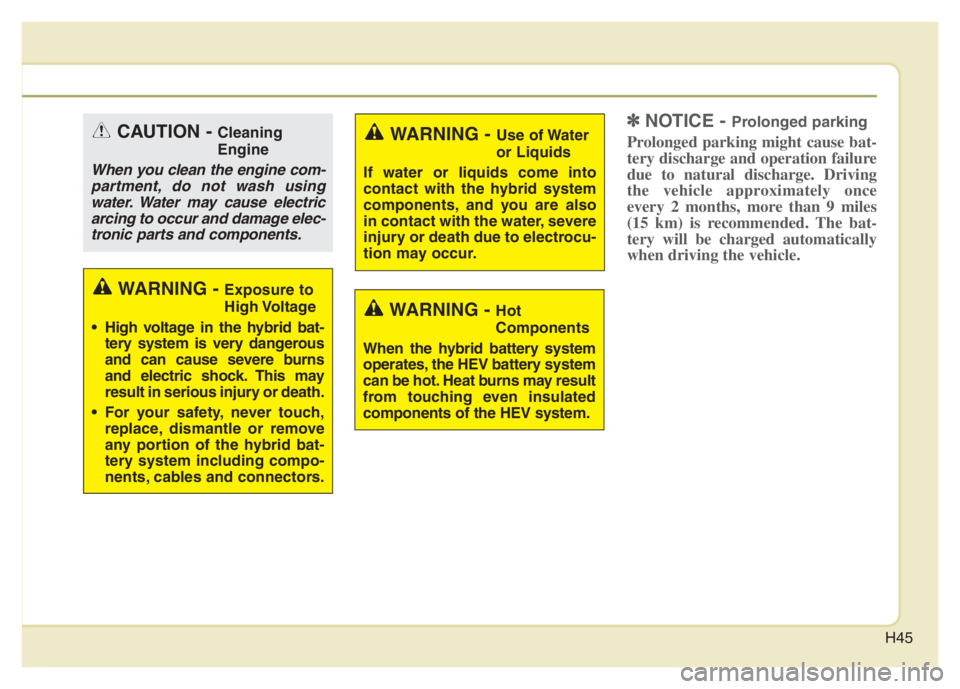
NOTICE - Prolonged parking
Prolonged parking might cause bat-
tery discharge and operation failure
due to natural discharge. Driving
the vehicle approximately once
every 2 months, more than 9 miles
(15 km) is recommended. The bat-
tery will be charged automatically
when driving the vehicle.
WARNING - Exposure to
High Voltage
High voltage in the hybrid bat-
tery system is very dangerous
and can cause severe burns
and electric shock. This may
result in serious injury or death.
For your safety, never touch,
replace, dismantle or remove
any portion of the hybrid bat-
tery system including compo-
nents, cables and connectors.
WARNING - Use of Water
or Liquids
If water or liquids come into
contact with the hybrid system
components, and you are also
in contact with the water, severe
injury or death due to electrocu-
tion may occur.
WARNING - Hot
Components
When the hybrid battery system
operates, the HEV battery system
can be hot. Heat burns may result
from touching even insulated
components of the HEV system.
CAUTION - Cleaning
Engine
When you clean the engine com-
partment, do not wash using
water. Water may cause electric
arcing to occur and damage elec-
tronic parts and components.
Page 51 of 710
H46
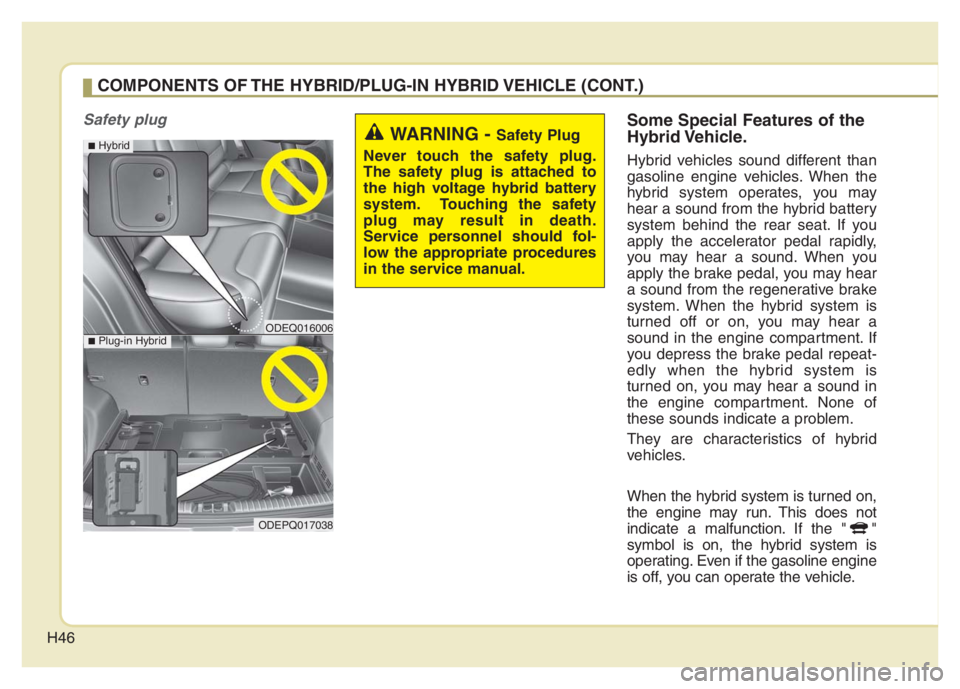
Safety plugSome Special Features of the
Hybrid Vehicle.
Hybrid vehicles sound different than
gasoline engine vehicles. When the
hybrid system operates, you may
hear a sound from the hybrid battery
system behind the rear seat. If you
apply the accelerator pedal rapidly,
you may hear a sound. When you
apply the brake pedal, you may hear
a sound from the regenerative brake
system. When the hybrid system is
turned off or on, you may hear a
sound in the engine compartment. If
you depress the brake pedal repeat-
edly when the hybrid system is
turned on, you may hear a sound in
the engine compartment. None of
these sounds indicate a problem.
They are characteristics of hybrid
vehicles.
When the hybrid system is turned on,
the engine may run. This does not
indicate a malfunction. If the " "
symbol is on, the hybrid system is
operating. Even if the gasoline engine
is off, you can operate the vehicle.
WARNING - Safety Plug
Never touch the safety plug.
The safety plug is attached to
the high voltage hybrid battery
system. Touching the safety
plug may result in death.
Service personnel should fol-
low the appropriate procedures
in the service manual.
ODEQ016006
■Hybrid
ODEPQ017038
■Plug-in Hybrid
COMPONENTS OF THE HYBRID/PLUG-IN HYBRID VEHICLE (CONT.)
Page 53 of 710
H48
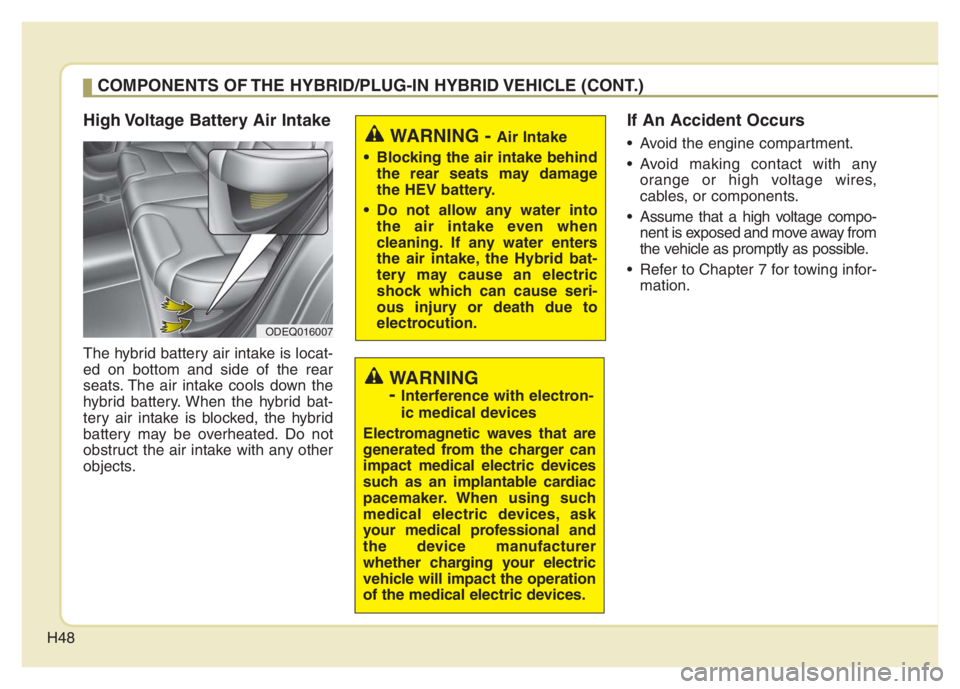
High Voltage Battery Air Intake
The hybrid battery air intake is locat-
ed on bottom and side of the rear
seats. The air intake cools down the
hybrid battery. When the hybrid bat-
tery air intake is blocked, the hybrid
battery may be overheated. Do not
obstruct the air intake with any other
objects.
If An Accident Occurs
Avoid the engine compartment.
Avoid making contact with any
orange or high voltage wires,
cables, or components.
Assume that a high voltage compo-
nent is exposed and move away from
the vehicle as promptly as possible.
Refer to Chapter 7 for towing infor-
mation.WARNING - Air Intake
Blocking the air intake behind
the rear seats may damage
the HEV battery.
Do not allow any water into
the air intake even when
cleaning. If any water enters
the air intake, the Hybrid bat-
tery may cause an electric
shock which can cause seri-
ous injury or death due to
electrocution.
ODEQ016007
WARNING
-
Interference with electron-
ic medical devices
Electromagnetic waves that are
generated from the charger can
impact medical electric devices
such as an implantable cardiac
pacemaker. When using such
medical electric devices, ask
your medical professional and
the device manufacturer
whether charging your electric
vehicle will impact the operation
of the medical electric devices.
COMPONENTS OF THE HYBRID/PLUG-IN HYBRID VEHICLE (CONT.)
Page 54 of 710

H49
After parking the vehicle, shift the
transmission into "P" position. Turn
off the hybrid system by pushing
the Engine Start/Stop button.
For your safety, do not touch high
voltage cables, connectors and
package modules. High Voltage
components are orange in color.
Exposed cables or wires may be
visible inside or outside of the vehi-
cle. Never touch the wires or
cables, because an electrical
shock may occur causing injury or
death.If a vehicle accident occurs:
1.Stop the vehicle and shift the trans-
mission into "P" position and then
depress the parking brake.
2.Turn off the Hybrid system by
pushing the Engine Start/Stop
Button.
3.Step away from the vehicle and go
to a safe place.
4.Call emergency services for help
and let them know the vehicle is a
Hybrid vehicle.
Do not touch high voltage cables,
connectors and package modules.
High voltage components are
orange in color.
Exposed cables or wires may be vis-
ible inside or outside of the vehicle.
Never touch the wires or cables,
because an electrical shock may
occur causing injury or death.
WARNING
If a small scale fire occurs,
use a fire extinguisher (ABC,
BC) that is meant for electrical
fires.
If it is impossible to extin-
guish the fire in the early
stage, remain a safe distance
from the vehicle and immedi-
ately call your local fire emer-
gency responders. Also,
advise them that a hybrid
vehicle is involved.
If the fire spreads to the high
voltage battery, large amount
of water is needed to put out
the fire.
Using small amount of water
or fire extinguishers not
meant for electrical fires
could cause serious injury or
death from electrical shocks.
If you need towing, refer to
chapter 6.
Page 55 of 710

H50
When the hybrid vehicle shuts
off
When the high voltage battery or 12-
volt battery discharges, or fuel tank is
empty, the hybrid system may not
operate.
If the Hybrid system stops operating
while the vehicle is moving, reduce
the vehicle speed gradually, pull your
vehicle off the road to a safe area,
and shift the transmission in to Park
(P) position and;
1. Turn on the hazard warning flashers.
2. Set the start button at OFF, and try
to start the Hybrid system by
applying the brake pedal and
pushing the start button.
3. If the Hybrid system will not oper-
ate, refer to "EMERGENCY
STARTING" in chapter 6.
Before you try to jump start the vehi-
cle, confirm the fuel level. If the fuel
level is low add more fuel before
attempting as emergency start.
WARNING
If submersion in water occurs:
If your vehicle was flooded and
has soaked carpeting or water
on the flooring, you should not
try to start the Hybrid system.
Never touch the high voltage
cables, connectors or package
modules, because an electrical
shock may occur causing injury
or death. High Voltage cables
are orange in color.
If this occurs. have the vehicle
towed to and inspected by an
authorized Kia dealer.
WARNING - Vehicle
Accident
Never touch electric wires or
cable. If exposed electric wires
or cables are visible inside or
outside of your vehicle, an elec-
tric shock may occur.
WARNING - Putting out
fire
Never use a small quantity of
water to put out a fire in your
vehicle. If a fire occurs, evacu-
ate the car immediately and
contact the fire department.
COMPONENTS OF THE HYBRID/PLUG-IN HYBRID VEHICLE (CONT.)
Page 60 of 710
15
Introduction
This vehicle should not be modified.
Modification of your vehicle could
affect its performance, safety or
durability and may even violate gov-
ernmental safety and emissions reg-
ulations.
In addition, damage or performance
problems resulting from any modifi-
cation may not be covered under
warranty.
• If you use unauthorized electronicdevices, it may cause the vehicle to
operate abnormally, wire damage,
battery discharge and fire. For your
safety, do not use unauthorized
electronic devices. No special break-in period is needed.
By following a few simple precautions
for the first 600 miles (1,000 km) you
may add to the performance, econo-
my and life of your vehicle.
Do not race the engine.
While driving, keep your engine
speed (rpm, or revolutions per
minute) between 2,000 rpm and
bellow 4,000 rpm.
Do not maintain a single speed for long periods of time, either fast or
slow. Varying engine speed is
needed to properly break-in the
engine.
Avoid hard stops, except in emer- gencies, to allow the brakes to seat
properly.
Don't tow a trailer during the first 1,200 miles (2,000 km) of opera-
tion.
Fuel economy and engine perform- ance may vary depending on vehi-
cle break-in process and stabilize
after driving about 3,750 miles
(6,000 km). Engines may consume
more oil during the vehicle break-in
period. By following a few simple precautions
for the first 600 miles (1,000 km) you
may add to the performance, econo-
my and life of your vehicle.
Do not race the engine.
Avoid hard stops, except in emer-
gencies, to allow the brakes to seat
properly.
VEHICLE MODIFICATIONS HEV/PHEV POWERTRAIN
VEHICLE BREAK-IN
PROCESS
Page 65 of 710
Your vehicle at a glance
4 2
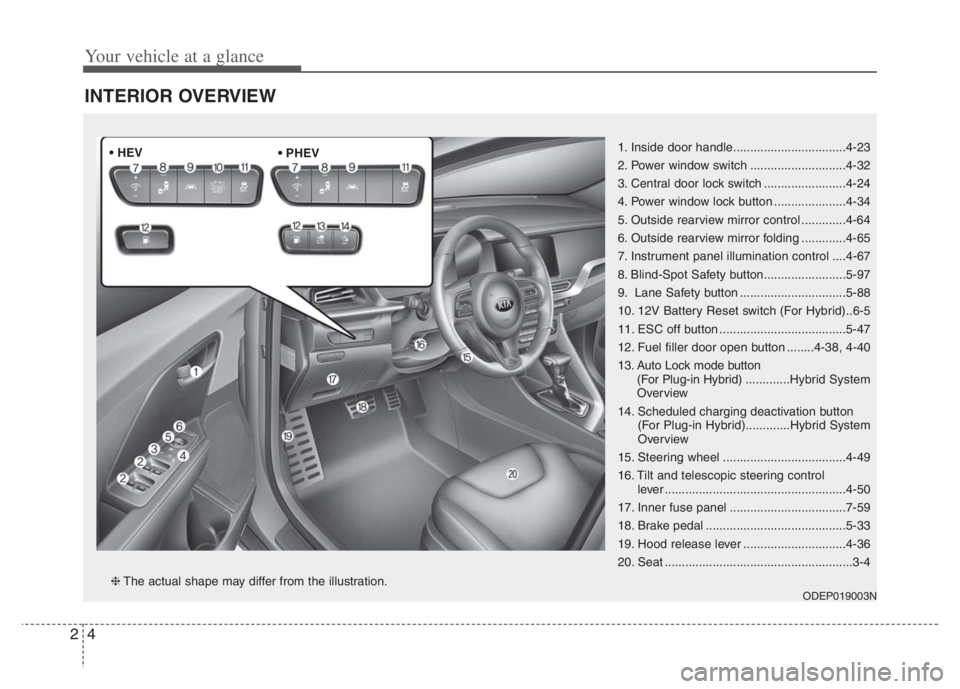
INTERIOR OVERVIEW
1. Inside door handle.................................4-23
2. Power window switch ............................4-32
3. Central door lock switch ........................4-24
4. Power window lock button .....................4-34
5. Outside rearview mirror control .............4-64
6. Outside rearview mirror folding .............4-65
7. Instrument panel illumination control ....4-67
8. Blind-Spot Safety button........................5-97
9. Lane Safety button ...............................5-88
10. 12V Battery Reset switch (For Hybrid)..6-5
11. ESC off button .....................................5-47
12. Fuel filler door open button ........4-38, 4-40
13. Auto Lock mode button
(For Plug-in Hybrid).............Hybrid System
Overview
14. Scheduled charging deactivation button
(For Plug-in Hybrid).............Hybrid System
Overview
15. Steering wheel ....................................4-49
16. Tilt and telescopic steering control
lever .....................................................4-50
17. Inner fuse panel ..................................7-59
18. Brake pedal .........................................5-33
19. Hood release lever ..............................4-36
20. Seat .......................................................3-4
ODEP019003N❈The actual shape may differ from the illustration. • HEV
Page 77 of 710
Safety features of your vehicle
10
3
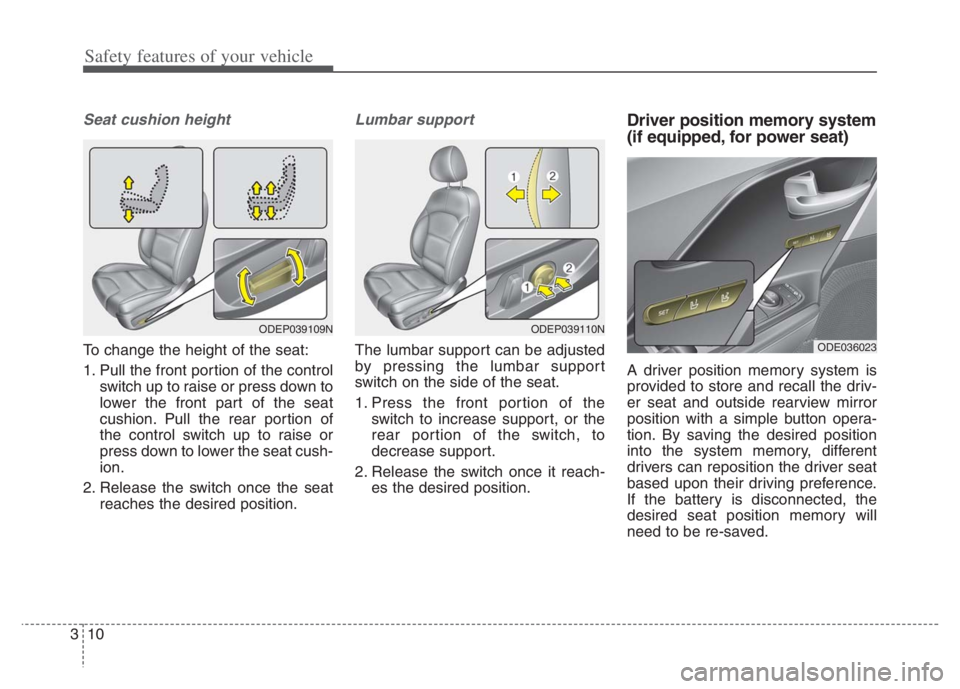
Seat cushion height
To change the height of the seat:
1. Pull the front portion of the control
switch up to raise or press down to
lower the front part of the seat
cushion. Pull the rear portion of
the control switch up to raise or
press down to lower the seat cush-
ion.
2. Release the switch once the seat reaches the desired position.
Lumbar support
The lumbar support can be adjusted
by pressing the lumbar support
switch on the side of the seat.
1. Press the front portion of theswitch to increase support, or the
rear portion of the switch, to
decrease support.
2. Release the switch once it reach- es the desired position.
Driver position memory system
(if equipped, for power seat)
A driver position memory system is
provided to store and recall the driv-
er seat and outside rearview mirror
position with a simple button opera-
tion. By saving the desired position
into the system memory, different
drivers can reposition the driver seat
based upon their driving preference.
If the battery is disconnected, the
desired seat position memory will
need to be re-saved.
ODE036023
ODEP039109NODEP039110N
Page 84 of 710
317
Safety features of your vehicle
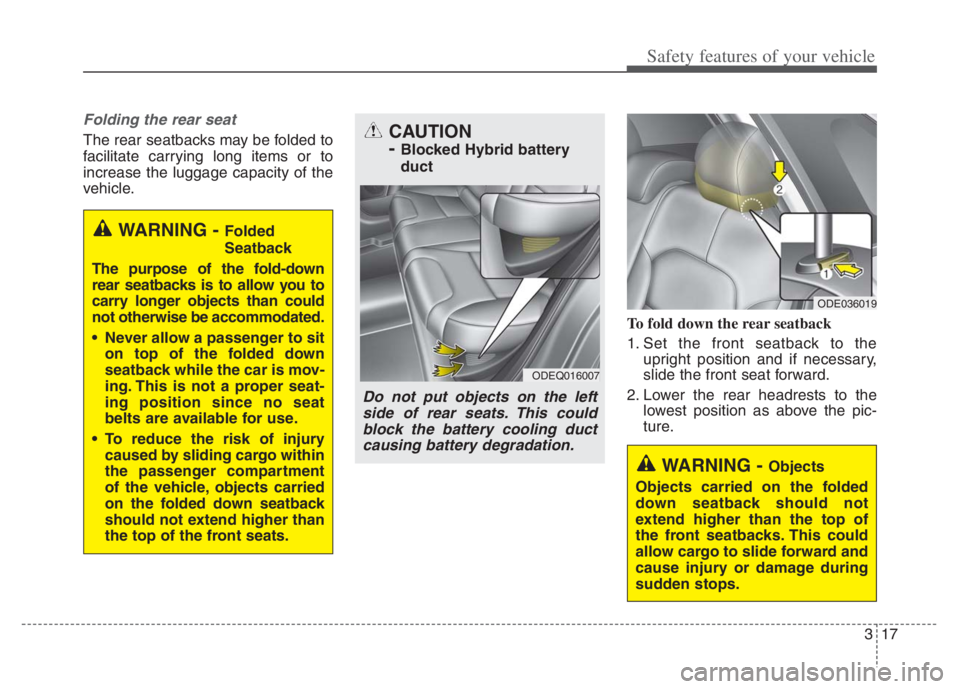
Folding the rear seat
The rear seatbacks may be folded to
facilitate carrying long items or to
increase the luggage capacity of the
vehicle.
To fold down the rear seatback
1. Set the front seatback to the
upright position and if necessary,
slide the front seat forward.
2. Lower the rear headrests to the
lowest position as above the pic-
ture.
WARNING - Folded
Seatback
The purpose of the fold-down
rear seatbacks is to allow you to
carry longer objects than could
not otherwise be accommodated.
Never allow a passenger to sit
on top of the folded down
seatback while the car is mov-
ing. This is not a proper seat-
ing position since no seat
belts are available for use.
To reduce the risk of injury
caused by sliding cargo within
the passenger compartment
of the vehicle, objects carried
on the folded down seatback
should not extend higher than
the top of the front seats.
CAUTION
-
Blocked Hybrid battery
duct
Do not put objects on the left
side of rear seats. This could
block the battery cooling duct
causing battery degradation.
ODEQ016007
WARNING - Objects
Objects carried on the folded
down seatback should not
extend higher than the top of
the front seatbacks. This could
allow cargo to slide forward and
cause injury or damage during
sudden stops.
ODE036019
Page 88 of 710
321
Safety features of your vehicle
SEAT BELTS
Seat belt restraint system
For maximum restraint system pro-
tection, the seat belts must always
be used whenever the vehicle is
moving. A properly positioned
shoulder belt should be positioned
midway over your shoulder across
your collarbone.
Never allow children to ride in the
front passenger seat. See child
restraint system section for further
discussion.Seat belts are designed to bear upon
the bony structure of the body, and
should be worn low across the front
of the pelvis, chest and shoulders, as
applicable; wearing the lap section of
the belt across the abdominal area
must be avoided.
Seat belts should be adjusted as
firmly as possible, consistent with
comfort, to provide the protection for
which they have been designed.
A slack belt will greatly reduce the
protection afforded to the wearer.
Care should be taken to avoid con-
tamination of the webbing with pol-
ishes, oils and chemicals, and partic-
ularly battery acid. Cleaning may
safely be carried out using mild soap
and water. The belt should be
replaced if webbing becomes frayed,
contaminated or damaged.
WARNING- Damaged
seat belt
Replace the entire seat belt
assembly if any part of the web-
bing or hardware is damaged as
you can no longer be sure that a
damaged seat belt will provide
protection in a crash.WARNING- Twisted seat
belt
Make sure your seat belt is not
twisted when worn. A twisted
seat belt may not properly pro-
tect you in an accident and
could even cut into your body.
WARNING- Shoulder Belt
Never wear the shoulder belt
under your arm or behind
your back. An improperly
positioned shoulder belt can-
not protect the occupant in a
crash.
Always wear both the shoul-
der portion and lap portion of
the lap/shoulder belt.