ESP KIA NIRO 2021 Workshop Manual
[x] Cancel search | Manufacturer: KIA, Model Year: 2021, Model line: NIRO, Model: KIA NIRO 2021Pages: 710, PDF Size: 14.77 MB
Page 433 of 710
Driving your vehicle
110 5
WARNING
Driver Attention Warning is
not a substitute for safe driv-
ing practices, but a conven-
ience function only. It is the
driver's responsibility to
always drive cautiously and
safely.
A fatigued driver should take
a break, even if there is no
suggestion to do so by Driver
Attention Warning.
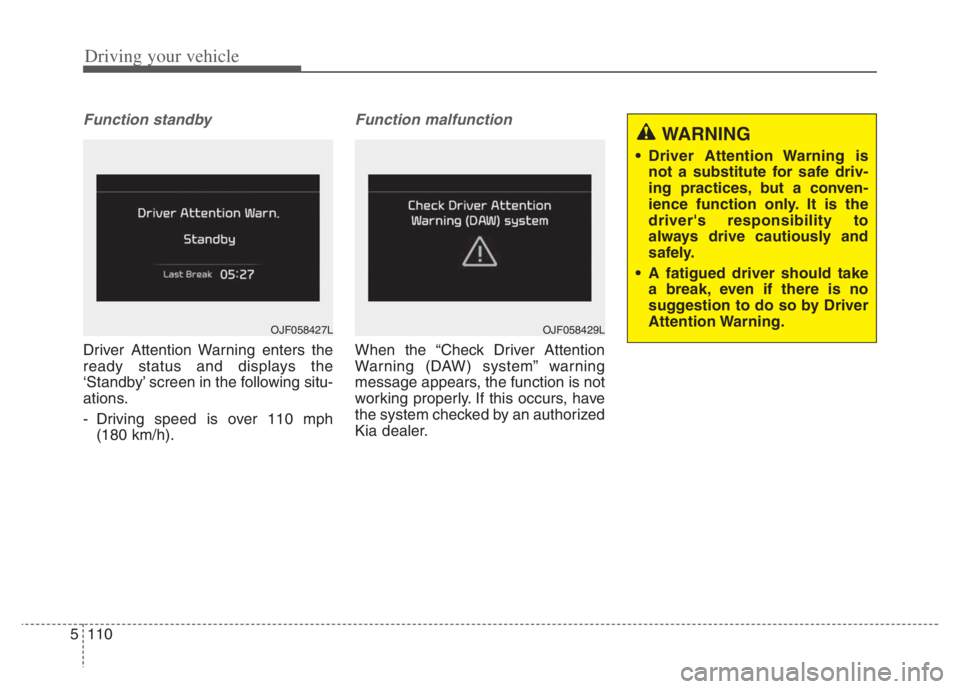
Function standby
Driver Attention Warning enters the
ready status and displays the
‘Standby’ screen in the following situ-
ations.
- Driving speed is over 110 mph
(180 km/h).
Function malfunction
When the “Check Driver Attention
Warning (DAW) system” warning
message appears, the function is not
working properly. If this occurs, have
the system checked by an authorized
Kia dealer.
OJF058429LOJF058427L
Page 449 of 710
Driving your vehicle
126 5
(Continued)
- Highway interchange and
tollgate
- Road surrounded by multi-
ple steel constructions (sub-
way construction, steel tun-
nel, etc)
- Parking lot
- Lanes beside guard rail on a
road
- Slippery road with rain, ice,
or snow covered
- Abrupt curved road
- Steep hills
- Windy roads
- Off roads
- Rods under construction
- Rumble strip
- When driving near crash bar-
riers
(Continued)(Continued)
- When the vehicle sensing
ability decreases due to
vehicle modification that
causes a difference in the
level of the vehicle's front
and rear
- When driving with limited
view (possibly due to bad
weather, such as fog, snow,
rain or sandstorm)
Pay particular attention to the
driving conditions whenever
using Smart Cruise Control.
Smart Cruise Control is not a
substitute for safe driving. It is
the responsibility of the driver
to always check the speed
and distance of the vehicle
ahead.
Be careful when driving
downhill using SCC.
(Continued)(Continued)
Smart Cruise Control should
not be used when the vehicle
is being towed.
Always set the vehicle speed
under the applicable speed
limit.
Unexpected situations may
lead to accidents. Pay contin-
uous attention to road condi-
tions and your surroundings
even when Smart Cruise
Control is operating.
Page 462 of 710
5139
Driving your vehicle
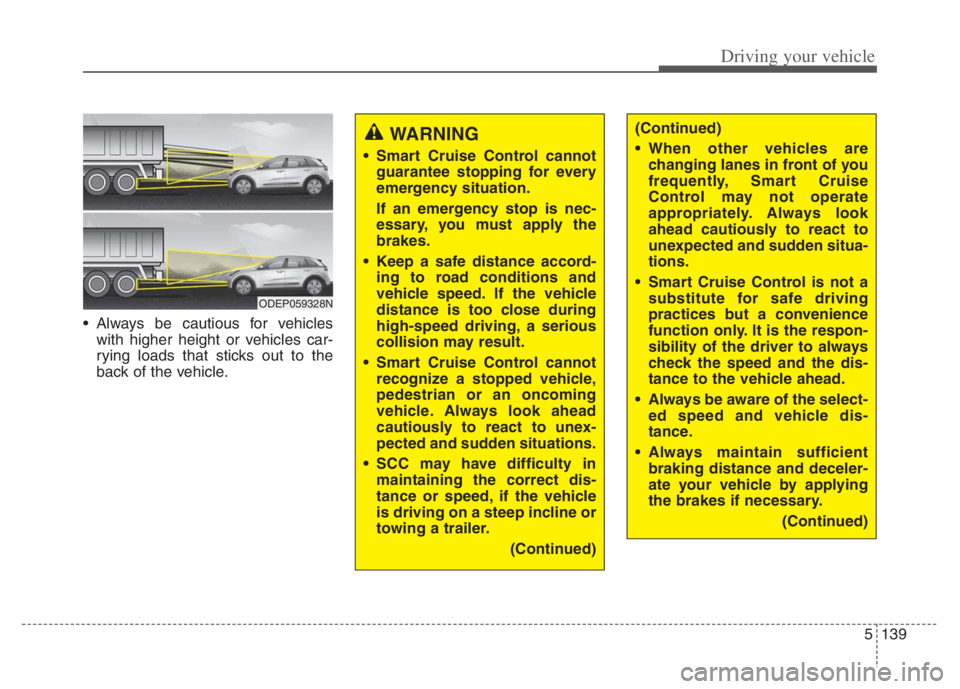
Always be cautious for vehicles
with higher height or vehicles car-
rying loads that sticks out to the
back of the vehicle.
WARNING
Smart Cruise Control cannot
guarantee stopping for every
emergency situation.
If an emergency stop is nec-
essary, you must apply the
brakes.
Keep a safe distance accord-
ing to road conditions and
vehicle speed. If the vehicle
distance is too close during
high-speed driving, a serious
collision may result.
Smart Cruise Control cannot
recognize a stopped vehicle,
pedestrian or an oncoming
vehicle. Always look ahead
cautiously to react to unex-
pected and sudden situations.
SCC may have difficulty in
maintaining the correct dis-
tance or speed, if the vehicle
is driving on a steep incline or
towing a trailer.
(Continued)
ODEP059328N
(Continued)
When other vehicles are
changing lanes in front of you
frequently, Smart Cruise
Control may not operate
appropriately. Always look
ahead cautiously to react to
unexpected and sudden situa-
tions.
Smart Cruise Control is not a
substitute for safe driving
practices but a convenience
function only. It is the respon-
sibility of the driver to always
check the speed and the dis-
tance to the vehicle ahead.
Always be aware of the select-
ed speed and vehicle dis-
tance.
Always maintain sufficient
braking distance and deceler-
ate your vehicle by applying
the brakes if necessary.
(Continued)
Page 469 of 710
![KIA NIRO 2021 Workshop Manual Driving your vehicle
146 5
[3]: Driving route, [4]: Main road, [5]: Set route,
[6]: Branch line
When there is a difference
between the navigation route
(main road) and the driving route
(branch line](/img/2/54800/w960_54800-468.png "KIA NIRO 2021 Workshop Manual Driving your vehicle
146 5
[3]: Driving route, [4]: Main road, [5]: Set route,
[6]: Branch line
When there is a difference
between the navigation route
(main road) and the driving route
(branch line")
Driving your vehicle
146 5
[3]: Driving route, [4]: Main road, [5]: Set route,
[6]: Branch line
When there is a difference
between the navigation route
(main road) and the driving route
(branch line), Highway Auto Curve
Slowdown function may temporari-
ly operate due to the navigation
information of the highway curve
section.
When it is judged that you are driv-
ing out of the route by entering the
highway interchange and junction,
Highway Auto Curve Slowdown
function will not operate.
[3]: Driving route, [5]: Main road, [6]: Branch
line
If there is no destination set on the
navigation, Highway Auto Curve
Slowdown function will operate
based on the curve information on
the main road.
Even if you depart from the main
road, Highway Auto Curve
Slowdown function may temporari-
ly operate due to navigation infor-
mation of the highway curve sec-
tion
ODEP050002NOMQ4050208L
WARNING
Navigation-based Smart
Cruise Control is not a substi-
tute for safe driving practices,
but a convenience function.
Always have your eyes on the
road, and it is the responsibil-
ity of the driver to avoid violat-
ing traffic laws.
The navigation's speed limit
information may differ from
the actual speed limit informa-
tion on the road. It is the dri-
ver's responsibility to check
the speed limit on the actual
driving road or lane.
Highway Auto Curve
Slowdown will automatically
cancel when you leave the
main road of the highway.
Always pay attention to road
and driving conditions while
driving.
(Continued)
Page 472 of 710
5149
Driving your vehicle
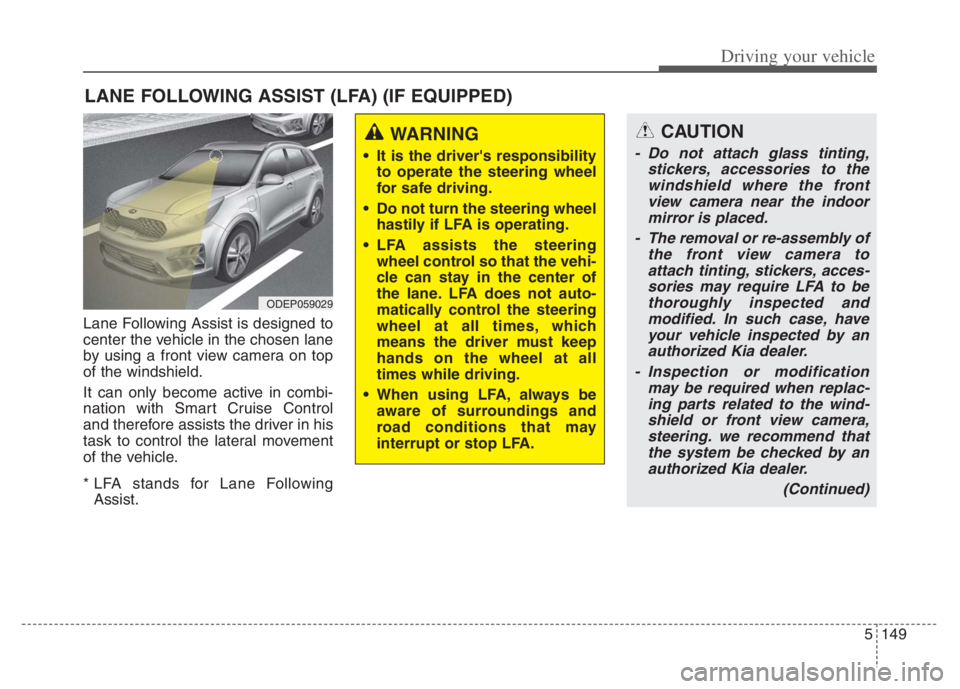
Lane Following Assist is designed to
center the vehicle in the chosen lane
by using a front view camera on top
of the windshield.
It can only become active in combi-
nation with Smart Cruise Control
and therefore assists the driver in his
task to control the lateral movement
of the vehicle.
* LFA stands for Lane Following
Assist.
LANE FOLLOWING ASSIST (LFA) (IF EQUIPPED)
ODEP059029
WARNING
It is the driver's responsibility
to operate the steering wheel
for safe driving.
Do not turn the steering wheel
hastily if LFA is operating.
LFA assists the steering
wheel control so that the vehi-
cle can stay in the center of
the lane. LFA does not auto-
matically control the steering
wheel at all times, which
means the driver must keep
hands on the wheel at all
times while driving.
When using LFA, always be
aware of surroundings and
road conditions that may
interrupt or stop LFA.
CAUTION
- Do not attach glass tinting,
stickers, accessories to the
windshield where the front
view camera near the indoor
mirror is placed.
- The removal or re-assembly of
the front view camera to
attach tinting, stickers, acces-
sories may require LFA to be
thoroughly inspected and
modified. In such case, have
your vehicle inspected by an
authorized Kia dealer.
- Inspection or modification
may be required when replac-
ing parts related to the wind-
shield or front view camera,
steering. we recommend that
the system be checked by an
authorized Kia dealer.
(Continued)
Page 476 of 710
5153
Driving your vehicle
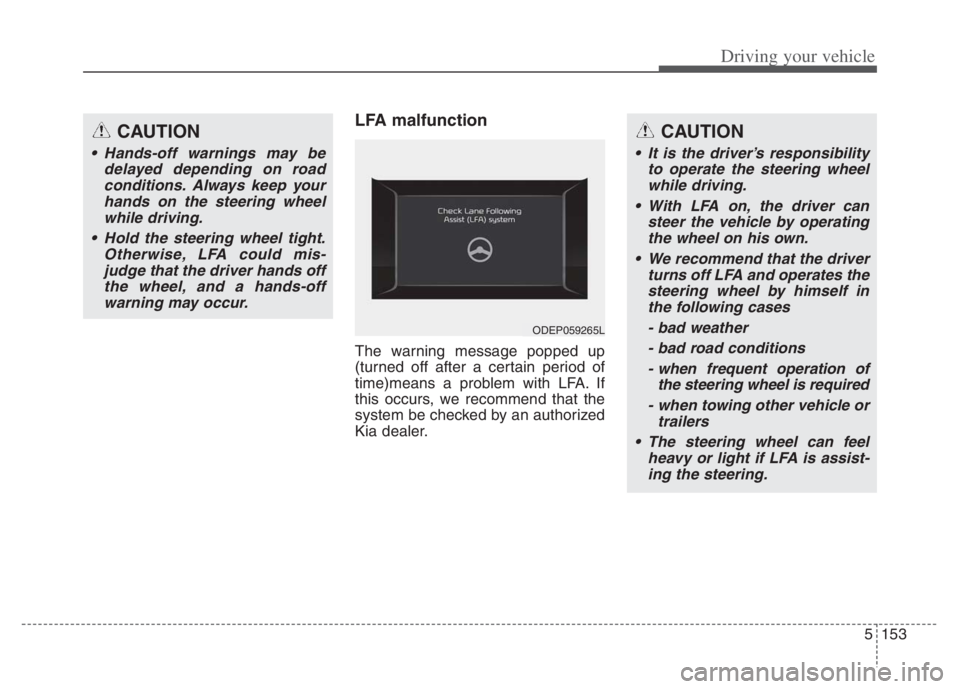
LFA malfunction
The warning message popped up
(turned off after a certain period of
time)means a problem with LFA. If
this occurs, we recommend that the
system be checked by an authorized
Kia dealer.
CAUTION
Hands-off warnings may be
delayed depending on road
conditions. Always keep your
hands on the steering wheel
while driving.
Hold the steering wheel tight.
Otherwise, LFA could mis-
judge that the driver hands off
the wheel, and a hands-off
warning may occur.
CAUTION
It is the driver’s responsibility
to operate the steering wheel
while driving.
With LFA on, the driver can
steer the vehicle by operating
the wheel on his own.
We recommend that the driver
turns off LFA and operates the
steering wheel by himself in
the following cases
- bad weather
- bad road conditions
- when frequent operation of
the steering wheel is required
- when towing other vehicle or
trailers
The steering wheel can feel
heavy or light if LFA is assist-
ing the steering.
ODEP059265L
Page 479 of 710
Driving your vehicle
156 5
HDA is designed to control the vehi-
cle distance and speed of the vehicle
when driving on a highway.
The function assists drivers by
receiving information about the
speed limit of the highway that the
vehicle is on and automatically
changing the set speed of Smart
Cruise Control when needed.✽ ✽
NOTICE
• HDA is available only on con-
trolled access road of certain high-
ways.
❈ ❈
Controlled access road indi-
cates roads with limited
entrances and exits that allow
uninterrupted high speed traf-
fic flow. Only passenger cars
and motorcycles are allowed on
controlled access roads.
• Additional highways may be
expanded by navigation updates.
HIGHWAY DRIVING ASSIST (HDA) (IF EQUIPPED)
WARNING
HDA is not a substitute for
safe driving practices, but a
convenience function. It is the
responsibility of the driver to
always be aware of the sur-
roundings and drive safely.
HDA relies entirely on the
road information provided by
the navigation system. It is the
responsibility of the driver to
follow traffic laws and avoid
accidents.
Turn off Highway Driving
Assist when the vehicle is
being towed.
For your safety, please read
the owner's manual before
using the function.
Available highway
(Controlled access road)
USASelect Interstate Highways
Page 486 of 710
5163
Driving your vehicle
This device complies with Part 15
of the FCC rules.
Operation is subject to the following
three conditions:
1. This device may not cause harmful
interference, and
2. This device must accept any inter-
ference received, including inter-
ference that may cause undesired
operation.
3. Changes or modifications not
expressly approved by the party
responsible for compliance could
void the user's authority to operate
the device.Radio frequency radiation
exposure information:
This equipment complies with FCC
radiation exposure limits set forth for
an uncontrolled environment.
This equipment should be installed
and operated with a minimum dis-
tance of 8 in (20 cm) between the
radio (antenna) and your body.
This transmitter must not be colocat-
ed or operating in conjunction with
any other antenna or transmitter.
Page 490 of 710
5167
Driving your vehicle
Detecting Sensor
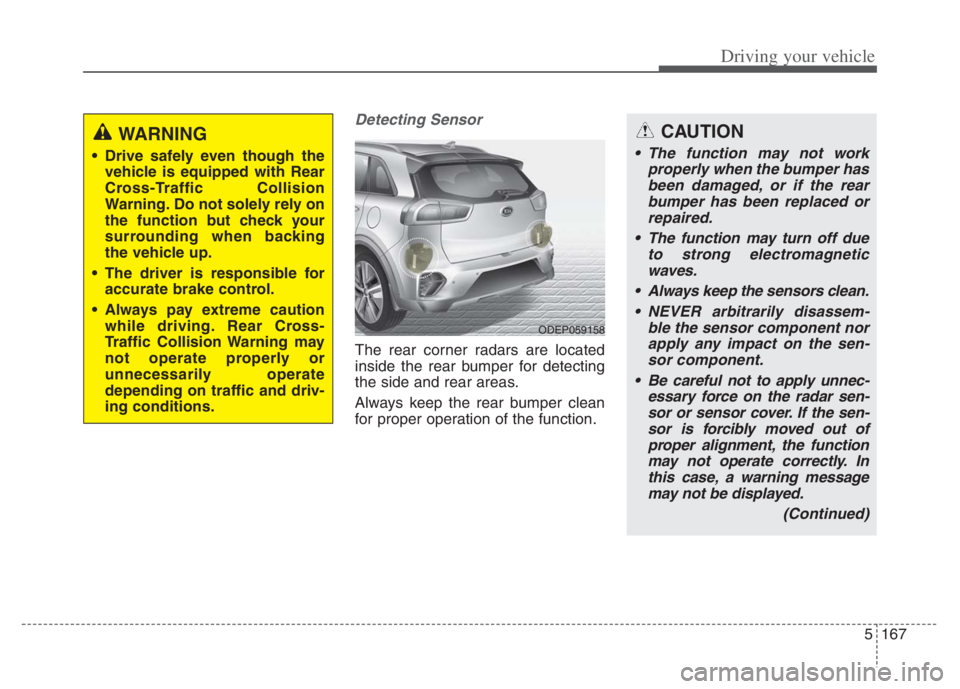
The rear corner radars are located
inside the rear bumper for detecting
the side and rear areas.
Always keep the rear bumper clean
for proper operation of the function.
ODEP059158
CAUTION
The function may not work
properly when the bumper has
been damaged, or if the rear
bumper has been replaced or
repaired.
The function may turn off due
to strong electromagnetic
waves.
Always keep the sensors clean.
NEVER arbitrarily disassem-
ble the sensor component nor
apply any impact on the sen-
sor component.
Be careful not to apply unnec-
essary force on the radar sen-
sor or sensor cover. If the sen-
sor is forcibly moved out of
proper alignment, the function
may not operate correctly. In
this case, a warning message
may not be displayed.
(Continued)
WARNING
Drive safely even though the
vehicle is equipped with Rear
Cross-Traffic Collision
Warning. Do not solely rely on
the function but check your
surrounding when backing
the vehicle up.
The driver is responsible for
accurate brake control.
Always pay extreme caution
while driving. Rear Cross-
Traffic Collision Warning may
not operate properly or
unnecessarily operate
depending on traffic and driv-
ing conditions.
Page 505 of 710

Driving your vehicle
182 5
Your vehicle's fuel economy depends
mainly on your style of driving, where
you drive and when you drive.
Each of these factors affects how
many miles (kilometers) you can get
from a gallon (liter) of fuel. To operate
your vehicle as economically as pos-
sible, use the following driving sug-
gestions to help save money in both
fuel and repairs:
Drive smoothly. Accelerate at a
moderate rate. Don't make "jack-
rabbit" starts or full-throttle shifts
and maintain a steady cruising
speed. Don't race between stop-
lights. Try to adjust your speed to
the traffic so you don't have to
change speeds unnecessarily.
Avoid heavy traffic whenever pos-
sible. Always maintain a safe dis-
tance from other vehicles so you
can avoid unnecessary braking.
This also reduces brake wear.
Drive at a moderate speed. The
faster you drive, the more fuel your
vehicle uses. Driving at a moderate
speed, especially on the highway,
is one of the most effective ways to
reduce fuel consumption. Don't "ride" the brake pedal. This
can increase fuel consumption and
also increase wear on these com-
ponents. In addition, driving with
your foot resting on the brake pedal
may cause the brakes to overheat,
which reduces their effectiveness
and may lead to more serious con-
sequences.
Take care of your tires. Keep them
inflated to the recommended pres-
sure. Incorrect inflation, either too
much or too little, results in unnec-
essary tire wear. Check the tire
pressures at least once a month.
Be sure that the wheels are
aligned correctly. Improper align-
ment can result from hitting curbs
or driving too fast over irregular
surfaces. Poor alignment causes
faster tire wear and may also result
in other problems as well as
greater fuel consumption. Keep your vehicle in good condi-
tion. For better fuel economy and
reduced maintenance costs, main-
tain your vehicle in accordance
with the maintenance schedule in
chapter 8. If you drive your vehicle
in severe conditions, more frequent
maintenance is required (see
chapter 8 for details).
Keep your vehicle clean. For maxi-
mum service, your vehicle should
be kept clean and free of corrosive
materials. It is especially important
that mud, dirt, ice, etc. not be
allowed to accumulate on the
underside of the vehicle. This extra
weight can result in increased fuel
consumption and also contribute to
corrosion.
Travel lightly. Don't carry unneces-
sary weight in your vehicle. Weight
reduces fuel economy.
Don't let the engine idle longer
than necessary. If you are waiting
(and not in traffic), turn off your
engine and restart only when
you're ready to go.
ECONOMICAL OPERATION