charger KIA NIRO HYBRID EV 2021 Owners Manual
[x] Cancel search | Manufacturer: KIA, Model Year: 2021, Model line: NIRO HYBRID EV, Model: KIA NIRO HYBRID EV 2021Pages: 667, PDF Size: 9.17 MB
Page 9 of 667
H4
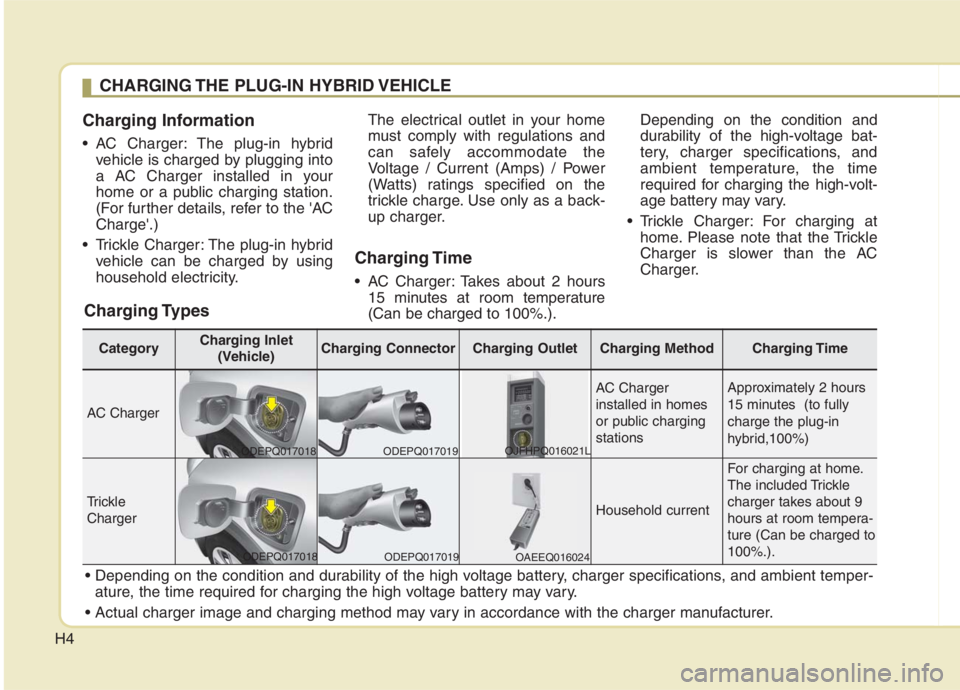
Charging Information
• AC Charger: The plug-in hybrid
vehicle is charged by plugging into
a AC Charger installed in your
home or a public charging station.
(For further details, refer to the 'AC
Charge'.)
Trickle Charger: The plug-in hybrid
vehicle can be charged by using
household electricity.The electrical outlet in your home
must comply with regulations and
can safely accommodate the
Voltage / Current (Amps) / Power
(Watts) ratings specified on the
trickle charge. Use only as a back-
up charger.
Charging Time
AC Charger: Takes about 2 hours
15 minutes at room temperature
(Can be charged to 100%.).Depending on the condition and
durability of the high-voltage bat-
tery, charger specifications, and
ambient temperature, the time
required for charging the high-volt-
age battery may vary.
Trickle Charger: For charging at
home. Please note that the Trickle
Charger is slower than the AC
Charger.
CHARGING THE PLUG-IN HYBRID VEHICLE
Charging Types
ature, the time required for charging the high voltage battery may vary.
CategoryCharging Inlet
(Vehicle)Charging ConnectorCharging OutletCharging Method Charging Time
AC Charger
AC Charger
installed in homes
or public charging
stations Approximately 2 hours
15 minutes (to fully
charge the plug-in
hybrid,100%)
Trickle
ChargerHousehold current
For charging at home.
The included Trickle
charger takes about 9
hours at room tempera-
ture (Can be charged to
100%.).
ODEPQ017018
ODEPQ017019
ODEPQ017019
OAEEQ016024 OJFHPQ016021L
ODEPQ017018
Page 13 of 667
H8
Scheduled Charging
(if equipped)
You can set reserved charging
using the Infotainment System.
Refer to the Infotainment System
for detailed information about set-
ting reserved charging.
Scheduled charging can only be
done when using a AC Charger or
the portable charging cable (ICCB:
In-Cable Control Box).
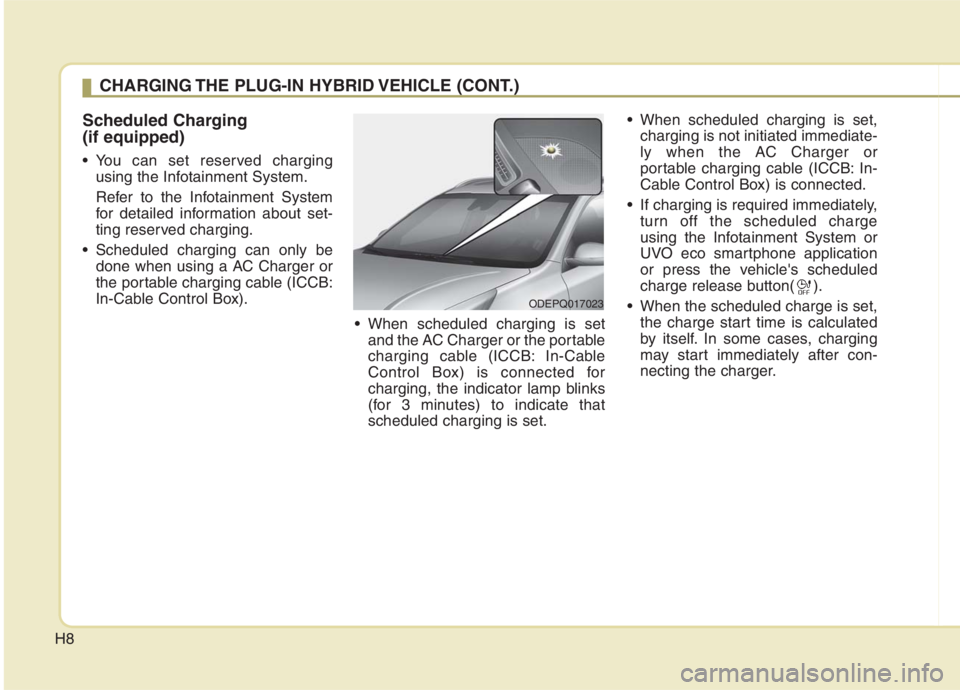
When scheduled charging is set
and the AC Charger or the portable
charging cable (ICCB: In-Cable
Control Box) is connected for
charging, the indicator lamp blinks
(for 3 minutes) to indicate that
scheduled charging is set. When scheduled charging is set,
charging is not initiated immediate-
ly when the AC Charger or
portable charging cable (ICCB: In-
Cable Control Box) is connected.
If charging is required immediately,
turn off the scheduled charge
using the Infotainment System or
UVO eco smartphone application
or press the vehicle's scheduled
charge release button( ).
When the scheduled charge is set,
the charge start time is calculated
by itself. In some cases, charging
may start immediately after con-
necting the charger.
CHARGING THE PLUG-IN HYBRID VEHICLE (CONT.)
ODEPQ017023
Page 14 of 667

H9
If you press the scheduled charging
deactivation ( ) button to immedi-
ately charge the battery, charging
must be initiated 3 minutes after the
charging cable has been connected.
When you press the scheduled
charging deactivation ( ) button
for immediate charging, the sched-
uled charge setting is not com-
pletely deactivated. If you need to
completely deactivate the sched-
uled charge setting, use the
Infotainment System to finalize the
deactivation.Refer to "AC Charge or Trickle
Charge" for details about connect-
ing the AC Charger and the
portable charger (ICCB: In-Cable
Control Box).
Charging Precautions
ODEPQ019022
OJFHPQ016021L
■AC Charger
WARNING
-
Fires caused by dust or
water
Do not connect the charging
cable connector plug to the vehi-
cle if there is water or dust on the
charging inlet. Connecting while
there is water or dust on the
charging cable connector and
plug may cause a fire or electric
shock.
Page 15 of 667
H10
Comply with the following in order
to prevent electrical shock when
charging:
- Use a waterproof charger
- Make sure to not touch the charg-
ing connector and charging plug
when your hand is wet
- Do not charge when there is light-
ning
- Do not charge when the charging
connector and plug is wet
WARNING
-
Interference with electron-
ic medical devices
When using medical electric
devices such as an implantable
cardiac pacemaker, make sure to
ask the medical team and manu-
facturer whether charging your
electric vehicle will impact the
operation of the medical
devices. In some instances, elec-
tromagnetic waves that are gen-
erated from the charger can seri-
ously impact medical electric
devices such as an implantable
cardiac pacemaker.
WARNING
-
Touching the charging
connector
Do not to touch the charging
connector, charging plug, or the
charging inlet when connecting
the charger connecting cable to
the charging outlet and the
charging inlet on the vehicle.
Doing so may result in electro-
cution.
WARNING
-
Old or Worn out Electric
Outlets
Do not use old or worn out elec-
tric outlets to charge your vehi-
cle. There may be a risk of fire
and injury when using old worn
out public electrical outlets.
CHARGING THE PLUG-IN HYBRID VEHICLE (CONT.)
WARNING - Charging
cable
• Immediately stop charging
when you discover abnormal
symptoms (smell, smoke).
Replace the charging cable if
the cable coating is damaged
to prevent electrical shock.
When connecting or removing
the charging cable, make sure
to hold the charging connec-
tor handle.
(Continued)
Page 16 of 667
H11
Always keep the charging connec-
tor and charging plug clean and
dry. Be sure to keep the charging
cable in a condition where there is
no water or moisture.
Before charging the battery, turn
the vehicle OFF.
Be careful not to drop the charging
connector. The charging connector
can be damaged.
Always inspect the charging con-
nector terminals for damage or
overheating. Do not use if dam-
aged, as this may damage the
vehicle side charge connector and
is not a warrantable repair.AC Charge
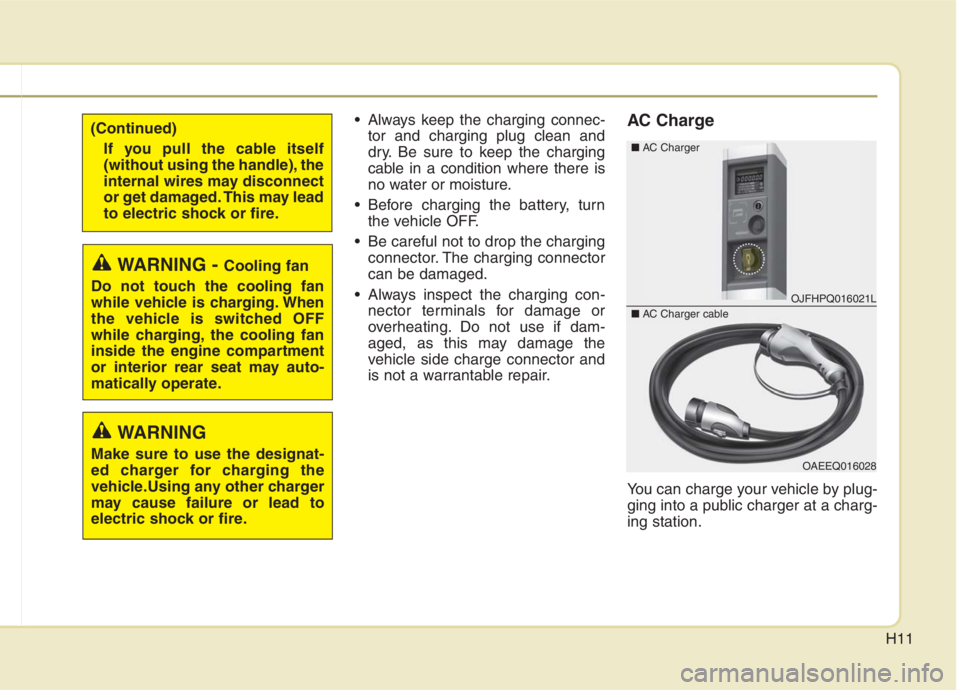
You can charge your vehicle by plug-
ging into a public charger at a charg-
ing station.
WARNING - Cooling fan
Do not touch the cooling fan
while vehicle is charging. When
the vehicle is switched OFF
while charging, the cooling fan
inside the engine compartment
or interior rear seat may auto-
matically operate.
OJFHPQ016021L
OAEEQ016028
■AC Charger
■AC Charger cable
WARNING
Make sure to use the designat-
ed charger for charging the
vehicle.Using any other charger
may cause failure or lead to
electric shock or fire.
(Continued)
If you pull the cable itself
(without using the handle), the
internal wires may disconnect
or get damaged. This may lead
to electric shock or fire.
Page 17 of 667
H12
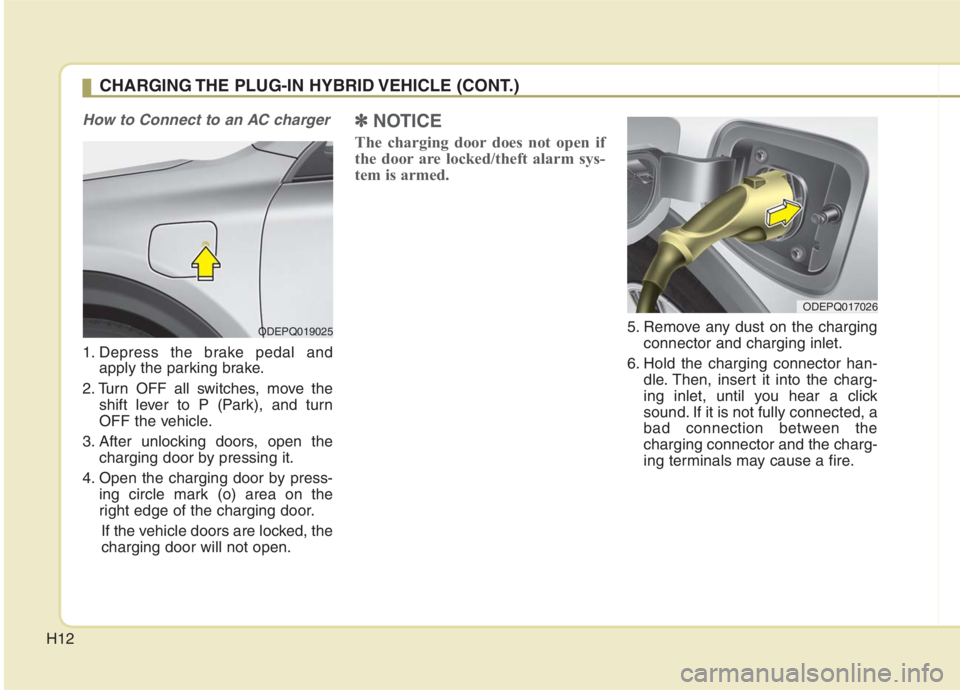
How to Connect to an AC charger
1. Depress the brake pedal and
apply the parking brake.
2. Turn OFF all switches, move the
shift lever to P (Park), and turn
OFF the vehicle.
3. After unlocking doors, open the
charging door by pressing it.
4. Open the charging door by press-
ing circle mark (o) area on the
right edge of the charging door.
If the vehicle doors are locked, the
charging door will not open.
✽ ✽
NOTICE
The charging door does not open if
the door are locked/theft alarm sys-
tem is armed.
5. Remove any dust on the charging
connector and charging inlet.
6. Hold the charging connector han-
dle. Then, insert it into the charg-
ing inlet, until you hear a click
sound. If it is not fully connected, a
bad connection between the
charging connector and the charg-
ing terminals may cause a fire.
CHARGING THE PLUG-IN HYBRID VEHICLE (CONT.)
ODEPQ019025
ODEPQ017026
Page 20 of 667

H15
How to Disconnect an AC charger
1.The vehicle must be in the AUTO
mode or the doors must be
unlocked in order to be able to dis-
connect the charging connector. A
lock system prevents charger
cable disconnection when the vehi-
cle's doors are locked.
2.While holding the charging con-
nector, pressing the locking
release button (1) and then pull it
out.
To prevent charging cable theft, the
charging connector cannot be dis-
connected from the inlet when the
doors are locked. Unlock all doors
to disconnect the charging connec-
tor from the inlet.
However, if the vehicle is in the
charging connector AUTO mode,
the charging connector automati-
cally unlocks from the inlet when
charging is completed.
ODEPQ017031
CAUTION
In order to disconnect the
charging connector, unlock the
doors to unlatch the charging
connector lock system. If not,
the charging connector and the
vehicle's charging inlet may be
damaged.
Operation of
Charging Indicator
Lamp (1)
Charging Status
Turns on (Green)Charging in
progress
Turns offNot Charging or
fully charged
Slowly blinks
(Green) and then
turns off (repeat
for 3 minutes)Waiting for sched-
uled charging
(turns off after 3
minutes)
Quickly
blinks(Green) and
then turns off
(repeats during
operation)
Aux. Battery Saver
+ operating in
progress
Slowly blinks (Red)Malfunction
Page 22 of 667

H17
Trickle Charger
(Portable Charging Cable)
Trickle charger can be used if AC
Charger is unavailable.
❈➀: Plug and cable
➁: Control box (ICCB)
➂: Charging connector/cable
How to Connect Portable
Charging Cable
(ICCB: In-Cable Control Box)
1. Turn OFF all switches, move the
shift lever to P (Park), and turn
OFF the vehicle.
2. Depress the brake pedal and
apply the parking brake.3. After unlocking doors, open the
charging door by pressing it.
4. Open the charging door by press-
ing circle mark (o) area on the
right edge of the charging door.
If the vehicle doors are locked, the
charging door will not open.
OAEEQ016042
ODEPQ019025
OJFHPQ016015N
Page 26 of 667
H21
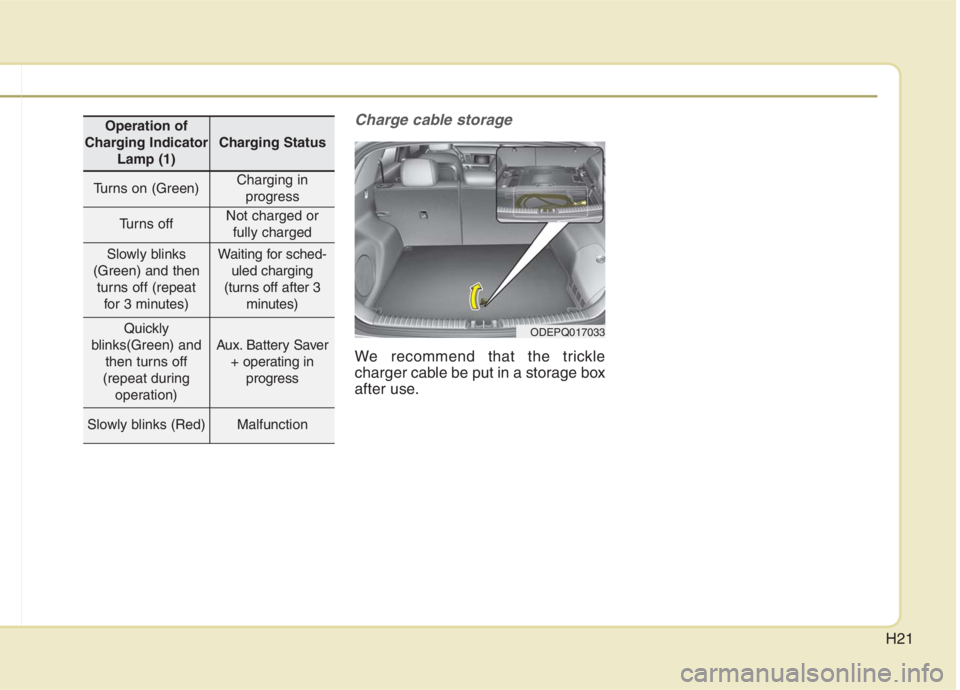
Charge cable storage
We recommend that the trickle
charger cable be put in a storage box
after use.
ODEPQ017033
Operation of
Charging Indicator
Lamp (1)
Charging Status
Turns on (Green)Charging in
progress
Turns offNot charged or
fully charged
Slowly blinks
(Green) and then
turns off (repeat
for 3 minutes)Waiting for sched-
uled charging
(turns off after 3
minutes)
Quickly
blinks(Green) and
then turns off
(repeat during
operation)
Aux. Battery Saver
+ operating in
progress
Slowly blinks (Red)Malfunction
Page 31 of 667
H26
Precautions for Portable
Charging Cable
(ICCB: In-Cable Control Box)
Use a portable charging cable that
is certified by Kia.
Do not try to repair, disassemble, or
adjust the portable charging cable.
Do not use an extension cord or
adapter.
Stop using immediately if failure
warning light occurs.
Do not touch the plug and charging
connector with wet hands.
Do not touch the terminal part of the
AC Charging connector and the AC
Charging inlet on the vehicle.
Do not connect the charging con-
nector to voltage that does not
comply with regulations.
Do not use the portable charging
cable if it is worn out, exposed, or
there exists any type of damage on
the portable charging cable. If the ICCB case and AC Charging
connector is damaged, cracked, or
the wires are exposed in any way,
do not use the portable charging
cable.
Do not let children operate or touch
the portable charging cable.
Keep the control box free of water.
Keep the AC Chargingconnector or
plug terminal free of foreign sub-
stances.
Do not step on the cable or cord.
Do not pull the cable or cord and
do not twist or bend it.
Do not charge when there is light-
ning.
Do not drop the control box, charg-
ing connector, or place a heavy
object on the control box.
Do not place an object that can
generate high temperatures near
the charger when charging. Charging with a worn out or dam-
aged household electric outlet can
result in a risk of electric shock. If
you are unsure about the condition
of a household electric outlet, have
it checked by a licensed electri-
cian.
Stop using the portable charging
cable immediately if the household
electric outlet or any components
are overheating or you smell burn-
ing.
CHARGING THE PLUG-IN HYBRID VEHICLE (CONT.)