driver seat adjustment KIA NIRO HYBRID EV 2021 Owners Manual
[x] Cancel search | Manufacturer: KIA, Model Year: 2021, Model line: NIRO HYBRID EV, Model: KIA NIRO HYBRID EV 2021Pages: 667, PDF Size: 9.17 MB
Page 73 of 667
Safety features of your vehicle
6 3
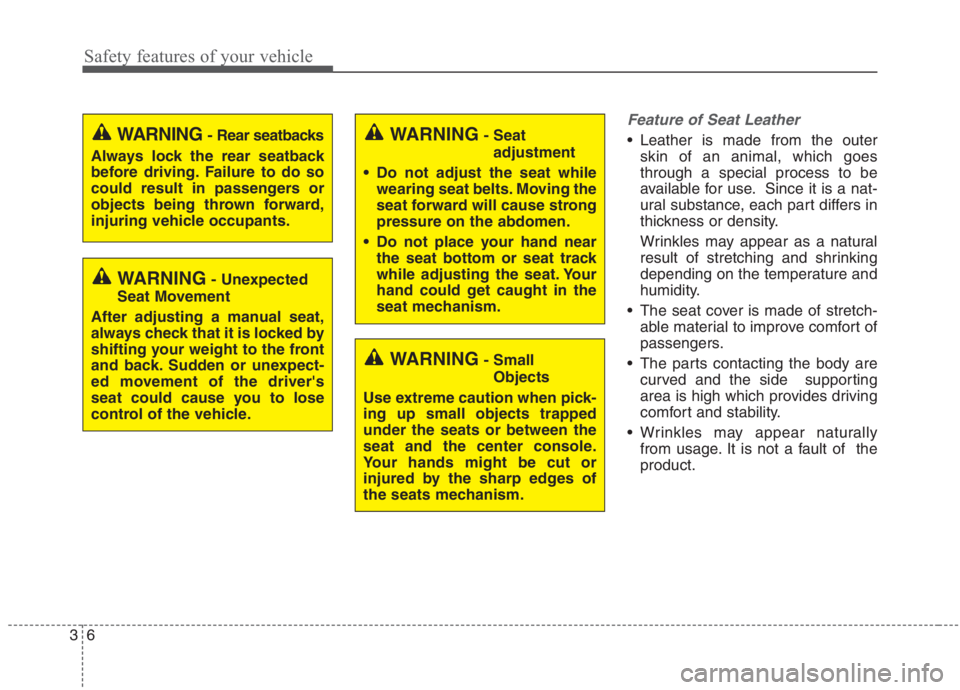
Feature of Seat Leather
Leather is made from the outer
skin of an animal, which goes
through a special process to be
available for use. Since it is a nat-
ural substance, each part differs in
thickness or density.
Wrinkles may appear as a natural
result of stretching and shrinking
depending on the temperature and
humidity.
The seat cover is made of stretch-
able material to improve comfort of
passengers.
The parts contacting the body are
curved and the side supporting
area is high which provides driving
comfort and stability.
Wrinkles may appear naturally
from usage. It is not a fault of the
product.
WARNING- Unexpected
Seat Movement
After adjusting a manual seat,
always check that it is locked by
shifting your weight to the front
and back. Sudden or unexpect-
ed movement of the driver's
seat could cause you to lose
control of the vehicle.
WARNING - Rear seatbacks
Always lock the rear seatback
before driving. Failure to do so
could result in passengers or
objects being thrown forward,
injuring vehicle occupants.WARNING- Seat
adjustment
Do not adjust the seat while
wearing seat belts. Moving the
seat forward will cause strong
pressure on the abdomen.
Do not place your hand near
the seat bottom or seat track
while adjusting the seat. Your
hand could get caught in the
seat mechanism.
WARNING- Small
Objects
Use extreme caution when pick-
ing up small objects trapped
under the seats or between the
seat and the center console.
Your hands might be cut or
injured by the sharp edges of
the seats mechanism.
Page 75 of 667

Safety features of your vehicle
8 3
Reclining seatback
Sitting in a reclined position when
the vehicle is in motion can be dan-
gerous. Even when buckled up, the
protections of your restraint system
(seat belts and/or air bags) is greatly
reduced by reclining your seatback.
Seat belts must be snug against your
hips and chest to work properly.
When the seatback is reclined, the
shoulder belt cannot do its job
because it will not be snug against
your chest. Instead, it will be in front
of you. During an accident, you could
be thrown into the seat belt, causing
neck or other injuries.
The more the seatback is reclined,
the greater chance the passenger’s
hips will slide under the lap belt or
the passenger’s neck will strike the
shoulder belt.Seat height
To change the height of the seat, push
the lever upwards or downwards.
To lower the seat cushion, push the
lever down several times.
To raise the seat cushion, pull the
lever up several times.
Front seat adjustment - power
(for driver’s seat, if equipped)
The driver’s seat can be adjusted by
using the control switches located on
the outside of the seat cushion.
Before driving, adjust the seat to the
proper position so you can easily
control the steering wheel, pedals
and switches on the instrument
panel.
ODEP039061
ODEP039106N
Page 78 of 667

311
Safety features of your vehicle
Storing positions into memory
using the buttons on the door
Storing driver’s seat positions
1. Shift the shift lever into P while the
engine start/stop button is ON or
ignition switch is ON.
2. Adjust the driver’s seat and out-
side rearview mirror comfortable
for the driver.
3. Press SET button on the control
panel. The system will beep once.
4. Press one of the memory buttons
(1 or 2) within 4 seconds after
pressing the SET button. The sys-
tem will beep twice when memory
has been successfully stored.
When recalling an adjustment mem-
ory button while sitting in the vehicle,
you can be surprised by the setting
chosen if the memory has been
adjusted by someone else. If that
occurs, immediately push the seat
position control knob in the direction
of the desired position to stop further
undesired movement.Recalling positions from memory
1. Shift the shift lever into P.
2. To recall the position in the memo-
ry, press the desired memory but-
ton (1 or 2). The system will beep
once, then the driver’s seat will
automatically adjust to the stored
position.
Adjusting the control switch for the
driver’s seat while the system is
recalling the stored position will
cause the movement to stop and
move in the direction that the control
switch is moved.
WARNING - Driver
Position Memory System
Never attempt to operate the
driver position memory system
while the vehicle is moving.
This could result in loss of con-
trol, and an accident causing
death or serious injury.
Page 79 of 667

Safety features of your vehicle
12 3
Easy access function (if equipped)
The system will move the driver's
seat automatically as follows:
Without smart key system
- It will move the driver’s seat rear-
ward when the ignition key is
removed and front driver’s door is
opened.
- It will move the driver’s seat forward
when the ignition key is inserted.
With smart key system
- It will move the driver’s seat rear-
ward when the engine start/stop
button is changed to the OFF
position.
- It will move the driver’s seat for-
ward when the engine start/stop
button is changed to the ACC or
START position.
- It will move the driver's seat for-
ward when you get in your vehicle
with the smart key after closing
the driver's door.
You can activate or deactivate this
feature. Refer to "User settings" in
chapter 4.
Headrest (for front seat)
The driver's and front passenger's
seats are equipped with a headrest
for the occupant's safety and comfort.
The headrest not only provides com-
fort for the driver and front passenger,
but also helps protect the head and
neck in the event of a rear collision.
For maximum effectiveness in case
of an accident, the headrest should
be adjusted so the middle of the
headrest is at the same height of the
center of gravity of an occupant's
head. Generally, the center of gravity
of most people's head is similar with
the height of the top of their eyes.Also, adjust the headrest as close to
your head as possible. For this rea-
son, the use of a cushion that holds
the body away from the seatback is
not recommended.
WARNING- Headrest
removal/adjustment
Do not operate the vehicle
with the headrests removed.
Headrests can provide critical
neck and head support in a
crash.
Do not adjust the headrest
height while the vehicle is in
motion. Driver may lose con-
trol of the vehicle.
ODE036074L
Page 82 of 667

315
Safety features of your vehicle
Seatback pocket (if equipped)
The seatback pocket is provided on
the back of the front passenger’s and
driver’s seatbacks.
Rear seat adjustment
Headrest
The rear seat is equipped with head-
rests in all the seating positions for
the occupant's safety and comfort.
The headrest not only provides com-
fort for passengers, but also helps
protect the head and neck in the
event of a collision.For maximum effectiveness in case
of an accident, the headrest should
be adjusted so the middle of the
headrest is at the same height of the
center of gravity of an occupant's
head. Generally, the center of gravity
of most people's heads is similar with
the height as the top of their eyes.
Also, adjust the headrest as close to
your head as possible. For this rea-
son, the use of a cushion that holds
the body away from the seatback is
not recommended.
ODE036015
WARNING- Seatback
pockets
Do not put heavy or sharp
objects in the seatback pockets.
In an accident, they could come
loose from the pocket and
injure vehicle occupants.
ODE036075L
Page 664 of 667

Index
8I
Mirrors . . . . . . . . . . . . . . . . . . . . . . . . . . . . . . . . . . . . . 4-51
Inside rearview mirror . . . . . . . . . . . . . . . . . . . . . . . 4-51
Outside rearview mirror . . . . . . . . . . . . . . . . . . . . . . 4-62
Owner maintenance . . . . . . . . . . . . . . . . . . . . . . . . . . . . 7-7
Owner maintenance schedule. . . . . . . . . . . . . . . . . . . 7-7
Parking brake . . . . . . . . . . . . . . . . . . . . . . . . . . . . . . . . 7-31
Checking the parking brake . . . . . . . . . . . . . . . . . . . 7-31
Rear Cross-Traffic Collision Warning (RCCW). . . . . 5-132
System description . . . . . . . . . . . . . . . . . . . . . . . . . 5-132
System setting and activation . . . . . . . . . . . . . . . . . 5-132
Warning message and system control . . . . . . . . . . 5-134
Rear View Monitor (RVM) . . . . . . . . . . . . . . . . . . . . . 4-120
Recommended lubricants and capacities . . . . . . . . . . . . 8-8
Recommended SAE viscosity number. . . . . . . . . . . . 8-9
Regenerative braking system . . . . . . . . . . . . . . . . . . . . 5-27
Regenerative Braking (Paddle Shifter) . . . . . . . . . . 5-27
Reporting Safety Defects . . . . . . . . . . . . . . . . . . . . . . . 8-13Reverse Parking Distance Warning (PDW) . . . . . . . . 4-121
Non-operational conditions of Reverse Parking
Distance Warning system . . . . . . . . . . . . . . . . . . . 4-122
Operation of Reverse Parking Distance
Warning system . . . . . . . . . . . . . . . . . . . . . . . . . . 4-121
Reverse Parking Distance Warning system
precautions . . . . . . . . . . . . . . . . . . . . . . . . . . . . . . 4-123
Self-diagnosis . . . . . . . . . . . . . . . . . . . . . . . . . . . . . 4-123
Road warning . . . . . . . . . . . . . . . . . . . . . . . . . . . . . . . . . 6-2
Hazard warning flasher . . . . . . . . . . . . . . . . . . . . . . . 6-2
Scheduled maintenance service . . . . . . . . . . . . . . . . . . . 7-9
Seat . . . . . . . . . . . . . . . . . . . . . . . . . . . . . . . . . . . . . . . . . 3-4
Driver position memory system (for power seat) . . 3-10
Front seat adjustment - manual . . . . . . . . . . . . . . . . . 3-7
Front seat adjustment - power (for driver’s seat) . . . . 3-8
Headrest (for front seat) . . . . . . . . . . . . . . . . . . . . . . 3-12
Rear seat adjustment . . . . . . . . . . . . . . . . . . . . . . . . 3-15
Seatback pocket . . . . . . . . . . . . . . . . . . . . . . . . . . . . 3-15
Seat belts . . . . . . . . . . . . . . . . . . . . . . . . . . . . . . . . . . . . 3-21
Care of seat belts . . . . . . . . . . . . . . . . . . . . . . . . . . . 3-33
Pre-tensioner seat belt . . . . . . . . . . . . . . . . . . . . . . . 3-29
Seat belt precautions . . . . . . . . . . . . . . . . . . . . . . . . 3-31
Seat belt restraint system . . . . . . . . . . . . . . . . . . . . . 3-21
P
O
R
S