engine KIA NIRO HYBRID EV 2022 Owners Manual
[x] Cancel search | Manufacturer: KIA, Model Year: 2022, Model line: NIRO HYBRID EV, Model: KIA NIRO HYBRID EV 2022Pages: 684, PDF Size: 9.67 MB
Page 629 of 684
787
Maintenance
LIGHT BULBS
Bulb replacement precaution
Please keep extra bulbs on hand
with appropriate wattage ratings in
case of emergencies.
Refer to “Bulb Wattage” in chapter 8.
When changing lamps, first turn off
the engine at a safe place, firmly
apply the parking brake and detach
the battery’s negative (-) terminal.
Use only bulbs of the specified
wattage.✽ ✽
NOTICE
• If the light bulb or lamp connector
is removed while the lamp is still
on, the fuse box's electronic sys-
tem may log it as a malfunction.
Therefore, a lamp malfunction
incident may be recorded as a
Diagnostic Trouble Code (DTC) in
the fuse box.
• It is normal for an operating lamp
to flicker momentarily. This is due
to a stabilization function of the
vehicle’s electronic control device.
If the lamp lights up normally
after momentarily blinking, then
it is functioning as normal.
However, if the lamp continues to
flicker several times or turns off
completely, there may be an error
in the vehicle’s electronic control
device. Please have the vehicle
checked by an authorized Kia
dealer immediately.
✽ ✽
NOTICE
We recommend that the headlight
aiming be adjusted by an authorized
Kia dealer after an accident or after
the headlight assembly is reinstalled.
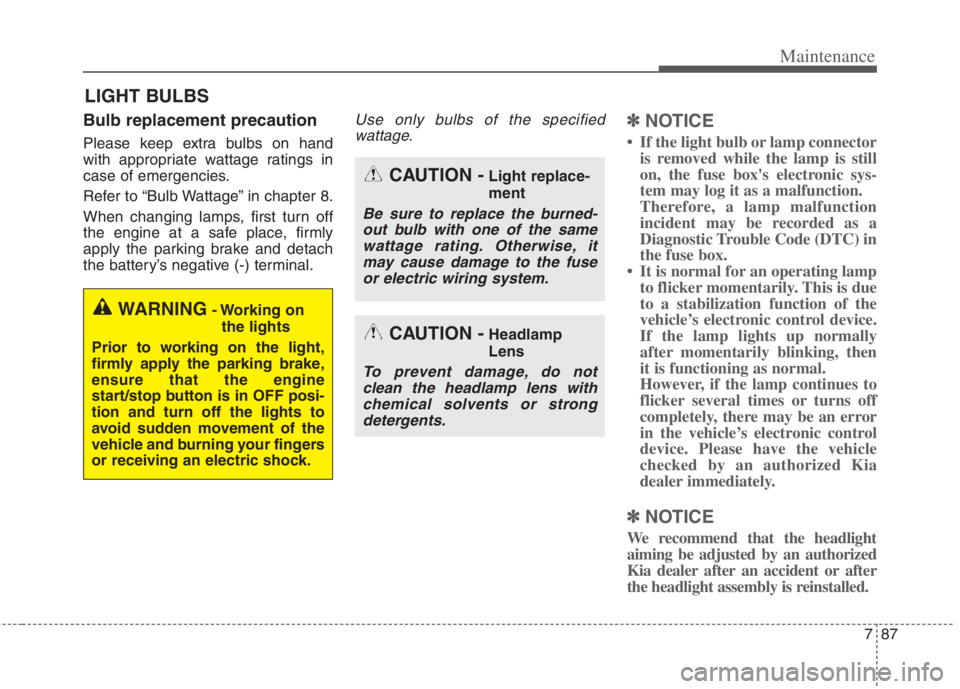
WARNING- Working on
the lights
Prior to working on the light,
firmly apply the parking brake,
ensure that the engine
start/stop button is in OFF posi-
tion and turn off the lights to
avoid sudden movement of the
vehicle and burning your fingers
or receiving an electric shock.
CAUTION -Light replace-
ment
Be sure to replace the burned-
out bulb with one of the same
wattage rating. Otherwise, it
may cause damage to the fuse
or electric wiring system.
CAUTION -Headlamp
Lens
To prevent damage, do not
clean the headlamp lens with
chemical solvents or strong
detergents.
Page 648 of 684
Maintenance
106 7
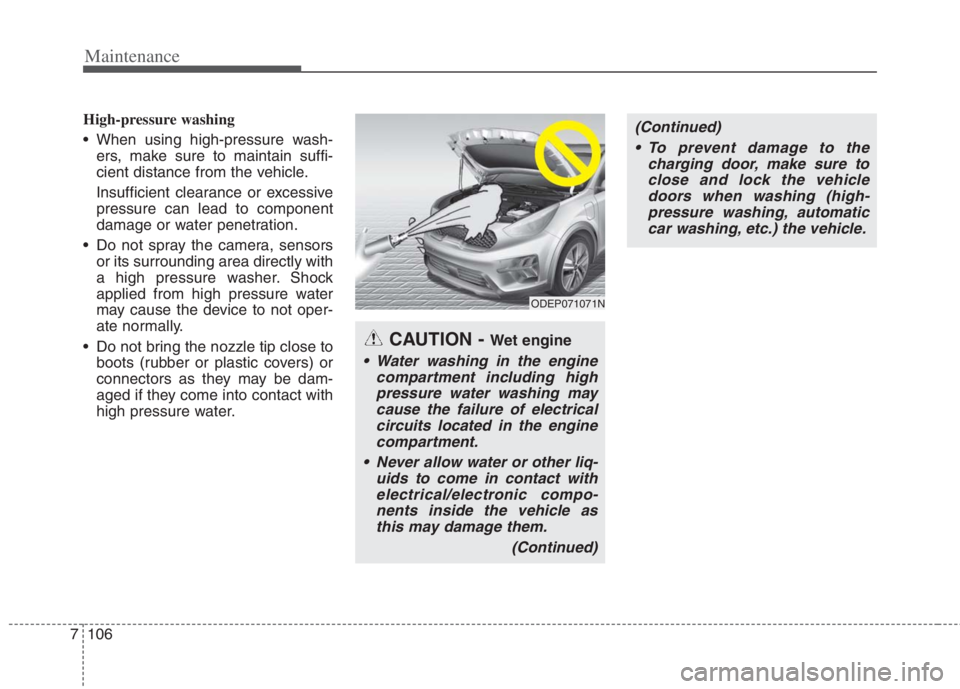
High-pressure washing
When using high-pressure wash-
ers, make sure to maintain suffi-
cient distance from the vehicle.
Insufficient clearance or excessive
pressure can lead to component
damage or water penetration.
Do not spray the camera, sensors
or its surrounding area directly with
a high pressure washer. Shock
applied from high pressure water
may cause the device to not oper-
ate normally.
Do not bring the nozzle tip close to
boots (rubber or plastic covers) or
connectors as they may be dam-
aged if they come into contact with
high pressure water.
ODEP071071N
CAUTION - Wet engine
Water washing in the engine
compartment including high
pressure water washing may
cause the failure of electrical
circuits located in the engine
compartment.
Never allow water or other liq-
uids to come in contact with
electrical/electronic compo-
nents inside the vehicle as
this may damage them.
(Continued)
(Continued)
To prevent damage to the
charging door, make sure to
close and lock the vehicle
doors when washing (high-
pressure washing, automatic
car washing, etc.) the vehicle.
Page 658 of 684
Maintenance
116 7
Canister
Fuel vapors generated inside the fuel
tank are absorbed and stored in the
onboard canister. When the engine is
running, the fuel vapors absorbed in
the canister are drawn into the surge
tank through the purge control sole-
noid valve.
Purge Control Solenoid Valve
(PCSV)
The purge control solenoid valve is
controlled by the Engine Control
Module (ECM); when the engine
coolant temperature is low during
idling, the PCSV closes so that evap-
orated fuel is not taken into the
engine. After the engine warms up
during ordinary driving, the PCSV
opens to introduce evaporated fuel to
the engine.
3. Exhaust emission control
system
The Exhaust Emission Control
System is a highly effective system
which controls exhaust emissions
while maintaining good vehicle per-
formance.
Engine exhaust gas precautions
(carbon monoxide)
Carbon monoxide can be present
with other exhaust fumes.
Therefore, if you smell exhaust
fumes of any kind inside your vehi-
cle, have it inspected and repaired
immediately. If you ever suspect
exhaust fumes are coming into
your vehicle, drive it only with all
the windows fully open. Have your
vehicle checked and repaired
immediately.
WARNING - Exhaust
Engine exhaust gases contain
carbon monoxide (CO). Though
colorless and odorless, it is
dangerous and could be lethal if
inhaled. Follow the instructions
on this page to avoid CO poi-
soning.
Page 659 of 684
7117
Maintenance
Do not operate the engine in con-
fined or closed areas (such as
garages) any more than what is
necessary to move the vehicle in or
out of the area.
When the vehicle is stopped in an
open area for more than a short
time with the engine running,
adjust the ventilation system (as
needed) to draw outside air into the
vehicle.
Never sit in a parked or stopped
vehicle for any extended time with
the engine running.
When the engine stalls or fails to
start, excessive attempts to restart
the engine may cause damage to
the emission control system.Operating precautions for catalyt-
ic converters (if equipped)
WARNING- Catalytic
converter
Keep away from the catalytic
converter and exhaust system
while the vehicle is running or
immediately thereafter. The
exhaust and catalytic systems
are very hot and may burn you.
WARNING- Fire
Do not park, idle or drive the
vehicle over or near flamma-
ble objects, such as grass,
vegetation, paper, leaves, etc.
A hot exhaust system can
ignite flammable items under
your vehicle.
Also, do not remove the heat
sink around the exhaust sys-
tem, do not seal the bottom of
the vehicle and do not coat
the vehicle for corrosion con-
trol. It may present a fire risk
under certain conditions.
Page 660 of 684
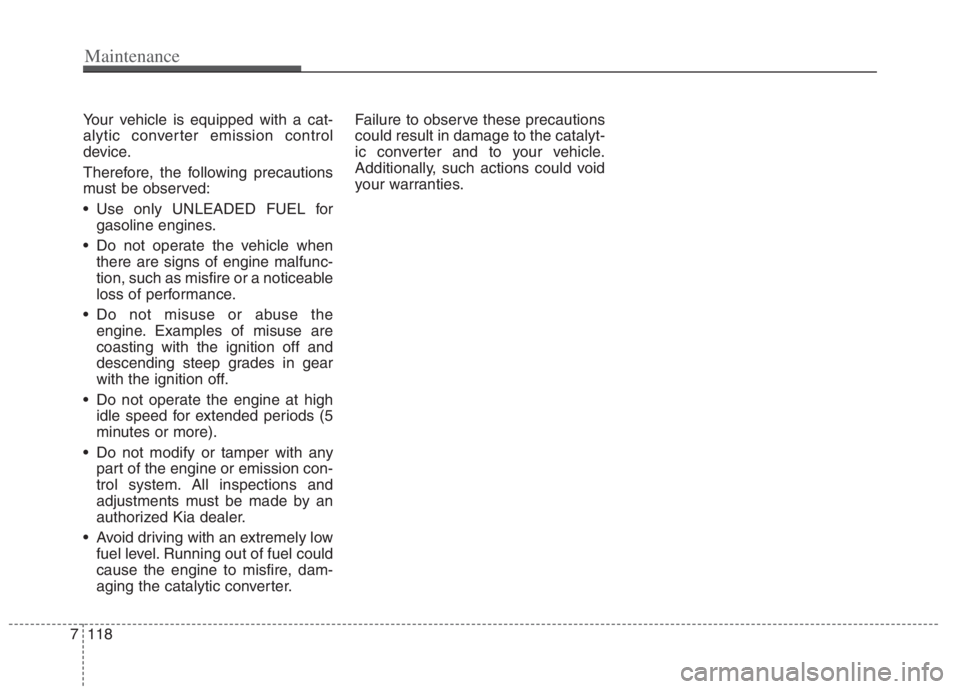
Your vehicle is equipped with a cat-
alytic converter emission control
device.
Therefore, the following precautions
must be observed:
Use only UNLEADED FUEL for
gasoline engines.
Do not operate the vehicle when
there are signs of engine malfunc-
tion, such as misfire or a noticeable
loss of performance.
Do not misuse or abuse the
engine. Examples of misuse are
coasting with the ignition off and
descending steep grades in gear
with the ignition off.
Do not operate the engine at high
idle speed for extended periods (5
minutes or more).
Do not modify or tamper with any
part of the engine or emission con-
trol system. All inspections and
adjustments must be made by an
authorized Kia dealer.
Avoid driving with an extremely low
fuel level. Running out of fuel could
cause the engine to misfire, dam-
aging the catalytic converter.Failure to observe these precautions
could result in damage to the catalyt-
ic converter and to your vehicle.
Additionally, such actions could void
your warranties.
7118
Maintenance
Page 661 of 684
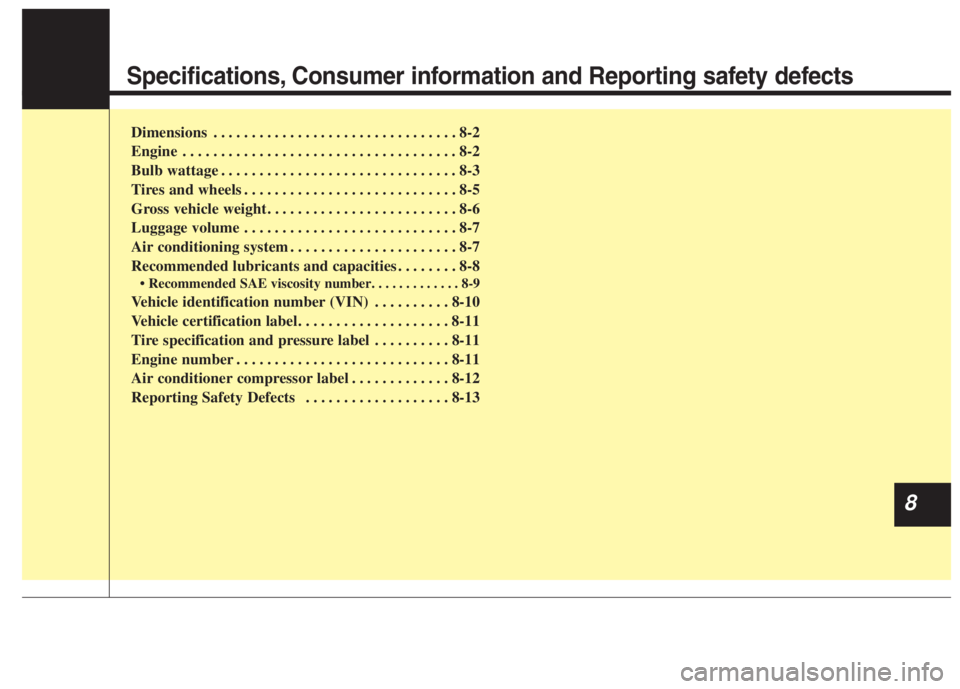
Specifications, Consumer information and Reporting safety defects
Dimensions . . . . . . . . . . . . . . . . . . . . . . . . . . . . . . . . 8-2
Engine . . . . . . . . . . . . . . . . . . . . . . . . . . . . . . . . . . . . 8-2
Bulb wattage . . . . . . . . . . . . . . . . . . . . . . . . . . . . . . . 8-3
Tires and wheels . . . . . . . . . . . . . . . . . . . . . . . . . . . . 8-5
Gross vehicle weight. . . . . . . . . . . . . . . . . . . . . . . . . 8-6
Luggage volume . . . . . . . . . . . . . . . . . . . . . . . . . . . . 8-7
Air conditioning system . . . . . . . . . . . . . . . . . . . . . . 8-7
Recommended lubricants and capacities . . . . . . . . 8-8
• Recommended SAE viscosity number. . . . . . . . . . . . . 8-9
Vehicle identification number (VIN) . . . . . . . . . . 8-10
Vehicle certification label. . . . . . . . . . . . . . . . . . . . 8-11
Tire specification and pressure label . . . . . . . . . . 8-11
Engine number . . . . . . . . . . . . . . . . . . . . . . . . . . . . 8-11
Air conditioner compressor label . . . . . . . . . . . . . 8-12
Reporting Safety Defects . . . . . . . . . . . . . . . . . . . 8-13
8
Page 662 of 684
2 8
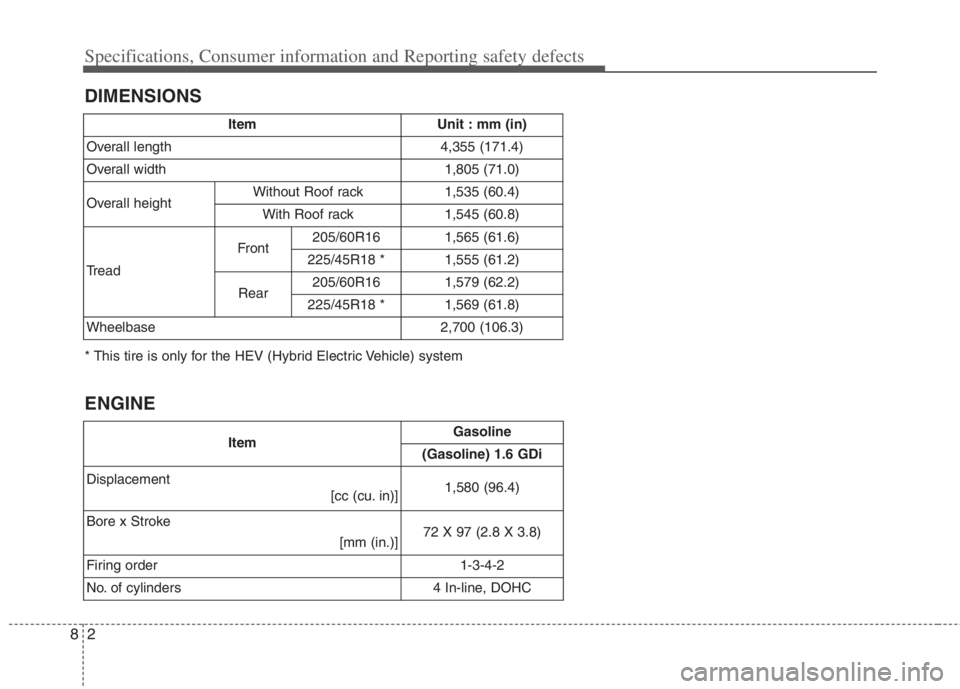
DIMENSIONS Specifications, Consumer information and Reporting safety defects
ENGINE
ItemUnit : mm (in)
Overall length4,355 (171.4)
Overall width1,805 (71.0)
Overall heightWithout Roof rack1,535 (60.4)
With Roof rack1,545 (60.8)
Tread
Front205/60R161,565 (61.6)
225/45R18 *1,555 (61.2)
Rear205/60R161,579 (62.2)
225/45R18 *1,569 (61.8)
Wheelbase2,700 (106.3)
ItemGasoline
(Gasoline) 1.6 GDi
Displacement
[cc (cu. in)]
1,580 (96.4)
Bore x Stroke
[mm (in.)]
72 X 97 (2.8 X 3.8)
Firing order
1-3-4-2
No. of cylinders
4 In-line, DOHC
* This tire is only for the HEV (Hybrid Electric Vehicle) system
Page 668 of 684

88
Specifications, Consumer information and Reporting safety defects
RECOMMENDED LUBRICANTS AND CAPACITIES
To help achieve proper engine and powertrain performance and durability, use only lubricants of the proper quality.
The correct lubricants also help promote engine efficiency that results in improved fuel economy.
These lubricants and fluids are recommended for use in your vehicle.
*1: Refer to the recommended SAE viscosity numbers on the next page.
*2: To maintain your vehicle’s best brake and ABS/ESC performance, use Kia genuine brake fluid as in the specification.
Lubricant VolumeClassification
Engine oil *1
(drain and refill)
3.8 liter (4.01 US qt.)Full synthetic SAE 0W-20, API Latest(ILSAC Latest) or ACEA C5
Dual Clutch Transmission Fluid1.6 ~ 1.7 liter
(1.69 ~ 1.79 US qt.)API GL-4, SAE 70W
HK D DCTF TGO-10 PLUS (SK)
SPIRAX S6 GHDE 70W DCTF PLUS (H.K.SHELL)
Coolant5.98 liter (6.31 US qt.)Mixture of antifreeze and water
(Ethylene glycol base coolant for aluminum radiator)
Inverter coolant2.43 liter (2.56 US qt.)Mixture of antifreeze and water
(Ethylene glycol base coolant for aluminum radiator)
Brake fluid *2402.6 ± 24.4 cc
(0.425 ± 0.025 US qt.)SAE J1704 DOT-4 LV, ISO4925 CLASS-6, FMVSS116 DOT-4
Engine clutch actuator fluid100 ± 20 cc
(0.105 ± 0.021 US qt.)DOT 3 or DOT 4
FuelHEV45 liter (11.9 gal)Refer to Fuel requirements in chapter 1.PHEV43 liter (11.4 gal)
Page 669 of 684

89
Specifications, Consumer information and Reporting safety defects
Recommended SAE viscosity
number
Engine oil viscosity (thickness) has an
effect on fuel economy and cold
weather operating (engine start and
engine oil flowability). Lower viscosity
engine oils can provide better fuel
economy and cold weather perform-
ance; however, higher viscosity
engine oils are required for satisfacto-
ry lubrication in hot weather. Using
oils of any viscosity other than those
recommended could result in engine
damage. When choosing an oil, con-
sider the range of temperature your
vehicle will be operated in before the
next oil change. Proceed to select the
recommended oil viscosity from the
chart.
Temperature Range for SAE Viscosity Numbers
Temperature°C
(°F)-30 -20 -10 0 10 20 30 40 50
-10 0 20 40 60 80 100 120
(Gasoline) 1.6 GDi0W-20
An engine oil displaying this API Certification Mark conforms
to the international Lubricant Specification Advisory
Committee (ILSAC). It is recommended to only use engine oils
that uphold this API Certification Mark.
Page 671 of 684
811
Specifications, Consumer information and Reporting safety defects
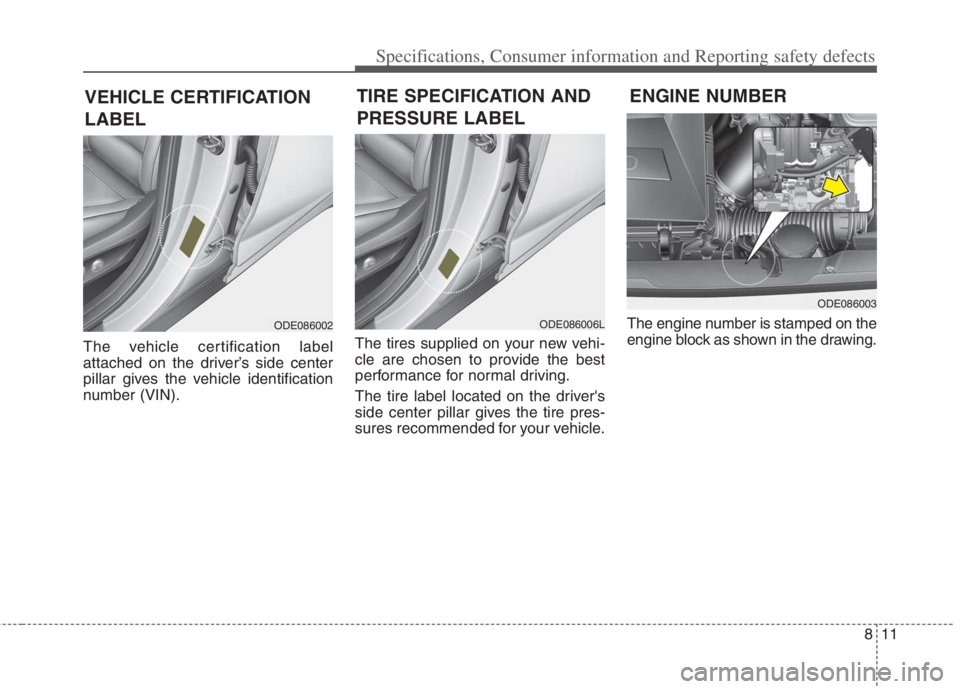
The vehicle certification label
attached on the driver’s side center
pillar gives the vehicle identification
number (VIN).The tires supplied on your new vehi-
cle are chosen to provide the best
performance for normal driving.
The tire label located on the driver's
side center pillar gives the tire pres-
sures recommended for your vehicle.The engine number is stamped on the
engine block as shown in the drawing.
ENGINE NUMBER TIRE SPECIFICATION AND
PRESSURE LABEL
ODE086006L
ODE086003
ODE086002
VEHICLE CERTIFICATION
LABEL