Eps KIA NIRO PHEV 2022 Owner's Manual
[x] Cancel search | Manufacturer: KIA, Model Year: 2022, Model line: NIRO PHEV, Model: KIA NIRO PHEV 2022Pages: 710, PDF Size: 10.35 MB
Page 506 of 710
5183
Driving your vehicle
Hazardous driving conditions
When hazardous driving conditions
are encountered such as water,
snow, ice, mud, sand, or similar haz-
ards, follow these suggestions:
Drive cautiously and allow extradistance for braking.
Avoid sudden braking or steering.
When braking with non-ABS brakes pump the brake pedal with
a light up-and-down motion until
the vehicle is stopped.
Do not pump the brake pedal on a
vehicle equipped with ABS. If stalled in snow, mud, or sand,
use the second gear. Accelerate
slowly to avoid spinning the drive
wheels.
Use sand, rock salt, or other non- slip material under the drive
wheels to provide traction when
stalled in ice, snow, or mud.
Reducing the risk of a rollover
This multi-purpose passenger vehi-
cle is defined as a Sports Utility
Vehicle (SUV). Utility vehicles have a
significantly higher rollover rate than
other types of vehicles. SUV's have
higher ground clearance and a nar-
rower track to make them capable of
performing in a wide variety of off-
road applications. Specific design
characteristics give them a higher
center of gravity than ordinary vehi-
cles. An advantage of the higher
ground clearance is a better view of
the road, which allows you to antici-
pate problems. They are not
designed for cornering at the same
speeds as conventional passenger
vehicles, any more than low-slung
sports vehicles are designed to per-
form satisfactorily in off-road condi-
tions. Due to this risk, driver and pas-
sengers are strongly recommended
to buckle their seat belts. In a rollover
crash, an unbelted person is signifi-
cantly more likely to die than a per-
son wearing a seat belt. There are
steps that a driver can make to
reduce the risk of a rollover.
SPECIAL DRIVING CONDITIONS
WARNING- Downshifting
Do not downshift with a dual
clutch transmission while driv-
ing on slippery surfaces. The
sudden change in tire speed
could cause the tires to skid
and result in an accident.
Page 516 of 710
5193
Driving your vehicle
Towing capacity:
We do not recommend using this
vehicle for trailer towing.
Cargo capacity:
The cargo capacity of your vehicle
will increase or decrease depending
on the weight and the number of
occupants.
Steps for Determining CorrectLoad Limit -
(1) Locate the statement "The com- bined weight of occupants and
cargo should never exceed XXX
kg or XXX lbs.'' on your vehicle's
placard.
(2) Determine the combined weight of the driver and passengers that
will be riding in your vehicle.
(3) Subtract the combined weight of the driver and passengers from
XXX kg or XXX lbs.
(4) The resulting figure equals the available amount of cargo and
luggage load capacity. For exam-
ple, if the "XXX" amount equals
1400 lbs. and there will be five
150 lb passengers in your vehi-
cle, the amount of available cargo
and luggage load capacity is 650
lbs.
(1400-750 (5 x 150) = 650 lbs.) (5) Determine the combined weight
of luggage and cargo being
loaded on the vehicle. That
weight may not safely exceed the
available cargo and luggage load
capacity calculated in Step 4.
(6) If your vehicle will be towing a trailer, load from your trailer will
be transferred to your vehicle.
Consult this manual to determine
how this reduces the available
cargo and luggage load capacity
of your vehicle.
WARNING - Loose cargo
Do not travel with unsecured
objects in the passenger com-
partment of your vehicle (e.g.
suit cases or unsecured child
seats). These items may strike
an occupant during a sudden
stop or crash.
Page 552 of 710

633
What to do in an emergency
Using the Tire Mobility Kit
Carefully follow below steps.
1. Shake the sealant bottle.
ODEP061006L
ODEP067048
WARNING
Before using the Tire Mobility
Kit, follow the instructions on
the sealant bottle.
Remove the label with the
speed restriction from the
sealant bottle and apply it to the
steering wheel.
Please note the expiration date
on the sealant bottle.
CAUTION
Before using the tire repair kit,please read carefully theinstruction attached on thesealant bottle. Detach the speedlimit label on the sealant caseand put it on a highly visibleplace. Always drive within thespeed limit.
Page 568 of 710
75
Maintenance
MAINTENANCE SERVICES
You should exercise the utmost care
to prevent damage to your vehicle
and injury to yourself whenever per-
forming any maintenance or inspec-
tion procedures.
Should you have any doubts con-
cerning the inspection or servicing of
your vehicle, we strongly recom-
mend that you have an authorized
Kia dealer perform this work.
An authorized Kia dealer has factory-
trained technicians and genuine Kia
parts to service your vehicle proper-
ly. For expert advice and quality serv-
ice, see an authorized Kia dealer.
Inadequate, incomplete or insuffi-
cient servicing may result in opera-
tional problems with your vehicle that
could lead to vehicle damage, an
accident, or personal injury.Owner’s responsibility
✽ ✽NOTICE
Maintenance Service and Record
Retention are the owner's responsi-
bility.
You should retain documents that
show proper maintenance has been
performed on your vehicle in accor-
dance with the scheduled mainte-
nance service charts shown on the
following pages. You need this infor-
mation to establish your compliance
with the servicing and maintenance
requirements of your vehicle war-
ranties.
Detailed warranty information is
provided in your Warranty &
Consumer Information manual.
Repairs and adjustments required as
a result of improper maintenance or
a lack of required maintenance are
not covered.
We recommend you have your vehi-
cle maintained and repaired by an
authorized Kia dealer. An authorized
Kia dealer meets Kia’s high service
quality standards and receives tech-
nical support from Kia in order to pro-
vide you with a high level of service
satisfaction.
✽ ✽NOTICE - NHTSA Safety
Corrosion Alert
The National Highway Traffic
Safety Administration (NHTSA) has
issued a general warning to all vehi-
cle owners of all brands regarding
the risks associated with vehicle
underbody corrosion. From your
initial purchase, take the following
steps to prevent unsafe corrosion
damage to your vehicle:
(Continued)
Page 569 of 710
Maintenance
67
(Continued)
• Wash the undercarriage of yourvehicle regularly during the win-
ter and whenever your vehicle has
been exposed to such salts or
chemicals.
• Do a thorough washing of the undercarriage at the end of the
winter.
• Use professional service techni- cians or governmental inspection
stations to annually inspect for
corrosion.
• Immediately seek an inspection of your vehicle if you become visual-
ly aware of corrosion flaking or
scaling or if you become aware of
a change in vehicle performance,
such as soft or spongy brakes, flu-
ids leaking, impairment of direc-
tional control, suspension noises
or rattling metal straps.
NHTSA further advises that after
a vehicle is 7 years old, it is essen-
tial that you take these indicated
maintenance steps to ensure that
you protect yourself from unsafe
corrosion conditions.Owner maintenance precau-
tions
Improper or incomplete service may
result in problems. This section gives
instructions only for the maintenance
items that are easy to perform.
As explained earlier in this section,
several procedures can be done only
by an authorized Kia dealer with spe-
cial tools.
✽ ✽ NOTICE
Improper owner maintenance dur-
ing the warranty period may affect
warranty coverage. For details, read
the separate Warranty & Consumer
Information manual provided with
the vehicle. If you're unsure about
any servicing or maintenance proce-
dure, have it done by an authorized
Kia dealer.
WARNING- Maintenance
work
Do not wear jewelry or loose
clothing while working under
the hood of your vehicle with
the engine running. These can
become entangled in moving
parts, if you must run the
engine while working under the
hood, make certain that you
remove all jewelry (especially
rings, bracelets, watches, and
necklaces) and all neckties,
scarves, and similar loose
clothing before getting near the
engine or cooling fans.
WARNING- Touching metal parts
Do not touch metal parts
(including strut bars) while the
engine is operating or hot.
Doing so could result in serious
bodily injury. Turn the engine off
and wait until the metal parts
cool down to perform any main-
tenance work on the vehicle.
Page 580 of 710

717
Maintenance
✽ ✽NOTICE - NHTSA Safety
Corrosion Alert
NHTSA has warned all vehicle own-
ers of all brands that they must main-
tain their vehicles in a manner which
will prevent brake hose and brake line
failures due to corrosion when such
vehicles are exposed to winter road
salt and related chemicals. While seri-
ous corrosion conditions typically only
manifest themselves as safety issues
after 7 years of vehicle use, the corro-
sion process starts immediately and
thus underbody cleaning maintenance
must commence from your vehicle's
first exposure to road salts and chem-
icals. NHTSA urges vehicle owners to
take the following steps to prevent
corrosion:
(Continued)(Continued)
1. Wash the undercarriage of your
vehicle regularly throughout the
winter and do a thorough washing
in the spring to remove road salt
and other de-icing chemicals.
2. Monitor the brake system for signs of corrosion by having regu-
lar professional inspections and
watching for signs of problems,
including loss of brake fluid,
unusual leaks and soft or spongy
feel in the brake pedal.
3. Replace the entire brake pipe assembly if you find severe corro-
sion that causes scaling or flaking
of brake components.
Brake fluid
Check the brake fluid level in the
brake fluid reservoir. The level should
be between “MIN” and “MAX” marks
on the side of the reservoir. Use only
hydraulic brake fluid conforming to
DOT 4 specification.
Parking brake
Inspect the parking brake system
including the parking brake pedal
and cables.
Brake discs, pads and calipers
Check the pads for excessive wear,
discs for run out and wear, and
calipers for fluid leakage.
Page 626 of 710

763
Maintenance
3. Check the removed fuse; replace itif it is blown. To remove or insert
the fuse, use the fuse puller in the
engine compartment fuse panel.
4. Push in a new fuse of the same rating, and make sure it fits tightly
in the clips. If it fits loosely, consult
an authorized Kia dealer.Multi fuse
If the multi fuse is blown, it must be
removed as follows:
1. Turn off the engine.
2. Disconnect the negative batterycable.
3. Remove the nuts shown in the pic- ture above.
4. Replace the fuse with a new one of the same rating.
5. Reverse these steps to reinstall the multi fuse.
✽ ✽NOTICE
Do not disassemble nor assemble the
multi fuse when it is secured with
nuts and bolts. Incorrect or partial
assembly torque may cause a fire.
Have the vehicle checked by an
authorized Kia dealer.
ODEP079022
CAUTION
After checking the fuse panel in
the engine compartment,securely install the fuse panelcover to protect against anyelectrical failure which mayoccur from water contact. Listenfor the audible clicking sound toensure the fuse panel cover issecurely fastened.
Page 627 of 710
Maintenance
64
7
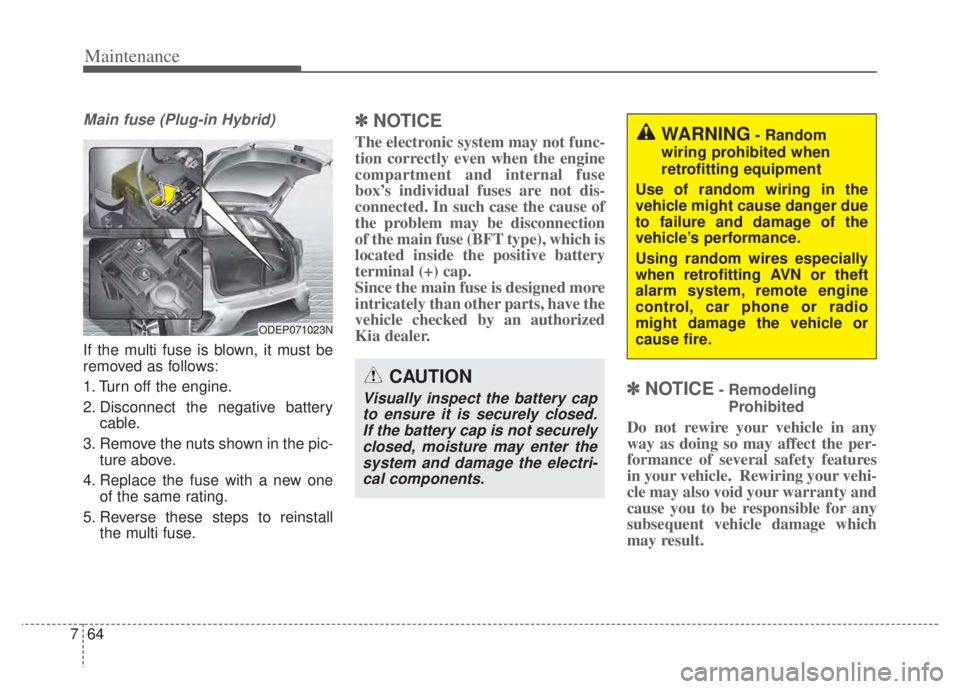
Main fuse (Plug-in Hybrid)
If the multi fuse is blown, it must be
removed as follows:
1. Turn off the engine.
2. Disconnect the negative battery
cable.
3. Remove the nuts shown in the pic- ture above.
4. Replace the fuse with a new one of the same rating.
5. Reverse these steps to reinstall the multi fuse.
✽ ✽NOTICE
The electronic system may not func-
tion correctly even when the engine
compartment and internal fuse
box’s individual fuses are not dis-
connected. In such case the cause of
the problem may be disconnection
of the main fuse (BFT type), which is
located inside the positive battery
terminal (+) cap.
Since the main fuse is designed more
intricately than other parts, have the
vehicle checked by an authorized
Kia dealer.
✽ ✽NOTICE- Remodeling
Prohibited
Do not rewire your vehicle in any
way as doing so may affect the per-
formance of several safety features
in your vehicle. Rewiring your vehi-
cle may also void your warranty and
cause you to be responsible for any
subsequent vehicle damage which
may result.
CAUTION
Visually inspect the battery capto ensure it is securely closed.If the battery cap is not securelyclosed, moisture may enter thesystem and damage the electri-cal components.
WARNING- Random
wiring prohibited when
retrofitting equipment
Use of random wiring in the
vehicle might cause danger due
to failure and damage of the
vehicle’s performance.
Using random wires especially
when retrofitting AVN or theft
alarm system, remote engine
control, car phone or radio
might damage the vehicle or
cause fire.
ODEP071023N
Page 671 of 710

Maintenance
108
7
Bright-metal maintenance
To remove road tar and insects,
use a tar remover, not a scraper or
other sharp object.
To protect the surfaces of bright- metal parts from corrosion, apply a
coating of wax or chrome preser-
vative and rub to a high luster.
During winter weather or in coastal areas, cover the bright metal parts
with a heavier coating of wax or
preservative. If necessary, coat the
parts with non-corrosive petroleum
jelly or other protective compound.
Underbody maintenance
Road salt and other corrosive chemi-
cals are used in cold weather states to
melt snow and prevent ice accumula-
tion. If these chemicals are not regu-
larly removed, they will corrode the
vehicle underbody and over time dam-
age fuel lines, the fuel tank retention
system, the vehicle suspension, the
exhaust system, and even the body
frame. The National Highway Traffic
Safety Administration has warned all
vehicle owners of all brands of the
need to take the following steps:
Wash the undercarriage of yourvehicle regularly during the winter
and whenever your vehicle has
been exposed to such salts or
chemicals.
Do a thorough washing of the undercarriage at the end of the
winter.
Use professional service techni- cians or governmental inspection
stations to annually inspect for cor-
rosion. Immediately seek an inspection of
your vehicle if you become visually
aware of corrosion flaking or scal-
ing or if you become aware of a
change in vehicle performance,
such as soft or spongey brakes,
fluids leaking, impairment of direc-
tional control, suspension noises
or rattling metal straps.
Page 708 of 710
Index
10I
Steering wheel . . . . . . . . . . . . . . . . . . . . . . . . . . . . . . . 4-49Electric Power Steering (EPS) . . . . . . . . . . . . . . . . . 4-49
Heated steering wheel . . . . . . . . . . . . . . . . . . . . . . . 4-51
Horn . . . . . . . . . . . . . . . . . . . . . . . . . . . . . . . . . . . . \
. 4-52
Tilt and telescopic steering . . . . . . . . . . . . . . . . . . . 4-50
Storage compartments . . . . . . . . . . . . . . . . . . . . . . . . 4-161 Center console storage . . . . . . . . . . . . . . . . . . . . . 4-161
Glove box . . . . . . . . . . . . . . . . . . . . . . . . . . . . . . . . 4-161
Luggage box . . . . . . . . . . . . . . . . . . . . . . . . . . . . . . 4-163
Sunglass holder . . . . . . . . . . . . . . . . . . . . . . . . . . . 4-162
Sunroof . . . . . . . . . . . . . . . . . . . . . . . . . . . . . . . . . . . . \
. 4-44 Automatic reversal . . . . . . . . . . . . . . . . . . . . . . . . . . 4-46
Resetting the sunroof . . . . . . . . . . . . . . . . . . . . . . . . 4-47
Slide open/close . . . . . . . . . . . . . . . . . . . . . . . . . . . . 4-46
Sunroof open warning . . . . . . . . . . . . . . . . . . . . . . . 4-48
Sunshade. . . . . . . . . . . . . . . . . . . . . . . . . . . . . . . . . . 4-44\
Tilt open/close . . . . . . . . . . . . . . . . . . . . . . . . . . . . . 4-45
Theft-alarm system . . . . . . . . . . . . . . . . . . . . . . . . . . . . 4-19 Armed stage . . . . . . . . . . . . . . . . . . . . . . . . . . . . . . . 4-19
Disarmed stage . . . . . . . . . . . . . . . . . . . . . . . . . . . . . 4-21
Theft-alarm stage . . . . . . . . . . . . . . . . . . . . . . . . . . . 4-20
Tire Pressure Monitoring System (TPMS) . . . . . . . . . . 6-13 Changing a tire with TPMS . . . . . . . . . . . . . . . . . . . 6-17
Check tire pressure . . . . . . . . . . . . . . . . . . . . . . . . . . 6-13
Low tire pressure position telltale . . . . . . . . . . . . . . 6-15 Low tire pressure telltale . . . . . . . . . . . . . . . . . . . . . 6-15
Tire specification and pressure label . . . . . . . . . . . . . . 8-11
Tires and wheels . . . . . . . . . . . . . . . . . . . . . . . . . . 7-43, 8-5 All season tires . . . . . . . . . . . . . . . . . . . . . . . . . . . . 7-55
Checking tire inflation pressure . . . . . . . . . . . . . . . . 7-44
Low aspect ratio tire. . . . . . . . . . . . . . . . . . . . . . . . . 7-57
Radial-ply tires . . . . . . . . . . . . . . . . . . . . . . . . . . . . . 7-56
Recommended cold tire inflation pressures . . . . . . . 7-43
Snow tires . . . . . . . . . . . . . . . . . . . . . . . . . . . . . . . . . 7-56
Summer tires . . . . . . . . . . . . . . . . . . . . . . . . . . . . . . 7-55
Tire care . . . . . . . . . . . . . . . . . . . . . . . . . . . . . . . . . . 7-43\
Tire chains . . . . . . . . . . . . . . . . . . . . . . . . . . . . . . . . 7-56
Tire maintenance . . . . . . . . . . . . . . . . . . . . . . . . . . . 7-48
Tire pressure . . . . . . . . . . . . . . . . . . . . . . . . . . . . . . . 7-44
Tire replacement . . . . . . . . . . . . . . . . . . . . . . . . . . . . 7-47
Tire rotation . . . . . . . . . . . . . . . . . . . . . . . . . . . . . . . 7-45
Tire sidewall labeling . . . . . . . . . . . . . . . . . . . . . . . . 7-48
Tire terminology and definitions . . . . . . . . . . . . . . . 7-52
Tire traction . . . . . . . . . . . . . . . . . . . . . . . . . . . . . . . 7-48
Wheel alignment and tire balance . . . . . . . . . . . . . . 7-46
Wheel replacement . . . . . . . . . . . . . . . . . . . . . . . . . . 7-47
Towing . . . . . . . . . . . . . . . . . . . . . . . . . . . . . . . . . . . . \
. 6-39 Emergency towing . . . . . . . . . . . . . . . . . . . . . . . . . . 6-41
Removable towing hook. . . . . . . . . . . . . . . . . . . . . . 6-40
Towing service . . . . . . . . . . . . . . . . . . . . . . . . . . . . . 6-39
Trailer Towing. . . . . . . . . . . . . . . . . . . . . . . . . . . . . . . 5-191
T