ignition KIA Opirus 2008 1.G Owner's Guide
[x] Cancel search | Manufacturer: KIA, Model Year: 2008, Model line: Opirus, Model: KIA Opirus 2008 1.GPages: 283, PDF Size: 20.47 MB
Page 65 of 283
355
Knowing your vehicle
Air bag system components
• The SRS air bag consists of the fol-lowing components;
1. Driver's air bag module
2. Passenger's air bag module
3. Side air bag module
4. Curtain air bag module
5. Front impact sensors
6. Side impact sensors
7. SRS air bag control module
8. Driver's seat position sensor
9. Occupant Classification System (Front passenger's seat only)
10. "PASSENGER AIR BAG OFF" indicator (Front passenger's seat
only)
11. Driver's and front passenger's safety belt buckle sensors
12. Retractor Pre-tensioner Assemblies
13. SRS "AIR BAG" warning light
• A diagnostic system that continually monitors the system operation.
• An indicator light to warn you of a pos- sible problem with the system.
• Emergency power backup in case your car’s electrical system is disconnected
in a crash. The SRS uses a collection of sensors to
gather information about the driver’s seat
position, the driver’s and front passen-
ger’s safety belt usage and impact sever-
ity.
The driver’s seat position sensor, which
is installed on the seat track, determines
if the seat is fore or aft of a reference
position. Similarly, the safety belt usage
sensors determine if the driver and front
passenger’s safety belts are fastened.
These sensors provide the ability to con-
trol the SRS deployment based on how
close the driver’s seat is to the steering
wheel, how close the passenger’s seat is
to the instrument panel, whether or not
the safety belts are fastened, and the
severity of the impact.
(Continued)
• If your vehicle has been subject-
ed to flood conditions (e.g.
soaked carpeting/standing water
on the floor of the vehicle, etc.) or
if your vehicle has become flood
damaged in any way, do not
attempt to start the vehicle or put
the key in the ignition before di s-
connecting the battery.
Disregarding thi s precaution may
cause air bag deployment, which
could result in serious per sonal
injury or death. If your vehicle i s
subjected to flooded condition s,
before starting the vehicle, have
the vehicle towed to an author-
ized Kia dealer for in spection and
necessary repair s.
Page 66 of 283
Knowing your vehicle
563
The advanced SRS offers the ability to
control the air bag inflation with two lev-
els. A first stage level is provided for
moderate-severity impacts. A second
stage level is provided for more severe
impacts.
According to the impact severity, seating
position (only driver) and safety belt
usage, the SRSCM (SRS Control
Module) controls the air bag inflation.
Failure to properly wear safety belts
can increase the risk or severity of
injury in an accident.
Additionally, your SRS is equipped with
an occupant classification system in the
front passenger’s seat. The occupant
classification system detects the pres-
ence of a passenger in the front passen-
ger’s seat and will turn off the front pas-
senger’s air bag under certain conditions.
For more detail, see “Occupant
Classification System” later in this sec-
tion.
CAUTION
If the seat position sensor is not
working properly, the SRS air bag warning light ( ) on the in stru-
ment panel will illuminate even if there is no malfunction of the SRSair bag system, because the SRS airbag warning light i s connected with
the seat position sensor. If the SRS
air bag warning light doe s not illu-
minate when the ignition key is turned to the "ON" po sition, if it
remains illuminated after blinking for approximately 6 seconds, or if it
illuminates while the vehicle is
being driven, have an authorized Kia dealer inspect the seat position sensor and the advanced SRS airbag system as soon as possible.
AIR
BAG
WARNING
• Modification to the seat structure
can adver sely affect the s eat
position sensor and cause the air
bag to deploy at a different level
than should be provided.
• Failure to properly wear safety
belts can increas e the risk or
severity of injury by causing the
air bags to deploy at a different
level than should be provided.
• Do not place any object s under-
neath the driver’ s seats which
could damage the seat position
sensor.
• Do not place any object s that may
cause magnetic fields near the
front seat. These may cause a
malfunction of the seat position
sensor.
Page 69 of 283
359
Knowing your vehicle
If there is no passenger in the front pas-
senger seat or if the passenger in the
front passenger's seat is very small,
(such as a child), the front PASSENGER
AIR BAG OFF indicator may go ON.
When this indicator is ON, the front pas-
senger's air bag will not deploy.
The front passenger’s side air bag will
not deploy if the front seat is unoccupied.
The front passenger’s side air bag may
deploy if the front seat is occupied by a
small occupant.Always be sure that you and all vehicle
occupants are seated and restrained
properly (sitting upright with the seat in
an upright position, centered on the seat
cushion, with the person's legs comfort-
ably extended, feet on the floor, and
wearing the safety belt properly) for the
most effective protection by the air bag
and the safety belt.
• The OCS may not function properly if
the passenger takes actions which can
defeat the detection system. These
include:
(1) Failing to sit in an upright position.
(2) Leaning against the door or center console.
(3) Sitting towards the sides or the front of the seat.
(4) Putting legs on the dashboard or rest- ing them on other locations which
reduce the passenger weight on the
front seat.
(5) Improperly wearing the safety belt.
(6) Reclining the seat back. • The "PASSENGER AIR BAG OFF"
indicator illuminates after the ignition
key is turned to the "ON" position or
after the engine is started. If the front
passenger seat is unoccupied or is
occupied by very small person, or is
occupied by someone who is improp-
erly seated, the "PASSENGER AIR
BAG OFF" indicator will remain illumi-
nated. If the front passenger seat is
occupied by someone of adult size and
body shape, the "PASSENGER AIR
BAG OFF" indicator will turn off after 6
seconds.
• If the "PASSENGER AIR BAG OFF" indicator illuminates, the front passen-
ger's air bag will not deploy.
The front passenger’s side air bag will
not deploy if the front seat is unoccu-
pied.
The front passenger’s side air bag may
deploy if the front seat is occupied by a
small occupant.
• If the "PASSENGER AIR BAG OFF" indicator is not illuminated, the front
passenger front air bag and front pas-
senger side air bag may deploy in
either a side or frontal collision.
OGH036367N
The location of OCS warning indicator
Page 81 of 283
371
Knowing your vehicle
How does the air bag system
operate
• Air bag only operates when the ignition
switch is turned to the ON or START
positions.
• Air bags inflate instantly in the event of serious frontal or side collision (if
equipped with side air bag or curtain
air bag) in order to help protect the
occupants from serious physical injury.
• There is no single speed at which the air bags will inflate.
Generally, air bags are designed to
inflate by the severity of a collision and
its direction. These two factors deter-
mine whether the sensors send out an
electronic deployment/inflation signal. • Air bag deployment depends on a
number of factors including vehicle
speed, angles of impact and the densi-
ty and stiffness of the vehicles or
objects which your vehicle hits in the
collision. However, factors are not limit-
ed to those mentioned above.
• The front air bags will completely inflate and deflate in an instant.
It is virtually impossible for you to see
the air bags inflate during an accident.
It is much more likely that you will sim-
ply see the deflated air bags hanging
out of their storage compartments after
the collision. • In order to help provide protection in a
severe collision, the air bags must
inflate rapidly. The speed of air bag
inflation is a consequence of the
extremely short time in which a collision
occurs and the need to get the air bag
between the occupant and the vehicle
structures before the occupant impacts
those structures. This speed of inflation
reduces the risk of serious or life-
threatening injuries in a severe collision
and is thus a necessary part of air bag
design.
However, air bag inflation can also
cause injuries which normally can
include facial abrasions, bruises and
broken bones, and sometimes more
serious injuries because that inflation
speed also causes the air bags to
expand with a great deal force.
• There are even circums tances
under which contact with the steer-
ing wheel air bag can cause fatal
injuries,e specially if the occupant
is positioned excessively close to
the steering wheel.
Page 83 of 283
373
Knowing your vehicle
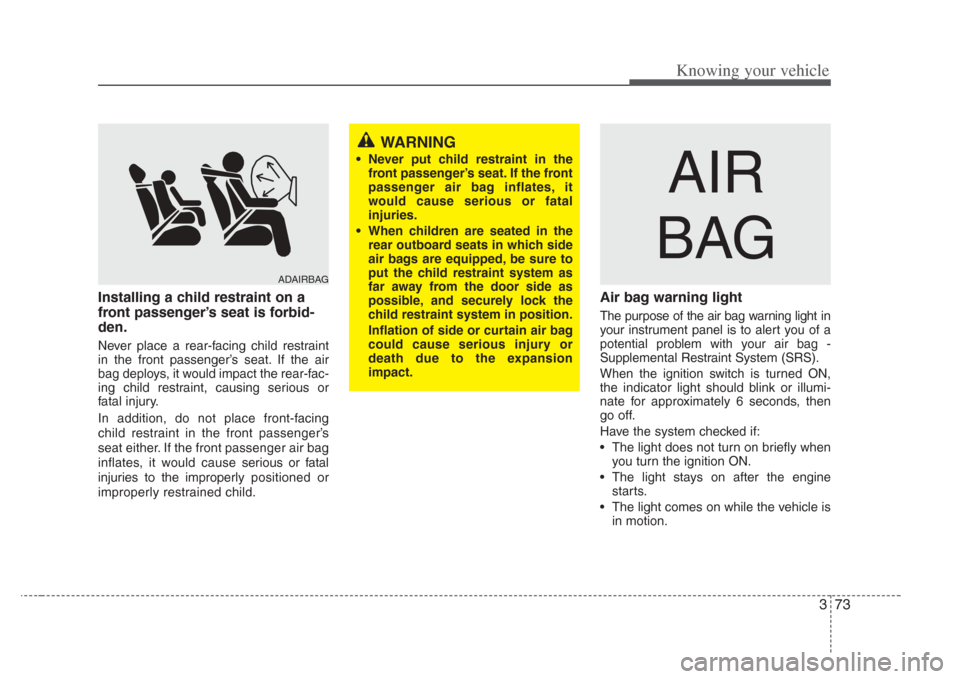
Installing a child restraint on a
front passenger’ s seat is forbid-
den.
Never place a rear-facing child restraint
in the front passenger’s seat. If the air
bag deploys, it would impact the rear-fac-
ing child restraint, causing serious or
fatal injury.
In addition, do not place front-facing
child restraint in the front passenger’s
seat either. If the front passenger air bag
inflates, it would cause ser ious or fatal
injuries to the improperly positioned or
improperly restrained child.
Air bag warning light
The purpose of the air bag warning light in
your instrument panel is to alert you of a
potential problem with your air bag -
Supplemental Restraint System (SRS).
When the ignition switch is turned ON,
the indicator light should blink or illumi-
nate for approximately 6 seconds, then
go off.
Have the system checked if:
• The light does not turn on briefly when you turn the ignition ON.
• The light stays on after the engine starts.
• The light comes on while the vehicle is in motion.
ADAIRBAG
AIR
BAG
WARNING
• Never put child restraint in the front passenger’ s seat. If the front
passenger air bag inflates ,it
would caus e serious or fatal
injuries.
• When children are seated in the rear outboard seats in which side
air bags are equipped, be sure to
put the child restraint system as
far away from the door side as
possible, and securely lock the
child restraint system in position.
Inflation of side or curtain air bag
could caus e serious injury or
death due to the expans ion
impact.
Page 98 of 283
Knowing your vehicle
883
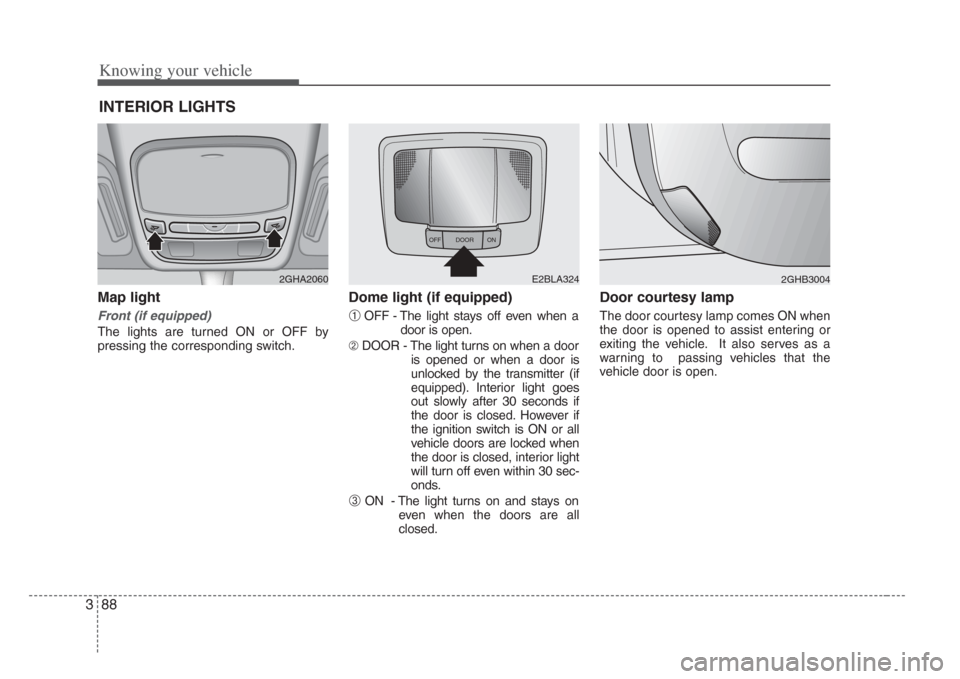
Map light
Front (if equipped)
The lights are turned ON or OFF by
pressing the corresponding switch.
Dome light (if equipped)
➀OFF - The light stays off even when adoor is open.
➁ DOOR - The light turns on when a door
is opened or when a door is
unlocked by the transmitter (if
equipped). Interior light goes
out slowly after 30 seconds if
the door is closed. However if
the ignition switch is ON or all
vehicle doors are locked when
the door is closed, interior light
will turn off even within 30 sec-
onds.
➂ ON - The light turns on and stays oneven when the doors are all
closed.
Door courtesy lamp
The door courtesy lamp comes ON when
the door is opened to assist entering or
exiting the vehicle. It also serves as a
warning to passing vehicles that the
vehicle door is open.
INTERIOR LIGHTS
2GHA2060
OFF DOORON
E2BLA3242GHB3004
Page 101 of 283
391
Knowing your vehicle
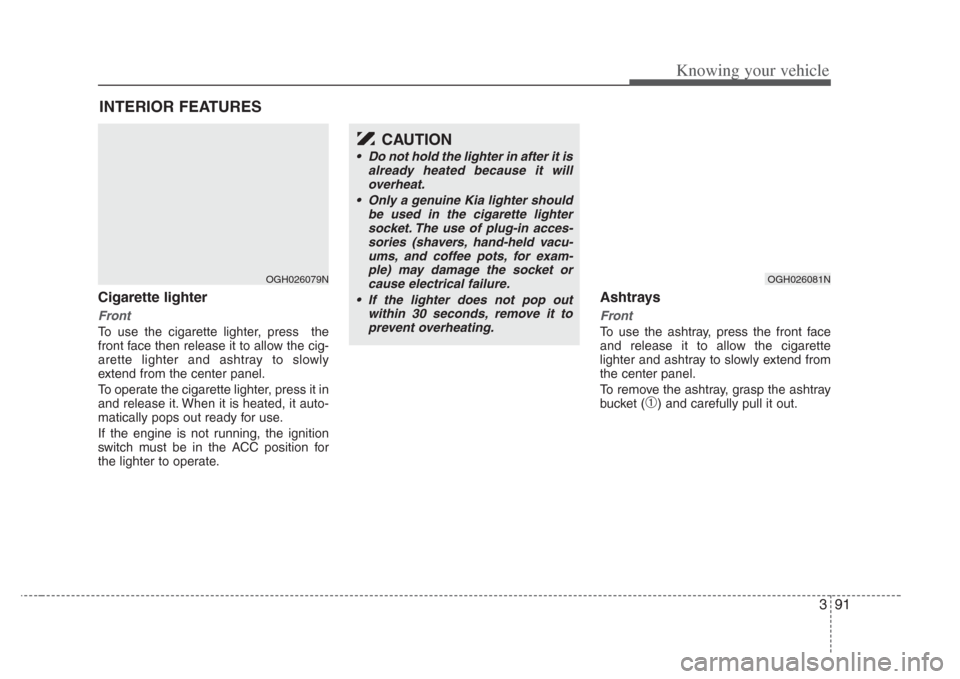
Cigarette lighter
Front
To use the cigarette lighter, press the
front face then release it to allow the cig-
arette lighter and ashtray to slowly
extend from the center panel.
To operate the cigarette lighter, press it in
and release it. When it is heated, it auto-
matically pops out ready for use.
If the engine is not running, the ignition
switch must be in the ACC position for
the lighter to operate.
Ashtrays
Front
To use the ashtray, press the front face
and release it to allow the cigarette
lighter and ashtray to slowly extend from
the center panel.
To remove the ashtray, grasp the ashtray
bucket (
➀) and carefully pull it out.
INTERIOR FEATURES
OGH026079NOGH026081N
CAUTION
• Do not hold the lighter in after it is
already heated becaus e it will
overheat.
• Only a genuine Kia lighter should
be used in the cigarette lighter socket. The use of plug-in acce s-
sories ( shavers, hand-held vacu-
ums, and coffee pot s, for exam-
ple) may damage the socket or
cause electrical failure.
• If the lighter does not pop out within 30 seconds, remove it toprevent overheating.
Page 105 of 283
395
Knowing your vehicle
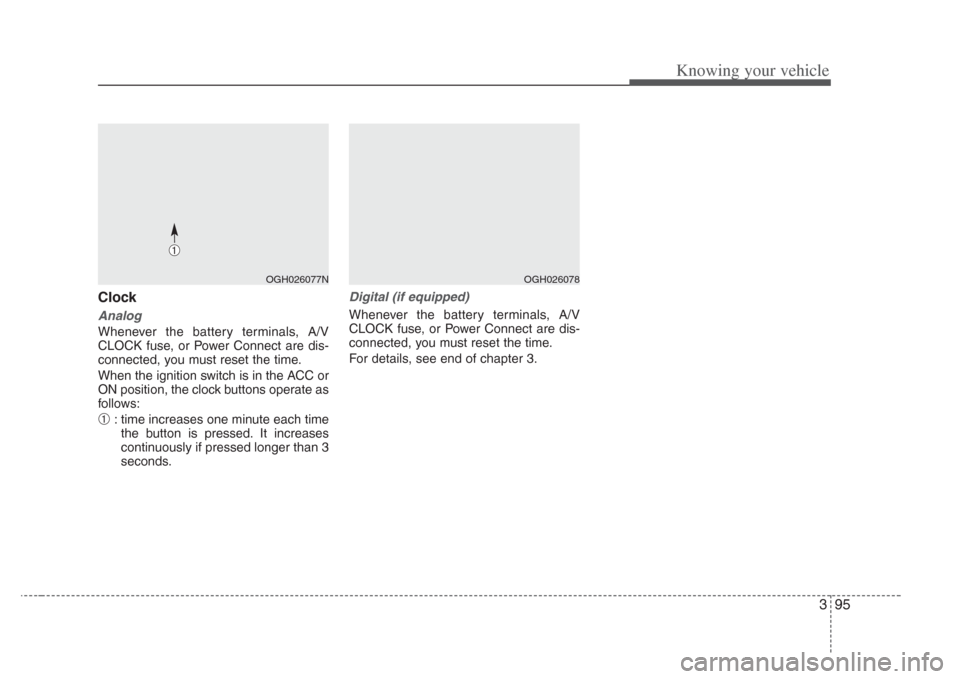
Clock
Analog
Whenever the battery terminals, A/V
CLOCK fuse, or Power Connect are dis-
connected, you must reset the time.
When the ignition switch is in the ACC or
ON position, the clock buttons operate as
follows:
➀: time increases one minute each timethe button is pressed. It increases
continuously if pressed longer than 3
seconds.
Digital (if equipped)
Whenever the battery terminals, A/V
CLOCK fuse, or Power Connect are dis-
connected, you must reset the time.
For details, see end of chapter 3.
OGH026078OGH026077N
➀
Page 106 of 283
Knowing your vehicle
963
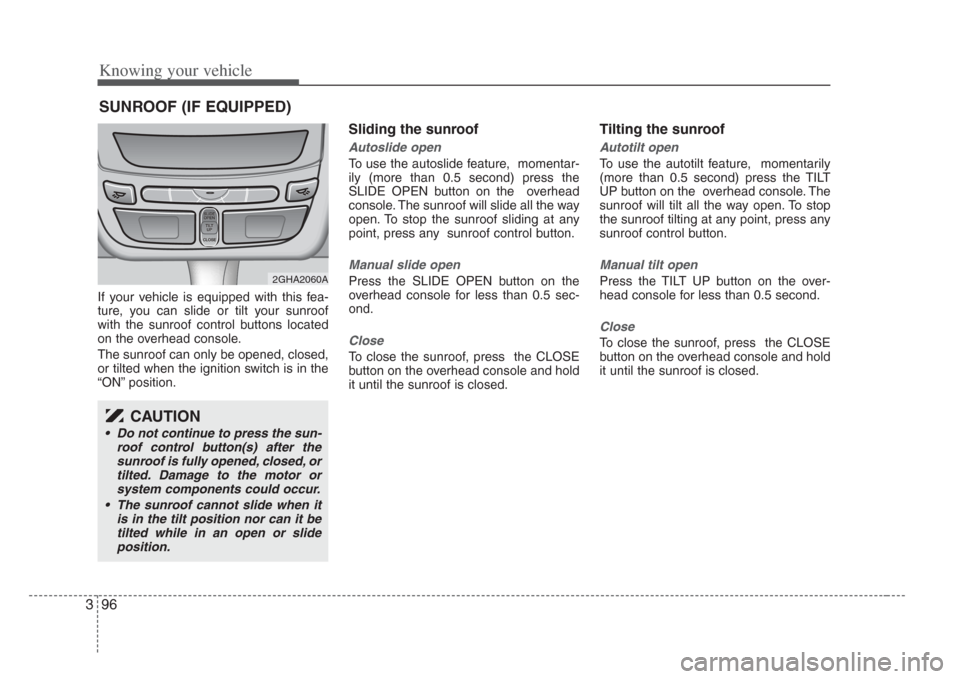
If your vehicle is equipped with this fea-
ture, you can slide or tilt your sunroof
with the sunroof control buttons located
on the overhead console.
The sunroof can only be opened, closed,
or tilted when the ignition switch is in the
“ON” position.
Sliding the sunroof
Autoslide open
To use the autoslide feature, momentar-
ily (more than 0.5 second) press the
SLIDE OPEN button on the overhead
console. The sunroof will slide all the way
open. To stop the sunroof sliding at any
point, press any sunroof control button.
Manual slide open
Press the SLIDE OPEN button on the
overhead console for less than 0.5 sec-
ond.
Close
To close the sunroof, press the CLOSE
button on the overhead console and hold
it until the sunroof is closed.
Tilting the sunroof
Autotilt open
To use the autotilt feature, momentarily
(more than 0.5 second) press the TILT
UP button on the overhead console. The
sunroof will tilt all the way open. To stop
the sunroof tilting at any point, press any
sunroof control button.
Manual tilt open
Press the TILT UP button on the over-
head console for less than 0.5 second.
Close
To close the sunroof, press the CLOSE
button on the overhead console and hold
it until the sunroof is closed.
SUNROOF (IF EQUIPPED)
SLIDESLIDEOPENOPENTILT
UPUPCLOSECLOSE
SLIDESLIDEOPENOPENTILT
UPUPCLOSECLOSE
2GHA2060A
CAUTION
• Do not continue to pre ss the sun-
roof control button(s) after the sunroof is fully opened, clo sed, or
tilted. Damage to the motor or system components could occur.
• The sunroof cannot slide when it
is in the tilt position nor can it be tilted while in an open or slide
position.
Page 108 of 283
Knowing your vehicle
983
Resetting the sunroof
Whenever the vehicle battery is discon-
nected or discharged, or you use the
emergency handle to operate the sun-
roof, you have to reset your sunroof sys-
tem as follows:
1. Turn the ignition key to the ON posi-tion.
2. According to the position of the sun- roof, do as follows.
1) in case that the sunroof has closedcompletely or been tilted
: Press the TILT UP button for 1 second.
2) in case that the sunroof has slide- opened
: Press and hold the CLOSE button for more than 5 seconds until the
sunroof has closed completely.
And then press the TILT UP but-
ton for 1 second
3. Then, release it.
4. Press and hold the TILT UP button once again until the sunroof has
returned to the original position of
TILT UP after it is raised a little higher
than the maximum TILT UP position.
When this is complete, the sunroof sys-
tem is reset.
Glass antenna (if equipped)
When the radio power switch is turned on
while the ignition key is in either the “ON”
or “ACC” position, your car will receive
both AM and FM broadcast signals
through the antenna in the rear window
glass.
ANTENNA
OGH036399N
CAUTION
• Do not clean the in side of the rear
window gla ss with a cleaner or
s craper to remove the foreign
deposits a s this may cause dam-
age to the antenna element s.
• Avoid adding metallic coating such as Ni, Cd, and so on. Thesecan disturb receiving AM and FMbroadcast signals.