ECU KIA Opirus 2008 1.G Owner's Guide
[x] Cancel search | Manufacturer: KIA, Model Year: 2008, Model line: Opirus, Model: KIA Opirus 2008 1.GPages: 283, PDF Size: 20.47 MB
Page 220 of 283
67
In case of an emergency
If you do not have a spare, use a fuse ofthe same rating from a circuit you maynot need for operating the vehicle, suchas the radio or room lamp fuse.
If the headlights or other electrical com-
ponents do not work and the fuses are
OK, check the fuse block in the engine
compartment. If a fuse is blown, it must
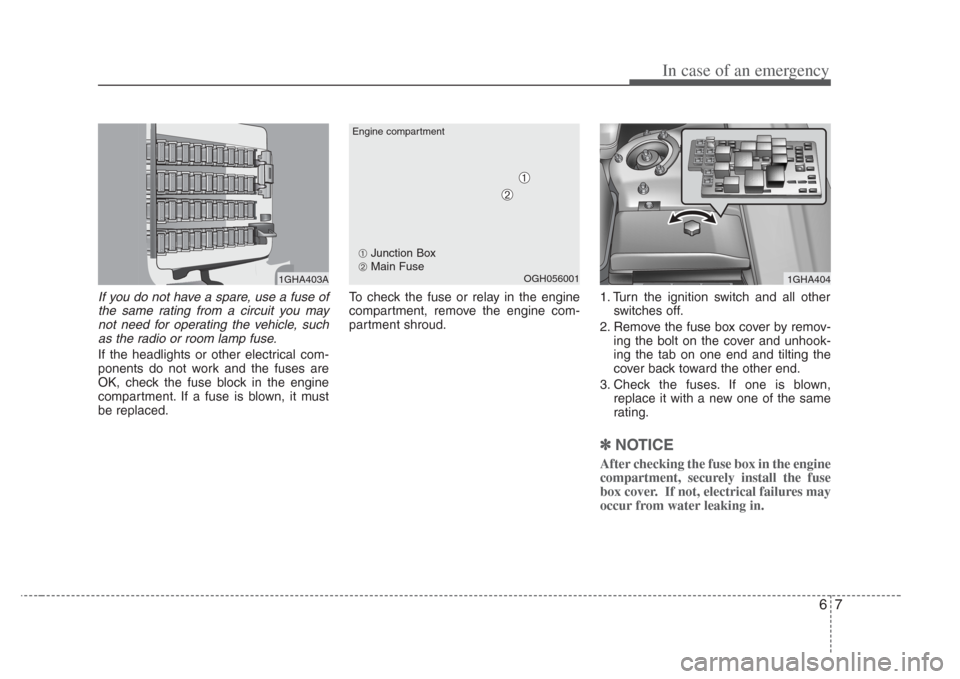
be replaced. To check the fuse or relay in the engine
compartment, remove the engine com-
partment shroud.
1. Turn the ignition switch and all other
switches off.
2. Remove the fuse box cover by remov- ing the bolt on the cover and unhook-
ing the tab on one end and tilting the
cover back toward the other end.
3. Check the fuses. If one is blown, replace it with a new one of the same
rating.
✽NOTICE
After checking the fuse box in the engine
compartment, securely install the fuse
box cover. If not, electrical failures may
occur from water leaking in.
1GHA403A1GHA404OGH056001
Engine compartment
➀
➁
➀
Junction Box
➁ Main Fuse
Page 222 of 283
69
In case of an emergency
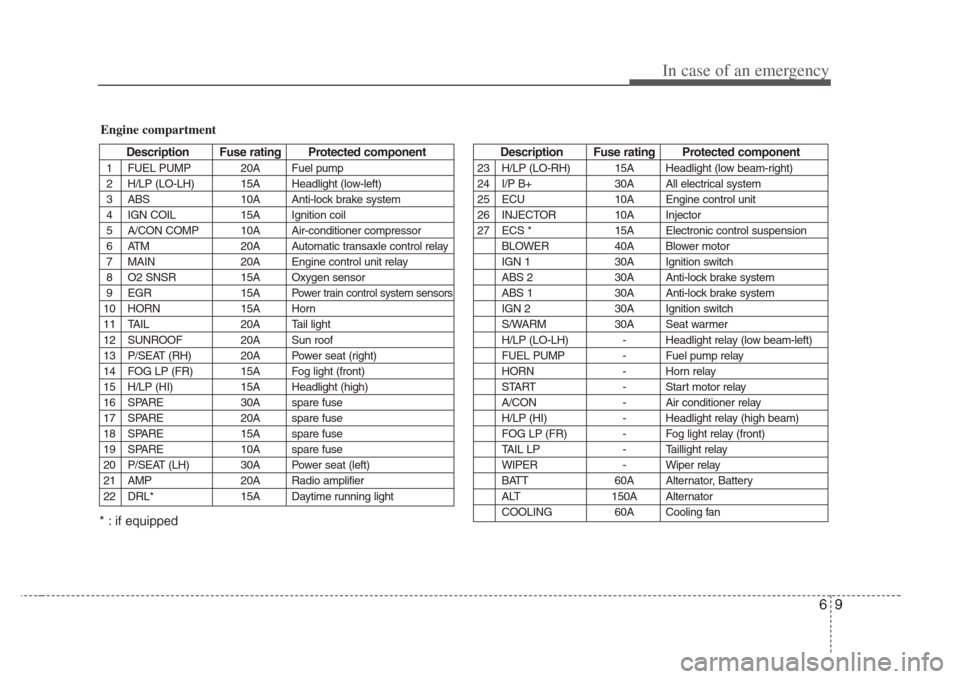
Description Fus e rating Protected component
1 FUEL PUMP 20A Fuel pump
2 H/LP (LO-LH) 15A Headlight (low-left)
3 ABS 10A Anti-lock brake system
4 IGN COIL 15A Ignition coil
5 A/CON COMP 10A Air-conditioner compressor
6 ATM 20A Automatic transaxle control relay
7 MAIN 20A Engine control unit relay
8 O2 SNSR 15A Oxygen sensor
9 EGR 15A
Power train control system sensors
10 HORN 15A Horn
11 TAIL 20A Tail light
12 SUNROOF 20A Sun roof
13 P/SEAT (RH) 20A Power seat (right)
14 FOG LP (FR) 15A Fog light (front)
15 H/LP (HI) 15A Headlight (high)
16 SPARE 30A spare fuse
17 SPARE 20A spare fuse
18 SPARE 15A spare fuse
19 SPARE 10A spare fuse
20 P/SEAT (LH) 30A Power seat (left)
21 AMP 20A Radio amplifier
22 DRL* 15A Daytime running light
Engine compartment
Description Fus e rating Protected component
23 H/LP (LO-RH) 15A Headlight (low beam-right)
24 I/P B+ 30A All electrical system
25 ECU 10A Engine control unit
26 INJECTOR 10A Injector
27 ECS * 15A Electronic control suspension
BLOWER 40A Blower motor
IGN 1 30A Ignition switch
ABS 2 30A Anti-lock brake system
ABS 1 30A Anti-lock brake system
IGN 2 30A Ignition switch
S/WARM 30A Seat warmer
H/LP (LO-LH) - Headlight relay (low beam-left)
FUEL PUMP - Fuel pump relay
HORN - Horn relay
START - Start motor relay
A/CON - Air conditioner relay
H/LP (HI) - Headlight relay (high beam)
FOG LP (FR) - Fog light relay (front)
TAIL LP - Taillight relay
WIPER - Wiper relay
BATT 60A Alternator, Battery
ALT 150A Alternator
COOLING 60A Cooling fan
* : if equipped
Page 227 of 283
In case of an emergency
146
Towing with a vehicle other than
a tow truck
If towing is necessary, we recommend
you to have it done by an Authorized Kia
dealer or a commercial tow truck service.
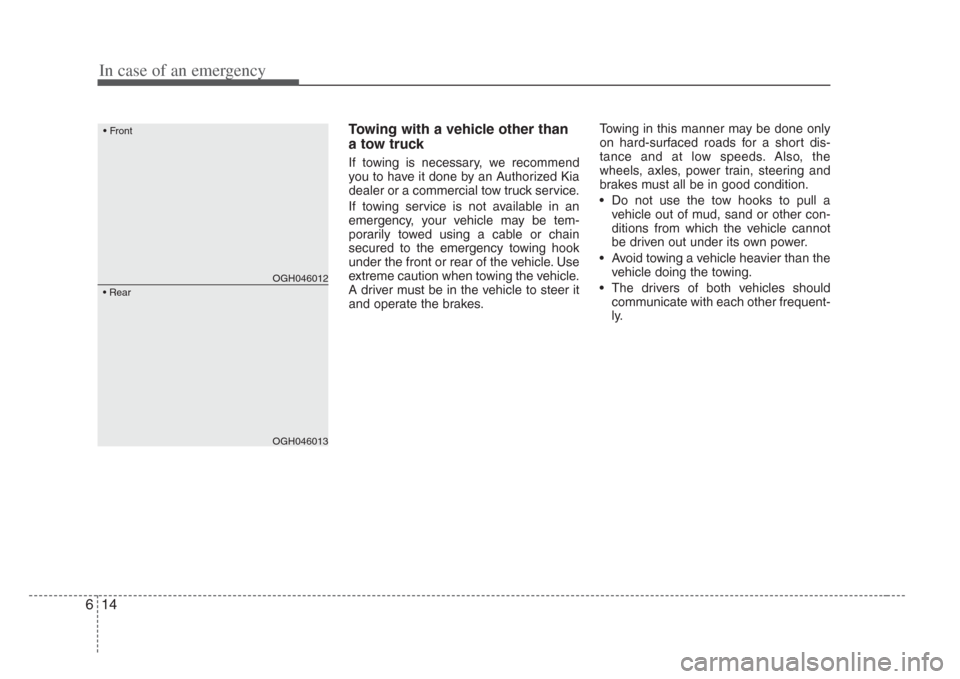
If towing service is not available in an
emergency, your vehicle may be tem-
porarily towed using a cable or chain
secured to the emergency towing hook
under the front or rear of the vehicle. Use
extreme caution when towing the vehicle.
A driver must be in the vehicle to steer it
and operate the brakes.Towing in this manner may be done only
on hard-surfaced roads for a short dis-
tance and at low speeds. Also, the
wheels, axles, power train, steering and
brakes must all be in good condition.
• Do not use the tow hooks to pull a
vehicle out of mud, sand or other con-
ditions from which the vehicle cannot
be driven out under its own power.
• Avoid towing a vehicle heavier than the vehicle doing the towing.
• The drivers of both vehicles should communicate with each other frequent-
ly.
OGH046012
• Front
OGH046013
• Rear
Page 228 of 283
615
In case of an emergency
• Before emergency towing, check thatthe hook is not broken or damaged.
• Fasten the towing cable or chain securely to the hook.
• Do not jerk the hook. Apply steady and even force.
• To avoid damaging the hook, do not pull from the side or at a vertical angle.
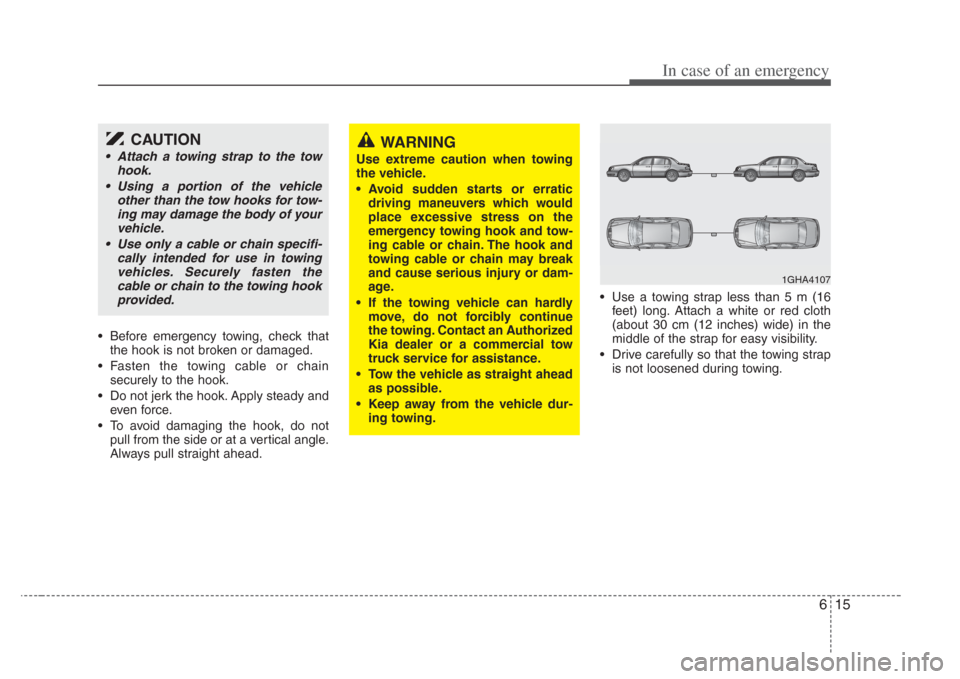
Always pull straight ahead. • Use a towing strap less than 5 m (16
feet) long. Attach a white or red cloth
(about 30 cm (12 inches) wide) in the
middle of the strap for easy visibility.
• Drive carefully so that the towing strap is not loosened during towing.
1GHA4107
WARNING
Use extreme caution when towing
the vehicle.
• Avoid sudden starts or erratic
driving maneuver s which would
place excessive stress on the
emergency towing hook and tow-
ing cable or chain. The hook and
towing cable or chain may break
and cause serious injury or dam-
age.
• If the towing vehicle can hardly move, do not forcibly continue
the towing. Contact an Authorized
Kia dealer or a commercial tow
truck service for assistance.
• Tow the vehicle as straight ahead
as possible.
• Keep away from the vehicle dur- ing towing.
CAUTION
• Attach a towing strap to the tow hook.
•U sing a portion of the vehicle
other than the tow hook s for tow-
ing may damage the body of your vehicle.
•U se only a cable or chain specifi-
cally intended for u se in towing
vehicles . Securely fas ten the
cable or chain to the towing hook provided.
Page 232 of 283
619
In case of an emergency
Changing tires
Jacking instructions
The jack is provided for emergency
tire changing only.
Follow jacking instructions to reduce
the possibility of personal injury.
Tire replacement
1. Park on a level surface and apply
the parking brake firmly.
2. Shift the shift lever into P (Park).
3. Activate the hazard warning flash- er.
WARNING- Changing tire s
• Never attempt vehicle repair s
in the traffic lanes of a public
road or highway.
•Alway s move the vehicle com-
pletely off the road and onto
the shoulder before trying to
change a tire. The jack should
be used on level firm ground
whenever possible. If you can-
not find a firm, level place off
the road, call a towing service
company for assistance.
• Be sure to use the correct
front and rear jacking po si-
tions on the vehicle; never use
the bumper s or any other part
of the vehicle for jack support.
(Continued)
(Continued)
• The vehicle can easily roll off the jack caus ing serious
injury or death. No per son
should place any portion of
their body under a vehicle that
is supported only by a jack ;
use vehicle support stands.
• Do not start or run the engine while the vehicle i s on the
jack.
• Do not allow anyone to remain in the vehicle while it i s on the
jack.
• Make sure any children pres-
ent are in a secure place away
from the road and from the
vehicle to be rai sed with the
jack.
1JBA6021
Page 235 of 283
In case of an emergency
226
13. Once the wheel lug nuts havebeen tightened, lower the vehicle
fully to the ground and continue to
tighten the lug nuts until they are
fully secured. Tighten the wheel
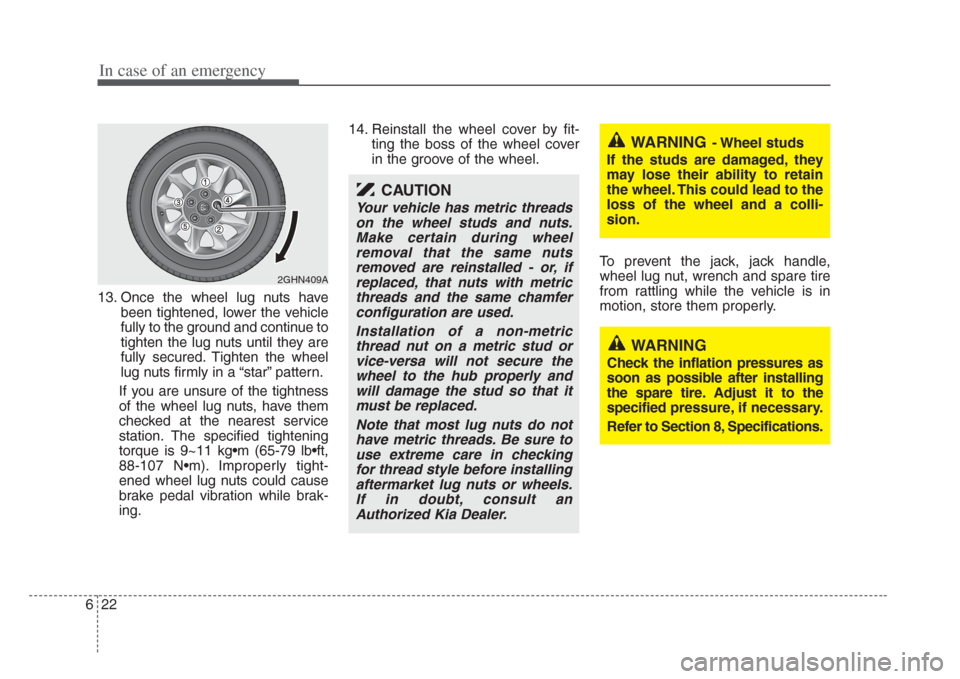
lug nuts firmly in a “star” pattern.
If you are unsure of the tightness
of the wheel lug nuts, have them
checked at the nearest service
station. The specified tightening
torque is 9~11 kg•m (65-79 lb•ft,
88-107 N•m). Improperly tight-
ened wheel lug nuts could cause
brake pedal vibration while brak-
ing. 14. Reinstall the wheel cover by fit-
ting the boss of the wheel cover
in the groove of the wheel.
To prevent the jack, jack handle,
wheel lug nut, wrench and spare tire
from rattling while the vehicle is in
motion, store them properly.
2GHN409A
CAUTION
Your vehicle has metric threadson the wheel studs and nuts.Make certain during wheelremoval that the s ame nuts
removed are reinstalled - or, if replaced, that nut s with metric
threads and the same chamfer configuration are used.
Ins tallation of a non-metric
thread nut on a metric stud or
vice-ver sa will not secure the
wheel to the hub properly and will damage the stud so that it
mu st be replaced.
Note that most lug nuts do not have metric threads. Be sure to
use extreme care in checking for thread style before in stalling
aftermarket lug nut s or wheels.
If in doubt, cons ult an
Authorized Kia Dealer.
WARNING- Wheel studs
If the studs are damaged, they
may lose their ability to retain
the wheel. Thi s could lead to the
loss of the wheel and a colli-
sion.
WARNING
Check the inflation pressures as
s oon as possible after ins talling
the spare tire. Adjus t it to the
s pecified pre ssure, if necessary.
Refer to Section 8, Specifications .
Page 258 of 283
723
Maintenance
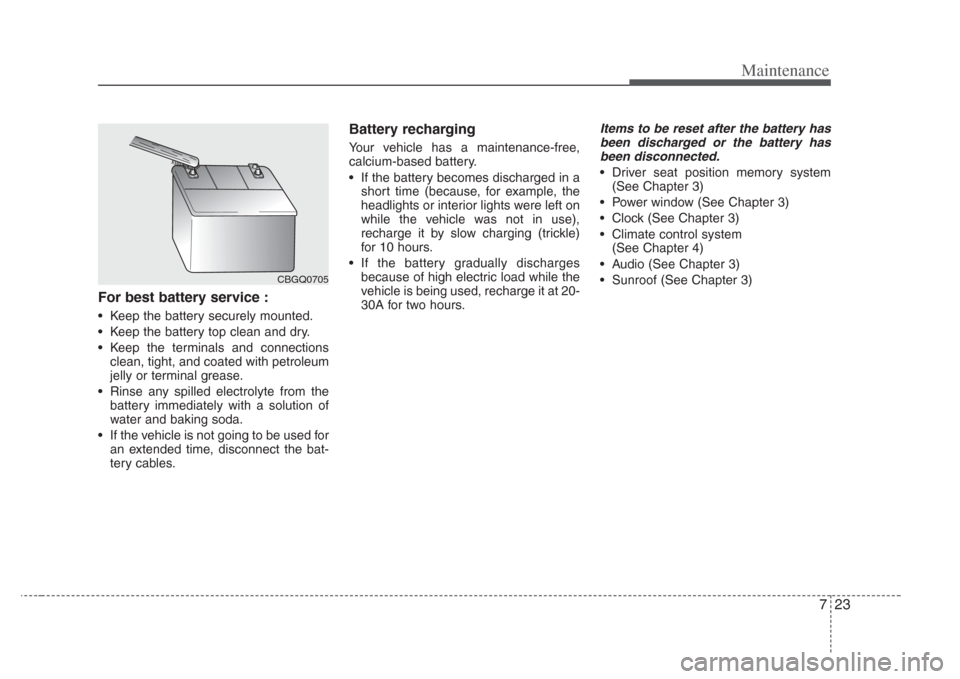
For best battery service :
• Keep the battery securely mounted.
• Keep the battery top clean and dry.
• Keep the terminals and connectionsclean, tight, and coated with petroleum
jelly or terminal grease.
• Rinse any spilled electrolyte from the battery immediately with a solution of
water and baking soda.
• If the vehicle is not going to be used for an extended time, disconnect the bat-
tery cables.
Battery recharging
Your vehicle has a maintenance-free,
calcium-based battery.
• If the battery becomes discharged in ashort time (because, for example, the
headlights or interior lights were left on
while the vehicle was not in use),
recharge it by slow charging (trickle)
for 10 hours.
• If the battery gradually discharges because of high electric load while the
vehicle is being used, recharge it at 20-
30A for two hours.
Items to be reset after the battery ha s
been discharged or the battery ha s
been disconnected.
• Driver seat position memory system (See Chapter 3)
• Power window (See Chapter 3)
• Clock (See Chapter 3)
• Climate control system (See Chapter 4)
• Audio (See Chapter 3)
• Sunroof (See Chapter 3)
CBGQ0705