ECU KIA Opirus 2008 1.G User Guide
[x] Cancel search | Manufacturer: KIA, Model Year: 2008, Model line: Opirus, Model: KIA Opirus 2008 1.GPages: 283, PDF Size: 20.47 MB
Page 58 of 283
Knowing your vehicle
483
✽NOTICE
When the safety belt is allowed to
retract to its fully stowed position, the
retractor will automatically switch from
the “Auto Lock” mode to the emergency
lock mode for normal adult usage.
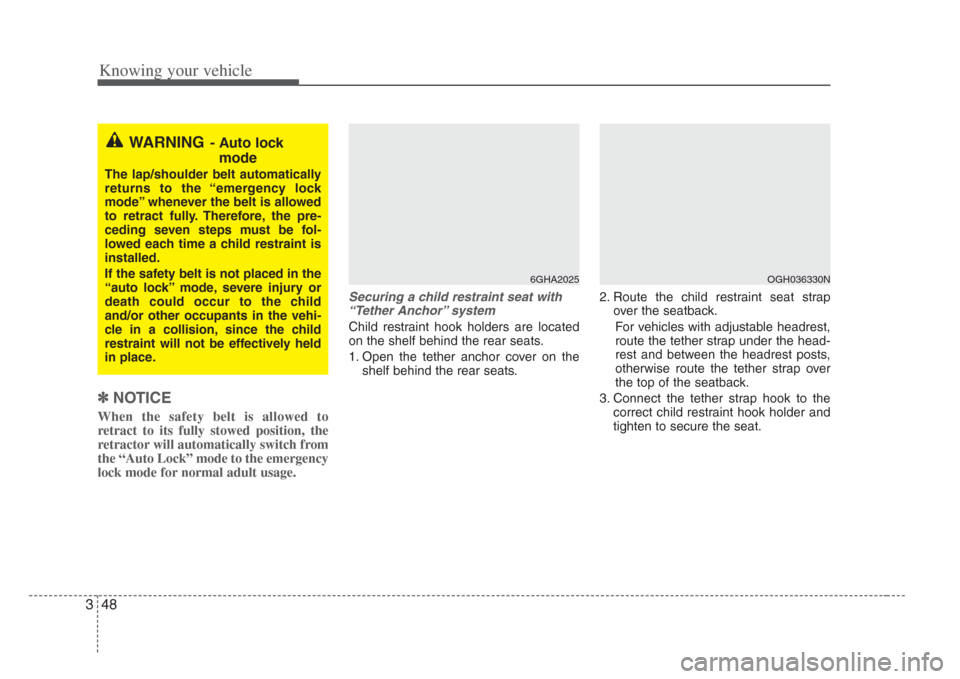
Securing a child re straint seat with
“Tether Anchor” system
Child restraint hook holders are located
on the shelf behind the rear seats.
1. Open the tether anchor cover on the
shelf behind the rear seats. 2. Route the child restraint seat strap
over the seatback.
For vehicles with adjustable headrest,
route the tether strap under the head-
rest and between the headrest posts,
otherwise route the tether strap over
the top of the seatback.
3. Connect the tether strap hook to the correct child restraint hook holder and
tighten to secure the seat.
WARNING- Auto lockmode
The lap/shoulder belt automatically
returns to the “emergency lock
mode” whenever the belt i s allowed
to retract fully. Therefore, the pre-
ceding seven steps mu st be fol-
lowed each time a child re straint is
installed.
If the s afety belt is not placed in the
“auto lock” mode, severe injury or
death could occur to the child
and/or other occupants in the vehi-
cle in a collis ion,since the child
res traint will not be effectively held
in place.
6GHA2025OGH036330N
Page 59 of 283
349
Knowing your vehicle
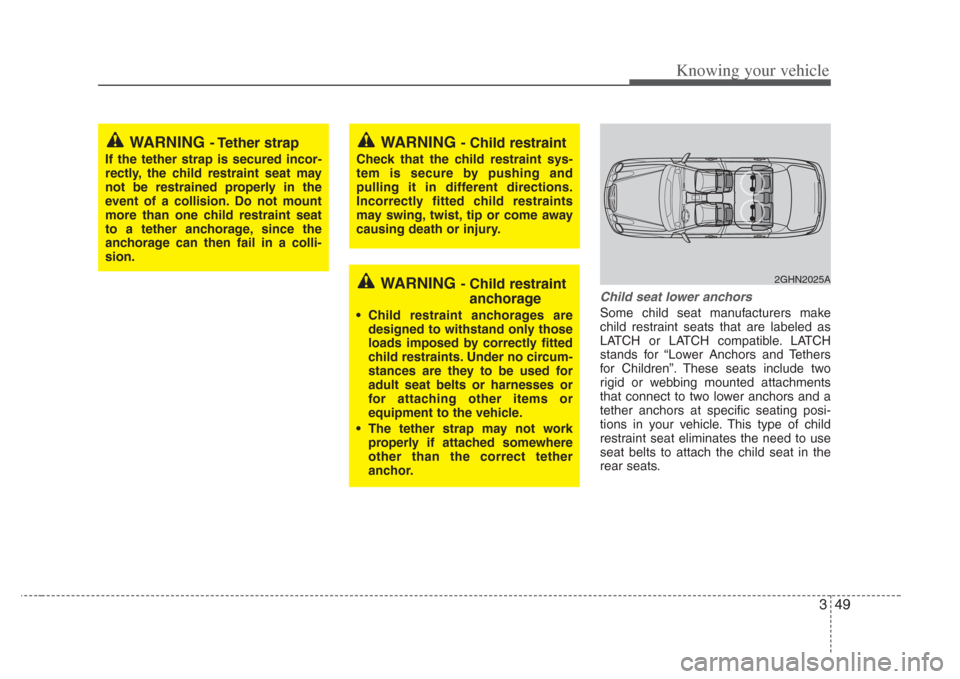
Child seat lower anchor s
Some child seat manufacturers make
child restraint seats that are labeled as
LATCH or LATCH compatible. LATCH
stands for “Lower Anchors and Tethers
for Children”. These seats include two
rigid or webbing mounted attachments
that connect to two lower anchors and a
tether anchors at specific seating posi-
tions in your vehicle. This type of child
restraint seat eliminates the need to use
seat belts to attach the child seat in the
rear seats.
WARNING - Tether strap
If the tether strap is secured incor-
rectly, the child restraint seat may
not be restrained properly in the
event of a collision. Do not mount
more than one child re straint seat
to a tether anchorage, since the
anchorage can then fail in a colli-
sion.
2GHN2025A
WARNING - Child restraint
Check that the child restraint sys-
tem is secure by pus hing and
pulling it in different directions .
Incorrectly fitted child res traints
may swing, twist, tip or come away
causing death or injury.
WARNING - Child restraint anchorage
• Child res traint anchorages are
designed to withstand only tho se
loads imposed by correctly fitted
child restraints. Under no circum-
stances are they to be used for
adult seat belts or harnesses or
for attaching other items or
equipment to the vehicle.
• The tether strap may not work
properly if attached somewhere
other than the correct tether
anchor.
Page 61 of 283
351
Knowing your vehicle
WARNING
If the child restraint is not anchored
properly, the risk of a child being
seriously injured or killed in a colli-
sion greatly increases.
WARNING
When using the vehicle’ s “LATCH”
system to install a child restraint
system in the rear seat, all unused
vehicle rear seat belt metal latch
plates or tabs must be latched
securely in their seat belt buckles
and the seat belt webbing mu st be
retracted behind the child re straint
to prevent the child from reaching
and taking hold of unretracted seat
belts. Unlatched metal latch plate s
or tabs may allow the child to reach
the unretracted seat belts which
may result in strangulation and a
serious injury or death to the child
in the child restraint.
WARNING
• Do not mount more than one child restraint to a single tether or
to a child restraint lower anchor-
age point. The improper
increas ed load may caus e the
anchorage points or tether
anchor to break, causing serious
injury or death.
• Do not install a child restraint seat at the rear center seating
pos ition us ing the vehicle’ s
LATCH anchor s. The LATCH
anchor s are only provided for the
left and right outboard rear seat-
ing positions. Do not mi suse the
LATCH anchor s by attempting to
attach a child restraint seat in the
middle rear seating position to
the LATCH anchor s.
In a crash, the child restraint seat
LATCH attachment s may not be
strong enough to secure the child
restraint seat improperly in the
rear center seating position and
may break, causing serious injur
y
or death.
(Continued)
(Continued)
• Attach the LATCH or LATCH-com-patible child restraint seat only to
the appropriate location s shown
in the illustration.
•Alway s follow the installation and
use instructions provided by the
manufacturer of the child res traint.
Page 75 of 283
365
Knowing your vehicle
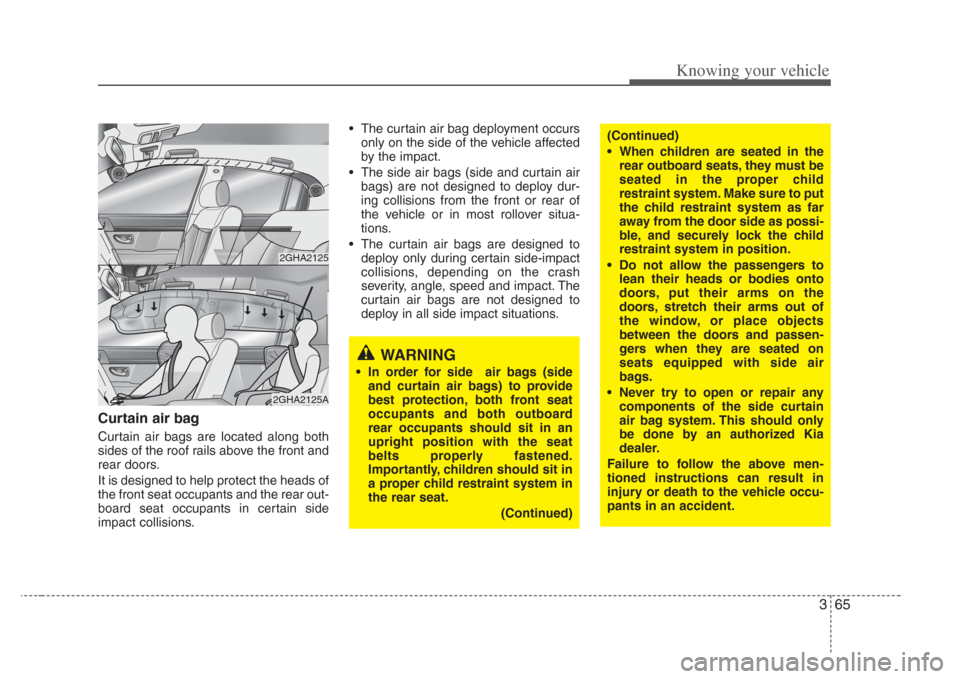
Curtain air bag
Curtain air bags are located along both
sides of the roof rails above the front and
rear doors.
It is designed to help protect the heads of
the front seat occupants and the rear out-
board seat occupants in certain side
impact collisions.• The curtain air bag deployment occurs
only on the side of the vehicle affected
by the impact.
• The side air bags (side and curtain air bags) are not designed to deploy dur-
ing collisions from the front or rear of
the vehicle or in most rollover situa-
tions.
• The curtain air bags are designed to deploy only during certain side-impact
collisions, depending on the crash
severity, angle, speed and impact. The
curtain air bags are not designed to
deploy in all side impact situations.
WARNING
• In order for side air bags ( side
and curtain air bag s) to provide
best protection, both front seat
occupants and both outboard
rear occupants should sit in an
upright pos ition with the s eat
belts properly fas tened.
Importantly, children should sit in
a proper child restraint system in
the rear seat.
(Continued)
(Continued)
• When children are seated in the
rear outboard seats, they must be
s eated in the proper child
restraint system. Make sure to put
the child restraint system as far
away from the door side as possi-
ble, and securely lock the child
restraint system in position.
• Do not allow the pa ssengers to
lean their head s or bodies onto
door s, put their arms on the
door s,stretch their arms out of
the window, or place objects
between the door s and passen-
ger s when they are seated on
s eats equipped with s ide air
bags.
• Never try to open or repair any components of the side curtain
air bag system.
This should only
be done by an authorized Kia
dealer.
Failure to follow the above men-
tioned ins tructions can res ult in
injury or death to the vehicle occu-
pants in an accident.
2GHA2125
2GHA2125A
Page 83 of 283
373
Knowing your vehicle
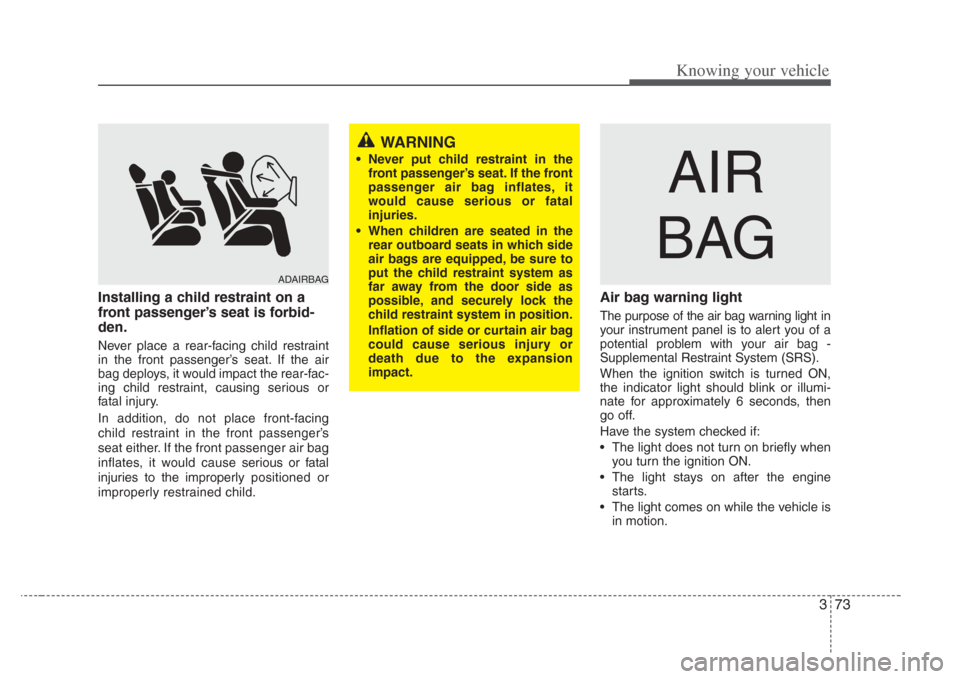
Installing a child restraint on a
front passenger’ s seat is forbid-
den.
Never place a rear-facing child restraint
in the front passenger’s seat. If the air
bag deploys, it would impact the rear-fac-
ing child restraint, causing serious or
fatal injury.
In addition, do not place front-facing
child restraint in the front passenger’s
seat either. If the front passenger air bag
inflates, it would cause ser ious or fatal
injuries to the improperly positioned or
improperly restrained child.
Air bag warning light
The purpose of the air bag warning light in
your instrument panel is to alert you of a
potential problem with your air bag -
Supplemental Restraint System (SRS).
When the ignition switch is turned ON,
the indicator light should blink or illumi-
nate for approximately 6 seconds, then
go off.
Have the system checked if:
• The light does not turn on briefly when you turn the ignition ON.
• The light stays on after the engine starts.
• The light comes on while the vehicle is in motion.
ADAIRBAG
AIR
BAG
WARNING
• Never put child restraint in the front passenger’ s seat. If the front
passenger air bag inflates ,it
would caus e serious or fatal
injuries.
• When children are seated in the rear outboard seats in which side
air bags are equipped, be sure to
put the child restraint system as
far away from the door side as
possible, and securely lock the
child restraint system in position.
Inflation of side or curtain air bag
could caus e serious injury or
death due to the expans ion
impact.
Page 87 of 283
377
Knowing your vehicle
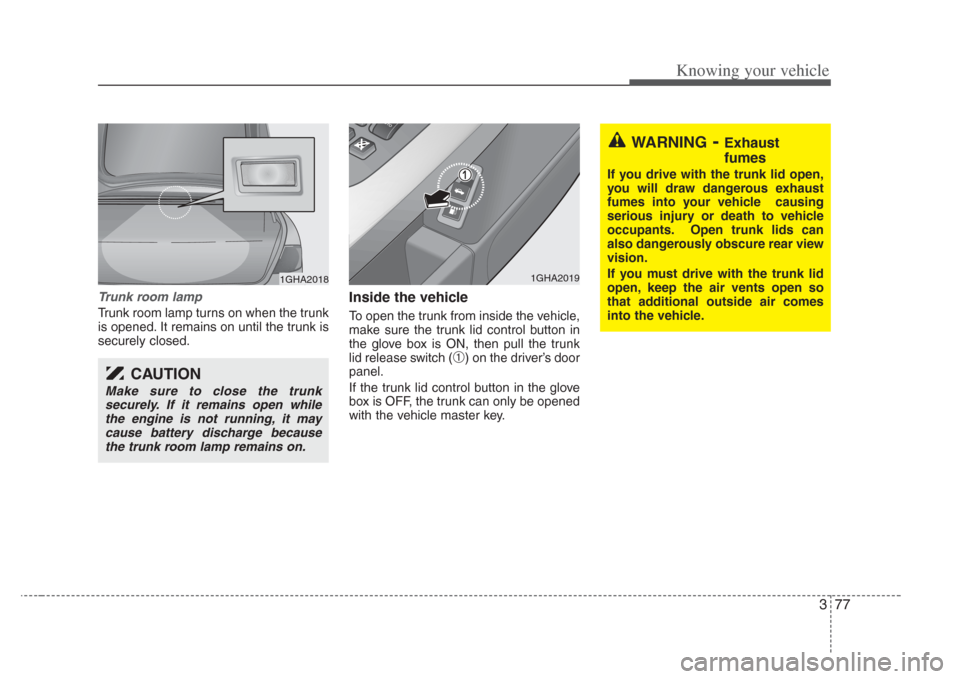
Trunk room lamp
Trunk room lamp turns on when the trunk
is opened. It remains on until the trunk is
securely closed.
Inside the vehicle
To open the trunk from inside the vehicle,
make sure the trunk lid control button in
the glove box is ON, then pull the trunk
lid release switch (
➀) on the driver’s door
panel.
If the trunk lid control button in the glove
box is OFF, the trunk can only be opened
with the vehicle master key.
WARNING-Exhaust
fumes
If you drive with the trunk lid open,
you will draw dangerou s exhaust
fumes into your vehicle cau sing
serious injury or death to vehicle
occupants. Open trunk lid s can
also dangerously ob scure rear view
vision.
If you must drive with the trunk lid
open, keep the air vents open so
that additional outside air come s
into the vehicle.
1GHA2018
CAUTION
Make sure to clos e the trunk
securely. If it remains open while the engine i s not running, it may
cause battery discharge because the trunk room lamp remains on.
1GHA2019
Page 90 of 283
Knowing your vehicle
803
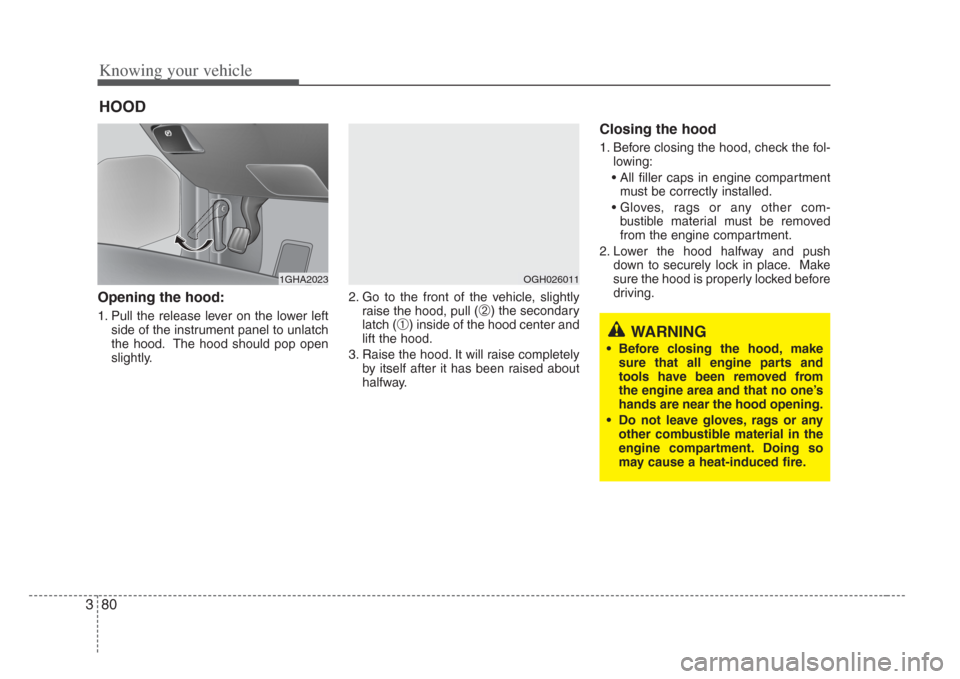
Opening the hood:
1. Pull the release lever on the lower leftside of the instrument panel to unlatch
the hood. The hood should pop open
slightly. 2. Go to the front of the vehicle, slightly
raise the hood, pull (➁) the secondary
latch (
➀) inside of the hood center and
lift the hood.
3. Raise the hood. It will raise completely by itself after it has been raised about
halfway.
Closing the hood
1. Before closing the hood, check the fol-lowing:
• All filler caps in engine compartment must be correctly installed.
• Gloves, rags or any other com- bustible material must be removed
from the engine compartment.
2. Lower the hood halfway and push down to securely lock in place. Make
sure the hood is properly locked before
driving.
HOOD
1GHA2023OGH026011
WARNING
• Before closing the hood, makesure that all engine part s and
tools have been removed from
the engine area and that no one’ s
hands are near the hood opening.
• Do not leave glove s,rags or any
other combustible material in the
engine compartment. Doing s o
may cause a heat-induced fire.
Page 91 of 283
381
Knowing your vehicle
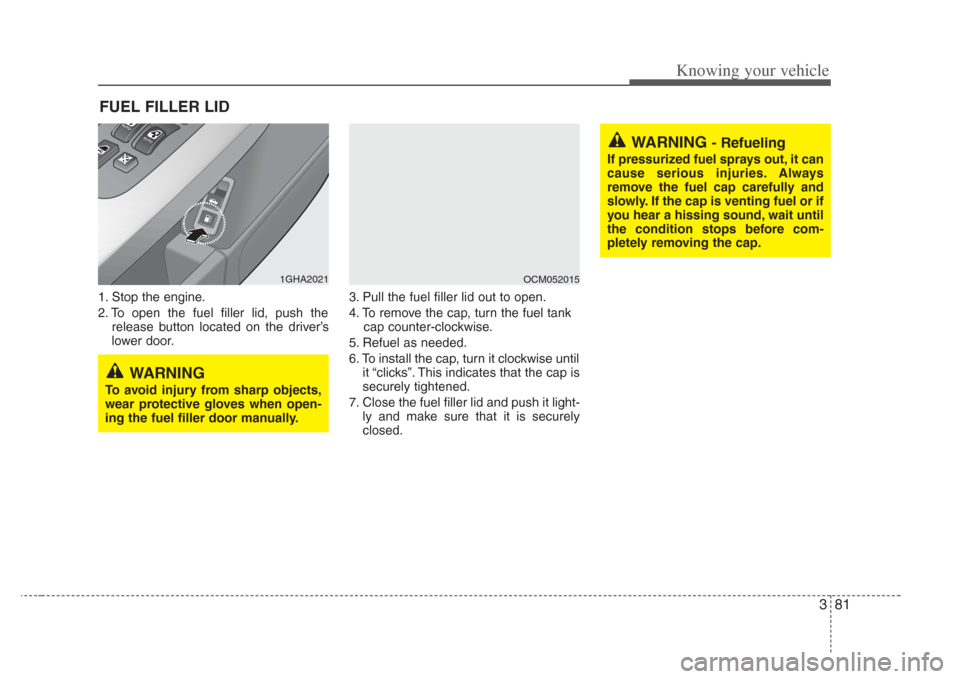
1. Stop the engine.
2. To open the fuel filler lid, push therelease button located on the driver’s
lower door. 3. Pull the fuel filler lid out to open.
4. To remove the cap, turn the fuel tank
cap counter-clockwise.
5. Refuel as needed.
6. To install the cap, turn it clockwise until it “clicks”. This indicates that the cap is
securely tightened.
7. Close the fuel filler lid and push it light- ly and make sure that it is securely
closed.
FUEL FILLER LID
1GHA2021OCM052015
WARNING
To avoid injury from sharp object s,
wear protective gloves when open-
ing the fuel filler door manually.
WARNING - Refueling
If pressurized fuel sprays out, it can
caus e serious injuries .Always
remove the fuel cap carefully and
slowly. If the cap is venting fuel or if
you hear a hissing sound, wait until
the condition s tops before com-
pletely removing the cap.
Page 92 of 283
Knowing your vehicle
823
WARNING
Automotive fuels are flammable/
explosive materials. When refuel-
ing, pleas e note the following
guidelines carefully. Failure to fol-
low these guidelines may result in
s evere per sonal injury, severe
burns or death by fire or explo sion.
• Before refueling alway s note the
location of the Emergency
Gasoline Shut-Off, if available, at
the gas station facility.
Note and follow all safety precau-
tions and warning posted at the
facility.
• Before touching the fuel nozzle or fuel filler cap, you should elimi-
nate potentially dangerou s static
electricity discharge by touching
another metal part of the front of
the vehicle, a safe distance away
from the fuel filler neck, nozzle, or
other gas source.
(Continued)
(Continued)
• Do not get back into a vehicleonce you have begun refueling.
Do not touch, rub or slide against
any item or fabric (polyes ter,
satin, nylon, etc.) capable of pro-
ducing static electricity. Static
electricity dis charge can ignite
fuel vapor s res ulting in explo-
sion. If you must re-enter the
vehicle, you should once again
eliminate potentially dangerous
s tatic electricity dis charge by
touching a metal part of the vehi-
cle, away from the fuel filler neck,
nozzle or other gasoline source.
•
When us ing a portable fuel con-
tainer be s ure to place the contain-
er on the ground prior to refueling.
Static electricity dis charge from
the container can ignite fuel vapor s
caus ing a fire. Once refueling has
begun, contact with the vehicle
s hould be maintained until the fill-
ing is complete. Us e only portable
fuel container s des igned to carry
and store gas oline.
(Continued)
(Continued)
• Do not us e cellular phones
around a gas station or while
refueling any vehicle. Electric
current and/or electronic interfer-
ence from cellular phones can
potentially ignite fuel vapor s
causing a fire. If you must use
your cellular phone u se it in a
place away from the ga s station.
• When refueling alway s shut the
engine off. Spark s produced by
electrical components related to
the engine can ignite fuel vapor s
causing a fire. Alway s insure that
the engine i s OFF before and dur-
ing refueling. Once refueling i s
complete, check to make sure the
fuel filler cap and door are
securely closed, before starting
the engine.
(Continued)
Page 93 of 283
383
Knowing your vehicle
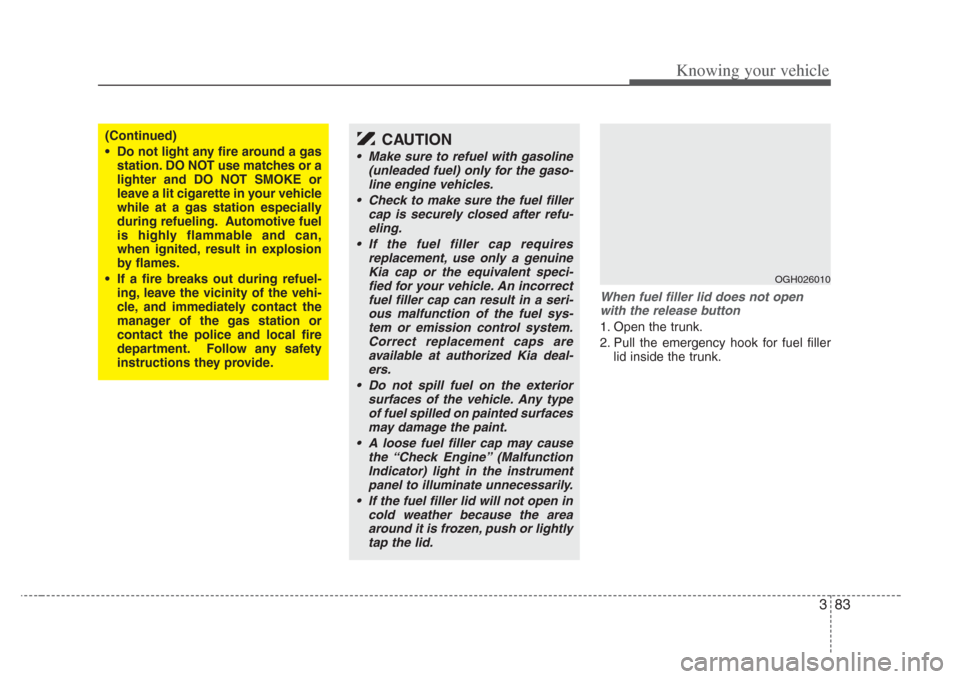
When fuel filler lid does not openwith the relea se button
1. Open the trunk.
2. Pull the emergency hook for fuel filler
lid inside the trunk.
OGH026010
(Continued)
• Do not light any fire around a ga s
station. DO NOT u se matches or a
lighter and DO NOT SMOKE or
leave a lit cigarette in your vehicle
while at a gas station especially
during refueling. Automotive fuel
i s highly flammable and can,
when ignited, re sult in explosion
by flames.
• If a fire breaks out during refuel- ing, leave the vicinity of the vehi-
cle, and immediately contact the
manager of the ga s station or
contact the police and local fire
department. Follow any safety
instructions they provide.CAUTION
• Make sure to refuel with ga soline
(unleaded fuel) only for the ga so-
line engine vehicles.
• Check to make sure the fuel filler cap is securely closed after refu-
eling.
• If the fuel filler cap requires replacement, u se only a genuine
Kia cap or the equivalent speci- fied for your vehicle. An incorrectfuel filler cap can result in a seri- ous malfunction of the fuel sys-tem or emission control system.Correct replacement caps are
available at authorized Kia deal- er s.
• Do not spill fuel on the exterior surfaces of the vehicle. Any typeof fuel spilled on painted surfaces
may damage the paint.
• A loose fuel filler cap may cause the “Check Engine” (MalfunctionIndicator) light in the instrument panel to illuminate unnecessarily.
• If the fuel filler lid will not open in cold weather because the areaaround it is frozen, push or lightly tap the lid.