ESP KIA Optima 2006 2.G User Guide
[x] Cancel search | Manufacturer: KIA, Model Year: 2006, Model line: Optima, Model: KIA Optima 2006 2.GPages: 225, PDF Size: 3.77 MB
Page 103 of 225
MALFUNCTION
INDICATOR LIGHT
(IF EQUIPPED)The CHECK ENGINE or malfunction
indicator light is installed in your
vehicle’s instrument panel and responds
to signals from the vehicle’s On Board
Diagnostic (OBD -II) System. The OBD-
II System monitors the performance of the
vehicle’s Emission Control System
(ECS), which is designed to reduce the
amount of air pollutants in engine exhaust
to the levels required by government
regulations.
When you first start the engine, the check
engine light will illuminate briefly as a
system check to confirm that the OBD-II
System is operating properly. As the
engine starts, this light turns off.
However, if at any time the OBD-II
system detects a faulty signal or
determines that the ECS is not performing
to specification, the CHECK ENGINE
light will illuminate continuously or flash.
Continuously ON :If the CHECK ENGINE light comes ON
while driving and illuminates continuously,
a potential problem has been discovered in
the ECS or one of the exhaust system
components. Generally, the vehicle will
continue to be driveablebut it should
be checked by an Authorized Kia Dealer
as soon as possible. This condition is
unlikely to lead to engine damage unless
a decrease in vehicle power or poor
running conditions is immediately
apparent.
Flashing ON and OFF :If the CHECK ENGINE light begins to
flash ON and OFF, a more serious
problem with the ECS or exhaust system
component has been detected. If this
happens, and there is no degradation
to performance, the vehicle is still
driveable(avoid high speeds) but should
be checked by an Authorized Kia Dealer
at your earliest possible convenience. If
the flashing CHECK ENGINE light is
accompanied by a decrease in power or
poor running conditions, safely stop the
vehicle and immediately contact Kia
Roadside Assistance.
Note that the CHECK ENGINE light
will illuminate for a problem like a loose
or missing gas cap, but will not
illuminate as a result of low engine oil or
coolant, low automatic transaxle fluid or
engine overheating. The driver will be
alerted to these conditions by other
indicators on the instrument panel.
DRIVING YOUR VEHICLE
4-24
CHECK
MS-CNA-Eng 4(~39).QXD 7/25/2005 5:16 PM Page 24
Page 108 of 225
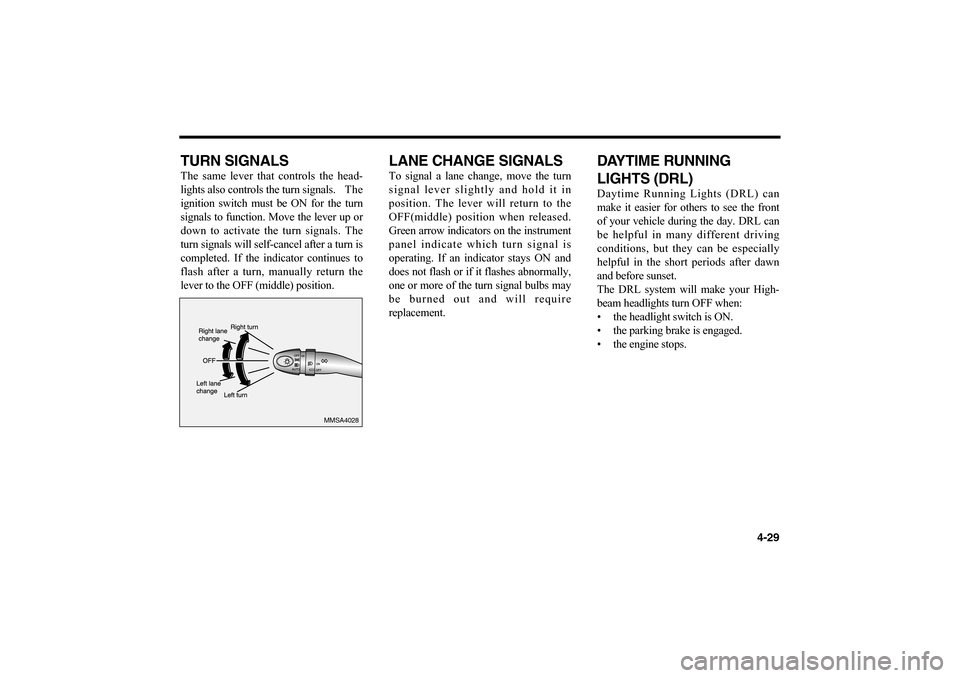
TURN SIGNALSThe same lever that controls the head-
lights also controls the turn signals. The
ignition switch must be ON for the turn
signals to function. Move the lever up or
down to activate the turn signals. The
turn signals will self-cancel after a turn is
completed. If the indicator continues to
flash after a turn, manually return the
lever to the OFF (middle) position.
LANE CHANGE SIGNALSTo signal a lane change, move the turn
signal lever slightly and hold it in
position. The lever will return to the
OFF(middle) position when released.
Green arrow indicators on the instrument
panel indicate which turn signal is
operating. If an indicator stays ON and
does not flash or if it flashes abnormally,
one or more of the turn signal bulbs may
be burned out and will require
replacement.
DAYTIME RUNNING
LIGHTS (DRL) Daytime Running Lights (DRL) can
make it easier for others to see the front
of your vehicle during the day. DRL can
be helpful in many different driving
conditions, but they can be especially
helpful in the short periods after dawn
and before sunset.
The DRL system will make your High-
beam headlights turn OFF when:
• the headlight switch is ON.
• the parking brake is engaged.
• the engine stops.
4-29
MMSA4028
MS-CNA-Eng 4(~39).QXD 7/25/2005 5:16 PM Page 29
Page 124 of 225

4-45
OUTSIDE(FRESH) AIR
POSITIONWhen the air intake control
switch is depressed (switch indicator
illuminates) air enters the ventilation
system from outside the vehicle. Use this
position for normal ventilation and
heating.
The air flow control will be set at outside
(fresh) air position automatically if any
of following occur.
- The ignition key is OFF.
- The fan speed control knob is OFF (0).
- When you select the floor, floor-defrost
or defrost mode position.
If you want the recirculated air position,
press the corresponding button.
To cancel the forced outside (fresh) air
position, refer to the canceling procedure
in “Windshield Defrosting and
Defogging” section.
AIR CONDITIONING
SWITCH (IF EQUIPPED)Press the switch to turn the air
conditioning system on. An indicator
light in the switch will illuminate when
the fan switch is ON indicating air
conditioning system operation. Press the
switch again to turn the air conditioning
system OFF.
MAX A/C MODE (IF EQUIPPED)When you select the MAX A/C mode
(switch indicator illuminates) while the
fan speed is on, it will be set the system
automatically as follows;
- the air conditioning system will be
turned on.
- the recirculated air position will be
selected.
- the face mode will be selected.
If you select the MAX A/C mode, you
could not cancel the A/C system and the
recirculated air position.
Set the fan speed control knob to desired
speed and rotate the temperature control
knob to the extreme left position.
To turn the MAX A/C mode off, press
the MAX A/C mode button again or
select the others except face mode.
MAX
A/C
MMSA4051B
MAX
A/C
MMSA4051B
MS-CNA-Eng 4(40~).QXD 7/25/2005 5:15 PM Page 45
Page 129 of 225

DRIVING YOUR VEHICLE
4-50FLOOR-DEFROST
POSITION
Most of the air flow is
directed to the floor and the
windshield with a small
amount directed to the side
window defrosters.
(outlet port: , , )
The air conditioning will
automatically on based on the
ambient temperature and
outside(fresh) air position
will be selected
automatically. If you don’t
want the air-conditioning or
outside (fresh) air position
press the corresponding
button to cancel the opeation.
DEFROST BUTTON
Most of the air flow is
directed to the windshield
with a small amount of air
directed to the side window
defrosters. (outlet port: , )
When the defrost button is
pressed the outside (fresh) air
position will automatically
selected and the air will be
discharged through the
windshield defrost vents. The
air conditioning will
automatically operate based
on ambient temperature. If
you don’t want the air-
conditioning or outside
(fresh) air position press the
corresponding button to
cancel the operation.
A
C
D
A
D
MS-CNA-Eng 4(40~).QXD 7/25/2005 5:15 PM Page 50
Page 135 of 225

If you don’t want the outside (fresh) air
position when operating in either of these
modes, you can turn off the system
operation by performing the following:
1. Make sure the engine is running or
the ignition switch is in the ON
position.
2. Turn the fan speed control knob to
the “0” position.
3. Turn the mode selection knob to the
defrost ( ) position.
4. Push the air intake control button
( ) at least 5 times within 3
seconds.
5. Then the indicator light on the air
intake control button ( ) will blink
3 times with 0.5 second intervals
between blinks.
If you want to return to the outside
(fresh) air position, repeat the procedure
above.
WINDSHIELD DEFROST-
ING AND DEFOGGING
(AUTOMATIC TYPE)TO DEFOG INSIDE WINDSHIELD1. Select any fan speed except OFF
( ) position.
2. Select desired temperature.
3. Press the defrost button ( ).
4. The air conditioning will be turned
on according to the detected ambient
temperature and outside (fresh) air
position will be selected.
If you don’t want the air conditioning or
outside (fresh) air position press the
corresponding button to cancel the
operation.
TO DEFROST OUTSIDE
WINDSHIELD 1. Set temperature to the extreme hot
(25°C~32°C) position.
2. Set the fan speed to the or
position.
3. Press the defrost button ( ).
4. The air conditioning will be turned
on according to the detected ambient
temperature and outside (fresh) air
position will be selected.
If you don’t want the air conditioning or
outside (fresh) air position press the
corresponding button to cancel the
operation.
• Before driving, clear all snow and ice
from the windshield, rear window,
outside rear view mirrors, and all side
windows.
• Clear all snow and ice from the hood
and the air inlet in the cowl grille to
improve heater and defroster
efficiency and to reduce the
probability of fogging on the inside
of the windshield.
DRIVING YOUR VEHICLE
4-56
A/C
1
2
34
MMSA4055
MS-CNA-Eng 4(40~).QXD 7/25/2005 5:15 PM Page 56
Page 144 of 225
DRIVING TIPS
5-8
DRIVING AT NIGHTBecause night driving presents many
more hazards than driving in the
daylight, here are some important tips to
remember:
Slow down and keep more distance
between you and other vehicles as it
may be more difficult to see at night,
especially in rural areas where there
may not be any street lights.
Adjust your mirrors to reduce the
glare from other driver’s headlights.
Keep your headlights clean and
properly aimed. Dirty or misaimed
headlights will make it much more
difficult to see at night.
Avoid staring directly at the
headlights of oncoming vehicles.
You could be temporarily blinded
and it will take several seconds for
your eyes to readjust to the darkness.
DRIVING IN THE RAINRain and wet roads can make driving
dangerous, especially if you’re not
prepared for the slick pavement. Here are
a few things to consider when driving in
the rain:
Be sure your windshield wipers are
in good condition.
A heavy rainfall will make it harder
to see and will increase the distance
needed to stop your vehicle, so slow
down.
If your tires aren’t in good condition,
making a quick stop on wet
pavement can cause a skid and
possibly lead to an accident. Be sure
your tires and windshield wipers are
in good shape.
Turn on your headlights to make it
easier for others to see you.
Driving too fast through large
puddles can affect your brakes. If
you must go through puddles, try to
drive through them slowly.
WARNING -
Spinning
Tires
Do not spin the wheels
especially at speeds more than
35 mph (56 km/h). Spinning the
wheels at high speeds when the
vehicle is stationary could
cause a tire to overheat,
explode and injure by standers.
MS-CNA-Eng 5 New.qxd 7/25/2005 5:21 PM Page 8
Page 172 of 225
6-21 Do not take this vehicle through an
automatic car wash with the compact
spare tire installed.
Do not use tire chains on this tire.
Because of the smaller size, a tire
chain will not fit properly. This could
damage the vehicle and result in loss
of the chain.
This tire should not be installed on
the front axle if the vehicle must be
driven in snow or on ice.
Do not use the compact spare tire on
any other vehicle because this tire
has been designed especially for your
vehicle.
The compact spare’s tread life is
shorter than a regular tire.
Inspect your compact spare tire
regularly and replace worn compact
spare tires with the same size and
design, mounted on the same wheel.
MS-CNA-Eng 6.QXD 7/25/2005 5:13 PM Page 21
Page 178 of 225
MAINTENANCE
7-2MAINTENANCE SERVICESYou should exercise the utmost care to
prevent damage to your vehicle and/or
injury to yourself whenever performing
any maintenance or inspection procedures.
Should you have any doubts concerning
the inspection or servicing of your vehicle,
we strongly recommend that you have an
Authorized Kia Dealer this work.
An Authorized Kia Dealer has factory-
trained technicians and genuine Kia parts
to service your vehicle properly. For
expert advice and quality service, see an
Authorized Kia Dealer.
Inadequate, incomplete or insufficient
servicing may result in operational
problems with your vehicle that could lead
to vehicle damage, an accident or personal
injury.
OWNER’S RESPONSIBILITYMAINTENANCE SERVICE AND
RECORD RETENTION ARE THE
OWNER’S RESPONSIBILITY.You should retain documents to show that
proper maintenance has been performed
on your vehicle in accordance with the
scheduled maintenance service charts
shown on the following pages. You need
this information to be able to establish
your compliance with the servicing and
maintenance requirements of your Kia
warranties.
Detailed warranty information is provided
in your Warranty Information Manual.
Repairs and adjustments required as a
result of improper maintenance or a lack
of required maintenance are not covered.We recommend that such maintenance be
performed by an Authorized Kia Dealer
using genuine Kia parts. However, such
maintenance may be performed by any
competent automotive repair
establishment using automotive parts
equivalent to those with which your
vehicle or engine was originally equipped.
Whenever we recommend that you have
service or maintenance performed by an
Authorized Kia Dealer, you may have a
competent automotive repair est-
ablishment using proper parts perform
that work as well.
MS-CNA-Eng 7.QXD 7/25/2005 5:09 PM Page 2
Page 185 of 225
7-9
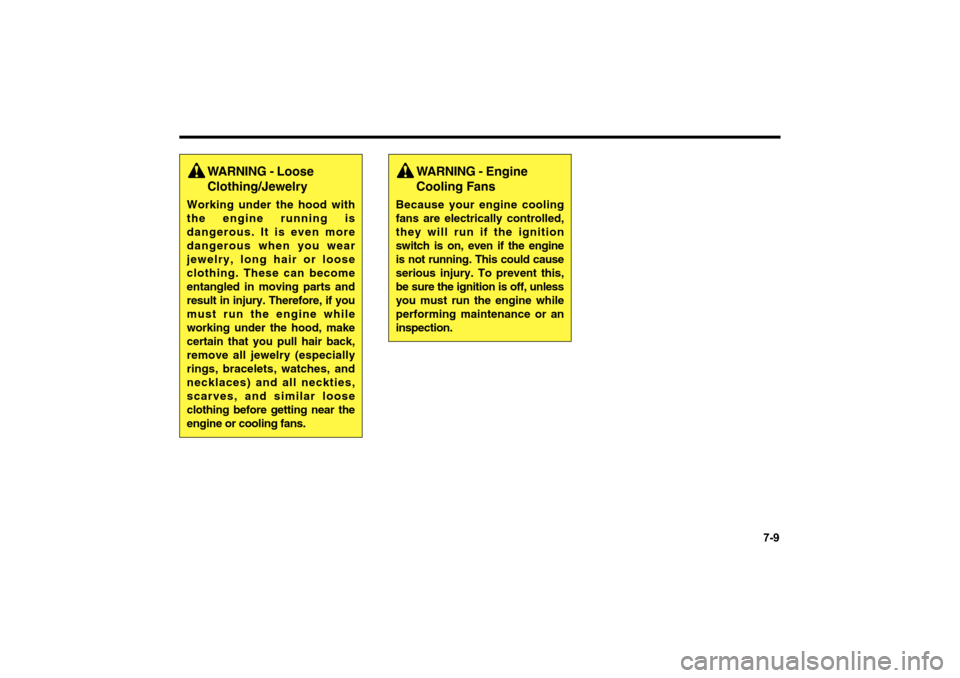
WARNING - Loose
Clothing/Jewelry
Working under the hood with
the engine running is
dangerous. It is even more
dangerous when you wear
jewelry, long hair or loose
clothing. These can become
entangled in moving parts and
result in injury. Therefore, if you
must run the engine while
working under the hood, make
certain that you pull hair back,
remove all jewelry (especially
rings, bracelets, watches, and
necklaces) and all neckties,
scarves, and similar loose
clothing before getting near the
engine or cooling fans.
WARNING - Engine
Cooling Fans
Because your engine cooling
fans are electrically controlled,
they will run if the ignition
switch is on, even if the engine
is not running. This could cause
serious injury. To prevent this,
be sure the ignition is off, unless
you must run the engine while
performing maintenance or an
inspection.
MS-CNA-Eng 7.QXD 7/25/2005 5:09 PM Page 9
Page 206 of 225
MAINTENANCE
7-30WHEEL SIZE DESIGNATIONWheels are also marked with important
information that you need if you ever
need to replace one. The following
explains what the letters and numbers in
the wheel size designation mean.
Example wheel size designation: 15 X 6J
15 - Rim diameter in inches.
6 - Rim width in inches.
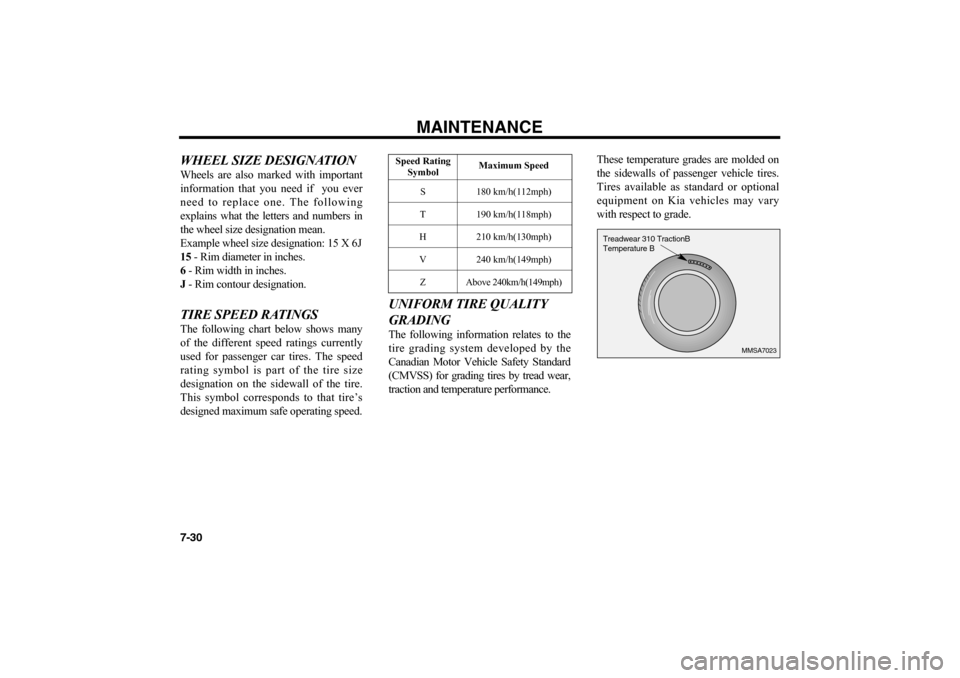
J - Rim contour designation.TIRE SPEED RATINGSThe following chart below shows many
of the different speed ratings currently
used for passenger car tires. The speed
rating symbol is part of the tire size
designation on the sidewall of the tire.
This symbol corresponds to that tire’s
designed maximum safe operating speed.
UNIFORM TIRE QUALITY
GRADINGThe following information relates to the
tire grading system developed by the
Canadian Motor Vehicle Safety Standard
(CMVSS) for grading tires by tread wear,
traction and temperature performance.These temperature grades are molded on
the sidewalls of passenger vehicle tires.
Tires available as standard or optional
equipment on Kia vehicles may vary
with respect to grade.
MMSA7023
Treadwear 310 TractionB
Temperature B
Maximum Speed
S 180 km/h(112mph)
T 190 km/h(118mph)
H 210 km/h(130mph)
V 240 km/h(149mph)
Z Above 240km/h(149mph)
Speed Rating
Symbol
MS-CNA-Eng 7.QXD 7/25/2005 5:09 PM Page 30