engine oil KIA Optima 2006 2.G User Guide
[x] Cancel search | Manufacturer: KIA, Model Year: 2006, Model line: Optima, Model: KIA Optima 2006 2.GPages: 225, PDF Size: 3.77 MB
Page 179 of 225
7-3
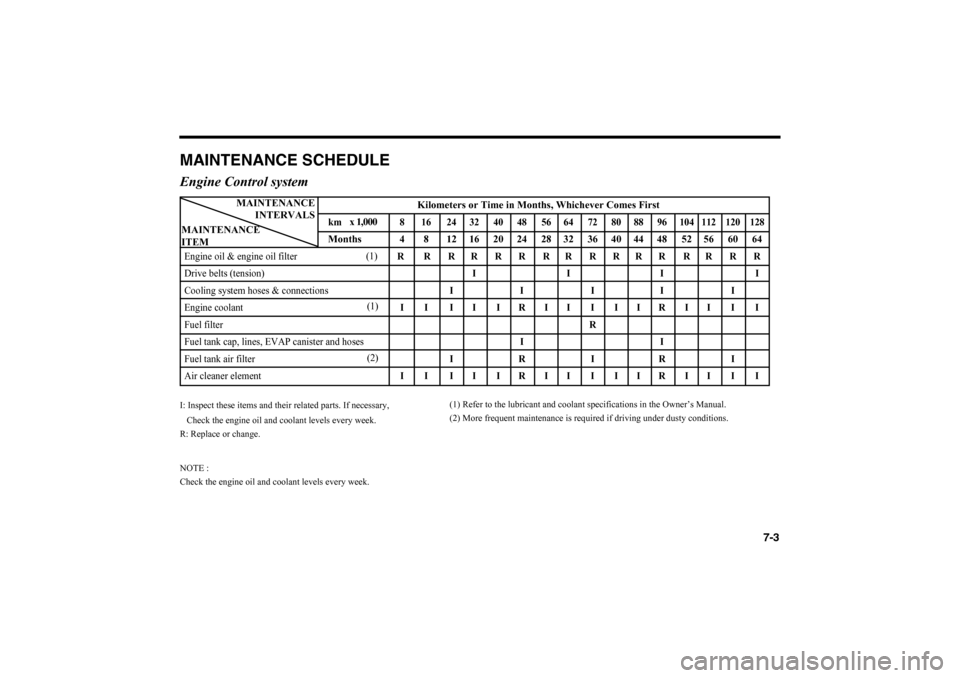
MAINTENANCE SCHEDULEEngine Control systemI: Inspect these items and their related parts. If necessary,
Check the engine oil and coolant levels every week.
R: Replace or change.
NOTE :
Check the engine oil and coolant levels every week.
Kilometers or Time in Months, Whichever Comes First
km 8 16 24 32 40 48 56 64 72 80 88 96 104 112 120 128Months 4 8 12 16 20 24 28 32 36 40 44 48 52 56 60 64
Engine oil & engine oil filter R R R R R R R R R R R R R R R R
Drive belts (tension)III I
Cooling system hoses & connectionsIIII I
Engine coolant II IIIRIIIIIRIIII
Fuel filterR
Fuel tank cap, lines, EVAP canister and hosesII
Fuel tank air filterIRIR I
Air cleaner element II IIIRIIIIIRIIII
MAINTENANCE
INTERVALS
MAINTENANCE
ITEM
x 1,000
(1)
(1)
(2)
(1) Refer to the lubricant and coolant specifications in the Owner’s Manual.
(2) More frequent maintenance is required if driving under dusty conditions.
MS-CNA-Eng 7.QXD 7/25/2005 5:09 PM Page 3
Page 184 of 225
MAINTENANCE
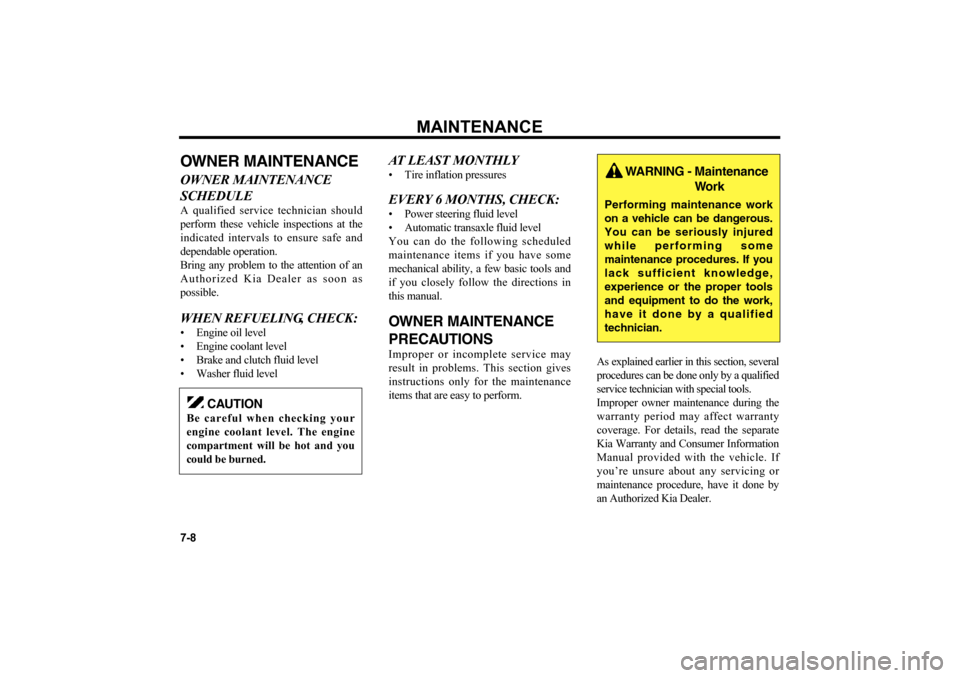
7-8OWNER MAINTENANCEOWNER MAINTENANCE
SCHEDULEA qualified service technician should
perform these vehicle inspections at the
indicated intervals to ensure safe and
dependable operation.
Bring any problem to the attention of an
Authorized Kia Dealer as soon as
possible.WHEN REFUELING, CHECK:• Engine oil level
• Engine coolant level
• Brake and clutch fluid level
• Washer fluid level
AT LEAST MONTHLY• Tire inflation pressuresEVERY 6 MONTHS, CHECK:• Power steering fluid level
• Automatic transaxle fluid level
You can do the following scheduled
maintenance items if you have some
mechanical ability, a few basic tools and
if you closely follow the directions in
this manual.OWNER MAINTENANCE
PRECAUTIONSImproper or incomplete service may
result in problems. This section gives
instructions only for the maintenance
items that are easy to perform.As explained earlier in this section, several
procedures can be done only by a qualified
service technician with special tools.
Improper owner maintenance during the
warranty period may affect warranty
coverage. For details, read the separate
Kia Warranty and Consumer Information
Manual provided with the vehicle. If
you’re unsure about any servicing or
maintenance procedure, have it done by
an Authorized Kia Dealer.
CAUTION
Be careful when checking your
engine coolant level. The engine
compartment will be hot and you
could be burned.
WARNING - Maintenance
Work
Performing maintenance work
on a vehicle can be dangerous.
You can be seriously injured
while performing some
maintenance procedures. If you
lack sufficient knowledge,
experience or the proper tools
and equipment to do the work,
have it done by a qualified
technician.
MS-CNA-Eng 7.QXD 7/25/2005 5:09 PM Page 8
Page 186 of 225
MAINTENANCE
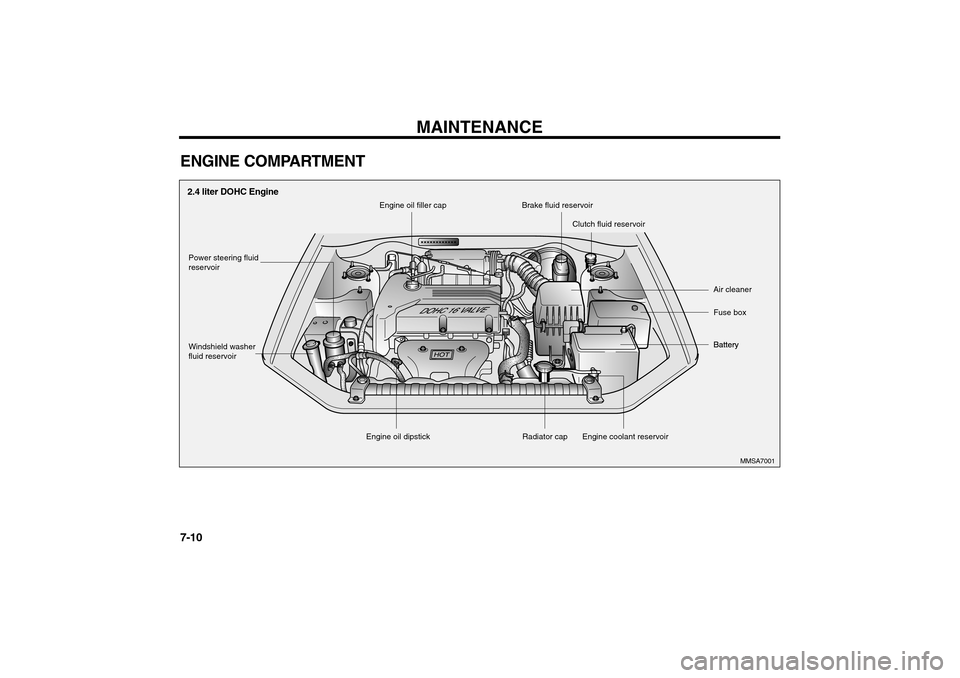
7-10ENGINE COMPARTMENT
MMSA7001
Air cleaner
Fuse box
Battery Battery
Windshield washer
fluid reservoir Power steering fluid
reservoirBrake fluid reservoir
Clutch fluid reservoir
Engine coolant reservoir Radiator cap Engine oil filler cap
Engine oil dipstick
2.4 liter DOHC Engine
MS-CNA-Eng 7.QXD 7/25/2005 5:09 PM Page 10
Page 187 of 225
7-11
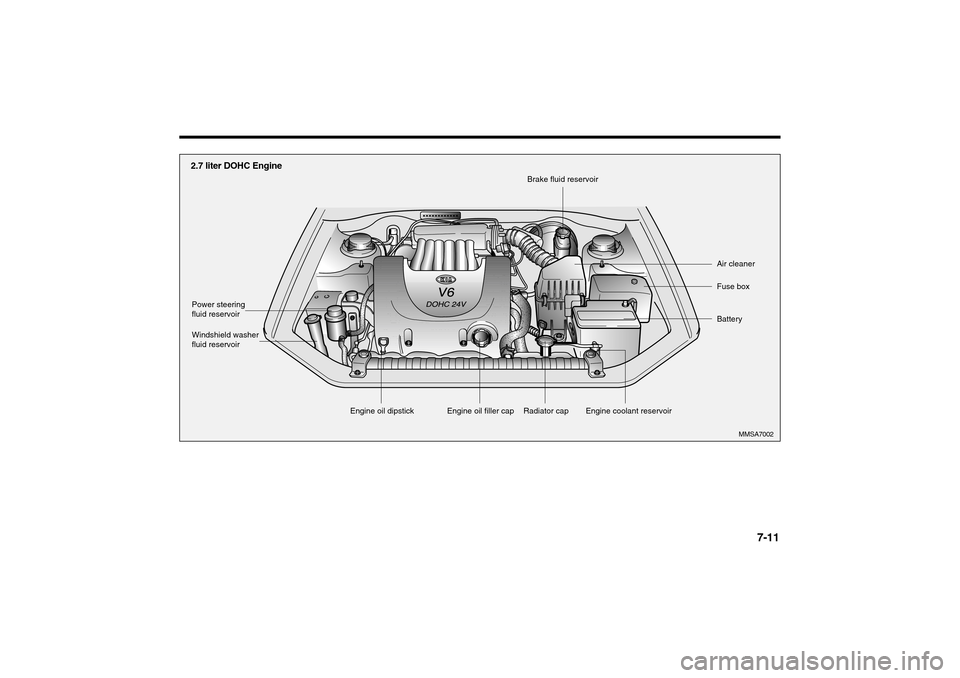
MMSA7002
2.7 liter DOHC Engine
Air cleaner
Fuse box
Battery
Windshield washer
fluid reservoir Power steering
fluid reservoirBrake fluid reservoir
Engine coolant reservoir Radiator cap Engine oil dipstick
Engine oil filler cap
MS-CNA-Eng 7.QXD 7/25/2005 5:09 PM Page 11
Page 188 of 225
MAINTENANCE
7-12ENGINE OIL AND OIL
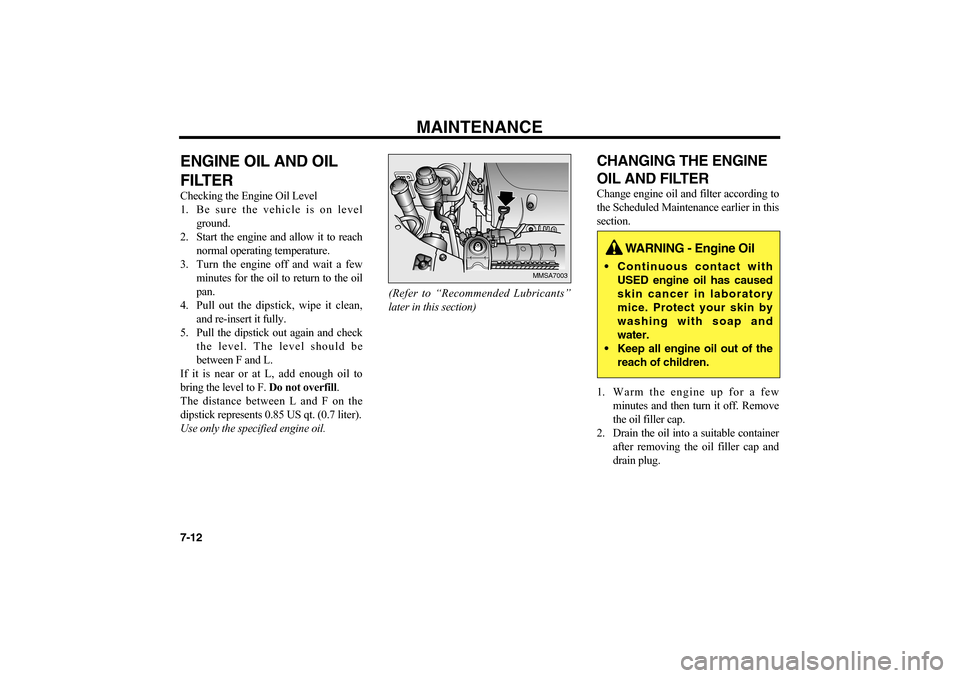
FILTERChecking the Engine Oil Level
1. Be sure the vehicle is on level
ground.
2. Start the engine and allow it to reach
normal operating temperature.
3. Turn the engine off and wait a few
minutes for the oil to return to the oil
pan.
4. Pull out the dipstick, wipe it clean,
and re-insert it fully.
5. Pull the dipstick out again and check
the level. The level should be
between F and L.
If it is near or at L, add enough oil to
bring the level to F. Do not overfill.
The distance between L and F on the
dipstick represents 0.85 US qt. (0.7 liter).
Use only the specified engine oil.(Refer to “Recommended Lubricants”
later in this section)
CHANGING THE ENGINE
OIL AND FILTERChange engine oil and filter according to
the Scheduled Maintenance earlier in this
section.
1. Warm the engine up for a few
minutes and then turn it off. Remove
the oil filler cap.
2. Drain the oil into a suitable container
after removing the oil filler cap and
drain plug.
MMSA7003
WARNING - Engine Oil
Continuous contact with
USED engine oil has caused
skin cancer in laboratory
mice. Protect your skin by
washing with soap and
water.
Keep all engine oil out of the
reach of children.
MS-CNA-Eng 7.QXD 7/25/2005 5:09 PM Page 12
Page 189 of 225
7-13
3. Remove the engine oil filter with an
oil filter wrench.
4. Use a clean rag to clean the oil filter
mounting surface on the engine.
5. Apply a small amount of engine oil
to the new oil filter O-ring seal.6. Install the oil filter and tighten it.
(Refer to the oil filter caution label
for tightening instructions.)
7. Replace the drain plug tightly after
the oil has thoroughly drained.
8. Refill the engine with new oil to the
F mark on the dipstick. Do not
overfill.
9. Re-install the oil filler cap securely.
10. Start the engine and inspect around
the oil filter seal for leaks.
Stop the engine.
Check the oil level and fill to the F
mark, if necessary.
OIL CAPACITY
2400cc Engine
- Without filter change : 4.0 liters
- With filter change : 4.3 liters
2700cc Engine
- Without filter change : 4.5 liters
- With filter change : 4.8 liters
Use only the specified engine oil. (Refer
to “Recommended Lubricants” later in
this section)
CAUTION
Both the oil and engine are hot. Do
not burn yourself.✻
NOTICE
When installing the replacement oil
filter, do not allow the oil filter
gasket to remain on the oil filter
mounting surface. This will cause
oil leakage and engine damage.
Remove the old gasket completely
so that a new gasket will properly
seat and seal.
✻
NOTICE
• Follow these instructions
carefully. An improper oil filter
installation can cause oil leakage
and engine damage.
• Although oil filters may have the
same external appearance, their
internal designs differ
significantly. These filters are not
interchangeable. To avoid
potential engine damage, use only
the specified filter. Consult an
Authorized Kia Dealer.
MS-CNA-Eng 7.QXD 7/25/2005 5:09 PM Page 13
Page 197 of 225
7-21
BODY LUBRICATIONAll moving points of the body, such as
doors, hood hinges and locks, should be
lubricated each time the engine oil is
changed.
Use a non-freezing lubricant on locks
during cold weather.
Make sure the engine hood secondary
latch keeps the hood from opening when
the primary latch is released.
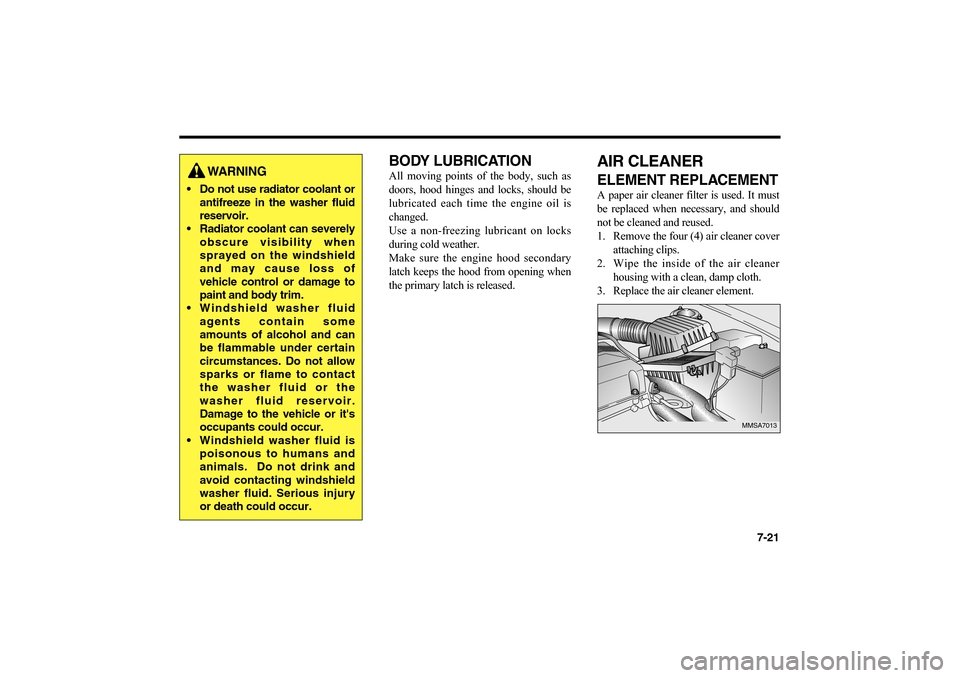
AIR CLEANERELEMENT REPLACEMENTA paper air cleaner filter is used. It must
be replaced when necessary, and should
not be cleaned and reused.
1. Remove the four (4) air cleaner cover
attaching clips.
2. Wipe the inside of the air cleaner
housing with a clean, damp cloth.
3. Replace the air cleaner element.
MMSA7013
WARNING
Do not use radiator coolant or
antifreeze in the washer fluid
reservoir.
Radiator coolant can severely
obscure visibility when
sprayed on the windshield
and may cause loss of
vehicle control or damage to
paint and body trim.
Windshield washer fluid
agents contain some
amounts of alcohol and can
be flammable under certain
circumstances. Do not allow
sparks or flame to contact
the washer fluid or the
washer fluid reservoir.
Damage to the vehicle or it's
occupants could occur.
Windshield washer fluid is
poisonous to humans and
animals. Do not drink and
avoid contacting windshield
washer fluid. Serious injury
or death could occur.
MS-CNA-Eng 7.QXD 7/25/2005 5:09 PM Page 21
Page 201 of 225
7-25
TIRES AND WHEELSTIRE CAREFor proper maintenance, safety, and
maximum fuel economy, you must
always maintain recommended tire
inflation pressures and stay within the
load limits and weight distribution
recommended for your vehicle.INFLATION PRESSURESCheck all tire pressures (including the
spare) monthly when the tires are cold.
“Cold tires” means the car has not been
driven for at least three hours or driven
less than one mile (1.6 km).
Recommended pressures must be
maintained to ensure ride quality, vehicle
handling, and minimum tire wear.
Watch the battery during
charging, and stop or reduce
the charging rate if the battery
cells begin gasing (boiling)
violently or if the temperature
of the electrolyte of any cell
exceeds 120°F (49°C).
Wear eye protection when
checking the battery during
charging.
Disconnect the battery
charger in the following
order.
1. Turn off the battery
charger main switch.
2. Unhook the negative
clamp from the negative
battery terminal.
3. Unhook the positive clamp
from the positive battery
terminal.
✻
NOTICE
• Before performing battery
maintenance or recharging, turn
OFF all accessories and stop the
engine.
• When remounted battery,
disconnect the negative (-)
battery cable first. When re-
installing the battery, reconnect
the negative (-) battery cable
last.
MS-CNA-Eng 7.QXD 7/25/2005 5:09 PM Page 25
Page 212 of 225
MAINTENANCE
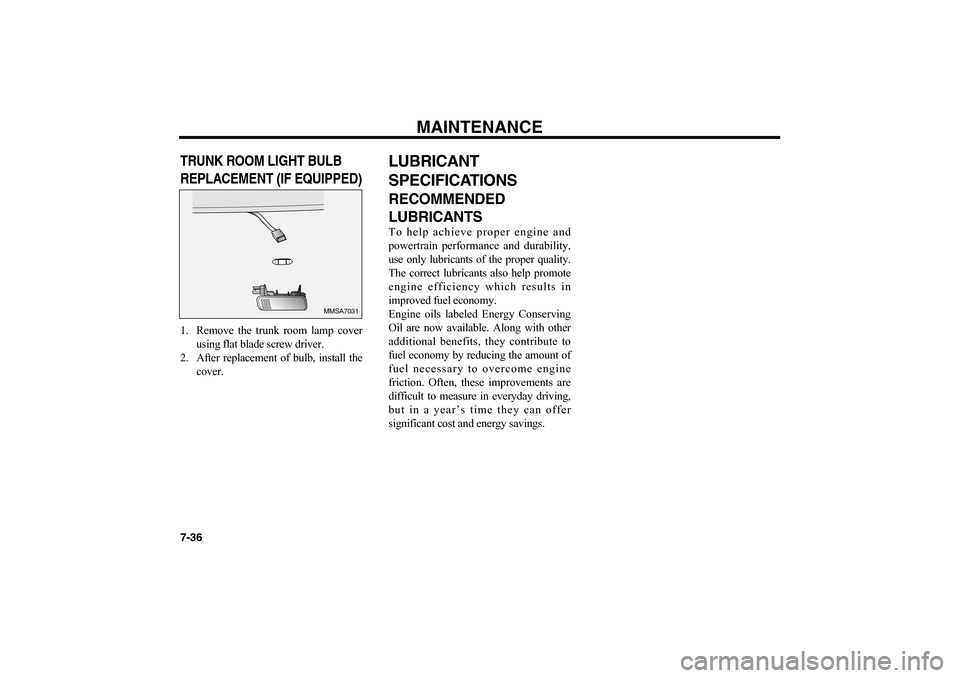
7-36TRUNK ROOM LIGHT BULB
REPLACEMENT (IF EQUIPPED)1. Remove the trunk room lamp cover
using flat blade screw driver.
2. After replacement of bulb, install the
cover.
LUBRICANT
SPECIFICATIONSRECOMMENDED
LUBRICANTSTo help achieve proper engine and
powertrain performance and durability,
use only lubricants of the proper quality.
The correct lubricants also help promote
engine efficiency which results in
improved fuel economy.
Engine oils labeled Energy Conserving
Oil are now available. Along with other
additional benefits, they contribute to
fuel economy by reducing the amount of
fuel necessary to overcome engine
friction. Often, these improvements are
difficult to measure in everyday driving,
but in a year’s time they can offer
significant cost and energy savings.
MMSA7031
MS-CNA-Eng 7.QXD 7/25/2005 5:09 PM Page 36
Page 213 of 225
7-37
RECOMMENDED SAE
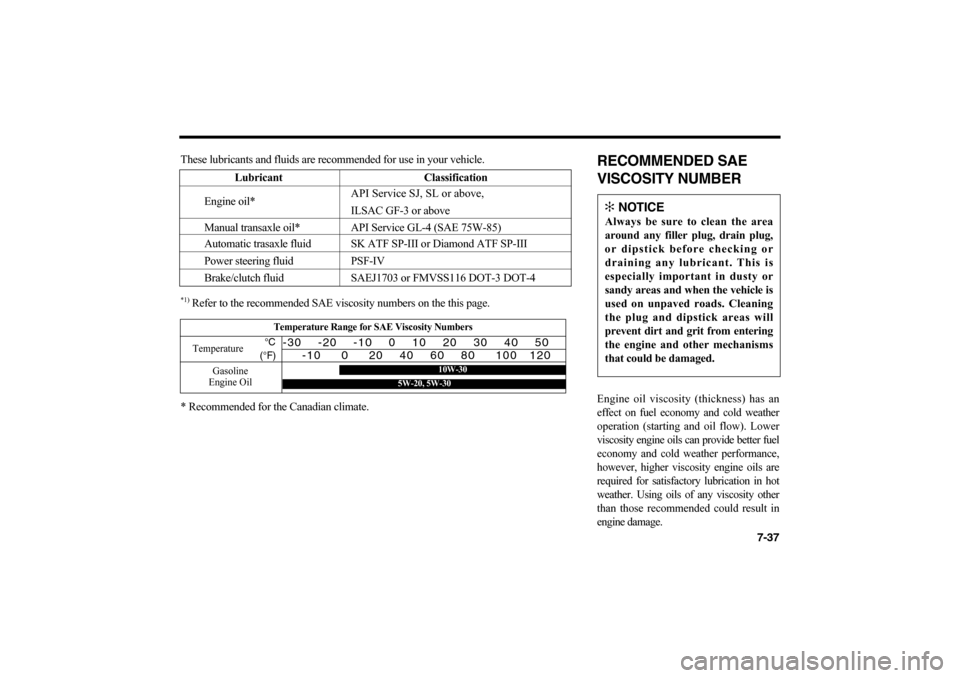
VISCOSITY NUMBEREngine oil viscosity (thickness) has an
effect on fuel economy and cold weather
operation (starting and oil flow). Lower
viscosity engine oils can provide better fuel
economy and cold weather performance,
however, higher viscosity engine oils are
required for satisfactory lubrication in hot
weather. Using oils of any viscosity other
than those recommended could result in
engine damage.
These lubricants and fluids are recommended for use in your vehicle.*1)
Refer to the recommended SAE viscosity numbers on the this page.
* Recommended for the Canadian climate.
Lubricant Classification
Engine oil* API Service SJ, SL or above,
ILSAC GF-3 or above
Manual transaxle oil* API Service GL-4 (SAE 75W-85)
Automatic trasaxle fluid SK ATF SP-III or Diamond ATF SP-III
Power steering fluid PSF-IV
Brake/clutch fluid SAEJ1703 or FMVSS116 DOT-3 DOT-4
✻
NOTICE
Always be sure to clean the area
around any filler plug, drain plug,
or dipstick before checking or
draining any lubricant. This is
especially important in dusty or
sandy areas and when the vehicle is
used on unpaved roads. Cleaning
the plug and dipstick areas will
prevent dirt and grit from entering
the engine and other mechanisms
that could be damaged.
Temperature Range for SAE Viscosity Numbers
Temperature
Gasoline
Engine Oil°C
(°F)
-30 -20 -10 0 10 20 30 40 50
-10 0 20 40 60 80 100 120
10W-30
5W-20, 5W-30
MS-CNA-Eng 7.QXD 7/25/2005 5:09 PM Page 37