fuel KIA Optima 2006 2.G Owner's Guide
[x] Cancel search | Manufacturer: KIA, Model Year: 2006, Model line: Optima, Model: KIA Optima 2006 2.GPages: 225, PDF Size: 3.77 MB
Page 164 of 225
6-13
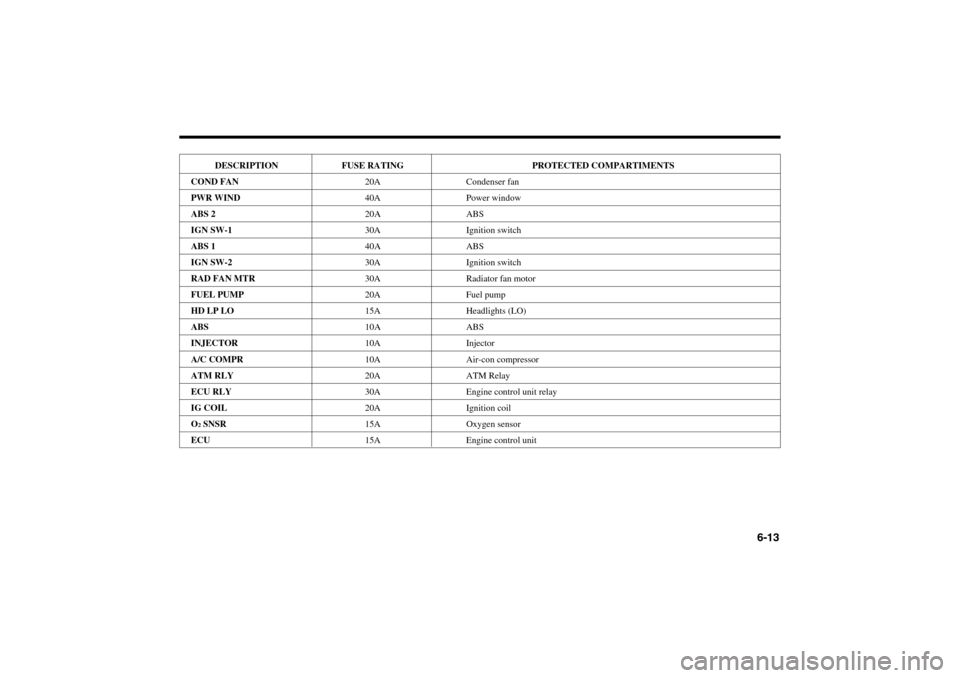
DESCRIPTION FUSE RATING PROTECTED COMPARTIMENTS
COND FAN20A Condenser fan
PWR WIND40A Power window
ABS 220A ABS
IGN SW-130A Ignition switch
ABS 140A ABS
IGN SW-230A Ignition switch
RAD FAN MTR30A Radiator fan motor
FUEL PUMP20A Fuel pump
HD LP LO15A Headlights (LO)
ABS10A ABS
INJECTOR10A Injector
A/C COMPR10A Air-con compressor
ATM RLY20A ATM Relay
ECU RLY30A Engine control unit relay
IG COIL20A Ignition coil
O
2SNSR15A Oxygen sensor
ECU15A Engine control unit
MS-CNA-Eng 6.QXD 7/25/2005 5:13 PM Page 13
Page 179 of 225
7-3
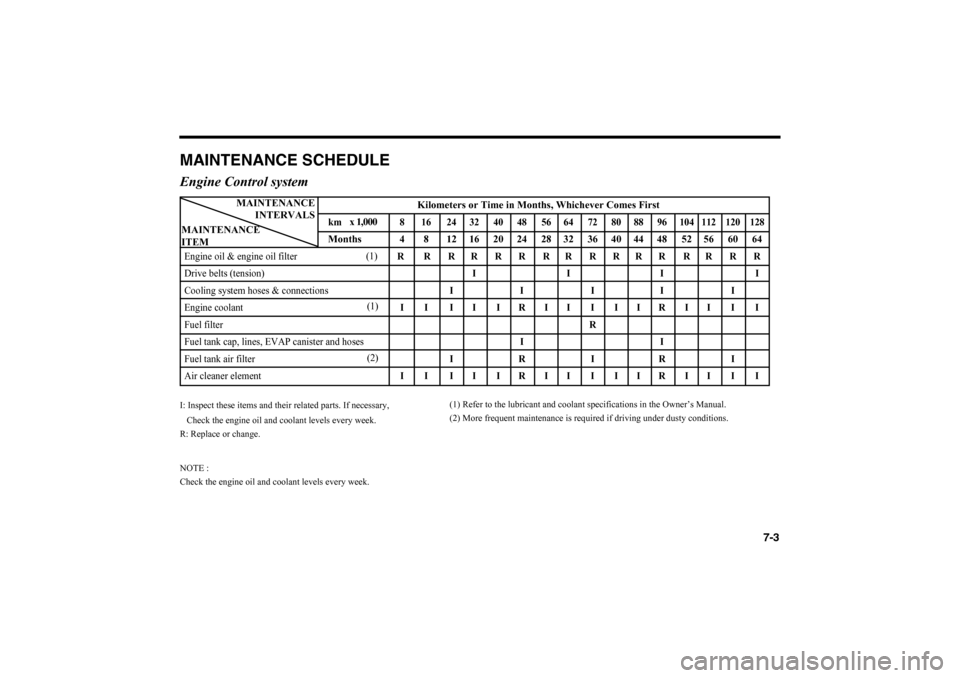
MAINTENANCE SCHEDULEEngine Control systemI: Inspect these items and their related parts. If necessary,
Check the engine oil and coolant levels every week.
R: Replace or change.
NOTE :
Check the engine oil and coolant levels every week.
Kilometers or Time in Months, Whichever Comes First
km 8 16 24 32 40 48 56 64 72 80 88 96 104 112 120 128Months 4 8 12 16 20 24 28 32 36 40 44 48 52 56 60 64
Engine oil & engine oil filter R R R R R R R R R R R R R R R R
Drive belts (tension)III I
Cooling system hoses & connectionsIIII I
Engine coolant II IIIRIIIIIRIIII
Fuel filterR
Fuel tank cap, lines, EVAP canister and hosesII
Fuel tank air filterIRIR I
Air cleaner element II IIIRIIIIIRIIII
MAINTENANCE
INTERVALS
MAINTENANCE
ITEM
x 1,000
(1)
(1)
(2)
(1) Refer to the lubricant and coolant specifications in the Owner’s Manual.
(2) More frequent maintenance is required if driving under dusty conditions.
MS-CNA-Eng 7.QXD 7/25/2005 5:09 PM Page 3
Page 184 of 225
MAINTENANCE
7-8OWNER MAINTENANCEOWNER MAINTENANCE
SCHEDULEA qualified service technician should
perform these vehicle inspections at the
indicated intervals to ensure safe and
dependable operation.
Bring any problem to the attention of an
Authorized Kia Dealer as soon as
possible.WHEN REFUELING, CHECK:• Engine oil level
• Engine coolant level
• Brake and clutch fluid level
• Washer fluid level
AT LEAST MONTHLY• Tire inflation pressuresEVERY 6 MONTHS, CHECK:• Power steering fluid level
• Automatic transaxle fluid level
You can do the following scheduled
maintenance items if you have some
mechanical ability, a few basic tools and
if you closely follow the directions in
this manual.OWNER MAINTENANCE
PRECAUTIONSImproper or incomplete service may
result in problems. This section gives
instructions only for the maintenance
items that are easy to perform.As explained earlier in this section, several
procedures can be done only by a qualified
service technician with special tools.
Improper owner maintenance during the
warranty period may affect warranty
coverage. For details, read the separate
Kia Warranty and Consumer Information
Manual provided with the vehicle. If
you’re unsure about any servicing or
maintenance procedure, have it done by
an Authorized Kia Dealer.
CAUTION
Be careful when checking your
engine coolant level. The engine
compartment will be hot and you
could be burned.
WARNING - Maintenance
Work
Performing maintenance work
on a vehicle can be dangerous.
You can be seriously injured
while performing some
maintenance procedures. If you
lack sufficient knowledge,
experience or the proper tools
and equipment to do the work,
have it done by a qualified
technician.
MS-CNA-Eng 7.QXD 7/25/2005 5:09 PM Page 8
Page 201 of 225
7-25
TIRES AND WHEELSTIRE CAREFor proper maintenance, safety, and
maximum fuel economy, you must
always maintain recommended tire
inflation pressures and stay within the
load limits and weight distribution
recommended for your vehicle.INFLATION PRESSURESCheck all tire pressures (including the
spare) monthly when the tires are cold.
“Cold tires” means the car has not been
driven for at least three hours or driven
less than one mile (1.6 km).
Recommended pressures must be
maintained to ensure ride quality, vehicle
handling, and minimum tire wear.
Watch the battery during
charging, and stop or reduce
the charging rate if the battery
cells begin gasing (boiling)
violently or if the temperature
of the electrolyte of any cell
exceeds 120°F (49°C).
Wear eye protection when
checking the battery during
charging.
Disconnect the battery
charger in the following
order.
1. Turn off the battery
charger main switch.
2. Unhook the negative
clamp from the negative
battery terminal.
3. Unhook the positive clamp
from the positive battery
terminal.
✻
NOTICE
• Before performing battery
maintenance or recharging, turn
OFF all accessories and stop the
engine.
• When remounted battery,
disconnect the negative (-)
battery cable first. When re-
installing the battery, reconnect
the negative (-) battery cable
last.
MS-CNA-Eng 7.QXD 7/25/2005 5:09 PM Page 25
Page 202 of 225
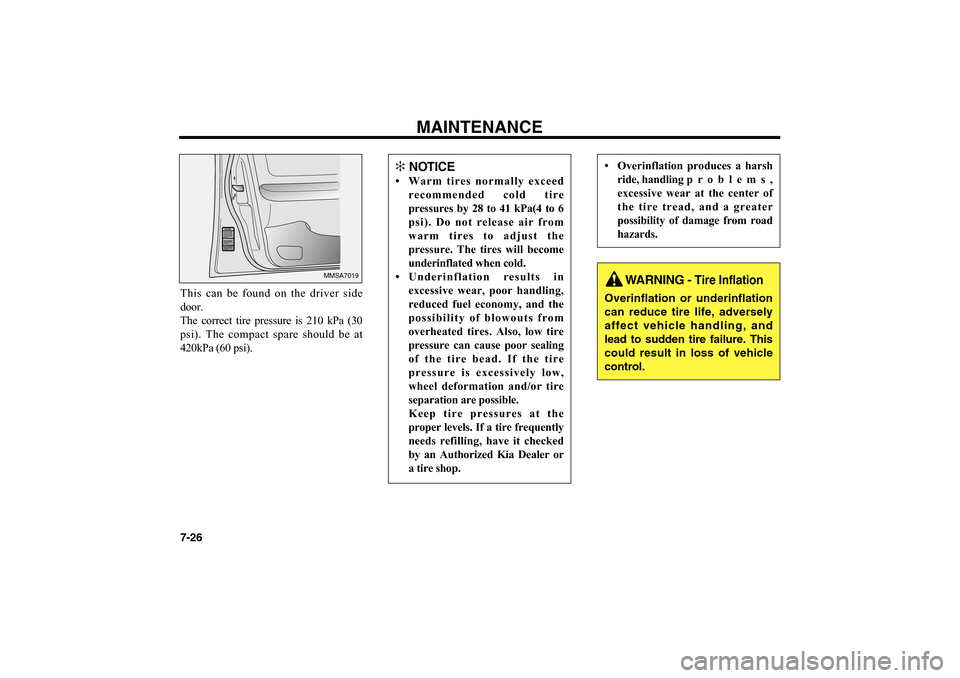
This can be found on the driver side
door.
The correct tire pressure is 210 kPa (30
psi). The compact spare should be at
420kPa (60 psi).
MAINTENANCE
7-26
MMSA7019
✻
NOTICE
• Warm tires normally exceed
recommended cold tire
pressures by 28 to 41 kPa(4 to 6
psi). Do not release air from
warm tires to adjust the
pressure. The tires will become
underinflated when cold.
• Underinflation results in
excessive wear, poor handling,
reduced fuel economy, and the
possibility of blowouts from
overheated tires. Also, low tire
pressure can cause poor sealing
of the tire bead. If the tire
pressure is excessively low,
wheel deformation and/or tire
separation are possible.
Keep tire pressures at the
proper levels. If a tire frequently
needs refilling, have it checked
by an Authorized Kia Dealer or
a tire shop.
• Overinflation produces a harsh
ride, handling problems,
excessive wear at the center of
the tire tread, and a greater
possibility of damage from road
hazards.
WARNING -
Tire Inflation
Overinflation or underinflation
can reduce tire life, adversely
affect vehicle handling, and
lead to sudden tire failure. This
could result in loss of vehicle
control.
MS-CNA-Eng 7.QXD 7/25/2005 5:09 PM Page 26
Page 212 of 225
MAINTENANCE
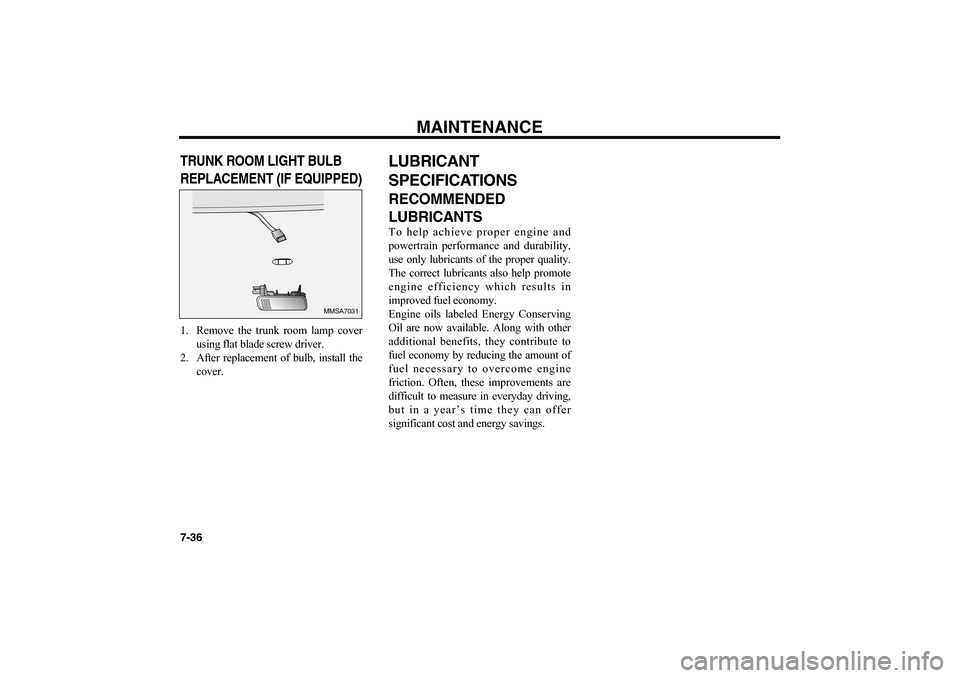
7-36TRUNK ROOM LIGHT BULB
REPLACEMENT (IF EQUIPPED)1. Remove the trunk room lamp cover
using flat blade screw driver.
2. After replacement of bulb, install the
cover.
LUBRICANT
SPECIFICATIONSRECOMMENDED
LUBRICANTSTo help achieve proper engine and
powertrain performance and durability,
use only lubricants of the proper quality.
The correct lubricants also help promote
engine efficiency which results in
improved fuel economy.
Engine oils labeled Energy Conserving
Oil are now available. Along with other
additional benefits, they contribute to
fuel economy by reducing the amount of
fuel necessary to overcome engine
friction. Often, these improvements are
difficult to measure in everyday driving,
but in a year’s time they can offer
significant cost and energy savings.
MMSA7031
MS-CNA-Eng 7.QXD 7/25/2005 5:09 PM Page 36
Page 213 of 225
7-37
RECOMMENDED SAE
VISCOSITY NUMBEREngine oil viscosity (thickness) has an
effect on fuel economy and cold weather
operation (starting and oil flow). Lower
viscosity engine oils can provide better fuel
economy and cold weather performance,
however, higher viscosity engine oils are
required for satisfactory lubrication in hot
weather. Using oils of any viscosity other
than those recommended could result in
engine damage.
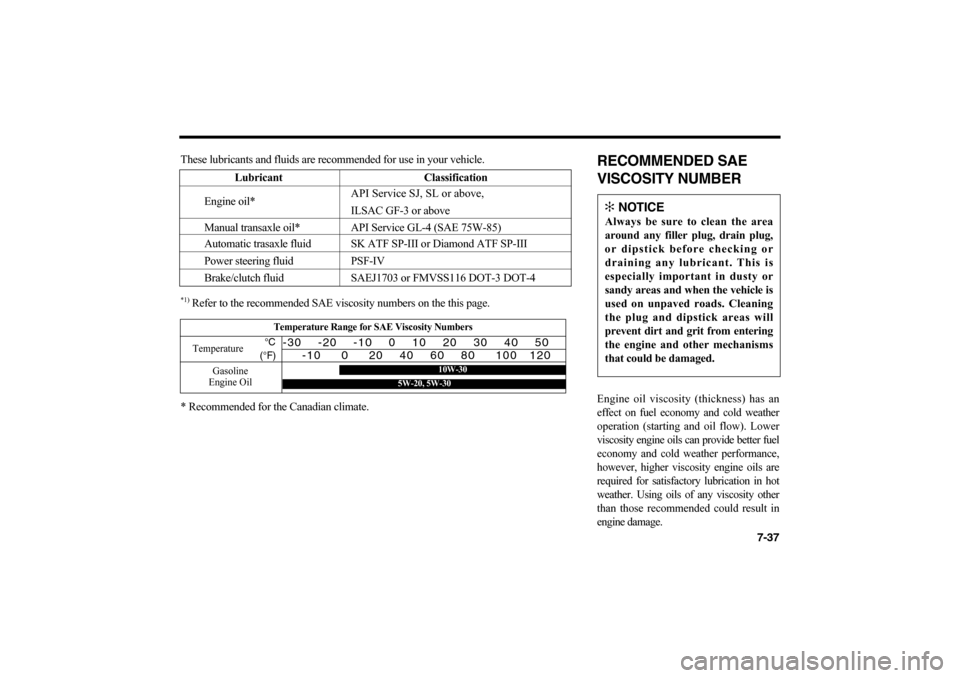
These lubricants and fluids are recommended for use in your vehicle.*1)
Refer to the recommended SAE viscosity numbers on the this page.
* Recommended for the Canadian climate.
Lubricant Classification
Engine oil* API Service SJ, SL or above,
ILSAC GF-3 or above
Manual transaxle oil* API Service GL-4 (SAE 75W-85)
Automatic trasaxle fluid SK ATF SP-III or Diamond ATF SP-III
Power steering fluid PSF-IV
Brake/clutch fluid SAEJ1703 or FMVSS116 DOT-3 DOT-4
✻
NOTICE
Always be sure to clean the area
around any filler plug, drain plug,
or dipstick before checking or
draining any lubricant. This is
especially important in dusty or
sandy areas and when the vehicle is
used on unpaved roads. Cleaning
the plug and dipstick areas will
prevent dirt and grit from entering
the engine and other mechanisms
that could be damaged.
Temperature Range for SAE Viscosity Numbers
Temperature
Gasoline
Engine Oil°C
(°F)
-30 -20 -10 0 10 20 30 40 50
-10 0 20 40 60 80 100 120
10W-30
5W-20, 5W-30
MS-CNA-Eng 7.QXD 7/25/2005 5:09 PM Page 37
Page 215 of 225
7-39
FINISH DAMAGE REPAIRDeep scratches or stone chips in the
painted surface must be repaired
promptly. Exposed metal will quickly
rust and may develop into a major repair
expense.
BRIGHT-METAL MAINTENANCE• To remove road tar and insects, use a
tar remover, not a scraper or other
sharp object.
• To protect the surfaces of bright-
metal parts from corrosion, apply a
coating of wax or chrome
preservative and rub to a high luster.
• During winter weather or in coastal
areas, cover the bright metal parts
with a heavier coating of wax or
preservative. If necessary, coat the
parts with non-corrosive petroleum
jelly or other protective compound.
UNDERBODY
MAINTENANCECorrosive materials used for ice and
snow removal or dust control may
collect on the underbody. If these
materials are not removed, accelerated
rusting can occur on underbody parts,
such as the fuel lines, frame, floor pan
and exhaust system, even though they
have been treated with rust protection.
Thoroughly flush the vehicle underbody
and wheel openings with lukewarm or
cold water once a month and especially
at the end of each winter. Pay special
attention to these areas because it is
difficult to see all the mud and dirt. The
lower edges of doors, rocker panels, and
frame members have drain holes that
should not be allowed to clog with dirt;
trapped water in these areas can cause
rusting. It will do more harm than good
to wet down the road grime without
removing it.
✻
NOTICE
• Wiping dust or dirt off the body
with a dry cloth will scratch the
inish.
• Do not use steel wool, abrasive
cleaners, or strong detergents
containing highly alkaline or
caustic agents on chrome-plated
or anodized aluminum parts.
This may result in damage to the
protective coating and cause
discoloration or paint
deterioration.
✻
NOTICE
If your vehicle is damaged and
requires any metal repair or
replacement, be sure the body shop
applies anti-corrosion materials to
the parts repaired or replaced.
MS-CNA-Eng 7.QXD 7/25/2005 5:09 PM Page 39
Page 218 of 225
MAINTENANCE
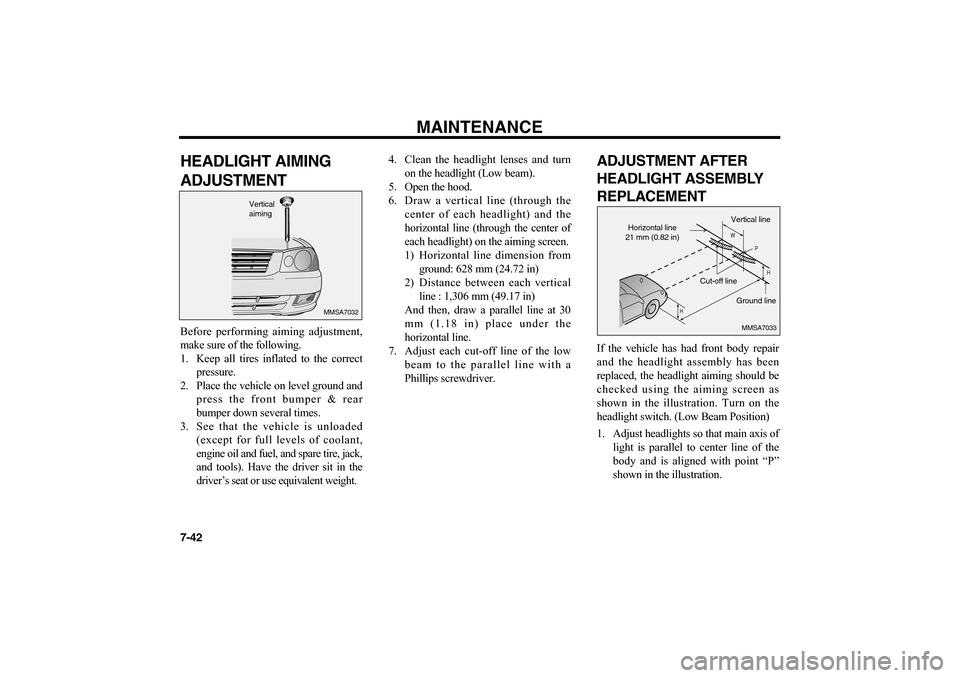
7-42HEADLIGHT AIMING
ADJUSTMENTBefore performing aiming adjustment,
make sure of the following.
1. Keep all tires inflated to the correct
pressure.
2. Place the vehicle on level ground and
press the front bumper & rear
bumper down several times.
3. See that the vehicle is unloaded
(except for full levels of coolant,
engine oil and fuel, and spare tire, jack,
and tools). Have the driver sit in the
driver’s seat or use equivalent weight.4. Clean the headlight lenses and turn
on the headlight (Low beam).
5. Open the hood.
6. Draw a vertical line (through the
center of each headlight) and the
horizontal line (through the center of
each headlight) on the aiming screen.
1) Horizontal line dimension from
ground: 628 mm (24.72 in)
2) Distance between each vertical
line : 1,306 mm (49.17 in)
And then, draw a parallel line at 30
mm (1.18 in) place under the
horizontal line.
7. Adjust each cut-off line of the low
beam to the parallel line with a
Phillips screwdriver.
ADJUSTMENT AFTER
HEADLIGHT ASSEMBLY
REPLACEMENTIf the vehicle has had front body repair
and the headlight assembly has been
replaced, the headlight aiming should be
checked using the aiming screen as
shown in the illustration. Turn on the
headlight switch. (Low Beam Position)
1. Adjust headlights so that main axis of
light is parallel to center line of the
body and is aligned with point “P”
shown in the illustration.
MMSA7032
Vertical
aiming
HH W
P
MMSA7033
Horizontal line
21 mm (0.82 in)
Cut-off line
Ground line Vertical line
MS-CNA-Eng 7.QXD 7/25/2005 5:09 PM Page 42
Page 223 of 225
ENGINE
ELECTRICAL SYSTEMCAPACITIES
(Unit: Liter)
SPECIFICATIONS
8-4
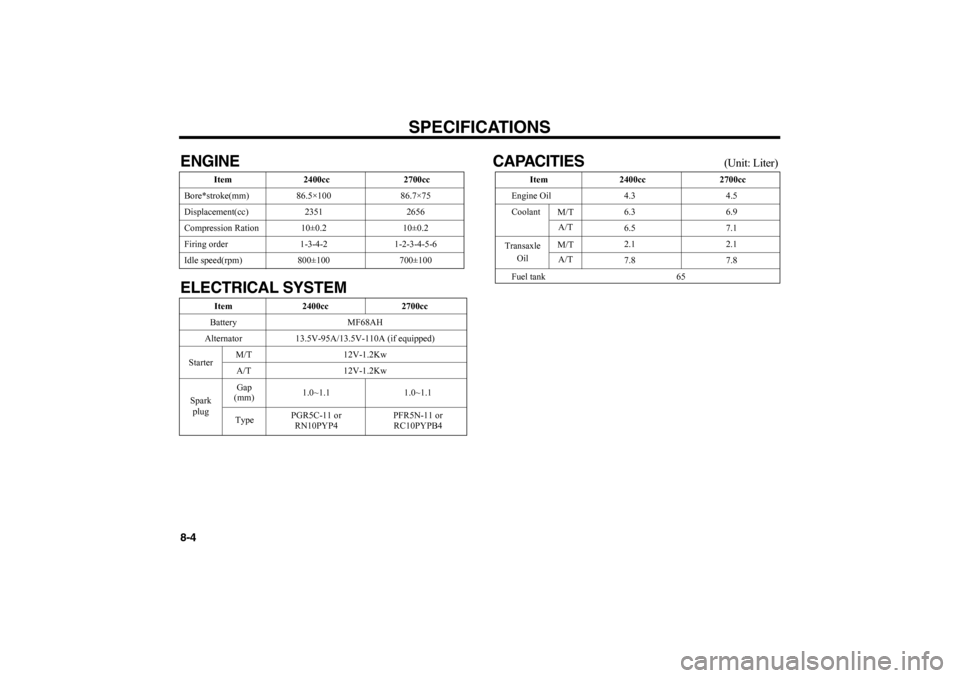
Item 2400cc 2700cc
Battery MF68AH
Alternator 13.5V-95A/13.5V-110A (if equipped)
M/T 12V-1.2Kw
A/T 12V-1.2Kw
1.0~1.1 1.0~1.1
PGR5C-11 or PFR5N-11 or
RN10PYP4 RC10PYPB4 Starter
Gap
(mm)
Type Spark
plugItem 2400cc 2700cc
Bore*stroke(mm) 86.5×100 86.7×75
Displacement(cc) 2351 2656
Compression Ration 10±0.2 10±0.2
Firing order 1-3-4-2 1-2-3-4-5-6
Idle speed(rpm) 800±100 700±100
Item 2400cc 2700cc
Engine Oil 4.3 4.5
Coolant 6.3 6.9
6.5 7.1
2.1 2.1
7.8 7.8
Fuel tank 65
Transaxle
OilM/T
A/T
M/T
A/T
MS-CNA-Eng 8.QXD 7/25/2005 5:07 PM Page 4