lock KIA Optima 2007 2.G Owner's Guide
[x] Cancel search | Manufacturer: KIA, Model Year: 2007, Model line: Optima, Model: KIA Optima 2007 2.GPages: 294, PDF Size: 3.37 MB
Page 33 of 294
Knowing your vehicle24
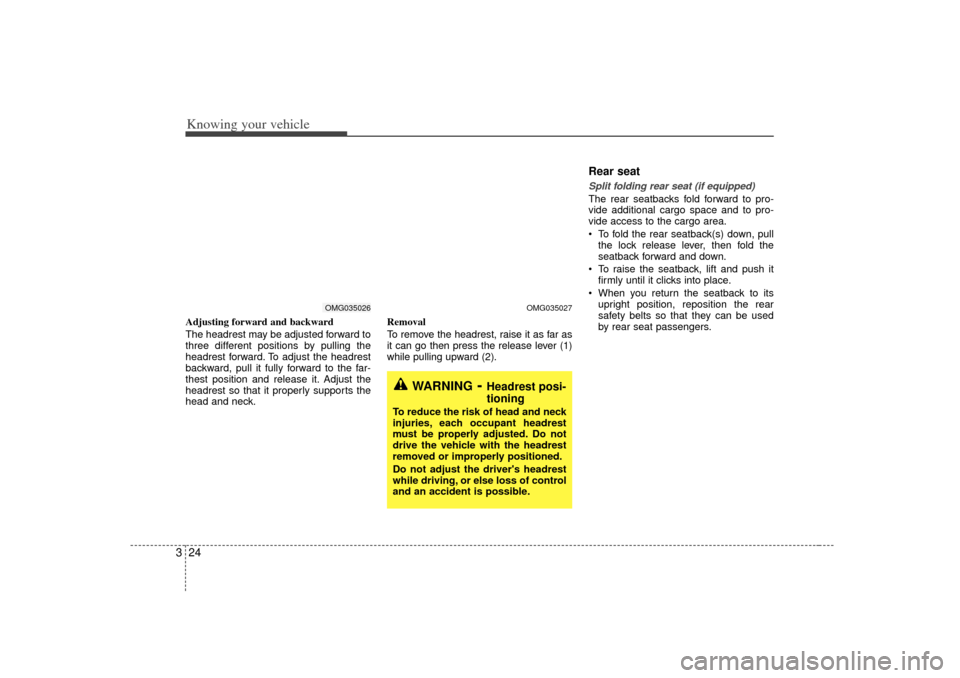
3Adjusting forward and backward
The headrest may be adjusted forward to
three different positions by pulling the
headrest forward. To adjust the headrest
backward, pull it fully forward to the far-
thest position and release it. Adjust the
headrest so that it properly supports the
head and neck. Removal
To remove the headrest, raise it as far as
it can go then press the release lever (1)
while pulling upward (2).
Rear seat Split folding rear seat (if equipped) The rear seatbacks fold forward to pro-
vide additional cargo space and to pro-
vide access to the cargo area.
To fold the rear seatback(s) down, pull
the lock release lever, then fold the
seatback forward and down.
To raise the seatback, lift and push it
firmly until it clicks into place.
When you return the seatback to its
upright position, reposition the rear
safety belts so that they can be used
by rear seat passengers.
WARNING
- Headrest posi-
tioning
To reduce the risk of head and neck
injuries, each occupant headrest
must be properly adjusted. Do not
drive the vehicle with the headrest
removed or improperly positioned.
Do not adjust the driver's headrest
while driving, or else loss of control
and an accident is possible.
OMG035026
OMG035027
Page 34 of 294
325
Knowing your vehicle
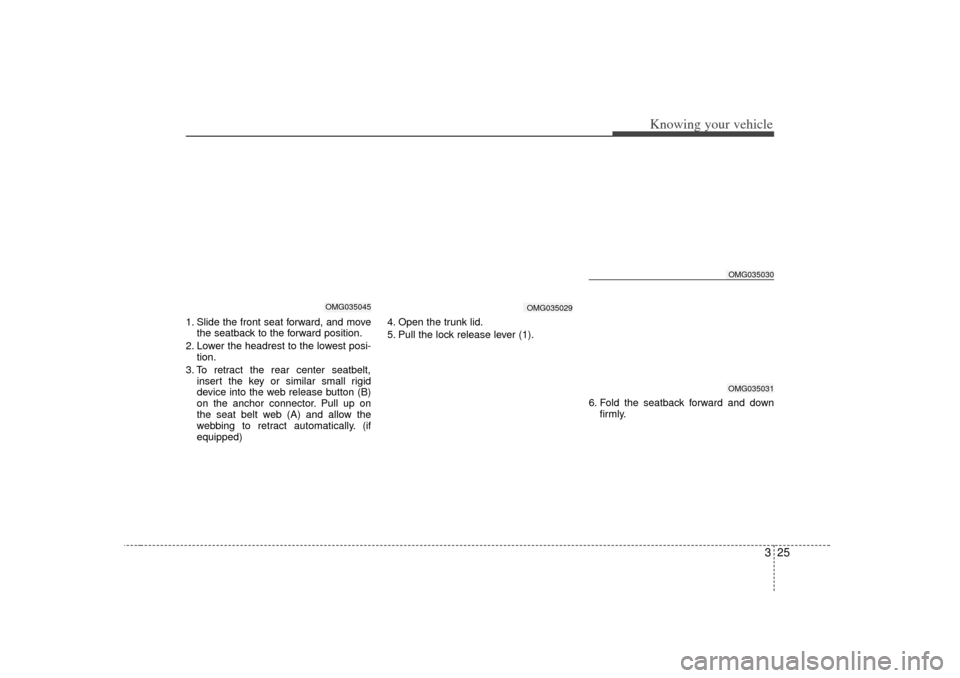
1. Slide the front seat forward, and movethe seatback to the forward position.
2. Lower the headrest to the lowest posi- tion.
3. To retract the rear center seatbelt, insert the key or similar small rigid
device into the web release button (B)
on the anchor connector. Pull up on
the seat belt web (A) and allow the
webbing to retract automatically. (if
equipped) 4. Open the trunk lid.
5. Pull the lock release lever (1).
6. Fold the seatback forward and downfirmly.
OMG035045
OMG035029
OMG035030OMG035031
Page 39 of 294
Knowing your vehicle30
3Safety belt restraint system
We strongly recommend that the driver
and all passengers be properly
restrained at all times by using the safety
belts provided with the vehicle. Proper
use of the safety belts decreases the risk
of severe injury or death in accidents or
sudden stops. In most states, and in
Canada, the law requires their use.
All seats have lap/shoulder belts. Inertial
locks in the safety belt retractors allow all
of the lap/shoulder safety belts to remain
unlocked during normal vehicle opera-
tion. This allows the occupants some
freedom of movement and increased
comfort while using the safety belts. If a
force is applied to the vehicle, such as a
sudden stop, a sharp turn, or a collision,
the safety belt retractors will automatical-
ly lock the safety belts.
Since the inertial locks do not require a
collision in order to lock up, you may
become aware of the safety belts locking
while braking or going around sharp cor-
ners.
Always use the rear seat position(s) to
install your child restraint(s). The rear safety belts use a special auto-
lock feature designed to allow a child
restraint to be used in these positions
without an added locking clip. They nor-
mally lock only under extreme or emer-
gency conditions (emergency lock
mode). However they can be adjusted so
that they remain fixed and locked when a
child restraint system is placed in these
positions. (Use this auto-lock mode only
to secure a child restraint, never for pas-
sengers restrained by the safety belts.)
Page 3-43 gives instructions on placing
the safety belt in the auto lock mode.
The drivers safety belt can only operate
in the emergency lock mode.
WARNING
- Safety belts
To minimize the risk of serious or
fatal injury in an accident, the driv-
er and all passengers should use
the appropriate safety restraints for
their age and size. The presence of
air bags does not change the need
to be properly restrained by a safe-
ty belt or size-appropriate child
restraint. In fact, air bags are
designed to work the best when
passengers are correctly restrained
in the vehicle.
Be sure you are familiar with the
information in this section,
including the information on
infant and child restraints.
Read the safety warnings on the sun visors of your vehicle also.
WARNING
- Child restraint
in front seat
Never install a child restraint sys-
tem in the front passenger position,
as an inflating air bag could cause
serious or fatal injury to a child in
that position.
Page 42 of 294
333
Knowing your vehicle
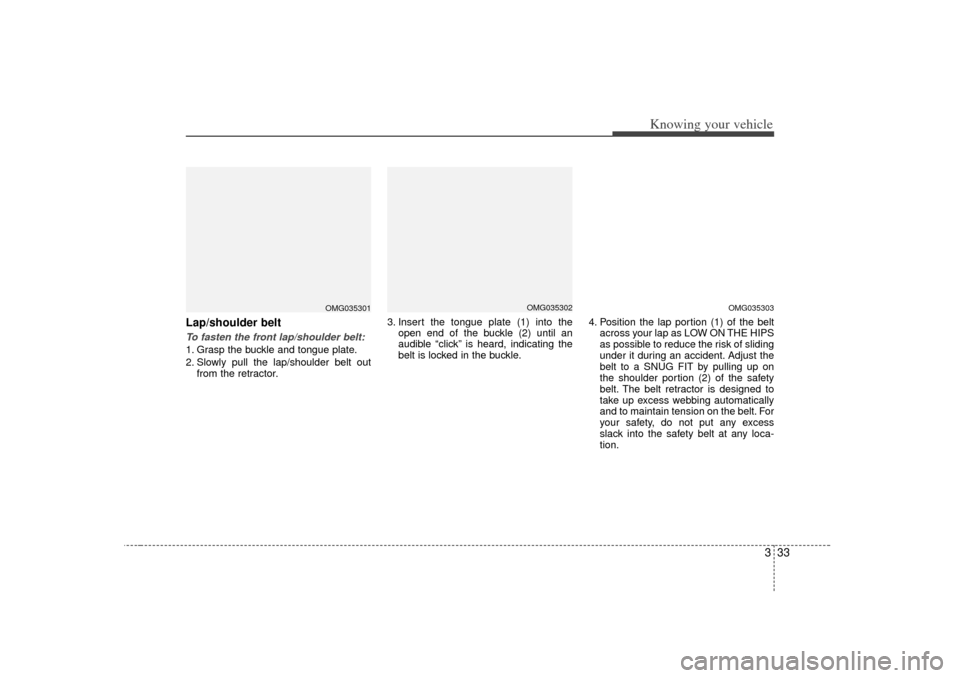
Lap/shoulder beltTo fasten the front lap/shoulder belt:1. Grasp the buckle and tongue plate.
2. Slowly pull the lap/shoulder belt outfrom the retractor. 3. Insert the tongue plate (1) into the
open end of the buckle (2) until an
audible “click”is heard, indicating the
belt is locked in the buckle. 4. Position the lap portion (1) of the belt
across your lap as LOW ON THE HIPS
as possible to reduce the risk of sliding
under it during an accident. Adjust the
belt to a SNUG FIT by pulling up on
the shoulder portion (2) of the safety
belt. The belt retractor is designed to
take up excess webbing automatically
and to maintain tension on the belt. For
your safety, do not put any excess
slack into the safety belt at any loca-
tion.
OMG035303
OMG035301
OMG035302
Page 43 of 294

Knowing your vehicle34
35. Adjust the shoulder anchor position to
your size. To raise the anchor position,
push the anchor up (1). To lower the
anchor position, press (2) the button
(A) and slide the anchor down (3).
After adjustment, make sure the
anchor is locked in position.
If the height of the adjusting seat belt is
too near your neck, you will not be getting
the most effective protection. The shoul-
der portion should be adjusted so that it
lies across your chest and midway over
your shoulder nearest the door and not
your neck.
To unfasten the front lap/shoulder belt:Press the release button on the buckle
and allow the belt to slowly retract.
OMG035304
WARNING
The height adjuster must be in the locked position when the
vehicle is moving.
The misadjustment of height of the shoulder belt could reduce
the effectiveness of the seat belt
in a crash.
OMG035038
Page 44 of 294
335
Knowing your vehicle
Rear lap/shoulder belt To fasten the rear lap/shoulder belt:1. Grasp the buckle and tongue plate.
2. Slowly pull the lap/shoulder belt out.
3. Insert the tongue plate (1) into theopen end of the buckle (2) until an
audible “click’’is heard, indicating the
belt is locked in the buckle. 4. Position the lap portion (1) of the belt
across your lap as LOW ON THE HIPS
as possible to reduce the risk of sliding
under it during an accident. Adjust the
belt to a SNUG FIT by pulling up on
the shoulder portion (2) of the safety
belt. The belt retractor is designed to
take up excess webbing automatically
and to maintain tension on the belt. For
your safety do not put any excess
slack into the safety belt.
To unfasten the rear lap/shoulder belt:Press the release button on the buckle
and allow the belt to slowly retract.
OMG035302
OMG035303
OMG035304
Page 45 of 294
Knowing your vehicle36
3✽
✽
NOTICEWhen returning the rear seatbacks to
the upright position, remember to
return the rear shoulder belts to their
proper position. Routing the safety belt
webbing through the rear safety belt
guides will help keep the belts from
being trapped behind or under the seats.
3 Point rear center belt
(if equipped) To fasten the rear center belt1. Insert the tongue plate (A) into the
open end of the anchor connector (B)
until an audible “click" is heard, indi-
cating the latch is locked. Make sure
the belt is not twisted. 2. Pull the tongue plate (C) and insert the
tongue plate (C) into the open end of
the buckle (D) until an audible “click”is
heard, indicating the latch is locked.
Make sure the belt is not twisted.
OMG035042
(if equipped)
OMG035041
OMG035043
Page 46 of 294
337
Knowing your vehicle
There will be an audible “click”when the
tab locks in the buckle. The seat belt
automatically adjusts to the proper length
only after the lap belt is adjusted manu-
ally so that it fits snugly around your hips.
If you lean forward in a slow, easy
motion, the belt will extend and let you
move around. If there is a sudden stop or
impact, the belt will lock into position. It
will also lock if you try to lean forward too
quickly.
When using the rear center seat belt, the
buckle with the “CENTER”mark must be
used.
WARNING
When using the rear seat center
belt, you must lock all tongue plates
and buckle/anchor connector. If any
tongue plate or buckle/anchor con-
nector is not locked, it will increase
the chance of injury or death in the
event of collision.
OMG035039
WARNING
- Lock center rear seat
When using the rear center belt,
you must lock all tongue plates
and buckles prior to use. If any
tongue plate or buckle is not
locked, it will increase the chance
of injury or death in the event of
collision.
The rear center seatbelt tongue plate (A) and anchor connector
(B) should remain locked at all
times. They should only be
unlocked when folding the rear
seatback down or when carrying
an object in the rear seat that
could cause damage to the seat-
belt webbing or locking devices.
In either case, lock the tongue
plate (A) and anchor connector
(B) immediately after unfolding
the seatbacks or removing the
object being transported.
Page 51 of 294
Knowing your vehicle42
3
Installing a child restraint system For safety reasons, we recommend that
the child restraint system be used in the
rear seats.
Never place a rear-facing child
restraint in the front passenger seat,
because of the danger that an inflat-
ing passenger side air bag could
impact the rear-facing child restraint
and kill the child.
Since all passenger safety belts move
freely under normal conditions and only
lock under extreme or emergency condi-
tions (emergency lock mode), you must
manually change these safety belts to
the auto lock mode to secure a child
restraint.
(Continued)
If the vehicle’s safety belt will not
properly fit the child, you must
use an appropriate child restraint
or booster seat in the rear.
Never allow a child to stand up or kneel while the vehicle is moving.
Never use an infant carrier or child seat that "hooks" over a
seatback. It will not provide ade-
quate protection in an accident.
Never allow a child to be held while they are in a moving vehi-
cle, as this could result in serious
injury or death to the child in the
event of an accident or sudden
stop. Holding a child in a moving
vehicle does not provide the child
with any protection during an
accident, even if the person hold-
ing the child is wearing a seat
belt.
WARNING
- Child seat
installation
Before installing the child
restraint system, read the instruc-
tions supplied by the child
restraint system manufacturer.
If the safety belt does not operate as described in this section, have
the system checked immediately
by your authorized Kia dealer.
Failure to observe this manual's instructions regarding child
restraint system and the instruc-
tions provided with the child
restraint system could increase
the chance and/or severity of
injury or death in an accident.
Page 52 of 294
343
Knowing your vehicle
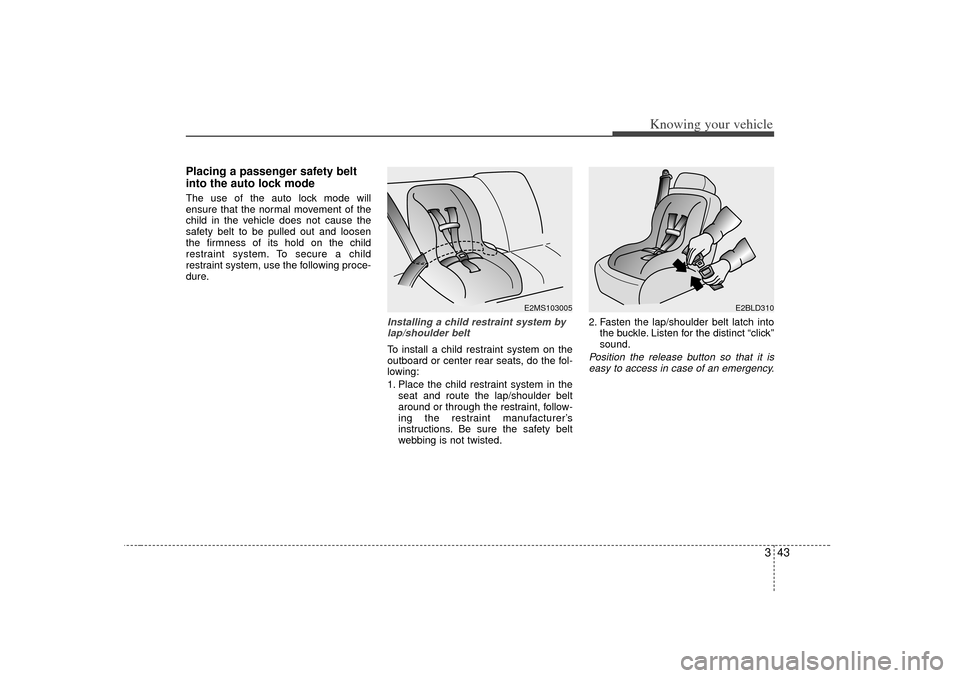
Placing a passenger safety belt
into the auto lock modeThe use of the auto lock mode will
ensure that the normal movement of the
child in the vehicle does not cause the
safety belt to be pulled out and loosen
the firmness of its hold on the child
restraint system. To secure a child
restraint system, use the following proce-
dure.
Installing a child restraint system bylap/shoulder beltTo install a child restraint system on the
outboard or center rear seats, do the fol-
lowing:
1. Place the child restraint system in the seat and route the lap/shoulder belt
around or through the restraint, follow-
ing the restraint manufacturer’ s
instructions. Be sure the safety belt
webbing is not twisted. 2. Fasten the lap/shoulder belt latch into
the buckle. Listen for the distinct “click”
sound.
Position the release button so that it is easy to access in case of an emergency.
E2MS103005
E2BLD310