warning KIA Optima 2008 2.G Owners Manual
[x] Cancel search | Manufacturer: KIA, Model Year: 2008, Model line: Optima, Model: KIA Optima 2008 2.GPages: 289, PDF Size: 4.78 MB
Page 210 of 289
Driving tips8 5Snow tires If you mount snow tires on your Kia,
make sure they are radial tires of the
same size and load range as the original
tires. Mount snow tires on all four wheels
to balance your vehicle’s handling in all
weather conditions. Keep in mind that the
traction provided by snow tires on dry
roads may not be as high as your vehi-
cle's original equipment tires. You should
drive cautiously even when the roads are
clear. Check with the tire dealer for max-
imum speed recommendations.Do not install studded tires without first
checking local, state and municipal regu-
lations for possible restrictions against
their use.
Driving in flooded areas Avoid driving through flooded areas
unless you are sure the water is no high-
er than the bottom of the wheel hub.
Drive through any water slowly. Allow
adequate stopping distance because
brake performance may be affected.
After driving through water, dry the
brakes by gently applying them several
times while the vehicle is moving slowly.
WARNING
- Snow tire size
Snow tires should be equivalent in
size and type to the vehicle's stan-
dard tires. Otherwise, the safety and
handling of your vehicle may be
adversely affected.
Page 211 of 289
59
Driving tips
TRAILER TOWING
✽ ✽
NOTICE
Pulling a trailer improperly can damage
your vehicle and result in costly repairs
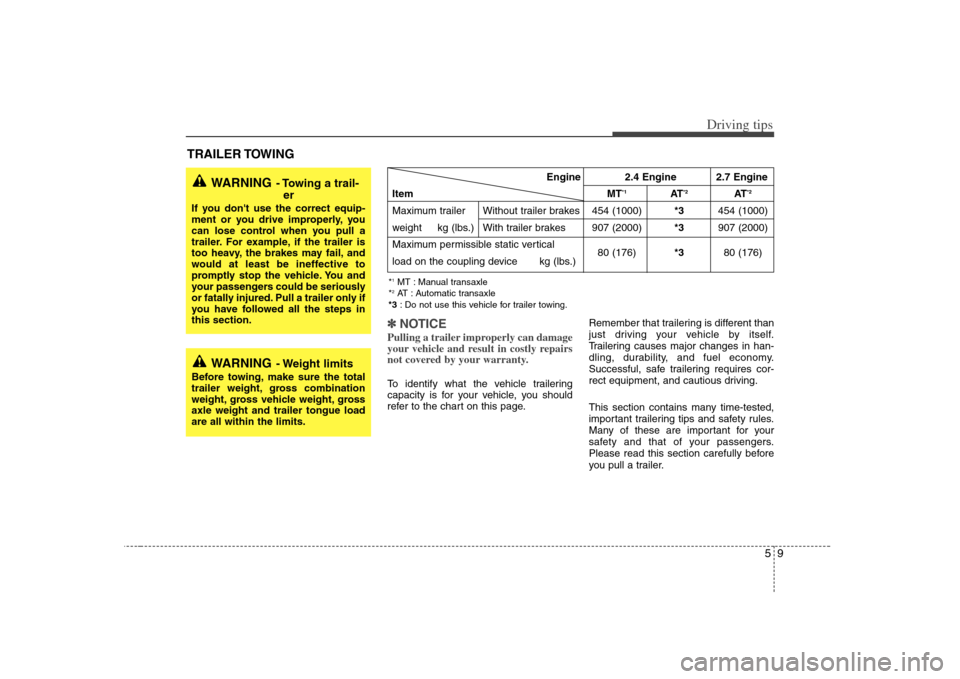
not covered by your warranty. To identify what the vehicle trailering
capacity is for your vehicle, you should
refer to the chart on this page.Remember that trailering is different than
just driving your vehicle by itself.
Trailering causes major changes in han-
dling, durability, and fuel economy.
Successful, safe trailering requires cor-
rect equipment, and cautious driving.
This section contains many time-tested,
important trailering tips and safety rules.
Many of these are important for your
safety and that of your passengers.
Please read this section carefully before
you pull a trailer.
WARNING
- Towing a trail-
er
If you don't use the correct equip-
ment or you drive improperly, you
can lose control when you pull a
trailer. For example, if the trailer is
too heavy, the brakes may fail, and
would at least be ineffective to
promptly stop the vehicle. You and
your passengers could be seriously
or fatally injured. Pull a trailer only if
you have followed all the steps in
this section.
WARNING
- Weight limits
Before towing, make sure the total
trailer weight, gross combination
weight, gross vehicle weight, gross
axle weight and trailer tongue load
are all within the limits.
Engine 2.4 Engine 2.7 Engine
Item MT
*1
AT
*2
AT
*2
Maximum trailer Without trailer brakes 454 (1000)*3454 (1000)
weight kg (lbs.) With trailer brakes 907 (2000)*3907 (2000)
Maximum permissible static vertical
80 (176)*380 (176)
load on the coupling device kg (lbs.)*1MT : Manual transaxle
*2AT : Automatic transaxle
*3: Do not use this vehicle for trailer towing.
Page 212 of 289
Driving tips10 5Load-pulling components such as the
engine, transaxle, wheel assemblies, and
tires are forced to work harder against
the load of the added weight. The engine
is required to operate at relatively higher
speeds and under greater loads. This
additional burden generates extra heat
which creates more wear in engine, and
a shortened engine life. The trailer also
adds considerably to wind resistance,
increasing the pulling requirements.Hitches It's important to have the correct hitch
equipment. Crosswinds, large trucks
going by, and rough roads are a few rea-
sons why you’ll need the right hitch. Here
are some rules to follow:
Do not attach a trailer hitch which
requires you to alter other parts on
your vehicle.
Never make a hole in your vehicle to
accommodate a hitch.
The bumpers on your vehicle are not
intended for hitches. Do not attach
rental hitches or other bumper-type
hitches to them. Use only a frame-
mounted hitch that does not attach to
the bumper.
Safety chains You should always attach chains
between your vehicle and your trailer.
Cross the safety chains under the tongue
of the trailer so that the tongue will not
drop to the road if it becomes separated
from the hitch.
Instructions about safety chains may be
provided by the hitch manufacturer or by
the trailer manufacturer. Follow the man-
ufacturer’s recommendation for attaching
safety chains. Always leave just enough
slack so you can turn with your trailer.
And, never allow safety chains to drag on
the ground.
Trailer brakes If your trailer weighs more than the max-
imum weight for a trailer without brakes,
then the trailer needs its own brakes. You
must consult with a knowledgeable and
reputabel trailer vendor to determine
which brake equipped trailer is right for
your needs. Be sure to read and follow
the instructions for the trailer brakes so
you’ll be able to install, adjust and main-
tain them properly.
WARNING
If you damage the body of your car,
installing, or using a trailer hitch,
you must have any resulting hole
immediately repaired, An unsealed
hole can allow deadly carbon
monoxide (CO) from your exhaust
into your vehicle.
WARNING
- Trailer brakes
Do not use a trailer with its own
brakes unless you are absolutely
certain that you have properly set
up the brake system pursuant to
the trailer manufacture’s instruc-
tions. This is not a task for ama-
teurs. Use an experienced, compe-
tent trailer shop for this work.
WARNING
- Trailer and
vehicle brakes
NEVER connect or allow anyone
else to connect your vehicle’s
brakes to any trailer brake system.
Altering your vehicle’s brakes could
result in total brake failure.
Page 213 of 289
511
Driving tips
Driving with a trailer Towing a trailer requires experience. You
must gain that experience slowly and
carefully which practicing with an
unloaded or lightly loaded trailer. Before
setting out for the open road, you must
get to know your trailer. Acquaint yourself
with the feel of handling and braking with
the trailer. And always keep in mind that
the vehicle you are driving is now a good
deal longer and not nearly so responsive
as your vehicle is by itself.
Before you start, check the trailer hitch
and platform, safety chains, electrical
connector(s), lights, tires and mirror
adjustment. If the trailer has brakes, fol-
low the trailer manufacturer’s instructions
as to how to check the brakes before you
start driving.
During your trip, stop every hour or so to
be sure that the load is secure, and that
the lights and any trailer brakes are work-
ing.Following distance Stay at least twice as far behind the vehi-
cle ahead as you would when driving
your vehicle without a trailer. This can
help you avoid situations that require
heavy braking and sudden turns.
Passing You’ll need more passing distance up
ahead when you’re towing a trailer. And,
because of the increased vehicle length,
you’ll need to go much farther beyond the
passed vehicle before you can return to
your lane.Backing up The trailer will go in the opposite direc-
tion of the rear of your vehicle when
backing up. This is very difficult for an
inexperienced trailer driver to get used
to. To help you avoid mistakes, hold the
bottom of the steering wheel with one
hand. Then, to move the trailer to the left,
just hold the steering wheel firmly and
move your hand to the left. To move the
trailer to the right, move your hand to the
right. Always back up slowly and, if pos-
sible, have someone guide you.Making turns When you’re turning with a trailer, make
wider turns than normal. Do this so your
trailer won’t strike soft shoulders, curbs,
road signs, trees, or other objects. Avoid
jerky or sudden maneuvers. Signal well
in advance.
Turn signals when towing a trailer When you tow a trailer, your vehicle has
to have a different turn signal flasher and
extra wiring. The green arrows on your
instrument panel will flash whenever you
signal a turn or lane change. Properly
connected, the trailer lights will also flash
to alert other drivers you’re about to turn,
change lanes, or stop.
When towing a trailer, the green arrows
on your instrument panel will flash for
turns even if the bulbs on the trailer are
burned out. Thus, you may think drivers
behind you are seeing your signals
when, in fact, they are not. It’s important
to check occasionally to be sure the trail-
er bulbs are still working. You must also
check the lights every time you discon-
nect and then reconnect the wires.
Do not connect a trailer lighting system
directly to your vehicle’s lighting system.
Use only an approved trailer wiring har-
ness.
Your Authorized Kia Dealer can assist
you in installing the wiring harness.
WARNING -
Trailer wiring
harness
Failure to use an approved trailer
wiring harness could result in an
accident due to the failure of the
trailer lights to operate.
Page 214 of 289
Driving tips12 5✽
✽
NOTICEFailure to sue a trailer wiring harness
can damage your vehicle’s electrical sys-
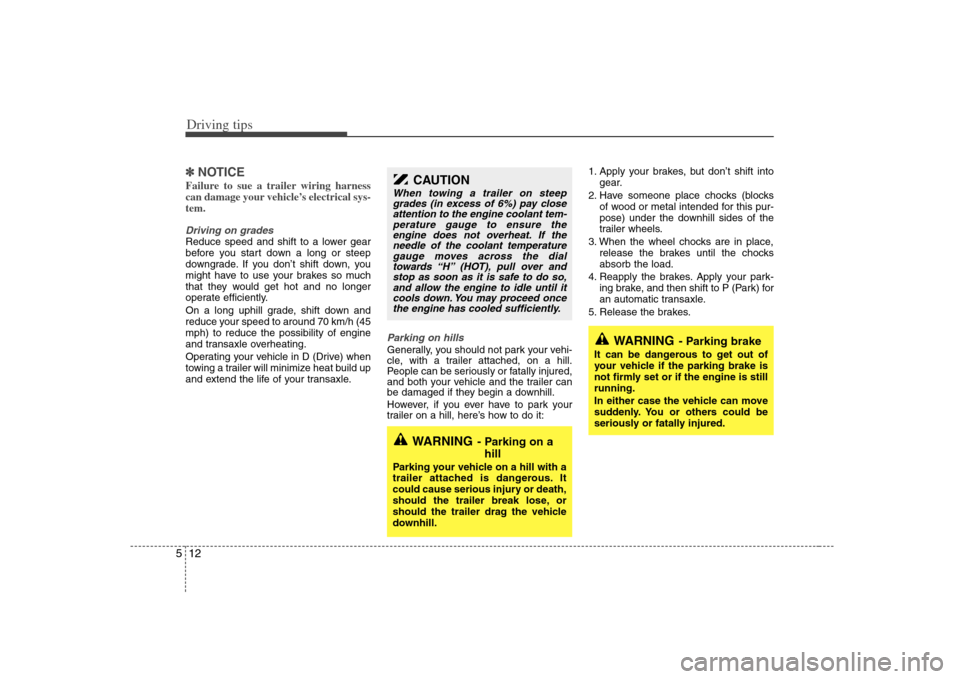
tem.Driving on grades Reduce speed and shift to a lower gear
before you start down a long or steep
downgrade. If you don’t shift down, you
might have to use your brakes so much
that they would get hot and no longer
operate efficiently.
On a long uphill grade, shift down and
reduce your speed to around 70 km/h (45
mph) to reduce the possibility of engine
and transaxle overheating.
Operating your vehicle in D (Drive) when
towing a trailer will minimize heat build up
and extend the life of your transaxle.
Parking on hills Generally, you should not park your vehi-
cle, with a trailer attached, on a hill.
People can be seriously or fatally injured,
and both your vehicle and the trailer can
be damaged if they begin a downhill.
However, if you ever have to park your
trailer on a hill, here’s how to do it:1. Apply your brakes, but don’t shift into
gear.
2. Have someone place chocks (blocks
of wood or metal intended for this pur-
pose) under the downhill sides of the
trailer wheels.
3. When the wheel chocks are in place,
release the brakes until the chocks
absorb the load.
4. Reapply the brakes. Apply your park-
ing brake, and then shift to P (Park) for
an automatic transaxle.
5. Release the brakes.
CAUTION
When towing a trailer on steep
grades (in excess of 6%) pay close
attention to the engine coolant tem-
perature gauge to ensure the
engine does not overheat. If the
needle of the coolant temperature
gauge moves across the dial
towards “H” (HOT), pull over and
stop as soon as it is safe to do so,
and allow the engine to idle until it
cools down. You may proceed once
the engine has cooled sufficiently.
WARNING
- Parking on a
hill
Parking your vehicle on a hill with a
trailer attached is dangerous. It
could cause serious injury or death,
should the trailer break lose, or
should the trailer drag the vehicle
downhill.
WARNING
- Parking brake
It can be dangerous to get out of
your vehicle if the parking brake is
not firmly set or if the engine is still
running.
In either case the vehicle can move
suddenly. You or others could be
seriously or fatally injured.
Page 216 of 289
Driving tips14 5Weight of the trailer tongue
The tongue load of any trailer is an
important weight to measure because it
affects the total gross vehicle weight
(GVW) of your vehicle since that is the
trailer weight pushing down on the hitch
on your vehicle. The rest of the trailer
weight is sitting on the trailer’s wheels.
The trailer tongue should weigh a maxi-
mum of 10% of the total loaded trailer
weight. After you've loaded the trailer, go
to a Weigh Station and weigh the trailer
and then the tongue, separately, to see if
the weights are proper. If they aren’t, you
may be able to correct them simply by
moving some items around in the trailer.
WARNING -
Trailer balance
Never load a trailer with more
weight in the rear than in the
front. The front should be loaded
with approximately 60% of the
total trailer load; the rear should
be loaded with approximately
40% of the total trailer load.
Never exceed the maximum
weight limits of the trailer or trail-
er towing equipment. Improper
loading can result in excessive
personal injury. Check weights
and loading at a commercial
scale or highway patrol office
equipped with scales.
An improperly loaded trailer can
cause loss of vehicle control.
WARNING
- Vehicle weight
The gross axle weight rating
(GAWR) and the gross vehicle
weight rating (GVWR) for your vehi-
cle are on the manufacturer's label
attached to the driver's door.
Exceeding these ratings can cause
an accident or vehicle damage. You
can calculate the weight of your
load by weighing the items (and
people) before putting them in the
vehicle. Be careful not to overload
your vehicle.
OVERLOADING
Page 219 of 289
6
Road warning / 6-2
Overheating / 6-2
Emergency starting / 6-3
Electrical circuit protection / 6-6
Towing / 6-13
If you have a flat tire / 6-18
In case of an emergency
Page 220 of 289
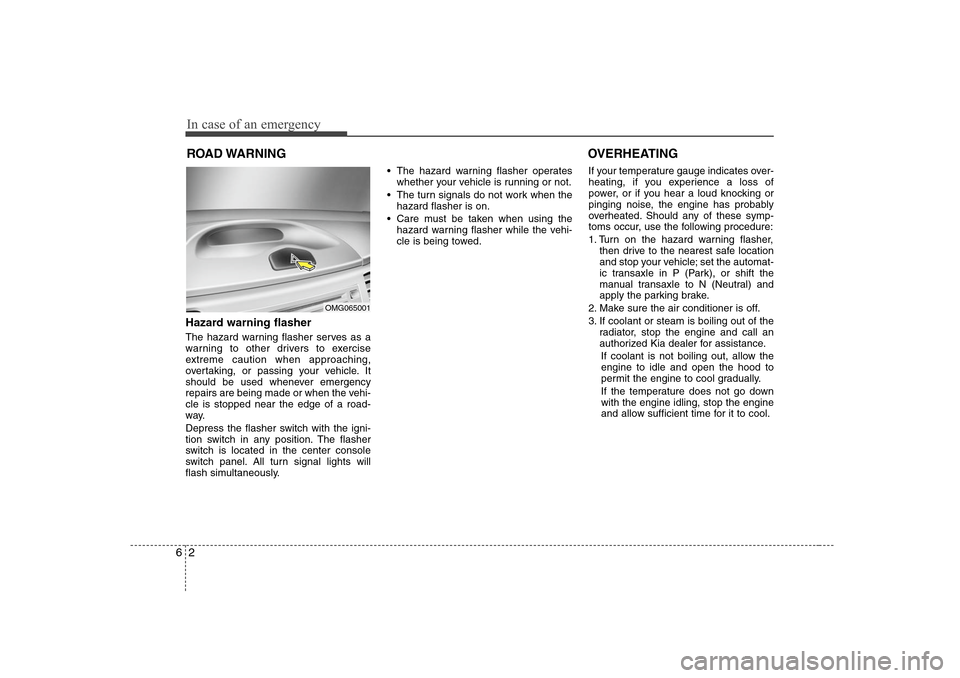
In case of an emergency2 6ROAD WARNING Hazard warning flasher The hazard warning flasher serves as a
warning to other drivers to exercise
extreme caution when approaching,
overtaking, or passing your vehicle. It
should be used whenever emergency
repairs are being made or when the vehi-
cle is stopped near the edge of a road-
way.
Depress the flasher switch with the igni-
tion switch in any position. The flasher
switch is located in the center console
switch panel. All turn signal lights will
flash simultaneously.• The hazard warning flasher operates
whether your vehicle is running or not.
The turn signals do not work when the
hazard flasher is on.
Care must be taken when using the
hazard warning flasher while the vehi-
cle is being towed.If your temperature gauge indicates over-
heating, if you experience a loss of
power, or if you hear a loud knocking or
pinging noise, the engine has probably
overheated. Should any of these symp-
toms occur, use the following procedure:
1. Turn on the hazard warning flasher,
then drive to the nearest safe location
and stop your vehicle; set the automat-
ic transaxle in P (Park), or shift the
manual transaxle to N (Neutral) and
apply the parking brake.
2. Make sure the air conditioner is off.
3. If coolant or steam is boiling out of the
radiator, stop the engine and call an
authorized Kia dealer for assistance.
If coolant is not boiling out, allow the
engine to idle and open the hood to
permit the engine to cool gradually.
If the temperature does not go down
with the engine idling, stop the engine
and allow sufficient time for it to cool.
OVERHEATING
OMG065001
Page 221 of 289
63
In case of an emergency
4. The coolant level should then be
checked. If the level in the reservoir is
low, look for leaks at the radiator hoses
and connections, heater hoses and
connections, radiator, and water
pump. If you find a major leak or anoth-
er problem that may have caused the
engine to overheat, do not operate the
engine until it has been corrected. Call
an authorized Kia dealer for assis-
tance. If you do not find a leak or other
problem, carefully add coolant to the
reservoir.If the engine frequently overheats, have
the cooling system checked and repaired
by an authorized Kia dealer.
Jump starting Jump starting can be dangerous if done
incorrectly. Therefore, to avoid harm to
yourself or damage to your vehicle or
battery, follow the jump starting proce-
dures. If in doubt, we strongly recom-
mend that you have a competent techni-
cian or towing service jump start your
vehicle.✽ ✽
NOTICEUse only a 12-volt jumper system. You
can damage a 12-volt starting motor,
ignition system, and other electrical
parts beyond repair by use of a 24-volt
power supply (either two 12-volt batter-
ies in series or a 24-volt motor generator
set).
WARNING
- Removing
radiator cap
Do not remove the radiator cap
when the engine and radiator are
hot. Scalding hot coolant and steam
may blow out under pressure. This
could cause serious injury.
EMERGENCY STARTING
WARNING
- Battery
• Keep all flames or sparks away
from the battery. The battery pro-
duces hydrogen gas which may
explode if exposed to flame or
sparks.
Do not attempt to jump start the
vehicle if the discharged battery
is frozen or if the electrolyte level
is low; the battery may rupture or
explode.
WARNING
- Battery
Never attempt to check the elec-
trolyte level of the battery as this
may cause the battery to rupture or
explode causing serious injury.
Page 224 of 289
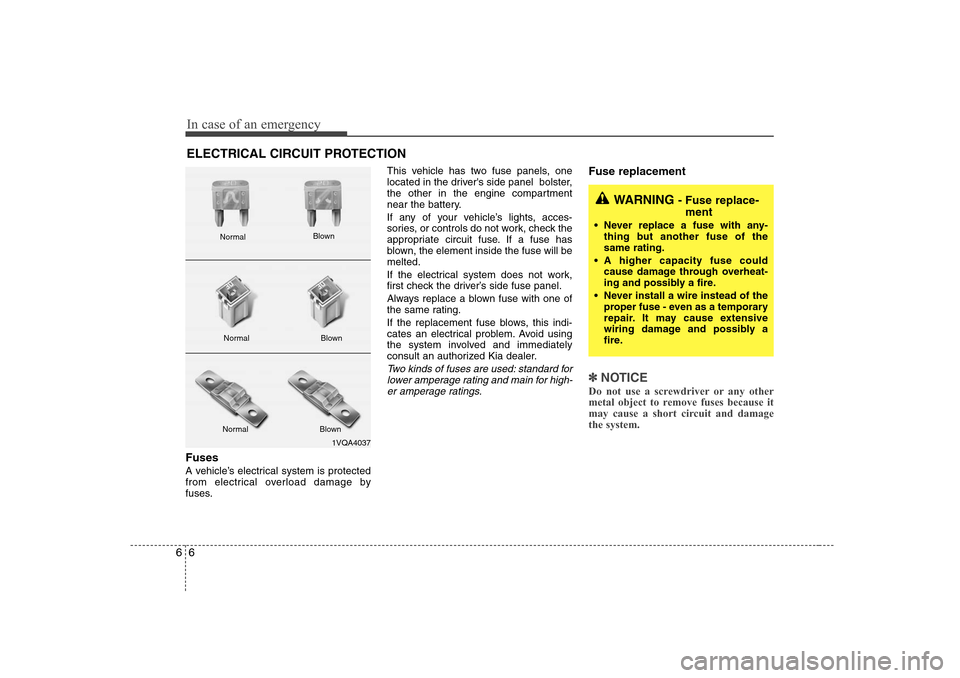
In case of an emergency6 6ELECTRICAL CIRCUIT PROTECTIONFuses A vehicle’s electrical system is protected
from electrical overload damage by
fuses.This vehicle has two fuse panels, one
located in the driver's side panel bolster,
the other in the engine compartment
near the battery.
If any of your vehicle’s lights, acces-
sories, or controls do not work, check the
appropriate circuit fuse. If a fuse has
blown, the element inside the fuse will be
melted.
If the electrical system does not work,
first check the driver’s side fuse panel.
Always replace a blown fuse with one of
the same rating.
If the replacement fuse blows, this indi-
cates an electrical problem. Avoid using
the system involved and immediately
consult an authorized Kia dealer.
Two kinds of fuses are used: standard for
lower amperage rating and main for high-
er amperage ratings.
Fuse replacement ✽ ✽
NOTICEDo not use a screwdriver or any other
metal object to remove fuses because it
may cause a short circuit and damage
the system.
WARNING
- Fuse replace-
ment
Never replace a fuse with any-
thing but another fuse of the
same rating.
A higher capacity fuse could
cause damage through overheat-
ing and possibly a fire.
Never install a wire instead of the
proper fuse - even as a temporary
repair. It may cause extensive
wiring damage and possibly a
fire.
1VQA4037 Normal NormalBlown
Blown
Normal Blown