lights KIA Optima 2014 3.G Owner's Guide
[x] Cancel search | Manufacturer: KIA, Model Year: 2014, Model line: Optima, Model: KIA Optima 2014 3.GPages: 479, PDF Size: 13.21 MB
Page 324 of 479
Driving your vehicle
52
5
Adjust your mirrors to reduce the
glare from other driver's head-
lights.
Keep your headlights clean and properly aimed on vehicles not
equipped with the automatic head-
light aiming feature. Dirty or
improperly aimed headlights will
make it much more difficult to see
at night.
Avoid staring directly at the head- lights of oncoming vehicles. You
could be temporarily blinded, and it
will take several seconds for your
eyes to readjust to the darkness.Driving in the rain
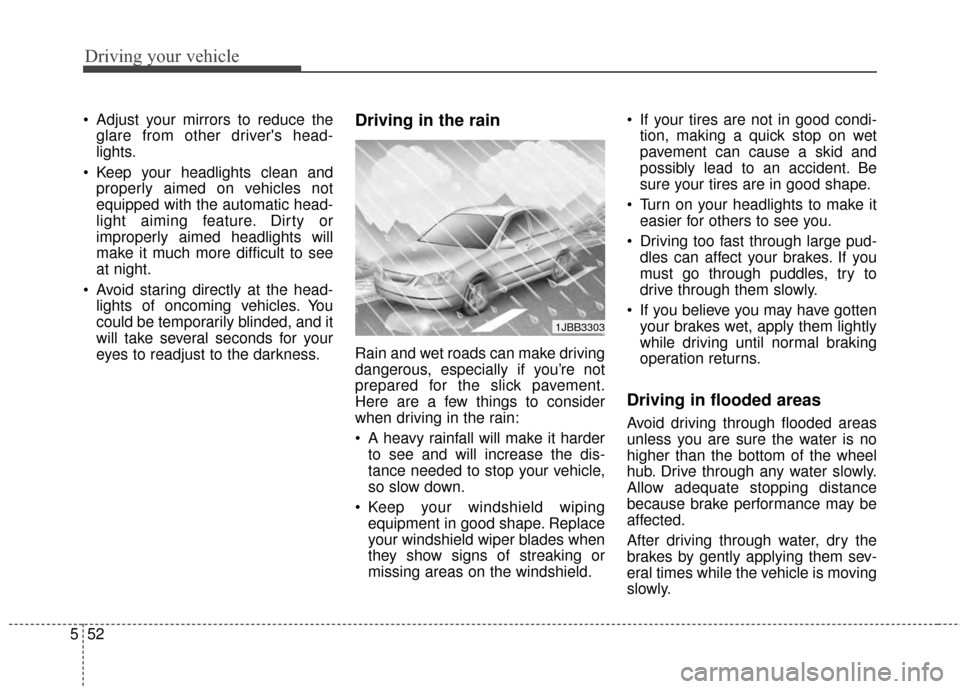
Rain and wet roads can make driving
dangerous, especially if you’re not
prepared for the slick pavement.
Here are a few things to consider
when driving in the rain:
A heavy rainfall will make it harderto see and will increase the dis-
tance needed to stop your vehicle,
so slow down.
Keep your windshield wiping equipment in good shape. Replace
your windshield wiper blades when
they show signs of streaking or
missing areas on the windshield. If your tires are not in good condi-
tion, making a quick stop on wet
pavement can cause a skid and
possibly lead to an accident. Be
sure your tires are in good shape.
Turn on your headlights to make it easier for others to see you.
Driving too fast through large pud- dles can affect your brakes. If you
must go through puddles, try to
drive through them slowly.
If you believe you may have gotten your brakes wet, apply them lightly
while driving until normal braking
operation returns.
Driving in flooded areas
Avoid driving through flooded areas
unless you are sure the water is no
higher than the bottom of the wheel
hub. Drive through any water slowly.
Allow adequate stopping distance
because brake performance may be
affected.
After driving through water, dry the
brakes by gently applying them sev-
eral times while the vehicle is moving
slowly.
1JBB3303
Page 336 of 479
What to do in an emergency
26
ROAD WARNING
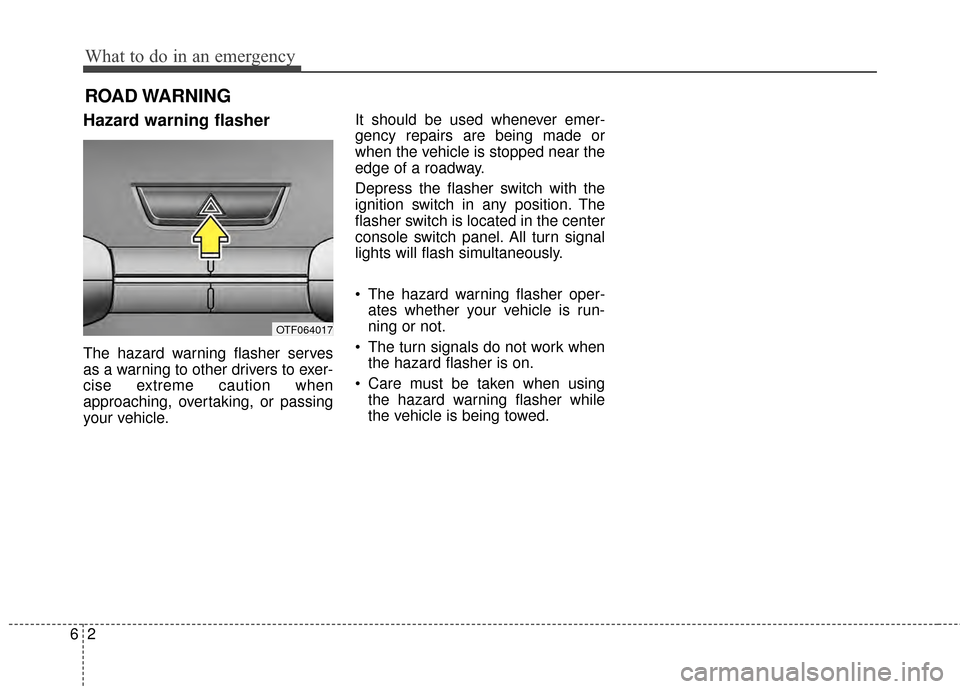
Hazard warning flasher
The hazard warning flasher serves
as a warning to other drivers to exer-
cise extreme caution when
approaching, overtaking, or passing
your vehicle.It should be used whenever emer-
gency repairs are being made or
when the vehicle is stopped near the
edge of a roadway.
Depress the flasher switch with the
ignition switch in any position. The
flasher switch is located in the center
console switch panel. All turn signal
lights will flash simultaneously.
• The hazard warning flasher oper-
ates whether your vehicle is run-
ning or not.
The turn signals do not work when the hazard flasher is on.
Care must be taken when using the hazard warning flasher while
the vehicle is being towed.
OTF064017
Page 367 of 479
77
Maintenance
At least monthly:
Check the coolant level in theengine coolant reservoir.
Check the operation of all exterior lights, including the stoplights, turn
signals and hazard warning flash-
ers.
Check the inflation pressures of all tires including the spare.
At least twice a year
(i.e., every Spring and Fall) :
Check the radiator, heater and air conditioning hoses for leaks or
damage.
Check the windshield washer spray and wiper operation. Clean
the wiper blades with clean cloth
dampened with washer fluid.
Check the headlight alignment.
Check the muffler, exhaust pipes, shields and clamps.
Check the lap/shoulder belts for wear and function.
Check for worn tires and loose wheel lug nuts.
At least once a year :
Clean the body and door drainholes.
Lubricate the door hinges and check the hood hinges.
Lubricate the door and hood locks and latches.
Lubricate the door rubber weather- strips.
Check the air conditioning system.
Check the power steering fluid level.
Inspect and lubricate automatic transaxle linkage and controls.
Clean the battery and terminals.
Check the brake fluid level.
Page 406 of 479
Maintenance
46
7
Battery recharging
Your vehicle has a maintenance-free,
calcium-based battery.
If the battery becomes discharged
in a short time (because, for exam-
ple, the headlights or interior lights
were left on while the vehicle was
not in use), recharge it by slow
charging (trickle) for 10 hours.
If the battery gradually discharges because of high electric load while
the vehicle is being used, recharge
it at 20-30A for two hours. When recharging the battery,
observe the following precautions:
The battery must be removed from
the vehicle and placed in an area
with good ventilation.
Watch the battery during charging, and stop or reduce the charging
rate if the battery cells begin
gassing (boiling) violently or if the
temperature of the electrolyte of
any cell exceeds 49°C (120°F ).
Wear eye protection when check- ing the battery during charging.
Disconnect the battery charger in the following order.
1. Turn off the battery charger main switch.
2. Unhook the negative clamp from the negative battery terminal.
3. Unhook the positive clamp from the positive battery terminal.
Before performing maintenance or recharging the battery, turn off all
accessories and stop the engine.
The negative battery cable must be removed first and installed last
when the battery is disconnected.
Reset items
Items should be reset after the bat-
tery has been discharged or the bat-
tery has been disconnected.
Auto down window (See chapter 4)
Sunroof (See chapter 4)
Trip computer (See chapter 4)
Climate control system (See chapter 4)
Clock (See chapter 4)
Audio (See chapter 4)
Page 421 of 479
761
Maintenance
FUSES
A vehicle’s electrical system is pro-
tected from electrical overload dam-
age by fuses.
This vehicle has 2 fuse panels, one
located in the driver’s side panel bol-
ster, the other in the engine compart-
ment near the battery.
If any of your vehicle’s lights, acces-
sories, or controls do not work, check
the appropriate circuit fuse. If a fuse
has blown, the element inside the
fuse will melt.
If the electrical system does not
work, first check the driver’s side
fuse panel.
Before replacing a blown fuse, dis-
connect the negative battery cable.
Always replace a blown fuse with
one of the same rating.
If the replacement fuse blows, this
indicates an electrical problem. Avoid
using the system involved and imme-
diately consult an authorized Kia
dealer.
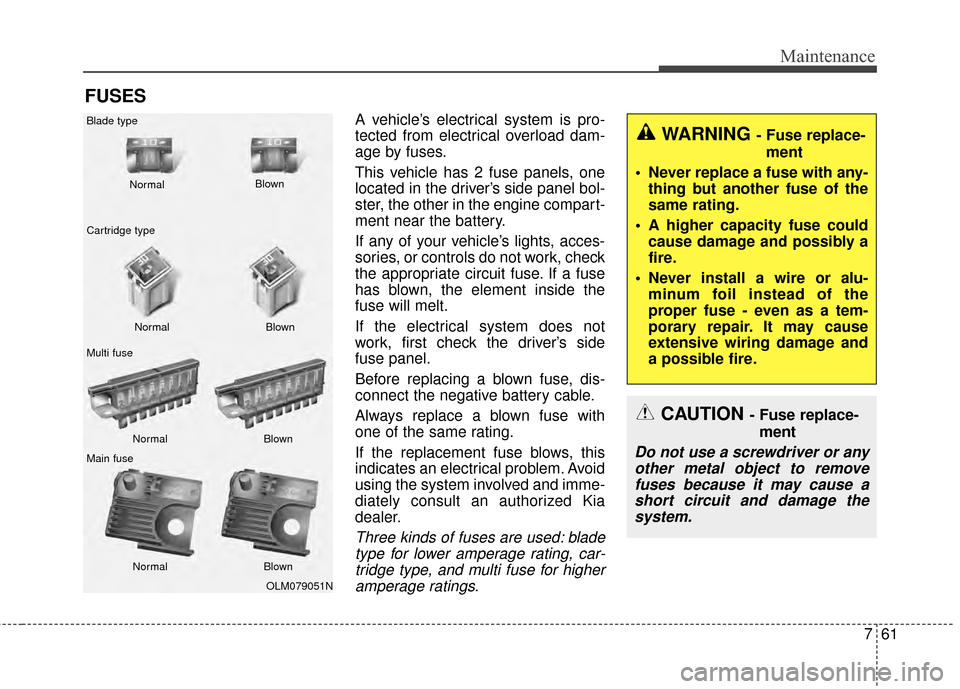
Three kinds of fuses are used: bladetype for lower amperage rating, car-tridge type, and multi fuse for higheramperage ratings.
WARNING - Fuse replace-
ment
Never replace a fuse with any- thing but another fuse of the
same rating.
A higher capacity fuse could cause damage and possibly a
fire.
Never install a wire or alu- minum foil instead of the
proper fuse - even as a tem-
porary repair. It may cause
extensive wiring damage and
a possible fire.
CAUTION - Fuse replace-
ment
Do not use a screwdriver or anyother metal object to removefuses because it may cause ashort circuit and damage thesystem.
OLM079051N
Normal
Normal
Blade type
Cartridge type
Multi fuse
Main fuse Blown
Blown
Normal Blown
Normal Blown
Page 423 of 479
763
Maintenance
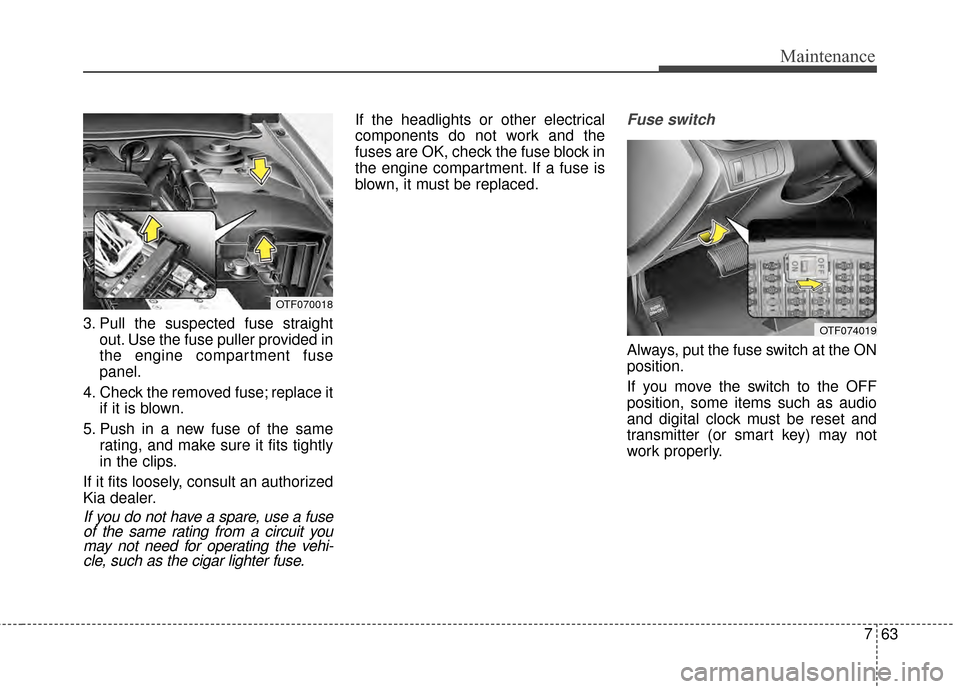
3. Pull the suspected fuse straightout. Use the fuse puller provided in
the engine compartment fuse
panel.
4. Check the removed fuse; replace it if it is blown.
5. Push in a new fuse of the same rating, and make sure it fits tightly
in the clips.
If it fits loosely, consult an authorized
Kia dealer.
If you do not have a spare, use a fuse of the same rating from a circuit youmay not need for operating the vehi-cle, such as the cigar lighter fuse.
If the headlights or other electrical
components do not work and the
fuses are OK, check the fuse block in
the engine compartment. If a fuse is
blown, it must be replaced.Fuse switch
Always, put the fuse switch at the ON
position.
If you move the switch to the OFF
position, some items such as audio
and digital clock must be reset and
transmitter (or smart key) may not
work properly.
OTF070018
OTF074019
Page 439 of 479
779
Maintenance
LIGHT BULBS
Use only the bulbs of the specifiedwattage.
If you don’t have necessary tools, the
correct bulbs and the expertise, con-
sult an authorized Kia dealer. In
many cases, it is difficult to replace
vehicle light bulbs because other
parts of the vehicle must be removed
before you can get to the bulb. This is
especially true if you have to remove
the headlight assembly to get to the
bulb(s). Removing/installing the
headlight assembly can result in
damage to the vehicle.Headlight, position light, turn
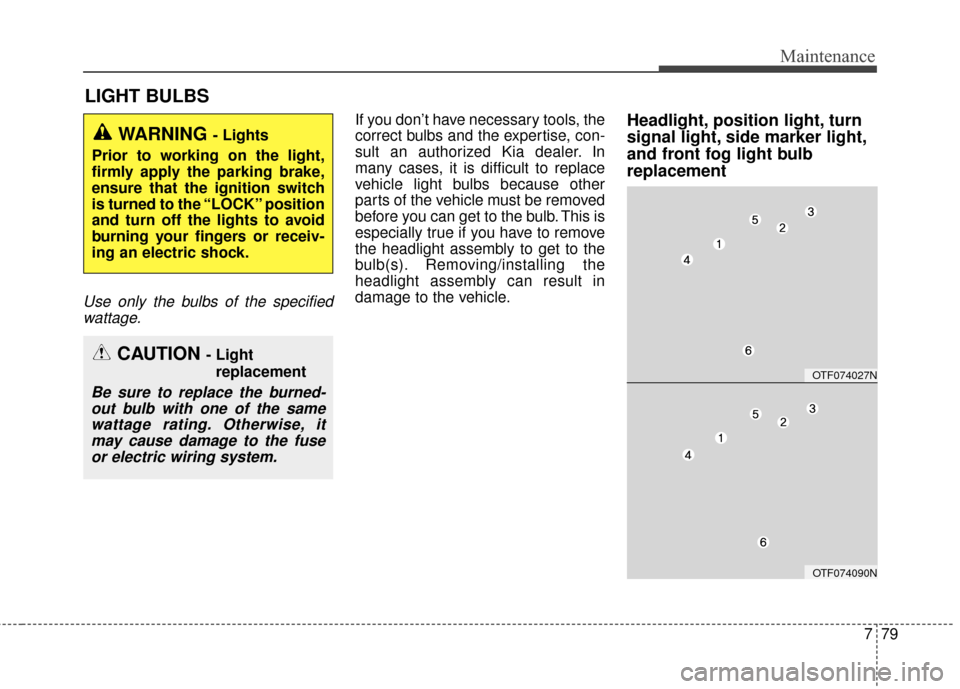
signal light, side marker light,
and front fog light bulb
replacementWARNING - Lights
Prior to working on the light,
firmly apply the parking brake,
ensure that the ignition switch
is turned to the “LOCK” position
and turn off the lights to avoid
burning your fingers or receiv-
ing an electric shock.
CAUTION - Light replacement
Be sure to replace the burned-out bulb with one of the samewattage rating. Otherwise, itmay cause damage to the fuseor electric wiring system.
OTF074027N
OTF074090N
Page 451 of 479
791
Maintenance
Interior light bulb replacement
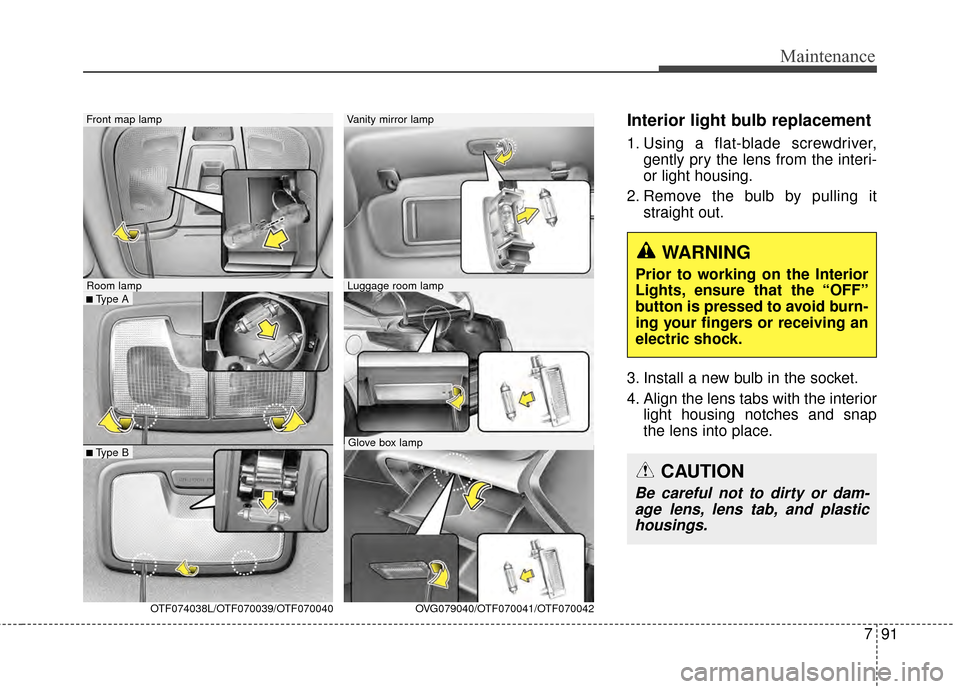
1. Using a flat-blade screwdriver,gently pry the lens from the interi-
or light housing.
2. Remove the bulb by pulling it straight out.
3. Install a new bulb in the socket.
4. Align the lens tabs with the interior light housing notches and snap
the lens into place.
WARNING
Prior to working on the Interior
Lights, ensure that the “OFF”
button is pressed to avoid burn-
ing your fingers or receiving an
electric shock.
CAUTION
Be careful not to dirty or dam-age lens, lens tab, and plastichousings.
■Type A
Front map lamp
OTF074038L/OTF070039/OTF070040
Room lamp
■Type B
Vanity mirror lamp
Luggage room lamp
Glove box lamp OVG079040/OTF070041/OTF070042
Page 479 of 479
Index
8I
Removable towing hook (front) . . . . . . . . . . . . . . . . 6-24
Towing service . . . . . . . . . . . . . . . . . . . . . . . . . . . . . 6-23
Trip computer . . . . . . . . . . . . . . . . . . . . . . . . . . . . . . . . 4-76 Fuel Economy . . . . . . . . . . . . . . . . . . . . . . . . . . . . . 4-77
Overview . . . . . . . . . . . . . . . . . . . . . . . . . . . . . . . . . 4-76
Trip A/B . . . . . . . . . . . . . . . . . . . . . . . . . . . . . . . . . . 4-79\
Trunk . . . . . . . . . . . . . . . . . . . . . . . . . . . . . . . . . . . . \
. . . 4-22 Closing the trunk . . . . . . . . . . . . . . . . . . . . . . . . . . . 4-23
Emergency trunk lid release cable . . . . . . . . . . . . . . 4-23
Emergency trunk safety release . . . . . . . . . . . . . . . . 4-24
Opening the trunk. . . . . . . . . . . . . . . . . . . . . . . . . . . 4-22
Vehicle break-in process . . . . . . . . . . . . . . . . . . . . . . . . . 1-5
Vehicle certification label . . . . . . . . . . . . . . . . . . . . . . . . 8-9
Vehicle identification number (VIN) . . . . . . . . . . . . . . . 8-9
Vehicle load limit . . . . . . . . . . . . . . . . . . . . . . . . . . . . . 5-57 Certification label . . . . . . . . . . . . . . . . . . . . . . . . . . . 5-60
Tire and loading information label. . . . . . . . . . . . . . 5-57
Vehicle weight . . . . . . . . . . . . . . . . . . . . . . . . . . . . . . . 5-62
Warning and indicator lights. . . . . . . . . . . . . . . . . . . . . 4-81 Indicator Lights . . . . . . . . . . . . . . . . . . . . . . . . . . . . 4-87
Warning lights . . . . . . . . . . . . . . . . . . . . . . . . . . . . . 4-81
Washer fluid . . . . . . . . . . . . . . . . . . . . . . . . . . . . . . . . . 7-35 Checking the washer fluid level . . . . . . . . . . . . . . . . 7-35 Welcome system . . . . . . . . . . . . . . . . . . . . . . . . . . . . . . 4-95
Escort welcome . . . . . . . . . . . . . . . . . . . . . . . . . . . . 4-95
Interior light . . . . . . . . . . . . . . . . . . . . . . . . . . . . . . 4-95
Welcome light . . . . . . . . . . . . . . . . . . . . . . . . . . . . . 4-95
Windows . . . . . . . . . . . . . . . . . . . . . . . . . . . . . . . . . . . . \
4-25 Power window lock button. . . . . . . . . . . . . . . . . . . . 4-29
Power windows . . . . . . . . . . . . . . . . . . . . . . . . . . . . 4-26
Windshield defrosting and defogging. . . . . . . . . . . . . 4-130 Automatic climate control system . . . . . . . . . . . . . 4-131
Defogging logic . . . . . . . . . . . . . . . . . . . . . . . . . . . 4-132
Manual climate control system . . . . . . . . . . . . . . . 4-130
Winter driving . . . . . . . . . . . . . . . . . . . . . . . . . . . . . . . . 5-54 Carry emergency equipment . . . . . . . . . . . . . . . . . . 5-56
Change to "winter weight" oil if necessary . . . . . . . 5-55
Check battery and cables . . . . . . . . . . . . . . . . . . . . . 5-55
Check spark plugs and ignition system . . . . . . . . . . 5-55
Don't let ice and snow accumulate underneath . . . . 5-56
Don't let your parking brake freeze . . . . . . . . . . . . . 5-56
Snowy or Icy conditions. . . . . . . . . . . . . . . . . . . . . . 5-54
To keep locks from freezing. . . . . . . . . . . . . . . . . . . 5-55
Use approved window washer anti-freeze in system . . 5-55
Use high quality ethylene glycol coolant. . . . . . . . . 5-55
Wiper blades . . . . . . . . . . . . . . . . . . . . . . . . . . . . . . . . . 7-41 Blade inspection . . . . . . . . . . . . . . . . . . . . . . . . . . . . 7-41
Blade replacement . . . . . . . . . . . . . . . . . . . . . . . . . . 7-41
Wipers and washers . . . . . . . . . . . . . . . . . . . . . . . . . . 4-102 Windshield washers . . . . . . . . . . . . . . . . . . . . . . . . 4-103
Windshield wipers . . . . . . . . . . . . . . . . . . . . . . . . . 4-102
V
W