coolant KIA Optima 2016 4.G Owner's Guide
[x] Cancel search | Manufacturer: KIA, Model Year: 2016, Model line: Optima, Model: KIA Optima 2016 4.GPages: 623, PDF Size: 15.4 MB
Page 529 of 623
Maintenance
30
8
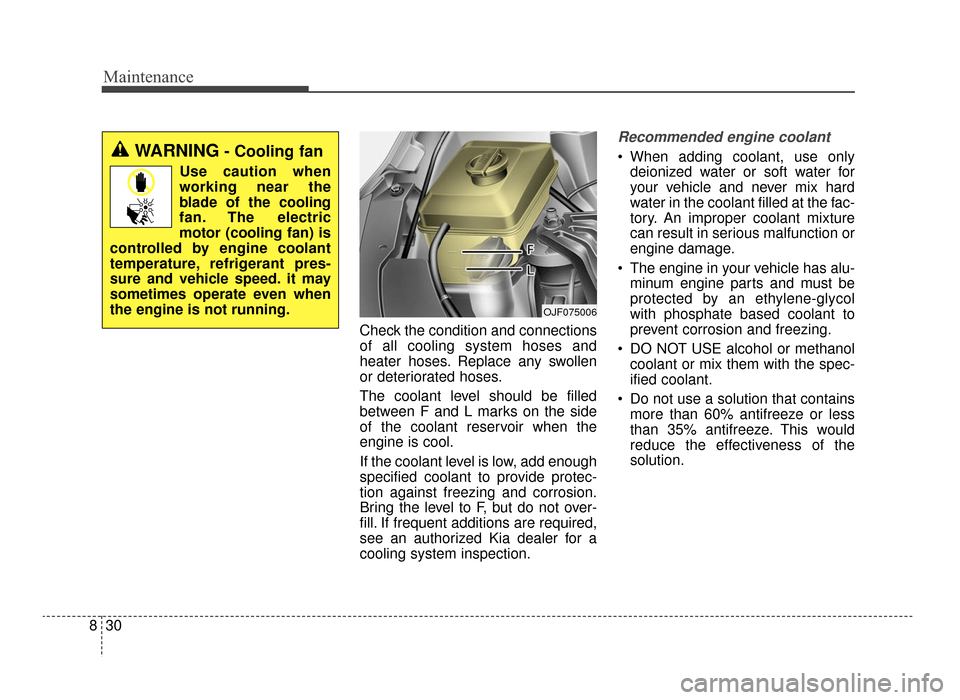
Check the condition and connections
of all cooling system hoses and
heater hoses. Replace any swollen
or deteriorated hoses.
The coolant level should be filled
between F and L marks on the side
of the coolant reservoir when the
engine is cool.
If the coolant level is low, add enough
specified coolant to provide protec-
tion against freezing and corrosion.
Bring the level to F, but do not over-
fill. If frequent additions are required,
see an authorized Kia dealer for a
cooling system inspection.
Recommended engine coolant
When adding coolant, use only
deionized water or soft water for
your vehicle and never mix hard
water in the coolant filled at the fac-
tory. An improper coolant mixture
can result in serious malfunction or
engine damage.
The engine in your vehicle has alu- minum engine parts and must be
protected by an ethylene-glycol
with phosphate based coolant to
prevent corrosion and freezing.
DO NOT USE alcohol or methanol coolant or mix them with the spec-
ified coolant.
Do not use a solution that contains more than 60% antifreeze or less
than 35% antifreeze. This would
reduce the effectiveness of the
solution.
OJF075006
WARNING- Cooling fan
Use caution when
working near the
blade of the cooling
fan. The electric
motor (cooling fan) is
controlled by engine coolant
temperature, refrigerant pres-
sure and vehicle speed. it may
sometimes operate even when
the engine is not running.
JF CAN (ENG) 8.qxp 11/5/2015 6:40 PM Page 30
Page 530 of 623
831
Maintenance
For mixture percentage, refer to the
following table.Changing the coolant
Have the coolant changed by an
authorized Kia dealer according to
the Maintenance Schedule at the
beginning of this chapter.
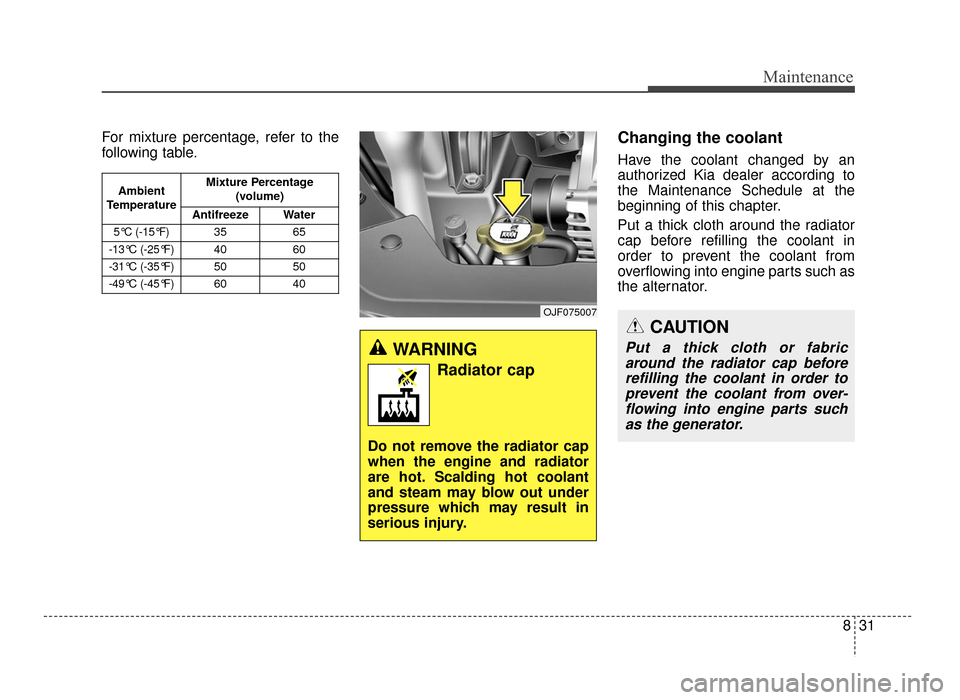
Put a thick cloth around the radiator
cap before refilling the coolant in
order to prevent the coolant from
overflowing into engine parts such as
the alternator.
OJF075007
Ambient
Temperature Mixture Percentage
(volume)
Antifreeze Water
5°C (-15°F)35 65
-13°C (-25°F)4060
-31°C (-35°F)5050
-49°C (-45°F)6040
WARNING
Radiator cap
Do not remove the radiator cap
when the engine and radiator
are hot. Scalding hot coolant
and steam may blow out under
pressure which may result in
serious injury.
CAUTION
Put a thick cloth or fabric
around the radiator cap beforerefilling the coolant in order toprevent the coolant from over-flowing into engine parts suchas the generator.
JF CAN (ENG) 8.qxp 11/5/2015 6:40 PM Page 31
Page 532 of 623
833
Maintenance
WASHER FLUID
Checking the washer fluid
level
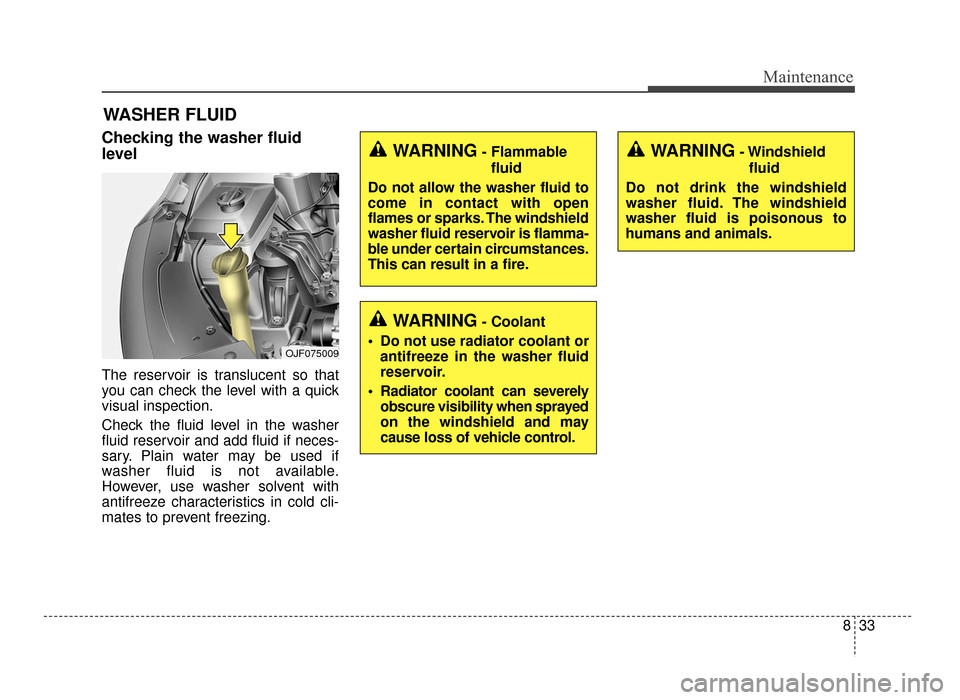
The reservoir is translucent so that
you can check the level with a quick
visual inspection.
Check the fluid level in the washer
fluid reservoir and add fluid if neces-
sary. Plain water may be used if
washer fluid is not available.
However, use washer solvent with
antifreeze characteristics in cold cli-
mates to prevent freezing.
WARNING- Flammablefluid
Do not allow the washer fluid to
come in contact with open
flames or sparks. The windshield
washer fluid reservoir is flamma-
ble under certain circumstances.
This can result in a fire.WARNING- Windshield fluid
Do not drink the windshield
washer fluid. The windshield
washer fluid is poisonous to
humans and animals.
WARNING- Coolant
Do not use radiator coolant or antifreeze in the washer fluid
reservoir.
Radiator coolant can severely obscure visibility when sprayed
on the windshield and may
cause loss of vehicle control.
OJF075009
JF CAN (ENG) 8.qxp 11/5/2015 6:40 PM Page 33
Page 554 of 623
855
Maintenance
Temperature -A, B & C
The temperature grades are A (the
highest), B and C representing the
tire’s resistance to the generation of
heat and its ability to dissipate heat
when tested under controlled condi-
tions on a specified indoor laboratory
test wheel.
Sustained high temperature can
cause the material of the tire to
degenerate and reduce tire life, and
excessive temperature can lead to
sudden tire failure. Grades B and A
represent higher levels of perform-
ance on the laboratory test wheel
than the minimum required by law.Tire terminology and definitions
Air Pressure:
The amount of air
inside the tire pressing outward on
the tire. Air pressure is expressed in
kilopascal (kPa) or pounds per
square inch (psi).
Accessory Weight: This means the
combined weight of optional acces-
sories. Some examples of optional
accessories are, automatic
transaxle, power seats, and air con-
ditioning.
Aspect Ratio: The relationship of a
tire's height to its width.
Belt: A rubber coated layer of cords
that is located between the plies and
the tread. Cords may be made from
steel or other reinforcing materials.
Bead: The tire bead contains steel
wires wrapped by steel cords that
hold the tire onto the rim.
Bias Ply Tire: A pneumatic tire in
which the plies are laid at alternate
angles less than 90 degrees to the
centerline of the tread. Cold Tire Pressure:
The amount of
air pressure in a tire, measured in
kilopascals (kPa) or pounds per
square inch (psi) before a tire has
built up heat from driving.
Curb Weight: This means the weight
of a motor vehicle with standard and
optional equipment including the
maximum capacity of fuel, oil and
coolant, but without passengers and
cargo.
DOT Markings: The DOT code
includes the Tire Identification
Number (TIN), an alphanumeric des-
ignator which can also identify the
tire manufacturer, production plant,
brand and date of production.
JF CAN (ENG) 8.qxp 11/5/2015 6:40 PM Page 55
Page 600 of 623
8101
Maintenance
Canister
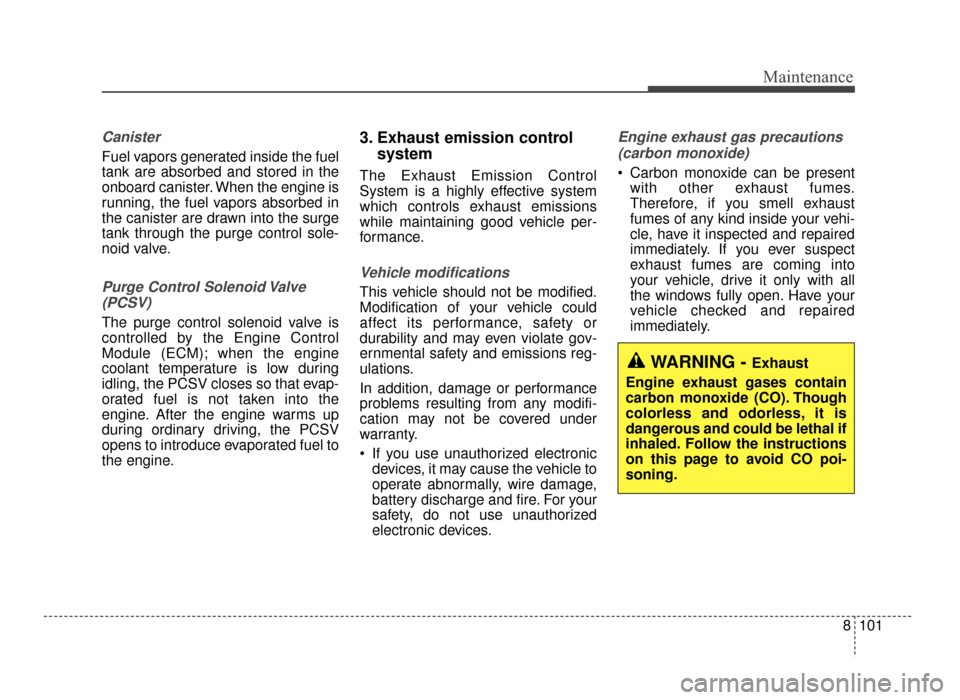
Fuel vapors generated inside the fuel
tank are absorbed and stored in the
onboard canister. When the engine is
running, the fuel vapors absorbed in
the canister are drawn into the surge
tank through the purge control sole-
noid valve.
Purge Control Solenoid Valve(PCSV)
The purge control solenoid valve is
controlled by the Engine Control
Module (ECM); when the engine
coolant temperature is low during
idling, the PCSV closes so that evap-
orated fuel is not taken into the
engine. After the engine warms up
during ordinary driving, the PCSV
opens to introduce evaporated fuel to
the engine.
3. Exhaust emission control system
The Exhaust Emission Control
System is a highly effective system
which controls exhaust emissions
while maintaining good vehicle per-
formance.
Vehicle modifications
This vehicle should not be modified.
Modification of your vehicle could
affect its performance, safety or
durability and may even violate gov-
ernmental safety and emissions reg-
ulations.
In addition, damage or performance
problems resulting from any modifi-
cation may not be covered under
warranty.
If you use unauthorized electronic
devices, it may cause the vehicle to
operate abnormally, wire damage,
battery discharge and fire. For your
safety, do not use unauthorized
electronic devices.
Engine exhaust gas precautions
(carbon monoxide)
Carbon monoxide can be present with other exhaust fumes.
Therefore, if you smell exhaust
fumes of any kind inside your vehi-
cle, have it inspected and repaired
immediately. If you ever suspect
exhaust fumes are coming into
your vehicle, drive it only with all
the windows fully open. Have your
vehicle checked and repaired
immediately.
WARNING - Exhaust
Engine exhaust gases contain
carbon monoxide (CO). Though
colorless and odorless, it is
dangerous and could be lethal if
inhaled. Follow the instructions
on this page to avoid CO poi-
soning.
JF CAN (ENG) 8.qxp 11/5/2015 6:41 PM Page 101
Page 609 of 623
97
Specifications & Consumer information
LubricantVolumeClassification
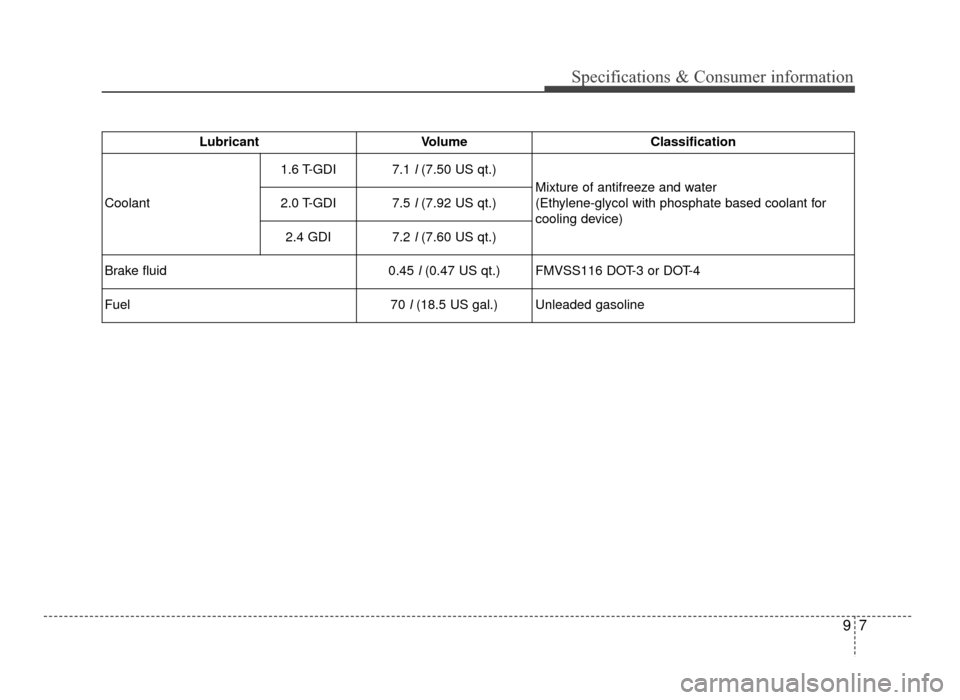
Coolant 1.6 T-GDI
7.1l(7.50 US qt.)
Mixture of antifreeze and water
(Ethylene-glycol with phosphate based coolant for
cooling device)
2.0 T-GDI
7.5 l(7.92 US qt.)
2.4 GDI
7.2l(7.60 US qt.)
Brake fluid
0.45 l(0.47 US qt.) FMVSS116 DOT-3 or DOT-4
Fuel70l (18.5 US gal.)Unleaded gasoline
JF CAN (ENG) 9.qxp 11/5/2015 4:31 PM Page 7
Page 617 of 623
I5
Index
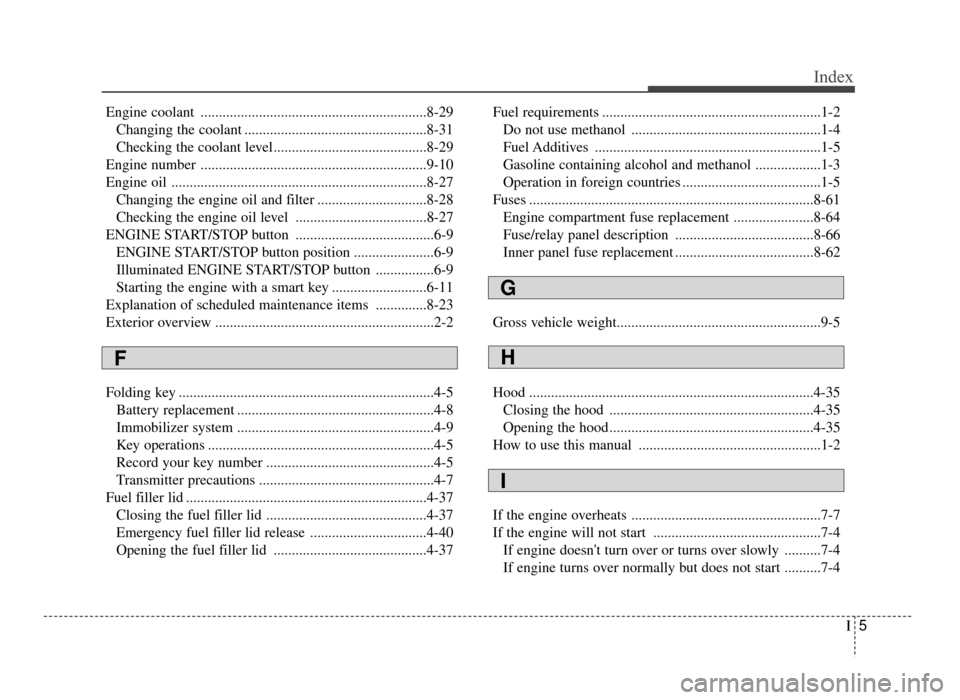
Engine coolant ..............................................................8-29Changing the coolant ..................................................8-31
Checking the coolant level..........................................8-29
Engine number ..............................................................9-10
Engine oil ......................................................................8-\
27 Changing the engine oil and filter ..............................8-28
Checking the engine oil level ....................................8-27
ENGINE START/STOP button ......................................6-9 ENGINE START/STOP button position ......................6-9
Illuminated ENGINE START/STOP button ................6-9
Starting the engine with a smart key ..........................6-11
Explanation of scheduled maintenance items ..............8-23
Exterior overview ............................................................2-2
Folding key ......................................................................4-\
5 Battery replacement ......................................................4-8
Immobilizer system ......................................................4-9
Key operations ..............................................................4-5
Record your key number ..............................................4-5
Transmitter precautions ................................................4-7
Fuel filler lid ..................................................................4-37 Closing the fuel filler lid ............................................4-37
Emergency fuel filler lid release ................................4-40
Opening the fuel filler lid ..........................................4-37 Fuel requirements ............................................................1-2
Do not use methanol ....................................................1-4
Fuel Additives ..............................................................1-5
Gasoline containing alcohol and methanol ..................1-3
Operation in foreign countries ......................................1-5
Fuses ........................................................................\
......8-61 Engine compartment fuse replacement ......................8-64
Fuse/relay panel description ......................................8-66
Inner panel fuse replacement ......................................8-62
Gross vehicle weight........................................................9-5\
Hood ........................................................................\
......4-35 Closing the hood ........................................................4-35
Opening the hood ........................................................4-35
How to use this manual ..................................................1-2
If the engine overheats ....................................................7-7
If the engine will not start ..............................................7-4 If engine doesn't turn over or turns over slowly ..........7-4
If engine turns over normally but does not start ..........7-4
FH
G
I
JF CAN (ENG) Index.qxp 9/23/2015 4:32 PM Page 5
Page 623 of 623
I11
Index
Winter driving ..............................................................6-103Carry emergency equipment ....................................6-105
Change to "winter weight" oil if necessary ..............6-104
Check battery and cables ..........................................6-104
Check spark plugs and ignition system ....................6-104
Don’t let your parking brake freeze..........................6-105
Don't let ice and snow accumulate underneath ........6-105
Snowy or icy conditions ..........................................6-103
To keep locks from freezing ....................................6-104
Trailer towing ............................................................6-105
Use approved window washer anti-freeze in system ..6 -104
Use high quality ethylene glycol coolant ................6-104
Wiper blades ..................................................................8-39 Blade inspection ..........................................................8-39
Blade replacement ......................................................8-39
Wipers and washers ....................................................4-110 Front windshield washers ........................................4-112
Windshield wipers ....................................................4-110
JF CAN (ENG) Index.qxp 9/23/2015 4:32 PM Page 11