battery KIA OPTIMA HYBRID 2015 User Guide
[x] Cancel search | Manufacturer: KIA, Model Year: 2015, Model line: OPTIMA HYBRID, Model: KIA OPTIMA HYBRID 2015Pages: 495, PDF Size: 13.38 MB
Page 18 of 495
H12
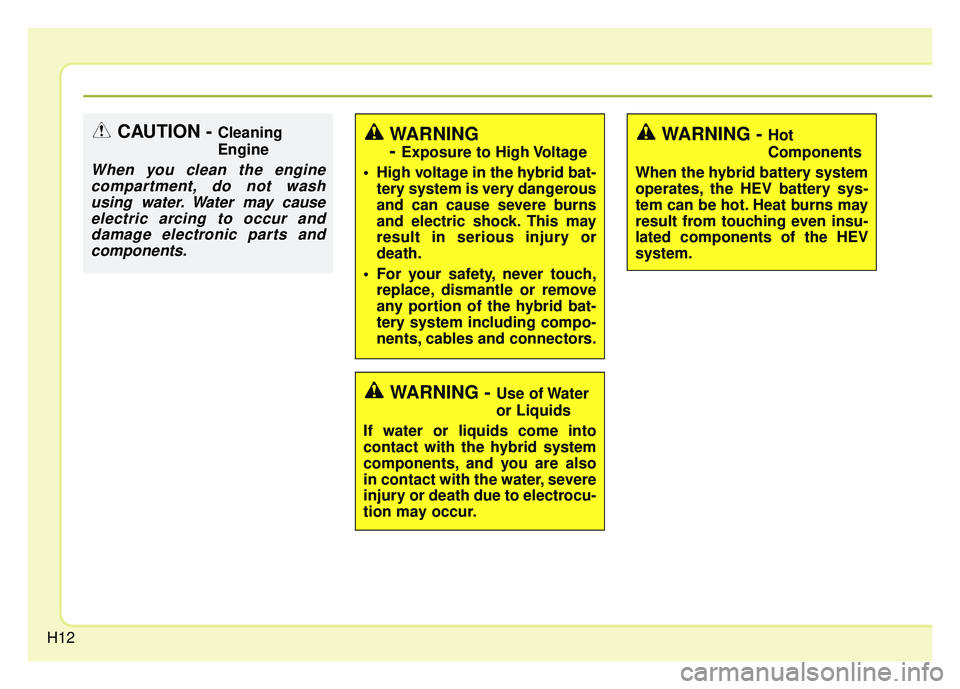
CAUTION - Cleaning
Engine
When you clean the enginecompartment, do not washusing water. Water may causeelectric arcing to occur anddamage electronic parts andcomponents.
WARNING
-
Exposure to High Voltage
High voltage in the hybrid bat- tery system is very dangerous
and can cause severe burns
and electric shock. This may
result in serious injury or
death.
For your safety, never touch, replace, dismantle or remove
any portion of the hybrid bat-
tery system including compo-
nents, cables and connectors.
WARNING - Use of Water
or Liquids
If water or liquids come into
contact with the hybrid system
components, and you are also
in contact with the water, severe
injury or death due to electrocu-
tion may occur.
WARNING - Hot
Components
When the hybrid battery system
operates, the HEV battery sys-
tem can be hot. Heat burns may
result from touching even insu-
lated components of the HEV
system.
Page 19 of 495
H13
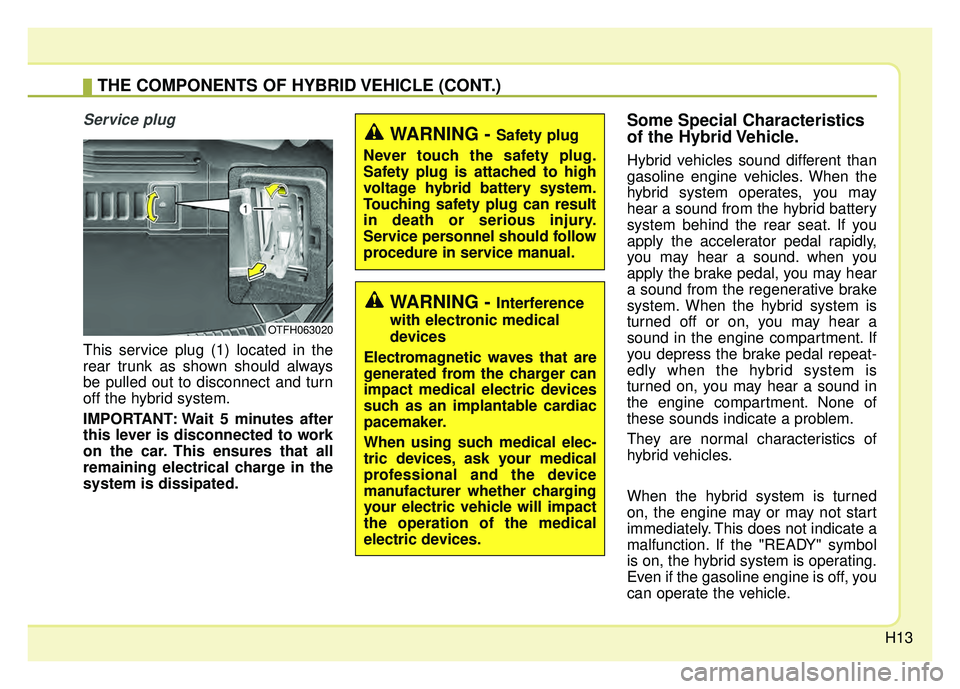
Service plug
This service plug (1) located in the
rear trunk as shown should always
be pulled out to disconnect and turn
off the hybrid system.
IMPORTANT: Wait 5 minutes after
this lever is disconnected to work
on the car. This ensures that all
remaining electrical charge in the
system is dissipated.
Some Special Characteristics
of the Hybrid Vehicle.
Hybrid vehicles sound different than
gasoline engine vehicles. When the
hybrid system operates, you may
hear a sound from the hybrid battery
system behind the rear seat. If you
apply the accelerator pedal rapidly,
you may hear a sound. when you
apply the brake pedal, you may hear
a sound from the regenerative brake
system. When the hybrid system is
turned off or on, you may hear a
sound in the engine compartment. If
you depress the brake pedal repeat-
edly when the hybrid system is
turned on, you may hear a sound in
the engine compartment. None of
these sounds indicate a problem.
They are normal characteristics of
hybrid vehicles.
When the hybrid system is turned
on, the engine may or may not start
immediately. This does not indicate a
malfunction. If the "READY" symbol
is on, the hybrid system is operating.
Even if the gasoline engine is off, you
can operate the vehicle.
OTFH063020
THE COMPONENTS OF HYBRID VEHICLE (CONT.)
WARNING - Safety plug
Never touch the safety plug.
Safety plug is attached to high
voltage hybrid battery system.
Touching safety plug can result
in death or serious injury.
Service personnel should follow
procedure in service manual.
WARNING - Interference
with electronic medical
devices
Electromagnetic waves that are
generated from the charger can
impact medical electric devices
such as an implantable cardiac
pacemaker.
When using such medical elec-
tric devices, ask your medical
professional and the device
manufacturer whether charging
your electric vehicle will impact
the operation of the medical
electric devices.
Page 21 of 495
H15
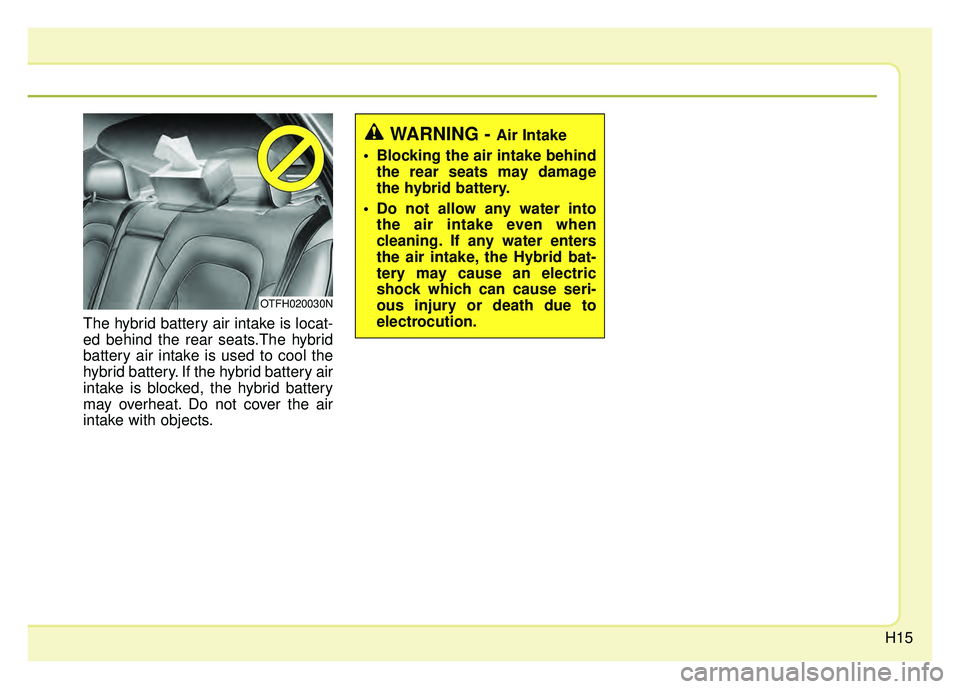
The hybrid battery air intake is locat-
ed behind the rear seats.The hybrid
battery air intake is used to cool the
hybrid battery. If the hybrid battery air
intake is blocked, the hybrid battery
may overheat. Do not cover the air
intake with objects.
WARNING - Air Intake
Blocking the air intake behind the rear seats may damage
the hybrid battery.
Do not allow any water into the air intake even when
cleaning. If any water enters
the air intake, the Hybrid bat-
tery may cause an electric
shock which can cause seri-
ous injury or death due to
electrocution.
OTFH020030N
Page 23 of 495
H17
When the hybrid vehicle shuts
off
When the high voltage battery or 12-
volt battery discharges, or fuel tank is
empty, the hybrid system may not
operate.
If the Hybrid system stops operating
while the vehicle is moving, reduce
the vehicle speed gradually. Pull your
vehicle off the road in a safe area,
and shift the transmission in to Park
(P) position and;
1.Turn on the hazard warning flash-ers.
2.Using the Start button, turn the system OFF. Try to start the Hybrid
system by applying the brake
pedal and pushing the start button.
3.If the Hybrid system will not oper- ate, refer to "EMERGENCY
STARTING" in chapter 6. Before you try to jump start the vehi-
cle, confirm the fuel level. If the fuel
level is low add more fuel before
attempting as emergancy start.
WARNING - Accident
Vehicle
Never touch electric wires or
cable. If exposed electric wires
or cables are visible inside or
outside of your vehicle, an elec-
tric shock may occur.
WARNING - PUTTING
OUT FIRE
If a fire occurs, evacuate the car
immediately and contact the fire
department.
Page 35 of 495
27
Your vehicle at a glance
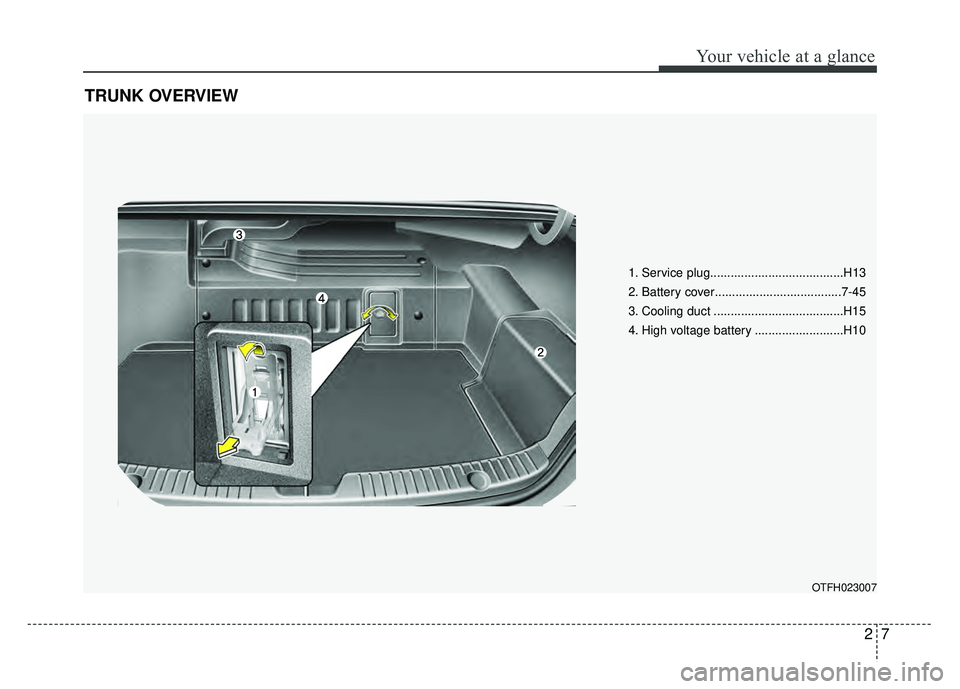
TRUNK OVERVIEW
OTFH023007
1. Service plug.......................................H13
2. Battery cover.....................................7-45
3. Cooling duct ......................................H15
4. High voltage battery ..........................H10
Page 51 of 495
Safety features of your vehicle
16
3
Carrying long/narrow cargo
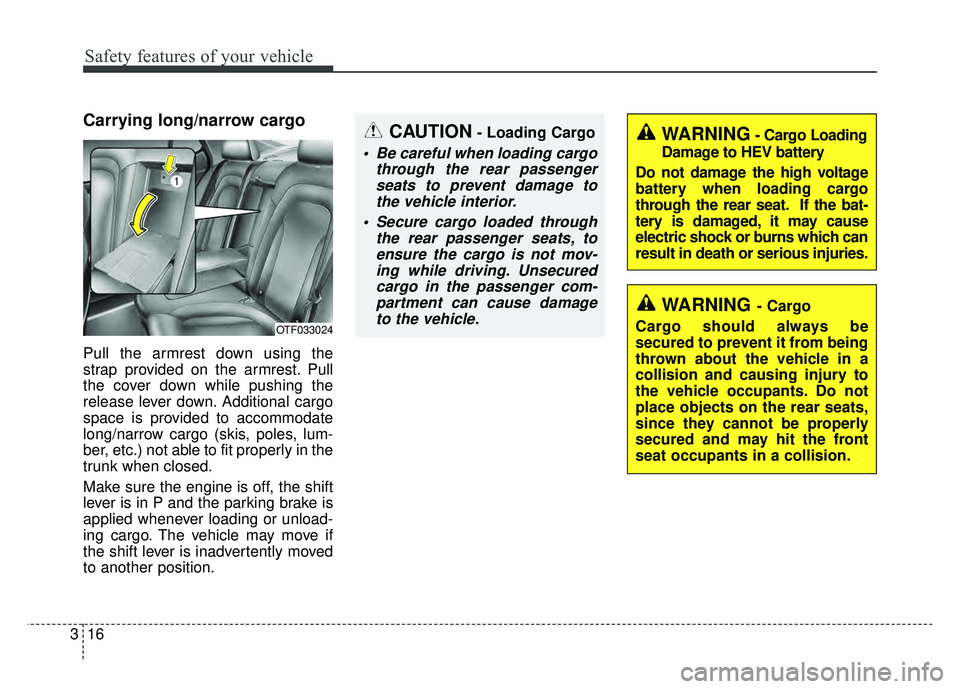
Pull the armrest down using the
strap provided on the armrest. Pull
the cover down while pushing the
release lever down. Additional cargo
space is provided to accommodate
long/narrow cargo (skis, poles, lum-
ber, etc.) not able to fit properly in the
trunk when closed.
Make sure the engine is off, the shift
lever is in P and the parking brake is
applied whenever loading or unload-
ing cargo. The vehicle may move if
the shift lever is inadvertently moved
to another position.
OTF033024
CAUTION- Loading Cargo
Be careful when loading cargo
through the rear passengerseats to prevent damage tothe vehicle interior.
Secure cargo loaded through the rear passenger seats, toensure the cargo is not mov-ing while driving. Unsecuredcargo in the passenger com-partment can cause damageto the vehicle.
WARNING- Cargo
Cargo should always be
secured to prevent it from being
thrown about the vehicle in a
collision and causing injury to
the vehicle occupants. Do not
place objects on the rear seats,
since they cannot be properly
secured and may hit the front
seat occupants in a collision.
WARNING- Cargo Loading
Damage to HEV battery
Do not damage the high voltage
battery when loading cargo
through the rear seat. If the bat-
tery is damaged, it may cause
electric shock or burns which can
result in death or serious injuries.
Page 52 of 495
317
Safety features of your vehicle
SEAT BELTS
Seat belt restraint system
Seat belts are designed to bear upon
the bony structure of the body, and
should be worn low across the
pelvis, chest and shoulders as appli-
cable. Wearing the lap section of the
belt across the abdominal area must
be avoided.
Seat belts should be adjusted as
firmly as possible, consistent with
comfort, to provide the protection for
which they have been designed.
A slack belt will greatly reduce the
protection afforded to the wearer.
Care should be taken to avoid con-
tamination of the webbing with pol-
ishes, oils and chemicals, and partic-
ularly battery acid. Cleaning may
safely be carried out using mild soap
and water. The belt should be
replaced if webbing becomes frayed,
contaminated or damaged. For maximum restraint system pro-
tection, the seat belts must always
be used whenever the vehicle is
moving. A properly positioned
shoulder belt should be positioned
midway over your shoulder across
your collarbone.
Never allow children to ride in the front passenger seat. See child
restraint system section for further
discussion.
WARNING- Shoulder belt
Never wear the shoulder belt under your arm or behind
your back. An improperly
positioned shoulder belt can-
not protect the occupant in a
crash.
Always wear both the shoul- der portion and lap portion of
the lap/shoulder belt.
WARNING- Damagedseat belt
Replace the entire seat belt
assembly if any part of the web-
bing or hardware is damaged as
you can no longer be sure that a
damaged seat belt will provide
protection in a crash.
Page 75 of 495
Safety features of your vehicle
40
3
✽
✽
NOTICE
Before you replace a fuse or discon-
nect a battery terminal, turn the
ignition switch to the LOCK posi-
tion and remove the ignition key.
Never remove or replace the air bag
related fuse(s) when the ignition
switch is in the ON position. Failure
to heed this warning will cause the
SRS air bag warning light to illumi-
nate.
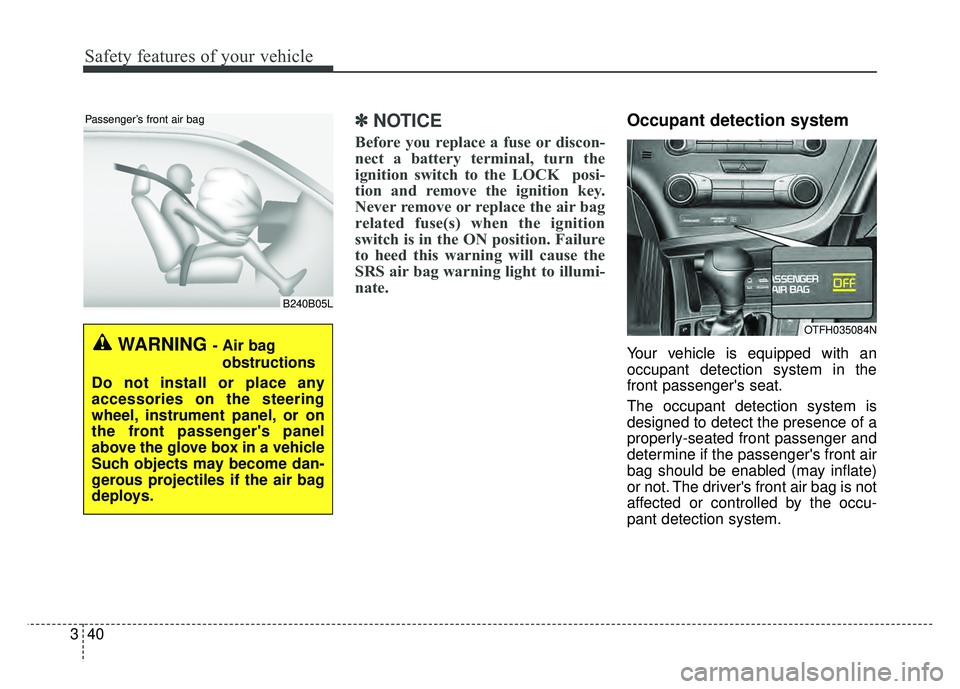
Occupant detection system
Your vehicle is equipped with an
occupant detection system in the
front passenger's seat.
The occupant detection system is
designed to detect the presence of a
properly-seated front passenger and
determine if the passenger's front air
bag should be enabled (may inflate)
or not. The driver's front air bag is not
affected or controlled by the occu-
pant detection system.
B240B05L
Passenger’s front air bag
WARNING - Air bag
obstructions
Do not install or place any
accessories on the steering
wheel, instrument panel, or on
the front passenger's panel
above the glove box in a vehicle
Such objects may become dan-
gerous projectiles if the air bag
deploys.
OTFH035084N
Page 100 of 495
![KIA OPTIMA HYBRID 2015 User Guide 49
Features of your vehicle
The smart key will not work if any of
following occurs:
The ignition key is in the ignitionswitch.
You exceed the operating distance limit (about 90 feet [30 m]).
The ba](/img/2/55003/w960_55003-99.png "KIA OPTIMA HYBRID 2015 User Guide 49
Features of your vehicle
The smart key will not work if any of
following occurs:
The ignition key is in the ignitionswitch.
You exceed the operating distance limit (about 90 feet [30 m]).
The ba")
49
Features of your vehicle
The smart key will not work if any of
following occurs:
The ignition key is in the ignitionswitch.
You exceed the operating distance limit (about 90 feet [30 m]).
The battery in the smart key is weak.
Other vehicles or objects may be blocking the signal.
The weather is extremely cold.
The smart key is close to a radio transmitter such as a radio station or
an airport which can interfere with
normal operation of the transmitter.
When the smart key does not work
properly, open and close the door
with the ignition key. If you have a
problem with the smart key, contact
an authorized Kia dealer. If the smart key is in close proximity
to your cell phone or smart phone,
the signal from the smart key could
be blocked by normal operation of
your cell phone or smart phone.
This is especially important when
the phone is active such as making
call, receiving calls, text messaging,
and/or sending/receiving emails.
Avoid placing the smart key and
your cell phone or smart phone in
the same pants or jacket pocket and
maintain adequate distance
between the two devices. This device complies with Part 15
of the FCC rules.
Operation is subject to the following
two conditions:
1. This device may not cause harm-
ful interference, and
2. This device must accept any inter- ference received, including inter-
ference that may cause undesired
operation.
✽ ✽NOTICE
Changes or modifications not
expressly approved by the party
responsible for compliance could void
the user’s authority to operate the
equipment. If the keyless entry sys-
tem is inoperative due to changes or
modifications not expressly approved
by the party responsible for compli-
ance, it will not be covered by your
manufacturer’s vehicle warranty.
Page 101 of 495
Features of your vehicle
10
4
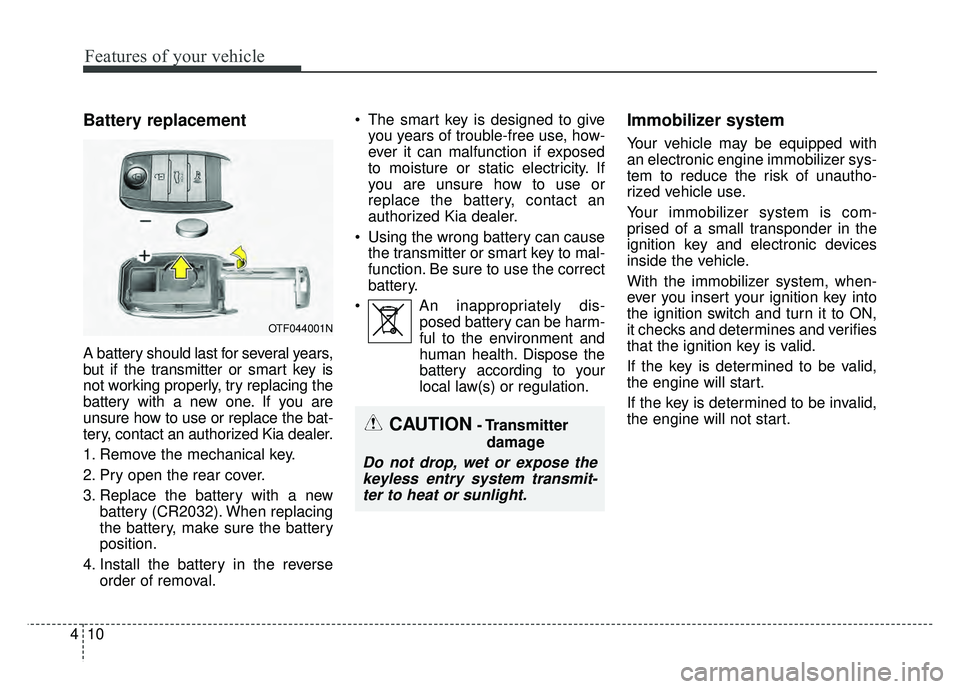
Battery replacement
A battery should last for several years,
but if the transmitter or smart key is
not working properly, try replacing the
battery with a new one. If you are
unsure how to use or replace the bat-
tery, contact an authorized Kia dealer.
1. Remove the mechanical key.
2. Pry open the rear cover.
3. Replace the battery with a new
battery (CR2032). When replacing
the battery, make sure the battery
position.
4. Install the battery in the reverse order of removal. The smart key is designed to give
you years of trouble-free use, how-
ever it can malfunction if exposed
to moisture or static electricity. If
you are unsure how to use or
replace the battery, contact an
authorized Kia dealer.
Using the wrong battery can cause the transmitter or smart key to mal-
function. Be sure to use the correct
battery.
An inappropriately dis- posed battery can be harm-
ful to the environment and
human health. Dispose the
battery according to your
local law(s) or regulation.
Immobilizer system
Your vehicle may be equipped with
an electronic engine immobilizer sys-
tem to reduce the risk of unautho-
rized vehicle use.
Your immobilizer system is com-
prised of a small transponder in the
ignition key and electronic devices
inside the vehicle.
With the immobilizer system, when-
ever you insert your ignition key into
the ignition switch and turn it to ON,
it checks and determines and verifies
that the ignition key is valid.
If the key is determined to be valid,
the engine will start.
If the key is determined to be invalid,
the engine will not start.
OTF044001N
CAUTION- Transmitter
damage
Do not drop, wet or expose thekeyless entry system transmit-ter to heat or sunlight.