wheel KIA OPTIMA PHEV 2020 Owners Manual
[x] Cancel search | Manufacturer: KIA, Model Year: 2020, Model line: OPTIMA PHEV, Model: KIA OPTIMA PHEV 2020Pages: 597, PDF Size: 14.2 MB
Page 519 of 597
751
Maintenance
All season tires
Kia specifies all season tires on
some models to provide good per-
formance for use all year round,
including snowy and icy road condi-
tions. All season tires are identified
by ALL SEASON and/or M+S (Mud
and Snow) on the tire sidewall. Snow
tires have better snow traction than
all season tires and may be more
appropriate in some areas.
Summer tires
Kia specifies summer tires on some
models to provide superior perform-
ance on dry roads. Summer tire per-
formance is substantially reduced in
snow and ice. Summer tires do not
have the tire traction rating M+S
(Mud and Snow) on the tire side wall.
If you plan to operate your vehicle in
snowy or icy conditions, Kia recom-
mends the use of snow tires or all
season tires on all four wheels.
Snow tires
If you equip your car with snow tires,
they should be the same size and
have the same load capacity as the
original tires. Snow tires should be
installed on all four wheels; other-
wise, poor handling may result.
Snow tires should carry 4 psi (28
kPa) more air pressure than the
pressure recommended for the stan-
dard tires on the tire label on the dri-
ver's side of the center pillar, or up to
the maximum pressure shown on the
tire sidewall, whichever is less.
Do not drive faster than 75 mph (120
km/h) when your vehicle is equipped
with snow tires.WARNING
Do not use summer tires at tem-
peratures below 45°F (7°C) or
when driving on snow or ice. At
temperatures below 45°F (7°C),
summer tires can lose elastici-
ty, and therefore traction and
braking power as well. Change
the tires on your vehicle to win-
ter or all-weather tires of the
same size as the standard tires
of the vehicle. Both types of
tires are identified by the M+S
(Mud and Snow) marking. Using
summer tires at very cold tem-
peratures could cause cracks to
form, thereby damaging the
tires permanently.
Page 520 of 597
Maintenance
52
7
Tire chains
Tire chains, if necessary, should be
installed on the front wheels.
Be sure that the chains are installed
in accordance with the manufactur-
er's instructions.
To minimize tire and chain wear, do
not continue to use tire chains when
they are no longer needed.
When driving on roads covered
with snow or ice, drive at less than
20 mph (30 km/h).
Use the SAE “S” class or wire chains.
If you hear noise caused by chains contacting the body, retighten the
chain to avoid contact with the
vehicle body.
To prevent body damage, retighten the chains after driving 0.3~0.6
miles (0.5~1.0 km).
Do not use tire chains on vehicles equipped with aluminum wheels.
In unavoidable circumstances, use
a wire type chain.
Use wire chains less than 0.47 inches (12 mm) to prevent damage
to the chain’s connection.
Radial-ply tires
Radial-ply tires provide improved
tread life, road hazard resistance and
smoother high speed ride. The radi-
al-ply tires used on this vehicle are
of belted construction and are select-
ed to complement the ride and han-
dling characteristics of your vehicle.
Radial-ply tires have the same load
carrying capacity as bias-ply or bias
belted tires of the same size and use
the same recommended inflation
pressure. Mixing of radial-ply tires
with bias-ply or bias belted tires is
not recommended. Any combina-
tions of radial-ply and bias-ply or bias
belted tires when used on the same
vehicle will seriously deteriorate
vehicle handling. The best rule to fol-
low is: identical radial-ply tires should
always be used as a set of four. Longer wearing tires can be more
susceptible to irregular tread wear. It
is very important to follow the tire
rotation interval shown in this section
to achieve the tread life potential of
these tires. Cuts and punctures in
radial-ply tires are repairable only in
the tread area, because of sidewall
flexing. Consult your tire dealer for
radial-ply tire repairs.
Page 529 of 597
761
Maintenance
Fuse NameFuse ratingCircuit Protected
MDPS10AMDPS Unit (Column/Rack)
IG125APCB Block (Fuse - OPCU2/ELECTRICAL WATER PUMP/TCU2/ACTIVE HYDRAULIC BOOTER 3/HEV
ECU2/ECU3)
MODULE 910ASmart Key Control Module
WASHER15AMultifunction Switch (Wiper Low & Washer Switch)
MODULE 810ADriver/Passenger Door Module
CLUSTER10AInstrument Cluster
MULTI MEDIA15AAudio, A/V & Navigation Head Unit, Keyboard
HTD STRG15ABCM (Steering Wheel Heated)
MODULE 110AConsole Switch, Active Air Flap Unit, Gateway, Driver/Passenger Door Module
DR LOCK20ADoor Lock Relay, Door Unlock Relay, ICM Relay Box (Dead Lock Relay)
MEMORY 210ASiren Control Module, Ultrasonic Instrusion Protection Sensor
SMART KEY15ASmart Key Control Module
Page 561 of 597
793
Maintenance
Underbody maintenance
Road salt and other corrosive chemi-
cals are used in cold weather states to
melt snow and prevent ice accumula-
tion. If these chemicals are not regu-
larly removed, they will corrode the
vehicle underbody and over time dam-
age fuel lines, the fuel tank retention
system, the vehicle suspension, the
exhaust system, and even the body
frame. The National Highway Traffic
Safety Administration has warned all
vehicle owners of all brands of the
need to take the following steps:
Wash the undercarriage of yourvehicle regularly during the winter
and whenever your vehicle has
been exposed to such salts or
chemicals.
Do a thorough washing of the undercarriage at the end of the
winter.
Use professional service techni- cians or governmental inspection
stations to annually inspect for cor-
rosion. Immediately seek an inspection of
your vehicle if you become visually
aware of corrosion flaking or scal-
ing or if you become aware of a
change in vehicle performance,
such as soft or spongey brakes,
fluids leaking, impairment of direc-
tional control, suspension noises
or rattling metal straps.
Aluminum wheel maintenance
The aluminum wheels are coated
with a clear protective finish.
Do not use any abrasive cleaner,polishing compound, solvent, or
wire brushes on aluminum wheels.
They may scratch the finish.
Clean the wheel when it has cooled.
Use only a mild soap or neutral detergent, and rinse thoroughly with
water. Also, be sure to clean the
wheels after driving on salted roads.
This helps prevent corrosion.
Avoid washing the wheels with highspeed vehicle wash brushes.
Do not use any alkaline or acid detergents It may damage and cor-
rode the aluminum wheels coated
with a clear protective finish.
Page 564 of 597
Maintenance
96
7
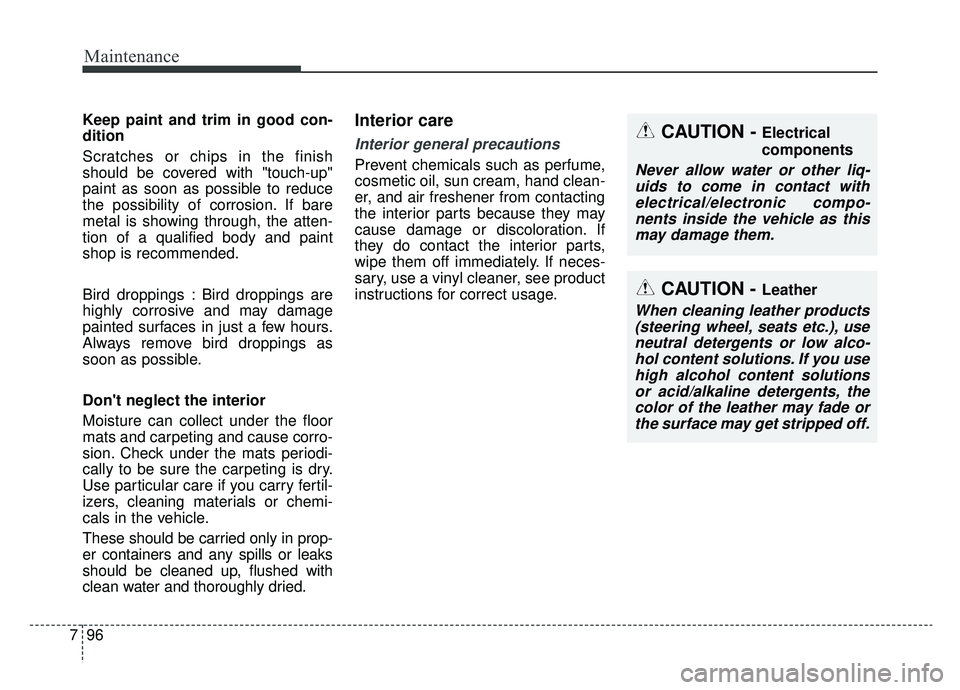
Keep paint and trim in good con-
dition
Scratches or chips in the finish
should be covered with "touch-up"
paint as soon as possible to reduce
the possibility of corrosion. If bare
metal is showing through, the atten-
tion of a qualified body and paint
shop is recommended.
Bird droppings : Bird droppings are
highly corrosive and may damage
painted surfaces in just a few hours.
Always remove bird droppings as
soon as possible.
Don't neglect the interior
Moisture can collect under the floor
mats and carpeting and cause corro-
sion. Check under the mats periodi-
cally to be sure the carpeting is dry.
Use particular care if you carry fertil-
izers, cleaning materials or chemi-
cals in the vehicle.
These should be carried only in prop-
er containers and any spills or leaks
should be cleaned up, flushed with
clean water and thoroughly dried.Interior care
Interior general precautions
Prevent chemicals such as perfume,
cosmetic oil, sun cream, hand clean-
er, and air freshener from contacting
the interior parts because they may
cause damage or discoloration. If
they do contact the interior parts,
wipe them off immediately. If neces-
sary, use a vinyl cleaner, see product
instructions for correct usage.
CAUTION - Electrical
components
Never allow water or other liq-
uids to come in contact withelectrical/electronic compo-nents inside the vehicle as thismay damage them.
CAUTION - Leather
When cleaning leather products(steering wheel, seats etc.), useneutral detergents or low alco-hol content solutions. If you usehigh alcohol content solutionsor acid/alkaline detergents, thecolor of the leather may fade orthe surface may get stripped off.
Page 571 of 597
Specifications, Consumer information and Reporting safety defects
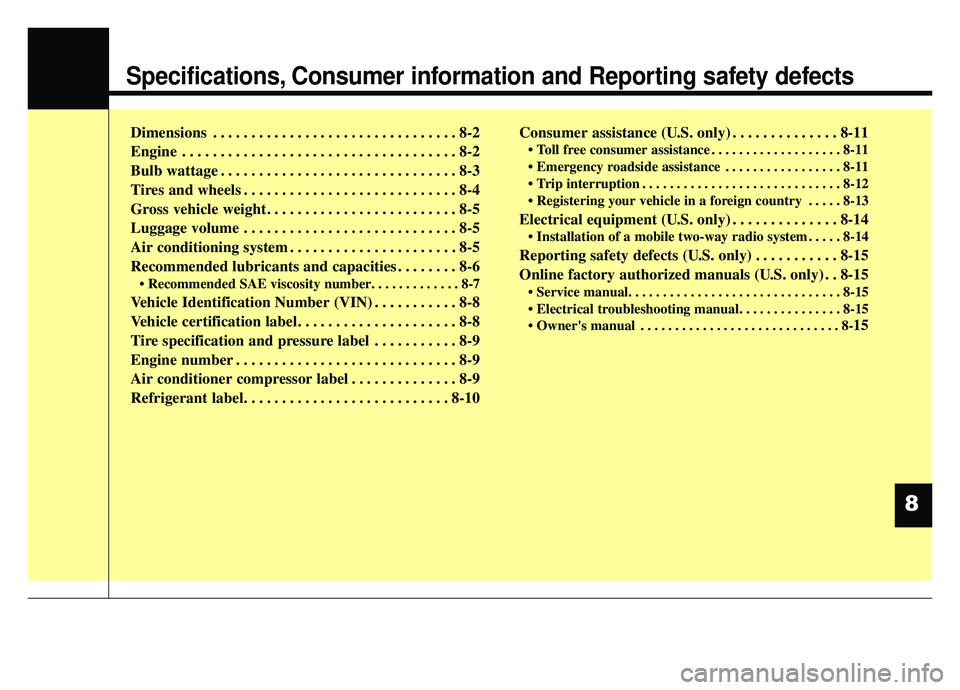
Dimensions . . . . . . . . . . . . . . . . . . . . . . . . . . . . . . . . 8-2
Engine . . . . . . . . . . . . . . . . . . . . . . . . . . . . . . . . . . . . \
8-2
Bulb wattage . . . . . . . . . . . . . . . . . . . . . . . . . . . . . . . 8-3
Tires and wheels . . . . . . . . . . . . . . . . . . . . . . . . . . . . 8-4
Gross vehicle weight. . . . . . . . . . . . . . . . . . . . . . . . . 8-5
Luggage volume . . . . . . . . . . . . . . . . . . . . . . . . . . . . 8-5
Air conditioning system . . . . . . . . . . . . . . . . . . . . . . 8-5
Recommended lubricants and capacities . . . . . . . . 8-6
• Recommended SAE viscosity number. . . . . . . . . . . . . 8-7
Vehicle Identification Number (VIN) . . . . . . . . . . . 8-8
Vehicle certification label. . . . . . . . . . . . . . . . . . . . . 8-8
Tire specification and pressure label . . . . . . . . . . . 8-9
Engine number . . . . . . . . . . . . . . . . . . . . . . . . . . . . . 8-9
Air conditioner compressor label . . . . . . . . . . . . . . 8-9
Refrigerant label. . . . . . . . . . . . . . . . . . . . . . . . . . . 8-10 Consumer assistance (U.S. only) . . . . . . . . . . . . . . 8-11
•
Toll free consumer assistance . . . . . . . . . . . . . . . . . . . 8-11
• Emergency roadside assistance . . . . . . . . . . . . . . . . . 8-11
• Trip interruption . . . . . . . . . . . . . . . . . . . . . . . . . . . . . 8-12
• Registering your vehicle in a foreign country . . . . . 8-13
Electrical equipment (U.S. only) . . . . . . . . . . . . . . 8-14
• Installation of a mobile two-way radio system . . . . . 8-14
Reporting safety defects (U.S. only) . . . . . . . . . . . 8-15
Online factory authorized manuals (U.S. only) . . 8-15
• Service manual. . . . . . . . . . . . . . . . . . . . . . . . . . . . . . . 8-15
• Electrical troubleshooting manual. . . . . . . . . . . . . . . 8-15
• Owner's manual . . . . . . . . . . . . . . . . . . . . . . . . . . . . . 8-
15
8
Page 572 of 597

Specifications, Consumer information, Reporting safety defects
28
DIMENSIONS
ENGINE
ItemUnit : in (mm)
Overall length191.1 (4,855)
Overall width73.2 (1,860)
Overall height57.7 (1,460)
Tread
Front205/65 R16 *63.5 (1,614)
215/55 R1763 (1,602)
Rear205/65 R16 *63.8 (1,621)
215/55 R1763.3 (1,609)
Wheelbase110.4 (2,805)
Item
Gasoline
2.0L GDI HEV
Displacement [cu. in (cc)]
121.99 (1,999)
Bore x Stroke [in. (mm)]
3.19 X 3.81 (81.0 X 97.0)
Firing order
1-3-4-2
No. of cylinders
4. In-line
* : Only for Hybrid vehicle. Not for Plug-in hybrid vehicle
Page 574 of 597
Specifications, Consumer information, Reporting safety defects
48
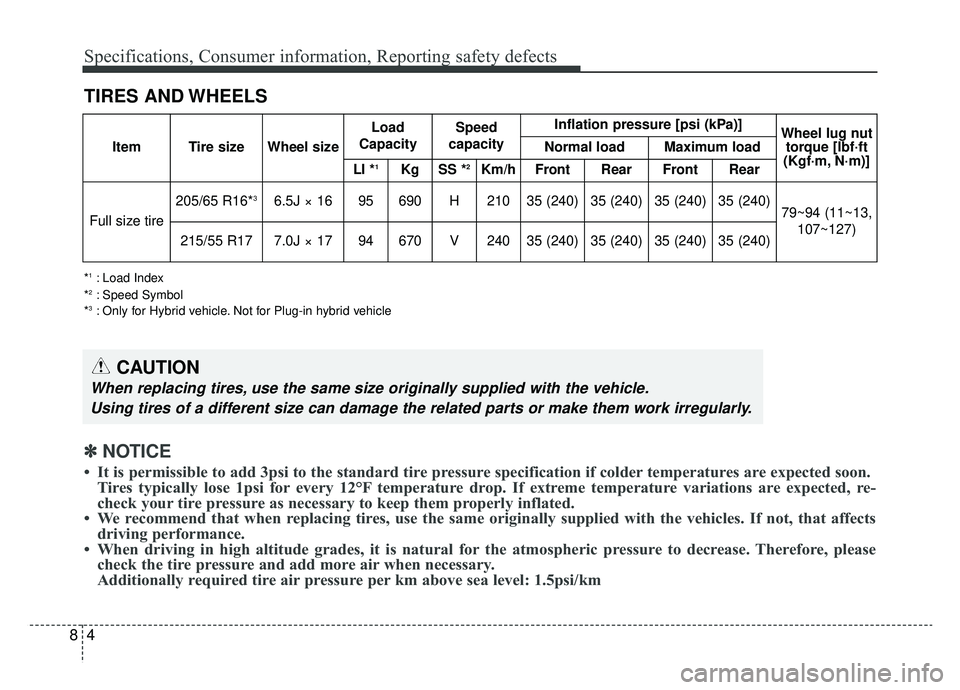
TIRES AND WHEELS
CAUTION
When replacing tires, use the same size originally supplied with the vehicle.Using tires of a different size can damage the related parts or make them work irregularly.
✽ ✽ NOTICE
• It is permissible to add 3psi to the standard tire pressure specification if colder temperatures are expected soon.
Tires typically lose 1psi for every 12°F temperature drop. If extreme temperature variations are expected, re-
check your tire pressure as necessary to keep them properly inflated.
• We recommend that when replacing tires, use the same originally supplied with the vehicles. If not, that aff\
ects driving performance.
• When driving in high altitude grades, it is natural for the atmospheric pressure to decrease. Therefore, please check the tire pressure and add more air when necessary.
Additionally required tire air pressure per km above sea level: 1.5psi/km
*1: Load Index
*2: Speed Symbol
*3: Only for Hybrid vehicle. Not for Plug-in hybrid vehicle
ItemTire sizeWheel size
Load
CapacitySpeed
capacityInflation pressure [psi (kPa)]Wheel lug nut torque [lbf·ft
(Kgf·m, N·m)]Normal loadMaximum load
LI *1KgSS *2Km/hFront RearFront Rear
Full size tire
205/65 R16*36.5J × 1695690H21035 (240)35 (240)35 (240)35 (240)79~94 (11~13,
107~127)
215/55 R177.0J × 1794670V24035 (240)35 (240)35 (240)35 (240)
Page 594 of 597

I9
Index
Smart key ........................................................................\
4-4Battery replacement ......................................................4-8
Loss of the smart key ....................................................4-7
Record your key number ..............................................4-4
Smart key function ........................................................4-4
Smart key immobilizer system ....................................4-8
Smart key precautions ..................................................4-7
Smart trunk ....................................................................4-18\
Detecting area ............................................................4-22
Emergency trunk safety release ..................................4-22
How to deactivate the Smart Trunk function using the smart key ..................................................................4-21
How to use the Smart Trunk ......................................4-18
Special driving conditions ..........................................5-132 Driving at night ........................................................5-133
Driving in flooded areas ..........................................5-135
Driving in the rain ....................................................5-134
Hazardous driving conditions ..................................5-132
Highway driving ......................................................5-135
Rocking the vehicle ..................................................5-132
Smooth cornering ......................................................5-133
Steering wheel ..............................................................4-44 Electric Power Steering (EPS) ....................................4-44
Heated steering wheel ................................................4-46
Horn ........................................................................\
....4-47
Tilt and telescopic steering ........................................4-45 Storage compartments ................................................4-138
Center console storage ..............................................4-138
Glove box ..................................................................4-139
Sunglass holder ........................................................4-139
Theft-alarm system ........................................................4-10 Armed stage ................................................................4-10
Disarmed stage ............................................................4-11
Theft-alarm stage ........................................................4-11
Tire Pressure Monitoring System (TPMS) ......................6-9 Changing a tire with TPMS ........................................6-13
Check tire pressure.....................................................\
...6-9
Low tire pressure position telltale ..............................6-11
Tire specification and pressure label ..............................8-9
Tires and wheels ....................................................7-39, 8-4 All season tires ..........................................................7-51
Checking tire inflation pressure ..................................7-40
Radial-ply tires ............................................................7-52
Recommended cold tire inflation pressures................7-39
Snow tires....................................................................7-51\
Summer tires ..............................................................7-51
Tire care ......................................................................7-\
39
Tire chains ..................................................................7-52
Tire maintenance ........................................................7-44
Tire pressure................................................................7-40
Tire replacement ........................................................7-43
T
Page 595 of 597
Index
10I
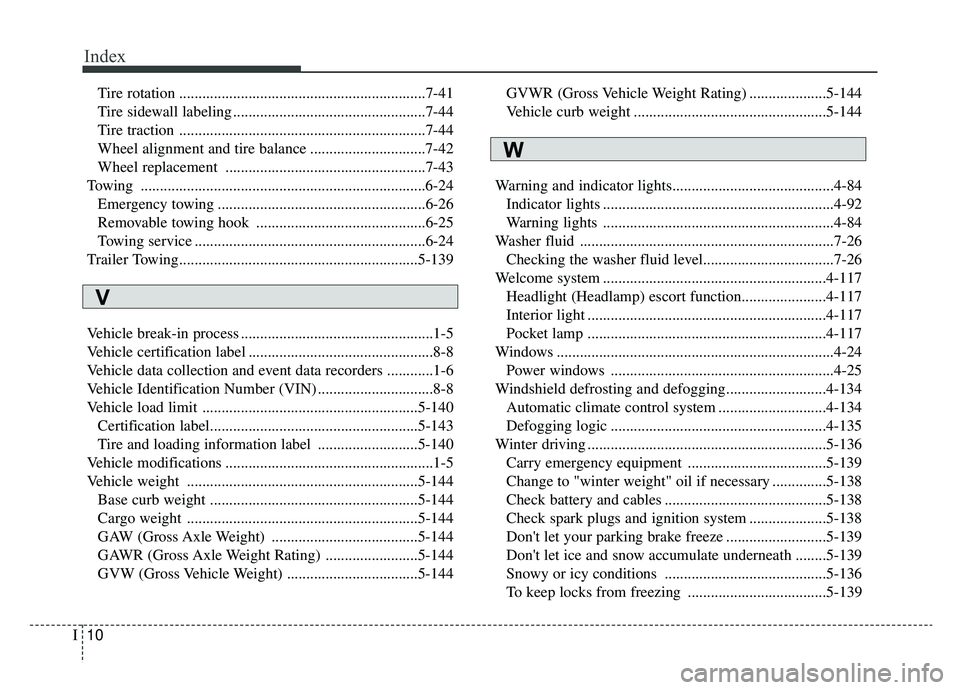
Tire rotation ................................................................7-41
Tire sidewall labeling ..................................................7-44
Tire traction ................................................................7-44
Wheel alignment and tire balance ..............................7-42
Wheel replacement ....................................................7-43
Towing ........................................................................\
..6-24 Emergency towing ......................................................6-26
Removable towing hook ............................................6-25
Towing service ............................................................6-24
Trailer Towing..............................................................5-139
Vehicle break-in process ..................................................1-5
Vehicle certification label ................................................8-8
Vehicle data collection and event data recorders ............1-6
Vehicle Identification Number (VIN) ..............................8-8
Vehicle load limit ........................................................5-140 Certification label......................................................5-143
Tire and loading information label ..........................5-140
Vehicle modifications ......................................................1-5
Vehicle weight ............................................................5-144 Base curb weight ......................................................5-144
Cargo weight ............................................................5-144
GAW (Gross Axle Weight) ......................................5-144
GAWR (Gross Axle Weight Rating) ........................5-144
GVW (Gross Vehicle Weight) ..................................5-144 GVWR (Gross Vehicle Weight Rating) ....................5-144
Vehicle curb weight ..................................................5-144
Warning and indicator lights..........................................4-84 Indicator lights ............................................................4-92
Warning lights ............................................................4-84
Washer fluid ..................................................................7-26 Checking the washer fluid level..................................7-26
Welcome system ..........................................................4-117 Headlight (Headlamp) escort function......................4-117
Interior light ..............................................................4-117
Pocket lamp ..............................................................4-117
Windows ........................................................................\
4-24 Power windows ..........................................................4-25
Windshield defrosting and defogging..........................4-134 Automatic climate control system ............................4-134
Defogging logic ........................................................4-135
Winter driving ..............................................................5-136 Carry emergency equipment ....................................5-139
Change to "winter weight" oil if necessary ..............5-138
Check battery and cables ..........................................5-138
Check spark plugs and ignition system ....................5-138
Don't let your parking brake freeze ..........................5-139
Don't let ice and snow accumulate underneath ........5-139
Snowy or icy conditions ..........................................5-136
To keep locks from freezing ....................................5-139
V
W