ignition KIA OPTIMA PHEV 2020 Workshop Manual
[x] Cancel search | Manufacturer: KIA, Model Year: 2020, Model line: OPTIMA PHEV, Model: KIA OPTIMA PHEV 2020Pages: 597, PDF Size: 14.2 MB
Page 464 of 597
625
What to do in an emergency
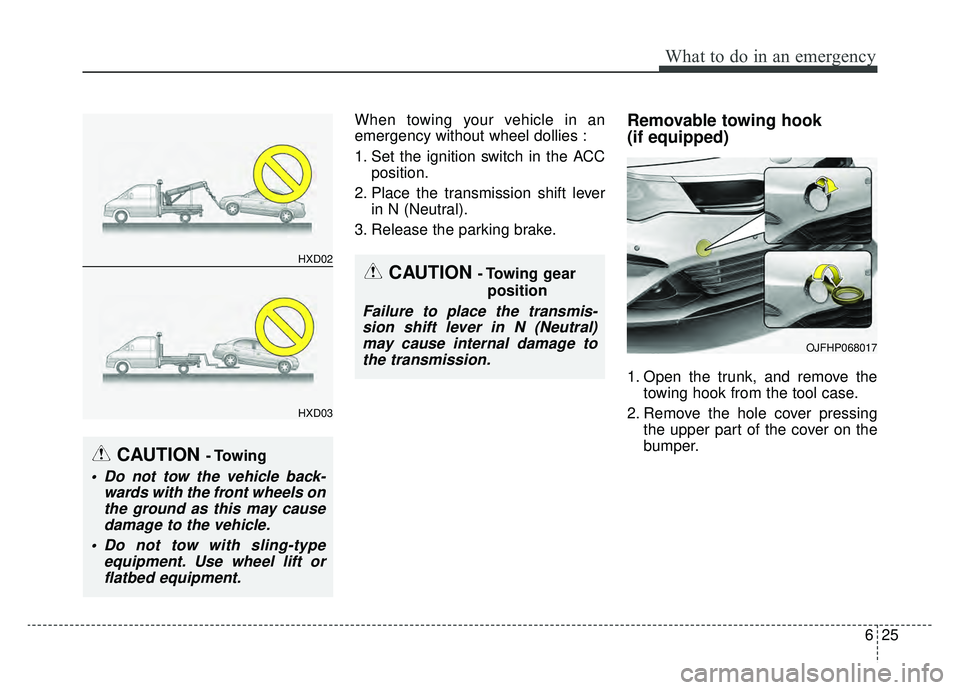
When towing your vehicle in an
emergency without wheel dollies :
1. Set the ignition switch in the ACCposition.
2. Place the transmission shift lever in N (Neutral).
3. Release the parking brake.Removable towing hook
(if equipped)
1. Open the trunk, and remove the towing hook from the tool case.
2. Remove the hole cover pressing the upper part of the cover on the
bumper.
CAUTION - Towing gear
position
Failure to place the transmis-sion shift lever in N (Neutral)may cause internal damage tothe transmission.
CAUTION - Towing
Do not tow the vehicle back- wards with the front wheels onthe ground as this may causedamage to the vehicle.
Do not tow with sling-type equipment. Use wheel lift orflatbed equipment.
HXD02
HXD03
OJFHP068017
Page 467 of 597
What to do in an emergency
28
6
Emergency towing precautions
Turn the ignition switch to ACC so
the steering wheel isn’t locked.
Place the transmission shift lever in N (Neutral).
Release the parking brake.
Press the brake pedal with more force than normal since you will
have reduced brake performance.
More steering effort will be required because the power steer-
ing system will be disabled.
If you are driving down a long hill, the brakes may overheat and brake
performance will be reduced. Stop
often and let the brakes cool off. If the car is being towed with all
four wheels on the ground, it can
be towed only from the front. Be
sure that the transmission is in
neutral. Be sure the steering is
unlocked by placing the ignition
switch in the ACC position. A driver
must be in the towed vehicle to
operate the steering and brakes.
CAUTION - Automatic
transmission
To avoid serious damage to the automatic transmission,limit the vehicle speed to 10mph (15 km/h) and drive lessthan 1 mile (1.5 km) when tow-ing.
Before towing, check the auto- matic transmission for fluidleaks under your vehicle. If theautomatic transmission fluidis leaking, flatbed equipmentor a towing dolly must beused.
Page 522 of 597
Maintenance
54
7
✽ ✽
NOTICE
• When replacing a fuse, turn the
ignition “OFF” and turn off
switches of all electrical devices
then remove battery (-) terminal.
• The actual fuse/relay panel label may differ from equipped items.
WARNING- Electrical Fire
Always ensure replacements
fuses and relays are securely
fastened when installed. Failure
to do so can result in a vehicle
fire.
CAUTION
When replacing a blown fuse or relay, make sure the newfuse or relay fits tightly intothe clips. Failure to tightlyinstall the fuse or relay maycause damage to the wiringand electric systems.
Do not remove fuses, relays and terminals fastened withbolts or nuts. The fuses, relaysand terminals may not be fas-tened correctly which maycause vehicle damage.
CAUTION
Do not input any other objects except fuses or relays intofuse/relay terminals, such as adriver or wiring. It may causecontact failure and systemmalfunction.
Do not plug in screwdrivers or aftermarket wiring into the ter-minal originally designed forfuse and relays only. The elec-trical system and wiring of thevehicle interior may be dam-aged or burned due to contactfailure.
If you directly connect the wire on the taillight or replacethe bulb which is over the reg-ulated capacity to install trail-ers, etc., the inner junctionblock can get burned.
Page 538 of 597

Maintenance
70
7
Fuse NameFuse ratingCircuit Protected
FUSE
SENSOR 115AOxygen Sensor (Up/Down), E/R Junction Block (Cooling Fan Relay)
IGN COIL20AIgnition Coil #1/#2/#3/#4
ECU 210APCM
TCU 110APCM
HEV ECU 210AHPCU, E/R Junction Block (Battery C/Fan Relay)
ECU 310APCM
POWER OUT-
LET220AFront Power Outlet #1
HORN20AHorn Relay, ICM Relay Box (Burglar Alarm Horn Relay)
WIPER 130AWiper Power Relay
BATTERYC/FAN15AE/R Junction Block (Battery C/Fan Relay)
Page 570 of 597
Your vehicle is equipped with a cat-
alytic converter emission control
device.
Therefore, the following precautions
must be observed:
Use only UNLEADED FUEL forgasoline engines.
Do not operate the vehicle when there are signs of engine malfunc-
tion, such as misfire or a noticeable
loss of performance.
Do not misuse or abuse the engine. Examples of misuse are
coasting with the ignition off and
descending steep grades in gear
with the ignition off.
Do not operate the engine at high idle speed for extended periods (5
minutes or more).
Do not modify or tamper with any part of the engine or emission con-
trol system. All inspections and
adjustments must be made by an
authorized Kia dealer.
Avoid driving with an extremely low fuel level. Running out of fuel could
cause the engine to misfire, dam-
aging the catalytic converter. Failure to observe these precautions
could result in damage to the catalyt-
ic converter and to your vehicle.
Additionally, such actions could void
your warranties.
Perchlorate Material-special handling
may apply, See www.dtsc.ca.gov/haz-
ardouswaste/ perchlorate.
Notice to California Vehicle Dismantlers:
Perchlorate containing materials,
such as air bag inflators, seatbelt
pretensioners and keyless remote
entry batteries, must be disposed of
according to Title 22 California Code
of Regulations Chapter 67384.10
(a).
CALIFORNIA
PERCHLORATE NOTICE
7 102
Maintenance
Page 595 of 597
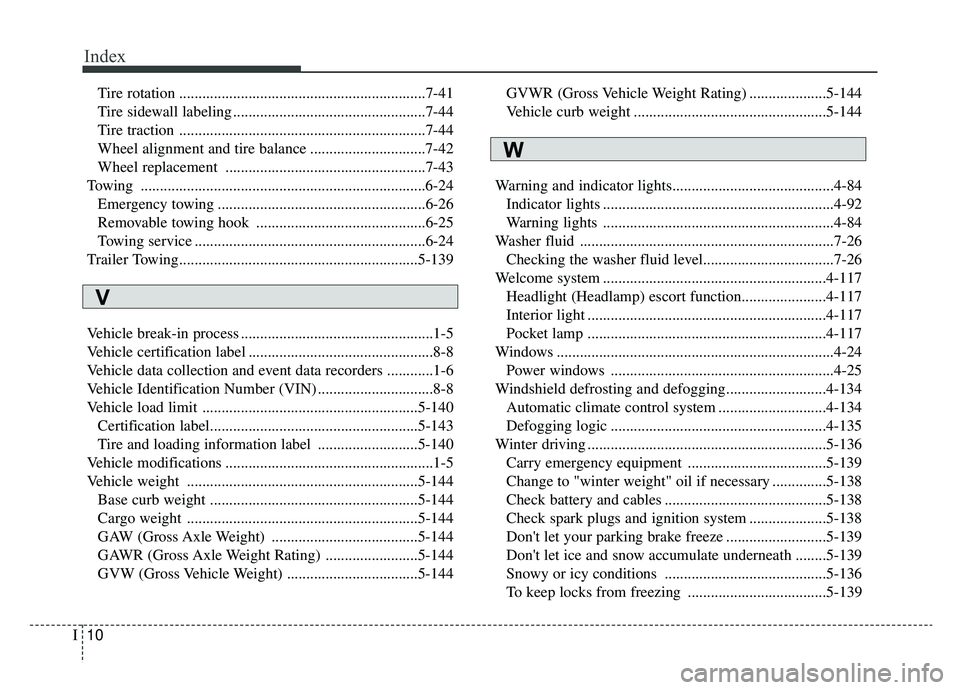
Index
10I
Tire rotation ................................................................7-41
Tire sidewall labeling ..................................................7-44
Tire traction ................................................................7-44
Wheel alignment and tire balance ..............................7-42
Wheel replacement ....................................................7-43
Towing ........................................................................\
..6-24 Emergency towing ......................................................6-26
Removable towing hook ............................................6-25
Towing service ............................................................6-24
Trailer Towing..............................................................5-139
Vehicle break-in process ..................................................1-5
Vehicle certification label ................................................8-8
Vehicle data collection and event data recorders ............1-6
Vehicle Identification Number (VIN) ..............................8-8
Vehicle load limit ........................................................5-140 Certification label......................................................5-143
Tire and loading information label ..........................5-140
Vehicle modifications ......................................................1-5
Vehicle weight ............................................................5-144 Base curb weight ......................................................5-144
Cargo weight ............................................................5-144
GAW (Gross Axle Weight) ......................................5-144
GAWR (Gross Axle Weight Rating) ........................5-144
GVW (Gross Vehicle Weight) ..................................5-144 GVWR (Gross Vehicle Weight Rating) ....................5-144
Vehicle curb weight ..................................................5-144
Warning and indicator lights..........................................4-84 Indicator lights ............................................................4-92
Warning lights ............................................................4-84
Washer fluid ..................................................................7-26 Checking the washer fluid level..................................7-26
Welcome system ..........................................................4-117 Headlight (Headlamp) escort function......................4-117
Interior light ..............................................................4-117
Pocket lamp ..............................................................4-117
Windows ........................................................................\
4-24 Power windows ..........................................................4-25
Windshield defrosting and defogging..........................4-134 Automatic climate control system ............................4-134
Defogging logic ........................................................4-135
Winter driving ..............................................................5-136 Carry emergency equipment ....................................5-139
Change to "winter weight" oil if necessary ..............5-138
Check battery and cables ..........................................5-138
Check spark plugs and ignition system ....................5-138
Don't let your parking brake freeze ..........................5-139
Don't let ice and snow accumulate underneath ........5-139
Snowy or icy conditions ..........................................5-136
To keep locks from freezing ....................................5-139
V
W