heating KIA OPTIMA PLUG-IN HYBRID 2017 User Guide
[x] Cancel search | Manufacturer: KIA, Model Year: 2017, Model line: OPTIMA PLUG-IN HYBRID, Model: KIA OPTIMA PLUG-IN HYBRID 2017Pages: 686, PDF Size: 35.24 MB
Page 453 of 686
• Do not coast down hills with the vehi‐cle out of gear. This is extremely haz‐
ardous. Keep the vehicle in gear at all times, use the brakes to slow down,
then shift to a lower gear so that en‐
gine braking will help you maintain a
safe speed.
• Do not "ride" the brake pedal. Resting your foot on the brake pedal whiledriving can be dangerous because it
can result in the brakes overheating
and losing their effectiveness. It also
increases the wear of the brake com‐
ponents.
• If a tire goes flat while you are driv‐ ing, apply the brakes gently and keep
the vehicle pointed straight ahead
while you slow down. When you are
moving slowly enough for it to be safe to do so, pull off the road and
stop in a safe place.
• If your vehicle is equipped with an Automatic Transaxle / Dual clutch
transmission, do not let your vehicle
creep forward. To avoid creeping for‐
ward, keep your foot firmly on the
brake pedal when the vehicle is stop‐
ped. • Be cautious when parking on a hill.
Firmly engage the parking brake and
place the shift lever in P (automatic transaxle) or in first or reverse gear
(manual transaxle). If your vehicle is
facing downhill, turn the front wheels
into the curb to help keep the vehicle from rolling. If your vehicle is facing
uphill, turn the front wheels away
from the curb to help keep the vehi‐
cle from rolling. If there is no curb or
if it is required by other conditions to keep the vehicle from rolling, block
the wheels.
• Under some conditions your parking brake can freeze in the engaged posi‐
tion. This is most likely to happen
when there is an accumulation of snow or ice around or near the rear
brakes or if the brakes are wet. If
there is a risk that the parking brake
may freeze, apply it only temporarily while you put the shift lever in P (Au‐
tomatic Transaxle / Dual clutch trans‐
mission) or in first or reverse gear
(manual transaxle) and block the rear
wheels so the vehicle cannot roll.
Then release the parking brake. • Do not hold the vehicle on the up‐
grade with the accelerator pedal. This
can cause the transaxle to overheat.
Always use the brake pedal or park‐
ing brake.
Driving your vehicle
7-36
Page 516 of 686

SPECIAL DRIVING CONDITIONS
Hazardous driving conditions
When hazardous driving conditions are
encountered such as water, snow, ice, mud, sand, or similar hazards, follow
these suggestions: • Drive cautiously and allow extra dis‐ tance for braking.
• Avoid sudden braking or steering.
• When braking with non-ABS brakes pump the brake pedal with a light up-
and-down motion until the vehicle is stopped.
WARNING
nABS
Do not pump the brake pedal on avehicle equipped with ABS.
• If stalled in snow, mud, or sand, use second gear. Accelerate slowly to
avoid spinning the drive wheels.
• Use sand, rock salt, tire chains, or other non-slip material under the
drive wheels to provide traction when
stalled in ice, snow, or mud.
WARNING
nDownshifting
Downshifting with an automatictransaxle, while driving on slipperysurfaces can cause an accident. Thesudden change in tire speed couldcause the tires to skid. Be carefulwhen downshifting on slippery sur‐faces.
Rocking the vehicle
If it is necessary to rock the vehicle to
free it from snow, sand, or mud, first turn the steering wheel right and left
to clear the area around your front
wheels. Then, shift back and forth be‐ tween 1 (First) and R (Reverse) in vehi‐
cles equipped with a manual transaxle
or R (Reverse) and any forward gear in vehicles equipped with an Automatic
Transaxle / Dual clutch transmission. Do
not race the engine, and spin the wheels as little as possible. If you are
still stuck after a few tries, have the
vehicle pulled out by a tow vehicle to
avoid engine overheating and possible
damage to the transaxle.
CAUTION
Prolonged rocking may cause engineover-heating, transaxle damage orfailure, and tire damage.
WARNING
nSpinning tires
Do not spin the wheels, especially atspeeds more than 56 km/h(35 mph). Spinning the wheels athigh speeds when the vehicle is sta‐tionary could cause a tire to over‐heat which could result in tire dam‐age that may injure bystanders.
NOTICE
The ESC system should be turned
OFF prior to rocking the vehicle.
7-99
7
Driving your vehicle
Page 519 of 686
Driving off-road
Drive carefully off-road because your
vehicle may be damaged by rocks or roots of trees. Become familiar with
the off-road conditions where you are
going to drive before you begin driving.
Highway driving
Tires
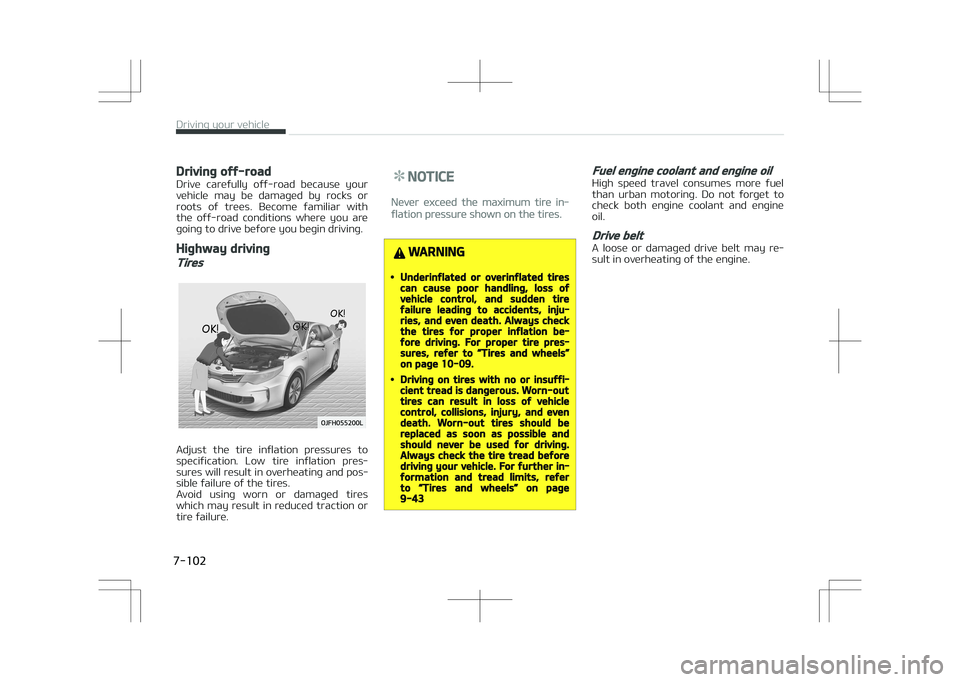
Adjust the tire inflation pressures to
specification. Low tire inflation pres‐ sures will result in overheating and pos‐
sible failure of the tires.
Avoid using worn or damaged tires
which may result in reduced traction or tire failure.
NOTICE
Never exceed the maximum tire in‐
flation pressure shown on the tires.
WARNING
•Underinflated or overinflated tirescan cause poor handling, loss ofvehicle control, and sudden tirefailure leading to accidents, inju‐ries, and even death. Always checkthe tires for proper inflation be‐fore driving. For proper tire pres‐sures, refer to L
Page 532 of 686

IF THE ENGINE OVERHEATS
If your temperature gauge indicates
overheating, you will experience a loss of power, or hear loud pinging or knock‐
ing, the engine is probably too hot. If
this happens, you should: 1. Turn on the emergency warning flasher and stop in a safe place.
Move the shift lever to P (Park) and
engage the parking brake.
2. If hot steam does not come out from the engine room, carefullyopen the engine room and check
whether the water pump connector
is properly engaged. If the connec‐
tor is not properly engaged, stop
the engine immediately and prop‐
erly engage the connector. Then,
turn the engine on.
3. Turn on the air conditioner.
4. If the L