towing KIA PICANTO 2006 User Guide
[x] Cancel search | Manufacturer: KIA, Model Year: 2006, Model line: PICANTO, Model: KIA PICANTO 2006Pages: 281, PDF Size: 9.89 MB
Page 193 of 281
615
In case of an emergency
1 23456789
When towing your vehicle in an emergency without wheel dollies :
1. Set the ignition switch in the ACCposition.
2. Place the transaxle shift lever in N (Neutral).
3. Release the parking brake.
✽✽ NOTICE
Failure to place the transaxle shift
lever in N (Neutral) may cause inter-nal damage to the transaxle.
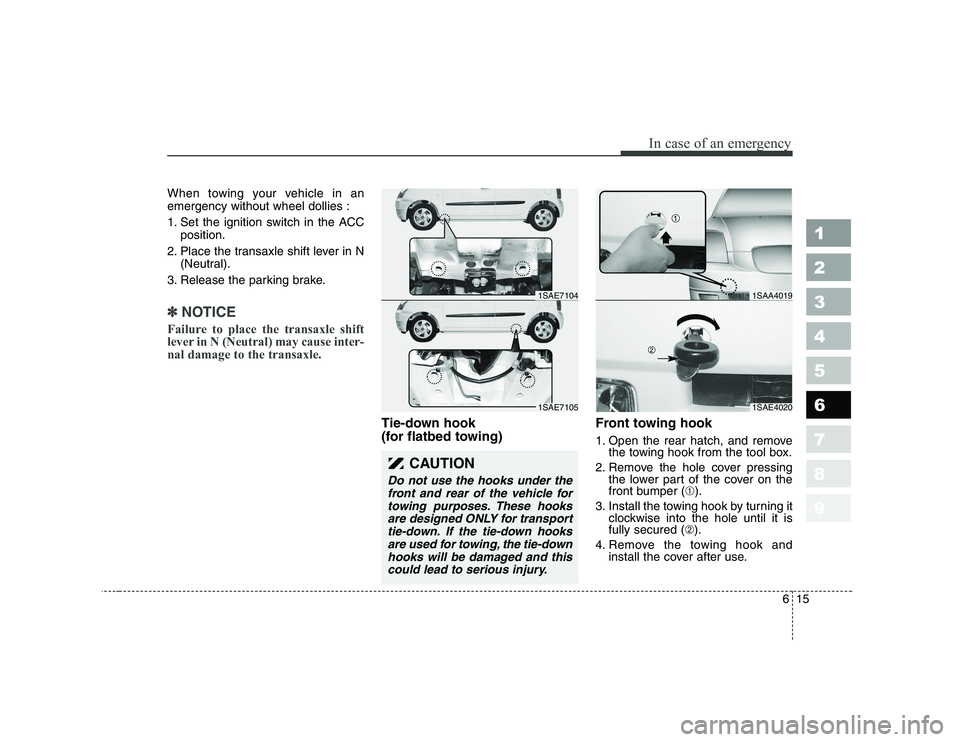
Tie-down hook
(for flatbed towing) Front towing hook
1. Open the rear hatch, and remove
the towing hook from the tool box.
2. Remove the hole cover pressing the lower part of the cover on the
front bumper ( ➀).
3. Install the towing hook by turning it clockwise into the hole until it isfully secured ( ➁).
4. Remove the towing hook and install the cover after use.
CAUTION
Do not use the hooks under the
front and rear of the vehicle fortowing purposes. These hooksare designed ONLY for transport tie-down. If the tie-down hooksare used for towing, the tie-downhooks will be damaged and this could lead to serious injury.
1SAE40201SAE7105
1SAA40191SAE7104
Page 194 of 281
In case of an emergency
16
6
1 23456789
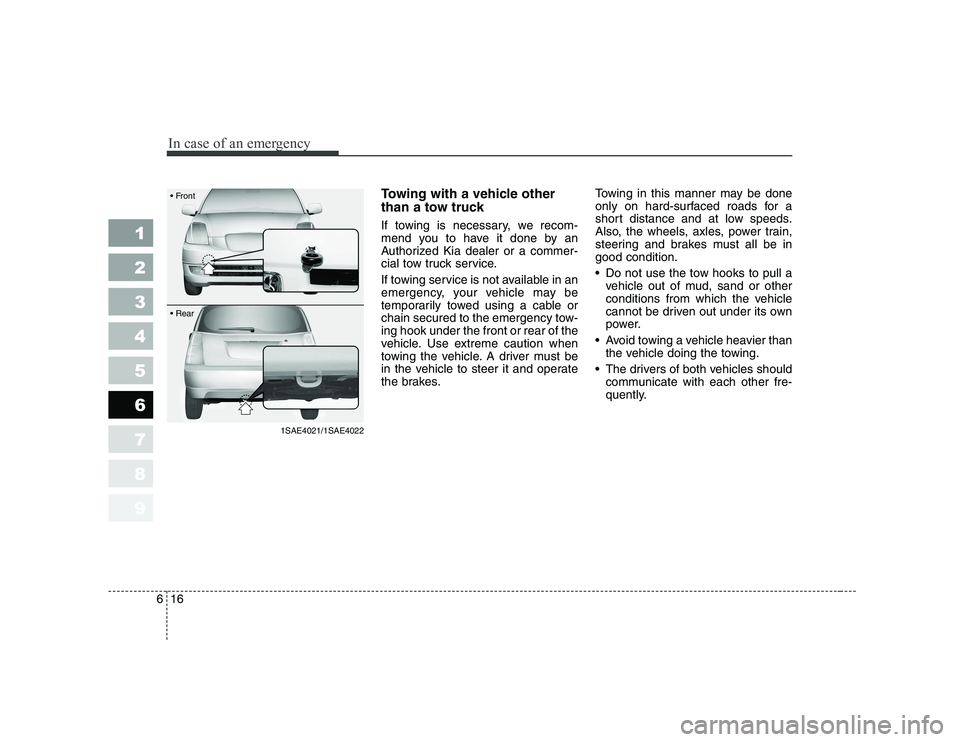
Towing with a vehicle other
than a tow truck
If towing is necessary, we recom-
mend you to have it done by an
Authorized Kia dealer or a commer-
cial tow truck service.
If towing service is not available in an
emergency, your vehicle may be
temporarily towed using a cable or
chain secured to the emergency tow-ing hook under the front or rear of the
vehicle. Use extreme caution when
towing the vehicle. A driver must be
in the vehicle to steer it and operate
the brakes. Towing in this manner may be done
only on hard-surfaced roads for a
short distance and at low speeds.
Also, the wheels, axles, power train,
steering and brakes must all be ingood condition.
Do not use the tow hooks to pull a
vehicle out of mud, sand or other
conditions from which the vehicle
cannot be driven out under its own
power.
Avoid towing a vehicle heavier than the vehicle doing the towing.
The drivers of both vehicles should communicate with each other fre-
quently.
1SAE4021/1SAE4022
Front Rear
Page 196 of 281
In case of an emergency
18
6
1 23456789
When your vehicle is being
towed by another vehicle
other than a tow truck (in case
of an emergency)
Turn the ignition switch to ACC so
the steering wheel isn’t locked.
Place the transaxle shift lever in N (Neutral).
Release the parking bake.
Vehicles equipped with automatic transaxles should not exceed 45 km/h (28 mph) and should not be
towed more than 80 km (50 miles).
Vehicles equipped with manual transaxles should not be towed in
excess of 88 km/h (55 mph) and
should not be towed more than645 km (400 miles). Press the brake pedal with more
force than normal since you will
have reduced brake performance.
More steering effort will be required because the power steer-
ing system will be disabled.
If you are driving down a long hill, the brakes may overheat and brake
performance will be reduced. Stop
often and let the brakes cool off.
✽✽ NOTICE
To prevent internal damage to the
transaxle, never tow your vehicle
from the rear (backwards) with all
four tires in contact with the sur-face.
Tips for towing a stuck vehicle
The following methods are effective
when your vehicle is stuck in mud,sand or similar substances that pre-
vent the vehicle from being driven
out under its own power.
Remove the soil and sand, etc. from the front and the back of the
tires.
Place a stone or wood under the tires.
Page 197 of 281
619
In case of an emergency
1 23456789
IF YOU HAVE A FLAT TIRE (IF THE VEHICLE IS EQUIPPED WITH SPARE TIRE)
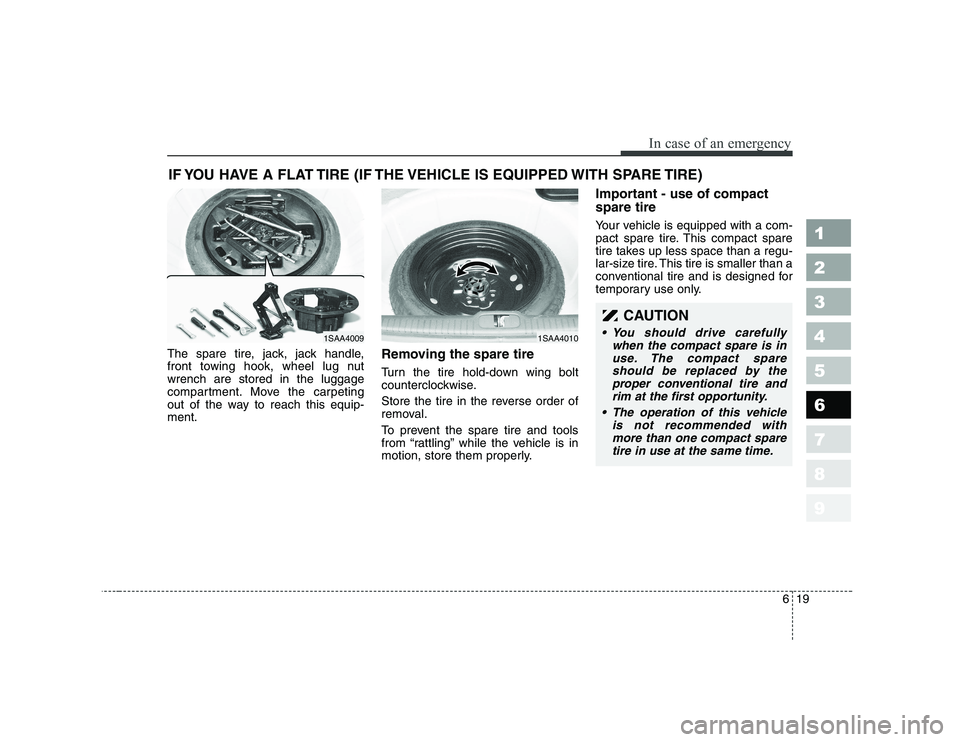
The spare tire, jack, jack handle,
front towing hook, wheel lug nutwrench are stored in the luggage
compartment. Move the carpeting
out of the way to reach this equip-ment. Removing the spare tire
Turn the tire hold-down wing bolt
counterclockwise.
Store the tire in the reverse order of
removal.
To prevent the spare tire and tools
from “rattling” while the vehicle is in
motion, store them properly.Important - use of compact spare tire
Your vehicle is equipped with a com-
pact spare tire. This compact spare
tire takes up less space than a regu-
lar-size tire. This tire is smaller than a
conventional tire and is designed for
temporary use only.
1SAA40091SAA4010
CAUTION
You should drive carefully
when the compact spare is inuse. The compact spareshould be replaced by theproper conventional tire and rim at the first opportunity.
The operation of this vehicle is not recommended withmore than one compact sparetire in use at the same time.
Page 199 of 281
621
In case of an emergency
1 23456789
Changing tires
Jacking instructions
The jack is provided for emergency
tire changing only.
Follow jacking instructions to reduce
the possibility of personal injury.
WARNING- Changing
tires
Never attempt vehicle repairs in the traffic lanes of a public
road or highway.
Always move the vehicle com- pletely off the road and onto
the shoulder before trying to
change a tire. The jack should
be used on level firm ground
whenever possible. If you can-
not find a firm, level place off
the road, call a towing service
company for assistance.
Be sure to use the correct front and rear jacking posi-
tions on the vehicle; never use
the bumpers or any other part
of the vehicle for jack support.
(Continued)(Continued)
The vehicle can easily roll offthe jack causing serious
injury or death. No person
should place any portion of
their body under a vehicle that
is supported only by a jack ;
use vehicle support stands.
Do not start or run the engine while the vehicle is on the
jack.
Do not allow anyone to remain in the vehicle while it is on the
jack.
Make sure any children pres- ent are in a secure place away
from the road and from the
vehicle to be raised with the
jack.
Page 206 of 281
In case of an emergency
28
6
1 23456789
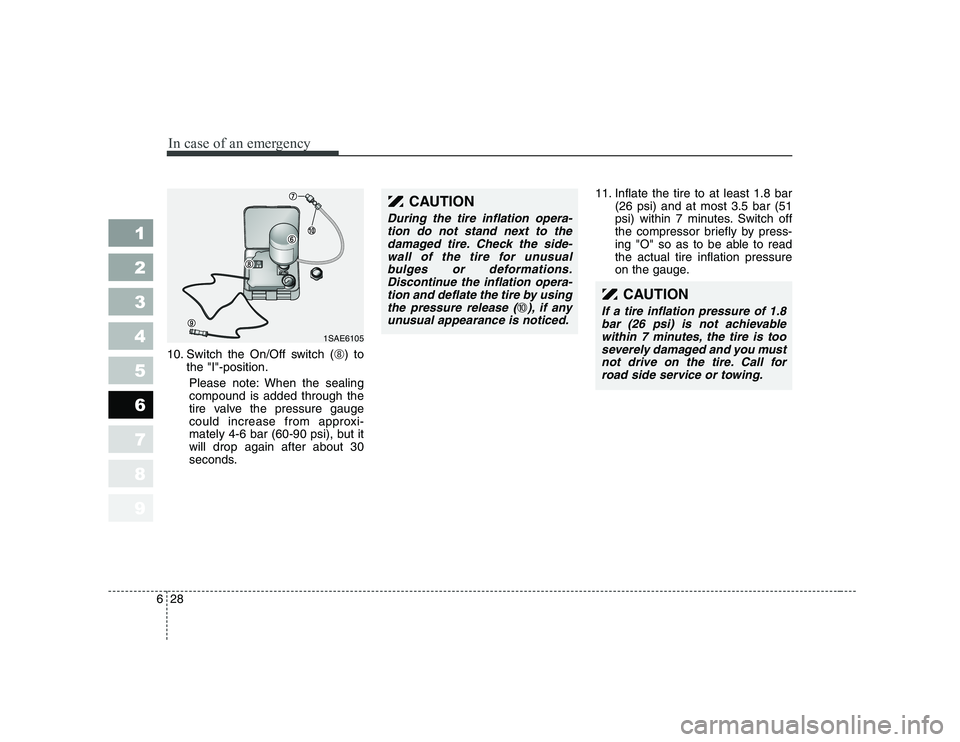
10. Switch the On/Off switch (
➇) to
the "I"-position.
Please note: When the sealing compound is added through the
tire valve the pressure gauge
could increase from approxi-
mately 4-6 bar (60-90 psi), but itwill drop again after about 30
seconds. 11. Inflate the tire to at least 1.8 bar
(26 psi) and at most 3.5 bar (51
psi) within 7 minutes. Switch off
the compressor briefly by press-
ing "O" so as to be able to readthe actual tire inflation pressure
on the gauge.
CAUTION
During the tire inflation opera-
tion do not stand next to thedamaged tire. Check the side-wall of the tire for unusual bulges or deformations.Discontinue the inflation opera-tion and deflate the tire by using the pressure release (
➉), if any
unusual appearance is noticed.
CAUTION
If a tire inflation pressure of 1.8 bar (26 psi) is not achievablewithin 7 minutes, the tire is tooseverely damaged and you must not drive on the tire. Call forroad side service or towing.
1SAE6105
Page 207 of 281
629
In case of an emergency
1 23456789
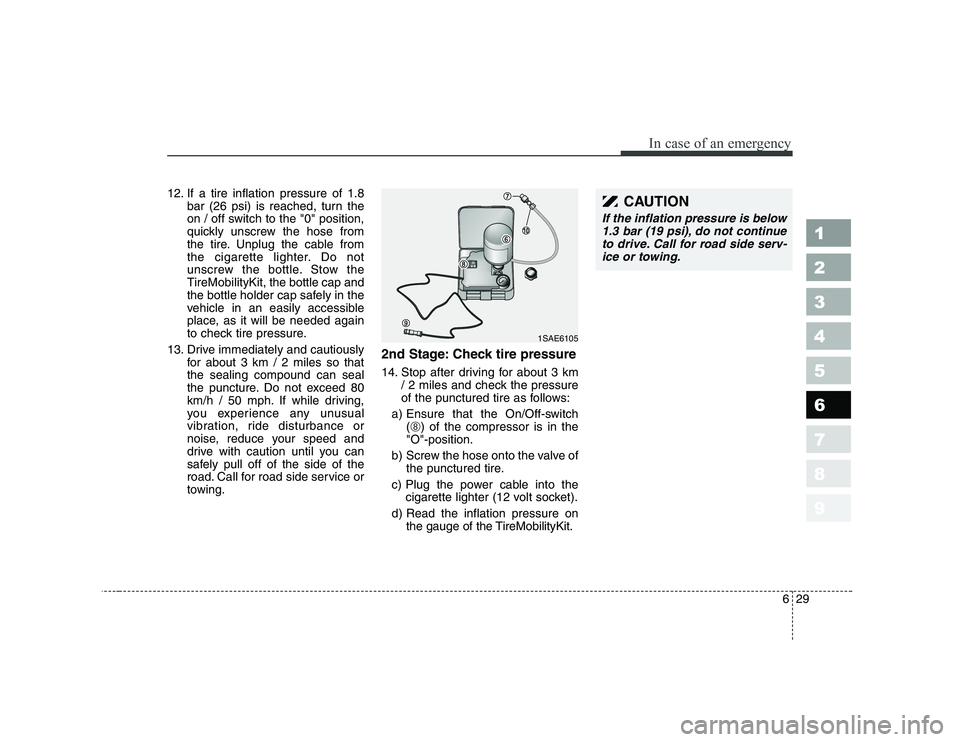
12. If a tire inflation pressure of 1.8bar (26 psi) is reached, turn the
on / off switch to the "0" position,
quickly unscrew the hose from
the tire. Unplug the cable from
the cigarette lighter. Do not
unscrew the bottle. Stow theTireMobilityKit, the bottle cap and
the bottle holder cap safely in the
vehicle in an easily accessible
place, as it will be needed again
to check tire pressure.
13. Drive immediately and cautiously for about 3 km / 2 miles so thatthe sealing compound can seal
the puncture. Do not exceed 80
km/h / 50 mph. If while driving,
you experience any unusual
vibration, ride disturbance or
noise, reduce your speed and
drive with caution until you can
safely pull off of the side of the
road. Call for road side service or
towing. 2nd Stage: Check tire pressure
14. Stop after driving for about 3 km
/ 2 miles and check the pressure
of the punctured tire as follows:
a) Ensure that the On/Off-switch (➇ ) of the compressor is in the
"O"-position.
b) Screw the hose onto the valve of the punctured tire.
c) Plug the power cable into the cigarette lighter (12 volt socket).
d) Read the inflation pressure on the gauge of the TireMobilityKit.CAUTION
If the inflation pressure is below
1.3 bar (19 psi), do not continueto drive. Call for road side serv- ice or towing.
1SAE6105
Page 222 of 281
79
Maintenance
1 23456789
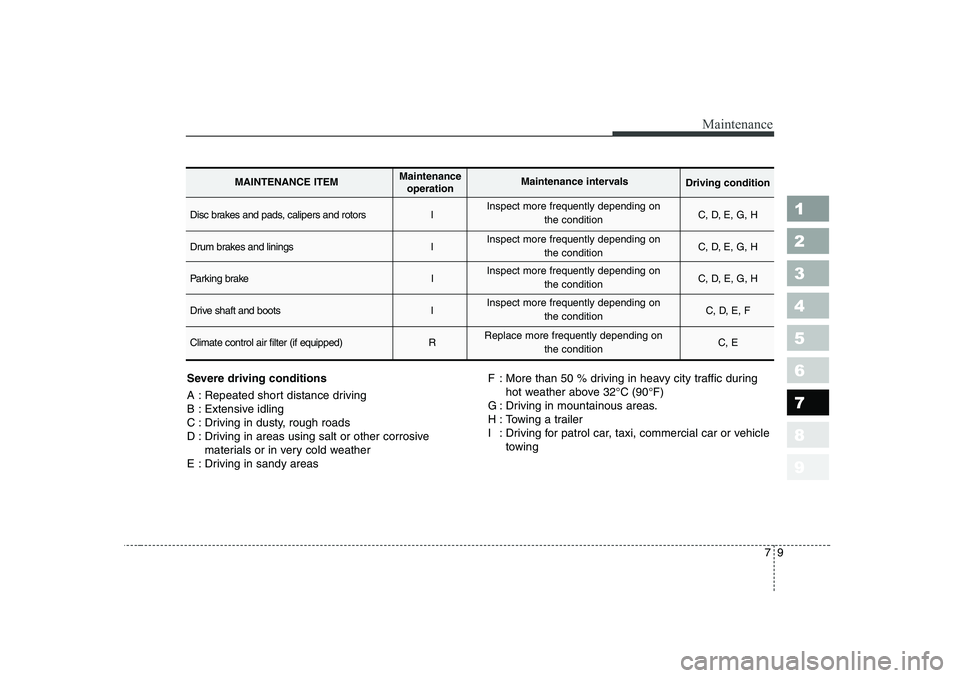
Severe driving conditions
A : Repeated short distance driving
B : Extensive idling
C : Driving in dusty, rough roads
D : Driving in areas using salt or other corrosive materials or in very cold weather
E : Driving in sandy areas F : More than 50 % driving in heavy city traffic during
hot weather above 32°C (90°F)
G : Driving in mountainous areas.
H : Towing a trailer
I : Driving for patrol car, taxi, commercial car or vehicle towing
Disc brakes and pads, calipers and rotors I C, D, E, G, H
Drum brakes and linings I C, D, E, G, H
Parking brake I C, D, E, G, H
Drive shaft and boots I C, D, E, F
Climate control air filter (if equipped) R C, E
MAINTENANCE ITEMMaintenance
operation Maintenance intervals
Driving condition
Inspect more frequently depending on the condition
Inspect more frequently depending on the condition
Inspect more frequently depending on the condition
Inspect more frequently depending on the condition
Replace more frequently depending on the condition
Page 280 of 281
93
1 23456789
Index
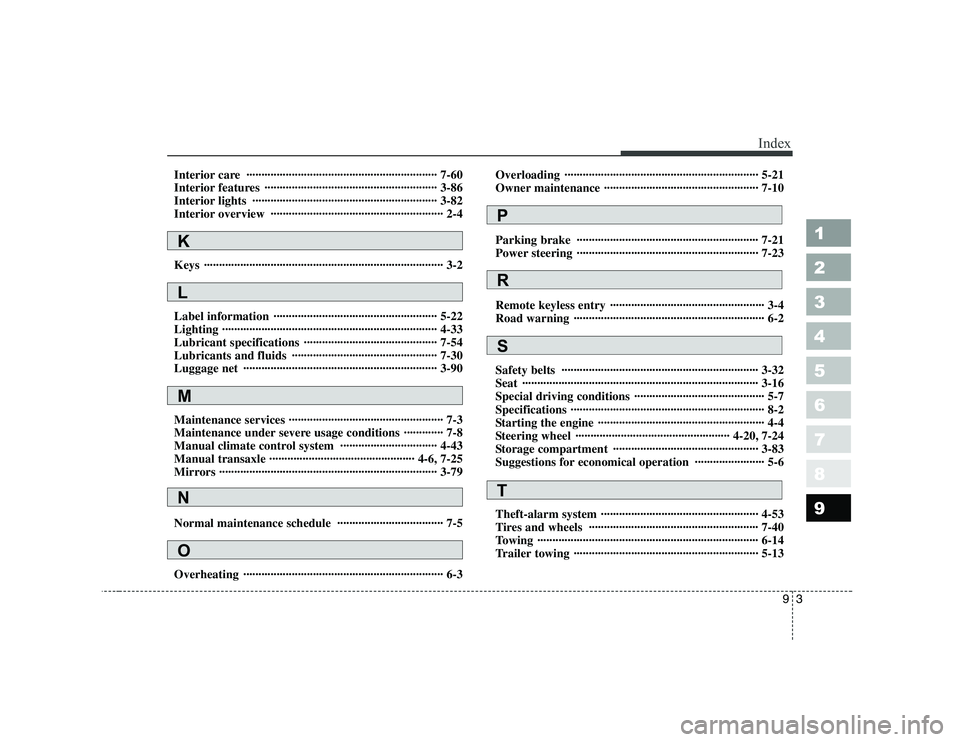
Interior care ······························································· 7-60
Interior features ························································· 3-86
Interior lights ····························································· 3-82
Interior overview ························································· 2-4
Keys ··············································································· 3-2
Label information ······················································ 5-22
Lighting ······································································· 4-33
Lubricant specifications ············································ 7-54
Lubricants and fluids ················································ 7-30
Luggage net ································································ 3-90
Maintenance services ··················································· 7-3
Maintenance under severe usage conditions ············· 7-8
Manual climate control system ································ 4-43
Manual transaxle ················································ 4-6, 7-25
Mirrors ········································································ 3-79
Normal maintenance schedule ··································· 7-5
Overheating ·································································· 6-3Overloading ································································ 5-21
Owner maintenance ··················································· 7-10
Parking brake ···························································· 7-21
Power steering ···························································· 7-23
Remote keyless entry ··················································· 3-4
Road warning ······························································· 6-2
Safety belts ································································· 3-32
Seat ·············································································· 3-16
Special driving conditions ··········································· 5-7
Specifications ································································ 8-2
Starting the engine ······················································· 4-4
Steering wheel ··················································· 4-20, 7-24
Storage compartment ················································ 3-83
Suggestions for economical operation ······················· 5-6
Theft-alarm system ···················································· 4-53
Tires and wheels ························································ 7-40
Towing ········································································· 6-14
Trailer towing ····························································· 5-13
K
L
M
N
O
P
R
S
T