airbag KIA PICANTO 2006 Owner's Manual
[x] Cancel search | Manufacturer: KIA, Model Year: 2006, Model line: PICANTO, Model: KIA PICANTO 2006Pages: 281, PDF Size: 9.89 MB
Page 78 of 281
Knowing your vehicle
68
3
1 23456789
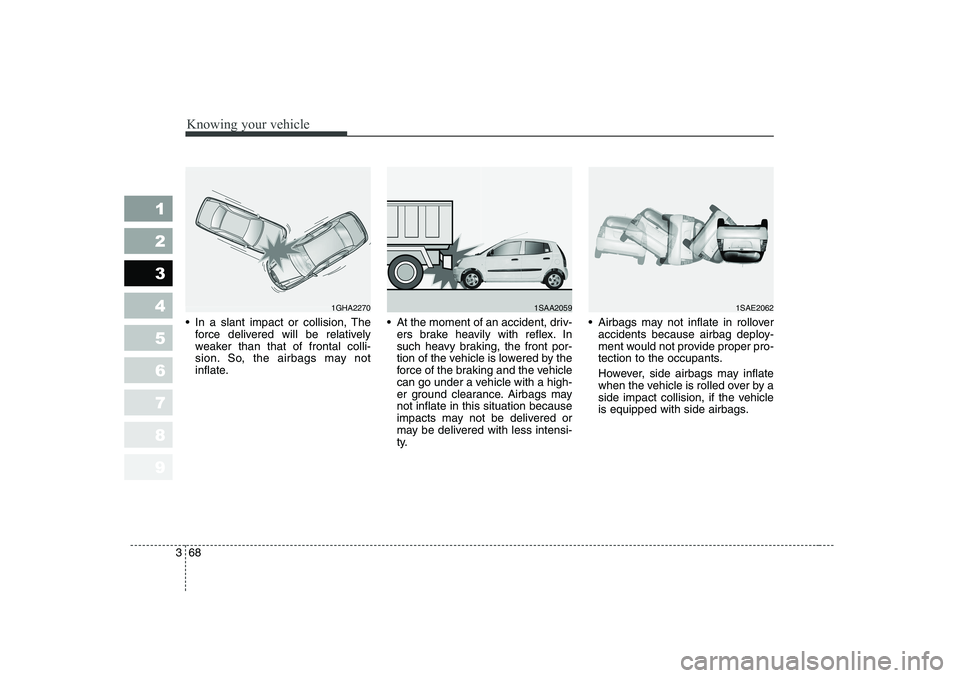
In a slant impact or collision, The
force delivered will be relatively
weaker than that of frontal colli-
sion. So, the airbags may not
inflate. At the moment of an accident, driv-
ers brake heavily with reflex. In
such heavy braking, the front por-
tion of the vehicle is lowered by the
force of the braking and the vehicle
can go under a vehicle with a high-
er ground clearance. Airbags maynot inflate in this situation because
impacts may not be delivered or
may be delivered with less intensi-
ty. Airbags may not inflate in rollover
accidents because airbag deploy-
ment would not provide proper pro-
tection to the occupants.
However, side airbags may inflate when the vehicle is rolled over by a
side impact collision, if the vehicle
is equipped with side airbags.
1GHA22701SAA20591SAE2062
Page 79 of 281
369
1 23456789
Knowing your vehicle
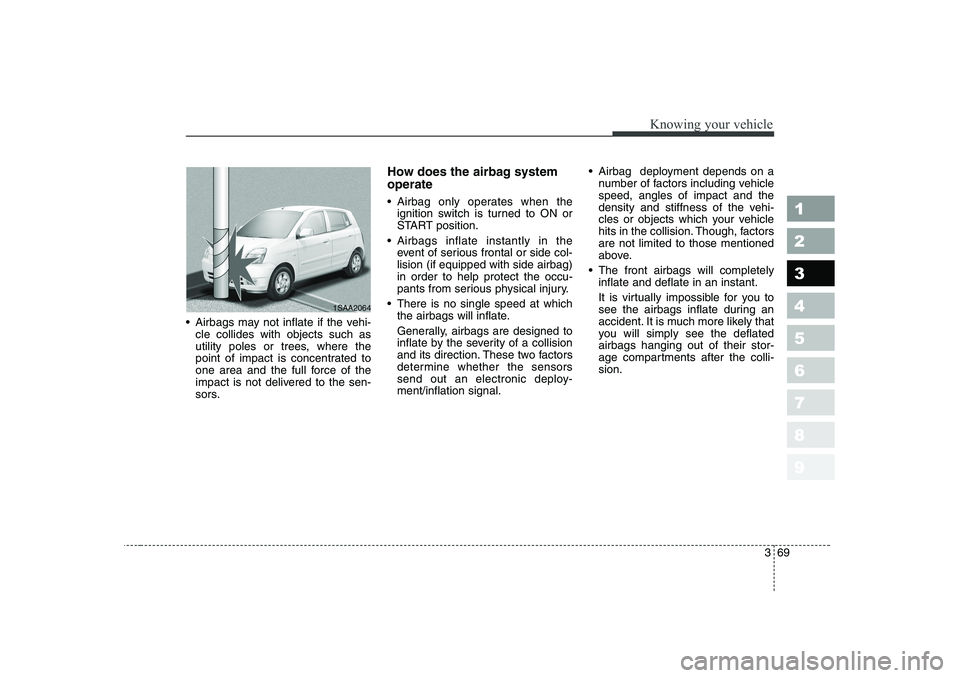
Airbags may not inflate if the vehi-cle collides with objects such as
utility poles or trees, where the
point of impact is concentrated to
one area and the full force of the
impact is not delivered to the sen-
sors. How does the airbag system operate
Airbag only operates when the
ignition switch is turned to ON or
START position.
Airbags inflate instantly in the event of serious frontal or side col-lision (if equipped with side airbag)in order to help protect the occu-
pants from serious physical injury.
There is no single speed at which the airbags will inflate.
Generally, airbags are designed to
inflate by the severity of a collision
and its direction. These two factors
determine whether the sensors
send out an electronic deploy-ment/inflation signal. Airbag deployment depends on a
number of factors including vehiclespeed, angles of impact and the
density and stiffness of the vehi-
cles or objects which your vehicle
hits in the collision. Though, factorsare not limited to those mentioned
above.
The front airbags will completely inflate and deflate in an instant.
It is virtually impossible for you to
see the airbags inflate during an
accident. It is much more likely that
you will simply see the deflatedairbags hanging out of their stor-
age compartments after the colli-sion.
1SAA2064
Page 80 of 281
Knowing your vehicle
70
3
1 23456789
In order to help provide protection
in a severe collision, the airbags
must inflate rapidly. The speed of
airbag inflation reduces the likeli-
hood of serious or life-threatening
injuries and is thus a mandatory
part of the airbag design.
However, airbag inflation can also
cause injuries which normally can
include facial abrasions, bruises
and broken bones, because thatspeed also causes the airbags to
expand with a great deal force.
There are even circumstances under which contact with the
steering wheel airbag can cause
fatal injuries, especially if the
occupant is positioned exces-
sively close to the steeringwheel. Noise and smoke
When the airbags inflate, they make
a loud noise and they leave smoke
and powder in the air inside of the
vehicle. This is normal and is a result
of the ignition of the airbag inflator.
After the airbag inflates, you may feel
substantial discomfort in breathing
due to the contact of your chest to
both the safety belt and the airbag,
as well as from breathing the smoke
and powder.
We strongly urge you
to open your doors and/or win-
dows as soon as possible after
impact in order to reduce discom-
fort and prevent prolonged expo-
sure to the smoke and powder.
Though smoke and powder are non-
toxic, it may cause irritation to the
skin (eyes, nose and throat etc). If
this is the case, wash and rinse with
the cold water immediately and con-sult the doctor if the symptom per-
sists.WARNING
Driver should sit as far back (at least 250 mm (10 inches)
away) from the steering wheel
airbag as possible to reduce
the risk of injury or death in a
collision. The front passenger
should always move their seat
as far back as possible and sit
back in their seat.
Airbag inflates instantly in an event of collision, passengers
may be injured by the airbag
expansion force if they are not
in proper position.
Airbag inflation may cause injuries which normally
include facial or bodily abra-
sions, injuries by the broken
glasses or burns by the explo-sives.
Page 81 of 281
371
1 23456789
Knowing your vehicle
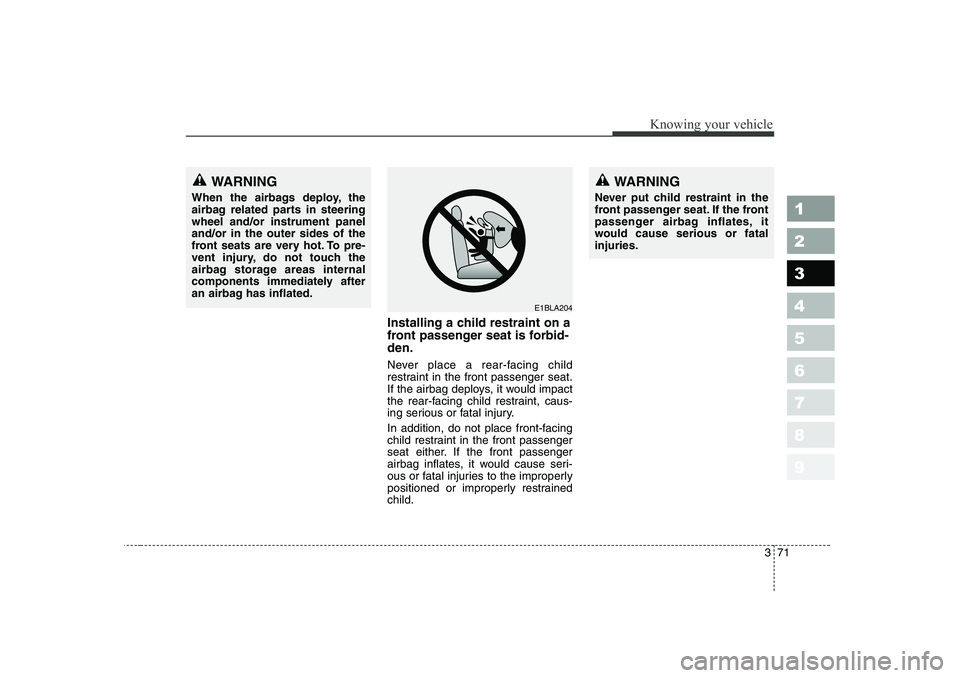
Installing a child restraint on a
front passenger seat is forbid-den.
Never place a rear-facing child
restraint in the front passenger seat.
If the airbag deploys, it would impact
the rear-facing child restraint, caus-
ing serious or fatal injury.
In addition, do not place front-facing
child restraint in the front passenger
seat either. If the front passenger
airbag inflates, it would cause seri-
ous or fatal injuries to the improperly
positioned or improperly restrainedchild.
WARNING
Never put child restraint in the
front passenger seat. If the front
passenger airbag inflates, it
would cause serious or fatalinjuries.WARNING
When the airbags deploy, the
airbag related parts in steeringwheel and/or instrument paneland/or in the outer sides of the
front seats are very hot. To pre-
vent injury, do not touch the
airbag storage areas internal
components immediately after
an airbag has inflated.
E1BLA204
Page 82 of 281
Knowing your vehicle
72
3
1 23456789
Airbag warning light
The purpose of airbag warning light
in your instrument panel is to alert
you of a potential problem with your
airbag - Supplemental RestraintSystem (SRS). When the ignition switch is turned
ON, the indicator light should blink or
illuminate for approximately 6 sec-
onds, then go off.
Have the system checked if:
The light does not turn on briefly
when you turn the ignition ON.
The light stays on after the engine starts.
The light comes on while the vehi- cle is in motion. Airbag (Supplemental
Restraint System) service
Your Supplemental Restraint System
is virtually maintenance-free. There
are no parts which you can service.
You must have the system serviced
under the following circumstances:
If an airbag ever inflates, the airbag
must be replaced. Do not try to
remove or discard the airbag by
yourself. This must be done by an
authorized Kia dealer.
If the airbag warning indicator light alerts you to a problem, have the
airbag system checked as soon as
possible. Otherwise, your airbag
system may be ineffective.
AIR
BAG
Page 83 of 281
373
1 23456789
Knowing your vehicle
When repairing or scrapping thevehicles
Repairing steering wheel, instru- ment panel, center console or
roofs, or installing car audio aroundcenter console or painting front
metal sheet could disable the
airbag system. Have them checked
by an authorized Kia dealer.
When leaving the vehicle at an authorized Kia dealer, inform that
the vehicle is equipped with airbag
system, and leave the owner’s
manual in the vehicle.
Since airbag system contains explosive chemical substances,
contact an authorized Kia dealer
when scrapping the vehicle.
CAUTION
Do not modify any part of the
Supplemental Restraint System. Excessive modification couldmake the airbag system ineffec-tive.
WARNING
Do not modify your steering wheel, seat or any other part of the Supplemental Restraint
System. Modification could
make the system inoperable.
Do not work on the system’s components or wiring. This
could cause the airbags to
inflate inadvertently, possibly
seriously injuring someone.
Working on the system could
also disable the system so
that the airbags would not
deploy in a collision.
Any work on the SRS system, such as removing, installing,
repairing, or any work on the
steering wheel must be per-
formed by a qualified Kia tech-
nician. Improper handling of
the airbag system may result
in serious personal injury.
Page 84 of 281
Knowing your vehicle
74
3
1 23456789
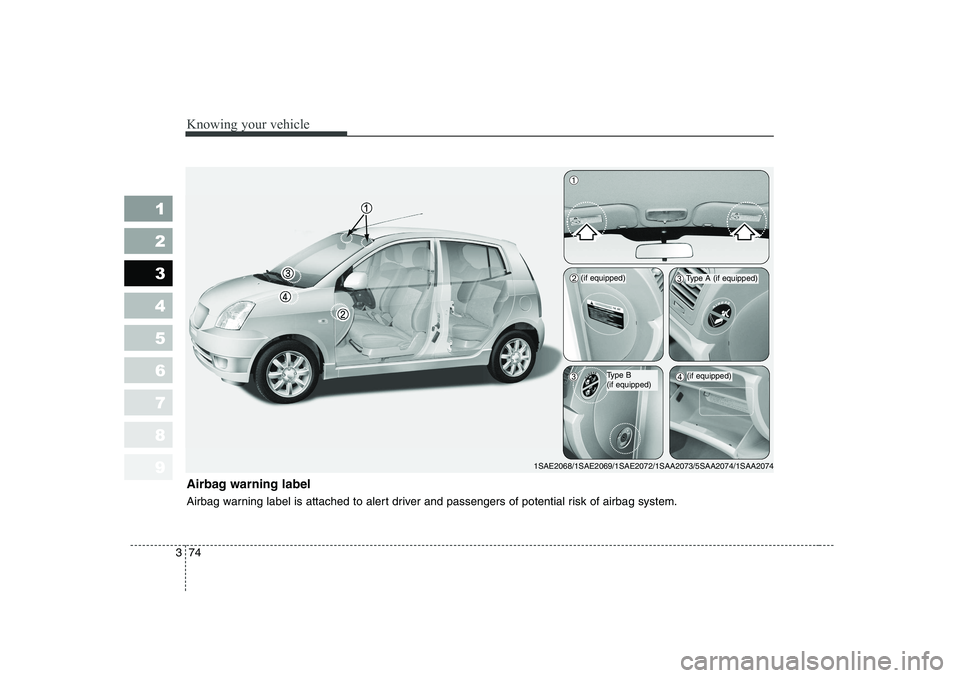
Airbag warning label
Airbag warning label is attached to alert driver and passengers of potential risk of airbag system.
1SAE2068/1SAE2069/1SAE2072/1SAA2073/5SAA2074/1SAA2074
➀
➁➂
➃(if equipped)
Type A (if equipped)
➂Type B (if equipped)
(if equipped)
Page 190 of 281
In case of an emergency
12
6
1 23456789
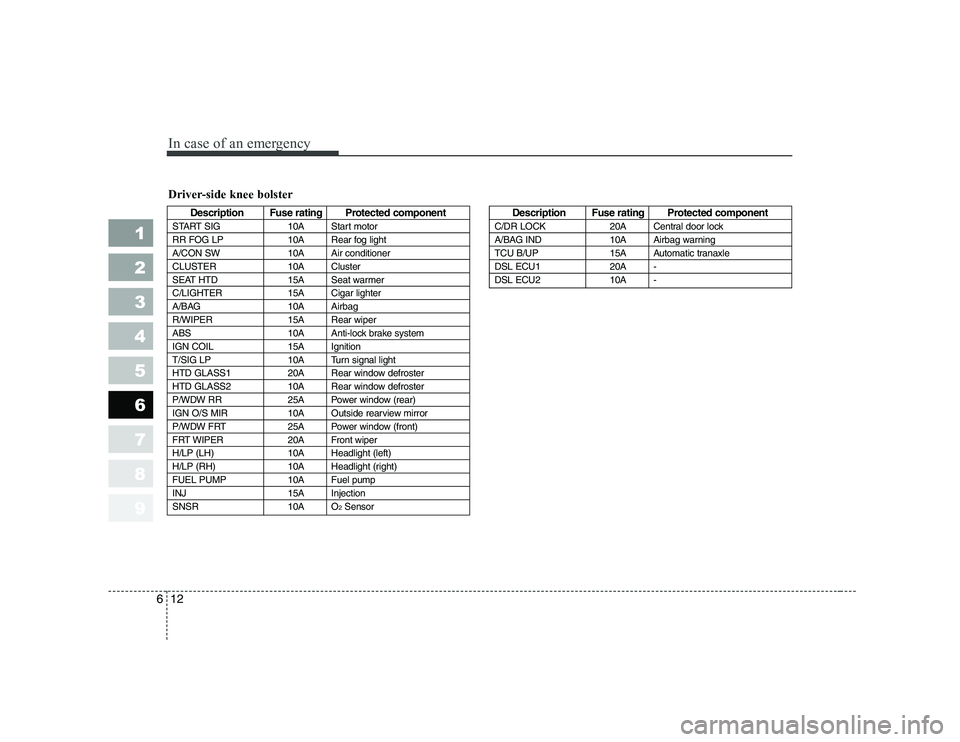
Driver-side knee bolster
Description Fuse rating Protected component
START SIG 10A Start motor
RR FOG LP 10A Rear fog light
A/CON SW 10A Air conditioner
CLUSTER 10A Cluster
SEAT HTD 15A Seat warmer
C/LIGHTER 15A Cigar lighter
A/BAG 10A Airbag
R/WIPER 15A Rear wiper
ABS 10A Anti-lock brake system
IGN COIL 15A Ignition
T/SIG LP 10A Turn signal light
HTD GLASS1 20A Rear window defroster
HTD GLASS2 10A Rear window defroster
P/WDW RR 25A Power window (rear)
IGN O/S MIR 10A Outside rearview mirror
P/WDW FRT 25A Power window (front)
FRT WIPER 20A Front wiper
H/LP (LH) 10A Headlight (left)
H/LP (RH) 10A Headlight (right)
FUEL PUMP 10A Fuel pump
INJ 15A Injection
SNSR 10A O 2SensorDescription Fuse rating Protected component
C/DR LOCK 20A Central door lock
A/BAG IND 10A Airbag warning
TCU B/UP 15A Automatic tranaxle
DSL ECU1 20A -
DSL ECU2 10A -
Page 279 of 281
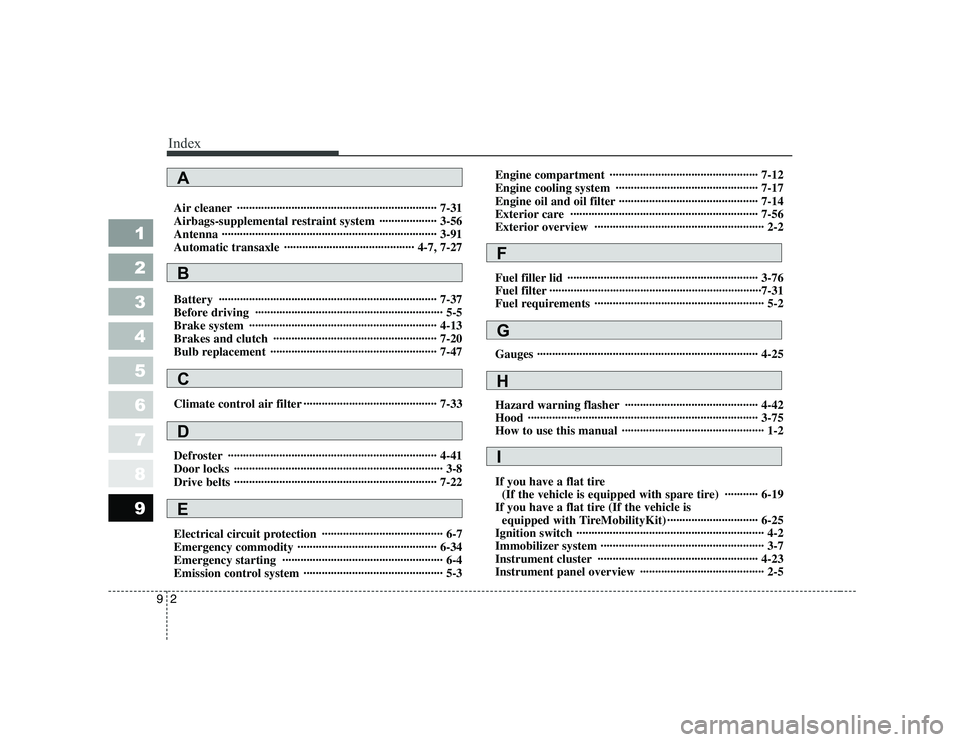
Index
2
9
1 23456789
Air cleaner ·································································· 7-31
Airbags-supplemental restraint system ··················· 3-56
Antenna ······································································· 3-91
Automatic transaxle ··········································· 4-7, 7-27
Battery ········································································ 7-37
Before driving ······························································ 5-5
Brake system ······························································ 4-13
Brakes and clutch ······················································ 7-20
Bulb replacement ······················································· 7-47
Climate control air filter ············································ 7-33
Defroster ····································································· 4-41
Door locks ····································································· 3-8
Drive belts ··································································· 7-22
Electrical circuit protection ········································ 6-7
Emergency commodity ·············································· 6-34
Emergency starting ····················································· 6-4
Emission control system ·············································· 5-3 Engine compartment ················································· 7-12
Engine cooling system ··············································· 7-17
Engine oil and oil filter ·············································· 7-14
Exterior care ······························································ 7-56
Exterior overview ························································ 2-2
Fuel filler lid ······························································· 3-76
Fuel filter ······································································7-31
Fuel requirements ························································ 5-2
Gauges ········································································· 4-25
Hazard warning flasher ············································ 4-42
Hood ············································································ 3-75
How to use this manual ··············································· 1-2
If you have a flat tire
(If the vehicle is equipped with spare tire) ··········· 6-19
If you have a flat tire (If the vehicle is
equipped with TireMobilityKit) ······························ 6-25
Ignition switch ······························································ 4-2
Immobilizer system ······················································ 3-7
Instrument cluster ····················································· 4-23
Instrument panel overview ········································· 2-5
A
B
C
D
E
F
G
H
I