airbag KIA PICANTO 2006 User Guide
[x] Cancel search | Manufacturer: KIA, Model Year: 2006, Model line: PICANTO, Model: KIA PICANTO 2006Pages: 281, PDF Size: 9.89 MB
Page 67 of 281
357
1 23456789
Knowing your vehicle
What your airbag system does
Driver’s airbag and front passenger’s airbag are designed to supplement
the protection offered by the safety
belt in certain frontal collisions.
Likewise, side airbags are designed
to supplement the protection offered
by the safety belt in side collisions.
Safety belts are designed to reduce
the injury of the driver or passengersin case of light impact or collision.
However, to help reduce impact on
driver or passengers in a serious col-
lision, seat belts must also be cor-
rectly worn.
What your airbag system does not do The air bag system is designed to
supplement the protection offered by
the safety belt system. IT IS NOT A
SUBSTITUTE FOR THE SAFETY
BELT.The importance of using
safety belts
There are four very important rea-
sons to use safety belts even with an
airbag supplemental restraint sys-
tem. They:
help keep you in the proper posi-
tion (away from the airbag) when it
inflates.
reduce the risk of harm in rollover, side impact (vehicles not equippedwith side airbags) or rear impact
collisions, because an airbag is notdesigned to inflate in such situa-
tions and even a side airbag is
designed to inflate only in certain
side impact collisions.
reduce the risk of harm in frontal or side collisions which are not
severe enough to actuate the
airbag supplemental restraint sys-tem.
reduce the risk of being thrown from your vehicle.WARNING - Airbags &
safety belts
Even in vehicles with air bags, you and your passengers
must always wear the safety
belts provided in order to min-
imize the risk and severity of
injury in the event of a colli-
sion or rollover.
Always wear your safety belt. It can help keep you away
from the air bags during heavy
braking just before a collision.
If occupants are not fastened or correctly seated, they can-
not be protected, and thus
face serious injury or death.
Driver’s and front passenger’s airbag are designed to inflate
only in certain frontal colli-
sions, and side airbags (ifequipped) are designed to
inflate in certain side impacts.
(Continued)
Page 68 of 281
Knowing your vehicle
58
3
1 23456789
Airbag system components
The main components of your SRS are:
To indicate that your vehicle is
equipped with airbags, the corre-
sponding airbag covers are
marked with “SRS AIRBAG”.
- Driver’s airbag
- Passenger’s airbag- Side airbag
A diagnostic system that continual- ly monitors the system operation.
An indicator light to warn you of a possible problem with the system.
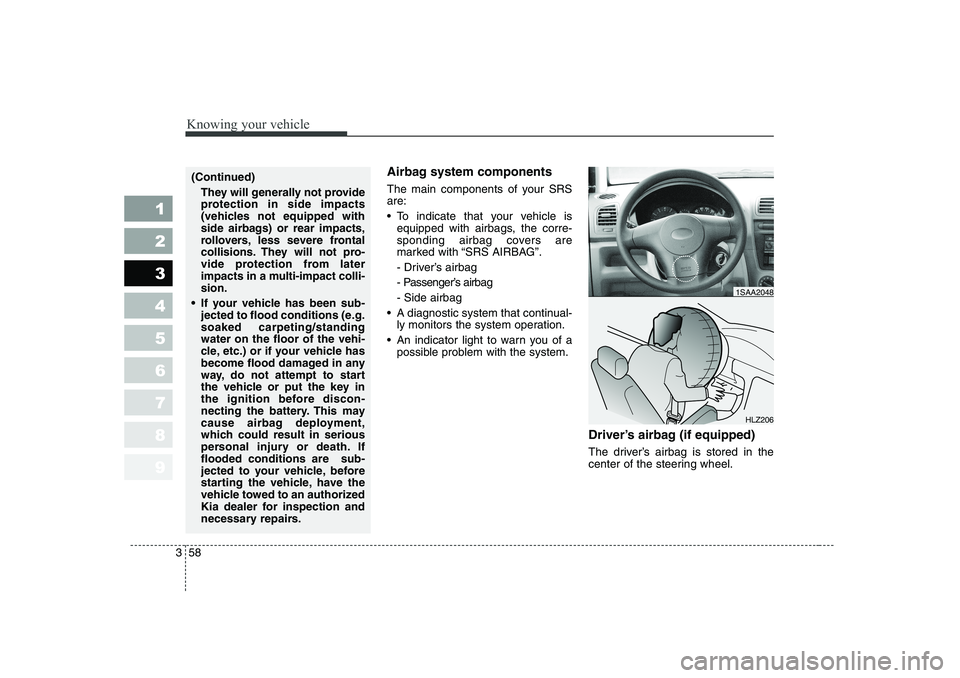
Driver’s airbag (if equipped)
The driver’s airbag is stored in the
center of the steering wheel.(Continued)They will generally not provide
protection in side impacts
(vehicles not equipped with
side airbags) or rear impacts,
rollovers, less severe frontal
collisions. They will not pro-
vide protection from later
impacts in a multi-impact colli-sion.
If your vehicle has been sub- jected to flood conditions (e.g.soaked carpeting/standingwater on the floor of the vehi-
cle, etc.) or if your vehicle has
become flood damaged in any
way, do not attempt to start
the vehicle or put the key in
the ignition before discon-
necting the battery. This may
cause airbag deployment,
which could result in serious
personal injury or death. Ifflooded conditions are sub-
jected to your vehicle, before
starting the vehicle, have the
vehicle towed to an authorized
Kia dealer for inspection and
necessary repairs.
HLZ206
1SAA2048
Page 69 of 281
359
1 23456789
Knowing your vehicle
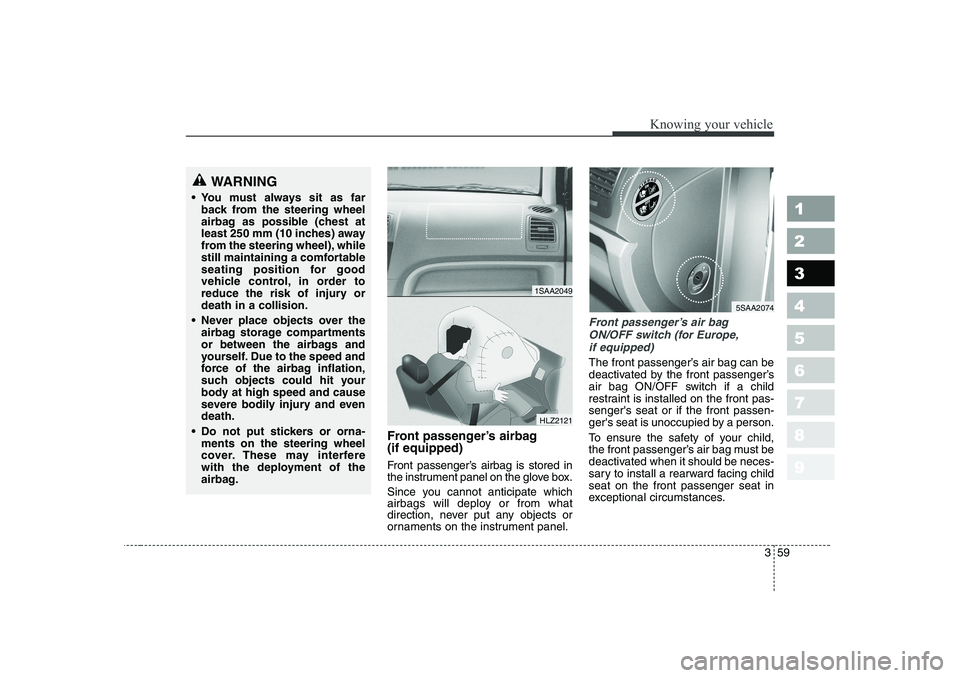
Front passenger’s airbag (if equipped)
Front passenger’s airbag is stored in
the instrument panel on the glove box.
Since you cannot anticipate which
airbags will deploy or from what
direction, never put any objects or
ornaments on the instrument panel.
Front passenger’s air bagON/OFF switch (for Europe, if equipped)
The front passenger’s air bag can be
deactivated by the front passenger’s
air bag ON/OFF switch if a child
restraint is installed on the front pas-senger's seat or if the front passen-
ger's seat is unoccupied by a person.
To ensure the safety of your child,
the front passenger’s air bag must be
deactivated when it should be neces-
sary to install a rearward facing childseat on the front passenger seat in
exceptional circumstances.
WARNING
You must always sit as far back from the steering wheel
airbag as possible (chest at
least 250 mm (10 inches) away
from the steering wheel), while
still maintaining a comfortable
seating position for good
vehicle control, in order to
reduce the risk of injury ordeath in a collision.
Never place objects over the airbag storage compartments
or between the airbags and
yourself. Due to the speed and
force of the airbag inflation,
such objects could hit your
body at high speed and cause
severe bodily injury and evendeath.
Do not put stickers or orna- ments on the steering wheel
cover. These may interfere
with the deployment of the
airbag.
1SAA2049
HLZ2121
5SAA2074
Page 71 of 281
361
1 23456789
Knowing your vehicle
WARNING
The front seat passenger’s airbag is much larger than the
steering wheel airbag and
inflates with considerably
more force. It can seriously
hurt or kill a passenger who is
not in the proper position and
wearing the safety belt proper-
ly. The front passengers
should always move their seat
as far back as practical and sit
back in their seat.
It is essential that the front passengers always wear their
safety belts, even when the
vehicle is moving in a parking
lot or up a driveway into
garage. (Continued)(Continued)
Even though your vehicle isequipped with the front pas-
senger's air bag ON/OFF
switch, do not install a child
restraint system in the front
passenger's seat. A child
restraint system must never
be placed in the front seat.
Children who are too large for
child restraint systems should
always occupy the rear seat
and use the available
lap/shoulder belts. Children
are afforded the most safety in
the event of an accident when
they are restrained by a prop-er restraint system in the rearseat.
As soon as the child seat is no longer needed on the front
passenger's seat, reactivate
the front passenger's air bag.WARNING
The driver is responsible for the proper position of the
front passenger’s air bag
ON/OFF switch.
Deactivate the front passen- ger's air bag only when the
ignition switch is switched off,
or the malfunction may occur
in the SRS Control Module.
And there may be a danger
that the driver's and/or front
passenger’s and/or side and
curtain air bag may fail to trig-
ger, or not trigger correctlyduring a collision.
Never install a rearward facing child seat on the front passen-
ger's seat unless the front
passenger's air bag has been
deactivated. The infant or child
could be severely injured or
killed by an air bag deploy-ment in case of an accident. (Continued)
Page 72 of 281
Knowing your vehicle
62
3
1 23456789
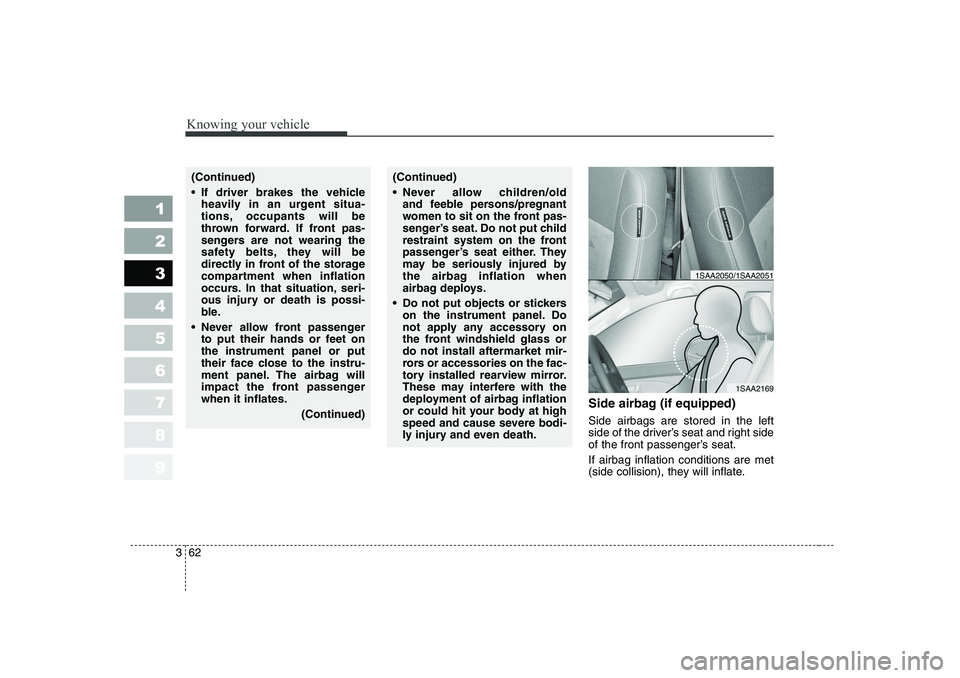
Side airbag (if equipped) Side airbags are stored in the left
side of the driver’s seat and right side
of the front passenger’s seat. If airbag inflation conditions are met
(side collision), they will inflate.
1SAA2169
1SAA2050/1SAA2051
(Continued)
If driver brakes the vehicle
heavily in an urgent situa-
tions, occupants will be
thrown forward. If front pas-
sengers are not wearing the
safety belts, they will be
directly in front of the storage
compartment when inflation
occurs. In that situation, seri-
ous injury or death is possi-
ble.
Never allow front passenger to put their hands or feet onthe instrument panel or put
their face close to the instru-
ment panel. The airbag will
impact the front passengerwhen it inflates.
(Continued)(Continued)
Never allow children/old and feeble persons/pregnant
women to sit on the front pas-
senger’s seat. Do not put child
restraint system on the front
passenger’s seat either. They
may be seriously injured by
the airbag inflation when
airbag deploys.
Do not put objects or stickers on the instrument panel. Do
not apply any accessory on
the front windshield glass ordo not install aftermarket mir-
rors or accessories on the fac-
tory installed rearview mirror.
These may interfere with the
deployment of airbag inflation
or could hit your body at high
speed and cause severe bodi-
ly injury and even death.
Page 73 of 281
363
1 23456789
Knowing your vehicle
The side airbags are not designedto deploy during collisions from the
front or rear of the vehicle or in
most rollover situations.
The side airbags are designed to deploy only during certain side-
impact collisions, depending on the
crash severity, angle, speed and
impact. The side airbags are not
designed to deploy in all side
impact situations.WARNING
In order for side airbags to provide its best protection,
both front seat occupantsshould sit in an upright posi-
tion with the seat belts proper-
ly fastened.
Do not allow the passengers to lean their heads or bodies
onto doors, put their arms on
the doors, stretch their arms
out of the window, or place
objects between the doors
and passengers when they areseated on the seats where
side airbags are equipped.
Never try to open or repair any components of the side airbag
system. This should be done
only by an authorized Kia
dealer.
Failure to follow the above men-tioned instructions can result in
injury or death to the vehicleoccupants in an accident.WARNING
Do not use any accessory seat covers for the vehicle
equipped with side airbags.
Use of seat covers could inter-
fere with side airbag deploy-ment.
If seat or seat cover is dam-
aged, have the vehicle
checked and repaired by an
authorized Kia dealer. Inform
them that your vehicle is
equipped with side airbags.
Do not make modifications or additions to the seats. If seats
not allowed by Kia Motors are
used, unexpected injury mayresult in due to the malfunc-
tion of the airbag system.
Page 74 of 281
Knowing your vehicle
64
3
1 23456789
Why didn’t my airbag go off in a collision?
(Inflation and non-inflation condi-
tions of the airbag)
There are many types of accidents in
which the airbag would not be
expected to provide additional pro-tection.
These include rear impacts, second
or third collisions in multiple impact
accidents, as well as low speed
impacts. In other words, just because
your vehicle is damaged and even if
it is totally unusable, don’t be sur-
prised that the airbags did not inflate.
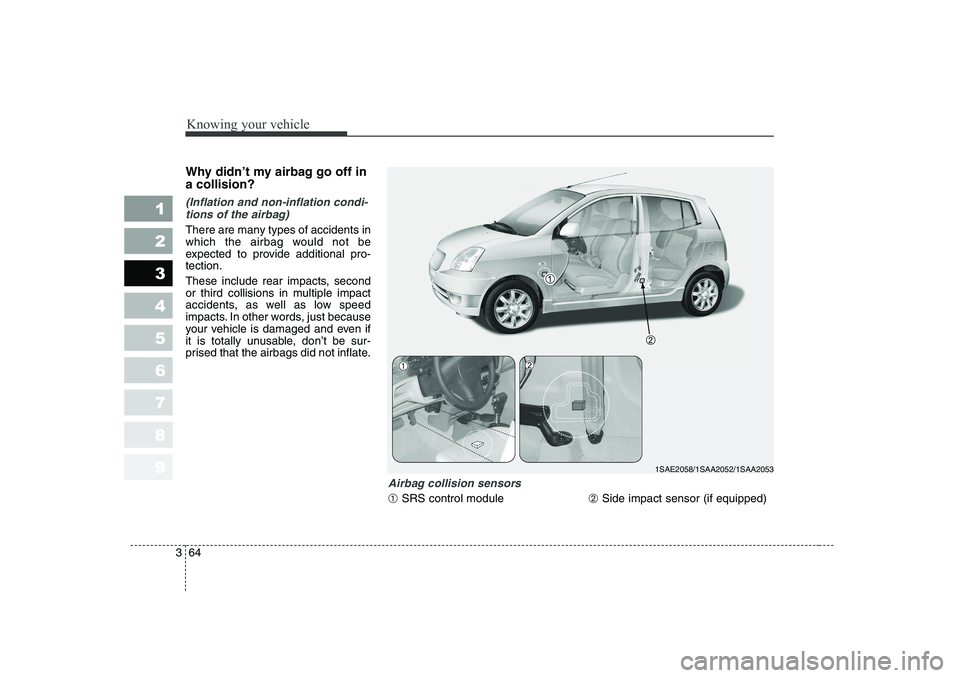
Airbag collision sensors
➀ SRS control module
➁ Side impact sensor (if equipped)
1SAE2058/1SAA2052/1SAA2053
➀➁
Page 75 of 281
365
1 23456789
Knowing your vehicle
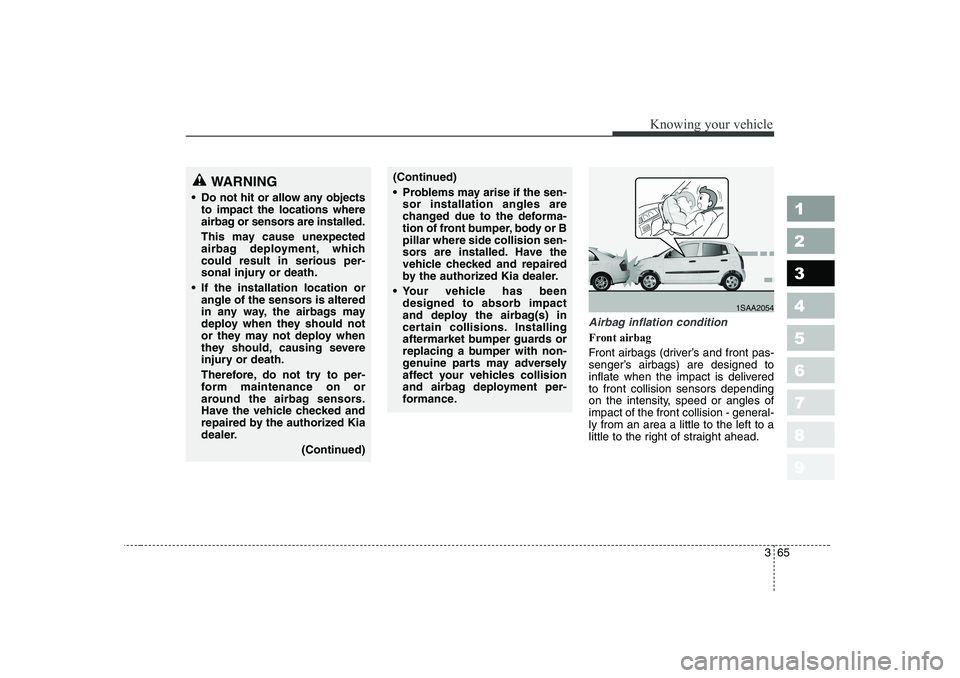
Airbag inflation condition
Front airbag
Front airbags (driver’s and front pas-
senger’s airbags) are designed to
inflate when the impact is deliveredto front collision sensors depending
on the intensity, speed or angles of
impact of the front collision - general-ly from an area a little to the left to a
little to the right of straight ahead.
WARNING
Do not hit or allow any objects to impact the locations where
airbag or sensors are installed.
This may cause unexpected
airbag deployment, whichcould result in serious per-
sonal injury or death.
If the installation location or angle of the sensors is altered
in any way, the airbags may
deploy when they should not
or they may not deploy when
they should, causing severe
injury or death.
Therefore, do not try to per-
form maintenance on or
around the airbag sensors.
Have the vehicle checked and
repaired by the authorized Kia
dealer.
(Continued)(Continued)
Problems may arise if the sen-sor installation angles are
changed due to the deforma-
tion of front bumper, body or Bpillar where side collision sen-
sors are installed. Have the
vehicle checked and repaired
by the authorized Kia dealer.
Your vehicle has been designed to absorb impact
and deploy the airbag(s) in
certain collisions. Installing
aftermarket bumper guards or
replacing a bumper with non-
genuine parts may adversely
affect your vehicles collision
and airbag deployment per-
formance.
1SAA2054
Page 76 of 281
Knowing your vehicle
66
3
1 23456789
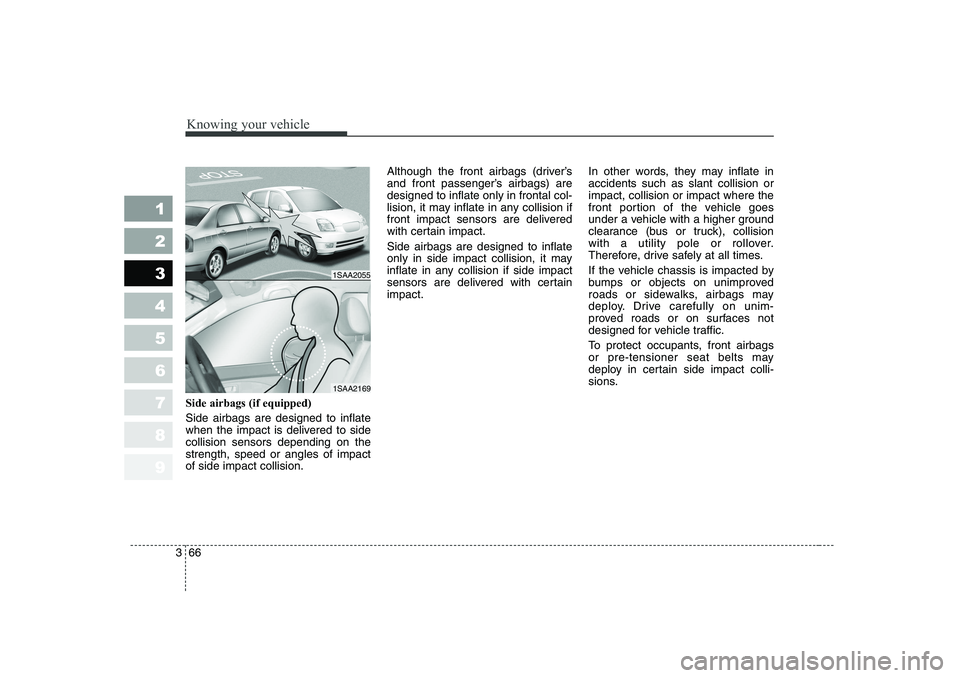
Side airbags (if equipped) Side airbags are designed to inflate
when the impact is delivered to sidecollision sensors depending on thestrength, speed or angles of impactof side impact collision. Although the front airbags (driver’s
and front passenger’s airbags) aredesigned to inflate only in frontal col-
lision, it may inflate in any collision if
front impact sensors are delivered
with certain impact. Side airbags are designed to inflate
only in side impact collision, it may
inflate in any collision if side impact
sensors are delivered with certainimpact.
In other words, they may inflate inaccidents such as slant collision orimpact, collision or impact where the
front portion of the vehicle goes
under a vehicle with a higher ground
clearance (bus or truck), collision
with a utility pole or rollover.
Therefore, drive safely at all times.
If the vehicle chassis is impacted by
bumps or objects on unimproved
roads or sidewalks, airbags may
deploy. Drive carefully on unim-
proved roads or on surfaces not
designed for vehicle traffic.
To protect occupants, front airbags
or pre-tensioner seat belts may
deploy in certain side impact colli-
sions.
1SAA2055
1SAA2169
Page 77 of 281
367
1 23456789
Knowing your vehicle
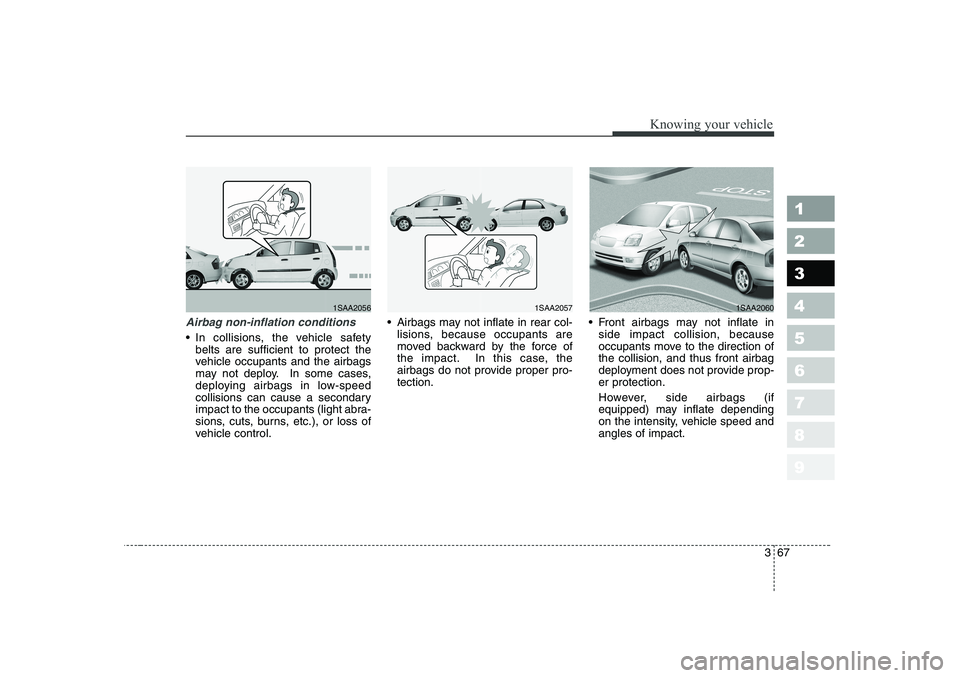
Airbag non-inflation conditions
In collisions, the vehicle safetybelts are sufficient to protect the
vehicle occupants and the airbags
may not deploy. In some cases,
deploying airbags in low-speed
collisions can cause a secondary
impact to the occupants (light abra-
sions, cuts, burns, etc.), or loss of
vehicle control. Airbags may not inflate in rear col-
lisions, because occupants are
moved backward by the force of
the impact. In this case, the
airbags do not provide proper pro-tection. Front airbags may not inflate in
side impact collision, because
occupants move to the direction ofthe collision, and thus front airbag
deployment does not provide prop-er protection.
However, side airbags (if
equipped) may inflate depending
on the intensity, vehicle speed andangles of impact.
1SAA20571SAA20561SAA2060