steering KIA PICANTO 2006 Owner's Manual
[x] Cancel search | Manufacturer: KIA, Model Year: 2006, Model line: PICANTO, Model: KIA PICANTO 2006Pages: 281, PDF Size: 9.89 MB
Page 162 of 281
57
Driving tips
SPECIAL DRIVING CONDITIONS
Hazardous driving conditions
When hazardous driving conditions
are encountered such as water,
snow, ice, mud, sand, or similar haz-
ards, follow these suggestions:
Drive cautiously and allow extra distance for braking.
Avoid sudden movements in brak- ing or steering.
When braking, pump the brake pedal with a light up-and-down
motion until the vehicle is stopped.
✽✽ NOTICE
Do not pump the brake pedal on a
vehicle equipped with ABS.
If stalled in snow, mud, or sand, use second gear. Accelerate slow-
ly to avoid spinning the drive
wheels.
Use sand, rock salt, tire chains, or other non-slip material under the
drive wheels to provide traction
when stalled in ice, snow, or mud. Rocking the vehicle
If it is necessary to rock the vehicle
to free it from snow, sand, or mud,
first turn the steering wheel right and
left to clear the area around your
front wheels. Then, shift back and
forth between 1 (First) and R
(Reverse) in vehicles equipped with
a manual transaxle or R (Reverse)
and any forward gear in vehiclesequipped with an automatic
transaxle. Do not race the engine,and spin the wheels as little as pos-
sible. If you are still stuck after a few
tries, have the vehicle pulled out by a
tow vehicle to avoid engine overheat-
ing and possible damage to the
transaxle.
✽✽
NOTICE
Prolonged rocking may cause engine
over-heating, transaxle damage or
failure, and tire damage.
1 23456789
WARNING - Downshifting
Downshifting with an automatic
transaxle, while driving on slip-
pery surfaces can cause an
accident. The sudden change intire speed could cause the tires
to skid. Be careful when down-
shifting on slippery surfaces.
Page 173 of 281
Driving tips
18
5
1 23456789
Following distance
Stay at least twice as far behind the
vehicle ahead as you would when
driving your vehicle without a trailer.
This can help you avoid situations
that require heavy braking and sud-
den turns.
Passing
You’ll need more passing distance
up ahead when you’re towing a trail-
er. And, because you’re a good deal
longer, you’ll need to go much farther
beyond the passed vehicle before
you can return to your lane.
Backing up
Hold the bottom of the steering
wheel with one hand. Then, to move
the trailer to the left, just move your
hand to the left. To move the trailer to
the right, move your hand to the
right. Always back up slowly and, if
possible, have someone guide you.
Making turns
When you’re turning with a trailer,
make wider turns than normal. Do
this so your trailer won’t strike soft
shoulders, curbs, road signs, trees,
or other objects. Avoid jerky or sud-
den maneuvers. Signal well in
advance.
Turn signals when towing a trailer
When you tow a trailer, your vehicle
has to have a different turn signal
flasher and extra wiring. The green
arrows on your instrument panel will
flash whenever you signal a turn or
lane change. Properly connected,
the trailer lights will also flash to alert
other drivers you’re about to turn,
change lanes, or stop.
When towing a trailer, the green
arrows on your instrument panel will
flash for turns even if the bulbs on
the trailer are burned out. Thus, you
may think drivers behind you are
seeing your signals when, in fact,
they are not. It’s important to check
occasionally to be sure the trailer
bulbs are still working. You must also
check the lights every time you dis-connect and then reconnect the
wires.
Page 189 of 281

611
In case of an emergency
1 23456789
Description Fuse rating Protected component
ECU1 20A (30A) Engine control unit
STOP 10A Stop light
FR/FOG 10A Front fog light
A/CON 10A Air conditioner
HORN 10A Horn
ECU2 10A Engine control unit
SPARE 10A spare fuse
SPARE 15A spare fuse
SPARE 10A spare fuse
ABS2 30A Anti-lock brake system
ABS1 30A Anti-lock brake system
B+ 30A In panel B+
BLOWER 30A Blower
IGN1 30A Ignition
IGN2 30A Ignition
TAIL LH 10A Tail light (left)
TAIL RH 10A Tail light (right)
DRL 10A Daytime running light
HAZARD 15A Hazard warning flasher
R/LP 10A Room lamp
AUDIO 15A Audio
P/WDW 30A Power windowDescription Fuse rating Protected component
RAD 30A Radiator fan
BATT 100A (120A) Alternator, Battery
F/FOG - Front fog light relay
A/CON - Air conditioner relay
HORN - Horn relay
START - Start motor relay
RAD1 - Radiator fan relay
RAD2 - Radiator fan relay
RR FOG - Rear fog light relay
TAIL - Tail light relay
Engine compartment
Engine compartment (Diesel only)
Description Fuse rating Protected component
FFHTS 30A
Fuel filter heater temporary sensor
GLOW PLUG 80A Glow plug
MDPS 80A Motor driven power steering
PTC HTR1 40A PTC heater1
PTC HTR2 40A PTC heater2
PTC HTR3 40A PTC heater3
Page 194 of 281
In case of an emergency
16
6
1 23456789
Towing with a vehicle other
than a tow truck
If towing is necessary, we recom-
mend you to have it done by an
Authorized Kia dealer or a commer-
cial tow truck service.
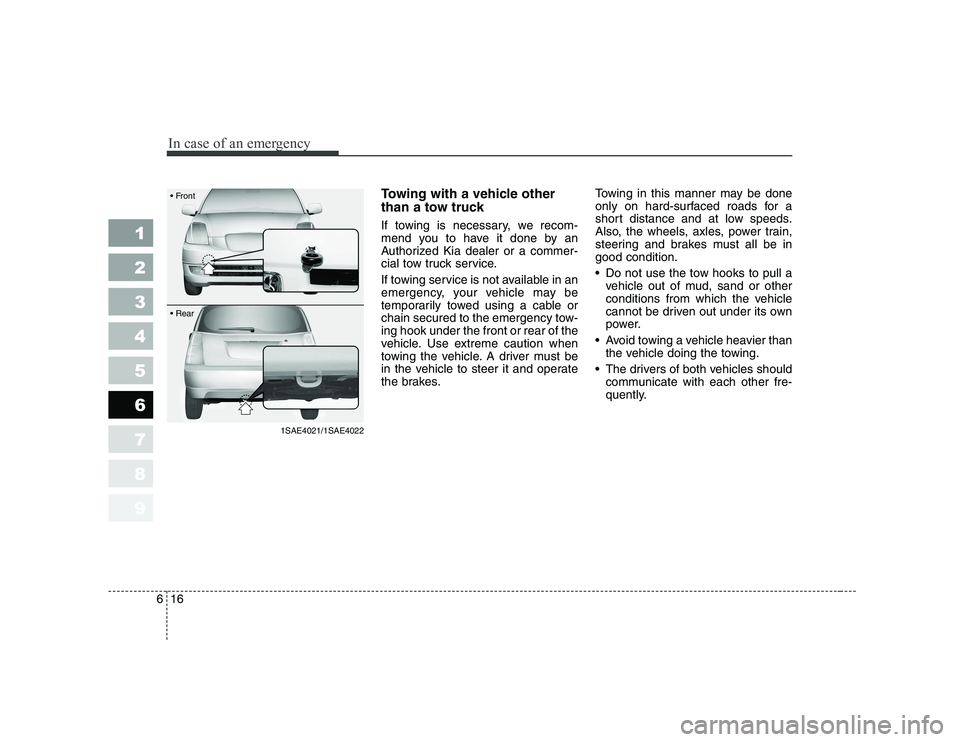
If towing service is not available in an
emergency, your vehicle may be
temporarily towed using a cable or
chain secured to the emergency tow-ing hook under the front or rear of the
vehicle. Use extreme caution when
towing the vehicle. A driver must be
in the vehicle to steer it and operate
the brakes. Towing in this manner may be done
only on hard-surfaced roads for a
short distance and at low speeds.
Also, the wheels, axles, power train,
steering and brakes must all be ingood condition.
Do not use the tow hooks to pull a
vehicle out of mud, sand or other
conditions from which the vehicle
cannot be driven out under its own
power.
Avoid towing a vehicle heavier than the vehicle doing the towing.
The drivers of both vehicles should communicate with each other fre-
quently.
1SAE4021/1SAE4022
Front Rear
Page 196 of 281
In case of an emergency
18
6
1 23456789
When your vehicle is being
towed by another vehicle
other than a tow truck (in case
of an emergency)
Turn the ignition switch to ACC so
the steering wheel isn’t locked.
Place the transaxle shift lever in N (Neutral).
Release the parking bake.
Vehicles equipped with automatic transaxles should not exceed 45 km/h (28 mph) and should not be
towed more than 80 km (50 miles).
Vehicles equipped with manual transaxles should not be towed in
excess of 88 km/h (55 mph) and
should not be towed more than645 km (400 miles). Press the brake pedal with more
force than normal since you will
have reduced brake performance.
More steering effort will be required because the power steer-
ing system will be disabled.
If you are driving down a long hill, the brakes may overheat and brake
performance will be reduced. Stop
often and let the brakes cool off.
✽✽ NOTICE
To prevent internal damage to the
transaxle, never tow your vehicle
from the rear (backwards) with all
four tires in contact with the sur-face.
Tips for towing a stuck vehicle
The following methods are effective
when your vehicle is stuck in mud,sand or similar substances that pre-
vent the vehicle from being driven
out under its own power.
Remove the soil and sand, etc. from the front and the back of the
tires.
Place a stone or wood under the tires.
Page 203 of 281
625
In case of an emergency
1 23456789
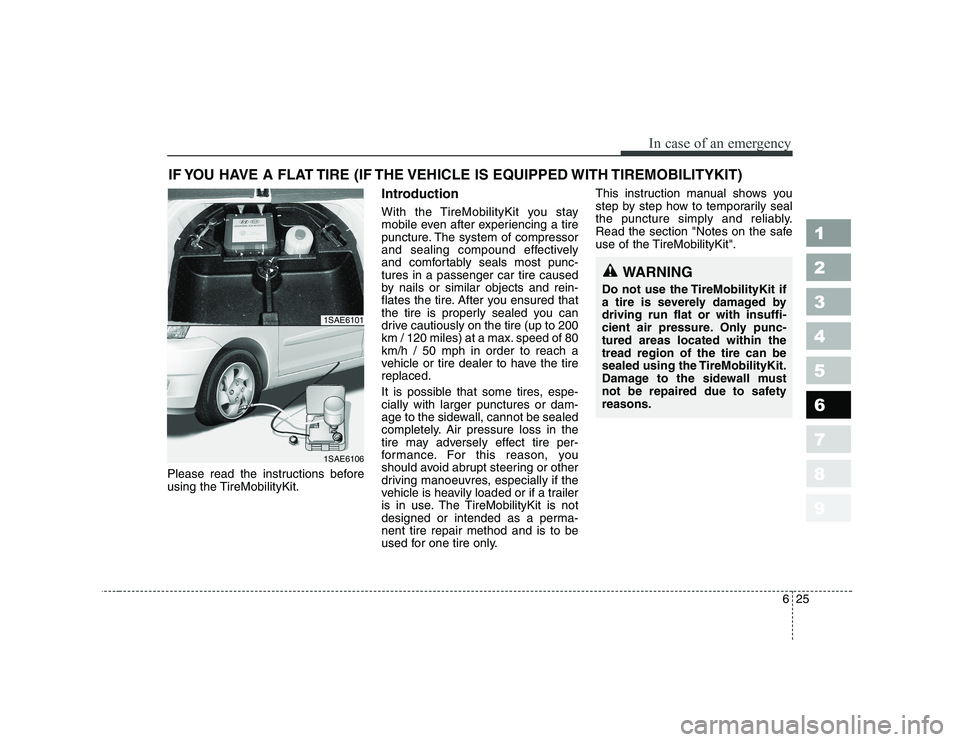
IF YOU HAVE A FLAT TIRE (IF THE VEHICLE IS EQUIPPED WITH TIREMOBILITYKIT)
Please read the instructions before
using the TireMobilityKit. Introduction
With the TireMobilityKit you stay
mobile even after experiencing a tire
puncture. The system of compressor
and sealing compound effectively
and comfortably seals most punc-tures in a passenger car tire caused
by nails or similar objects and rein-
flates the tire. After you ensured that
the tire is properly sealed you can
drive cautiously on the tire (up to 200
km / 120 miles) at a max. speed of 80km/h / 50 mph in order to reach a
vehicle or tire dealer to have the tirereplaced.
It is possible that some tires, espe- cially with larger punctures or dam-
age to the sidewall, cannot be sealed
completely. Air pressure loss in the
tire may adversely effect tire per-
formance. For this reason, you
should avoid abrupt steering or other
driving manoeuvres, especially if the
vehicle is heavily loaded or if a trailer
is in use. The TireMobilityKit is not
designed or intended as a perma-nent tire repair method and is to be
used for one tire only.This instruction manual shows you
step by step how to temporarily seal
the puncture simply and reliably.
Read the section "Notes on the safe
use of the TireMobilityKit".
WARNING
Do not use the TireMobilityKit if
a tire is severely damaged bydriving run flat or with insuffi-
cient air pressure. Only punc-tured areas located within thetread region of the tire can be
sealed using the TireMobilityKit.
Damage to the sidewall must
not be repaired due to safetyreasons.
1SAE6101
1SAE6106
Page 214 of 281
1 234567891 23456789
10
Maintenance services / 7-3 Normal maintenance schedule / 7-5
Maintenance under severe usage conditions / 7-8
Owner maintenance / 7-10Engine compartment / 7-12
Engine oil and oil filter / 7-14Engine cooling system / 7-17Brakes and clutch / 7-20Parking brake / 7-21Drive belts / 7-22
Power steering / 7-23
Steering wheel / 7-24Manual transaxle / 7-25Automatic transaxle / 7-27Lubricants and fluids / 7-30
Fuel filter / 7-31
Air cleaner / 7-31
Climate control air filter / 7-33
Wiper blades / 7-35
Maintenance
Page 218 of 281

1 23456789
75
Maintenance
NORMAL MAINTENANCE SCHEDULE
I : Inspect and if necessary, adjust, correct, clean or replace.
R : Replace or change. *1: Adjust alternator and power steering (and water pump drive belt) and airconditioner drive belt (if equipped).
Inspect and if necessary correct or replace.
*2 : Check the engine oil level and leak every 500 km (350 miles) or before starting a long trip.
MAINTENANCE
INTERVALS
MAINTENANCE ITEMNumber of months or driving distance, whichever comes first
Months 12 24 36 48 60 72 84 96
Miles×1,000 10 20 30 40 50 60 70 80
Km×1,000 15 30 45 60 75 90 105 120
Drive belts *1 Gasoline I I I I I I I I
Diesel I I I I
Engine oil and Gasoline R R R R R R R R
engine oil filter *2
DieselFor Europe R R R R R R R R
Except Europe
Engine timing belt
I R
Air cleaner element I R I R I R I R
Spark plugs (Gasoline) For Europe R R R R
Except Europe
Valve clearance
I I I I
Vapor hose and fuel filler cap I I I I
Vacuum and crankcase ventilation hoses I I I IFuel filter (
Gasoline) RR
Replace every 40,000 km (25,000 miles)
Replace every 10,000 km (6,000 miles) or 12 months
Page 220 of 281
1 23456789
77
Maintenance
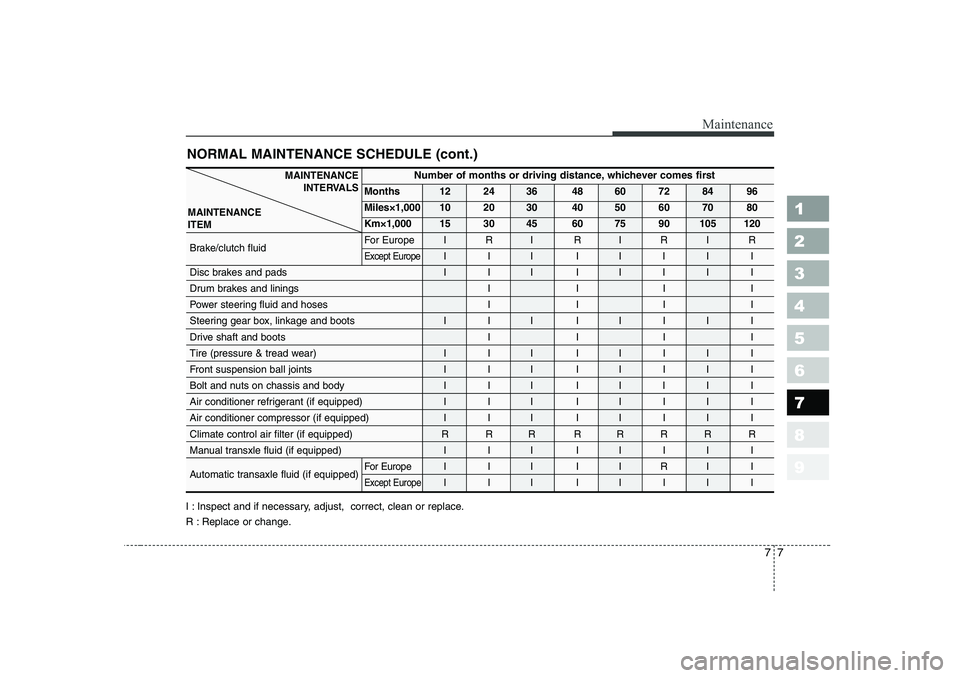
NORMAL MAINTENANCE SCHEDULE (cont.)
I : Inspect and if necessary, adjust, correct, clean or replace.
R : Replace or change.
Number of months or driving distance, whichever comes first
Months 12 24 36 48 60 72 84 96
Miles×1,000 10 20 30 40 50 60 70 80
Km×1,000 15 30 45 60 75 90 105 120
Brake/clutch fluid For Europe I R I R I R I R
Except EuropeIII IIIII
Disc brakes and pads I I I I I I I I
Drum brakes and linings I I I I
Power steering fluid and hoses I I I I
Steering gear box, linkage and boots I I I I I I I I
Drive shaft and boots I I I I
Tire (pressure & tread wear) I I I I I I I I
Front suspension ball joints I I I I I I I I
Bolt and nuts on chassis and body I I I I I I I I
Air conditioner refrigerant (if equipped) I I I I I I I I
Air conditioner compressor (if equipped) I I I I I I I I
Climate control air filter (if equipped) R R R R R R R R
Manual transxle fluid (if equipped) I I I I I I I I
Automatic transaxle fluid (if equipped)
For Europe III IIRII
Except EuropeIII IIIII
MAINTENANCE INTERVALS
MAINTENANCE ITEM
Page 221 of 281
Maintenance
8
7
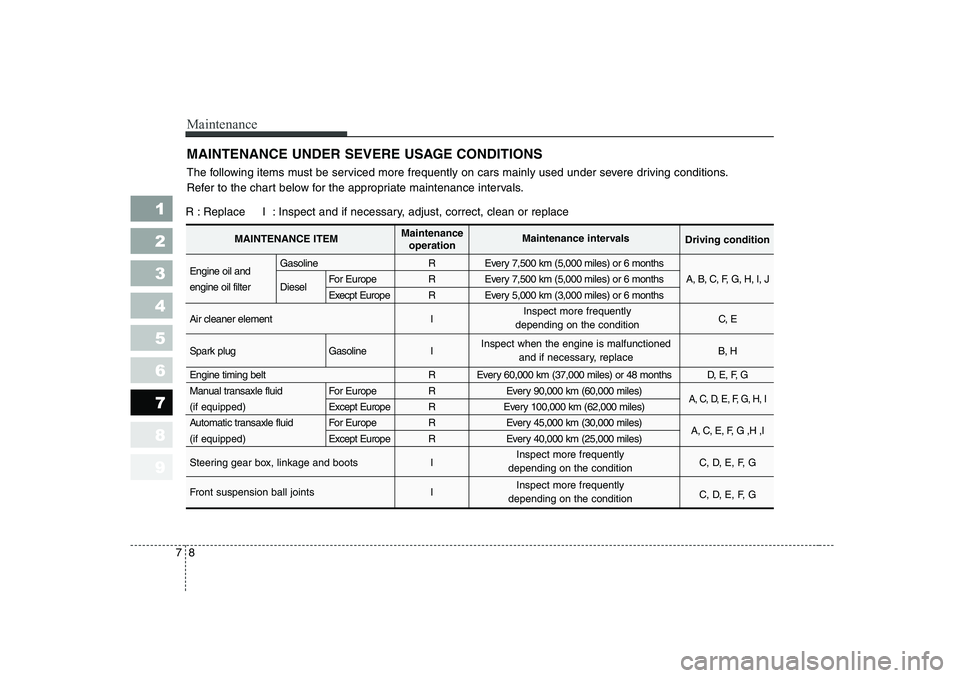
MAINTENANCE UNDER SEVERE USAGE CONDITIONS
1 23456789
The following items must be serviced more frequently on cars mainly used under severe driving conditions.
Refer to the chart below for the appropriate maintenance intervals.
R : Replace I : Inspect and if necessary, adjust, correct, clean or replace
Engine oil and Gasoline R Every 7,500 km (5,000 miles) or 6 months
engine oil filter Diesel For Europe R Every 7,500 km (5,000 miles) or 6 months A, B, C, F, G, H, I, J
Execpt Europe R Every
5,000 km (3,000 miles) or 6 months
Air cleaner element I C, E
Spark plug Gasoline I B, H
Engine timing belt R Every 60,000 km (37,000 miles) or 48 months D, E, F, G
Manual transaxle fluid For Europe R Every 90,000 km (60,000 miles)
A, C, D, E, F, G, H, I(if equipped)Except Europe R Every 100,000 km (62,000 miles)
Automatic transaxle fluid For Europe R Every 45,000 km (30,000 miles) A, C, E, F, G ,H ,I
(if equipped)Except Europe R Every 40,000 km (25,000 miles)
Steering gear box, linkage and boots I C, D, E, F, G
Front suspension ball joints I C, D, E, F, G
MAINTENANCE ITEMMaintenance
operation Maintenance intervals
Driving condition
Inspect more frequently
depending on the condition
Inspect more frequently
depending on the condition
Inspect more frequently
depending on the condition
Inspect when the engine is malfunctioned
and if necessary, replace