belt KIA PICANTO 2006 Owner's Guide
[x] Cancel search | Manufacturer: KIA, Model Year: 2006, Model line: PICANTO, Model: KIA PICANTO 2006Pages: 281, PDF Size: 9.89 MB
Page 71 of 281
361
1 23456789
Knowing your vehicle
WARNING
The front seat passenger’s airbag is much larger than the
steering wheel airbag and
inflates with considerably
more force. It can seriously
hurt or kill a passenger who is
not in the proper position and
wearing the safety belt proper-
ly. The front passengers
should always move their seat
as far back as practical and sit
back in their seat.
It is essential that the front passengers always wear their
safety belts, even when the
vehicle is moving in a parking
lot or up a driveway into
garage. (Continued)(Continued)
Even though your vehicle isequipped with the front pas-
senger's air bag ON/OFF
switch, do not install a child
restraint system in the front
passenger's seat. A child
restraint system must never
be placed in the front seat.
Children who are too large for
child restraint systems should
always occupy the rear seat
and use the available
lap/shoulder belts. Children
are afforded the most safety in
the event of an accident when
they are restrained by a prop-er restraint system in the rearseat.
As soon as the child seat is no longer needed on the front
passenger's seat, reactivate
the front passenger's air bag.WARNING
The driver is responsible for the proper position of the
front passenger’s air bag
ON/OFF switch.
Deactivate the front passen- ger's air bag only when the
ignition switch is switched off,
or the malfunction may occur
in the SRS Control Module.
And there may be a danger
that the driver's and/or front
passenger’s and/or side and
curtain air bag may fail to trig-
ger, or not trigger correctlyduring a collision.
Never install a rearward facing child seat on the front passen-
ger's seat unless the front
passenger's air bag has been
deactivated. The infant or child
could be severely injured or
killed by an air bag deploy-ment in case of an accident. (Continued)
Page 72 of 281
Knowing your vehicle
62
3
1 23456789
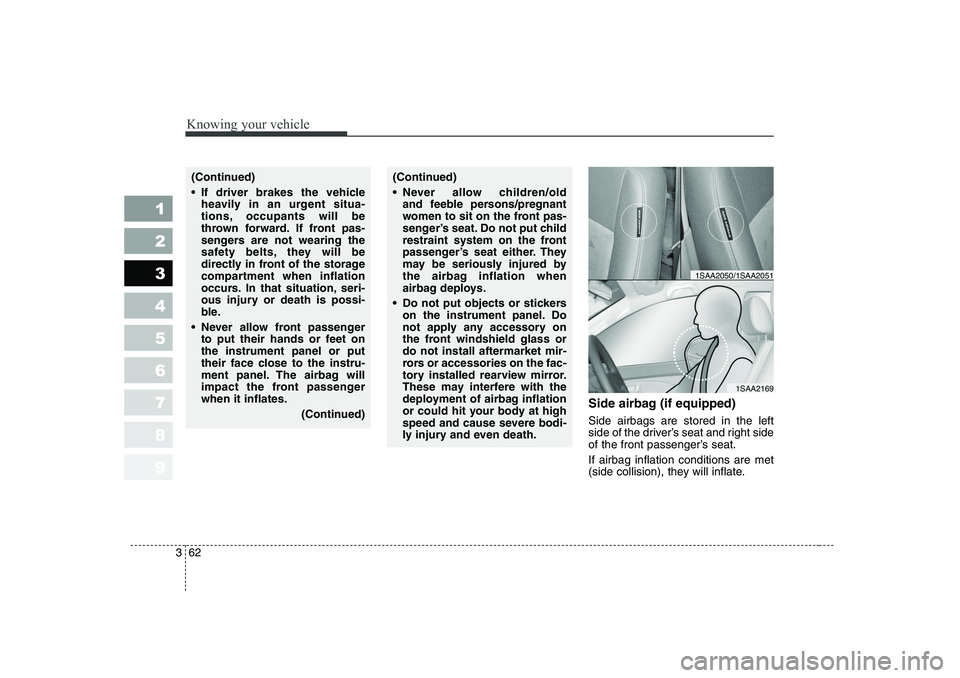
Side airbag (if equipped) Side airbags are stored in the left
side of the driver’s seat and right side
of the front passenger’s seat. If airbag inflation conditions are met
(side collision), they will inflate.
1SAA2169
1SAA2050/1SAA2051
(Continued)
If driver brakes the vehicle
heavily in an urgent situa-
tions, occupants will be
thrown forward. If front pas-
sengers are not wearing the
safety belts, they will be
directly in front of the storage
compartment when inflation
occurs. In that situation, seri-
ous injury or death is possi-
ble.
Never allow front passenger to put their hands or feet onthe instrument panel or put
their face close to the instru-
ment panel. The airbag will
impact the front passengerwhen it inflates.
(Continued)(Continued)
Never allow children/old and feeble persons/pregnant
women to sit on the front pas-
senger’s seat. Do not put child
restraint system on the front
passenger’s seat either. They
may be seriously injured by
the airbag inflation when
airbag deploys.
Do not put objects or stickers on the instrument panel. Do
not apply any accessory on
the front windshield glass ordo not install aftermarket mir-
rors or accessories on the fac-
tory installed rearview mirror.
These may interfere with the
deployment of airbag inflation
or could hit your body at high
speed and cause severe bodi-
ly injury and even death.
Page 73 of 281
363
1 23456789
Knowing your vehicle
The side airbags are not designedto deploy during collisions from the
front or rear of the vehicle or in
most rollover situations.
The side airbags are designed to deploy only during certain side-
impact collisions, depending on the
crash severity, angle, speed and
impact. The side airbags are not
designed to deploy in all side
impact situations.WARNING
In order for side airbags to provide its best protection,
both front seat occupantsshould sit in an upright posi-
tion with the seat belts proper-
ly fastened.
Do not allow the passengers to lean their heads or bodies
onto doors, put their arms on
the doors, stretch their arms
out of the window, or place
objects between the doors
and passengers when they areseated on the seats where
side airbags are equipped.
Never try to open or repair any components of the side airbag
system. This should be done
only by an authorized Kia
dealer.
Failure to follow the above men-tioned instructions can result in
injury or death to the vehicleoccupants in an accident.WARNING
Do not use any accessory seat covers for the vehicle
equipped with side airbags.
Use of seat covers could inter-
fere with side airbag deploy-ment.
If seat or seat cover is dam-
aged, have the vehicle
checked and repaired by an
authorized Kia dealer. Inform
them that your vehicle is
equipped with side airbags.
Do not make modifications or additions to the seats. If seats
not allowed by Kia Motors are
used, unexpected injury mayresult in due to the malfunc-
tion of the airbag system.
Page 76 of 281
Knowing your vehicle
66
3
1 23456789
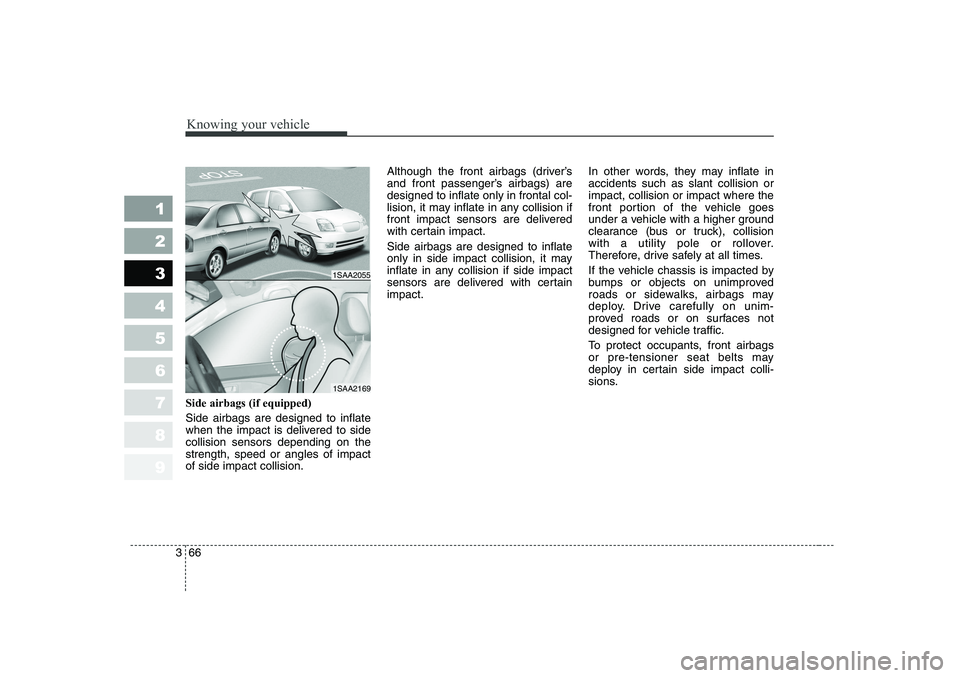
Side airbags (if equipped) Side airbags are designed to inflate
when the impact is delivered to sidecollision sensors depending on thestrength, speed or angles of impactof side impact collision. Although the front airbags (driver’s
and front passenger’s airbags) aredesigned to inflate only in frontal col-
lision, it may inflate in any collision if
front impact sensors are delivered
with certain impact. Side airbags are designed to inflate
only in side impact collision, it may
inflate in any collision if side impact
sensors are delivered with certainimpact.
In other words, they may inflate inaccidents such as slant collision orimpact, collision or impact where the
front portion of the vehicle goes
under a vehicle with a higher ground
clearance (bus or truck), collision
with a utility pole or rollover.
Therefore, drive safely at all times.
If the vehicle chassis is impacted by
bumps or objects on unimproved
roads or sidewalks, airbags may
deploy. Drive carefully on unim-
proved roads or on surfaces not
designed for vehicle traffic.
To protect occupants, front airbags
or pre-tensioner seat belts may
deploy in certain side impact colli-
sions.
1SAA2055
1SAA2169
Page 77 of 281
367
1 23456789
Knowing your vehicle
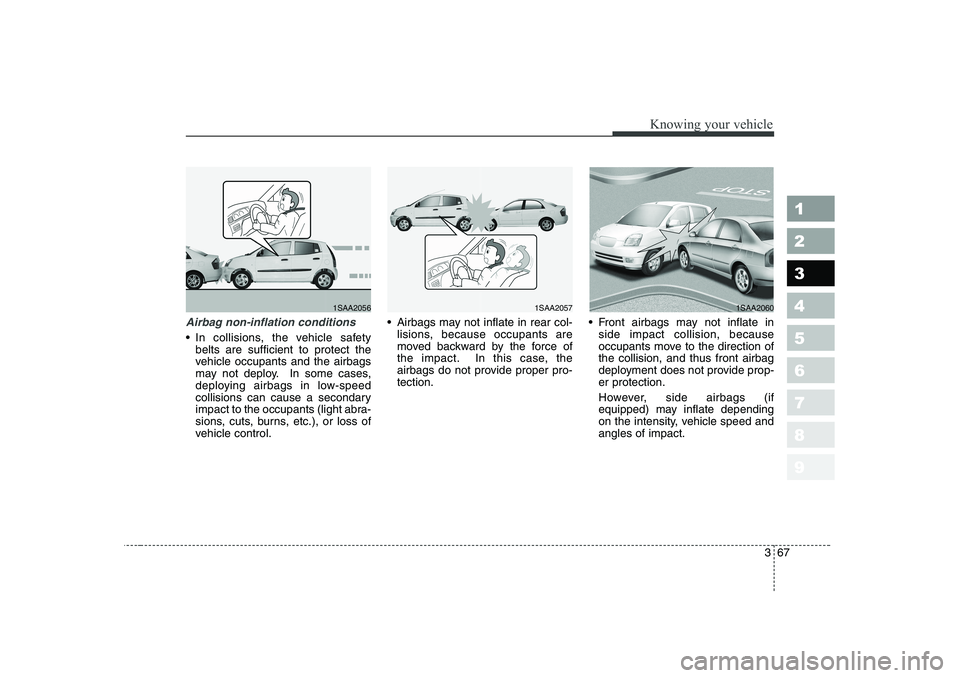
Airbag non-inflation conditions
In collisions, the vehicle safetybelts are sufficient to protect the
vehicle occupants and the airbags
may not deploy. In some cases,
deploying airbags in low-speed
collisions can cause a secondary
impact to the occupants (light abra-
sions, cuts, burns, etc.), or loss of
vehicle control. Airbags may not inflate in rear col-
lisions, because occupants are
moved backward by the force of
the impact. In this case, the
airbags do not provide proper pro-tection. Front airbags may not inflate in
side impact collision, because
occupants move to the direction ofthe collision, and thus front airbag
deployment does not provide prop-er protection.
However, side airbags (if
equipped) may inflate depending
on the intensity, vehicle speed andangles of impact.
1SAA20571SAA20561SAA2060
Page 80 of 281
Knowing your vehicle
70
3
1 23456789
In order to help provide protection
in a severe collision, the airbags
must inflate rapidly. The speed of
airbag inflation reduces the likeli-
hood of serious or life-threatening
injuries and is thus a mandatory
part of the airbag design.
However, airbag inflation can also
cause injuries which normally can
include facial abrasions, bruises
and broken bones, because thatspeed also causes the airbags to
expand with a great deal force.
There are even circumstances under which contact with the
steering wheel airbag can cause
fatal injuries, especially if the
occupant is positioned exces-
sively close to the steeringwheel. Noise and smoke
When the airbags inflate, they make
a loud noise and they leave smoke
and powder in the air inside of the
vehicle. This is normal and is a result
of the ignition of the airbag inflator.
After the airbag inflates, you may feel
substantial discomfort in breathing
due to the contact of your chest to
both the safety belt and the airbag,
as well as from breathing the smoke
and powder.
We strongly urge you
to open your doors and/or win-
dows as soon as possible after
impact in order to reduce discom-
fort and prevent prolonged expo-
sure to the smoke and powder.
Though smoke and powder are non-
toxic, it may cause irritation to the
skin (eyes, nose and throat etc). If
this is the case, wash and rinse with
the cold water immediately and con-sult the doctor if the symptom per-
sists.WARNING
Driver should sit as far back (at least 250 mm (10 inches)
away) from the steering wheel
airbag as possible to reduce
the risk of injury or death in a
collision. The front passenger
should always move their seat
as far back as possible and sit
back in their seat.
Airbag inflates instantly in an event of collision, passengers
may be injured by the airbag
expansion force if they are not
in proper position.
Airbag inflation may cause injuries which normally
include facial or bodily abra-
sions, injuries by the broken
glasses or burns by the explo-sives.
Page 129 of 281

Driving your vehicle
28
4
1 23456789
Engine oil pressure warning
This warning light indicates the
engine oil pressure is low.
If the warning light illuminates while
driving:
1. Drive safely to the side of the road
and stop.
2. With the engine off, check the engine oil level. If the level is low, add oil as required.
If the warning light remains on after
adding oil or if oil is not available, call
an Authorized Kia Dealer.
✽✽
NOTICE
If the engine is not stopped immedi-
ately, severe damage could result.
Charging system warning
This warning light indicates a mal-
function of either the generator or
electrical charging system.
If the warning light comes on while
the vehicle is in motion:
1. Drive to the nearest safe location.
2. With the engine off, check the gen- erator drive belt for looseness or
breakage.
3. If the belt is adjusted properly, a problem exists somewhere in the
electrical charging system. Have
an Authorized Kia Dealer correct
the problem as soon as possible. Safety belt warning
Type A
As a reminder to the driver and pas-
senger, safety belt warning light will
blink for approximately 6 seconds
each time you turn the ignition switchON.
If the driver
’s lap/shoulder belt is not
fastened when the key is turned ON,
the safety belt warning light blinks for
approximately 6 seconds. (ifequipped)
If the system does not operate as
described, see an Authorized Kia
Dealer for assistance.
Type B (for Europe)
As a reminder to the driver and pas-
senger, safety belt warning light will
blink or illuminate for approximately 6
seconds each time you turn the igni-
tion switch ON.
Page 130 of 281

429
1 23456789
Driving your vehicle
If the driver's lap/shoulder belt is not
fastened when the key is turned ON
or if it is disconnected after the key is
turn ON, the safety belt warning light
will blink or illuminate until the belt is
fastened.
But, if the driver's lap/shoulder belt is connected and disconnected twice
within 9 seconds after the belt is fas-
tened, the safety belt warning light
will not operate.
If the system does not operate as
described, see an authorized Kia
dealer for assistance.
Type C
If the driver's lap/shoulder belt is not
fastened when the key is turned ON
or if it is disconnected after the key is
turn ON, the safety belt warning light
illuminates until the belt is fastened.
If the system does not operate as
described, see an Authorized Kia
Dealer for assistance.Parking brake & brake fluid warning
Parking brake warning
This light is illuminated when the
parking brake is applied with the igni-
tion switch in the START or ON posi-
tion. The warning light should go off
when the parking brake is released.
Low brake fluid level warning
If the warning light remains on, it may
indicate that the brake fluid level in
the reservoir is low.
If the warning light remains on:
1. Drive carefully to the nearest safe
location and stop your vehicle.
2. With the engine stopped, check the brake fluid level immediately
and add fluid as required. Then
check all brake components for
fluid leaks. 3. Do not drive the vehicle if leaks
are found, the warning light
remains on or the brakes do not
operate properly. Have it towed to
any Authorized Kia Dealer for a
brake system inspection and nec-
essary repairs.
To check bulb operation, check
whether the parking brake and brake
fluid warning light illuminates when
the ignition switch is in the ON posi-tion.
WARNING
Driving the vehicle with a warn-
ing light on is dangerous. If thebrake warning light remains on,
have the brakes checked and
repaired immediately by an
Authorized Kia Dealer.
Page 133 of 281

Driving your vehicle
32
4
1 23456789
Glow indicator
(diesel engine only)
This light is turned on during warm-
up and turned off after it.
✽✽
NOTICE
If the glow indicator continues to
illuminate after the engine has
warmed up or while driving, checkthe system by an authorized Kia
dealer or other competent repairshop as soon as possible.
Sedimentor level warning (diesel
engine only)
The light comes on if water in the
sedimentor is accumulated more
than normal. Drain water if the light is
turned on. Driving with the light on
may damage the engine. Safety belt warning chime (if equipped)
Type A
If the driver's seat belt is not fastened
when the ignition key is turned
“ON ”
or if it is disconnected after the key is
ON, the safety belt warning chime
will sound for approximately 6 sec-
onds.
Type B (for Europe)
If the driver's lap/shoulder belt is not
fastened when the key is turned ON
and you drive over 9km/h, the safety
belt warning chime will sound for
approximately 100 seconds after the
warning light blinks for approximately
one minute.
If the driver's lap/shoulder belt is dis-
connected after the key is turn ON
and you drive over 9km/h, the safety
belt warning chime will sound for
approximately 100 seconds.
But, if the driver's lap/shoulder belt is connected and disconnected twice
within 9 seconds after the belt is fas-
tened, the safety belt warning chime
will not operate. Key reminder warning chime (if equipped)
If the driver
’s door is opened and the
ignition key is left in the ignition
switch in the LOCK or ACC position,
the key reminder warning chime will
sound. This is to prevent you from
locking your keys in the vehicle.
Overspeed warning chime (if equipped)
If you drive with the speed of 120
km/h or more, the overspeed warn-
ing chime will sound. This is to pre-
vent you from driving your vehicle
with overspeed.
Page 214 of 281
1 234567891 23456789
10
Maintenance services / 7-3 Normal maintenance schedule / 7-5
Maintenance under severe usage conditions / 7-8
Owner maintenance / 7-10Engine compartment / 7-12
Engine oil and oil filter / 7-14Engine cooling system / 7-17Brakes and clutch / 7-20Parking brake / 7-21Drive belts / 7-22
Power steering / 7-23
Steering wheel / 7-24Manual transaxle / 7-25Automatic transaxle / 7-27Lubricants and fluids / 7-30
Fuel filter / 7-31
Air cleaner / 7-31
Climate control air filter / 7-33
Wiper blades / 7-35
Maintenance