flat tire KIA PICANTO 2008 User Guide
[x] Cancel search | Manufacturer: KIA, Model Year: 2008, Model line: PICANTO, Model: KIA PICANTO 2008Pages: 335, PDF Size: 12.98 MB
Page 239 of 335
What to do in an emergency
16
6
F120200AUN What to do when a tire is punc- tured
A punctured tire is repaired in two
stages. In the 1st stage, sealing com-pound and air is inflated into the tire
and the vehicle driven a short dis-tance (3 km / 2 miles) to spread the
compound inside the tire. In the 2nd
stage, the inflation pressure is
checked and, if necessary, more air
is added into the tire. It is then possi-
ble to drive cautiously with the tire up
to 200 km (120 miles) at a maximumspeed of 80 km/h (50 mph) in order
to reach a vehicle or tire dealer to
have the tire replaced. If so inform
other drivers that the TireMobilityKit
has been used and provide advice
and warnings about changed driving
behaviour. F120201ASA
1st Stage: Pump sealing compound
and air into the tire
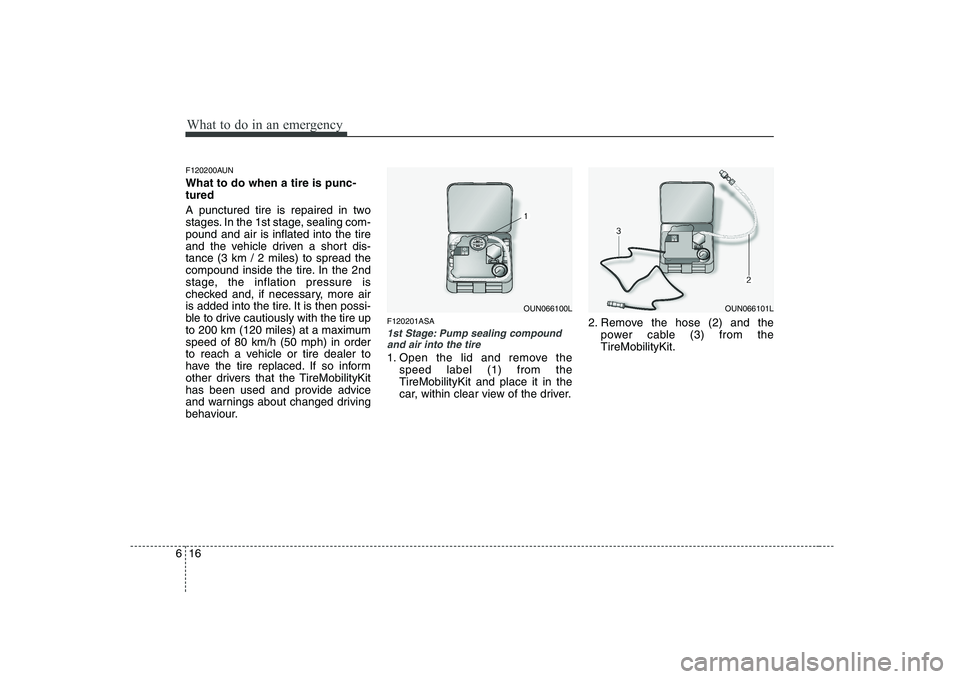
1. Open the lid and remove the
speed label (1) from the TireMobilityKit and place it in the
car, within clear view of the driver. 2. Remove the hose (2) and the
power cable (3) from theTireMobilityKit.
OUN066100LOUN066101L
Page 241 of 335
What to do in an emergency
18
6
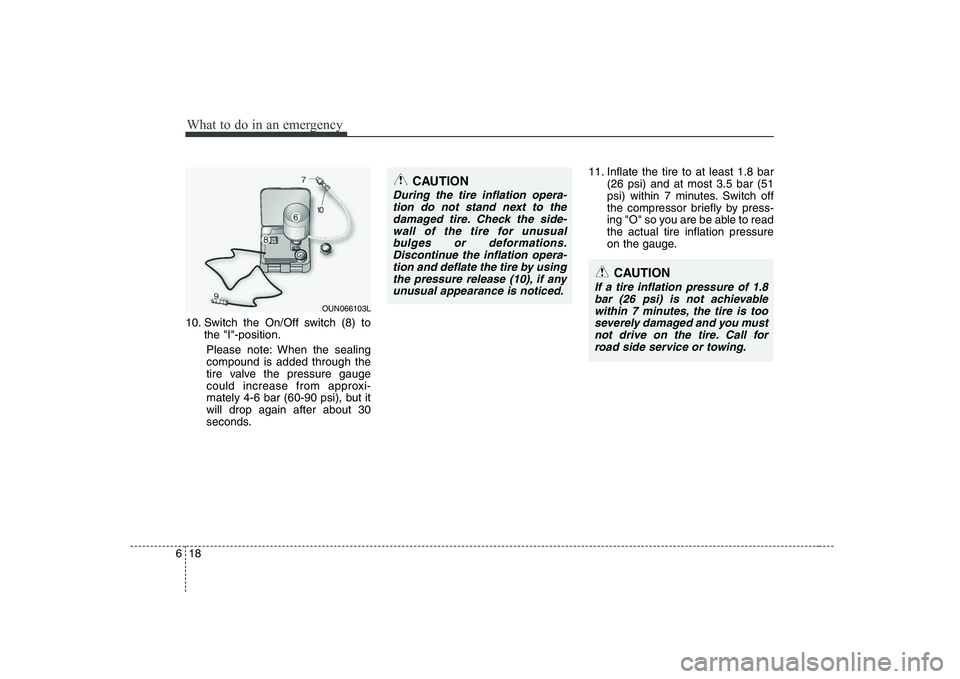
10. Switch the On/Off switch (8) to
the "I"-position.
Please note: When the sealing compound is added through the
tire valve the pressure gauge
could increase from approxi-
mately 4-6 bar (60-90 psi), but itwill drop again after about 30
seconds. 11. Inflate the tire to at least 1.8 bar
(26 psi) and at most 3.5 bar (51
psi) within 7 minutes. Switch off
the compressor briefly by press-
ing "O" so you are be able to readthe actual tire inflation pressure
on the gauge.
CAUTION
During the tire inflation opera-
tion do not stand next to thedamaged tire. Check the side-wall of the tire for unusual bulges or deformations.Discontinue the inflation opera-tion and deflate the tire by using the pressure release (10), if anyunusual appearance is noticed.
CAUTION
If a tire inflation pressure of 1.8 bar (26 psi) is not achievablewithin 7 minutes, the tire is tooseverely damaged and you must not drive on the tire. Call forroad side service or towing.
OUN066103L
Page 242 of 335
619
What to do in an emergency
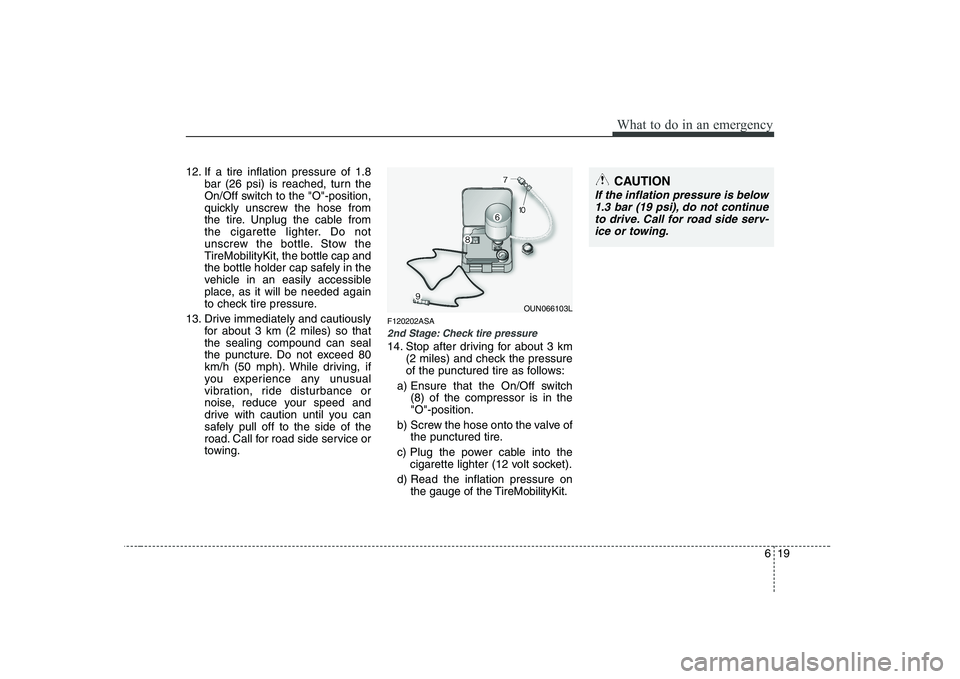
12. If a tire inflation pressure of 1.8bar (26 psi) is reached, turn the
On/Off switch to the "O"-position,
quickly unscrew the hose from
the tire. Unplug the cable from
the cigarette lighter. Do not
unscrew the bottle. Stow theTireMobilityKit, the bottle cap and
the bottle holder cap safely in the
vehicle in an easily accessible
place, as it will be needed again
to check tire pressure.
13. Drive immediately and cautiously for about 3 km (2 miles) so thatthe sealing compound can seal
the puncture. Do not exceed 80
km/h (50 mph). While driving, if
you experience any unusual
vibration, ride disturbance or
noise, reduce your speed and
drive with caution until you can
safely pull off to the side of the
road. Call for road side service or
towing. F120202ASA
2nd Stage: Check tire pressure
14. Stop after driving for about 3 km
(2 miles) and check the pressure
of the punctured tire as follows:
a) Ensure that the On/Off switch (8) of the compressor is in the"O"-position.
b) Screw the hose onto the valve of the punctured tire.
c) Plug the power cable into the cigarette lighter (12 volt socket).
d) Read the inflation pressure on the gauge of the TireMobilityKit.
CAUTION
If the inflation pressure is below
1.3 bar (19 psi), do not continueto drive. Call for road side serv- ice or towing.
OUN066103L
Page 243 of 335
What to do in an emergency
20
6
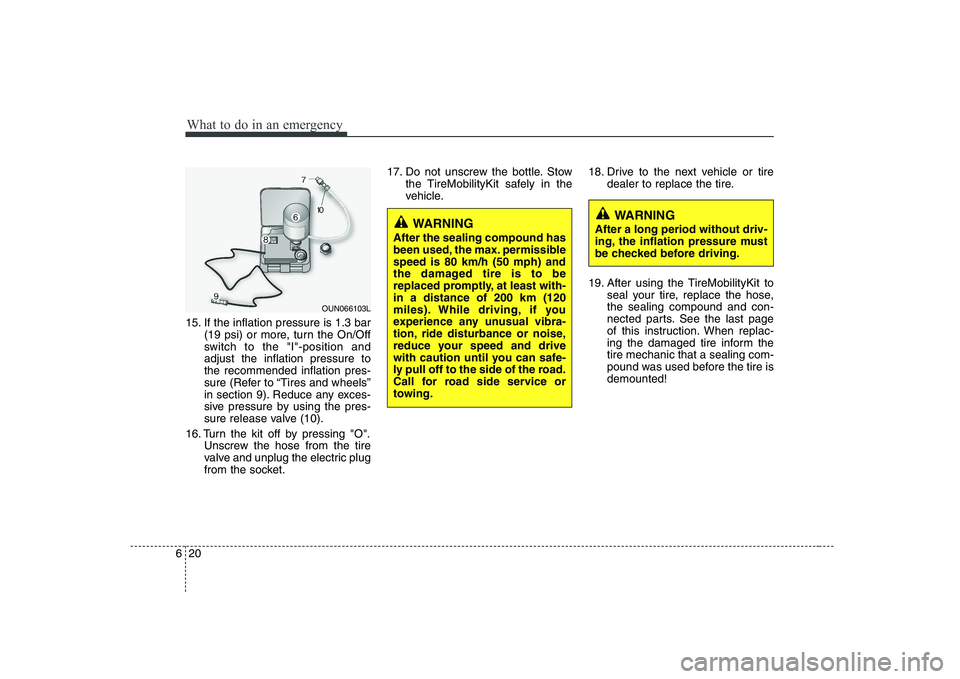
15. If the inflation pressure is 1.3 bar
(19 psi) or more, turn the On/Off
switch to the "I"-position andadjust the inflation pressure tothe recommended inflation pres-
sure (Refer to “Tires and wheels”
in section 9). Reduce any exces-
sive pressure by using the pres-
sure release valve (10).
16. Turn the kit off by pressing "O". Unscrew the hose from the tire
valve and unplug the electric plug
from the socket. 17. Do not unscrew the bottle. Stow
the TireMobilityKit safely in the
vehicle. 18. Drive to the next vehicle or tire
dealer to replace the tire.
19. After using the TireMobilityKit to seal your tire, replace the hose,the sealing compound and con-
nected parts. See the last page
of this instruction. When replac-
ing the damaged tire inform thetire mechanic that a sealing com-
pound was used before the tire isdemounted!
WARNING
After the sealing compound has
been used, the max. permissiblespeed is 80 km/h (50 mph) and
the damaged tire is to be
replaced promptly, at least with-in a distance of 200 km (120
miles). While driving, if you
experience any unusual vibra-
tion, ride disturbance or noise,
reduce your speed and drive
with caution until you can safe-
ly pull off to the side of the road.
Call for road side service or
towing.WARNING
After a long period without driv-
ing, the inflation pressure must
be checked before driving.
OUN066103L
Page 244 of 335
621
What to do in an emergency
F120203APA
3rd stage: What to do when checkingthe tire inflation pressure
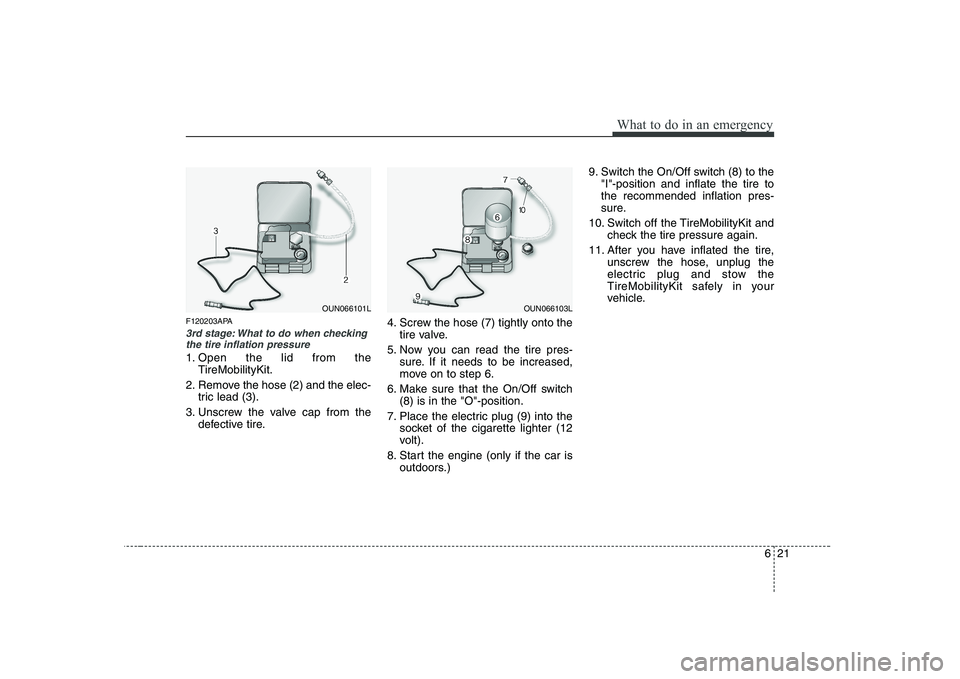
1. Open the lid from the
TireMobilityKit.
2. Remove the hose (2) and the elec- tric lead (3).
3. Unscrew the valve cap from the defective tire. 4. Screw the hose (7) tightly onto the
tire valve.
5. Now you can read the tire pres- sure. If it needs to be increased,
move on to step 6.
6. Make sure that the On/Off switch (8) is in the "O"-position.
7. Place the electric plug (9) into the socket of the cigarette lighter (12
volt).
8. Start the engine (only if the car is outdoors.) 9. Switch the On/Off switch (8) to the
"I"-position and inflate the tire tothe recommended inflation pres-
sure.
10. Switch off the TireMobilityKit and check the tire pressure again.
11. After you have inflated the tire, unscrew the hose, unplug the
electric plug and stow the
TireMobilityKit safely in your
vehicle.
OUN066103LOUN066101L
Page 245 of 335
What to do in an emergency
22
6
F120300ASA
Notes on the safe use of the TireMobilityKit
Park your car at the side of the
road so that you can work with the
TireMobilityKit away from moving
traffic. Place your warning triangle
in a prominent place to make pass-
ing vehicles aware of your location.
To be sure your vehicle won't move, even when you're on a fairly
level ground, always set your park-
ing brake.
Only use the TireMobilityKit for sealing/inflation passenger car
tires. Do not use on motorcycles,
bicycles or any other type of tires.
Do not remove any foreign objects - such as nails or screws - that
have penetrated the tire. Before using the TireMobilityKit
read the precautionary advice
printed on the sealant bottle!
Provided the car is outdoors, leave the engine running. Otherwise
operating the compressor may
eventually drain the car battery.
Never leave the TireMobilityKit unattended while it is being used.
Do not leave the compressor run- ning for more than 10 min. at a time
or it may overheat.
Do not use the TireMobilityKit if the ambient temperature is below -30°C (-20°F).
Do not use the sealing compound after its expiration date which can
be found on the label of the bottle.
Keep away from children.
CAUTION
Do not use the TireMobilityKit if the tire is severely damaged bydriving with insufficient airpressure (e.g. if the tire has bulges, cuts, cracks or similardefects). Only seal puncturedareas located within the tread region of the tire. Damage to thesidewall should not be sealedfor safety reasons.
Page 251 of 335
What to do in an emergency
28
6
EMERGENCY COMMODITY (IF EQUIPPED)
F110000AUN There are some emergency commodities
in the vehicle to help you respond to theemergency situation. F110100ASA
Fire extinguisher
If there is small fire and you know how to
use the fire extinguisher, take the follow-
ing steps carefully.
1. Pull out the pin at the top of the extin- guisher that keeps the handle from being accidentally pressed.
2. Aim the nozzle toward the base of the fire.
3. Stand approximately 2.5 m (8 ft) away from the fire and squeeze the handle
to discharge the extinguisher. If you
release the handle, the discharge will
stop.
4. Sweep the nozzle back and forth at the base of the fire. After the fire appears
to be out, watch carefully since it may
re-ignite. F110200AUN
First aid kit
There are some items such as scissors,
bandage and adhesive tape and etc. in
the kit to give first aid to an injured per-son.
F110300AUN
Triangle reflector
Place the triangle reflector on the road to
warn oncoming vehicles during emer-
gencies, such as when the vehicle is
parked by the roadside due to any prob-
lems.
F110400AUN
Tire pressure gauge (If equipped)
Tires normally lose some air in day-to-
day use, and you may have to add a few
pounds of air periodically and it is not
usually a sign of a leaking tire, but of nor-
mal wear. Always check tire pressurewhen the tires are cold because tire pres-
sure increases with temperature. To check the tire pressure, take the fol-
lowing steps;
1. Unscrew the inflation valve cap that is
located on the rim of the tire.
2. Press and hold the gauge against the tire valve. Some air will escape as you
begin and more will escape if you don't
press the gauge in firmly.
3. A firm non-leaking push will activate the gauge.
4. Read the tire pressure on the gauge to know whether the tire pressure is lowor high.
5. Adjust the tire pressures to the speci- fied pressure. Refer to “Tires and
wheels” in section 9.
6. Reinstall the inflation valve cap.
Page 257 of 335
Maintenance
6
7
OWNER MAINTENANCE
G030000AUN
The following lists are vehicle checks and
inspections that should be performed by
the owner or an authorized KIA dealer atthe frequencies indicated to help ensure
safe, dependable operation of your vehi-
cle.
Any adverse conditions should be
brought to the attention of your dealer as
soon as possible.
These Owner Maintenance Checks are
generally not covered by warranties and
you may be charged for labor, parts and
lubricants used. Owner maintenance schedule
G030101AUN
When you stop for fuel:
Check the engine oil level.
Check the coolant level in the coolant
reservoir.
Check the windshield washer fluid level.
Look for low or under-inflated tires. G030102AUN
While operating your vehicle:
Note any changes in the sound of the
exhaust or any smell of exhaust fumes
in the vehicle.
Check for vibrations in the steering wheel. Notice any increased steering
effort or looseness in the steering
wheel, or change in its straight-aheadposition.
Notice if your vehicle constantly turns slightly or “pulls” to one side when trav-
eling on smooth, level road.
When stopping, listen and check for unusual sounds, pulling to one side,
increased brake pedal travel or “hard-
to-push” brake pedal.
If any slipping or changes in the oper- ation of your transaxle occurs, check
the transaxle fluid level.
Check the automatic transaxle P (Park) function.
Check the parking brake.
Check for fluid leaks under your vehicle (water dripping from the air condition-
ing system during or after use is nor-mal).
WARNING
Be careful when checking your
engine coolant level when the
engine is hot. Scalding hot coolant
and steam may blow out under
pressure. This could cause burns
or other serious injury.
Page 258 of 335
77
Maintenance
G030103AUN
At least monthly:
Check coolant level in the enginecoolant reservoir.
Check the operation of all exterior lights, including the stoplights, turn sig-
nals and hazard warning flashers.
Check the inflation pressures of all tires including the spare. G030104AUN
At least twice a year
(i.e., every Spring and Fall):
Check radiator, heater and air condi- tioning hoses for leaks or damage.
Check windshield washer spray and wiper operation. Clean the wiper
blades with clean cloth dampened with
washer fluid.
Check the headlight alignment.
Check the muffler, exhaust pipes, shields and clamps.
Check the lap/shoulder belts for wear and function.
Check for worn tires and loose wheel lug nuts. G030105APA
At least once a year:
Clean body and door drain holes.
Lubricate door hinges and checks, and
hood hinges.
Lubricate door and hood locks and latches.
Lubricate door rubber weatherstrips.
Check the air conditioning system.
Inspect and lubricate automatic transaxle linkage and controls.
Clean battery and terminals.
Check the brake/clutch fluid level.
Page 292 of 335
741
Maintenance
TIRES AND WHEELS
G200100AUN Tire care
For proper maintenance, safety, and
maximum fuel economy, you must
always maintain the recommended
tire inflation pressures and stay with-
in the load limits and weight distribu-
tion recommended for your vehicle.
G200200AUN Recommended cold tire inflation pressures All tire pressures (including the
spare) should be checked when the
tires are cold. “Cold Tires” means the
vehicle has not been driven for at
least three hours or driven less than1.6 km (one mile).
Recommended pressures must be
maintained for the best ride, top vehi-
cle handling, and minimum tire wear.
For recommended inflation pressure,
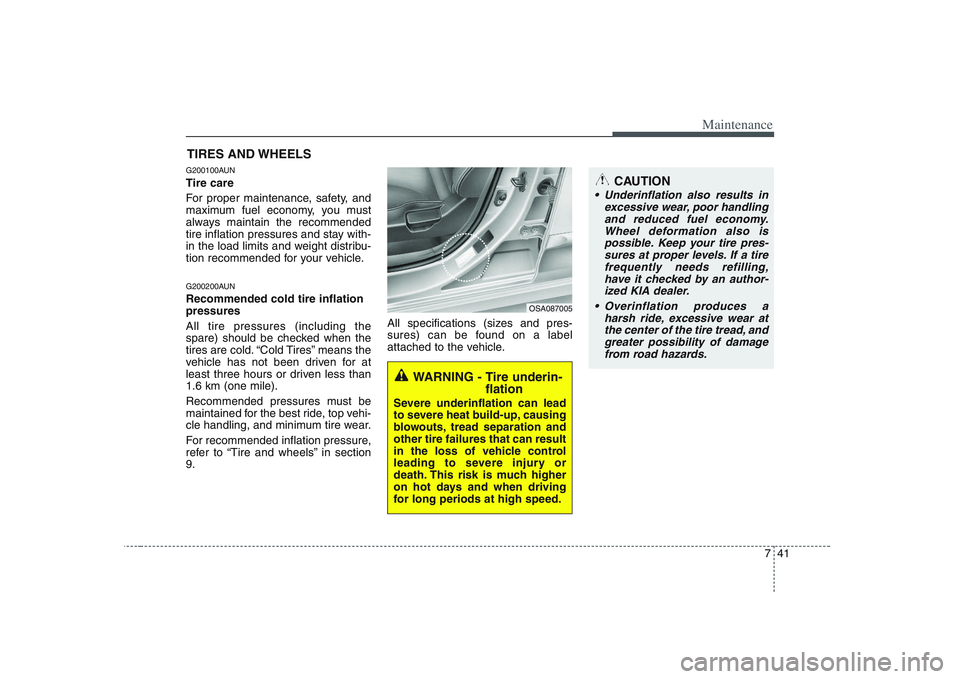
refer to “Tire and wheels” in section9. All specifications (sizes and pres-
sures) can be found on a label
attached to the vehicle.
WARNING - Tire underin-
flation
Severe underinflation can lead
to severe heat build-up, causing
blowouts, tread separation andother tire failures that can result
in the loss of vehicle control
leading to severe injury or
death. This risk is much higher
on hot days and when driving
for long periods at high speed.
OSA087005
CAUTION
Underinflation also results in excessive wear, poor handlingand reduced fuel economy.Wheel deformation also ispossible. Keep your tire pres-sures at proper levels. If a tire frequently needs refilling,have it checked by an author-ized KIA dealer.
Overinflation produces a harsh ride, excessive wear atthe center of the tire tread, andgreater possibility of damage from road hazards.