instrument panel KIA PICANTO 2008 User Guide
[x] Cancel search | Manufacturer: KIA, Model Year: 2008, Model line: PICANTO, Model: KIA PICANTO 2008Pages: 335, PDF Size: 12.98 MB
Page 112 of 335
441
Features of your vehicle
D190100AUN
Battery saver function (if equipped)
The purpose of this feature is to pre-vent the battery from being dis-
charged. The system automatically
turns off the exterior lights when the
driver removes the ignition key and
opens the driver-side door.
With this feature, the parking lights will be turned off automatically if the driver
parks on the side of road at night.
If necessary, to keep the lights on
when the ignition key is removed, per-
form the following:
1) Open the driver-side door.
2) Turn the parking lights OFF and ON again using the light switch on the
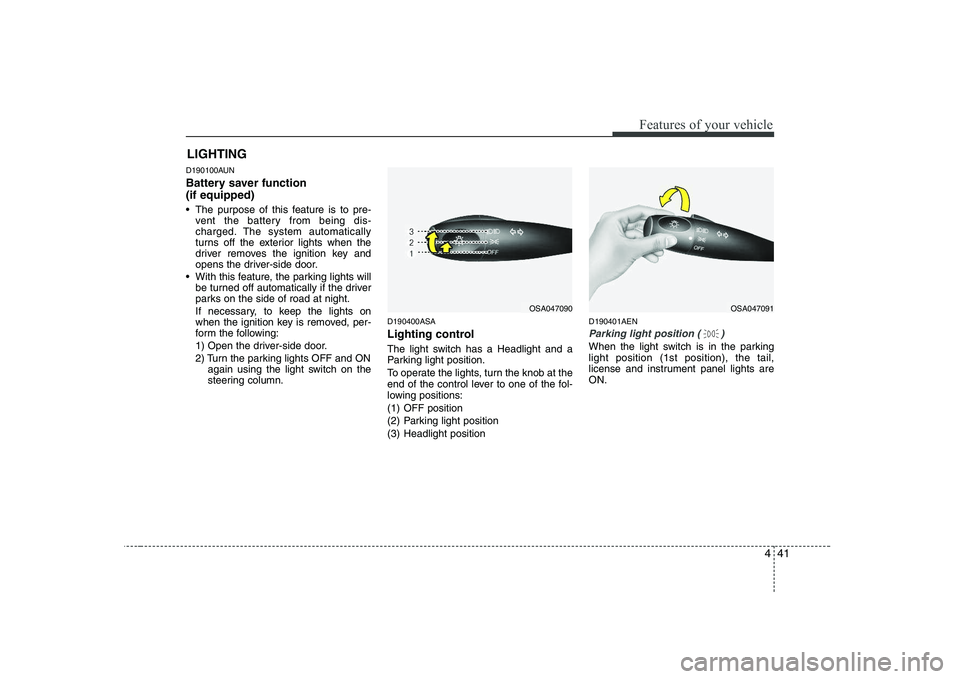
steering column. D190400ASA
Lighting control
The light switch has a Headlight and a
Parking light position.
To operate the lights, turn the knob at the
end of the control lever to one of the fol-
lowing positions:
(1) OFF position
(2) Parking light position
(3) Headlight position D190401AEN
Parking light position ( )
When the light switch is in the parking light position (1st position), the tail,
license and instrument panel lights areON.
LIGHTING
OSA047090OSA047091
Page 113 of 335
Features of your vehicle
42
4
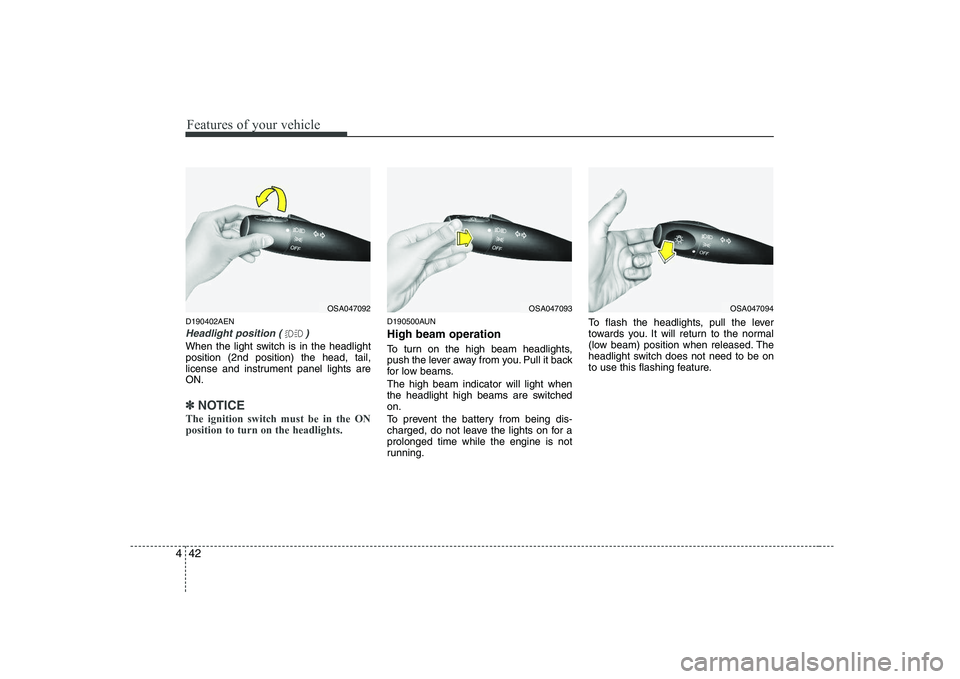
D190402AEN
Headlight position ( )
When the light switch is in the headlight position (2nd position) the head, tail,
license and instrument panel lights areON.
✽✽
NOTICE
The ignition switch must be in the ON position to turn on the headlights.
D190500AUN High beam operation
To turn on the high beam headlights,
push the lever away from you. Pull it back
for low beams. The high beam indicator will light when
the headlight high beams are switchedon.
To prevent the battery from being dis-
charged, do not leave the lights on for aprolonged time while the engine is not
running. To flash the headlights, pull the lever
towards you. It will return to the normal
(low beam) position when released. The
headlight switch does not need to be on
to use this flashing feature.
OSA047092OSA047093OSA047094
Page 125 of 335
Features of your vehicle
54
4
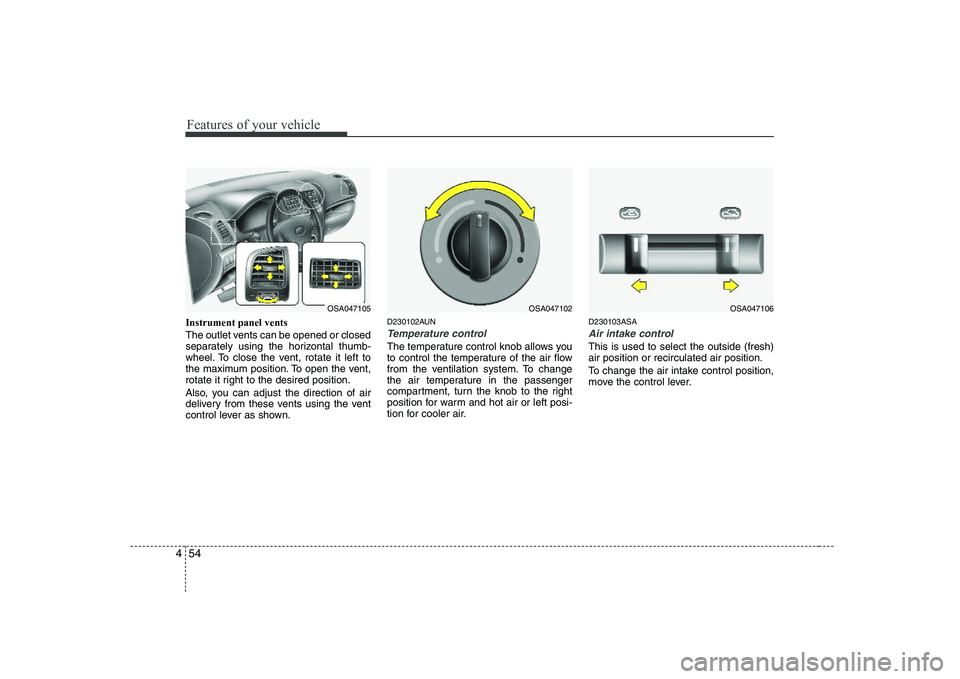
Instrument panel vents
The outlet vents can be opened or closed
separately using the horizontal thumb-
wheel. To close the vent, rotate it left to
the maximum position. To open the vent,
rotate it right to the desired position.
Also, you can adjust the direction of air
delivery from these vents using the vent
control lever as shown. D230102AUN
Temperature control
The temperature control knob allows you
to control the temperature of the air flow
from the ventilation system. To change
the air temperature in the passenger
compartment, turn the knob to the right
position for warm and hot air or left posi-
tion for cooler air.
D230103ASA
Air intake control
This is used to select the outside (fresh) air position or recirculated air position.
To change the air intake control position,
move the control lever.
OSA047102OSA047105OSA047106
Page 132 of 335
461
Features of your vehicle
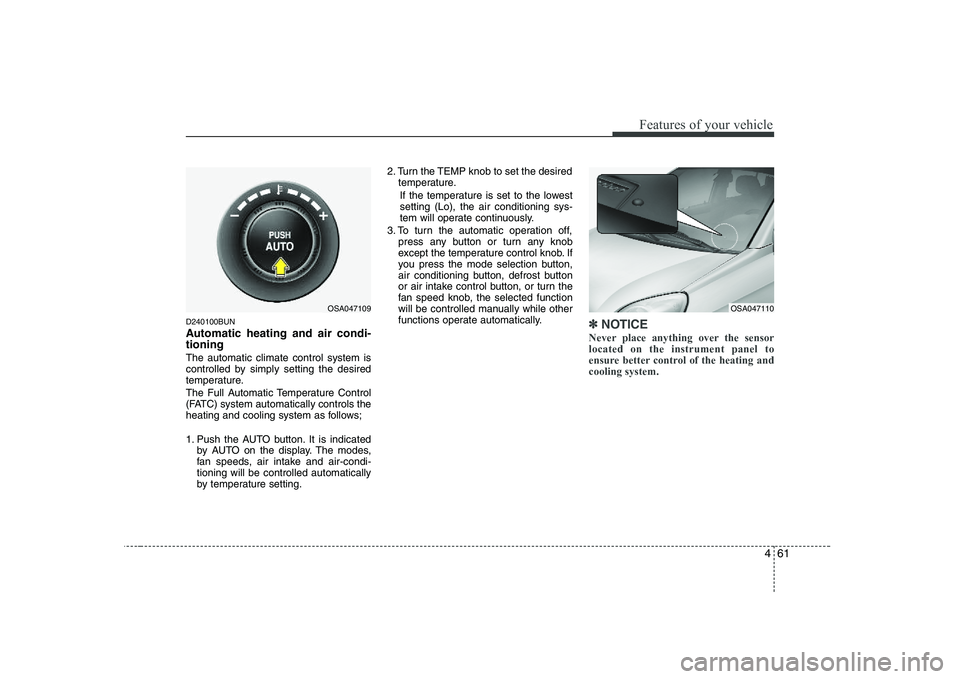
D240100BUN
Automatic heating and air condi- tioning The automatic climate control system is
controlled by simply setting the desired
temperature.
The Full Automatic Temperature Control
(FATC) system automatically controls the
heating and cooling system as follows;
1. Push the AUTO button. It is indicatedby AUTO on the display. The modes,
fan speeds, air intake and air-condi-tioning will be controlled automatically
by temperature setting. 2. Turn the TEMP knob to set the desired
temperature.
If the temperature is set to the lowestsetting (Lo), the air conditioning sys-
tem will operate continuously.
3. To turn the automatic operation off, press any button or turn any knob
except the temperature control knob. If
you press the mode selection button,
air conditioning button, defrost button
or air intake control button, or turn the
fan speed knob, the selected function
will be controlled manually while other
functions operate automatically.✽✽ NOTICE
Never place anything over the sensor located on the instrument panel to
ensure better control of the heating andcooling system.
OSA047110OSA047109
Page 134 of 335
463
Features of your vehicle
Floor-Level (C, A, D)
Most of the air flow is directed to the
floor, with a small amount of the air beingdirected to the windshield and side win-
dow defrosters.
Floor/Defrost-Level (A, C, D)
Most of the air flow is directed to the floorand the windshield with a small amount
directed to the side window defrosters. Defrost-Level (A, D)
Most of the air flow is directed to the windshield with a small amount of air
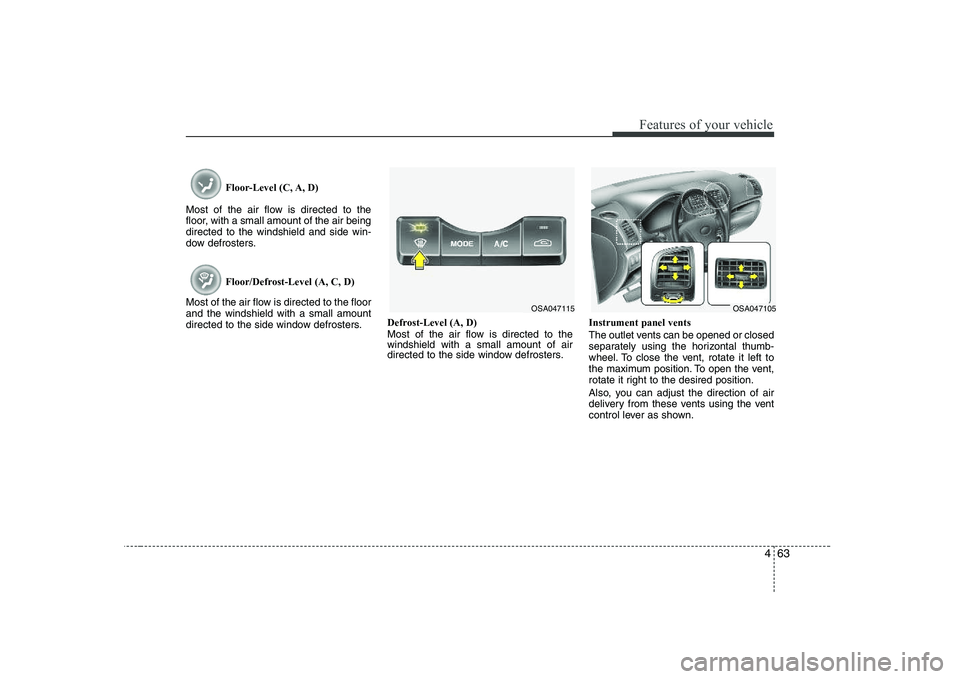
directed to the side window defrosters.Instrument panel vents
The outlet vents can be opened or closed
separately using the horizontal thumb-
wheel. To close the vent, rotate it left to
the maximum position. To open the vent,
rotate it right to the desired position.
Also, you can adjust the direction of air
delivery from these vents using the vent
control lever as shown.
OSA047115OSA047105
Page 192 of 335
513
Driving your vehicle
E060104ASA
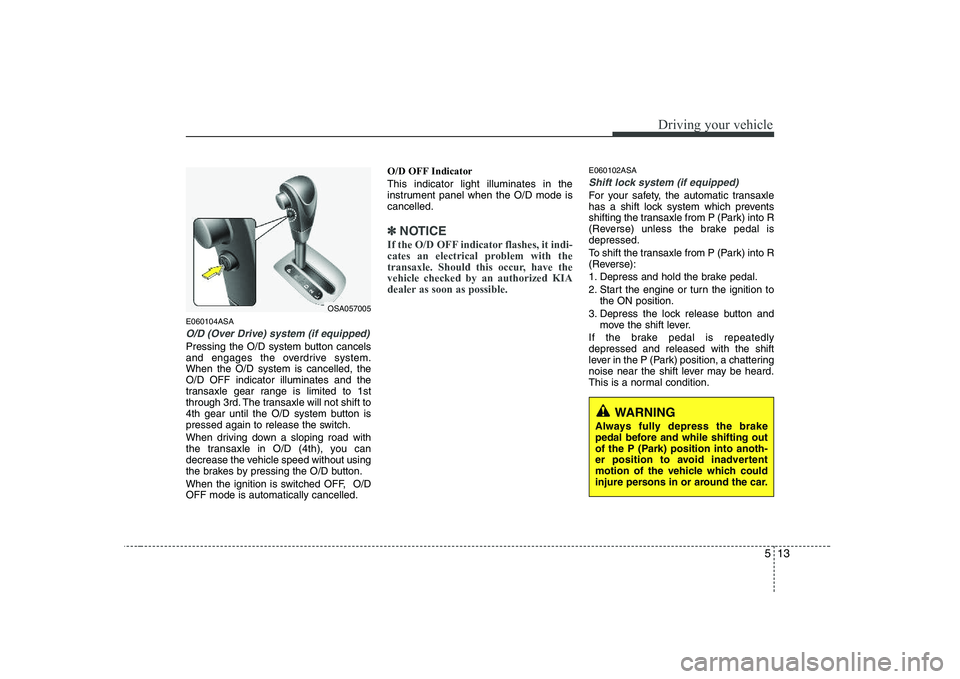
O/D (Over Drive) system (if equipped)
Pressing the O/D system button cancels
and engages the overdrive system.When the O/D system is cancelled, theO/D OFF indicator illuminates and the
transaxle gear range is limited to 1st
through 3rd. The transaxle will not shift to
4th gear until the O/D system button is
pressed again to release the switch.
When driving down a sloping road with
the transaxle in O/D (4th), you can
decrease the vehicle speed without using
the brakes by pressing the O/D button.
When the ignition is switched OFF, O/D OFF mode is automatically cancelled.O/D OFF Indicator This indicator light illuminates in the
instrument panel when the O/D mode iscancelled.
✽✽
NOTICE
If the O/D OFF indicator flashes, it indi-
cates an electrical problem with the
transaxle. Should this occur, have thevehicle checked by an authorized KIA
dealer as soon as possible.
E060102ASA
Shift lock system (if equipped)
For your safety, the automatic transaxle
has a shift lock system which prevents
shifting the transaxle from P (Park) into R
(Reverse) unless the brake pedal isdepressed.
To shift the transaxle from P (Park) into R
(Reverse):
1. Depress and hold the brake pedal.
2. Start the engine or turn the ignition to the ON position.
3. Depress the lock release button and move the shift lever.
If the brake pedal is repeatedly depressed and released with the shift
lever in the P (Park) position, a chattering
noise near the shift lever may be heard.
This is a normal condition.
OSA057005
WARNING
Always fully depress the brake
pedal before and while shifting out
of the P (Park) position into anoth-
er position to avoid inadvertent
motion of the vehicle which could
injure persons in or around the car.
Page 218 of 335
539
Driving your vehicle
E140401AUN
Following distance
Stay at least twice as far behind the vehi-
cle ahead as you would when driving
your vehicle without a trailer. This can
help you avoid situations that require
heavy braking and sudden turns.
E140402AUN
Passing
You’ll need more passing distance up
ahead when you’re towing a trailer. And,
because of the increased vehicle length,
you’ll need to go much farther beyond the
passed vehicle before you can return to
your lane.
E140403AUN
Backing up
Hold the bottom of the steering wheel
with one hand. Then, to move the trailer
to the left, just move your hand to the left.
To move the trailer to the right, move your
hand to the right. Always back up slowly
and, if possible, have someone guide
you.E140404AUN
Making turns
When you’re turning with a trailer, make
wider turns than normal. Do this so your
trailer won’t strike soft shoulders, curbs,
road signs, trees, or other objects. Avoid
jerky or sudden maneuvers. Signal well
in advance.
E140405AUN
Turn signals when towing a trailer
When you tow a trailer, your vehicle has
to have a different turn signal flasher and
extra wiring. The green arrows on your
instrument panel will flash whenever you
signal a turn or lane change. Properly
connected, the trailer lights will also flash
to alert other drivers you’re about to turn,
change lanes, or stop.
When towing a trailer, the green arrows
on your instrument panel will flash for
turns even if the bulbs on the trailer are
burned out. Thus, you may think drivers
behind you are seeing your signals
when, in fact, they are not. It’s important
to check occasionally to be sure the trail-
er bulbs are still working. You must also
check the lights every time you discon-
nect and then reconnect the wires.
Do not connect a trailer lighting system
directly to your vehicle’s lighting system.
Use only an approved trailer wiring har-
ness.An authorized KIA dealer can assist you
in installing the wiring harness. E140406ASADriving on grades
Reduce the speed and shift to a lower
gear before you start down a long or
steep downgrade. If you don’t shift down,
you might have to use your brakes so
much that they would get hot and no
longer operate efficiently.
On a long uphill grade, shift down and
reduce your speed to around 45 mph (70km/h) to reduce the possibility of engine
and transaxle overheating.
If your trailer weighs more than the max-
imum trailer weight without trailer brakes
and you have an automatic transaxle,
you should drive in D (Drive) when tow-
ing a trailer.
Operating your vehicle in D (Drive) when
towing a trailer will minimize heat build up
and extend the life of your transaxle.
WARNING
Failure to use an approved trailer wiring harness could result in dam-
age to the vehicle electrical system
and/or personal injury.
Page 303 of 335
Maintenance
52
7
G210100ASA Instrument panel fuse replace- ment
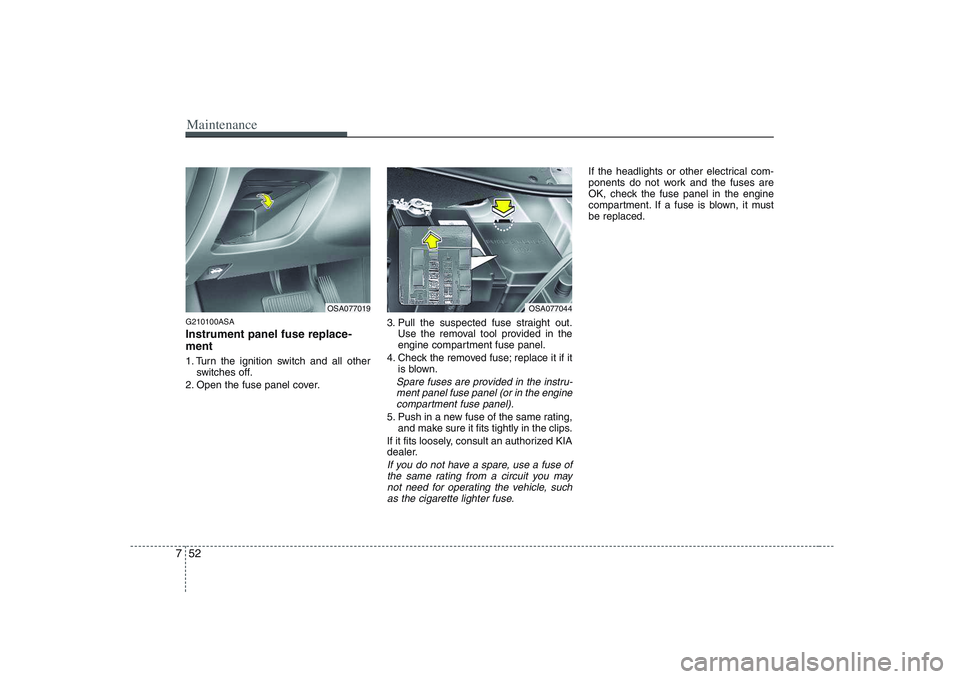
1. Turn the ignition switch and all other
switches off.
2. Open the fuse panel cover. 3. Pull the suspected fuse straight out.
Use the removal tool provided in the
engine compartment fuse panel.
4. Check the removed fuse; replace it if it is blown.
Spare fuses are provided in the instru-
ment panel fuse panel (or in the engine
compartment fuse panel).
5. Push in a new fuse of the same rating, and make sure it fits tightly in the clips.
If it fits loosely, consult an authorized KIA
dealer.
If you do not have a spare, use a fuse of the same rating from a circuit you may not need for operating the vehicle, suchas the cigarette lighter fuse.
If the headlights or other electrical com-
ponents do not work and the fuses are
OK, check the fuse panel in the engine
compartment. If a fuse is blown, it mustbe replaced.
OSA077044OSA077019
Page 306 of 335
755
Maintenance
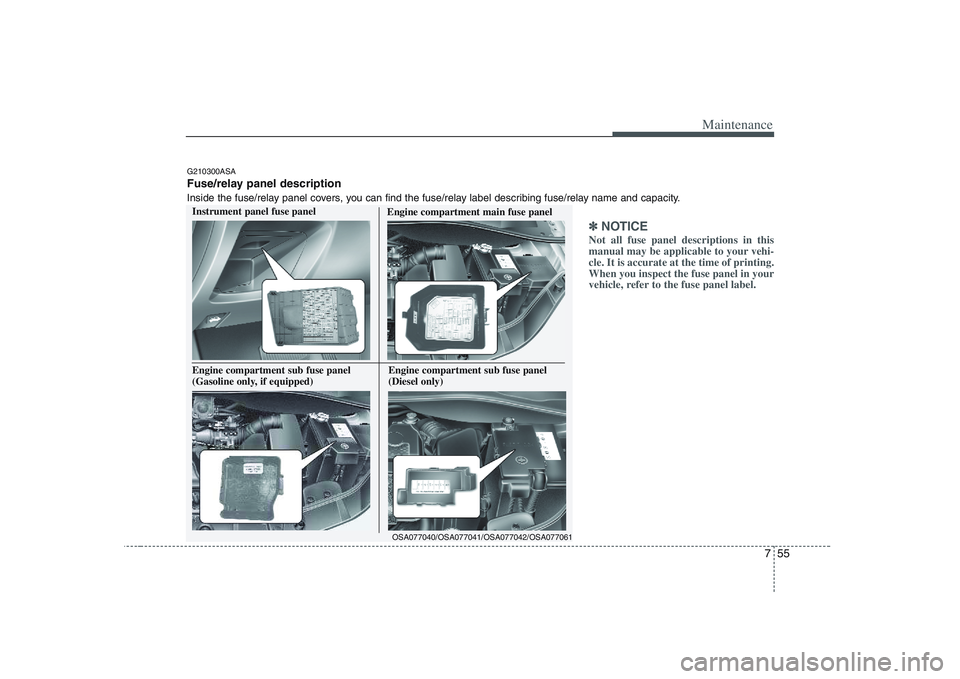
✽✽NOTICE
Not all fuse panel descriptions in this
manual may be applicable to your vehi-cle. It is accurate at the time of printing.When you inspect the fuse panel in your
vehicle, refer to the fuse panel label.
Instrument panel fuse panel Engine compartment main fuse panel
OSA077040/OSA077041/OSA077042/OSA077061
G210300ASA
Fuse/relay panel description
Inside the fuse/relay panel covers, you can find the fuse/relay label describing fuse/relay name and capacity.
Engine compartment sub fuse panel
(Gasoline only, if equipped) Engine compartment sub fuse panel(Diesel only)
Page 307 of 335
Maintenance
56
7
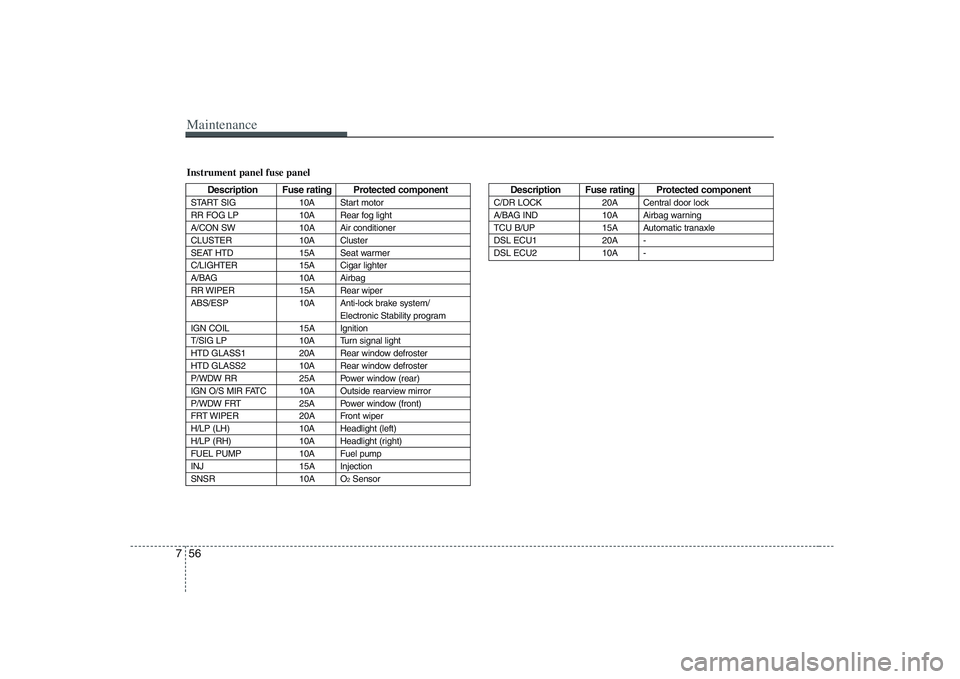
Instrument panel fuse panel
Description Fuse rating Protected component
START SIG 10A Start motor
RR FOG LP 10A Rear fog light
A/CON SW 10A Air conditioner
CLUSTER 10A Cluster
SEAT HTD 15A Seat warmer
C/LIGHTER 15A Cigar lighter
A/BAG 10A Airbag
RR WIPER 15A Rear wiper
ABS/ESP 10A Anti-lock brake system/ Electronic Stability program
IGN COIL 15A Ignition
T/SIG LP 10A Turn signal light
HTD GLASS1 20A Rear window defroster
HTD GLASS2 10A Rear window defroster
P/WDW RR 25A Power window (rear)
IGN O/S MIR FATC 10A Outside rearview mirror
P/WDW FRT 25A Power window (front)
FRT WIPER 20A Front wiper
H/LP (LH) 10A Headlight (left)
H/LP (RH) 10A Headlight (right)
FUEL PUMP 10A Fuel pump
INJ 15A Injection
SNSR 10A O 2SensorDescription Fuse rating Protected component
C/DR LOCK 20A Central door lock
A/BAG IND 10A Airbag warning
TCU B/UP 15A Automatic tranaxle
DSL ECU1 20A -
DSL ECU2 10A -