inflation KIA PICANTO 2012 Owner's Manual
[x] Cancel search | Manufacturer: KIA, Model Year: 2012, Model line: PICANTO, Model: KIA PICANTO 2012Pages: 840, PDF Size: 41.16 MB
Page 375 of 840
743
Maintenance
Remove the valve cap from the tire
valve stem. Press the tire gauge firm-
ly onto the valve to get a pressure
measurement. If the cold tire inflationpressure matches the recommendedpressure on the tire and loading
information label, no further adjust-
ment is necessary. If the pressure is
low, add air until you reach the rec-ommended amount.
If you overfill the tire, release air by pushing on the metal stem in the
center of the tire valve. Recheck the
tire pressure with the tire gauge. Be
sure to put the valve caps back on
the valve stems. They help prevent
leaks by keeping out dirt and mois-
ture.Tire rotation
To equalize tread wear, it is recom- mended that the tires be rotated
every 12,000 km (7,500 miles) or
sooner if irregular wear develops.
During rotation, check the tires for
correct balance.
When rotating tires, check for uneven
wear and damage. Abnormal wear is
usually caused by incorrect tire pres-
sure, improper wheel alignment, out-
of-balance wheels, severe braking or
severe cornering. Look for bumps or
bulges in the tread or side of tire.
Replace the tire if you find either of
these conditions. Replace the tire if
fabric or cord is visible. After rotation,
be sure to bring the front and rear tire
pressures to specification and check
lug nut tightness.
Refer to “Tire and wheels” in section 8.
WARNING
Inspect your tires frequently for proper inflation as well as
wear and damage. Always use
a tire pressure gauge.
Tires with too much or too little pressure wear unevenly caus-
ing poor handling, loss of vehi-
cle control, and sudden tirefailure leading to accidents,
injuries, and even death. Therecommended cold tire pres-
sure for your vehicle can be
found in this manual and onthe tire label located on the dri-
ver's side center pillar.
Worn tires can cause acci- dents. Replace tires that are
worn, show uneven wear, or
are damaged.
Remember to check the pres- sure of your spare tire. KIA
recommends that you check
the spare every time you
check the pressure of the
other tires on your vehicle.
Page 378 of 840
Maintenance
46
7
Compact spare tire replacement
(if equipped)
A compact spare tire has a shorter
tread life than a regular size tire.
Replace it when you can see the
tread wear indicator bars on the tire.The replacement compact spare tire
should be the same size and design
tire as the one provided with your
new vehicle and should be mountedon the same compact spare tire
wheel. The compact spare tire is notdesigned to be mounted on a regular
size wheel, and the compact spare
tire wheel is not designed for mount-
ing a regular size tire. Wheel replacement
When replacing the metal wheels for
any reason, make sure the new
wheels are equivalent to the original
factory units in diameter, rim widthand offset.
Tire traction
Tire traction can be reduced if you
drive on worn tires, tires that are
improperly inflated or on slippery
road surfaces. Tires should be
replaced when tread wear indicators
appear. Slow down whenever there
is rain, snow or ice on the road toreduce the possibility of losing con-
trol of the vehicle. Tire maintenance In addition to proper inflation, correct wheel alignment helps to decrease
tire wear. If you find a tire is worn
unevenly, have your dealer check thewheel alignment.
When you have new tires installed,
make sure they are balanced. This
will increase vehicle ride comfort and
tire life. Additionally, a tire should
always be rebalanced if it is removedfrom the wheel.
WARNING
A wheel that is not the correct
size may adversely affect wheel
and bearing life, braking and
stopping abilities, handling char-
acteristics, ground clearance,
body-to-tire clearance, snow
chain clearance, speedometer
and odometer calibration, head-
light aim and bumper height.
Page 381 of 840
749
Maintenance
4. Tire ply composition and material
The number of layers or plies of rub-
ber-coated fabric in the tire. Tire
manufacturers also must indicate the
materials in the tire, which include
steel, nylon, polyester, and others.
The letter "R" means radial ply con-
struction; the letter "D" means diago-
nal or bias ply construction; and theletter "B" means belted-bias ply con-
struction.
5. Maximum permissible inflationpressure
This number is the greatest amount of air pressure that should be put in
the tire. Do not exceed the maximum
permissible inflation pressure. Refer
to the Tire and Loading Information
label for recommended inflation
pressure.
6. Maximum load rating
This number indicates the maximum
load in kilograms and pounds that
can be carried by the tire. When
replacing the tires on the vehicle,
always use a tire that has the same
load rating as the factory installed
tire.
7. Uniform tire quality grading
Quality grades can be found where
applicable on the tire sidewall
between tread shoulder and maxi-
mum section width.
For example:
TREADWEAR 400
TRACTION A
TEMPERATURE A Tread wear
The tread wear grade is a compara-
tive rating based on the wear rate ofthe tire when tested under controlled
conditions on a specified govern-
ment test course. For example, a tire
graded 150 would wear one-and-a-
half times (1½) as well on the gov-
ernment course as a tire graded 100.
The relative performance of tires depends upon the actual conditions
of their use, however, and may
depart significantly from the norm
due to variations in driving habits,
service practices and differences in
road characteristics and climate.
These grades are molded on the
side-walls of passenger vehicle tires.
The tires available as standard or
optional equipment on your vehicle
may vary with respect to grade.
Page 382 of 840
Maintenance
50
7
Traction - AA, A, B & C
The traction grades, from highest to
lowest, are AA, A, B and C. Those
grades represent the tire’s ability to
stop on wet pavement as measuredunder controlled conditions on spec-
ified government test surfaces of
asphalt and concrete. A tire marked
C may have poor traction perform-
ance. Temperature - A, B & C
The temperature grades are A (the
highest), B, and C, representing the
tire’s resistance to the generation ofheat and its ability to dissipate heatwhen tested under controlled condi-
tions on a specified indoor laboratorytest wheel.
Sustained high temperature can
cause the material of the tire to
degenerate and reduce tire life, and
excessive temperature can lead to
sudden tire failure. Grades B and A
represent higher levels of perform-
ance on the laboratory test wheel
than the minimum required by law.
WARNING
- Tire
temperature
The temperature grade for this
tire is established for a tire that
is properly inflated and not
overloaded. Excessive speed,
underinflation, or excessive
loading, either separately or in
combination, can cause heat
build-up and possible sudden
tire failure. This can cause loss
of vehicle control and serious
injury or death.
WARNING
The traction grade assigned to this tire is based on straight-ahead braking traction tests,
and does not include accelera-
tion, cornering, hydroplaning,
or peak traction characteristics.
Page 413 of 840
83
Specifications & Consumer information
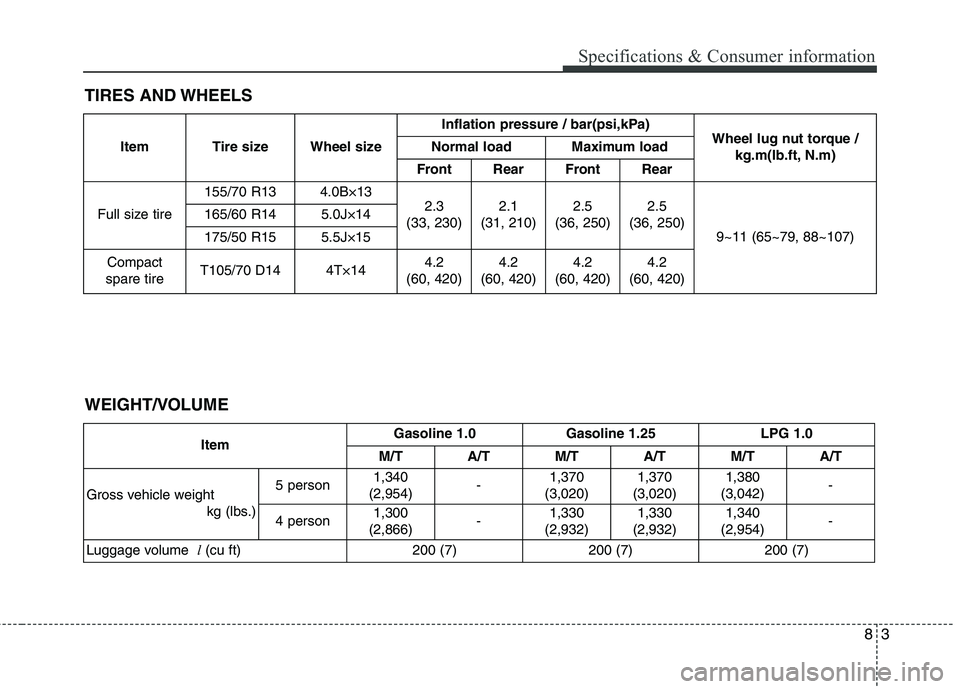
TIRES AND WHEELSItem Tire size Wheel size Inflation pressure / bar(psi,kPa)
Wheel lug nut torque /
kg.m(lb.ft, N.m)
Normal load Maximum load
Front Rear Front Rear
Full size tire
155/70 R13 4.0B×13 2.3
(33, 230) 2.1
(31, 210) 2.5
(36, 250) 2.5
(36, 250) 9~11 (65~79, 88~107)
165/60 R14 5.0J×14
175/50 R15 5.5J×15
Compact
spare tire
T105/70 D14 4T×14 4.2
(60, 420) 4.2
(60, 420) 4.2
(60, 420) 4.2
(60, 420)
Item Gasoline 1.0 Gasoline 1.25 LPG 1.0
M/T A/T M/T A/T M/T A/T
Gross vehicle weight kg (lbs.)
5 person1,340
(2,954) -
1,370
(3,020) 1,370
(3,020) 1,380
(3,042) -
4 person1,300
(2,866) -1,330
(2,932) 1,330
(2,932) 1,340
(2,954) -
Luggage volume l(cu ft)
200 (7) 200 (7) 200 (7)
WEIGHT/VOLUME
Page 420 of 840
I3
Index
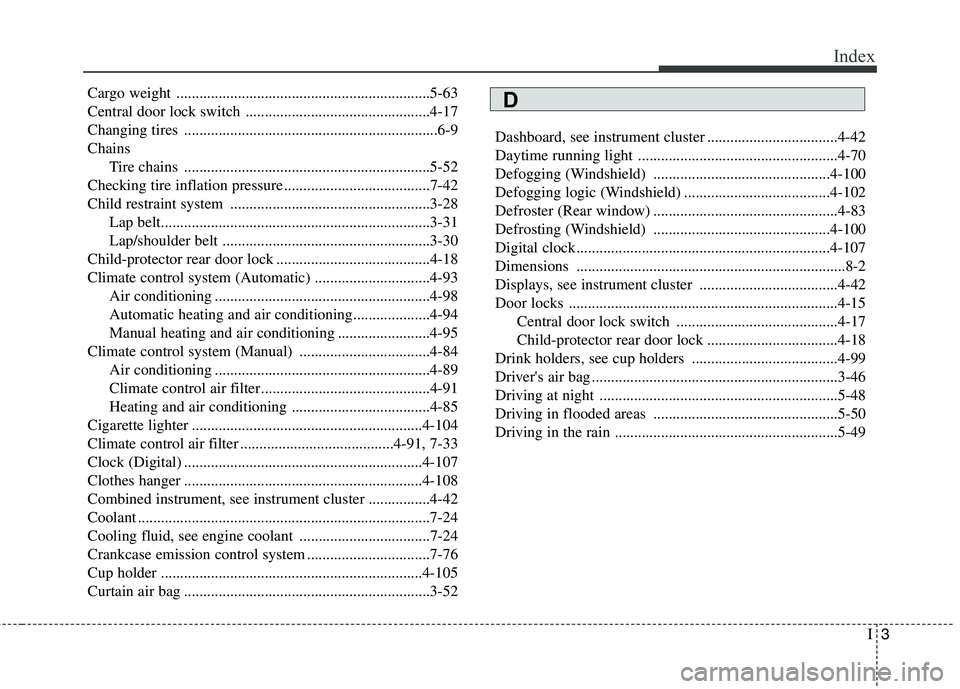
Cargo weight ..................................................................5-63
Central door lock switch ................................................4-17
Changing tires ..................................................................6-9Chains
Tire chains ................................................................5-52
Checking tire inflation pressure ......................................7-42
Child restraint system ....................................................3-28 Lap belt......................................................................3-31
Lap/shoulder belt ......................................................3-30
Child-protector rear door lock ........................................4-18
Climate control system (Automatic) ..............................4-93 Air conditioning ........................................................4-98
Automatic heating and air conditioning....................4-94
Manual heating and air conditioning ........................4-95
Climate control system (Manual) ..................................4-84 Air conditioning ........................................................4-89
Climate control air filter............................................4-91
Heating and air conditioning ....................................4-85
Cigarette lighter ............................................................4-104
Climate control air filter ........................................4-91, 7-33
Clock (Digital) ..............................................................4-107
Clothes hanger ..............................................................4-108
Combined instrument, see instrument cluster ................4-42
Coolant ............................................................................7-24
Cooling fluid, see engine coolant ..................................7-24
Crankcase emission control system ................................7-76
Cup holder ....................................................................4-105
Curtain air bag ................................................................3-52 Dashboard, see instrument cluster ..................................4-42
Daytime running light ....................................................4-70
Defogging (Windshield) ..............................................4-100
Defogging logic (Windshield) ......................................4-102
Defroster (Rear window) ................................................4-83
Defrosting (Windshield) ..............................................4-100
Digital clock..................................................................4-107
Dimensions ......................................................................8-2
Displays, see instrument cluster ....................................4-42
Door locks ......................................................................4-15
Central door lock switch ..........................................4-17
Child-protector rear door lock ..................................4-18
Drink holders, see cup holders ......................................4-99
Driver's air bag ................................................................3-46
Driving at night ..............................................................5-48
Driving in flooded areas ................................................5-50
Driving in the rain ..........................................................5-49D
Page 424 of 840
I7
Index
Parking brake inspect ......................................................7-30
Parking brake ..................................................................5-34
Passenger's front air bag ................................................3-46
Power brakes ..................................................................5-33
Power outlet ..................................................................4-106
Power steering (Electronic) ............................................4-35
Power window lock button ............................................4-24
Pre-tensioner seat belt ....................................................3-22
Push starting......................................................................6-6
Rear seat............................................................................3-9
Rear parking assist system ..............................................4-66Recommended cold tire inflation pressures....................7-41
Recommended lubricants and capacities ..........................8-4
Recommended SAE viscosity number........................8-5
Remote keyless entry ......................................................4-10
Road warning ....................................................................6-2
Rocking the vehicle ........................................................5-47 Scheduled maintenance service ........................................7-6
Maintenance under severe usage conditions ............7-17Normal maintenance schedule ....................................7-7
Seat belts ........................................................................3-15 Pre-tensioner seat belt ..............................................3-22
Lap belt......................................................................3-20
Lap/shoulder belt ......................................................3-18
Seat belt warning ......................................................3-16
Seatback pocket ................................................................3-8
Seats ..................................................................................3-2 Headrest ..............................................................3-5, 3-9
Folding the rear seat ..................................................3-10
Front seat adjustment - manual ..................................3-4
Rear seat ......................................................................3-9
Seatback pocket ..........................................................3-8
Shift lock system ............................................................5-30
Side air bag ....................................................................3-51
Smart key ..........................................................................4-9
Smooth cornering............................................................5-48
Snow tires........................................................................5-51Spare tire Removing and storing the spare tire ..........................6-9
P
R
S
Page 425 of 840
Index
8
I
Special driving conditions ..............................................5-47
Driving at night ........................................................5-48
Driving in flooded areas............................................5-50
Driving in the rain ....................................................5-49
Hazardous driving conditions ..................................5-47
Highway driving ........................................................5-50
Rocking the vehicle ..................................................5-47
Smooth cornering ......................................................5-48
Speedometer....................................................................4-44
Starting difficulties, see engine will not start ..................6-4
Starting the engine ............................................................5-9
Steering wheel ................................................................4-35 Electronic power steering..........................................4-35
Heated steering wheel ..............................................4-36
Horn ..........................................................................4-37
Tilt steering ..............................................................4-35
Steering wheel audio control ........................................4-111
Storage compartment ....................................................4-103 Glove box ................................................................4-103
Sunglass holder ......................................................4-103
Sunglass holder ............................................................4-103
Sunroof............................................................................4-31
Sunvisor ........................................................................4-106 Tachometer ......................................................................4-44
Tailgate ............................................................................4-19
Tilt steering ....................................................................4-35
Tire specification and pressure label ................................8-7
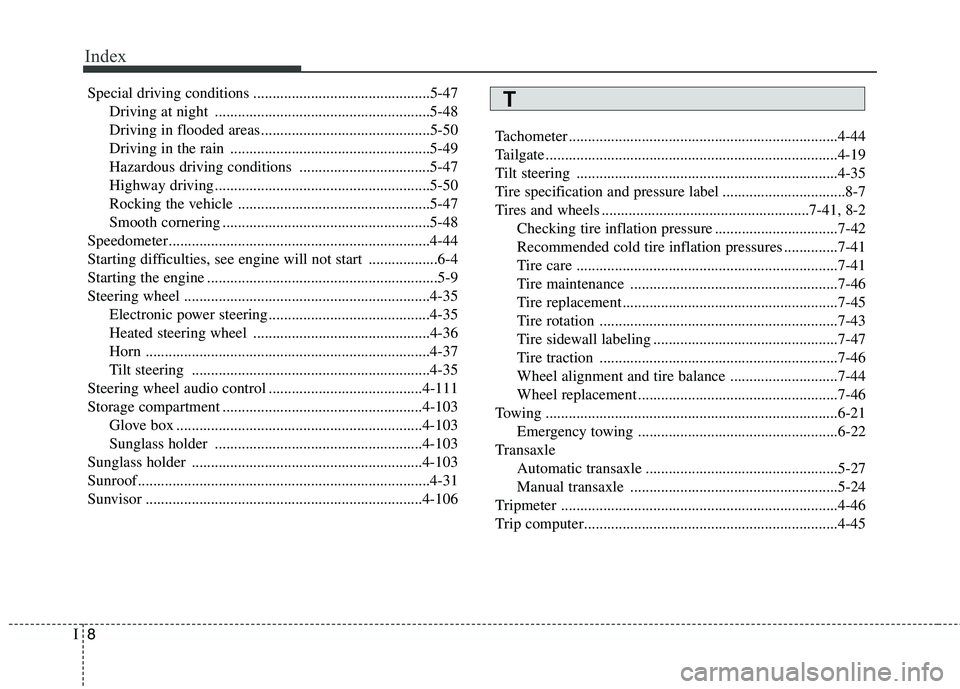
Tires and wheels ......................................................7-41, 8-2
Checking tire inflation pressure ................................7-42
Recommended cold tire inflation pressures ..............7-41
Tire care ....................................................................7-41
Tire maintenance ......................................................7-46
Tire replacement ........................................................7-45
Tire rotation ..............................................................7-43
Tire sidewall labeling ................................................7-47
Tire traction ..............................................................7-46
Wheel alignment and tire balance ............................7-44
Wheel replacement ....................................................7-46
Towing ............................................................................6-21 Emergency towing ....................................................6-22
Transaxle Automatic transaxle ..................................................5-27
Manual transaxle ......................................................5-24
Tripmeter ........................................................................4-46
Trip computer..................................................................4-45T
Page 478 of 840
Safety features of your vehicle
40
3
How does the air bag system operate
Air bags are activated (able to inflate if
necessary) only when the ignition
switch is turned to the ON or STARTposition.
Air bags inflate instantly in the event of a serious frontal or side collision (if
equipped with side air bag or curtainair bag) in order to help protect the
occupants from serious physical injury.
There is no single speed at which the air bags will inflate.
Generally, air bags are designed to
inflate based upon the severity of a col-
lision and its direction. These two fac-
tors determine whether the sensors
produce an electronic deployment/inflation signal.
Air bag deployment depends on a number of factors including vehiclespeed, angles of impact and the densi-
ty and stiffness of the vehicles or
objects which your vehicle hits in the
collision. The determining factors are
not limited to those mentioned above.
The front air bags will completely inflate and deflate in an instant.
It is virtually impossible for you to see
the air bags inflate during an accident. It is much more likely that you will sim-ply see the deflated air bags hanging
out of their storage compartments afterthe collision.
In order to help provide protection in a severe collision, the air bags must
inflate rapidly. The speed of air baginflation is a consequence of the
extremely short time in which a collisionoccurs and the need to inflate the air
bag between the occupant and the
vehicle structures before the occupant
impacts those structures. This speed of
inflation reduces the risk of serious or
life-threatening injuries in a severe col-
lision and is thus a necessary part of airbag design.
However, air bag inflation can also
cause injuries which can include facial
abrasions, bruises and broken bonesbecause the inflation speed also caus-
es the air bags to expand with a great
deal of force.
There are even circumstances under which contact with the steer-
ing wheel air bag can cause fatal
injuries, especially if the occupant
is positioned excessively close tothe steering wheel.
WARNING
To avoid severe personal injury or death caused by deploying air
bags in a collision, the driver
should sit as far back from the
steering wheel air bag as possi-
ble (at least 250 mm (10 inches)
away). The front passengers
should always move their seats
as far back as possible and sit
back in their seat.
Air bags inflate instantly in the event of collision, and passen-
gers may be injured by the air bag
expansion force if they are not in
a proper position.
Air bag inflation may cause injuries including facial or bodily
abrasions, injuries from broken
glasses or burns.
Page 479 of 840
341
Safety features of your vehicle
Noise and smoke
When the air bags inflate, they make a
loud noise and they leave smoke and
powder in the air inside of the vehicle.
This is normal and is a result of the igni-
tion of the air bag inflator. After the air
bag inflates, you may feel substantial dis-
comfort in breathing due to the contact of
your chest with both the seat belt and the
air bag, as well as from breathing the
smoke and powder.Open your doors
and/or windows as soon as possible
after impact in order to reduce dis-
comfort and prevent prolonged expo-
sure to the smoke and powder.
Though the smoke and powder are non-
toxic, they may cause irritation to the skin
(eyes, nose and throat, etc). If this is the
case, wash and rinse with cold waterimmediately and consult a doctor if the
symptom persists.
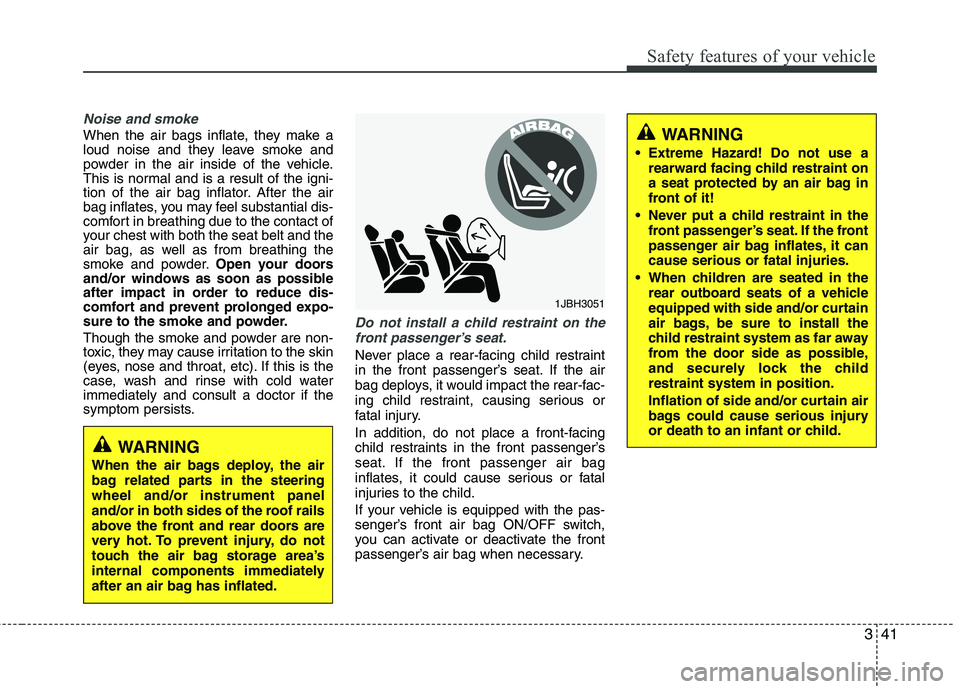
Do not install a child restraint on the
front passenger’s seat.
Never place a rear-facing child restraint
in the front passenger’s seat. If the air
bag deploys, it would impact the rear-fac-
ing child restraint, causing serious or
fatal injury.
In addition, do not place a front-facing
child restraints in the front passenger’s
seat. If the front passenger air bag
inflates, it could cause serious or fatal
injuries to the child.
If your vehicle is equipped with the pas-
senger’s front air bag ON/OFF switch,
you can activate or deactivate the front
passenger’s air bag when necessary.
1JBH3051
WARNING
When the air bags deploy, the air
bag related parts in the steeringwheel and/or instrument panel
and/or in both sides of the roof rails
above the front and rear doors are
very hot. To prevent injury, do not
touch the air bag storage area’s
internal components immediately
after an air bag has inflated.
WARNING
Extreme Hazard! Do not use a rearward facing child restraint on
a seat protected by an air bag in
front of it!
Never put a child restraint in the front passenger’s seat. If the front
passenger air bag inflates, it cancause serious or fatal injuries.
When children are seated in the rear outboard seats of a vehicle
equipped with side and/or curtain
air bags, be sure to install the
child restraint system as far away
from the door side as possible,
and securely lock the childrestraint system in position.
Inflation of side and/or curtain air
bags could cause serious injury
or death to an infant or child.