Size 12 KIA PICANTO 2016 Owner's Manual
[x] Cancel search | Manufacturer: KIA, Model Year: 2016, Model line: PICANTO, Model: KIA PICANTO 2016Pages: 488, PDF Size: 31.22 MB
Page 429 of 488
751
Maintenance
3. Checking tire life (TIN : TireIdentification Number)
Any tires that are over 6 years old,
based on the manufacturing date,(including the spare tire) should be
replaced by new ones. You can find
the manufacturing date on the tire
sidewall (possibly on the inside of the
wheel), displaying the DOT Code.
The DOT Code is a series of num-
bers on a tire consisting of numbers
and English letters. The manufactur-
ing date is designated by the last four
digits (characters) of the DOT code. DOT : XXXX XXXX OOOO
The front part of the DOT means a
plant code number, tire size and
tread pattern and the last four num-
bers indicate week and year manu-
factured.
For example:
DOT XXXX XXXX 1615 represents
that the tire was produced in the 16th
week of 2015.
4. Tire ply composition and material
The number of layers or plies of rub-
ber-coated fabric in the tire. Tire
manufacturers also must indicate the
materials in the tire, which include
steel, nylon, polyester, and others.
The letter "R" means radial ply con-
struction; the letter "D" means diago-
nal or bias ply construction; and theletter "B" means belted-bias ply con-
struction.
5. Maximum permissible inflation
pressure
This number is the greatest amount of air pressure that should be put in the
tire. Do not exceed the maximum per-
missible inflation pressure. Refer to
the Tire and Loading Information label
for recommended inflation pressure.
6. Maximum load rating
This number indicates the maximum
load in kilograms and pounds that can
be carried by the tire. When replacing
the tires on the vehicle, always use a
tire that has the same load rating as
the factory installed tire.
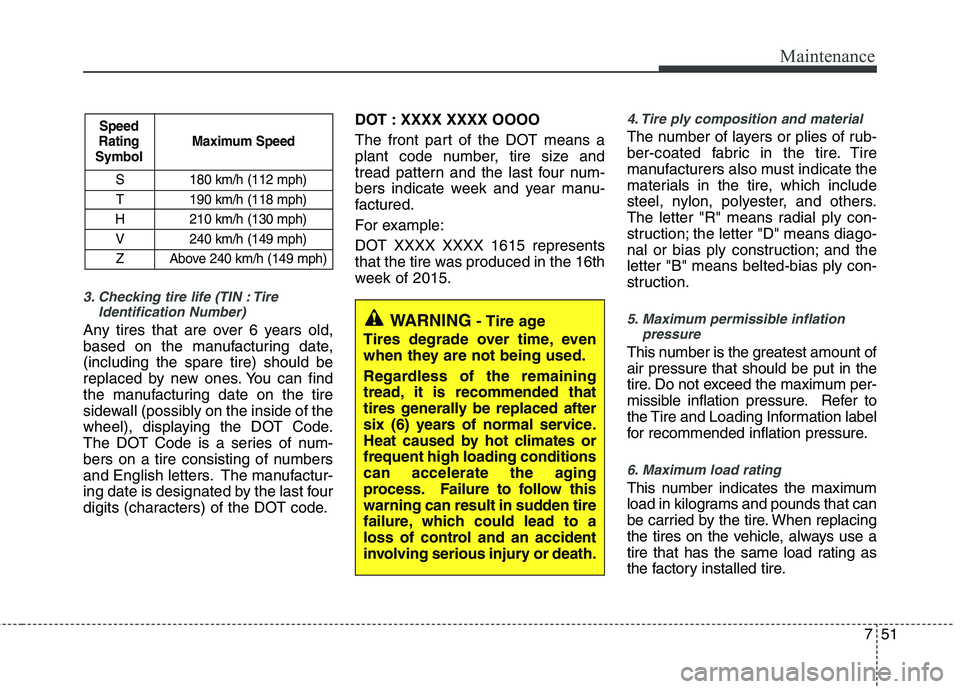
S 180 km/h (112 mph)
T 190 km/h (118 mph)
H 210 km/h (130 mph)
V 240 km/h (149 mph) Z Above 240 km/h (149 mph)
Maximum Speed
Speed
Rating
Symbol
WARNING - Tire age
Tires degrade over time, even
when they are not being used.
Regardless of the remaining
tread, it is recommended that
tires generally be replaced after
six (6) years of normal service.
Heat caused by hot climates orfrequent high loading conditions
can accelerate the aging
process. Failure to follow this
warning can result in sudden tire
failure, which could lead to a
loss of control and an accident
involving serious injury or death.
Page 465 of 488
83
Specifications & Consumer information
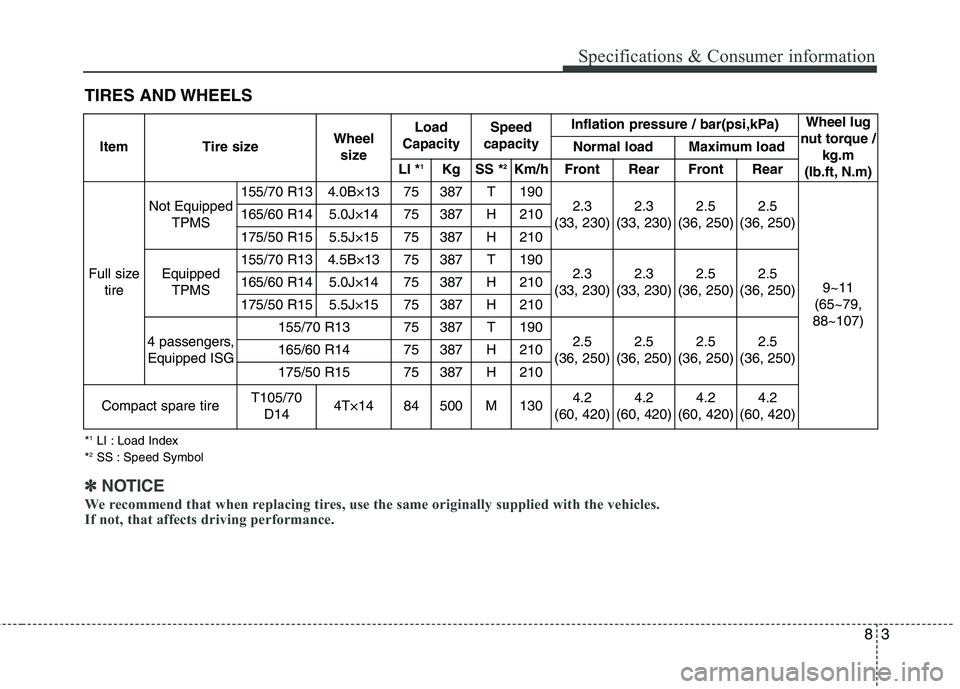
TIRES AND WHEELSItem Tire size Wheel
size Load
Capacity Speed
capacity Inflation pressure / bar(psi,kPa)
Wheel lug
nut torque / kg.m
(lb.ft, N.m)
Normal load Maximum load
LI * 1
Kg SS * 2
Km/h Front Rear Front Rear
Full size tire
Not Equipped TPMS155/70 R13 4.0B×13 75 387 T 190 2.3
(33, 230) 2.3
(33, 230) 2.5
(36, 250) 2.5
(36, 250)
9~11
(65~79,
88~107)
165/60 R14 5.0J×14 75 387 H 210
175/50 R15 5.5J×15 75 387 H 210
Equipped TPMS155/70 R13 4.5B×13 75 387 T 190 2.3
(33, 230) 2.3
(33, 230) 2.5
(36, 250) 2.5
(36, 250)
165/60 R14 5.0J×14 75 387 H 210
175/50 R15 5.5J×15 75 387 H 210
4 passengers, Equipped ISG155/70 R13 75 387 T 190 2.5
(36, 250) 2.5
(36, 250) 2.5
(36, 250) 2.5
(36, 250)
165/60 R14 75 387 H 210
175/50 R15 75 387 H 210
Compact spare tire
T105/70 D14 4T×14 84 500 M 130 4.2
(60, 420) 4.2
(60, 420) 4.2
(60, 420) 4.2
(60, 420)
✽✽ NOTICE
We recommend that when replacing tires, use the same originally supplied with the ve hicles.
If not, that affects driving performance.
* 1
LI : Load Index
* 2
SS : Speed Symbol