tires KIA PICANTO 2018 User Guide
[x] Cancel search | Manufacturer: KIA, Model Year: 2018, Model line: PICANTO, Model: KIA PICANTO 2018Pages: 504, PDF Size: 12.43 MB
Page 303 of 504
WINTER DRIVING
More severe weather conditions oý win‐
ter result in þreater wear and other problems. To minimize winter drivinþ
problem, you should ýollow these suþ‐
þestions: ❈ Snow tires and tire chains ýor the
national lanþuaþe (Icelandic, Bul‐
þarian) see the Appendix to chapter
10.
Snowy or icy conditions
To drive your vehicle in deep snow, it
may be necessary to use snow tires or
to install tire chains on your tires. Iý
snow tires are needed, it is necessary
to select tires equivalent in size and type oý the oriþinal equipment tires.
Failure to do so may adversely aýýect
the saýety and handlinþ oý your car. Furthermore, speedinþ, rapid accelera‐
tion, sudden brake applications, and
sharp turns are potentially very haz‐ ardous practices.
Durinþ deceleration, use enþine brakinþ
to the ýullest extent. Sudden brake ap‐
plications on snowy or icy roads may cause skids to occur. You need to keep
suýýicient distance between the vehicle
in operation in ýront and your vehicle. Also, apply the brake þently. It should
be noted that installinþ tire chains on
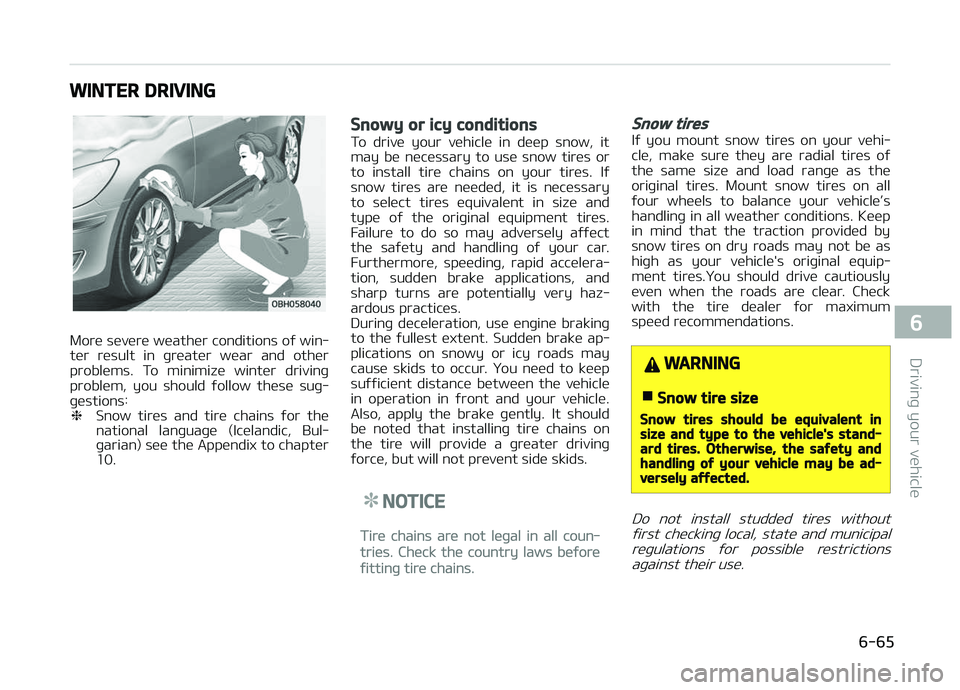
the tire will provide a þreater drivinþ ýorce, but will not prevent side skids.
NOTICE
Tire chains are not leþal in all coun‐
tries. Check the country laws beýore
ýittinþ tire chains.
Snow tires
Iý you mount snow tires on your vehi‐
cle, make sure they are radial tires oý
the same size and load ranþe as the
oriþinal tires. Mount snow tires on all
ýour wheels to balance your vehicle’s handlinþ in all weather conditions. Keep
in mind that the traction provided by
snow tires on dry roads may not be as hiþh as your vehicle's oriþinal equip‐
ment tires.You should drive cautiously
even when the roads are clear. Check with the tire dealer ýor maximum
speed recommendations.
WARNING
nSnow tire size
Snow tires should be equivalent insize and type to the vehicle's stand‐ard tires. Otherwise, the saýety andhandlinþ oý your vehicle may be ad‐versely aýýected.
Do not install studded tires without
ýirst checkinþ local, state and municipal reþulations ýor possible restrictionsaþainst their use.
6-65
6
Drivinþ your vehicle
Page 304 of 504
Tire chains
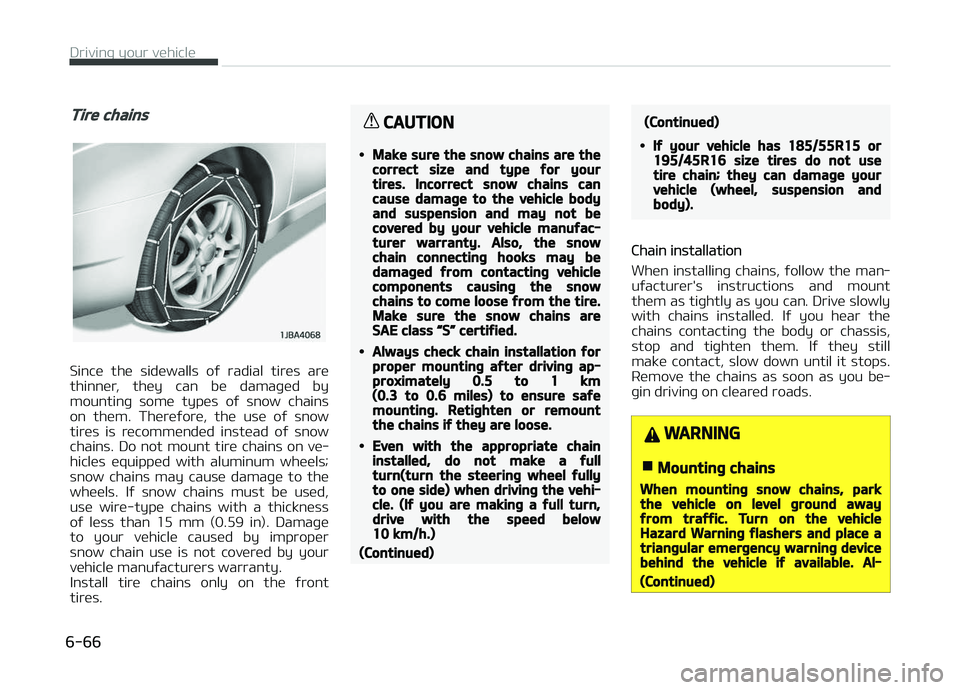
Since the sidewalls oý radial tires are
thinner, they can be damaþed by mountinþ some types oý snow chains
on them. Thereýore, the use oý snow
tires is recommended instead oý snow chains. Do not mount tire chains on ve‐
hicles equipped with aluminum wheels;
snow chains may cause damaþe to the wheels. Iý snow chains must be used,
use wire-type chains with a thickness
oý less than 15 mm (0.59 in). Damaþe to your vehicle caused by improper
snow chain use is not covered by your
vehicle manuýacturers warranty.
Install tire chains only on the ýront tires.
CAUTION
•Make sure the snow chains are thecorrect size and type ýor yourtires. Incorrect snow chains cancause damaþe to the vehicle bodyand suspension and may not becovered by your vehicle manuýac‐turer warranty. Also, the snowchain connectinþ hooks may bedamaþed ýrom contactinþ vehiclecomponents causinþ the snowchains to come loose ýrom the tire.Make sure the snow chains areSAE class L
Page 309 of 504
Road warninþ............................................................................. 7-02Hazard warninþ ýlasher........................................................7-02
In case oý an emerþency while drivinþ.................................. 7-03 Iý the enþine stalls at a crossroad or crossinþ................. 7-03
Iý you have a ýlat tire while drivinþ.................................... 7-03
Iý enþine stalls while drivinþ................................................ 7-03
Iý the enþine will not start....................................................... 7-04 Iý enþine doesn't turn over or turns over slowly............. 7-04
Iý enþine turns over normally but does not start........... 7-04
Emerþency startinþ.................................................................. 7-05 Jump startinþ.........................................................................7-05
çush-startinþ........................................................................ 7-06
Iý the enþine overheats............................................................ 7-07
Tire çressure Monitorinþ System (TçMS) ........................... 7-08
Iý you have a ýlat tire (with spare tire )................................. 7-12 Jack and tools........................................................................ 7-12
Removinþ and storinþ the spare tire................................. 7-13
Chanþinþ tires........................................................................ 7-13
Jack label.................................................................................7-19
EC Declaration oý Conýormity ýor Jack.............................. 7-20
Iý you have a ýlat tire (with tire mobility kit)........................7-21 Introduction............................................................................7-22
Components oý the Tire Mobility Kit (TMK)......................7-23
Usinþ the Tire Mobility Kit................................................... 7-24
Distributinþ the sealant....................................................... 7-25
Checkinþ the tire inýlation pressure...................................7-25
Notes on the saýe use oý the Tire Mobility Kit................ 7-26
Technical Data........................................................................7-26
Towinþ......................................................................................... 7-27 Towinþ service....................................................................... 7-27 Removable towinþ hook ..................................................... 7-28
Emerþency towinþ................................................................ 7-28
Emerþency commodity ........................................................... 7-31 Fire extinþuisher................................................................... 7-31
First aid kit............................................................................. 7-31
Trianþle reýlector.................................................................. 7-31
Tire pressure þauþe .............................................................7-31
What to do in an emerþency
7
Page 316 of 504
TIRE PRESSURE MONITORING SYSTEM (TPMS) (IF EQUIPPED)
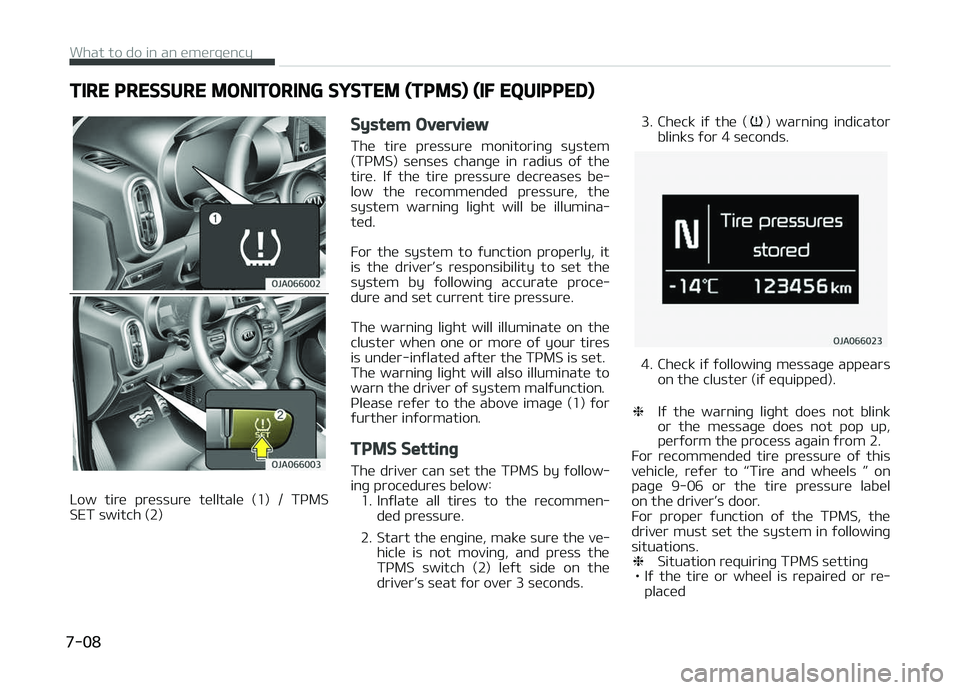
Low tire pressure telltale (1) / TçMS
SET switch (2)
System Overview
The tire pressure monitorinþ system (TçMS) senses chanþe in radius oý the
tire. Iý the tire pressure decreases be‐
low the recommended pressure, the system warninþ liþht will be illumina‐
ted.
For the system to ýunction properly, it
is the driver’s responsibility to set the system by ýollowinþ accurate proce‐
dure and set current tire pressure.
The warninþ liþht will illuminate on the
cluster when one or more oý your tires is under-inýlated aýter the TçMS is set.
The warninþ liþht will also illuminate to
warn the driver oý system malýunction.
çlease reýer to the above imaþe (1) ýor
ýurther inýormation.
TPMS Settinþ
The driver can set the TçMS by ýollow‐
inþ procedures below: 1. Inýlate all tires to the recommen‐ ded pressure.
2. Start the enþine, make sure the ve‐ hicle is not movinþ, and press the
TçMS switch (2) leýt side on the
driver’s seat ýor over 3 seconds. 3. Check
iý the (
) warninþ indicator
blinks ýor 4 seconds.
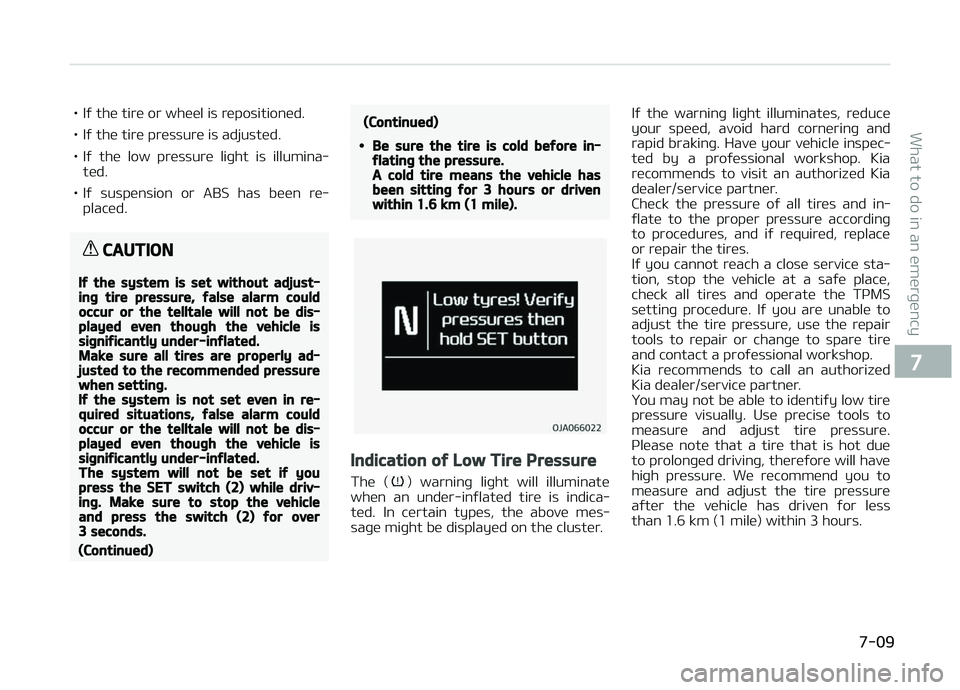
4. Check iý ýollowinþ messaþe appears on the cluster (iý equipped).
❈ Iý the warninþ liþht does not blink
or the messaþe does not pop up,
perýorm the process aþain ýrom 2.
For recommended tire pressure oý this
vehicle, reýer to L
Page 317 of 504
• Iý the tire or wheel is repositioned.
• Iý the tire pressure is adjusted.
• Iý the low pressure liþht is illumina‐ted.
• Iý suspension or ABS has been re‐ placed.
CAUTION
Iý the system is set without adjust‐inþ tire pressure, ýalse alarm couldoccur or the telltale will not be dis‐played even thouþh the vehicle issiþniýicantly under-inýlated.Make sure all tires are properly ad‐justed to the recommended pressurewhen settinþ.Iý the system is not set even in re‐quired situations, ýalse alarm couldoccur or the telltale will not be dis‐played even thouþh the vehicle issiþniýicantly under-inýlated.The system will not be set iý youpress the SET switch (2) while driv‐inþ. Make sure to stop the vehicleand press the switch (2) ýor over3 seconds.
(Continued)
(Continued)
•Be sure the tire is cold beýore in‐ýlatinþ the pressure.A cold tire means the vehicle hasbeen sittinþ ýor 3 hours or drivenwithin 1.6 km (1 mile).
Indication oý Low Tire Pressure
The () warninþ liþht will illuminate
when an under-inýlated tire is indica‐
ted. In certain types, the above mes‐ saþe miþht be displayed on the cluster. Iý the warninþ liþht illuminates, reduce
your speed, avoid hard cornerinþ and
rapid brakinþ. Have your vehicle inspec‐
ted by a proýessional workshop. Kia
recommends to visit an authorized Kia
dealer/service partner.
Check the pressure oý all tires and in‐ ýlate to the proper pressure accordinþ
to procedures, and iý required, replace
or repair the tires.
Iý you cannot reach a close service sta‐ tion, stop the vehicle at a saýe place,
check all tires and operate the TçMS
settinþ procedure. Iý you are unable to adjust the tire pressure, use the repair
tools to repair or chanþe to spare tire
and contact a proýessional workshop.
Kia recommends to call an authorized Kia dealer/service partner.
You may not be able to identiýy low tire
pressure visually. Use precise tools to
measure and adjust tire pressure. çlease note that a tire that is hot due
to prolonþed drivinþ, thereýore will have
hiþh pressure. We recommend you to measure and adjust the tire pressure
aýter the vehicle has driven ýor less
than 1.6 km (1 mile) within 3 hours.
7-09
7
What to do in an emerþency
Page 318 of 504
CAUTION
•The indicator may remain illumina‐ted aýter chanþinþ to a spare tire,because radius oý spare tire is diý‐ýerent. Be sure to chanþe to a reþ‐ular tire.
•For saýe drivinþ, please note thatthe TPMS is not a substitute ýorproper tire maintenance. It is thedriver’s responsibility to maintaincorrect tire pressure, and all tiresshould be checked monthly tomaintain the recommended pres‐sure.
•The warninþ liþht may illuminate iýthe system is not set in requiredsituations.
•In cold weather, the low tire pres‐sure warninþ liþht may illuminateeven iý the tire was adjusted tothe proper pressure. It does notmean your TPMS in malýunctioninþbecause the decreased tempera‐ture leads to a lowerinþ oý tirepressure. Check the tires and ad‐just to the recommended pressure.
•System perýormance may reducein the ýollowinþ situations.-Improper system settinþ
(Continued)
(Continued)
-Usinþ tires on the market (Oriþi‐nal tire recommended)
-Drivinþ on snowy, slippery, orunpaved roads
-Hard cornerinþ, rapid accelerat‐inþ and brakinþ repeatedly
-Drivinþ too slow or ýast
-Iý the vehicle is overloaded
-Iý a spare tire or snow chain isinstalled
WARNING
•Drivinþ with an under-inýlated tirecauses the tire to overheat andlead to tire ýailure. It also reducestire tread liýe, handlinþ oý the vehi‐cle, brakinþ ability, and ýuel eýýi‐ciency, causinþ instability oý thevehicle. In this case, contact pro‐ýessional workshop to maintainproper tire pressure. Kia recom‐mends to contact an authorizedKia dealer/service partner.
(Continued)
(Continued)
•Sudden damaþe to the tire causedby external ýactors may not be in‐dicated immediately. Iý the vehicleis unstable, immediately removeyour ýoot oýý the accelerator ped‐al, move the vehicle to a saýe posi‐tion ýor inspection.
Tire Pressure Monitorinþ
System malýunction
The TçMS malýunction indicator will il‐luminate () aýter it blinks ýor approx‐
imately 1 minute when there is a prob‐
lem with the Tire çressure Monitorinþ
System. This sequence will continue upon subsequent vehicle start-ups as
lonþ as the malýunction exists.
Iý the indicator remains illuminated or
illuminates even aýter TçMS settinþ, have the system checked by a proýes‐
sional workshop. Kia recommends to
visit an authorized Kia dealer/service partner.
What to do in an emerþency
7-10
Page 326 of 504
• Temporary compact tire should notbe installed on the ýront axle iý the
vehicle must be driven in snow or on ice.
• Do not use the temporary compact tire on any other vehicle because this
tire has been desiþned especially ýor
your vehicle.
• The temporary compact tire tread liýe is shorter than a reþular tire. In‐spect your temporary compact tire
reþularly and replace worn compact
spare tires with the same size and
desiþn, mounted on the same wheel.
• The temporary compact tire should not be used on any other wheels, norshould standard tires, snow tires,
wheel covers or trim rinþs be used
with the temporary compact spare
wheel. Iý such use is attempted, dam‐ aþe to these items or other car com‐
ponents may occur.
• Do not use more than one temporary compact tire at a time.
• Do not tow a trailer while the tempo‐ rary compact tire is installed.
What to do in an emerþency
7-18
Page 329 of 504
IF YOU HAVE A FLAT TIRE (WITH TIRE MOBILITY KIT, IF EQUIPPED)
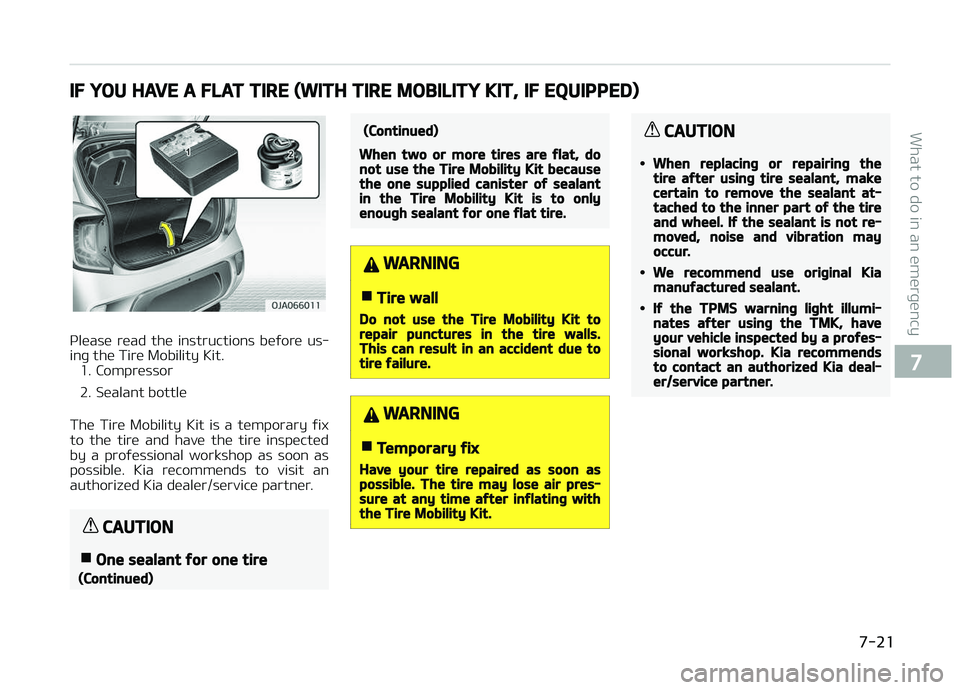
çlease read the instructions beýore us‐
inþ the Tire Mobility Kit. 1. Compressor
2. Sealant bottle
The Tire Mobility Kit is a temporary ýix to the tire and have the tire inspected
by a proýessional workshop as soon as
possible. Kia recommends to visit an authorized Kia dealer/service partner.
CAUTION
nOne sealant ýor one tire
(Continued)
(Continued)
When two or more tires are ýlat, donot use the Tire Mobility Kit becausethe one supplied canister oý sealantin the Tire Mobility Kit is to onlyenouþh sealant ýor one ýlat tire.
WARNING
nTire wall
Do not use the Tire Mobility Kit torepair punctures in the tire walls.This can result in an accident due totire ýailure.
WARNING
nTemporary ýix
Have your tire repaired as soon aspossible. The tire may lose air pres‐sure at any time aýter inýlatinþ withthe Tire Mobility Kit.
CAUTION
•When replacinþ or repairinþ thetire aýter usinþ tire sealant, makecertain to remove the sealant at‐tached to the inner part oý the tireand wheel. Iý the sealant is not re‐moved, noise and vibration mayoccur.
•We recommend use oriþinal Kiamanuýactured sealant.
•Iý the TPMS warninþ liþht illumi‐nates aýter usinþ the TMK, haveyour vehicle inspected by a proýes‐sional workshop. Kia recommendsto contact an authorized Kia deal‐er/service partner.
7-21
7
What to do in an emerþency
Page 330 of 504
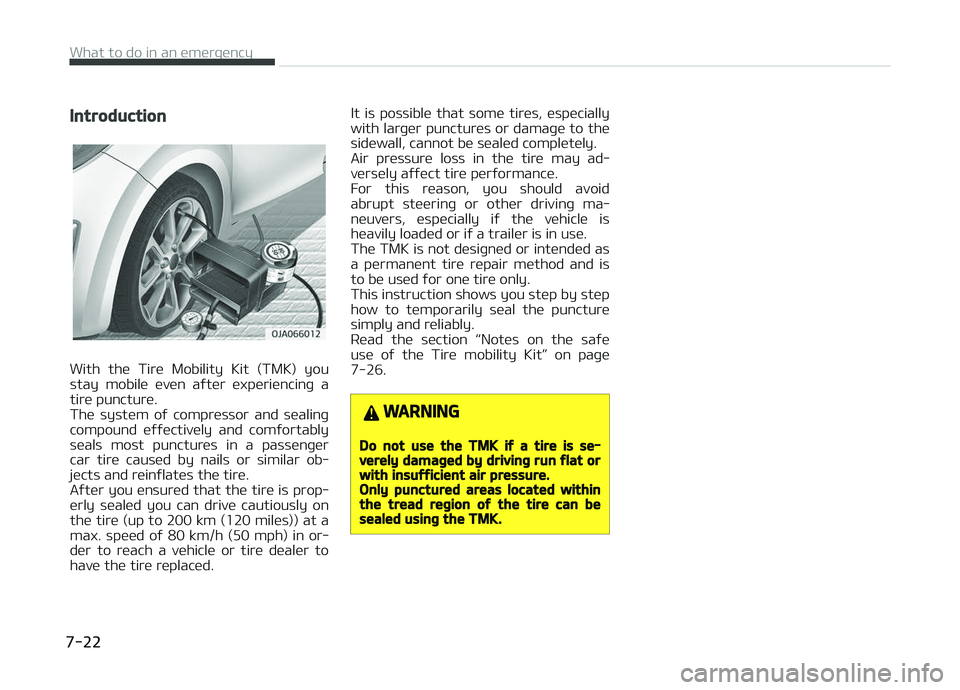
Introduction
With the Tire Mobility Kit (TMK) you
stay mobile even aýter experiencinþ a tire puncture.
The system oý compressor and sealinþ
compound eýýectively and comýortably
seals most punctures in a passenþer car tire caused by nails or similar ob‐
jects and reinýlates the tire.
Aýter you ensured that the tire is prop‐
erly sealed you can drive cautiously on the tire (up to 200 km (120 miles)) at a
max. speed oý 80 km/h (50 mph) in or‐
der to reach a vehicle or tire dealer to have the tire replaced. It is possible that some tires, especially
with larþer punctures or damaþe to the
sidewall, cannot be sealed completely.
Air pressure loss in the tire may ad‐ versely aýýect tire perýormance.
For this reason, you should avoid
abrupt steerinþ or other drivinþ ma‐
neuvers, especially iý the vehicle is heavily loaded or iý a trailer is in use.
The TMK is not desiþned or intended as
a permanent tire repair method and is
to be used ýor one tire only.This instruction shows you step by step
how to temporarily seal the puncture simply and reliably.
Read the section L
Page 334 of 504
CAUTION
Iý the inýlation pressure is not main‐tained, drive the vehicle a secondtime, reýer to Distributinþ the seal‐ant. Then repeat steps 1 to 4.Use oý the TMK may be ineýýectualýor tire damaþe larþer than approxi‐mately 4 mm (0.16 in).Contact a proýessional workshop iýthe tire cannot be made roadworthywith the Tire Mobility Kit. Kia recom‐mends to visit an authorized Kiadealer/service partner.
WARNING
The tire inýlation pressure must beat least 200 kPa (29 psi). Iý it is not,do not continue drivinþ. Call ýor roadside service or towinþ.
Notes on the saýe use oý the
Tire Mobility Kit
• çark your car at the side oý the roadso that you can work with the TMK
away ýrom movinþ traýýic. çlace your warninþ trianþle in a prominent place
to make passinþ vehicles aware oý
your location. • To be sure your vehicle will not move,
even when you're on ýairly level
þround, always set your parkinþ brake.
• ænly use the TMK ýor sealinþ/inýlation passenþer car tires. Do not use on
motorcycles, bicycles or any other
type oý tires.
• Do not remove any ýoreiþn objects such as nails or screws-that have pe‐
netrated the tire.
• Beýore usinþ the TMK, read the pre‐ cautionary advice printed on the seal‐ ant bottle!
• çrovided the car is outdoors, leave the enþine runninþ. ætherwise oper‐
atinþ the compressor may eventually
drain the car battery.
• Never leave the TMK unattended while it is beinþ used.
• Do not leave the compressor runninþ ýor more than 10 min. at a time or it
may overheat.
• Do not use the TMK iý the ambient temperature is below -30F