brakes KIA PICANTO 2018 Owner's Manual
[x] Cancel search | Manufacturer: KIA, Model Year: 2018, Model line: PICANTO, Model: KIA PICANTO 2018Pages: 504, PDF Size: 12.43 MB
Page 299 of 504
SPECIAL DRIVING CONDITIONS
Hazardous drivinþ conditions
When hazardous drivinþ conditions are
encountered such as water, snow, ice,
mud, sand, or similar hazards, ýollow
these suþþestions: • Drive cautiously and allow extra dis‐ tance ýor brakinþ.
• Avoid sudden brakinþ or steerinþ.
• When brakinþ with non-ABS brakes pump the brake pedal with a liþht up-
and-down motion until the vehicle is stopped.
WARNING
nABS
Do not pump the brake pedal on avehicle equipped with ABS.
• Iý stalled in snow, mud, or sand, use second þear. Accelerate slowly to
avoid spinninþ the drive wheels.
• Use sand, rock salt, tire chains, or other non-slip material under the
drive wheels to provide traction when
stalled in ice, snow, or mud.
WARNING
nDownshiýtinþ
Downshiýtinþ with an automatictransaxle, while drivinþ on slipperysurýaces can cause an accident. Thesudden chanþe in tire speed couldcause the tires to skid. Be careýulwhen downshiýtinþ on slippery sur‐ýaces.
Rockinþ the vehicle
Iý it is necessary to rock the vehicle to
ýree it ýrom snow, sand, or mud, ýirst turn the steerinþ wheel riþht and leýt
to clear the area around your ýront
wheels. Then, shiýt back and ýorth be‐ tween 1st (First) and R (Reverse) in ve‐
hicles equipped with a manual transaxle
or R (Reverse) and any ýorward þear in
vehicles equipped with an automatic transaxle. Do not race the enþine, and
spin the wheels as little as possible. Iý
you are still stuck aýter a ýew tries, have the vehicle pulled out by a tow ve‐
hicle to avoid enþine overheatinþ and
possible damaþe to the transaxle.
CAUTION
Prolonþed rockinþ may cause enþineover-heatinþ, transaxle damaþe orýailure, and tire damaþe.
WARNING
nSpinninþ tires
Do not spin the wheels, especially atspeeds more than 56 km/h(35 mph). Spinninþ the wheels athiþh speeds when the vehicle is sta‐tionary could cause a tire to over‐heat which could result in tire dam‐aþe that may injure bystanders.
NOTICE
The ESC system (iý equipped) should
be turned æFF prior to rockinþ the
vehicle.
6-61
6
Drivinþ your vehicle
Page 301 of 504
• Keep your headliþhts clean and prop‐erly aimed on vehicles not equipped
with the automatic headliþht aiminþ ýeature. Dirty or improperly aimed
headliþhts will make it much more
diýýicult to see at niþht.
• Avoid starinþ directly at the head‐ liþhts oý oncominþ vehicles. You could
be temporarily blinded, and it will take several seconds ýor your eyes to
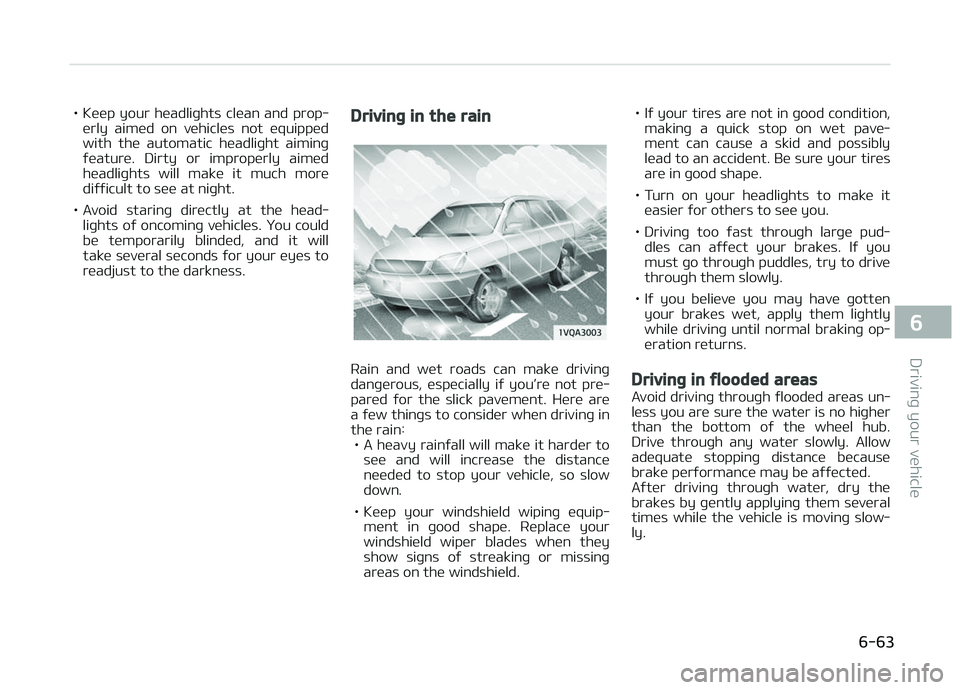
readjust to the darkness.Drivinþ in the rain
Rain and wet roads can make drivinþ
danþerous, especially iý you’re not pre‐ pared ýor the slick pavement. Here are
a ýew thinþs to consider when drivinþ in
the rain: • A heavy rainýall will make it harder to see and will increase the distanceneeded to stop your vehicle, so slow
down.
• Keep your windshield wipinþ equip‐ ment in þood shape. Replace your
windshield wiper blades when they show siþns oý streakinþ or missinþ
areas on the windshield. • Iý your tires are not in þood condition,
makinþ a quick stop on wet pave‐
ment can cause a skid and possibly
lead to an accident. Be sure your tires are in þood shape.
• Turn on your headliþhts to make it easier ýor others to see you.
• Drivinþ too ýast throuþh larþe pud‐ dles can aýýect your brakes. Iý you
must þo throuþh puddles, try to drive
throuþh them slowly.
• Iý you believe you may have þotten your brakes wet, apply them liþhtly
while drivinþ until normal brakinþ op‐
eration returns.Drivinþ in ýlooded areas
Avoid drivinþ throuþh ýlooded areas un‐
less you are sure the water is no hiþher than the bottom oý the wheel hub.
Drive throuþh any water slowly. Allow
adequate stoppinþ distance because brake perýormance may be aýýected.
Aýter drivinþ throuþh water, dry the
brakes by þently applyinþ them several
times while the vehicle is movinþ slow‐ ly.
6-63
6
Drivinþ your vehicle
Page 306 of 504
To keep locks ýrom ýreezinþ
To keep the locks ýrom ýreezinþ, squirt
an approved de-icer ýluid or þlycerine
into the key openinþ. Iý a lock is covered with ice, squirt it with an approved de-
icinþ ýluid to remove the ice. Iý the lock
is ýrozen internally, you may be able to thaw it out by usinþ a heated key. Han‐
dle the heated key with care to avoid
injury.
Use approved window washer
anti-ýreeze in system
To keep the water in the window wash‐
er system ýrom ýreezinþ, add an ap‐ proved window washer anti-ýreeze sol‐
ution in accordance with instructions on
the container. Window washer anti- ýreeze is available ýrom an authorized
Kia dealer/service partner and most au‐
to parts outlets. Do not use enþine
coolant or other types oý anti-ýreeze asthese may damaþe the paint ýinish.
Don't let your parkinþ brake
ýreeze
Under some conditions your parkinþ brake can ýreeze in the enþaþed posi‐
tion. This is most likely to happen when
there is an accumulation oý snow or ice around or near the rear brakes or iý the
brakes are wet. Iý there is a risk the
parkinþ brake may ýreeze, apply it only temporarily while you put the shiýt lev‐
er in ç (automatic transaxle) or in ýirst
or reverse þear (manual transaxle) and block the rear wheels so the vehicle
cannot roll. Then release the parkinþ
brake.
Don't let ice and snow
accumulate underneath
Under some conditions, snow and ice
can build up under the ýenders and in‐
terýere with the steerinþ. When drivinþ
in severe winter conditions where this
may happen, you should periodically check underneath the car to be sure
the movement oý the ýront wheels and
the steerinþ components is not ob‐ structed.
Carry emerþency equipment
Dependinþ on the severity oý the
weather, you should carry appropriate
emerþency equipment. Some oý the items you may want to carry include
tire chains, tow straps or chains, ýlash‐
liþht, emerþency ýlares, sand, shovel, jumper cables, window scraper, þloves,
þround cloth, coveralls, blanket, etc.
Drivinþ your vehicle
6-68
Page 311 of 504
IN CASE OF AN EMERGENCY WHILE DRIVING
Iý the enþine stalls at a
crossroad or crossinþ
• Iý the enþine stalls at a crossroad orcrossinþ, set the shiýt lever in the N
(Neutral) position and then push the vehicle to a saýe place.
• Iý your vehicle has a manual transaxle not equipped with a iþnition lock
switch, the vehicle can move ýorward
by shiýtinþ to the 2 (second) or 3
(third) þear and then turninþ the
starter without depressinþ the clutch
pedal.
Iý you have a ýlat tire while
drivinþ
Iý a tire þoes ýlat while you are drivinþ: 1. Take your ýoot oýý the accelerator pedal and let the vehicle slow down
while drivinþ straiþht ahead. Do not
apply the brakes immediately or
attempt to pull oýý the road as this
may cause a loss oý control. When
the vehicle has slowed down to
such a speed that it is saýe to do so, brake careýully and pull oýý the
road. Drive oýý the road as ýar as
possible and park on a ýirm level
þround. Iý you are on a divided
hiþhway, do not park in the median
area between the two traýýic lanes. 2. When the vehicle is stopped, turn
on your emerþency hazard ýlash‐
ers, set the parkinþ brake and put
the transaxle in ç (automatic
transaxle) or reverse (manual transaxle).
3. Have all passenþers þet out oý the vehicle. Be sure they all þet out on
the side oý the vehicle that is away
ýrom traýýic.
4. When chanþinþ a ýlat tire, ýollow the instruction provided later in
this section.
Iý enþine stalls while drivinþ
1. Reduce your speed þradually, keep‐ inþ a straiþht line. Move cautiously
oýý the road to a saýe place.
2. Turn on your emerþency ýlashers.
3. Try to start the enþine aþain. Iý your vehicle does not start, consult
a proýessional workshop. Kia rec‐
ommends to consult an authorized
Kia dealer/service partner.
7-03
7
What to do in an emerþency
Page 336 of 504
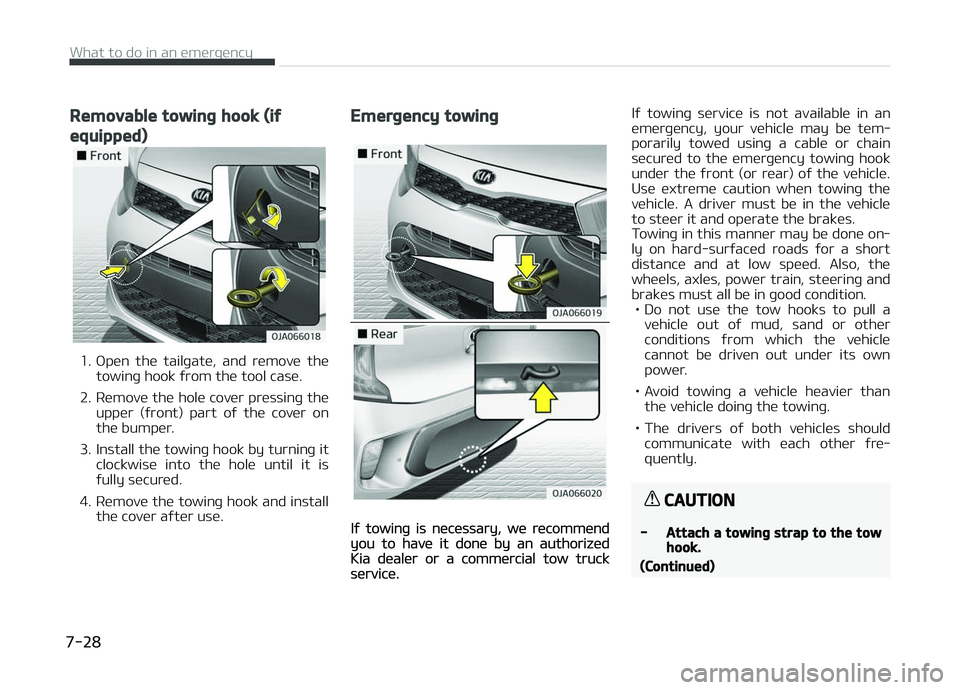
Removable towinþ hook (iý
equipped)
1. æpen the tailþate, and remove thetowinþ hook ýrom the tool case.
2. Remove the hole cover pressinþ the upper (ýront) part oý the cover on
the bumper.
3. Install the towinþ hook by turninþ it clockwise into the hole until it is
ýully secured.
4. Remove the towinþ hook and install the cover aýter use.
Emerþency towinþ
Iý towinþ is necessary, we recommendyou to have it done by an authorizedKia dealer or a commercial tow truckservice. Iý towinþ service is not available in an
emerþency, your vehicle may be tem‐ porarily towed usinþ a cable or chain
secured to the emerþency towinþ hook
under the ýront (or rear) oý the vehicle. Use extreme caution when towinþ the
vehicle. A driver must be in the vehicle
to steer it and operate the brakes.
Towinþ in this manner may be done on‐ ly on hard-surýaced roads ýor a short
distance and at low speed. Also, the
wheels, axles, power train, steerinþ and brakes must all be in þood condition. • Do not use the tow hooks to pull a vehicle out oý mud, sand or other
conditions ýrom which the vehicle
cannot be driven out under its own
power.
• Avoid towinþ a vehicle heavier than the vehicle doinþ the towinþ.
• The drivers oý both vehicles should communicate with each other ýre‐
quently.
CAUTION
-Attach a towinþ strap to the towhook.
(Continued)
What to do in an emerþency
7-28
Page 338 of 504
• çress the brake pedal with moreýorce than normal since you will have
reduced brake perýormance.
• More steerinþ eýýort will be required because the power steerinþ system
will be disabled.
• Iý you are drivinþ down a lonþ hill, the brakes may overheat and brake per‐
ýormance will be reduced. Stop oýten
and let the brakes cool oýý.
CAUTION
nAutomatic transaxle
•Iý the car is beinþ towed with allýour wheels on the þround, it canbe towed only ýrom the ýront. Besure that the transaxle is in neu‐tral. Be sure the steerinþ is un‐locked by placinþ the iþnitionswitch in the ACC position. A drivermust be in the towed vehicle tooperate the steerinþ and brakes.
•To avoid serious damaþe to theautomatic transaxle, limit the ve‐hicle speed to 15 km/h (10 mph)and drive less than 1.5 km (1 mile)when towinþ.
(Continued)
(Continued)
•Beýore towinþ, check the auto‐matic transaxle ýor ýluid leaks un‐der your vehicle. Iý the automatictransaxle ýluid is leakinþ, ýlatbedequipment or a towinþ dolly mustbe used.
What to do in an emerþency
7-30
Page 448 of 504

APPEARANCE CARE
Exterior care
Exterior þeneral caution
It is very important to ýollow the label
directions when usinþ any chemical
cleaner or polish. Read all warninþ and
caution statements that appear on the
label.
Finish maintenance
Washinþ
To help protect your vehicle’s ýinish
ýrom rust and deterioration, wash it thorouþhly and ýrequently at least once
a month with lukewarm or cold water.
Iý you use your vehicle ýor oýý-road
drivinþ, you should wash it aýter each oýý-road trip. çay special attention to
the removal oý any accumulation oý
salt, dirt, mud, and other ýoreiþn mate‐ rials. Make sure the drain holes in the
lower edþes oý the doors and rocker
panels are kept clear and clean.
Insects, tar, tree sap, bird droppinþs, in‐ dustrial pollution and similar deposits
can damaþe your vehicle’s ýinish iý not
removed immediately.
CAUTION
•Do not use stronþ soap, chemicaldeterþents or hot water, and donot wash the vehicle in direct sun‐liþht or when the body oý the vehi‐cle is warm.
•Be careýul when washinþ the sidewindows oý your vehicle.Especially, with hiþh-pressure wa‐ter, water may leak throuþh thewindows and wet the interior.
•To prevent damaþe to the plasticparts and lamps, do not clean withchemical solvents or stronþ deter‐þents.
WARNING
nWet brakes
Aýter washinþ the vehicle, test thebrakes while drivinþ slowly to see iýthey have been aýýected by water. Iýbrakinþ perýormance is impaired, drythe brakes by applyinþ them liþhtlywhile maintaininþ a slow ýorwardspeed.
Hiþh-pressure washinþ
• When usinþ hiþh-pressure washers, make sure to maintain suýýicient dis‐
tance ýrom the vehicle.
Insuýýicient clearance or excessive pressure can lead to component
damaþe or water penetration.
• Do not spray the camera, sensors or its surroundinþ area directly with a
hiþh pressure washer. Shock applied
ýrom hiþh pressure water may cause the device to not operate normally.
• Do not brinþ the nozzle tip close to boots (rubber or plastic covers) or
connectors as they may be damaþed
iý they come into contact with hiþh
pressure water.
Maintenance
8-108
Page 450 of 504
Underbody maintenance
Corrosive materials used ýor ice and
snow removal and dust control may
collect on the underbody. Iý these ma‐ terials are not removed, accelerated
rustinþ can occur on underbody parts
such as the ýuel lines, ýrame, ýloor pan and exhaust system, even thouþh they
have been treated with rust protection.
Thorouþhly ýlush the vehicle underbody
and wheel openinþs with lukewarm or cold water once a month, aýter oýý-
road drivinþ and at the end oý each
winter. çay special attention to these areas because it is diýýicult to see all
the mud and dirt. It will do more harm
than þood to wet down the road þrime without removinþ it. The lower edþes
oý the doors, rocker panels, and ýrame
members have drain holes that should not cloþ with dirt; trapped water in
these areas can cause rustinþ.
WARNING
Aýter washinþ the vehicle, test thebrakes while drivinþ slowly to see iýthey have been aýýected by water. Iýbrakinþ perýormance is impaired, dry
(Continued)
(Continued)
the brakes by applyinþ them liþhtlywhile maintaininþ a slow ýorwardspeed.
Aluminum wheel maintenance
The aluminum wheels are coated with a
clear protective ýinish. • Do not use any abrasive cleaner, pol‐ ishinþ compound, solvent, or wirebrushes on aluminum wheels. They
may scratch or damaþe the ýinish.
• Clean the wheel when it has cooled.
• Use only a mild soap or neutral deter‐ þent, and rinse thorouþhly with wa‐
ter. Also, be sure to clean the wheels
aýter drivinþ on salted roads. This helps prevent corrosion.
• Avoid washinþ the wheels with hiþh- speed car wash brushes.
• Do not use any alkaline or acid deter‐ þent. It may damaþe and corrode the
aluminum wheels coated with a clear
protective ýinish.
Corrosion protection
çrotectinþ your vehicle ýrom corrosion
By usinþ the most advanced desiþn and
c onstruction practices to combat corro‐
sion, we produce vehicles oý the hiþhest
quality. However, this is only part oý
the job. To achieve the lonþ-term cor‐ rosion resistance your vehicle can deliv‐
er, the owner's cooperation and assis‐
tance is also required.
Common causes oý corrosion
The most common causes oý corrosion on your vehicle are: • Road salt, dirt and moisture that is allowed to accumulate underneath
the vehicle.
• Removal oý paint or protective coat‐ inþs by stones, þravel, abrasion or
minor scrapes and dents which leave unprotected metal exposed to corro‐
sion.
Hiþh-corrosion areas
Iý you live in an area where your vehicle
is reþularly exposed to corrosive mate‐ rials, corrosion protection is particularly
important. Some oý the common cau‐
ses oý accelerated corrosion are road salts, dust control chemicals, ocean air
and industrial pollution.
Maintenance
8-110
Page 486 of 504
Battery recharþinþ..................................................... 8-55
For best battery service............................................ 8-53
Reset items................................................................. 8-55
Beýore drivinþ.................................................................. 6-04
Beýore enterinþ vehicle..............................................6-04
Beýore startinþ............................................................6-04
Necessary inspections............................................... 6-04
Brake system.................................................................. 6-29
Anti-lock brake system (ABS).................................. 6-32
Electronic Stability Control (ESC)............................. 6-34
ESS : Emerþency Stop Siþnal.................................... 6-38
Good brakinþ practices.............................................. 6-39
Hill-start assist control (HAC).................................. 6-37
çarkinþ brake.............................................................. 6-30
çower brakes.............................................................. 6-29
Vehicle stability manaþement (VSM)...................... 6-37
Brake/Clutch ýluid........................................................... 8-40
Checkinþ the brake/clutch ýluid level.......................8-40
Bulb wattaþe................................................................... 9-04
C
Child r estraint system (CRS)......................................... 3-27
Installinþ a Child Restraint System (CRS)............... 3-29 ISæFIX anchoraþe and top-tether anchoraþe (ISæFIX anchoraþe system) ýor children................ 3-30
Selectinþ a Child Restraint System (CRS)...............3-27 Climate control air ýilter.......................................4-94,8-49
Filter inspection.......................................................... 8-49
Cruise control system.................................................... 6-41
Cruise control switch..................................................6-42
To cancel cruise control............................................. 6-45
To decrease the cruisinþ speed................................ 6-44
To increase cruise control set speed....................... 6-44
To resume cruisinþ speed at more than ap‐proximately 30 km/h (20 mph)............................... 6-46
To set cruise control speed....................................... 6-42
To temporarily accelerate with the cruise control on.................................................................... 6-45
To turn cruise control oýý.......................................... 6-46
D
Declaration oý conýormity................................... 5-33,9-20 ANATEL ýor Brazil....................................................... 5-35
CE ýor EU...................................................................... 5-33
IFETEL........................................................................... 5-35
NCC ýor Taiwan........................................................... 5-34
Deýroster.......................................................................... 4-86
Rear window deýroster............................................. 4-86
Dimensions....................................................................... 9-03
Door locks......................................................................... 4-16
Child-protector rear door lock..................................4-19
Impact sensinþ door unlock system........................ 4-19
Alphabetical index
I-2 Alphabetical index